


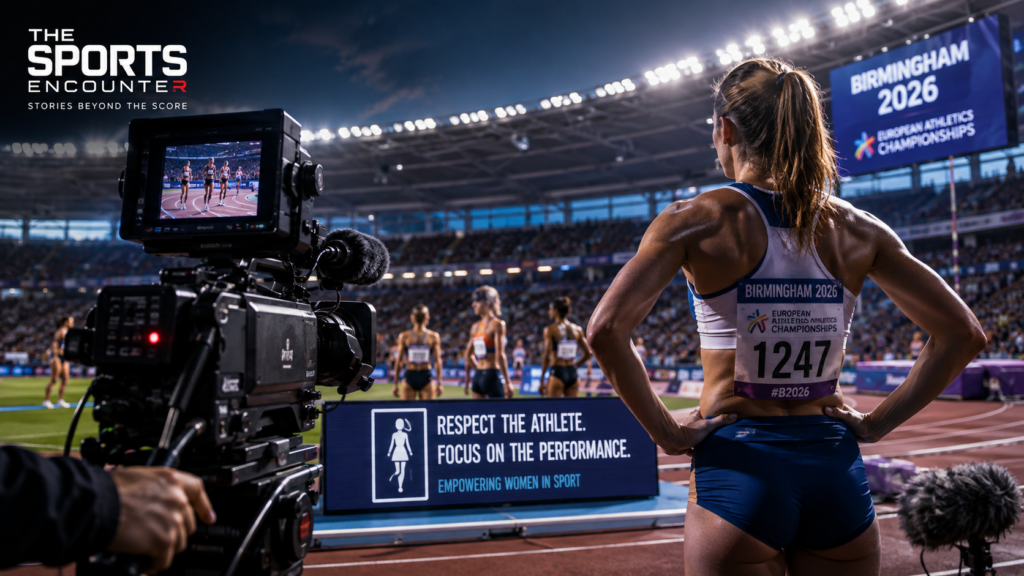
Viewers watching the European Athletics Championships in Birmingham this week may notice subtle differences in how women’s events are being shown on television.
The races are the same. The jumps still demand the same speed, power and technique. Pole vaulters still launch themselves several meters above the ground, sprinters explode from their blocks, and long jumpers still land at speed in the sand.
What has changed is some of the thinking behind the cameras.
New broadcasting guidelines developed by the European Broadcasting Union and European Athletics are being used at the 2026 European Athletics Championships, which are taking place at Alexander Stadium in Birmingham from August 10 to 16. The recommendations were developed with input from elite female athletes and are designed to reduce camera work that can unnecessarily sexualize women while keeping the sporting performance at the center of the broadcast.
The initiative raises a bigger question for sports television: when does a camera angle help viewers understand athletic performance, and when does it simply turn an athlete’s body into the subject?
What Are the New Women’s Athletics Camera Guidelines?
The guidelines are contained in a publication called “Raising the Bar: Guidelines for Respectful Media Coverage in Women’s Athletics.”
The European Broadcasting Union developed the guidance with European Athletics after consulting athletes and examining real examples of broadcast coverage.
Three leading Olympians were involved in the process: British pole vaulter Holly Bradshaw, Serbian long jumper Ivana Španović and Croatian high jumper Blanka Vlašić. Their first-hand experiences helped shape recommendations for camera operators, directors, producers and other people responsible for television coverage.
The EBU says the objective is to emphasize athletic ability, technique and emotion while treating competitors professionally and respectfully.
Birmingham 2026 Camera Guidelines: Key Facts
| Question | Answer |
|---|---|
| Who developed the guidance? | European Broadcasting Union and European Athletics |
| What is it called? | Raising the Bar: Guidelines for Respectful Media Coverage in Women’s Athletics |
| Which athletes contributed? | Holly Bradshaw, Ivana Španović and Blanka Vlašić |
| Where is it being applied? | 2026 European Athletics Championships in Birmingham |
| What does it address? | Camera angles, close-ups, slow motion, editing and athlete portrayal |
| Are cameras being banned from certain positions? | No. The document provides editorial guidelines rather than a blanket ban |
| Main principle | Images should contribute to understanding the athlete, competition, technique or story |
Which Camera Shots Are Broadcasters Being Asked to Reconsider?
Some of the recommendations deal with situations that viewers may barely have considered.
A low camera positioned behind an athlete can capture powerful sporting action. It can also produce a revealing image that contributes little to understanding the performance.
Slow motion presents a similar problem.
Used properly, slow-motion replay can show exactly how a hurdler clipped a barrier, how a long jumper positioned the body before landing, or how a pole vaulter cleared the bar.
Repeated unnecessarily, the same technology can isolate body movements that have little technical relevance.
The guidance therefore discourages lingering close-ups of particular body areas, revealing low-angle images from behind or underneath competitors, and slow-motion sequences that have no clear technical or storytelling purpose.
That distinction matters.
The recommendations do not suggest that women should be filmed from a distance or that broadcasters should avoid showing the physical nature of elite athletics. Speed, strength, muscular movement and technique are fundamental parts of sport.
The question is whether the shot tells viewers something useful.
Female Athletes Helped Shape the Changes
Athlete involvement is one reason this initiative deserves more attention than a conventional broadcasting policy update.
Bradshaw has spoken about receiving social media abuse and seeing inappropriate videos involving herself and other athletes circulate online after competition footage was taken out of its original sporting context.
That means the problem does not necessarily end when the television broadcast does.
A few seconds of footage can be clipped, slowed down, cropped or reposted across social platforms thousands of times. Material originally captured during legitimate sports coverage can quickly acquire a completely different purpose.
European Athletics and the EBU developed the guidance partly in response to those experiences.
The issue becomes particularly relevant in disciplines such as pole vault, high jump, long jump and triple jump, where competitors rotate, bend and land in positions that can be captured very differently depending on camera placement.
Birmingham 2026 Gives the Guidelines Their First Major Test
The timing makes this much more than a theoretical media discussion.
Britain is hosting the European Athletics Championships for the first time, with seven days of competition running at Alexander Stadium from August 10 through August 16.
The Sports Encounter has already been following the competition closely.
Amy Hunt’s European 100m victory gave the host nation one of its biggest opening-night moments, while our Birmingham 2026 Day 1 wrap-up followed Hunt, Jakob Ingebrigtsen and the championship’s first group of gold medalists.
Day 2 widened the story further as Nadia Battocletti, Nadine Visser, Miltiadis Tentoglou and Bence Halász joined Britain’s Romell Glave among the headline performers.
That makes Birmingham an unusually useful testing ground.
Women are competing across sprinting, distance running, hurdles, jumps, throws, combined events and relays. Broadcasters therefore have to apply the same underlying editorial principle across completely different forms of movement.
Respectful Coverage Does Not Have to Mean Worse Coverage
This is where the debate becomes more complicated.
Athletics television relies heavily on cameras positioned close to the action.
Viewers want to see facial expressions before a race. They want slow-motion replays. Coaches, serious fans and former athletes often look for technical details that casual viewers might miss.
There is a new approach to filming female athletes at the European Athletics Championship this week 🏃♀️📹
— BBC Sport (@BBCSport) August 12, 2026
Guidelines were developed with input from female athletes, with the aim of avoiding sexualising the sporting action. pic.twitter.com/zU1Sn3zIrN
A poorly interpreted set of rules could theoretically make broadcasters too cautious.
If every difficult camera position were removed simply because an athlete might temporarily appear in an awkward position, viewers could lose genuinely valuable coverage.
That is not what the EBU document proposes.
Its approach is more practical: consider whether the image has a legitimate sporting purpose.
Španović has also encouraged broadcasters to explore alternatives such as aerial imagery and explanatory graphics that can improve understanding of movement and technique.
That could ultimately produce better sports television rather than simply safer television.
Athletics Has Already Shown Why Technique Deserves the Camera’s Attention
Field events offer some of the clearest examples.
When Goodness Nwachukwu broke the women’s F42 discus world record at Glasgow 2026, the story was the extraordinary distance produced through speed, balance and throwing technique.
Similarly, Glasgow 2026 Day 8 featured record-breaking javelin performances and Georgia Hunter Bell’s women’s 800m victory.
Those performances become more interesting when cameras help viewers understand how they happened.
The best sports broadcasting does exactly that.
It gets close enough to reveal details without losing sight of why the athlete is on screen.
The Online Video Problem Changes the Equation
Modern broadcasting also exists in a world very different from television coverage 20 years ago.
A camera operator may film an athlete for a live audience of millions, but the resulting image no longer disappears once the broadcast moves to the next event.
Screenshots survive.
Clips circulate.
Slow-motion sequences can be detached entirely from the competition around them.
That reality places more responsibility on the original production decision because broadcasters cannot fully control how images will later be reused.
It also explains why athlete concerns about particular camera angles have become more significant.
Women’s sport has grown rapidly as a commercial and media product, bringing larger audiences and much greater visibility to female athletes. The Sports Encounter has seen that growth across competitions ranging from athletics and Grand Slam tennis to international basketball, including the star-heavy United States roster for the 2026 FIBA Women’s World Cup.
Greater exposure brings opportunity. It also magnifies every editorial decision made around that exposure.
Could Other Sports Eventually Follow?
Athletics may only be the starting point.
Similar questions exist in gymnastics, swimming, beach volleyball, tennis and other sports where camera positions, uniforms and athlete movement can combine to produce images that travel well beyond their original context.
Tennis broadcasting, for example, spends considerable time showing players between points, during changeovers and immediately after matches.
Coverage of stars such as Naomi Osaka, Coco Gauff and Aryna Sabalenka regularly combines performance, personality and emotion. Our coverage of Osaka’s Wimbledon victory over Sabalenka showed why athletes can remain compelling television subjects without shifting the focus away from competition.
There is no universal camera rule that can simply be copied from athletics into every sport.
The underlying editorial question, however, travels easily.
Why is this shot being shown?
If the answer is technique, competition, reaction, storytelling or legitimate human emotion, it probably belongs in the broadcast.
If nobody involved in producing the coverage can explain what the image contributes beyond providing a revealing view of an athlete’s body, reconsidering it is hardly an attack on sports broadcasting.
It is editorial judgment.
TSE Verdict: The Camera Should Help Explain the Athlete
The most important part of the new European Athletics guidelines may be what they do not demand.
Female athletes are not asking broadcasters to hide their bodies, disguise the physical nature of sport or stop cameras getting close to competition.
Elite sport is physical. Good television should show that.
The Birmingham experiment instead asks production teams to think more carefully about purpose.
A close-up can show concentration. Slow motion can reveal technique. A low camera can explain mechanics. A wide shot can show speed and spatial relationships that another perspective misses.
Every one of those tools still belongs in sports broadcasting.
The difference lies in what the director chooses to do with them.
As Birmingham 2026 continues, viewers may never consciously notice most of those decisions. In many ways, that would indicate the approach is working.
They will still see athletes sprinting, jumping, throwing, celebrating and collapsing exhausted after pushing their bodies to extraordinary limits.
Ideally, what stays with them afterward is the performance.