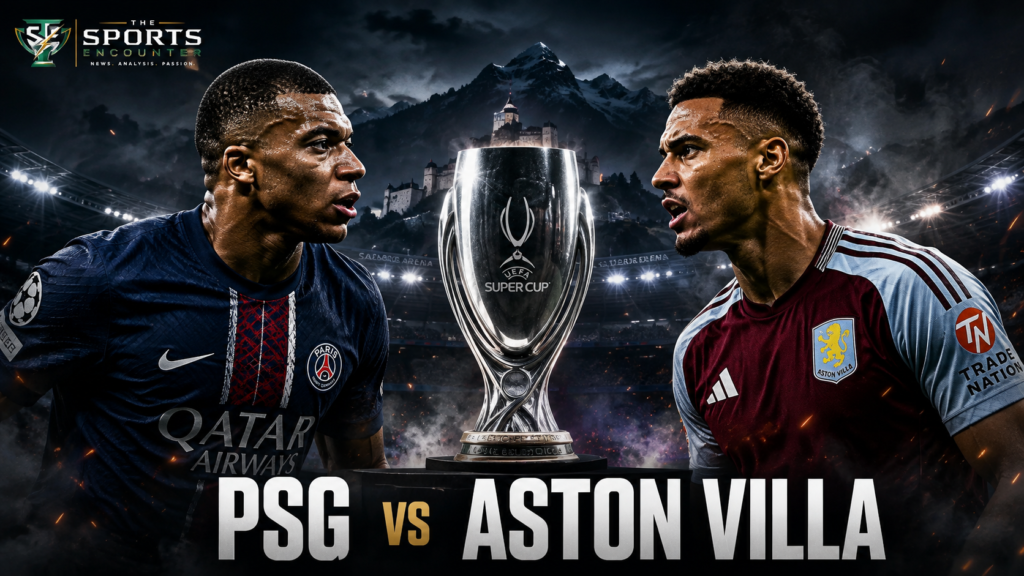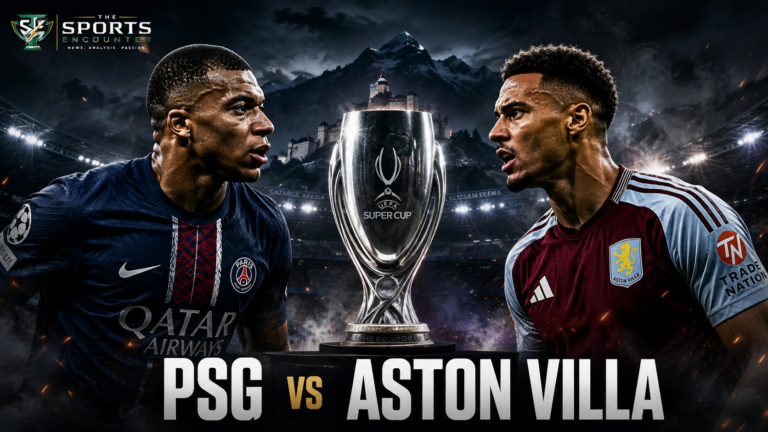
PSG vs Aston Villa UEFA Super Cup Preview: European Champions Collide in Salzburg
Back-to-back Champions League winners Paris Saint-Germain face Europa League champions Aston Villa in Salzburg for the 2026 UEFA Super Cup. Here is our full preview covering team news, tactical battles, head-to-head history, key players and prediction.
Published: August 11, 2026
Paris Saint-Germain and Aston Villa arrive in Salzburg carrying European trophies, very different summer stories and one piece of recent history that should stop anyone from treating Wednesday’s UEFA Super Cup as a ceremonial curtain-raiser.
PSG are back-to-back UEFA Champions League winners. Aston Villa are Europa League champions and have already proved they can beat Luis Enrique’s side. When the clubs last shared a pitch at Villa Park in April 2025, Unai Emery’s team won 3-2 and came frighteningly close to overturning a Champions League quarterfinal deficit.
Paris survived that tie 5-4 on aggregate. Villa have not forgotten it.
Now the stakes are simpler. One match. One trophy. No second leg to repair mistakes.
The 2026 UEFA Super Cup kicks off at 21:00 CET on Wednesday, August 12, at Stadion Salzburg in Austria. It will be the first showcase UEFA club final staged at the venue.
PSG enter as Champions League holders after retaining their European crown against Arsenal in Budapest. Villa earned their place by beating Freiburg 3-0 in the Europa League final, ending a 44-year wait for another major European trophy.
There is another layer to the reunion. Lucas Digne, one of the players who helped Villa win that Europa League, completed a permanent move back to PSG only days before the Super Cup. He could now face the club he represented for more than four years in the very competition Villa reached partly because of his contribution.
That is only one reason this matchup has far more substance than the usual August showpiece.
PSG vs Aston Villa: UEFA Super Cup 2026 Key Facts
- Match: Paris Saint-Germain vs Aston Villa
- Competition: UEFA Super Cup 2026
- Date: Wednesday, August 12, 2026
- Kickoff: 21:00 CET
- Venue: Stadion Salzburg, Salzburg, Austria
- PSG qualified as: UEFA Champions League winners
- Aston Villa qualified as: UEFA Europa League winners
- Previous competitive meetings: 2
- Head-to-head: PSG 1 win, Aston Villa 1 win
- Previous Super Cup titles: PSG 1, Aston Villa 1
- Referee: Omar Abdulkadir Artan of Somalia
Why This UEFA Super Cup Matters More Than Most
The UEFA Super Cup can sometimes feel caught between two seasons. It rewards the previous campaign while arriving just as clubs are trying to build the next one.
This year is different.
PSG are pursuing something much larger than another trophy for the cabinet. Luis Enrique’s team have reached the stage where European success is becoming an expectation rather than an aspiration.
They won their first Champions League in 2025. They retained it in 2026, defeating Arsenal 4-3 on penalties after a 1-1 draw following extra time in Budapest.
That made PSG only the second club in the Champions League era to successfully defend the trophy.
They also won the UEFA Super Cup last year after recovering from 2-0 down against Tottenham before winning the penalty shootout.
A victory in Salzburg would therefore give PSG consecutive Champions League titles and consecutive Super Cups, strengthening the argument that European club football has entered a Parisian phase.
UEFA notes that Real Madrid are the only side in the modern era to retain the Super Cup, doing so in 2016 and 2017.
Aston Villa arrive with a completely different motivation.
For Villa, this is another step in their transformation under Emery.
The club reached the Conference League semifinals in 2024, the Champions League quarterfinals in 2025 and then won the Europa League in 2026.
That progression matters.
Villa are no longer appearing in major European nights simply because of history. They are building new history.
Our recent assessment of the Premier League’s genuine 2026-27 title contenders identified Emery’s tactical maturity as Villa’s greatest strength. Salzburg offers another opportunity to test that strength against arguably the strongest club side in Europe.
PSG Have Turned Winning in Europe Into a Habit
The biggest change at PSG under Luis Enrique is psychological.
For years, the Champions League represented the club’s great unresolved obsession. Domestic titles were celebrated, but each European elimination reopened the same discussion about money, pressure, squad construction and whether PSG possessed the collective personality required to dominate outside France.
That argument has changed dramatically.
Paris defeated Arsenal on penalties in the 2026 Champions League final after navigating Monaco, Chelsea, Liverpool and Bayern Munich during the knockout rounds.
The achievement carried additional weight because they entered the season as defending champions.
Winning a first European Cup can release pressure.
Winning it again creates a standard.
PSG’s challenge now is maintaining that level after a disrupted summer that included the FIFA World Cup and staggered returns for several international players.
The club confirmed this week that Ousmane Dembélé, Bradley Barcola, Désiré Doué, Warren Zaïre-Emery, Lucas Hernandez, Achraf Hakimi and Fabián Ruiz had returned to training, leaving Luis Enrique with his senior squad reunited ahead of Salzburg.
That does not automatically mean every returning player will be ready for 90 high-intensity minutes.
UEFA’s own match preview lists several of PSG’s World Cup returnees as fitness doubts when projecting the starting lineup.
That creates the first major tactical question of Wednesday night.
Can Aston Villa Attack PSG Before Their Rhythm Returns?
Villa’s best opportunity may come early.
PSG’s strongest XI has enough technical quality to control almost any European opponent when fully synchronized. But several key players have had limited time together since returning from international duty.
Preseason has provided mixed evidence.
Paris lost 3-0 to Mallorca before drawing 1-1 with Manchester United. Neither result should be treated as a prediction of competitive form, but both underline the reality facing Luis Enrique.
His team are still transitioning from summer preparation into matches that matter.
Villa should have no interest in allowing PSG 30 comfortable minutes to find their passing rhythm.
Emery’s side were at their most dangerous against Paris in 2025 when they pushed numbers forward, attacked quickly after turnovers and forced PSG’s defenders to make decisions while retreating.
The second leg at Villa Park remains highly relevant to this Super Cup.
PSG arrived with a commanding advantage and appeared to end the tie when they moved 5-1 ahead on aggregate.
Villa refused to disappear.
They scored three times across the second leg, won the match 3-2 and transformed what looked like a routine PSG progression into a nervous finish.
Emery has openly referenced that performance while preparing for Salzburg.
Villa learned something that night.
PSG can be hurt when opponents escape the first line of pressure and attack before their defensive structure resets.
Emery vs Luis Enrique Gives the Final Its Tactical Edge
This is also a meeting between two Spanish coaches who approach elite football with very different instincts.
Luis Enrique wants his teams to dominate space and possession while creating overloads through constant movement.
PSG can build through Vitinha, use João Neves to attack pockets around the ball and push Nuno Mendes aggressively into advanced areas. Their front players interchange frequently enough to make conventional marking assignments uncomfortable.
Emery is more situational.
He is one of Europe’s finest managers when preparing a team for a specific opponent.
His Villa side can press high, drop into a compact mid-block or attack directly depending on where he sees vulnerability.
That flexibility has been a major part of Villa’s rise.
It also explains why Emery has been so successful in the Europa League. His victory with Villa over Freiburg in May was his fifth triumph in six Europa League finals.
He has not enjoyed the same record in the Super Cup.
Emery previously lost the fixture with Sevilla in 2014 and 2015 and Villarreal in 2021.
There is even a personal connection to the man in the opposite technical area.
Luis Enrique’s Barcelona defeated Emery’s Sevilla 5-4 after extra time in the 2015 UEFA Super Cup.
Eleven years later, they meet again with different clubs and another European trophy between them.
Lucas Digne Could Face Aston Villa Days After Leaving
Few storylines capture the strange timing of the Super Cup better than Lucas Digne.
Villa confirmed on August 9 that the French left back had completed a permanent transfer to PSG.
Paris then announced Digne’s return to the club he previously represented between 2013 and 2015, signing him through 2029.
The timing means Digne could theoretically begin his second PSG spell against the club he has just left.
His Villa career deserves context.
Digne joined the Birmingham club in January 2022 and made 182 appearances, contributing four goals and 24 assists according to PSG’s official announcement.
He also played a role in Villa’s Europa League triumph last season.
Now he is on the other side.
Whether Luis Enrique immediately uses him is another question, particularly with Nuno Mendes available and Digne only recently completing the transfer.
But even if he starts on the bench, his presence adds an unusual emotional subplot to a match already rich in history.
PSG Have Added Maghnes Akliouche to an Already Dangerous Attack
Digne is not PSG’s only significant new arrival.
Paris signed Maghnes Akliouche from Monaco earlier this month, handing the 24-year-old attacking midfielder the No. 11 shirt and a contract through 2031.
Akliouche arrives after producing seven goals and 11 assists for Monaco during the 2025-26 season.
His creativity fits Luis Enrique’s preference for technically secure players who can operate between lines rather than remain locked into traditional positions.
UEFA has identified Akliouche as one of the major new faces around the match, although Senny Mayulu and Khvicha Kvaratskhelia could receive greater responsibility if PSG’s returning World Cup players require careful management.
The deeper point is that PSG are adding rather than rebuilding.
The core that won consecutive European Cups remains intact.
That makes them a frightening opponent even when the strongest possible XI is unavailable.
Aston Villa Enter a New Season Without Several Familiar Faces
Villa’s summer has involved more structural change.
Morgan Rogers and Youri Tielemans have departed, while Digne’s switch to PSG removes another established player from Emery’s recent core.
Rogers’ exit is particularly significant after the role he played in Villa’s Europa League success. He scored ten Premier League goals last season and contributed a goal and an assist in the 3-0 final victory over Freiburg, a campaign that helped make him one of the summer’s major transfers, as covered in our ranking of the Premier League’s most expensive signings.
Villa have responded aggressively.
João Gomes has arrived from Wolverhampton Wanderers to reinforce midfield.
Modou Kéba Cissé has joined the defense from LASK.
Alejandro Garnacho has arrived on loan from Chelsea.
All three could make competitive debuts against PSG.
Villa also signed Johan Manzambi from Freiburg after his breakout Europa League season, but UEFA confirms the Swiss international will miss the Super Cup because of a knee injury.
Leon Bailey and Amadou Onana are also listed as unavailable, while several other Villa players were carrying fitness questions in UEFA’s latest preview.
That matters because this is exactly the type of opponent against whom squad disruption gets exposed.
PSG vs Aston Villa Predicted Lineups
Official starting lineups will only be confirmed closer to kickoff. UEFA’s latest projected teams reflect the fitness uncertainty surrounding several players returning from the World Cup.
Projected PSG XI
Safonov; Zabarnyi, Marquinhos, Willian Pacho, Nuno Mendes; João Neves, Vitinha, Dro Fernández; Mbaye, Mayulu, Kvaratskhelia.
The most striking feature is how many established PSG stars could begin outside the starting XI depending on their physical condition.
Dembélé, Doué, Hakimi, Barcola, Fabián Ruiz and Zaïre-Emery are among those whose readiness will be monitored.
Projected Aston Villa XI
Bizot; Cash, Lindelöf, Pau Torres, Maatsen; João Gomes, Kamara; McGinn, Buendía, Garnacho; Abraham.
Villa’s final selection could change significantly if Emiliano Martínez, Ollie Watkins, Ezri Konsa, John McGinn or Garnacho are cleared for greater involvement.
Five Players Who Could Decide the UEFA Super Cup
1. Vitinha
PSG’s attack contains more spectacular names, but Vitinha is often the player who determines whether the match is played at Paris’ preferred rhythm.
His ability to receive under pressure, alter the angle of possession and connect midfield with the front line gives PSG control.
Villa must prevent him from spending the evening dictating the game without resistance.
2. Khvicha Kvaratskhelia
Unlike several PSG teammates, Kvaratskhelia has enjoyed an uninterrupted preseason.
That could matter enormously.
His willingness to attack defenders directly may give PSG one of their sharpest attacking weapons while other players rebuild competitive rhythm.
3. João Gomes
One of Villa’s biggest summer signings could receive a severe first competitive examination.
Gomes will be asked to disrupt PSG’s midfield combinations without becoming dragged out of Villa’s defensive structure.
If Villa cannot compete around Vitinha and João Neves, the evening could become extremely long.
4. Emiliano Buendía
Buendía scored in Villa’s Europa League final victory over Freiburg and offers the type of technical ability Emery needs when his side recover possession.
Breaking PSG’s press is only half the challenge.
Villa then need somebody capable of turning those moments into attacks before Paris reorganize.
5. Nuno Mendes
Mendes may become one of the most important tactical players on the field.
His forward runs can turn PSG’s left side into an overload, but that aggression can also create transition space behind him.
How Villa attack that area could reveal Emery’s broader plan.
The Head-to-Head Is Closer Than PSG’s Reputation Suggests
PSG and Aston Villa have only met twice competitively.
| Season | Competition | Match | Result |
|---|---|---|---|
| 2024-25 | Champions League quarterfinal, first leg | PSG vs Aston Villa | PSG 3-1 Villa |
| 2024-25 | Champions League quarterfinal, second leg | Aston Villa vs PSG | Villa 3-2 PSG |
The overall record therefore stands at one victory each, with PSG scoring five goals to Villa’s four.
Paris won the tie.
Villa won the most recent match.
Both facts matter.
Villa should draw confidence from knowing they have already beaten this opponent.
PSG should remember how quickly control disappeared at Villa Park.
Aston Villa Already Know What Winning the Super Cup Feels Like
This is not Villa’s first appearance in the competition.
After winning the European Cup in 1982, Villa faced Barcelona across two legs in the UEFA Super Cup.
They won 3-1 on aggregate.
More than four decades later, they return to the fixture as Europa League champions.
The gap itself illustrates how unusual Villa’s current European revival is.
For a generation of supporters, the club’s greatest continental achievements belonged to history books, old footage and family stories.
Emery has brought those nights back into the present.
Winning on Wednesday would give Villa another European trophy only three months after Istanbul and further strengthen their status among England’s most dangerous emerging powers.
For more coverage of Villa, PSG and European soccer, readers can follow The Sports Encounter’s soccer news and analysis.
Omar Artan Will Make Refereeing History in Salzburg
The final also carries significance beyond the two clubs.
Somali referee Omar Abdulkadir Artan has been appointed to officiate the match following cooperation between UEFA and the Confederation of African Football.
His appointment makes him the first non-European referee to take charge of the UEFA Super Cup.
Artan will be assisted by Liban Abdoulrazack Ahmed of Djibouti and Stephen Eleazar Onyango Yiembe of Kenya. Italy’s Marco Di Bello will serve as VAR.
For a competition designed to bring together European champions, the refereeing appointment gives the 2026 edition an unusually global dimension.
Salzburg Gets Its First Showcase UEFA Club Final
Stadion Salzburg has hosted major international soccer before, including three matches at UEFA Euro 2008.
Wednesday will nevertheless mark a first.
No showcase UEFA club final has previously been played at the venue.
The stadium becomes the latest destination in the Super Cup’s traveling era after the competition moved away from its long association with Monaco.
Prague, Cardiff, Tbilisi, Trondheim, Skopje, Tallinn, Istanbul, Budapest, Belfast, Helsinki, Piraeus, Warsaw and Udine have all hosted since 2013.
Salzburg now joins that list.
The Rule That Could Become Very Important: No Extra Time
There is one competition rule supporters should remember if the match reaches the final minutes level.
There will be no extra time.
If PSG and Aston Villa are tied after 90 minutes, the Super Cup goes directly to a penalty shootout.
That increases the strategic importance of the closing stages.
A coach who believes his team has the stronger penalty takers may become more conservative.
A side carrying tired players may decide that chasing the winner in the 88th minute creates unnecessary risk.
PSG also know this route extremely well.
They won last year’s Super Cup on penalties after drawing 2-2 with Tottenham and retained the Champions League through another shootout against Arsenal in May.
Few teams in Europe enter a potential penalty contest with more recent experience of surviving one.
TSE Tactical Analysis: Where Aston Villa Can Hurt PSG
Villa’s route to victory probably depends on three areas.
1. Attack immediately after turnovers
Trying to out-possess PSG for 90 minutes would play directly into Paris’ strengths.
Villa should instead value the first five seconds after regaining the ball.
If they can move beyond PSG’s counter-press quickly, the space behind the advanced fullbacks becomes available.
2. Force PSG’s returning internationals into repeated sprints
Match fitness is difficult to hide when the game becomes transitional.
Villa should make PSG’s midfield and wide players repeatedly run toward their own goal rather than allowing Paris to manage possession at a comfortable pace.
3. Turn set pieces into genuine chances
Knockout football is frequently decided by moments that exist outside the broader tactical pattern.
Villa may not generate 15 high-quality open-play chances.
A corner, free kick or second ball can make the rest irrelevant.
Where PSG Can Break Villa
Paris have their own obvious routes.
Overload Villa’s midfield
Villa have lost important midfield experience this summer.
PSG should test that transition relentlessly by circulating possession through Vitinha and João Neves until Villa’s shape begins to stretch.
Attack the spaces beside Villa’s center backs
Kvaratskhelia and PSG’s fluid attacking players are particularly dangerous when they receive between a fullback and center back.
Villa cannot afford uncertain defensive spacing.
Make Villa defend for long sequences
Villa are dangerous when the match becomes emotional and transitional.
PSG’s best method of removing that energy is simple: keep the ball.
Ten-pass sequences become 20-pass sequences.
Villa’s attackers retreat.
The distance to PSG’s goal increases.
Eventually the counterattack begins from 80 yards away instead of 40.
That is how Paris can suffocate the contest without needing to play at frantic speed.
Why Aston Villa Have More of a Chance Than the Names Suggest
The easy prediction is PSG.
They are European champions twice over. Their squad contains exceptional technical quality, and Luis Enrique has built one of the most coherent teams in club soccer.
Yet Super Cups frequently arrive before champions have reached full rhythm.
That matters here.
Villa have a coach who excels in one-match tactical preparation and players who already know that PSG can be pushed into uncomfortable situations.
The departure of Rogers, Tielemans and Digne has changed Villa, while injuries complicate Emery’s options.
But PSG are also balancing preparation, World Cup recovery and the demands of beginning another trophy-heavy season almost immediately.
Villa’s opportunity lies inside that imperfect timing.
PSG vs Aston Villa Prediction
PSG deserve to begin as favorites because their technical ceiling remains higher and their squad offers greater solutions if the match becomes difficult.
Villa should make this competitive.
Emery knows the opponent, remembers the 2025 quarterfinal and has enough tactical flexibility to prevent PSG from turning the match into a comfortable possession exercise.
The opening 30 minutes could determine the tone.
If Villa score first, Salzburg could become very interesting.
If PSG establish control and force Villa into prolonged defending, their attacking depth should eventually tell.
The Sports Encounter prediction: PSG 2-1 Aston Villa.
A penalty shootout would not be surprising if both teams reach the final stages level.
What a Win Would Mean for PSG
A second consecutive Super Cup would strengthen something that cannot be measured simply by counting trophies.
PSG are developing institutional expectation.
The great European teams reach finals assuming they belong there.
Paris spent years trying to acquire that mentality.
Consecutive Champions Leagues followed by consecutive Super Cups would suggest they have finally built it.
It would also give Luis Enrique another trophy in a reign that has completely altered PSG’s European identity.
What a Win Would Mean for Aston Villa
For Villa, victory would accelerate the transformation already underway.
Winning the Europa League established them as European champions.
Beating PSG for the Super Cup would prove that the achievement was part of something larger.
Villa would begin a Champions League season with another continental trophy, having defeated the strongest team in Europe to claim it.
That would change expectations immediately.
The Premier League already knows how difficult Emery’s team can be.
Europe would receive another reminder.
Final Verdict: This Is More Than a Curtain-Raiser
PSG and Aston Villa could easily have arrived in Salzburg treating the Super Cup as an elegant bridge between seasons.
Their recent history makes that unlikely.
PSG remember Villa Park.
Villa remember how close they came to overturning Paris.
Luis Enrique wants his team to keep accumulating trophies.
Emery sees another chance to measure Villa against the standard they are trying to reach.
Digne could watch from the PSG bench after leaving Villa only days earlier. New signings may make competitive debuts. Several World Cup players are racing toward full fitness. Salzburg is hosting its first major UEFA club final, and Omar Artan will make refereeing history.
There is enough here to make Wednesday night matter before the ball has even moved.
PSG remain favorites.
Aston Villa have already shown why favorites should be careful around them.
For official match information, squad updates and competition details, visit the official UEFA Super Cup match center.
Frequently Asked Questions
When is PSG vs Aston Villa in the 2026 UEFA Super Cup?
Paris Saint-Germain face Aston Villa on Wednesday, August 12, 2026.
What time does PSG vs Aston Villa kick off?
The match kicks off at 21:00 CET in Salzburg, Austria.
Where is the 2026 UEFA Super Cup being played?
The game will take place at Stadion Salzburg, the home of FC Salzburg. It will be the venue’s first showcase UEFA club final.
Why are PSG playing in the UEFA Super Cup?
PSG qualified by winning the 2025-26 UEFA Champions League. They defeated Arsenal on penalties after the final finished 1-1 following extra time.
Why are Aston Villa playing in the UEFA Super Cup?
Aston Villa qualified after winning the 2025-26 UEFA Europa League, beating Freiburg 3-0 in the final in Istanbul.
Have PSG and Aston Villa played before?
Yes. They met twice in the 2024-25 Champions League quarterfinals. PSG won 3-1 in Paris before Aston Villa won 3-2 at Villa Park. PSG advanced 5-4 on aggregate.
Who has the better head-to-head record, PSG or Aston Villa?
The direct record is level at one victory each. PSG have scored five goals across the two meetings, while Aston Villa have scored four.
Has PSG won the UEFA Super Cup before?
Yes. PSG won the 2025 UEFA Super Cup after drawing 2-2 with Tottenham and winning the penalty shootout.
Has Aston Villa won the UEFA Super Cup before?
Yes. Aston Villa defeated Barcelona 3-1 on aggregate in the 1982-83 edition after winning the European Cup.
Will there be extra time in PSG vs Aston Villa?
No. If the match is level after 90 minutes, it will go directly to a penalty shootout.
Who is refereeing PSG vs Aston Villa?
Somalia’s Omar Abdulkadir Artan will referee the match. His appointment makes him the first non-European official to take charge of a UEFA Super Cup.
Could Lucas Digne play against Aston Villa?
Potentially. Digne completed a permanent transfer from Aston Villa to Paris Saint-Germain only days before the Super Cup and is now part of PSG’s squad.
Who are the players to watch in PSG vs Aston Villa?
Khvicha Kvaratskhelia, Vitinha and Nuno Mendes are key figures for PSG, while João Gomes, Emiliano Buendía and Villa’s attacking options could be decisive for Unai Emery’s side.
Who will win PSG vs Aston Villa?
The Sports Encounter makes PSG the favorite because of their superior squad depth, European experience and technical quality, but Villa’s tactical discipline and previous success against PSG give them a genuine route to an upset. Our prediction is PSG 2-1 Aston Villa.
Breaking News
Brandon Nakashima Beats Jodar to Reach First Masters 1000 Final
Brandon Nakashima held off Rafael Jodar 7-6(3), 6-4 to reach the first Masters 1000 final of his career at the 2026 National Bank Open in Montreal.
Brandon Nakashima is into the biggest final of his career after holding off 19-year-old Rafael Jodar 7-6(3), 6-4 in Montreal to reach his first ATP Masters 1000 championship match at the 2026 National Bank Open.
The 25-year-old American had never progressed beyond the fourth round of a Masters 1000 event before this week.
Now he is one win away from the title.
Nakashima needed two hours and two minutes to end Jodar’s remarkable run on Center Court, taking a tense opening set in a tiebreak before finding the decisive break in the second.
The result also guarantees an all-American men’s final in Montreal, with Ben Shelton and Learner Tien contesting the second semifinal later on Wednesday.
For Nakashima, this tournament has become a career reset in real time.
He survived a weather-interrupted three-set battle with Arthur Rinderknech, swept aside Luciano Darderi in the quarterfinals, and then met one of the hottest young players in tennis with a place in a Masters final at stake.
He never blinked.
Follow The Sports Encounter’s tennis coverage for the National Bank Open, ATP Tour, WTA Tour and major championship stories.
Nakashima vs Jodar: Montreal Semifinal at a Glance
| Match Detail | Information |
|---|---|
| Tournament | National Bank Open presented by Rogers |
| Round | Men’s Singles Semifinal |
| Venue | Center Court, Montreal |
| Winner | Brandon Nakashima |
| Score | 7-6(3), 6-4 |
| Match Duration | 2 hours, 2 minutes, 49 seconds |
| Nakashima Seed | No. 28 |
| Jodar Seed | No. 20 |
| Significance | Nakashima reaches first ATP Masters 1000 final |
The official result is confirmed by the ATP Tour results center.
The First Set Was the Match
There was very little between them early.
Jodar arrived with confidence, aggression and the fearless timing of a teenager who has spent most of 2026 climbing through levels that were supposed to slow him down.
Nakashima brought something different.
Experience.
Patience.
A serve built for hard courts.
The opening set became a test of who would give away the first cheap game.
Neither wanted to.
Jodar attacked returns and tried to get Nakashima moving laterally before the American could dictate with his first strike.
Nakashima responded by protecting his service games and refusing to overplay from neutral positions.
No player created enough separation to avoid the tiebreak.
That was where the match changed.
Nakashima Takes Control in the Tiebreak
A close set can disappear in a few points once a tiebreak begins.
Nakashima understood that immediately.
He played the breaker with more clarity than Jodar, controlling the early exchanges and taking away the Spaniard’s opportunity to build momentum.
The 7-3 tiebreak score gave Nakashima the opening set and placed Jodar in unfamiliar territory.
The teenager had been one of Montreal’s most dangerous frontrunners.
Now he had to chase.
That difference mattered.
Jodar’s attacking style works best when he can play freely and force the opponent to react.
Nakashima made him operate with scoreboard pressure instead.
Jodar Refuses to Go Quietly
The second set did not become easy.
Jodar continued attacking and kept the semifinal competitive deep into the set.
That should surprise nobody who has followed his season.
The Spaniard reached Montreal after one of the fastest rises on the ATP Tour, having already made major noise in Washington and beaten established players throughout the summer.
He entered the semifinal with 34 wins in 2026 and a live ranking that had pushed him toward the edge of the Top 10.
His route through Montreal had been equally impressive.
Jodar defeated Lorenzo Musetti 6-4, 6-3, beat Jiri Lehecka 6-3, 6-3, and then eliminated Arthur Fils 7-6(5), 6-3 in the quarterfinals.
The teenager had also led the tournament in return games won heading into the semifinal.
Nakashima therefore knew one loose service game could reopen the entire match.
Nakashima Finds the Break That Matters
Pressure eventually created the opening.
Nakashima found the decisive break in the second set and protected it through the finish.
There was no wild celebration before the final ball.
No attempt to rush the ending.
He continued serving with discipline, stayed inside the patterns that had carried him through the tournament, and made Jodar earn every chance.
At 6-4, the breakthrough was complete.
For the first time in his career, Brandon Nakashima was an ATP Masters 1000 finalist.
Montreal Has Changed Nakashima’s Career in Five Matches
Nakashima arrived in Montreal with an unusual résumé for a player of his quality.
He had reached ATP finals.
He had beaten Top 10 players.
He had established himself as a dangerous hard-court opponent.
Masters 1000 tournaments had repeatedly stopped him earlier than expected.
Before this week, Nakashima had gone 0-5 in Masters 1000 fourth-round matches.
That barrier finally disappeared against Arthur Rinderknech.
The match itself tested almost everything.
Nakashima won the opening set 7-6(4), lost the second 5-7, and reached 4-4 in the third before bad weather suspended play.
After a delay of one hour and 46 minutes, he returned and completed a 7-5 final set.
That victory sent him into his first Masters 1000 quarterfinal.
The Sports Encounter has repeatedly seen how breakthrough tournaments can change rapidly once one psychological barrier disappears.
Nakashima looks like a perfect example.
Darderi Never Gets a Chance to Build Pressure
The quarterfinal was completely different.
Nakashima dismantled Luciano Darderi 6-2, 6-3 in only 77 minutes.
He served with authority, struck 11 aces and repeatedly took control of rallies before Darderi could establish rhythm.
The victory sent Nakashima into his first Masters semifinal.
It also showed an important change from the Rinderknech match.
Survival had become aggression.
By the time he reached Jodar, Nakashima was no longer simply enjoying a breakthrough run.
He looked comfortable being there.
Jodar’s Run Still Confirms a Major Arrival
Defeat should not diminish what Jodar accomplished in Montreal.
At 19, he reached his first Masters 1000 semifinal during a season in which his ranking and expectations have changed almost monthly.
He had already reached an ATP 500 final in Washington earlier in August.
Then he arrived in Montreal and kept beating established players.
Jodar’s combination of return aggression, early ball striking and willingness to attack from inside the baseline makes him difficult to contain when he gains momentum.
The semifinal exposed one of the next challenges in his development.
When an opponent protects serve well and refuses to give away neutral points, Jodar has to create openings without forcing them.
Nakashima made that lesson expensive.
Two Former College Players Meet on a Much Bigger Stage
There was also a subtle connection between the semifinalists.
Both players spent one season competing for the University of Virginia before moving fully into professional tennis.
The paths after college could hardly have been more different.
Nakashima took the slower route into the established ATP middle class.
Jodar has exploded upward as a teenager.
Montreal brought those paths together for the first time.
The older player won.
The younger one made sure he had to earn it.
Nakashima Is Doing This With His Serve First
The most important weapon in Nakashima’s run has been obvious.
His serve.
He does not possess the raw left-handed violence of Ben Shelton or the towering delivery of some of the Tour’s biggest servers.
What Nakashima does extremely well is locate.
He changes direction.
He protects second serves.
He uses the first shot after the serve to establish the rally rather than simply hoping for aces.
That makes the serve particularly effective on North American hard courts.
The Darderi match provided the clearest example when Nakashima fired 11 aces and controlled most of his service games.
Against Jodar, he needed the same discipline rather than spectacular numbers.
The American Final Is Already Guaranteed
Nakashima will face an American in the final.
Ben Shelton and Learner Tien meet in the second semifinal, giving the United States three of the final four players in Montreal.
That itself is historic.
Three American men had not reached the Montreal semifinals together since 1992.
The final now guarantees another piece of American tennis history.
Whether it is Nakashima vs. Shelton or Nakashima vs. Tien, the championship match will feature two U.S. players.
The last all-American Masters 1000 final came more than two decades ago.
If It Is Shelton, Nakashima Gets the Power Test
Shelton would provide the more explosive matchup.
He enters the semifinal as the defending Montreal champion and one of the most dangerous servers on Tour.
The left-hander also destroyed Jakub Mensik 6-3, 6-1 in the quarterfinals, committing only three unforced errors in a performance that lasted just 72 minutes.
A Nakashima-Shelton final would therefore become a battle between two different versions of American hard-court tennis.
Shelton creates chaos.
Nakashima creates order.
If It Is Tien, the Match Becomes a Problem-Solving Contest
Learner Tien would present a completely different challenge.
The 20-year-old has reached his first Masters 1000 semifinal by using elite return skills, defense and counterpunching intelligence.
Tien dismantled Daniel Merida 6-3, 6-2 in the quarterfinals.
He also owns a strong record against Shelton, making the second semifinal far less predictable than the rankings suggest.
A Nakashima-Tien final would likely produce longer exchanges and greater pressure on Nakashima’s second serve.
Either opponent creates a compelling final.
Why This Run Matters Beyond One Tournament
Nakashima turned 25 on August 3.
That places him at an interesting point in his career.
He is too experienced to be framed as a prospect.
He is young enough to move his career into a completely different tier.
Montreal may be the tournament that does it.
Masters 1000 finals carry major ranking points, prize money and, more importantly, evidence that a player can survive six matches against elite fields.
That changes future draws.
It changes seeding.
It changes expectations.
Nakashima has already moved beyond his previous ceiling regardless of what happens in the final.
His 2026 Season Had Been Building Toward Something
The Montreal breakthrough did not come from nowhere.
Nakashima reached the Brisbane final in January before losing to Daniil Medvedev.
He later defeated world No. 6 Alex de Minaur at Queen’s Club, one of the biggest wins of his season.
In Washington, he reached another semifinal before falling to Taylor Fritz.
Those results showed consistency.
Montreal has added scale.
The difference between reaching ATP 250 or ATP 500 semifinals and a Masters 1000 final is substantial.
Nakashima has crossed it.
Turning Points in Nakashima vs Jodar
The first-set tiebreak
Neither player created enough separation through the opening set. Nakashima played the breaker with greater control and won it 7-3, forcing Jodar to chase the match.
Nakashima refuses to give Jodar easy return pressure
Jodar entered as one of Montreal’s leading returners. Nakashima protected enough service games to prevent the teenager from turning the semifinal into a momentum match.
The second-set break
Once Nakashima found his opening, he did not hand it back. The match shifted from competitive balance to scoreboard pressure almost immediately.
Nakashima closes without panic
First Masters finals can make players tighten near the finish. Nakashima stayed inside his patterns and completed the second set 6-4.
TSE Verdict: Nakashima Has Stopped Waiting for His Breakthrough
For years, Brandon Nakashima looked like a player capable of making this kind of run.
Montreal is where capability finally became reality.
The route has required everything.
A weather delay.
A three-set survival battle.
A dominant quarterfinal.
A semifinal against one of the hottest teenagers in tennis.
Nakashima has solved each problem differently.
That may be the most encouraging part.
He did not reach the final because one opponent collapsed or because the draw opened completely.
He earned it through adaptability.
Against Rinderknech, he survived.
Against Darderi, he attacked.
Against Jodar, he stayed composed.
The final now brings the biggest pressure yet.
Nakashima will face another American, either the defending champion Shelton or the rapidly rising Tien.
The opponent will change.
The opportunity will not.
One match remains between Brandon Nakashima and the biggest title of his career.
Montreal has already changed his season.
Thursday could change considerably more.
Follow The Sports Encounter’s tennis coverage for the National Bank Open final, ATP results, tactical analysis and major tournament stories.
Frequently Asked Questions
Who won Brandon Nakashima vs Rafael Jodar?
Brandon Nakashima defeated Rafael Jodar 7-6(3), 6-4 in the National Bank Open semifinal in Montreal.
Is this Nakashima’s first Masters 1000 final?
Yes. Montreal 2026 is the first ATP Masters 1000 final of Nakashima’s career.
How long did the semifinal last?
The match lasted 2 hours, 2 minutes and 49 seconds.
Who will Nakashima play in the final?
He will face the winner of the second semifinal between Ben Shelton and Learner Tien.
How old is Brandon Nakashima?
Nakashima is 25. He celebrated his birthday on August 3.
How did Nakashima reach the semifinal?
He defeated Arthur Rinderknech 7-6(4), 5-7, 7-5 in the Round of 16 and Luciano Darderi 6-2, 6-3 in the quarterfinals.
How far had Nakashima previously gone at a Masters 1000?
Before Montreal, Nakashima had never reached a Masters 1000 quarterfinal and had lost all five of his previous fourth-round matches at this level.
How old is Rafael Jodar?
Jodar is 19 and was playing his first ATP Masters 1000 semifinal.
Is the Montreal final guaranteed to be all-American?
Yes. Nakashima is American, and the other semifinal features Americans Ben Shelton and Learner Tien.
Breaking News
Lionel Messi Back on Inter Miami Duty Four Days After Father’s Death
Lionel Messi returned to Inter Miami’s matchday squad against Club León only four days after the death of his father, Jorge Messi, while still processing a loss that has made him question his football future.
Lionel Messi has returned to an Inter Miami matchday squad just four days after the death of his father, Jorge Messi, with the Argentine captain named among the substitutes for Wednesday night’s Leagues Cup game against Club León at Nu Stadium.
The 39-year-old had returned to Argentina after his father died in Rosario following a long illness and missed Inter Miami’s 2-1 defeat to Monterrey over the weekend.
His return to the bench against León does not signal a normal football comeback.
It comes during one of the most difficult periods of his life, only hours after Messi publicly described the depth of his grief and admitted that his father’s death had left him questioning how much longer he wants to continue playing.
Inter Miami therefore named Messi among the substitutes rather than asking him to start, while Rodrigo De Paul and Casemiro were included in the midfield for a crucial Leagues Cup Phase One game.
The Sports Encounter has already examined the importance of Jorge Messi’s role in his son’s life and career in our tribute to Lionel Messi’s father and longtime adviser.
Lionel Messi Returns to the Inter Miami Bench
| Match Detail | Information |
|---|---|
| Competition | 2026 Leagues Cup |
| Match | Inter Miami vs Club León |
| Date | August 12, 2026 |
| Venue | Nu Stadium, Miami |
| Messi status | Named among the substitutes |
| Previous match missed | Inter Miami 1-2 Monterrey |
| Reason for absence | Death of his father, Jorge Messi |
| Inter Miami midfield | Rodrigo De Paul, Casemiro, Telasco Segovia, Yannick Bright |
Official squad information, fixtures and club updates are available through Inter Miami CF.
Four Days That Changed the Context Around Messi
Jorge Messi died at the age of 68 in Rosario after a prolonged illness.
For Lionel Messi, the loss was deeply personal and also inseparable from his football life.
Jorge had been present from the earliest stages of his son’s career, supporting the move from Rosario to Barcelona and later acting as an adviser and representative during many of the major decisions that shaped Messi’s professional journey.
Messi has spoken repeatedly over the years about how much his father’s opinion mattered to him.
That relationship gives Wednesday’s return a very different emotional meaning.
He is back with his club.
That does not mean the grief has passed.
Messi Missed the Monterrey Match While Inter Miami Paid Tribute
Inter Miami played Monterrey without Messi on Saturday.
The club honored Jorge Messi with a moment of silence, while players wore black armbands.
Rodrigo De Paul then produced one of the most emotional moments of the night.
After scoring from distance in the first half, De Paul revealed a Messi shirt beneath his own and pointed toward the No. 10 as a tribute to his teammate and friend.
Monterrey eventually came back to win 2-1, leaving Inter Miami under pressure in the Leagues Cup standings.
The gesture mattered more than the result in the moment.
De Paul has shared some of the biggest stages of Messi’s recent career with Argentina, including the 2022 World Cup triumph and the 2026 final.
His tribute showed how strongly the loss was felt inside the dressing room.
Messi’s Own Words Changed the Story Again
Before returning to the matchday squad, Messi published an emotional tribute to his father that extended beyond mourning.
He admitted that Jorge’s death had left him with serious doubts about continuing his football career for much longer.
That statement matters because retirement discussions around Messi had previously been based largely on age, contracts and tournament cycles.
The Sports Encounter recently examined those questions in our analysis of when Lionel Messi might retire.
The context is different now.
Messi’s uncertainty comes from grief rather than a tactical or physical calculation.
He also revealed that his father’s wish had been one of the reasons he pushed himself to play at the 2026 World Cup despite the emotional strain surrounding Jorge’s declining health.
The 2026 World Cup Had Already Carried a Hidden Emotional Weight
Argentina reached another World Cup final this summer before losing 1-0 to Spain after extra time.
Messi scored eight goals and recorded four assists during the tournament, producing another extraordinary campaign at the age of 39.
The Sports Encounter covered the scale of that run in our Argentina vs Spain World Cup final coverage and later included Messi among the defining players of the tournament in the 2026 fan-voted World Cup Dream Team.
What the public did not fully understand during much of the competition was how heavily Messi was carrying his father’s illness.
He later explained that he had been waiting for messages from Jorge after matches and that the World Cup was the first major tournament his father could not attend.
That makes his performances in North America look different in retrospect.
Why a Bench Role Makes Sense
From a football perspective, naming Messi among the substitutes is logical.
He had spent time away from the team and traveled to Argentina under extraordinary emotional circumstances.
Starting him immediately would have asked for much more than simply match fitness.
A bench role gives Inter Miami flexibility.
Messi can remain part of the squad without the expectation of carrying the team from kickoff.
Coach Guillermo Hoyos can decide later whether the match situation and Messi’s own readiness justify using him.
That distinction is important.
Availability and readiness are not always the same thing.
Inter Miami Start De Paul and Casemiro Without Messi
Inter Miami began the game with Rocco Ríos Novo in goal and a midfield featuring Telasco Segovia, Casemiro, Rodrigo De Paul and Yannick Bright.
Lovend’s Delinois and Daniel Pinter started in attack.
That setup gives Miami more defensive structure through Casemiro and greater progression through De Paul while Messi waits on the bench.
The broader Inter Miami squad has changed significantly during 2026, with the arrival of both De Paul and Casemiro giving the club more experience around its older attacking core.
Messi remains the central creative figure when available.
His absence forces others to carry more of the possession and final-third responsibility.
Glad to have you back, Leo. ❤️
— Major League Soccer (@MLS) August 12, 2026
Messi has returned to @InterMiamiCF and is on the bench tonight against Leon in @LeaguesCup. pic.twitter.com/QApKUU2Rmc
The Leagues Cup Stakes Still Matter
Inter Miami entered the Club León game under pressure.
They had opened the tournament with a 4-2 victory over Atlético San Luis, a match in which Messi scored twice and added an assist after returning from the World Cup.
The defeat to Monterrey changed the qualification picture.
Only the leading teams advance to the knockout phase, leaving Miami needing a strong result against a León side that had won its first two matches.
León therefore arrived with greater control over its own qualification path.
Miami entered needing both performance and composure.
That is the football backdrop to Messi’s return.
It should remain the secondary story.
Messi’s Presence Changes the Atmosphere Even From the Bench
There is no need to exaggerate what Messi’s presence means to his teammates.
His importance is already obvious.
He remains the captain, the most accomplished player in the squad and the figure around whom Inter Miami have built much of their identity since his arrival in MLS.
The Sports Encounter explored that wider influence in our feature asking whether Lionel Messi belongs among the greatest athletes in sports history.
Seeing him back with the squad so soon after his father’s death inevitably changes the emotional atmosphere around the group.
That does not mean teammates should expect him to solve the match.
It means he has chosen, for now, to be present.
There Is No Need to Rush the Retirement Question
Messi’s comments about his future will naturally fuel another wave of retirement speculation.
That conversation deserves patience.
He remains contracted to Inter Miami and has not announced his retirement from club or international football.
Earlier this month, Argentine Football Association president Claudio Tapia made clear that the timing of any retirement decision belongs to Messi.
That position feels even more appropriate now.
Messi is processing the death of the person who accompanied virtually every stage of his football life.
Any decision about what comes next should be understood in that context.
A Career Built With His Father Beside Him
Jorge Messi’s influence stretched far beyond contract negotiations.
He was part of the decision to move the family’s football future toward Barcelona when Lionel was still a child.
He remained involved as his son became the defining player of the club’s greatest era.
Later came Paris Saint-Germain, Inter Miami and the final stages of Messi’s Argentina career.
That is why Lionel’s recent statement carried such weight.
Football had always been something he experienced with his father nearby.
Returning to an Inter Miami bench without that connection is a new reality.
The Human Side of Returning to Elite Sport
Athletes are often expected to move quickly between personal grief and professional responsibility.
Sport schedules do not stop.
Fixtures remain on calendars.
Teams still travel.
Qualification scenarios still exist.
The individual experiencing the loss has to decide when returning feels possible.
There is no standard timeline.
For Messi, that timeline has been only a few days.
The fact that he is on the bench should be understood as his decision to rejoin the group, rather than evidence that the emotional process is complete.
TSE Verdict: The Important Part Is That Messi Chose to Be There
Lionel Messi’s return against Club León should be treated carefully.
There will be questions about whether he comes on.
There will be questions about how many minutes he plays.
There will be questions about whether he can help Inter Miami qualify.
Those questions belong to the match.
The larger story belongs somewhere else.
Four days after losing his father, Messi has returned to the Inter Miami squad.
He has done so after publicly admitting that the loss has made him question the future of the career Jorge helped build from the beginning.
That makes Wednesday night unusually significant, regardless of whether Messi ever leaves the bench.
The football world has spent more than two decades watching him score, create, win trophies and rewrite records.
This moment asks for something different from the audience.
Restraint.
Messi has returned to the stadium.
For now, that is enough.
Follow The Sports Encounter’s soccer coverage for Inter Miami, Leagues Cup, international football and Lionel Messi developments.
Frequently Asked Questions
Is Lionel Messi playing against Club León?
Messi was named among Inter Miami’s substitutes for the Leagues Cup match against Club León. He did not start.
Why did Messi miss Inter Miami’s previous match?
Messi returned to Argentina following the death of his father, Jorge Messi, and missed the 2-1 defeat to Monterrey.
How old was Jorge Messi?
Jorge Messi was 68 when he died in Rosario after a long illness.
Did Inter Miami honor Messi’s father?
Yes. The club observed a moment of silence and players wore black armbands during the Monterrey match.
How did Rodrigo De Paul pay tribute?
After scoring against Monterrey, De Paul revealed a Lionel Messi shirt underneath his Inter Miami jersey and pointed toward the No. 10.
Has Lionel Messi announced his retirement?
No. Messi has not announced his retirement, although he has said his father’s death has left him with doubts about how much longer he wants to continue playing.
Who started in Inter Miami’s midfield against Club León?
Rodrigo De Paul, Casemiro, Telasco Segovia and Yannick Bright were included in the starting midfield.
Where was Inter Miami vs Club León played?
The Leagues Cup match was played at Nu Stadium in Miami.
Editor's Choice
Real Madrid Edge Deportivo 1-0 to Win Teresa Herrera as Brahim Díaz Delivers
Real Madrid edged Deportivo La Coruña 1-0 at Riazor as Brahim Díaz finished a rapid counter started by Andriy Lunin, while Bernardo Silva continued his promising midfield integration.
Real Madrid defeated Deportivo La Coruña 1-0 at Riazor to win the Trofeo Teresa Herrera, with Brahim Díaz turning Andriy Lunin’s rapid distribution into the decisive goal just before halftime.
The result extended Madrid’s unbeaten preseason run and gave José Mourinho another useful test before competitive football begins, but the scoreline only tells part of the story.
Deportivo made the match uncomfortable. Madrid struggled to create consistently against a compact opponent, several major first-team players were still absent, and Mourinho continued experimenting with shape and personnel.
The clearest positive came from Brahim.
His goal began with Lunin, who launched the ball forward immediately after collecting possession. Brahim controlled the long distribution, accelerated into space and finished the counterattack with the composure needed to separate two teams that had otherwise been difficult to split.
New signing Bernardo Silva also continued his integration into Madrid’s midfield, starting alongside Eduardo Camavinga and showing the movement, work rate and positional intelligence that made him such an important player during his years at Manchester City.
For Madrid, the Teresa Herrera trophy matters less than what the performance revealed about the team Mourinho is trying to build.
The Sports Encounter has been following that rebuild closely, including Vinícius Júnior’s new long-term Real Madrid contract, the arrival of Yan Diomande in a major summer transfer, and Madrid’s continuing interest in reshaping their midfield around elite control.
Deportivo vs Real Madrid: Teresa Herrera Final at a Glance
| Match Detail | Information |
|---|---|
| Competition | Trofeo Teresa Herrera |
| Venue | Riazor, A Coruña |
| Result | Deportivo La Coruña 0-1 Real Madrid |
| Goalscorer | Brahim Díaz |
| Assist / Build-up | Andriy Lunin long distribution |
| Real Madrid coach | José Mourinho |
| Key new signing involved | Bernardo Silva |
| Trophy significance | Real Madrid win Teresa Herrera for first time since 2013 |
Brahim Díaz Turns One Transition Into the Winning Moment
The match had offered few truly clean openings before Brahim changed it.
Deportivo defended with discipline and made Madrid work through slower phases of possession, limiting the spaces Mourinho’s attacking players could exploit.
The decisive action came from a completely different type of situation.
Lunin recovered the ball and immediately recognized that Deportivo had committed players forward.
His long throw released Brahim into space.
The Moroccan international still had work to do.
He controlled the distribution at speed, attacked the retreating defense and finished the move to give Madrid a 1-0 lead shortly before halftime.
The goal was significant because it showed a side of Mourinho’s Madrid that may become increasingly important this season.
Possession can control matches.
Transition speed can finish them.
Madrid have enough technical quality to dominate the ball against most opponents, but Mourinho has historically valued the ability to attack quickly once the opposition’s defensive structure breaks.
Brahim’s goal was a perfect example.
Lunin’s Distribution Creates More Than a Save
Goalkeepers are often judged almost entirely by what they stop.
Lunin influenced this match by starting the move that won it.
His decision to release the ball immediately changed the geometry of the game.
Instead of allowing Deportivo to recover into their shape, the Ukrainian turned a defensive possession into an attacking opportunity within seconds.
That is increasingly important for modern goalkeepers.
Distribution is no longer a secondary skill.
Elite teams want keepers who can identify whether a controlled short build-up or an immediate vertical release offers the better option.
Lunin chose the aggressive solution.
Brahim rewarded him.
The goalkeeper also made important interventions later as Deportivo searched for an equalizer, helping preserve Madrid’s narrow lead.
Bernardo Silva Shows Why Madrid Wanted Him
Bernardo Silva’s performance deserves attention even though he did not score or assist.
Madrid signed the Portuguese international on a free transfer after his Manchester City contract expired, giving Mourinho one of Europe’s most experienced positional midfielders without paying a transfer fee. Reuters reported that Bernardo signed a two-year agreement through 2028.
His value has never been limited to traditional midfield statistics.
Bernardo moves constantly.
He offers passing angles, presses intelligently, receives comfortably under pressure and understands when to slow a possession or accelerate it.
Against Deportivo, those qualities were visible as he worked alongside Camavinga in the central areas.
The pairing is interesting because the two midfielders solve different problems.
Camavinga provides athletic coverage, ball carrying and defensive range.
Bernardo offers orientation, manipulation of space and technical calm.
If Mourinho can combine those strengths consistently, Madrid may have greater control in matches where opponents defend deep and try to frustrate them.
WHAT A GOAL BY BRAHIM DIAZ!!
— 𝐟𝐞𝐝𝐞𝐯𝐚𝐥𝐯 (@fedevalv_) August 12, 2026
The Mourinho Era has begun 🤩 pic.twitter.com/Id0J0S4KFC
Madrid Still Had Problems Creating Against a Compact Deportivo
The trophy should not hide the less convincing parts of the performance.
Madrid did not create chances freely.
Deportivo remained organized for long stretches and prevented the visitors from turning territorial control into sustained pressure.
That matters because this type of game will appear repeatedly in La Liga.
Many opponents will protect the center, defend in numbers and ask Madrid to create through patient combinations rather than open transitions.
Mourinho acknowledged afterward that the match resembled the type of competitive resistance Madrid can expect once the league begins. He also stressed that preseason remains a period for experimentation and managing player workloads.
That makes the match useful precisely because it was not easy.
A 5-0 preseason victory can build confidence.
A difficult 1-0 can reveal more.
Mourinho Continues Testing Shapes
The second half offered another clue about Madrid’s development.
Mourinho used the match to test different structures rather than simply protect the starting system.
Spanish reporting noted that Madrid moved between variations of a 4-2-3-1 and a back-five shape later in the match, with Denzel Dumfries and Álvaro Carreras capable of operating higher as wingbacks.
That flexibility could become useful across a long season.
Madrid will face opponents that demand different solutions.
Some matches will require control through midfield.
Others will require stronger protection against transitions.
A back five can also allow Dumfries to attack space more aggressively without leaving the right side completely exposed.
Preseason is the safest place to explore those options.
Madrid’s Starting XI Showed the Depth of the Rebuild
The lineup itself reflected how quickly the squad has changed.
Lunin started in goal, with Dumfries, Dean Huijsen, Antonio Rüdiger and Carreras across the defense.
Camavinga and Bernardo formed the central midfield base.
Vinícius Júnior, Arda Güler and Brahim supported Endrick in attack.
That is already a very different-looking Madrid side.
The Sports Encounter has tracked several pieces of this rebuild throughout the summer.
Vinícius’ future is now secure after the club agreed a long-term extension, ending the uncertainty examined earlier in our analysis of his contract situation.
Madrid have also invested heavily in youth through the signing of Yan Diomande, while the club’s interest in midfield control has been reflected in its pursuit of Rodri.
Bernardo adds another layer.
He arrives with experience instead of potential.
Endrick and Güler Still Look Like Important Pieces
Endrick led the line while Arda Güler operated behind him.
Neither decided the match, but both remain important to Madrid’s future attacking structure.
Güler can play between lines, drift toward the right and create through combinations around the penalty area.
Endrick offers a more direct threat through central runs and physical attacks on defenders.
The challenge for Mourinho is creating enough complementary movement around them.
Young attacking players often look more comfortable when matches become stretched.
Deportivo rarely allowed that.
This was therefore useful experience.
Vinícius Remains Madrid’s Main Source of Chaos
Vinícius started from his familiar left-sided role and remains Madrid’s most natural one-on-one destabilizer.
His contract renewal has removed one of the biggest off-field questions surrounding the squad.
The Sports Encounter recently examined why Madrid committed to Vinícius through 2032 after weeks of market noise involving Arsenal and Saudi interest.
The Teresa Herrera match reinforced why the club values him.
Even when the attack lacks rhythm, his presence forces defenders to protect space differently.
The next step is ensuring the rest of Madrid’s structure benefits consistently from the attention he attracts.
Deportivo Offered the Kind of Test Madrid Needed
Deportivo deserve credit for preventing this from becoming a ceremonial preseason trophy match.
The hosts defended well, competed physically and created moments that required Madrid’s defensive line and goalkeeper to remain focused.
That matters for Mourinho.
Madrid’s recent friendly schedule has been designed to increase in difficulty, and the coach described Deportivo as a useful approximation of the type of match his players will encounter in La Liga.
Preseason preparation is most valuable when opponents expose weaknesses rather than simply provide minutes.
Deportivo did that.
Madrid Win the Teresa Herrera for the First Time Since 2013
The result also carries historical value.
Real Madrid lifted the Trofeo Teresa Herrera for the first time in 13 years.
The traditional summer competition has long been associated with Deportivo and the football culture of A Coruña.
For Madrid, the trophy will not rank alongside La Liga or Champions League success.
It still provides another positive marker during preseason.
Mourinho will care more about readiness than silverware.
The players will still prefer winning.
Why Bernardo’s Role Could Become More Important Once the Season Starts
Madrid’s midfield has undergone a generational transition over the past several seasons.
Luka Modrić has moved on and remains active at AC Milan, where The Sports Encounter recently covered his contract extension through 2027.
Toni Kroos is also no longer part of the midfield structure that defined Madrid’s previous era.
That leaves a different type of challenge.
Madrid have athleticism.
They have dribblers.
They have young creators.
Bernardo gives them someone who understands how to connect those pieces.
His experience under Pep Guardiola means he is accustomed to operating inside detailed positional structures, rotating across midfield and wide areas without losing team balance.
Mourinho will use those qualities differently, but the intelligence remains transferable.
Madrid’s Wider Summer Rebuild Is Becoming Visible
The Teresa Herrera final offered a first practical view of several decisions made during the summer.
Madrid are trying to move beyond a disappointing 2025-26 season in which they failed to win La Liga and exited the Champions League in the quarterfinals. Reuters highlighted those setbacks when confirming Bernardo’s arrival.
The response has been aggressive.
Madrid have strengthened the squad across multiple areas and committed to a mixture of established stars and younger talent.
That broader process has included Diomande, defensive reinforcements and the effort to preserve Vinícius as an attacking cornerstone.
The Sports Encounter’s analysis of Madrid’s summer rebuild showed how those moves fit into a larger attempt to restore balance rather than simply add names.
What Mourinho Will Like
The first positive is defensive control.
Madrid kept a clean sheet against an opponent willing to compete rather than sit passively.
The second is transition quality.
Brahim’s goal showed how quickly Madrid can punish a team once possession changes hands.
The third is flexibility.
Mourinho had enough depth to alter personnel and structure without abandoning the match.
Bernardo’s continued integration also gives the coach another midfielder capable of interpreting several roles.
What Mourinho Still Needs to Fix
The attack remains the obvious area for improvement.
Madrid need to create more consistently against organized defensive blocks.
There were stretches when possession became predictable and the forwards received the ball without enough movement around them.
That problem will become more serious against stronger La Liga opponents.
Mourinho also needs several returning players to regain full rhythm before conclusions can be drawn about his preferred XI.
The manager referenced players still working separately at Valdebebas, underlining how incomplete the preseason picture remains.
Turning Points in Deportivo vs Real Madrid
Lunin sees the counter before Deportivo can recover
The goalkeeper’s quick distribution created the only goal and prevented Deportivo from resetting its defensive shape.
Brahim turns a difficult control into a clean finish
The move still required quality after Lunin released the ball. Brahim’s first touch and acceleration gave Madrid the separation they needed.
Deportivo survive Madrid’s slower possession phases
The hosts repeatedly pushed Madrid away from dangerous central zones and showed that Mourinho’s team still has work to do against compact blocks.
Bernardo and Camavinga give Mourinho a new midfield pairing
The combination offered technical control and athletic coverage, even if Madrid did not dominate creatively throughout.
Lunin protects the lead late
Deportivo remained competitive enough to create late pressure, and Madrid needed their goalkeeper to make sure Brahim’s goal remained decisive.
TSE Verdict: The Trophy Matters Less Than the Lesson
Real Madrid will take the Trofeo Teresa Herrera back to Madrid.
José Mourinho will probably take something more useful from A Coruña.
This was the type of match elite teams regularly face once domestic competition begins.
The opponent defended with organization.
Open space was limited.
Chances were scarce.
One lapse in concentration could have changed the result.
Madrid still found a way through.
The winning move came from the kind of awareness Mourinho will value: Lunin saw the transition immediately, Brahim recognized the space and the entire attack was completed before Deportivo could recover.
Bernardo’s contribution was quieter but potentially more important over the long term.
His movement and understanding of space give Madrid another way to control difficult matches, especially as the midfield continues moving beyond the Modrić-Kroos era.
The performance was not complete.
It did not need to be.
Preseason is where teams discover which problems still exist before the league table starts punishing them.
Madrid leave Riazor unbeaten, with another trophy and another clean sheet.
Mourinho leaves with evidence.
Some of it encouraging.
Some of it still requiring work.
That may make a narrow 1-0 win more useful than a comfortable friendly victory would have been.
Follow The Sports Encounter’s soccer coverage for Real Madrid, La Liga, European football and major transfer developments throughout the 2026-27 season.