


Published: August 11, 2026
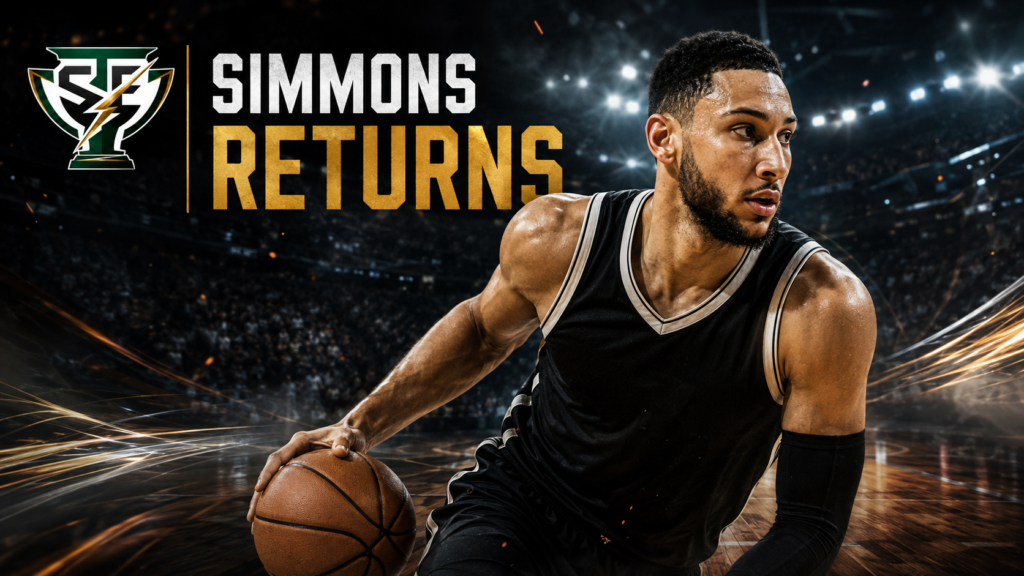
Ben Simmons is preparing to give the NBA another shot, and for the first time in years, the most encouraging part of his comeback story has little to do with statistics, contracts or reputation.
He is healthy enough to train without restrictions.
The 30-year-old former No. 1 overall pick is participating in a private, player-led Australian national team minicamp in Melbourne with what ESPN Andscape reported are “zero restrictions.” Simmons sat out the entire 2025-26 NBA season while allowing his body to recover from the back and other injuries that repeatedly interrupted his career. Multiple NBA teams have now shown interest, and at least one Western Conference club has reportedly put a non-guaranteed offer on the table.
That does not guarantee an NBA roster spot. It does, however, put Simmons closer to one than he has been in more than a year.
For a player whose career once seemed headed toward perennial All-Star status, the stakes have changed dramatically. Simmons is no longer trying to justify a maximum contract or prove he belongs among the league’s elite point guards. His next challenge is more basic and perhaps more interesting: demonstrate that a healthy, motivated version of Ben Simmons can still help an NBA team win.
That makes his attempted comeback one of the more unusual stories of the 2026 offseason.
Ben Simmons NBA Comeback: Key Facts
- Age: 30
- NBA status: Free agent
- Current activity: Training at a private Australian men’s national team minicamp in Melbourne
- Training status: Reportedly participating with zero restrictions
- Last NBA team: Los Angeles Clippers
- Last NBA appearances: 18 games for the Clippers in March and April 2025
- 2025-26 season: Did not play while recovering from back and other injuries
- NBA interest: Several teams reportedly interested
- Reported offer: Non-guaranteed deal from a Western Conference team
- Contract stance: Simmons is reportedly willing to accept a minimum deal
- International goal: Represent Australia at the 2028 Los Angeles Olympics
Ben Simmons Has Reached the Most Important Stage of His Comeback
There is an enormous difference between posting workout videos and participating fully in competitive basketball sessions.
Simmons appears to have crossed that line.
ESPN Andscape reported that the Australian is expected to participate fully in the Melbourne minicamp without restrictions. The sessions give him the opportunity to work against professional-level players while NBA teams evaluate whether his body can withstand the movement, contact and repeated effort required at league level.
Simmons had been working primarily in Miami, where he lives, before traveling to Australia for the camp. According to the report, he paid his own expenses to make the trip.
That small detail says something about where his priorities appear to be.
There is no guaranteed NBA contract waiting for him. There is no superstar salary to protect. He is putting himself in an environment where he can play, compete and show teams what he has left.
For a player who has spent much of the past several seasons surrounded by injury updates and questions about availability, simply being able to train freely is meaningful.
Several NBA Teams Are Reportedly Watching
Simmons does not appear to be pursuing a comeback without interest from the league.
Several NBA teams have contacted his representatives, while one Western Conference franchise has reportedly offered a non-guaranteed deal.
The identity of that team has not been publicly confirmed.
Simmons is also reportedly willing to sign for the veteran minimum, a major change from the financial circumstances that shaped much of his earlier career.
That makes him much easier for teams to evaluate as a basketball decision.
A minimum or non-guaranteed contract limits financial exposure. If Simmons remains healthy and provides defense, rebounding and secondary playmaking, the signing could offer genuine value. If his body cannot cope with the workload or his offensive limitations become too difficult to accommodate, the team can move on without carrying a major contract problem.
Those are very different circumstances from the years when Simmons’ salary and former superstar status dominated every discussion about him.
NBA roster construction is already producing plenty of unusual opportunities this summer. The Sports Encounter has followed major veteran movement throughout the offseason, including LeBron James’ move to the Philadelphia 76ers and Dillon Brooks’ new contract with the Phoenix Suns.
Simmons belongs at the opposite end of that market.
He does not need a franchise built around him anymore.
He needs the right role.
The Old Ben Simmons Was an Exceptional NBA Player
It is easy to forget how good Simmons once was because the difficult years eventually overwhelmed the conversation around his career.
Philadelphia selected him first overall in the 2016 NBA Draft after one season at LSU.
A foot injury delayed his NBA debut until the following season, but when he finally arrived, Simmons immediately looked like one of the league’s most unusual young talents.
At 6-foot-10, he combined the size of a forward with the passing instincts of a point guard. He could grab a defensive rebound, accelerate down the floor and create an open shot without giving the defense enough time to organize.
Simmons won the 2017-18 NBA Rookie of the Year award.
He later became a three-time All-Star, earned All-NBA Third Team recognition and made the NBA All-Defensive First Team twice.
At his best, Simmons could influence a game without scoring 25 points.
He defended guards, wings and forwards. He generated transition opportunities. He rebounded. He created open three-pointers for teammates. His combination of size, speed and court vision made him difficult to reproduce with another player.
Across 383 career NBA games, Simmons has averaged 13.1 points, 7.4 rebounds, 7.2 assists and 1.5 steals.
Those numbers explain why teams may still be curious.
Then the Career Changed
The decline was not caused by one problem.
Confidence, offensive limitations and injuries eventually combined.
Simmons’ unwillingness or inability to become a reliable perimeter shooter had always limited his offensive ceiling, particularly during playoff basketball when defenses could shrink the floor.
The pressure around that weakness intensified during his final postseason runs with Philadelphia.
Then his body became an even bigger issue.
Back trouble repeatedly interrupted his time with the Brooklyn Nets and eventually became one of the defining factors of his career.
The version of Simmons who once played 79 games as a rookie became increasingly difficult to find.
He has not appeared in more than 58 games during any season since 2018-19.
By the time he reached the Los Angeles Clippers in 2025, expectations had already fallen sharply.
He played only 18 games for Los Angeles in March and April before disappearing from NBA competition altogether for the 2025-26 season.
That year away may ultimately become the most important decision of his comeback attempt.
Sitting Out an Entire Season Could Have Saved His Career
Professional athletes rarely enjoy the luxury of completely rebuilding their bodies.
The calendar keeps moving.
Rehabilitation becomes preparation. Preparation becomes preseason. Preseason becomes another 82-game schedule.
Simmons stepped outside that cycle.
Rather than attempting another abbreviated return during 2025-26, he remained away from NBA competition and focused on his health.
We will not know whether that decision worked until he begins playing meaningful games again.
The current evidence is nevertheless more encouraging than another rushed comeback would have been.
Training without restrictions is the first requirement.
Playing through contact is another.
Recovering the next morning and doing it again is where the real test begins.
The Sports Encounter has seen the other side of that equation this offseason, including Jamir Watkins’ long rehabilitation after ACL surgery. The difficult part of professional sports recovery is rarely getting an athlete back onto a court once. The challenge is restoring the ability to withstand the repeated workload of an entire season.
TSE Analysis: Simmons Does Not Need to Become an All-Star Again
This may be the biggest reason a comeback can work.
The standards have changed.
A team signing Simmons for a minimum contract does not need 2019 Ben Simmons.
It needs a useful rotation player.
If Simmons can defend multiple positions, rebound, push the ball after misses and create easy shots for teammates, there is still a role available somewhere in the NBA.
The shooting issue remains.
Any lineup containing Simmons needs enough spacing around him to keep the half-court offense functional. Coaches cannot pretend that weakness disappeared simply because his contract became cheaper.
But role players come with limitations.
A coaching staff that understands what Simmons can still do may be able to extract value without asking him to solve the problems that eventually overwhelmed his Philadelphia career.
That could mean using him as a small-ball center in certain lineups.
It could mean assigning him to the opponent’s best wing while asking him to create in transition.
It could mean operating as a screener and short-roll passer rather than spending every possession as a conventional point guard.
The question is whether Simmons and his next team are willing to embrace that version of his career.
A Minimum Contract Could Be Exactly What Simmons Needs
There is something liberating about lowered expectations.
For much of Simmons’ career, every performance was measured against his draft position, All-Star status and enormous contract.
If he scored eight points, the conversation centered on what a maximum-salary player failed to do.
That framework disappears on a minimum deal.
An eight-point, eight-rebound, six-assist night with strong defense can be valuable from a bench player earning the minimum.
The same statistical line looks completely different when attached to a superstar salary.
This could allow Simmons to rebuild his basketball identity without trying to recreate the player he once was.
That may prove healthier for both the player and whichever team takes the chance.
Which Type of NBA Team Makes Sense for Ben Simmons?
The reported Western Conference offer has naturally created speculation, but the identity of the team should not be guessed without confirmation.
The basketball profile of Simmons’ ideal destination is easier to identify.
A Team With Strong Shooting
Simmons needs floor spacing around him.
Lineups containing multiple non-shooters would magnify his biggest offensive limitation.
A roster with several reliable perimeter threats could allow him to work as a passer, cutter and screener.
A Team That Does Not Need Him to Score
The worst possible environment would be one that expects Simmons to solve a scoring problem.
His value now should come from defense, transition play, rebounding and passing.
A Team With Established Leadership
Simmons would probably benefit from joining a stable locker room where his responsibilities are clearly defined.
A young rebuilding team asking him to become a central figure creates unnecessary pressure.
A Team Willing to Experiment Positionally
The old point-guard label may be less useful at this stage.
Simmons’ size gives a creative coaching staff options as a forward, screener, defensive specialist or occasional small-ball center.
The most interesting destination may therefore be the team willing to stop asking what position Ben Simmons plays and concentrate on which lineups he can improve.
Australia May Be Just as Important as the NBA
The Melbourne minicamp is not only an NBA audition.
Simmons reportedly wants to represent Australia at the 2028 Los Angeles Olympics.
His relationship with the Australian national program has always carried a strange sense of unfinished business.
Simmons has been one of the country’s most recognizable basketball players for years, yet he has never established the long international résumé many expected when he entered the NBA.
The current minicamp can begin changing that.
He reportedly paid his own way to Melbourne and joined the player-led sessions voluntarily.
The next Olympics are still two years away, giving Simmons time to rebuild his club career and establish himself within the Boomers program.
An NBA comeback and an Australian comeback could therefore develop together.
Los Angeles 2028 Gives Simmons a Longer-Term Goal
A two-year target may be useful for a player whose recent career has largely been measured from one injury update to the next.
The goal now has structure.
Get healthy.
Earn an NBA opportunity.
Stay available.
Rebuild competitive rhythm.
Put himself in contention for an Australian Olympic roster.
By the summer of 2028, Simmons would be 32.
That is old enough for his athleticism to have changed but young enough that a healthy version should still be capable of contributing at the international level.
Australia also offers something different from the NBA.
International basketball could use his size and defensive versatility in ways that do not require him to dominate offensively.
Can Ben Simmons Still Defend at an Elite Level?
This may ultimately decide whether the comeback lasts.
Shooting improvements would be welcome, but expecting Simmons to suddenly become a high-volume perimeter scorer at 30 is unrealistic.
Defense provides the clearer route.
At his peak, Simmons was one of the NBA’s most versatile perimeter defenders. His combination of length and lateral movement allowed him to switch across positions without immediately creating a mismatch.
Back injuries can dramatically affect that skill.
Defending at NBA level requires repeated acceleration, changes of direction, contact and recovery.
If Simmons has regained enough mobility to defend wings consistently, teams will notice.
If he cannot, the offensive limitations become considerably harder to accommodate.
This is why the Australian minicamp matters beyond the phrase “zero restrictions.”
Teams need to see how he moves.
The NBA Comeback Is a Mental Test Too
Simmons has spent years as one of basketball’s most scrutinized players.
Every missed jumper became content.
Every injury triggered another debate.
His postseason struggles in Philadelphia turned into a defining public narrative that followed him to Brooklyn and Los Angeles.
A comeback requires accepting that history without playing against it every night.
Simmons cannot undo what happened with the 76ers.
He can still decide how the final stage of his career looks.
That is another reason a smaller role may suit him.
The next contract should be about basketball rather than redemption.
There Is Still Real Risk for Any Team That Signs Him
Interest does not eliminate the obvious concerns.
Simmons’ recent availability record is poor.
He has not played an NBA game since April 2025.
Practice fitness and NBA game fitness are different.
A player can look excellent during controlled summer workouts and struggle once the league schedule begins producing flights, back-to-backs, contact and repeated recovery demands.
The offensive spacing problem has also not disappeared.
Opponents will test him immediately.
They will leave him unattended on the perimeter, clog passing lanes and attempt to force his team into playing four-on-five basketball in the half court.
Simmons and his next coach need answers.
That is why a non-guaranteed or minimum contract makes sense for both sides.
Why an NBA Team Should Still Take the Chance
The potential cost is small.
The upside is unusual for a minimum-contract player.
Most free agents available at that price have never been three-time All-Stars or two-time All-Defensive selections.
Simmons has.
His peak may be gone, but teams are not trying to buy his peak anymore.
They are trying to determine how much of the underlying skill set remains.
If the answer includes high-level defense, rebounding, transition creation and passing, a roster spot becomes easy to justify.
If he rediscovers even a portion of his old athleticism, the gamble becomes more interesting.
The Comeback Story Has Finally Reached the Court
Ben Simmons has been associated with comeback speculation before.
This situation carries more substance.
He took an entire NBA season away.
He has returned to unrestricted basketball work.
He is training with Australian players in Melbourne.
Several NBA teams reportedly have interest.
One Western Conference team has reportedly gone far enough to put a non-guaranteed offer on the table.
And Simmons is apparently prepared to accept a minimum contract rather than wait for his former market value to return.
Those are tangible steps.
They still leave one enormous question.
Can his body survive NBA basketball again?
If it can, Simmons remains young enough and talented enough to write a final chapter very different from the one many people assumed had already been written.
For more league developments, roster moves, player analysis and the latest stories from around basketball, follow The Sports Encounter’s NBA coverage.
Frequently Asked Questions About Ben Simmons’ NBA Comeback
Is Ben Simmons returning to the NBA?
Simmons is actively attempting an NBA comeback after sitting out the entire 2025-26 season. Several teams have reportedly expressed interest, although he has not yet officially signed a guaranteed NBA contract.
Is Ben Simmons healthy?
Simmons is reportedly participating in an Australian men’s national team minicamp with zero restrictions. That is an encouraging development after years of back and other injury problems, although NBA game fitness will present a greater test.
When did Ben Simmons last play in the NBA?
He last appeared for the Los Angeles Clippers in 2025, playing 18 games for the team during March and April.
Why did Ben Simmons miss the 2025-26 NBA season?
Simmons stayed out of NBA competition while recovering from back problems and other injuries that had disrupted several previous seasons.
Which NBA team is interested in Ben Simmons?
Several teams have reportedly shown interest. ESPN Andscape reported that one Western Conference team has offered a non-guaranteed deal, but the franchise has not been publicly identified.
Would Ben Simmons accept a minimum contract?
Yes. Simmons is reportedly open to signing for the NBA minimum as he tries to restart his career.
How old is Ben Simmons?
Simmons turned 30 in July 2026.
What are Ben Simmons’ career NBA statistics?
Across 383 NBA games, Simmons has averaged 13.1 points, 7.4 rebounds, 7.2 assists and 1.5 steals per game.
Which NBA teams has Ben Simmons played for?
Simmons has played for the Philadelphia 76ers, Brooklyn Nets and Los Angeles Clippers.
Was Ben Simmons an NBA All-Star?
Yes. Simmons is a three-time NBA All-Star. He also won Rookie of the Year, made an All-NBA team and earned two NBA All-Defensive First Team selections during his peak years in Philadelphia.
Will Ben Simmons play for Australia at the 2028 Olympics?
That is one of his goals. Simmons is currently participating in a private Australian men’s basketball minicamp and reportedly wants to compete for the Boomers at the Los Angeles 2028 Olympics.
What would make Ben Simmons’ NBA comeback successful?
Health and role acceptance will be crucial. Simmons does not need to return to All-Star form. Strong defense, rebounding, transition play and secondary playmaking could make him a useful NBA rotation player if he remains available.