


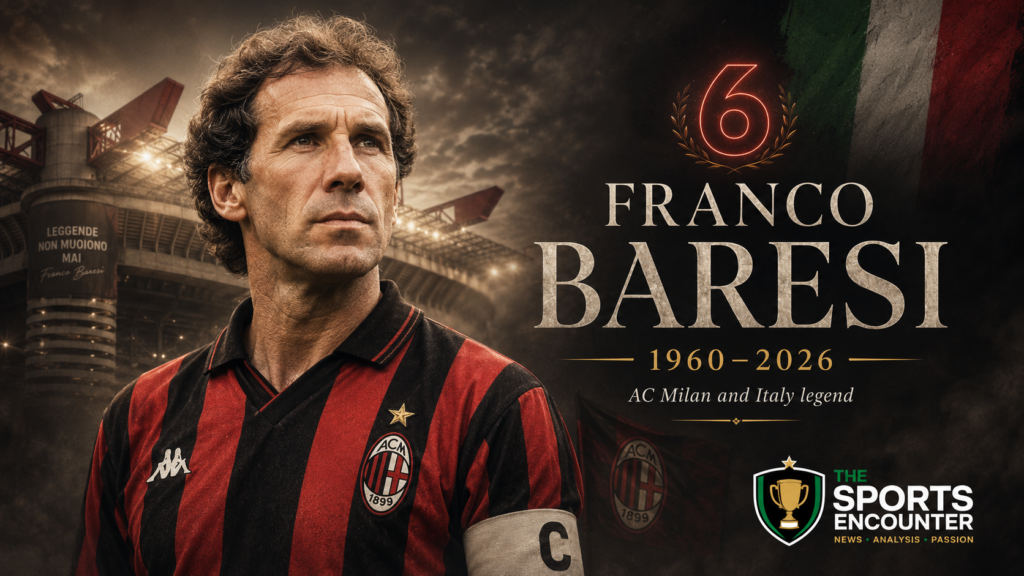
Franco Baresi, the legendary AC Milan and Italy defender who transformed the art of defending through intelligence, courage, anticipation, and leadership, has died at the age of 66. His passing removes one of the strongest living links to Italian football’s golden age and leaves AC Milan mourning the captain who stayed through relegation, led the club back to greatness, and made the number six immortal.
Football has lost a defender who rarely needed to chase a game because he understood where it was going before everyone else.
Franco Baresi, the former AC Milan and Italy captain, has died at the age of 66. AC Milan announced his passing on Friday, describing a club in tears and promising that his integrity, example, and iconic number six would remain part of its identity forever.
The words carried more meaning than the familiar language of a sporting tribute.
Baresi was not simply one of Milan’s greatest players. He represented the history, suffering, recovery, discipline, and eventual dominance of the Rossoneri across two defining decades. He joined as a teenager, stayed when the club fell into Serie B, led it back to the top, and later captained one of the finest teams the sport has produced.
His 20-year playing career never took him away from Milan. He made 719 official appearances, scored 33 goals, won six Serie A championships, lifted three European Cups, claimed two Intercontinental Cups, and collected four Italian Super Cups.
At international level, Baresi was a member of Italy’s 1982 World Cup-winning squad and later captained the Azzurri at the 1994 tournament. His display in that final, only 25 days after knee surgery, became one of the most extraordinary examples of physical courage in World Cup history.
He played all 120 minutes against Brazil.
Italy lost on penalties, and Baresi missed the first kick of the shootout. Yet the enduring meaning of that night was never the miss. It was the sight of a defender, recently operated on and carrying the responsibility of a nation, performing at the highest level through pain that should have kept him away from the field.
One of the greatest defenders of all time.
— 90s Football (@90sfootball) July 31, 2026
Here's Franco Baresi in the 1994 World Cup final at 34-years-old, putting in an incredible performance 24 days after suffering a severe meniscus tear that required surgery.
RIPpic.twitter.com/s8sPRil1Rs
His passing arrives at a difficult time for Italian football, which continues to search for the leadership, defensive identity, institutional clarity, and long-term thinking that once made the country an international reference point. The Sports Encounter recently examined those concerns in its analysis of why Italian soccer has lost direction.
Baresi belonged to a different Italy. It was not always successful, glamorous, or stable, but it understood the value of defensive intelligence, tactical discipline, and loyalty to an idea.
Franco Baresi’s Career at a Glance
| Category | Record |
|---|---|
| Full name | Franchino Baresi |
| Born | May 8, 1960, Travagliato, Italy |
| Died | July 31, 2026, aged 66 |
| Club | AC Milan |
| Senior seasons with Milan | 20 |
| Official Milan appearances | 719 |
| Official Milan goals | 33 |
| Serie A appearances | 470 |
| Serie A titles | Six |
| European Cups | Three |
| Intercontinental Cups | Two |
| Italian Super Cups | Four |
| Italy caps | 81 |
| World Cup achievement | Winner in 1982, captain and runner-up in 1994 |
| Milan shirt number | 6, retired after his final season |
AC Milan Mourn the Man Who Carried Their History
AC Milan’s official tribute said the entire history of the club was in tears.
That was not an exaggeration.
Some players belong to a successful period. Baresi connected several versions of Milan that felt almost like different institutions.
He experienced the late years of Gianni Rivera, the humiliation of relegation, the uncertainty of Serie B, the return to the top flight, Silvio Berlusconi’s ambitious transformation, Arrigo Sacchi’s tactical revolution, and Fabio Capello’s domestic domination.
Through each version, Baresi remained.
He played his first senior matches during the 1977-78 season and established himself as a regular the following year, when Milan won their tenth Scudetto. The teenager was already demonstrating the calmness, positioning, and authority that would later define his career.
His official record can be explored through AC Milan’s Franco Baresi Hall of Fame profile, which documents 719 matches across 20 seasons and the collection of trophies that followed.
The numbers are enormous, but they cannot fully explain his place in Milan culture.
Baresi did not merely wear the captain’s armband. He gave it meaning during moments when the club’s identity was under pressure.
Loyalty Was Tested Before It Became Romantic
Modern football often celebrates loyalty after success has already made staying comfortable.
Baresi’s loyalty was established when remaining at Milan carried real professional risk.
The club suffered relegation to Serie B in 1980 following the Totonero match-fixing scandal. Baresi could have pursued stability elsewhere. He stayed and helped Milan return to Serie A.
The recovery did not last.
Milan were relegated again in 1982, this time because of poor results rather than a disciplinary punishment. Baresi remained loyal again and led the club back into the top division.
Those years matter because they separate his story from the simpler version of a one-club legend who spent his entire career surrounded by trophies.
Baresi knew instability. He played in front of frustrated supporters, traveled to smaller grounds in the second tier, and carried the weight of a club whose famous history no longer guaranteed success.
His decision to stay was later described by Italian football leaders as romantic. It was also practical, demanding, and brave. At the time, there was no guarantee that Milan would become the dominant European power of the late 1980s.
He stayed because the shirt already meant something to him.
How Baresi Redefined the Sweeper
Baresi was often described as a libero or sweeper, but those labels can create the wrong image for modern readers.
Traditional sweepers operated behind the defensive line, clearing danger after teammates had been beaten. Baresi did far more.
He controlled the line, stepped into midfield, initiated attacks, anticipated passes, covered teammates, and decided when Milan should advance or retreat. His role required defensive judgment, technical quality, courage, and tactical command.
He was not physically imposing by the standards of elite central defenders. At approximately 5 feet 9 inches, he lacked the height associated with dominant aerial defenders.
He compensated through timing and awareness.
Baresi often reached the ball before a larger opponent had fully recognized the opportunity. He studied the angle of the pass, the orientation of the attacker’s body, and the space developing behind the midfield.
A clean interception could look simple. The work had been done seconds earlier in his mind.
His tackling was controlled rather than reckless. He defended aggressively without turning every duel into a physical confrontation. When he stepped forward, he usually did so with a clear picture of what would happen if he missed.
That intelligence allowed Milan to defend higher up the field than many teams of the era.
The Captain at the Center of Sacchi’s Revolution
Arrigo Sacchi’s arrival in 1987 changed European football.
His Milan side pressed collectively, compressed the field, defended through coordinated movement, and treated space as something the team could control together.
The system required exceptional discipline from the back four.
Baresi became its organizer.
Alongside Mauro Tassotti, Alessandro Costacurta, and the young Paolo Maldini, he helped form a defense that combined technical skill with tactical unity. Their movement was synchronized. When one stepped forward, the others understood the signal.
The offside trap became one of Milan’s most feared weapons. Baresi would raise an arm, move the line, and leave an opponent stranded beyond the last defender.
It looked dangerous because one mistimed movement could expose the goalkeeper. Milan executed it with such clarity that attacking teams began to appear uncertain about when to make their runs.
Sacchi’s system is often remembered for Ruud Gullit, Marco van Basten, Frank Rijkaard, pressing, and European spectacle. It worked because Baresi gave the structure an intelligent foundation.
Milan won the European Cup in 1989 and successfully defended it in 1990. They also won back-to-back Intercontinental Cups and became the standard against which elite European teams were measured.
Baresi did not command through constant theatrical gestures. His authority came from the accuracy of his decisions.
The Invincibles and the 58-Match Unbeaten Run
Fabio Capello succeeded Sacchi and adjusted Milan’s style without weakening its authority.
The team became known as Gli Invincibili, the Invincibles, after completing the 1991-92 Serie A season without defeat and extending an unbeaten league run to 58 matches.
Baresi remained central to that success.
The team could dominate possession, control territory, and punish opponents through attacking quality, but its defensive concentration gave it an extraordinary margin for error.
During the 1993-94 Serie A season, Milan conceded only 15 goals in 34 league matches. The same campaign ended with a 4-0 victory over Barcelona in the European Cup final, one of the most celebrated tactical performances in the competition’s history.
Baresi and Costacurta were suspended for the final in Athens. Their absence was widely expected to weaken Milan. Instead, Capello’s team delivered a near-perfect performance.
Even in absence, Baresi’s influence remained visible in the defensive principles the team had learned through years of working beside him.
Paolo Maldini’s Tribute Reveals Baresi’s Human Influence
Paolo Maldini’s tribute carried the emotional force of a younger teammate saying goodbye to the man who shaped him.
Maldini remembered Baresi as the player who protected him when he was a child, guided him as a young man, and continued to inspire him as an adult.
He described Baresi as the greatest footballer he had the honor of playing alongside.
That statement matters because Maldini shared fields with van Basten, Gullit, Rijkaard, Roberto Baggio, Andrea Pirlo, Kaká, Andriy Shevchenko, and many other all-time greats.
Baresi’s influence on Maldini also created a direct line between two eras of Milan leadership.
The number six retired with Baresi. The number three was later retired in Maldini’s honor.
Italian football has struggled in recent years to reproduce that type of generational transmission. Leadership once passed naturally from experienced defenders to younger players inside stable club and national structures.
The recent debate around Maldini’s reported departure from the Italian federation reflects a wider concern, as explored in The Sports Encounter’s report on Italy’s crisis of football leadership and identity.
Italy, the 1982 World Cup and an Unusual International Beginning
Baresi’s international career did not follow a simple path.
He was included in Italy’s squad for the 1982 World Cup in Spain but did not play during the tournament. Enzo Bearzot’s team recovered from a slow group stage and defeated Argentina, Brazil, Poland, and West Germany to become world champions.
Baresi earned a World Cup medal, but his true international influence developed later.
His ability was never in doubt. The tactical role available to him was more complicated because Italy already possessed experienced defensive leaders and coaches did not always build the team around the same high-line principles used at Milan.
He eventually became the captain and defensive reference point of the national side.
Baresi earned 81 caps and represented Italy at the 1990 World Cup on home soil, where the Azzurri did not concede a goal until the semifinal against Argentina.
The defeat on penalties in Naples prevented Italy from reaching the final, but Baresi’s performances reinforced his position among the tournament’s strongest defenders.
Four years later, the United States provided the defining international image of his career.
The 1994 World Cup Final Was His Greatest Defeat and Finest Act of Courage
Italy’s 1994 World Cup story is often remembered through Roberto Baggio.
Baggio carried a struggling team through the knockout rounds before missing the final penalty against Brazil. The Sports Encounter revisited that painful campaign in Roberto Baggio: The Man Who Died Standing.
Baresi’s journey through the same tournament was equally extraordinary.
He injured his knee during the group stage against Norway and underwent surgery. His World Cup appeared finished.
Italy continued advancing, and Baresi began a race against time that should have been impossible to win.
Twenty-five days after surgery, he returned for the final against Brazil at the Rose Bowl.
He did not return for a ceremonial appearance or a protected role. He played 120 minutes against Romário and Bebeto, two forwards capable of punishing a moment of hesitation.
Baresi read attacks, closed spaces, controlled the defense, and performed with astonishing composure. Brazil failed to score through regular time and extra time.
His penalty went over the crossbar during the shootout. Daniele Massaro and Roberto Baggio also missed, allowing Brazil to win their fourth World Cup.
Baresi cried after his miss.
The tears did not reduce the performance. They revealed how much the responsibility meant to him.
Football sometimes compresses a player’s life into one image. Baggio became the man staring at the ground after the final kick. Baresi became the captain in tears.
Both men deserved to be remembered for the courage that carried Italy into the final rather than only for the penalties that followed.
A Defender Who Made Intelligence Visible
Great defending can be difficult to celebrate because its best moments often prevent drama before it begins.
A striker scores and creates an obvious event. A defender moves three yards at the correct moment and removes the possibility of a shot.
Baresi made those invisible decisions noticeable.
Supporters watched his positioning because he controlled the shape around him. Teammates responded to his steps. Opponents altered their runs because they knew he was reading them.
He could move forward with the ball and break the first line of pressure. His passing was clean and purposeful rather than decorative.
Modern central defenders are expected to begin attacks, defend large spaces, control a high line, and remain comfortable in possession. Baresi was performing those tasks before they became standard descriptions in recruitment reports.
He would have suited the modern game because his qualities were based on thought, technique, and timing rather than the protection of a deeper defensive block.
Rules, pressing schemes, and athletic standards have evolved. The ability to understand space remains timeless.
The Number Six Became More Than a Shirt
When Baresi retired in 1997, Milan withdrew his number six.
He became the first player in the club’s history to receive that honor.
The decision acknowledged more than appearances and trophies. It recognized that the number had become inseparable from his identity.
Milan’s official archive of the 1996-97 season recalls the emotional farewell given to Baresi and Tassotti on the final day of that difficult campaign.
Milan finished 11th, far below the standards established during the previous decade. Baresi’s career ended without another trophy or perfect conclusion.
That felt appropriate in one sense.
His relationship with Milan had never depended only on winning. He had already proved that by staying through two relegations.
The number six remains unavailable because another player could wear the digits but could not inherit the complete meaning attached to them.
His Death Comes After a Public Health Battle
AC Milan announced in 2025 that Baresi had undergone surgery to remove a pulmonary nodule. The club said he would receive treatment under the supervision of a cancer specialist.
Baresi later returned to public life.
In February 2026, he appeared as a torchbearer during the opening ceremony of the Milano Cortina Winter Games. He carried the Olympic flame alongside Giuseppe Bergomi, the former Inter Milan and Italy defender who had spent years as his club rival and international teammate.
The sight of the two men together carried symbolic weight.
Milan and Inter shaped Italian football through fierce competition, but players such as Baresi and Bergomi also represented a national tradition larger than club rivalry.
That appearance now feels like a final public connection between Baresi, Milan, Italy, and the city whose football history he helped define.
Tributes Crossed Rivalries and Borders
Inter Milan, Juventus, Roma, Napoli, and other Italian clubs expressed condolences after news of Baresi’s death.
Real Madrid honored him as one of the great legends of Milan, Italian football, and the global game.
Italian Prime Minister Giorgia Meloni described him as both a historic champion and an example of seriousness, loyalty, and dedication.
The Italian Football Federation also promised to commemorate him during upcoming national-team matches. Its official national-team coverage and announcements are available through the Italian Football Federation’s Azzurri portal.
The breadth of the tributes reflected the respect Baresi earned beyond Milan.
Rivals could dislike the club he represented. They struggled to dismiss the integrity, ability, and competitive courage of its captain.
Baresi and the Lost Italian Art of Defensive Authority
Italy still produces gifted defenders, but Baresi’s death has reopened a larger conversation about what the country has lost.
The strongest Italian teams once treated defending as a collective intellectual exercise. Positioning, distances, communication, anticipation, and emotional control were taught as serious technical skills.
Baresi became the clearest expression of that culture.
He did not defend through fear. His high line required confidence. Stepping into midfield required trust. Directing experienced teammates demanded authority.
Italian football’s current struggles cannot be solved by searching for another Baresi. Players of his quality do not appear through institutional instructions.
The system can still learn from what formed him: patient development, tactical education, meaningful responsibility at a young age, stable coaching relationships, and respect for football intelligence.
Italy’s recent coaching uncertainty was explored in The Sports Encounter’s analysis of why the federation turned toward Andrea Pirlo. Whatever direction the Azzurri take, the team will need to rediscover the authority Baresi once provided naturally.
A Standard for One-Club Greatness
Football still celebrates one-club players because they have become increasingly rare.
Commercial opportunity, changing ownership, tactical fit, agent influence, and short managerial cycles make long careers at one institution difficult.
Baresi’s story should not be used to criticize every player who changes clubs. His circumstances belonged to another era.
His loyalty still offers an important lesson.
He did not stay because every season was comfortable. He stayed when Milan’s future looked uncertain. Success later rewarded that commitment, but the loyalty existed before the reward.
That is why supporters saw him as more than an employee.
His bond with Milan resembled the relationship between a person and a community. The club’s pain became his pain. Its return became his return. Its greatest team carried his armband.
How Baresi Compares With Football’s Greatest Defenders
Comparing players across eras is always imperfect.
Franz Beckenbauer transformed the libero role through elegance and attacking movement. Bobby Moore became the image of English defensive composure. Gaetano Scirea represented intelligence and dignity for Juventus and Italy. Paolo Maldini offered extraordinary longevity, versatility, and technical perfection.
Baresi belongs comfortably within that group.
His strongest case combines:
- Twenty seasons at one elite club
- 719 official appearances
- Leadership through relegation and restoration
- Six Serie A championships
- Three European Cups
- A central role in two tactical revolutions
- World Cup victory and captaincy
- Technical quality beyond traditional defending
- Influence on Maldini and the next Milan generation
- A retired number that became part of the club’s identity
Greatness cannot be reduced to medals. Baresi also changed how defenders were understood.
Football History Is Built by Those Who Shape the Next Generation
Baresi’s influence continued after retirement through ambassadorial, youth, and executive roles at Milan.
He served as honorary vice president and represented the club internationally. His presence connected modern players, supporters, and commercial partners with the standards of an earlier generation.
Football legends matter partly because they preserve memory.
Young fans may discover Baresi through old footage, historical articles, or comparisons with modern defenders. The grainy images do not always communicate the speed, tactical risk, and emotional pressure of the matches he controlled.
The responsibility now passes to Milan, Italian football, and sports media to tell the story properly.
The Sports Encounter has approached other football lives through the same historical lens, including the tribute to Andrés Escobar and the tragedy that followed the 1994 World Cup.
Both defenders remind us that football memory must extend beyond the final mistake, final score, or famous image.
What Today’s Defenders Can Learn From Baresi
Modern defenders can study several parts of Baresi’s game without trying to imitate his era completely.
Read the attacker before attacking the ball
Baresi rarely treated the ball as the only source of information. He watched hips, shoulders, passing angles, supporting runners, and the spaces opening behind teammates.
Control the line through communication
A high defensive line works only when every player understands the collective movement. Baresi made communication part of defending rather than an emotional reaction after danger appeared.
Use possession to defend
His ability to pass forward prevented Milan from returning the ball immediately to the opposition. A defender who starts an attack can protect the team as effectively as one who makes a tackle.
Separate aggression from recklessness
Baresi defended assertively but did not depend on uncontrolled challenges. His aggression came from stepping into the correct space with conviction.
Leadership begins before the trophy
He demonstrated commitment during relegation years. The great captain of European champions was formed when Milan were struggling in Serie B.
His Legacy Reaches Beyond Milan
Baresi will always belong most closely to AC Milan, but his influence crosses clubs and countries.
Coaches used his Milan teams as teaching material. Defenders studied his anticipation. Supporters recognized him as the image of a football culture that valued structure without removing creativity.
His career also challenges the idea that defenders cannot become central protagonists.
He did not score frequently or perform elaborate celebrations. His presence still dominated matches because he controlled their geography.
The modern game often celebrates attackers through goals, assists, and individual highlight packages. Baresi’s legacy asks viewers to watch what happens before the highlight.
Who closed the passing lane? Who moved the line? Who recognized the danger? Who played the first pass that changed defense into attack?
Very often, for Milan and Italy, the answer was Baresi.
Final Tribute: The Captain Leaves, but Number Six Remains
Franco Baresi’s death has removed one of football’s most respected living symbols.
It has not removed his presence from Milan.
He remains in the number six that no player will wear, the European nights that transformed the club, the defensive line that moved with one mind, the young Maldini who learned beside him, and the supporters who watched him remain when leaving would have been easier.
His career contained almost every experience football can offer.
He won the World Cup without playing. He lost another final after producing one of the finest defensive displays of his life. He lifted European trophies, suffered relegation, returned from surgery, missed a penalty, and continued leading.
The contradictions make the story human.
Baresi was not great because football protected him from pain. He was great because he carried responsibility through it.
AC Milan’s history will continue. New players will arrive, trophies will be pursued, managers will change, and generations of supporters will enter San Siro.
Number six will remain absent.
That empty space is not a loss of identity. It is a permanent reminder of the man who gave the shirt its meaning.
Frequently Asked Questions
How old was Franco Baresi when he died?
Franco Baresi was 66 years old. He was born on May 8, 1960, and died on July 31, 2026.
What was Franco Baresi’s cause of death?
AC Milan confirmed his death but did not immediately provide a detailed cause. The club had announced in 2025 that Baresi underwent surgery to remove a pulmonary nodule and was receiving specialist cancer treatment.
How many games did Franco Baresi play for AC Milan?
Baresi made 719 official appearances for AC Milan across 20 senior seasons.
Did Franco Baresi play for any club other than AC Milan?
No. He spent his entire senior playing career with AC Milan, making him one of football’s most celebrated one-club players.
How many Serie A titles did Baresi win?
He won six Serie A championships with AC Milan.
How many European Cups did Franco Baresi win?
Baresi won three European Cups with Milan, including consecutive titles in 1989 and 1990 and another triumph in 1994.
Did Franco Baresi win the World Cup?
Yes. He was part of Italy’s squad that won the 1982 FIFA World Cup, although he did not appear during the tournament.
What happened to Baresi at the 1994 World Cup?
Baresi suffered a knee injury during the group stage and underwent surgery. He returned only 25 days later to play all 120 minutes of the final against Brazil. Italy lost on penalties, with Baresi among the players who missed in the shootout.
How many international matches did Baresi play?
He earned 81 senior caps for Italy and captained the national team during the 1994 World Cup.
Why did AC Milan retire Baresi’s number six?
Milan retired the number to honor his 20-year career, leadership, loyalty, 719 appearances, and central role in the club’s most successful era.
Was Baresi part of AC Milan’s Invincibles team?
Yes. He captained the Milan side that completed the 1991-92 Serie A season unbeaten and helped establish a 58-match undefeated league run.
Who played alongside Baresi in Milan’s famous defense?
His best-known defensive teammates included Paolo Maldini, Alessandro Costacurta, and Mauro Tassotti.
What position did Franco Baresi play?
He played primarily as a central defender and libero. His anticipation, passing, leadership, and control of the defensive line helped redefine the sweeper role.
What role did Baresi hold after retirement?
He remained connected with AC Milan through ambassadorial, coaching, youth-development, and executive responsibilities. He served as the club’s honorary vice president from 2020.
Why is Franco Baresi considered one of the greatest defenders ever?
Baresi combined tactical intelligence, technical ability, anticipation, leadership, loyalty, major trophies, and influence on future generations. He controlled high defensive lines and helped Milan dominate Italy, Europe, and world club football.