


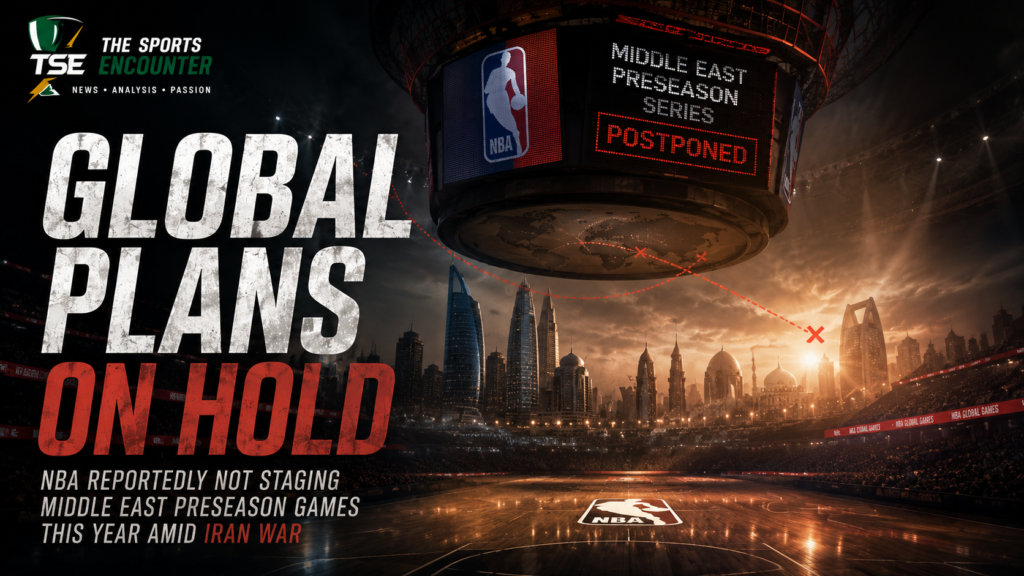
The NBA’s four-year run of preseason games in Abu Dhabi appears set to end in 2026, not because basketball interest has weakened, but because the security environment around the Gulf has become too unstable for a major American sports league to ignore.
According to a report cited by Reuters, the NBA will not stage preseason games in the Middle East this year because of the ongoing war involving Iran and the expanding risk around neighboring countries. The league had reportedly discussed sending the Brooklyn Nets, Cleveland Cavaliers, Miami Heat, or Washington Wizards to the region, although no teams or dates had been officially announced.
The NBA also explored the possibility of playing its first game in Doha, Qatar, where the FIBA Basketball World Cup will be held in 2027.
Those discussions are now understood to be on hold.
The decision interrupts one of the league’s most visible international growth projects. Abu Dhabi hosted NBA preseason games in each of the previous four seasons, turning Etihad Arena into a regular October destination for star players, league executives, sponsors, youth programs, and basketball fans from across the Middle East.
For more league news, global business stories, and team analysis, readers can follow The Sports Encounter’s NBA coverage hub.
TL;DR
- The NBA will reportedly stage no preseason games in the Middle East in 2026 because of the Iran war.
- No official 2026 Abu Dhabi or Doha games had been announced before the report.
- The Nets, Cavaliers, Heat, and Wizards had reportedly been discussed as possible participants.
- Abu Dhabi hosted NBA preseason games for four consecutive seasons from 2022 through 2025.
- The 2025 series featured the New York Knicks and Philadelphia 76ers at Etihad Arena.
- The NBA had also considered its first game in Doha before Qatar hosts the 2027 FIBA Basketball World Cup.
- The pause appears security-driven rather than a retreat from the NBA’s long-term Middle East strategy.
NBA Middle East Games: Key Information
| Detail | Current Position |
|---|---|
| Expected 2026 outcome | No NBA preseason games in the Middle East |
| Reported reason | Regional security concerns linked to the Iran war |
| Official NBA cancellation announcement | Not issued at the time of publication |
| Potential teams discussed | Brooklyn Nets, Cleveland Cavaliers, Miami Heat, Washington Wizards |
| Established host city | Abu Dhabi, United Arab Emirates |
| Potential new host city | Doha, Qatar |
| Previous Abu Dhabi run | Four consecutive preseason series from 2022 to 2025 |
| 2025 matchup | New York Knicks vs. Philadelphia 76ers |
| 2027 regional milestone | Doha will host the FIBA Basketball World Cup |
| Long-term NBA position | Abu Dhabi partnership remains active despite the reported pause |
Official league announcements and future Global Games information can be followed through the NBA’s official website. Details about Qatar’s preparations are available through the official FIBA Basketball World Cup 2027 platform.
Why the NBA Is Reportedly Staying Away
The league’s reported choice is best understood as a risk-management decision.
International games require months of advance planning. Teams must coordinate charter travel, player security, accommodation, insurance, medical services, practice facilities, broadcasting, sponsorship activations, visas, equipment transport, and arena operations.
A preseason trip also involves hundreds of people beyond the active roster. Coaches, medical staff, communications teams, league employees, broadcasters, security specialists, commercial partners, family members, and production crews may all travel.
When the security situation can change rapidly, certainty becomes almost impossible to guarantee.
The conflict has already involved military strikes, missile attacks, maritime disruption, and security concerns across several parts of the Gulf. Even when a proposed host city remains operational and physically removed from active fighting, leagues must assess airspace, regional travel routes, emergency planning, insurance exposure, and the possibility of sudden escalation.
The NBA does not need a direct threat to an arena before reconsidering a trip. The inability to promise a stable environment can be enough.
That logic is familiar across global sports. The Sports Encounter previously examined the challenge of protecting spectators, athletes, and organizers in its analysis of the largest operational risks facing FIFA World Cup 2026 organizers.
This Is a Pause, Not Necessarily a Strategic Retreat
The reported cancellation should not automatically be interpreted as the NBA abandoning the Middle East.
In January 2026, the league and Abu Dhabi’s Department of Culture and Tourism announced a long-term extension of their partnership. That agreement includes future preseason games, expanded fan activities, youth development, and an NBA Global Academy based in the UAE capital.
The academy is designed to serve elite high-school-age prospects from the UAE, the wider Middle East, and other international markets.
That commitment runs much deeper than one pair of exhibition games.
The league’s relationship with Abu Dhabi has become part of its international development strategy, linking live games with coaching, grassroots participation, commercial partnerships, merchandise, media distribution, and talent identification.
Skipping one preseason because of a war does not undo that infrastructure.
It does, however, remove the most visible annual expression of the partnership.
How Abu Dhabi Became a Regular NBA Destination
The NBA first played preseason games in Abu Dhabi in 2022, when the Atlanta Hawks faced the Milwaukee Bucks twice.
The Minnesota Timberwolves and Dallas Mavericks followed in 2023. Boston and Denver brought the previous two NBA champions to Etihad Arena in 2024, while the Knicks and 76ers completed the fourth edition in October 2025.
The event developed beyond two basketball games.
NBA District fan festivals, youth clinics, player appearances, merchandise sales, media events, and cultural visits became part of the program. Games were distributed through NBA TV, League Pass, and international broadcast partners, extending the value far beyond the arena.
The Knicks’ involvement also connected the Abu Dhabi series with one of the league’s strongest recent success stories. Their championship and changing place in the 2026-27 hierarchy were analyzed in The Sports Encounter’s breakdown of why the reigning champions opened only fourth in the NBA title market.
Philadelphia’s profile has grown even further since then. LeBron James has now joined the 76ers for his record-extending 24th season, a move explored in our analysis of how LeBron changed Philadelphia’s title mathematics.
The franchise later confirmed that James will wear No. 23, adding another layer of global interest around the team. The commercial and sporting impact of that announcement is covered in The Sports Encounter’s report on LeBron’s official 76ers signing.
What the Middle East Loses Without the Games
The immediate loss is access.
Fans across the Gulf will miss the rare opportunity to watch NBA players in person without traveling to North America, Europe, or Asia. For young basketball players, the games and surrounding clinics provide a direct connection to the league.
Abu Dhabi also loses a high-profile tourism and entertainment week that draws visitors, media, sponsors, and international attention.
The NBA loses a platform in a region with young populations, substantial commercial capacity, and growing investment in global sports.
Preseason games may not count in the standings, but their international value is substantial. They allow the league to build emotional loyalty through physical presence rather than depending only on television and social media.
The importance of location and fan programming can also be seen in the WNBA. The Sports Encounter examined how the league used Chicago’s Obama Presidential Center to connect basketball with youth development and community identity in its feature on the 2026 WNBA All-Star initiative.
The wider WNBA All-Star program in Chicago further showed how live events now function as fan festivals, commercial showcases, media platforms, and cultural gatherings.
The same principle applies internationally. The NBA is not merely exporting a game. It is building an ecosystem around it.
Doha’s Possible NBA Debut Would Have Carried Extra Meaning
The reported discussions about Doha may be the most strategically interesting part of the story.
Qatar will host the FIBA Basketball World Cup from August 27 to September 12, 2027. All 32 teams and 92 games will be based in Doha, making it the largest edition of the tournament staged in one city.
An NBA preseason game in Qatar would have allowed the league to enter the market before the World Cup and connect its stars with a major international basketball build-up.
It could also have served as a test of venue operations, audience demand, sponsorship interest, and regional broadcast value.
That opportunity has not necessarily disappeared. It has been delayed by a security situation that has made long-term event planning unusually difficult.
Qatar’s World Cup preparations continue, including confirmed venues, school basketball programs, qualifying events, and international marketing.
Why Global Leagues Cannot Separate Sport From Geopolitics
The NBA has spent years expanding its international calendar. It stages or plans games in markets such as Mexico City, London, Berlin, Paris, Canada, China, Australia, and Abu Dhabi.
Each destination creates new fans and revenue, but also exposes the league to political, diplomatic, legal, and security conditions beyond its control.
Global expansion increases opportunity and vulnerability at the same time.
A domestic preseason game can be moved between American cities with relative ease. An international event may depend on multiple governments, aviation corridors, customs rules, security agencies, and commercial partners.
World sport has learned that the host environment can become part of the competition’s identity. The Sports Encounter’s analysis of FIFA World Cup 2026 as a global marketing battlefield showed how major events attract brands, governments, tourism authorities, and international audiences at enormous scale.
The commercial rewards are significant. So are the risks when politics or conflict disrupts the plan.
What Happens to the Four Teams Reportedly Discussed?
Brooklyn, Cleveland, Miami, and Washington were reportedly among the teams considered for the Middle East trip.
Because no participation had been publicly confirmed, the four franchises do not face the same disruption that would follow a formal cancellation after tickets and schedules were released.
They can now build more conventional preseason programs closer to home or participate in other international opportunities should the league rearrange its calendar.
The reported discussions still offer a clue about what the NBA may have wanted.
Miami brings a globally recognized brand and strong international support. Cleveland offers an established franchise with recent relevance. Brooklyn plays in one of the world’s largest media markets. Washington has previously participated in international NBA programming.
None carried the championship profile of Boston or Denver in 2024, but each could have supported a commercially attractive event.
The NBA Will Prioritize Certainty Over Symbolism
There may have been symbolic value in continuing the series despite regional tension. It could have been presented as confidence in Abu Dhabi, commitment to fans, or proof that international sport can continue during political instability.
That symbolism would not outweigh operational responsibility.
Players and staff should not be used to demonstrate political confidence. The league’s first duty is to assess whether it can deliver an event safely and predictably.
That standard becomes even more important when teams are preparing for a long regular season. A disrupted return flight, unexpected security lockdown, or stressful travel environment could affect athletes before the first official game.
The NBA’s preseason is designed for preparation. It should not create avoidable instability.
Final Analysis: The Middle East Project Remains, but 2026 Has Become a Lost Year
The reported absence of NBA games from the Middle East is a setback for the league, Abu Dhabi, Qatar, sponsors, and regional fans.
Four consecutive seasons had created momentum. The league had established a recognizable October tradition at Etihad Arena. Doha offered a possible second market and a natural bridge toward the 2027 FIBA World Cup.
The Iran war has changed the calculation.
The NBA can control its matchups, broadcast plans, ticket strategy, and commercial partners. It cannot control military escalation, airspace disruption, missile threats, or the wider security environment across the Gulf.
That is why caution makes sense.
The most important point is that the league’s long-term relationship with the region remains intact. Abu Dhabi’s partnership has been renewed, youth programs are expanding, and the Global Academy provides a permanent foundation that does not depend on one preseason.
Doha’s basketball ambitions also remain substantial because the 2027 World Cup is moving forward.
There may be no NBA game in the Middle East in 2026, but the larger contest for basketball audiences, commercial partnerships, and sporting influence in the region has not ended.
It has simply been interrupted by circumstances more powerful than sport.