


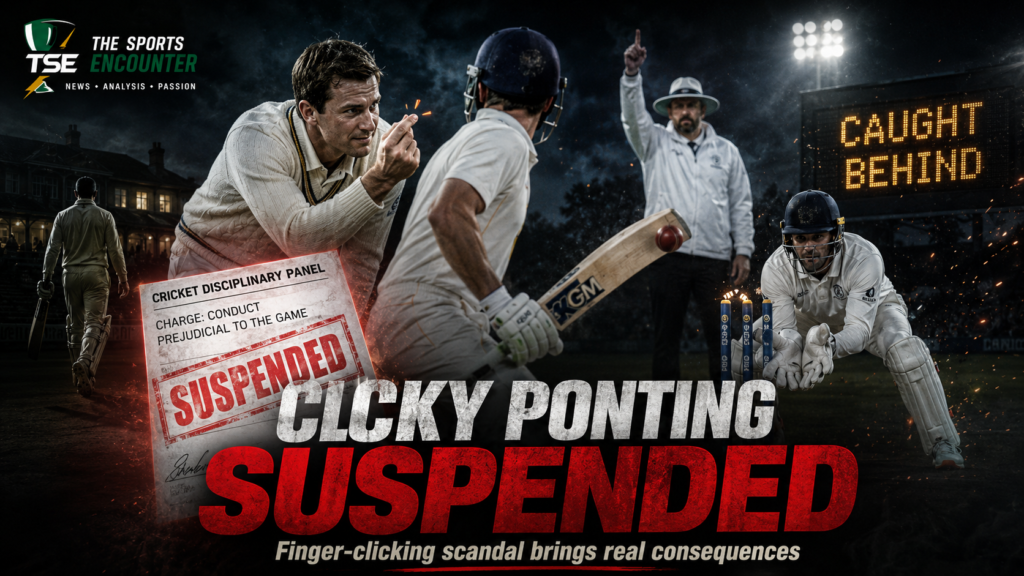
The finger click lasted a fraction of a second. The consequences may follow the player, his club, and the league for considerably longer.
Saltburn Cricket Club has suspended the amateur cricketer at the center of English cricket’s viral fake-edge controversy, confirming that he will not play again this season or “for the foreseeable future” while a formal investigation continues.
The player became known online as “Clicky Ponting,” a mocking reference to former Australia captain Ricky Ponting, after footage appeared to show a slip fielder clicking his fingers as the ball passed a batter’s outside edge. The artificial sound allegedly convinced the umpire that the batter had touched the ball before it was caught by the wicketkeeper.
The incident occurred during a North Yorkshire and South Durham Cricket League Division Two match involving Saltburn and Norton on July 25, 2026. Saltburn won the match by 159 runs, but the result quickly became secondary when the video spread across social media and generated accusations of deliberate deception.
The Sports Encounter first examined the footage, the applicable cricket laws, the spirit-of-the-game argument, and the possible disciplinary consequences in its original report on the Clicky Ponting finger-clicking controversy.
The latest development changes the status of the story.
This is no longer only a strange viral clip attracting jokes, memes, and angry reactions. Saltburn has taken formal action against the player, withdrawn him from competition, and begun cooperating with league officials. The North Yorkshire and South Durham Cricket League must now determine what happened, whether the conduct was deliberate, whether any other incidents require examination, and what additional punishment may be justified.
TL;DR
- Saltburn Cricket Club has suspended the player involved in the alleged finger-clicking deception.
- The player will not represent the club again this season or for the foreseeable future while the investigation continues.
- Footage appeared to show a slip fielder clicking his fingers to imitate the sound of a batter edging the ball.
- The incident occurred during Saltburn’s Division Two match against Norton on July 25, 2026.
- The North Yorkshire and South Durham Cricket League has received a formal complaint and opened an investigation.
- The suspension is a club action, not the league’s final disciplinary verdict.
- Saltburn remain leading contenders in Division Two, making the wider competitive consequences important.
Clicky Ponting Suspension: Key Information
| Detail | Current Information |
|---|---|
| Club | Saltburn Cricket Club |
| Competition | North Yorkshire and South Durham Cricket League Division Two |
| Match under investigation | Saltburn vs. Norton |
| Date of alleged incident | July 25, 2026 |
| Allegation | A fielder clicked his fingers to imitate the sound of an edge |
| Reported consequence on the field | A batter was given out caught behind |
| Saltburn’s action | Player suspended for the rest of the season and foreseeable future |
| League position | Formal investigation remains active |
| Final league punishment | Not announced at the time of publication |
| Saltburn’s Division Two record | 10 wins from 15 matches at the time of the suspension report |
| Main rules issue | Possible deliberate deception and conduct against the Spirit of Cricket |
Official competition structures, divisions, fixtures, tables, and league information can be followed through the North Yorkshire and South Durham Cricket League’s official Play-Cricket platform. The principles governing fair conduct are explained in the MCC’s official Spirit of Cricket guidance.
What Has Saltburn Cricket Club Announced?
Saltburn said it was treating the allegations with the “utmost seriousness” and confirmed that the player at the center of the complaint had been suspended.
The club stated that he would not play again during the current season or in the foreseeable future, pending the conclusion of the investigation.
That wording is significant.
The suspension is immediate and potentially indefinite, but it is not yet described as a permanent expulsion. Saltburn has acted before the league completes its formal process, which allows the club to remove the player from competition while avoiding a premature declaration about every allegation circulating online.
The club also confirmed that initial discussions had taken place with officials from the North Yorkshire and South Durham Cricket League.
Saltburn described the episode as distressing and stressful for everyone involved and asked the public and media to respect personal boundaries. That request reflects the scale of attention surrounding what began as a local amateur match.
The footage did not remain within the league. It crossed national borders, reached millions of social media users, and attracted coverage from major sporting and news organizations.
An amateur player who would ordinarily compete before a limited local audience suddenly became the subject of international ridicule, accusations, and personal scrutiny.
That does not remove the need for accountability. It does strengthen the case for a proper investigation rather than an uncontrolled online trial.
The Suspension Is Serious, but It Is Not the Final Verdict
The distinction between a club suspension and a completed disciplinary ruling must remain clear.
Saltburn has decided that allowing the player to continue representing the club would be inappropriate while the allegation remains under investigation. The league must still evaluate the formal complaint, available video, umpire reports, player accounts, match records, and any additional evidence.
The investigation may consider several questions:
- Did the player intentionally click his fingers as the ball passed the bat?
- Was the action designed to deceive the umpire?
- Did the false sound directly influence the dismissal?
- Was the alleged act isolated or repeated?
- Did teammates know what was happening?
- Did the captain take any action to prevent or correct the conduct?
- Were there similar complaints from previous matches?
- Should the result of the Norton match be reviewed?
- Should individual, team, or competition sanctions follow?
Until that process ends, the player remains accused of misconduct rather than formally found guilty by the league.
The viral footage appears damaging, and the club’s decision indicates that it considers the matter serious enough to require immediate removal. Proper disciplinary standards still require evidence to be considered systematically.
That same distinction between public concern and a final regulatory finding is important across cricket. The Sports Encounter applied similar caution while examining Mitchell Santner’s payment allegation against Mumbai Indians, where the available facts raised legitimate governance questions without disclosing every contractual detail needed for a final legal judgment.
Why Finger-Clicking Would Constitute Deliberate Deception
The controversy became so explosive because the alleged action was not an ordinary appeal made in hope or confusion.
Fielders regularly appeal when they believe a batter has been dismissed. Umpires can make mistakes, especially in amateur matches without television review, ball-tracking, edge-detection technology, or a third umpire.
Creating a false sound is different.
If a fielder intentionally clicked his fingers at the precise moment the ball passed the bat, the action would manufacture evidence that did not exist. The umpire would not simply misinterpret the ball’s movement. He would be responding to a sound created for the purpose of producing a false decision.
That is why the allegation falls naturally within cricket’s rules on deliberate deception.
The Laws of Cricket treat wilful attempts by a fielder to distract, deceive, or obstruct a batter as unfair play. Where an umpire identifies deliberate deception during the delivery, the laws provide mechanisms that can include calling the ball dead, preventing a dismissal, awarding penalty runs, and reporting the conduct.
The difficulty in this case is practical.
The umpire allegedly believed the click was an edge. A person successfully deceived in real time may have no reason to apply the deception law because he does not yet know deception occurred.
Video therefore becomes essential after the match.
Why Amateur Cricket Is Particularly Vulnerable
At the international level, a caught-behind dismissal may be examined through several replay angles, synchronized audio, ultra-edge technology, and a television umpire.
Local cricket rarely has those protections.
An amateur umpire may have only his own position, hearing, judgment, and reaction time. Players understand that limitation and are expected not to exploit it dishonestly.
The game depends on trust more heavily as technology decreases.
That is one reason the alleged click disturbed so many cricketers. It appeared to target the precise vulnerability that amateur cricket cannot easily eliminate.
The umpire had to decide whether the ball touched the bat. A strategically timed artificial noise could create enough uncertainty to change the decision.
Better technology could expose the trick, but local leagues cannot place professional review systems at every Division Two ground. The sustainable answer must include stronger behavioral standards.
Cricket already asks participants to respect safeguards that extend beyond the scoreboard. The Sports Encounter explored another amateur and developmental responsibility in its report on the safeguarding rules surrounding teenage cricketer Vaibhav Sooryavanshi. Different situations require different rules, but the same principle applies: organizers must create an environment where vulnerable participants and officials are protected.
The Batter Was Denied More Than a Fair Decision
The batter at the center of the disputed dismissal appeared to protest after the umpire raised his finger.
From his perspective, he had not touched the ball. The decision therefore looked inexplicable until the footage later revealed the possible source of the sound.
A wrongful dismissal affects the batter’s score, average, team position, match result, and reputation. In amateur cricket, those consequences may not involve international contracts or television audiences, but they still matter deeply to the people competing.
Players commit weekends, training hours, travel costs, family time, and physical effort to local cricket.
A fabricated dismissal disrespects that commitment.
It also places the umpire in an unfair position. The official becomes the public face of a wrong decision even though the alleged deception was designed to manipulate his senses.
The incident should therefore not be framed as a clever trick that embarrassed a batter.
It allegedly exploited both the opponent and the official.
Does the Result Against Norton Need to Be Reviewed?
Saltburn won the match by 159 runs, a margin large enough to suggest that one disputed wicket may not have changed the final result.
That argument cannot close the case.
Sporting integrity does not depend entirely on whether misconduct altered the winner. An attempted deception remains serious even when the offending team would probably have won anyway.
The league must nevertheless decide whether any competitive remedy is required.
Possible options could include allowing the original result to stand while punishing the player, deducting league points, ordering a replay, changing the result, or applying a broader club sanction if the investigation uncovers institutional involvement.
The proportional response will depend on the evidence.
If one individual acted alone during one delivery, an individual suspension may be considered sufficient alongside any standard league penalty.
If the investigation identifies repeated incidents, awareness among teammates, or a broader pattern, the competitive consequences may need to extend beyond one player.
Saltburn’s position at the top of Division Two raises the stakes. The club had recorded 10 wins from 15 matches when the suspension was announced.
Any points deduction or altered result could affect promotion, championship positions, and the competitive interests of clubs that were not involved in the Norton match.
Could the Club Face Punishment as Well?
A club is not automatically responsible for every action taken by one player.
Teams can adopt rules, educate members, appoint captains, and promote fair play, yet still encounter individual misconduct.
Saltburn’s quick suspension may help demonstrate that the organization does not accept the alleged behavior.
The league will still need to examine the surrounding circumstances.
Did anyone else recognize the click? Did teammates appeal despite knowing the ball had missed the bat? Was the captain aware of the method? Had earlier concerns been raised internally? Were there attempts to preserve or remove relevant footage?
Those questions determine whether this was an isolated act or a club culture problem.
Cricket has seen how organizational failures can deepen an initial controversy. The Sports Encounter’s coverage of the Jaffna Kings ownership crisis during the Lanka Premier League showed that problems away from the field can affect player confidence, public trust, and the competitive credibility of an entire team.
Saltburn operates at a very different level, but the governance principle remains relevant. Clubs protect themselves by responding transparently, preserving evidence, cooperating with investigators, and applying standards consistently.
Why “Clicky Ponting” Became a Global Story
Local cricket controversies happen every week without attracting international interest.
This one contained several qualities built for viral attention.
The alleged method was simple enough for anyone to understand. The video appeared visual and immediate. The nickname was memorable. The action involved an umpire being fooled by a sound produced only inches away from the supposed edge.
It also touched cricket’s oldest moral claim.
The sport regularly presents itself as a game governed not only by laws but by a shared spirit. Players are expected to compete hard while respecting opponents, officials, and the integrity of the contest.
The alleged click appeared almost comically small beside major scandals involving match-fixing, illegal betting, ball tampering, or corruption.
Its smallness made it relatable.
Anyone who has played a local game could imagine the scene. A batter knows he missed the ball. A fielder creates a noise. An umpire responds honestly to false information. The fielding team celebrates.
The simplicity removed the complexity that often surrounds major corruption cases.
Viewers felt they could see the alleged deception for themselves.
The Ricky Ponting Nickname Is Unfair to Its Namesake
The “Clicky Ponting” label spread because it rhymed and connected the incident with a famous cricketer known for an aggressive competitive personality.
There is no suggestion that Ricky Ponting had any involvement in the incident or endorsed the alleged conduct.
The nickname belongs to social media culture, not formal reporting or disciplinary language.
Its popularity also illustrates how quickly serious allegations can become entertainment.
A pun may make a story easier to share, but the individuals affected still face real consequences. The batter was dismissed. The umpire’s decision became internationally scrutinized. The suspended player has faced widespread ridicule. Saltburn’s reputation has been damaged.
Cricket history contains many disputes in which allegations, reputation, and national stereotypes became entangled. The Sports Encounter’s profile of Ian Botham’s brilliant and controversial career revisited how claims involving cheating, reverse swing, and Imran Khan developed into a public legal confrontation with lasting reputational consequences.
The present case is smaller in scale, but it carries the same warning. Labels can survive long after investigations end.
What Punishment Could Still Follow?
Saltburn has already removed the player from competition, but the league may have several additional disciplinary options available under its rules.
Depending on the findings, possible consequences could include:
- A formal warning or reprimand
- A fixed-term individual suspension
- A longer or indefinite ban from league cricket
- A requirement to attend a disciplinary hearing
- Match or competition disqualification
- League-point penalties
- A fine against the player or club
- A conduct agreement before any future return
- Education or officiating-related restorative measures
- Further investigation into previous matches
A permanent ban would be the most severe individual outcome and would require a strong evidentiary basis.
The league may prefer a substantial fixed suspension if it concludes that the action was deliberate but isolated. A longer sanction could become more likely if investigators identify repeated conduct, dishonesty during the hearing, or evidence that other players participated.
Discipline should punish the offense, deter repetition, and preserve confidence in the competition.
It should not become an attempt to satisfy the loudest social media demands.
Should the Player Be Allowed to Return?
The phrase “for the foreseeable future” leaves open the possibility of a return.
That may anger people who view the footage as conclusive evidence of intentional cheating. Sporting justice does not always require permanent exclusion.
A meaningful suspension, admission of wrongdoing, apology to the batter and umpire, cooperation with the league, and demonstrated behavioral change could eventually support rehabilitation.
Amateur sport depends on volunteers, community relationships, and the belief that people can learn from serious mistakes.
That principle should not weaken the punishment.
It should guide what happens after the punishment has been served.
A return without accountability would damage trust. A permanent ban imposed mainly because the video became famous could be disproportionate if the investigation finds one isolated act.
The league must assess conduct, intent, repetition, remorse, and wider harm.
Saltburn’s Response May Protect the Club
Saltburn could have denied everything, minimized the footage, attacked the complainants, or allowed the player to continue while the process moved slowly.
The club chose suspension.
That decision protects the competition from further disruption and communicates that the allegations are incompatible with ordinary participation.
It also creates space for the investigation.
Players and officials can be interviewed without the controversy following Saltburn into another match immediately. Opponents do not have to wonder whether the individual will be selected. Umpires are not placed under additional pressure.
The club’s request for respect around personal boundaries is also reasonable, provided it does not become a substitute for transparency.
Accountability does not require harassment.
People can condemn alleged cheating without contacting relatives, employers, sponsors, or private acquaintances. The disciplinary process should target sporting conduct rather than encourage personal punishment beyond cricket.
The League Must Examine Previous Claims Carefully
After the video circulated, other players reportedly raised concerns about alleged incidents in previous Saltburn matches.
Those claims increase the pressure on investigators but should not be treated as proven because they appeared after the viral footage.
The league must separate evidence from retrospective suspicion.
Unusual wicketkeeping statistics, high numbers of catches, deleted videos, or stories from former opponents may justify further examination. None of those elements proves a systematic scheme by itself.
A proper review could include available match recordings, scorecards, dismissal descriptions, umpire reports, witness accounts, and any communication among club officials.
The objective should be to establish whether the Norton incident was isolated or part of something broader.
Expanding an inquiry without evidence could unfairly damage players who had no involvement. Ignoring credible repeated allegations could leave the league exposed to accusations of protecting a leading club.
That balance requires independence and patience.
Cricket’s Spirit Matters Most When Technology Cannot Help
The phrase “Spirit of Cricket” can sound sentimental when used carelessly.
In this case, it describes a practical operating requirement.
Amateur cricket cannot verify every catch, run-out, stumping, boundary, or edge through professional technology. The sport survives because players usually accept that some decisions will go against them without manufacturing false evidence.
The MCC’s preamble places responsibility for fair play on captains while extending it to every player.
Respect for the umpire does not mean exploiting the umpire’s limitations.
Accepting an official’s decision also does not mean a player may deliberately create the information on which that decision is based.
The alleged finger click attacked the shared trust that allows low-resource cricket to function.
That is why the incident feels more serious than its physical action suggests.
What Umpires and Leagues Can Learn
No local league can remove every possibility of deception, but this case may encourage practical changes.
1. Umpires should discuss unusual sounds before matches
Officials can remind captains that deliberate noises intended to imitate an edge, call, or contact will be treated as possible unfair play.
2. Captains should receive clear responsibility
Teams should understand that the captain may face scrutiny when players engage in deliberate deception.
3. Available video should be preserved
Clubs streaming matches should maintain recordings for a defined period, especially when a complaint has been submitted.
4. Complaint procedures should be accessible
Players and officials need a clear route for reporting alleged misconduct without relying on social media exposure.
5. Sanctions should be published
Once the process ends, the league should explain the finding, rule applied, evidence standard, and punishment while avoiding unnecessary personal detail.
6. Officials need institutional support
The umpire should not be blamed for failing to detect a carefully timed artificial sound. Training and public communication should make that clear.
Decision-making controversies exist at every level. During the Lanka Premier League, The Sports Encounter examined how Kandy Royals’ dropped chances and no-balls altered a professional match. Those were visible cricketing errors. Deliberate deception requires a different response because the objective is not to outperform the opponent but to distort the official’s perception.
Why the Case Matters Beyond One Amateur Match
Cricket’s largest scandals often involve money, elite players, international boards, or televised tournaments.
This episode came from a local competition, yet it raises the same foundational question: can the audience trust that the contest is genuine?
Fans forgive poor batting, dropped catches, bad bowling, tactical mistakes, and even honest umpiring errors.
They react differently when they believe someone created a false event to obtain a wicket.
Without trust, statistics lose meaning. A catch is no longer simply a catch. A victory becomes open to suspicion. Opponents begin questioning previous dismissals. Umpires become reluctant to rely on sound.
That reputational damage can spread faster than the original act.
Cricket leaders frequently debate workload, player contracts, franchise ownership, selection, and commercial expansion. The Sports Encounter’s analysis of modern fast-bowling workload management showed how the game constantly changes around science, money, and scheduling.
Basic honesty remains non-negotiable through every era.
Final Analysis: The Joke Has Ended, but the Investigation Has Not
“Clicky Ponting” began as a social media nickname attached to one of the strangest alleged acts of cricket deception captured on video.
The suspension marks the moment when the story moved beyond online humor.
Saltburn Cricket Club has accepted that the allegations are serious enough to remove the player for the rest of the season and an undefined period afterward. The league now carries the harder responsibility of establishing exactly what occurred and determining a proportionate response.
The available footage appears to show an action that, if deliberate, conflicts directly with cricket’s rules on deception and its broader expectation of fair play.
The player deserves a proper process. The batter and umpire deserve recognition of the harm caused. Norton deserves clarity over the match. Saltburn’s other players deserve protection from unsupported collective blame. Competing clubs deserve confidence that the standings remain legitimate.
The league should therefore avoid two easy mistakes.
It should not minimize the case as harmless gamesmanship simply because it happened in amateur cricket.
It should also resist allowing viral anger to replace evidence, procedure, and proportionate discipline.
A finger click may seem trivial outside the context of the delivery.
Inside the match, it allegedly manufactured an edge, produced a wicket, embarrassed an official, and challenged the credibility of a competition.
Saltburn has delivered the first consequence.
The final judgment still belongs to the league.
For further rules analysis, cricket investigations, match coverage, and major stories from across the game, visit The Sports Encounter’s Cricket Hub.