Connect with us
Luke Edelman The Sports Encounter

Published

on

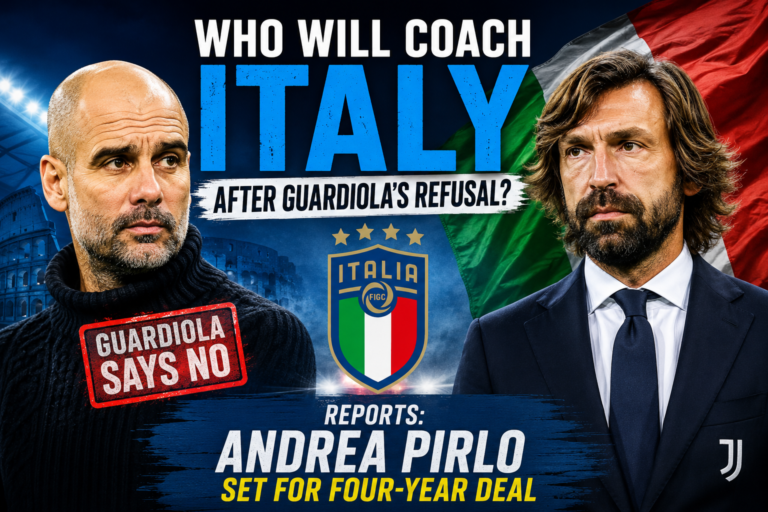
Andrea Pirlo is reportedly set to become Italy’s next national team coach after Pep Guardiola rejected the Italian Football Federation’s approach, but the decision carries far greater significance than a simple change of manager.

According to Italian media reports cited by Reuters, the FIGC has reached an agreement with Pirlo on a four-year contract. The federation had not formally confirmed the appointment at the time of reporting, which means Pirlo should still be described as Italy’s expected next coach rather than its officially installed manager.

Guardiola’s refusal removed the most glamorous candidate from the process. It also forced Italy to confront the real nature of the job.

The four-time world champions have now missed three consecutive World Cups. Their difficulties go beyond tactical mistakes, individual managers, or one poor generation of players. Italy is dealing with declining youth pathways, inconsistent opportunities for homegrown talent, attacking limitations, institutional pressure, and a national team carrying the weight of repeated failure.

Pirlo would inherit that entire problem.

The central question is therefore not simply whether he has enough coaching experience. Italy must decide whether a younger coach with deep emotional and tactical ties to the national team can become the face of a wider rebuild.

TL;DR: Why Is Italy Turning to Andrea Pirlo?

  • Pep Guardiola held talks over the Italy position but rejected the opportunity.
  • The FIGC also reportedly sounded out Carlo Ancelotti before moving toward Pirlo.
  • Italian media reported that Pirlo has agreed to a four-year contract.
  • Pirlo won the 2006 World Cup with Italy and made 116 appearances for the national team.
  • His managerial résumé includes Juventus, Fatih Karagümrük, Sampdoria, and United FC in Dubai.
  • He won the Coppa Italia and Italian Super Cup during his season at Juventus.
  • Italy needs more than a new formation. It needs a clearer identity, a younger squad, and a stronger development pathway.
  • The four-year deal suggests the federation is thinking beyond immediate results and toward a longer national rebuilding cycle.

Italy’s Coaching Situation at a Glance

Question Current Position
Is Andrea Pirlo officially Italy coach? Not yet. Reports indicate that an agreement has been reached, but the FIGC had not formally confirmed the appointment.
Why is Italy appointing a new coach? Gennaro Gattuso stepped down after Italy failed to qualify for a third consecutive World Cup.
Did Pep Guardiola hold talks? Yes. Guardiola discussed the role but declined the opportunity.
Was Carlo Ancelotti considered? Reuters reported that the federation also sounded out Ancelotti.
Where is Pirlo currently coaching? United FC in Dubai.
What has Pirlo won as a coach? The Coppa Italia and Italian Super Cup with Juventus.
How long is the reported contract? Four years, potentially covering Euro 2028 and the next World Cup cycle.

Why Did Pep Guardiola Reject the Italy Job?

The complete private reasoning behind Guardiola’s decision has not been publicly disclosed, but the refusal makes sense when viewed through the demands of the position and the stage he has reached in his career.

Guardiola had only recently completed a decade at Manchester City, where he won six Premier League titles, three FA Cups, five League Cups, and the Champions League. Before moving to England, he had already built dominant teams at Barcelona and Bayern Munich.

His achievements at City were shaped by daily coaching, detailed repetition, and continuous tactical refinement. Players under Guardiola do not simply learn a formation. They learn specific positional habits, pressing triggers, passing angles, movement patterns, and responses to almost every phase of a match.

That level of detail is harder to reproduce in international football.

National team coaches work with players during limited training windows. Individuals arrive from different clubs, systems, countries, and physical conditions. The manager may have only a few days to prepare for an important qualifying match.

Guardiola could certainly have adapted, but the role would have required him to simplify a coaching method built around daily access to players.

The former City manager may also have wanted distance from football after one of the most intense club tenures of the modern era. His decision follows a career in which his methods, workload, and influence reshaped not only Manchester City but modern tactical thinking around possession and space.

That influence can also be seen in how Manchester City players developed under him, including the attacking structure surrounding Erling Haaland’s record-breaking career and international evolution.

Italy offered prestige, history, and the opportunity to rebuild a fallen football power. It also offered considerable professional risk.

A national coach can improve selection, mentality, and tactics. He cannot single-handedly repair youth academies, increase playing time for Italian teenagers, modernize club finances, or create a generation of elite attackers.

Guardiola would have been held responsible for problems that began long before his arrival.

Why the Italy Job Was a Difficult Proposition for Guardiola

Factor Potential Attraction Potential Risk
Historic reputation Chance to revive a four-time world champion Expectations remain enormous despite recent decline
Tactical influence Opportunity to shape a national playing identity Very little training time compared with club football
Squad quality Several technically strong midfielders and defenders Limited depth in some attacking positions
Rebuilding authority Chance to influence wider reform Many structural problems remain outside the coach’s control
Personal timing Prestigious role after leaving Manchester City Little opportunity for a genuine break from management

Why Guardiola Alone Could Not Fix Italian Football

Italy’s recent World Cup record exposes a crisis that extends beyond the senior coach.

The national team failed to qualify in 2018, missed the 2022 tournament, and then failed again before the 2026 World Cup. A country with four world titles has therefore spent nearly an entire generation outside football’s largest event.

The contrast with Italy’s historical identity is severe. The country once produced world-class defenders, tactically sophisticated midfielders, elite goalkeepers, and decisive forwards in almost every generation.

The Sports Encounter’s profile of Roberto Baggio’s painful and heroic 1994 World Cup journey captures the kind of individual quality Italy once carried into global tournaments. Baggio did not simply represent talent. He represented a generation capable of changing major matches through personality and imagination.

Modern Italy still produces intelligent footballers, but the pathway from youth football to the senior national team has become less reliable.

Serie A clubs increasingly depend on international recruitment. Italian prospects may spend important developmental years on the bench, in lower divisions, or moving repeatedly through loan systems. That limits the number of young players arriving at international level with sustained experience under pressure.

A national coach cannot solve that problem during a ten-day international break.

Italy’s situation also reinforces why World Cup qualification should never be treated as automatic, even for major football nations. The Sports Encounter examined that broader vulnerability in our feature on historic World Cup shocks and the fragility of traditional powers.

Why Andrea Pirlo Became Italy’s Preferred Alternative

Pirlo offers a combination of symbolism, tactical intelligence, national credibility, and long-term potential.

He was one of the defining players of Italy’s 2006 World Cup-winning team. His ability to control tempo, break pressure, and dictate games from deep made him central to both club and country.

Pirlo finished his international career with 116 appearances. He understands the demands of representing Italy, the emotional pressure surrounding major tournaments, and the standard expected from the national team.

That history matters because Italy currently lacks a clear football identity.

The national side has moved through repeated tactical resets, coaching changes, and painful qualification failures. Pirlo gives the federation a figure who immediately connects the present team to the last Italian side that won the World Cup.

He also represents a longer-term choice rather than an emergency appointment.

A four-year contract would give Pirlo the opportunity to rebuild the squad across several international windows, develop younger players, and guide the team toward Euro 2028 and another World Cup qualification campaign.

Is Pirlo Experienced Enough to Coach Italy?

This is the strongest argument against the reported appointment.

Pirlo’s coaching résumé remains limited compared with Guardiola, Ancelotti, Antonio Conte, or Roberto Mancini.

Juventus appointed him in 2020 without previous senior first-team experience. He won the Coppa Italia and Italian Super Cup, but Juventus finished fourth in Serie A and lost the league title after nine consecutive championships.

The season revealed both promise and inexperience.

Pirlo wanted his team to control possession, rotate positions, press aggressively, and move fluidly between different defensive structures. Juventus sometimes produced impressive football, but the team struggled to maintain consistency and tactical balance.

His later spells at Fatih Karagümrük and Sampdoria did not establish him as an obvious national-team candidate.

The concern is therefore legitimate. Italy may be handing one of international football’s most demanding jobs to a coach who is still developing his own managerial identity.

However, Pirlo’s work in Dubai may have given him something he did not receive at Juventus: time away from constant global pressure.

At United FC, he has been required to teach, organize, and develop rather than inherit one of Europe’s most expensive squads. That environment may have allowed him to improve his communication, planning, and day-to-day management.

Pirlo’s Coaching Readiness Scorecard

This editorial infographic assesses Pirlo’s suitability based on his known strengths and limitations. It is an analytical evaluation, not an official FIGC rating.

Knowledge of Italian football: 95%
National-team credibility: 92%
Tactical potential: 78%
Youth-development suitability: 76%
Elite managerial experience: 55%
Proven long-term results: 45%

What Kind of Football Could Pirlo Bring to Italy?

Pirlo’s playing career will create immediate expectations of possession, calm buildup, and intelligent midfield control.

That image may influence his ideas, but he cannot simply recreate himself in the current squad.

Italy may not possess another deep-lying midfielder with Pirlo’s complete range of passing, vision, and ability to control the rhythm of a match. The coach must therefore build a system around the players available rather than around nostalgia.

During his Juventus tenure, Pirlo favored flexible positional structures. His team often changed shape depending on possession, with fullbacks, midfielders, and wide attackers occupying different zones.

In international football, those concepts will need to become simpler.

A likely Pirlo approach could include:

  • Controlled buildup from defense without unnecessary risk.
  • A technically secure central midfield.
  • Selective pressing rather than constant high-intensity pressure.
  • Wide players attacking space more directly.
  • A stable defensive structure behind the ball.
  • Greater freedom for midfielders to arrive in scoring positions.
  • A clearer role for younger players across the international cycle.

Pirlo must also avoid one of the most common errors in international coaching: forcing a complicated club system into a squad that has too little time to absorb it.

The importance of tactical adaptability was visible throughout the 2026 World Cup, including in our analysis of England’s tactical collapse against Argentina in the semifinal. National teams often succeed when the coach gives players clear solutions during changing match situations rather than overwhelming them with theory.

Why the Four-Year Contract Matters

The reported contract length may reveal more about the federation’s intentions than the identity of the coach itself.

A four-year deal suggests that Italy is considering a full rebuilding cycle rather than another short-term rescue mission.

Pirlo would have time to:

  • Identify a younger core of players.
  • Develop a consistent tactical structure.
  • Coordinate more closely with Italy’s youth teams.
  • Prepare for Euro 2028.
  • Begin the next World Cup qualification campaign with a settled squad.
  • Reduce dependence on aging or inconsistent players.

That approach would align with the wider evolution of international football, where long-term planning, player pathways, and squad identity increasingly separate successful national teams from reactive ones.

The emotional and structural importance of national-team identity was explored in our feature on family, nationality, and international football eligibility. National-team success now depends not only on tactics but also on how effectively federations identify, develop, and retain eligible talent.

The challenge is that Italian football has not always shown patience.

A four-year contract does not necessarily produce a four-year project. Poor early results, public pressure, or qualification anxiety could quickly threaten Pirlo’s position.

What Must Pirlo Fix First?

1. Restore Confidence

Italy’s repeated World Cup failures have created a psychological burden.

Players entering decisive qualifiers are no longer protected by Italy’s historic reputation. They are reminded constantly of the teams that failed before them.

Pirlo must rebuild emotional control and make qualification matches feel manageable again.

His experience as a 2006 world champion gives him credibility. He knows how an Italian team behaves when it trusts its structure, remains patient, and handles pressure without panic.

2. Find a Reliable Attacking System

Italy has struggled to convert possession into consistent goal production.

The country still produces tactically intelligent midfielders and defenders, but the absence of a dependable elite striker has placed greater pressure on the system.

Pirlo cannot create a world-class center forward. He can distribute attacking responsibility more effectively.

That may require:

  • More aggressive movement from wide players.
  • Greater midfield support inside the penalty area.
  • Improved set pieces.
  • Faster transitions after winning possession.
  • Less dependence on one central goal scorer.

3. Choose Form Over Reputation

The rebuild will fail if established names continue to receive automatic selection.

Pirlo must identify players who fit his system, even when they do not play for Italy’s largest clubs.

International football often rewards cohesion more than individual reputation. Spain’s successful 2026 World Cup campaign demonstrated the value of a clear team structure and shared tactical understanding, themes also explored across The Sports Encounter’s World Cup 2026 curtain raiser.

4. Build a Stronger Leadership Group

Italy needs players who can manage pressure during difficult matches without waiting for the coach to solve every problem from the touchline.

Pirlo played alongside strong personalities throughout his international career. He must now identify the current squad members capable of setting standards, calming younger players, and protecting the team when qualification pressure rises.

What Happens to United FC in Dubai?

Pirlo’s expected departure would create an immediate challenge for United FC.

The Dubai club gave him an opportunity to continue developing his coaching career away from the scrutiny attached to Juventus and Serie A. His association also increased the club’s international visibility.

Losing Pirlo would affect the club’s planning, coaching structure, and public profile. At the same time, a move from United FC to the Italian national team would strengthen the reputation of the Dubai project.

The club’s next task would be to appoint a coach capable of preserving Pirlo’s positive work rather than beginning another complete tactical rebuild.

What Happens Next?

The first step is formal confirmation from the federation.

Supporters can follow official announcements, squad information, federation developments, and national-team news through the official website of the Italian Football Federation.

Once Pirlo is confirmed, attention will shift toward his coaching staff.

Because his own experience remains limited, the quality of his assistants, analysts, fitness specialists, and scouts will become especially important. A strong support team could give the appointment greater stability and reduce the risks attached to Pirlo’s relative inexperience.

His first squad will then provide the clearest indication of his intentions.

Will he begin the youth transition immediately? Will he retain experienced players to stabilize results? Which midfielders will control the team? How will he solve the attacking problem? Will Italy use one consistent formation or adapt according to opponents?

The federation’s wider reforms will matter just as much.

Appointing Pirlo without improving youth development, domestic playing opportunities, and the transition between age-group teams and the senior side would place unrealistic expectations on one coach.

Is Pirlo the Right Coach for Italy?

There is no safe answer yet.

Pirlo does not offer Guardiola’s tactical authority, Ancelotti’s experience, Conte’s intensity, or Mancini’s proven national-team record.

His appointment would represent a different type of decision.

Italy would be betting on intelligence, emotional connection, national identity, and coaching potential. The federation would also be acknowledging that a famous name alone cannot repair the deeper problems affecting Italian football.

The risk is clear. The national team may be too demanding for a coach who is still building his résumé.

The opportunity is equally significant. Pirlo understands the shirt, the pressure, the culture, and the level Italy must recover.

His experience as a player gives him authority. His early coaching setbacks may have given him humility. His work in Dubai may have provided the quieter development period he never received before taking over Juventus.

Italy’s dilemma reflects a wider truth about international football. Historical reputation can open doors, but it does not guarantee modern success. The debate over legacy, adaptation, and changing standards also sits at the center of our analysis of how the 2026 World Cup reshaped the Messi versus Ronaldo debate.

Final Verdict

Guardiola’s refusal denied Italy the headline appointment its federation wanted.

It may also have pushed the country toward a more honest decision.

Italy does not need a celebrity coach to disguise the crisis. It needs someone capable of rebuilding belief, improving the connection between generations, selecting players on merit, and creating a structure that survives beyond one tournament.

Pirlo cannot repair Italian football alone.

Should the agreement become official, his success will depend on whether the FIGC treats him as the leader of a genuine long-term project or as the latest coach expected to solve a national problem from the technical area.

Readers can follow the continuing story through The Sports Encounter’s soccer coverage, including managerial developments, national-team analysis, tactical features, and major international football stories.

FAQs

Is Andrea Pirlo officially the new Italy coach?

Not yet. Italian media reported that Pirlo had reached a four-year agreement, but the FIGC had not formally announced the appointment at the time of reporting.

Why did Pep Guardiola reject the Italy job?

Guardiola’s complete private reasoning has not been officially disclosed. Reports suggest that personal timing, his desire for a break, and the different working demands of international football influenced the decision.

Did Italy approach Carlo Ancelotti?

Yes. Reuters reported that the Italian Football Federation also sounded out Ancelotti before moving toward other candidates.

What has Andrea Pirlo won as a manager?

Pirlo won the Coppa Italia and Italian Super Cup during his season in charge of Juventus.

Where is Andrea Pirlo currently coaching?

Pirlo is currently in charge of United FC in Dubai.

How many times did Pirlo play for Italy?

Pirlo made 116 senior international appearances and was a key member of Italy’s 2006 World Cup-winning team.

Why has Italy missed three consecutive World Cups?

Italy’s failures reflect several problems, including inconsistent qualification performances, limited attacking production, pressure in decisive matches, coaching changes, and wider concerns about domestic youth development.

What will Pirlo need to fix first?

His immediate priorities would include restoring confidence, building a dependable attacking system, selecting players based on form and tactical suitability, and creating a younger leadership core.

Luke Edelman is a London-based sports psychologist covering cricket and tennis across Europe for The Sports Encounter. His work focuses on athlete mindset, pressure management, performance routines, confidence, recovery from setbacks, and the mental side of elite competition. Coverage areas: sports psychology, cricket, tennis, athlete performance, mental resilience, European sports, tournament pressure.

Continue Reading

Editor's Choice

LeBron James vs Michael Jordan vs Kareem Abdul-Jabbar: Who Is the Best NBA Player Ever?

LeBron James, Michael Jordan, and Kareem Abdul-Jabbar define three different versions of basketball greatness. This in-depth NBA GOAT debate compares their stats, championships, MVPs, eras, skill sets, longevity, and cultural impact before making a final verdict.

Miley Rumer | The Sports Encounter

Published

on

Cinematic NBA GOAT debate featured image showing three anonymous basketball legends in a dramatic arena with The Sports Encounter logo.
NBA GOAT Debate

LeBron James vs Michael Jordan vs Kareem Abdul-Jabbar: Who Is the Best NBA Player Ever?

Three names sit at the center of every serious NBA GOAT debate. Michael Jordan owns the cleanest championship argument. LeBron James owns the strongest longevity and all-around production case. Kareem Abdul-Jabbar owns the most complete lifetime resume from high school to college to the NBA.

This is not a barbershop ranking dressed up as analysis. This is a category-by-category look at production, winning, peak dominance, skill, adaptability, era context, cultural impact, and the question fans really care about: if basketball history had one seat at the head of the table, who gets it?

TL;DR: The Short Answer

Michael Jordan remains the best NBA player ever if the debate centers on peak dominance, Finals perfection, two-way control, and cultural force. LeBron James has the strongest all-around career case because of his scoring record, playmaking, longevity, and unprecedented 20-plus-year relevance. Kareem Abdul-Jabbar has the deepest historical resume, with six MVPs, six championships, and the most unstoppable signature shot basketball has ever seen.

Final ranking for this article: 1. Michael Jordan, 2. LeBron James, 3. Kareem Abdul-Jabbar. The margin is thin enough that a fan can argue any of the three without sounding unserious.

Why This Debate Still Owns Basketball

The NBA GOAT debate keeps coming back because Jordan, LeBron, and Kareem do not represent the same kind of greatness. They answer different questions.

Jordan answers the question of peak competitive dominance. At his best, he looked less like a star player and more like the final problem every opponent failed to solve. Six NBA Finals, six championships, six Finals MVP awards, ten scoring titles, five regular-season MVP awards, and nine All-Defensive First Team selections give him the cleanest high-stakes case in NBA history.

LeBron answers the question of complete basketball value across time. He became the NBA’s all-time scoring leader, stayed elite across several eras, carried teams to ten NBA Finals, won titles with three franchises, and turned himself into one of the greatest passers the game has seen. His career has stretched from the dead-ball early 2000s to the spacing-heavy modern NBA, and he kept bending the league around him.

Kareem answers the question of lifetime basketball mastery. He dominated high school, changed college basketball at UCLA, entered the NBA as a force, won six MVP awards, collected six championships, and built a 20-season career around the skyhook, the sport’s most reliable high-pressure weapon. His case often gets squeezed between Jordan’s mythology and LeBron’s modern visibility, but the numbers keep pulling him back into the room.

For more NBA coverage and current league context, readers can follow The Sports Encounter’s NBA section.

The Big Resume Comparison

Category Michael Jordan LeBron James Kareem Abdul-Jabbar
NBA championships 6 4 6
Finals MVP awards 6 4 2
Regular-season MVP awards 5 4 6
Career points 32,292 NBA all-time leader, above 43,000 by 2026 38,387
Career scoring average 30.1 PPG 26-plus PPG 24.6 PPG
Core identity Peak scorer, closer, elite defender, global icon All-around engine, scorer, passer, longevity king Dominant center, skyhook master, long-term winner
Best argument Highest peak and perfect Finals resume Most complete career and longest elite run Best full basketball resume across levels

GOAT Debate Search Map

This article directly addresses the main questions fans search for: LeBron vs Jordan Michael Jordan vs LeBron James Kareem vs Jordan Kareem vs LeBron best NBA player ever NBA GOAT debate who is better LeBron or Jordan

Michael Jordan: The Strongest Peak the NBA Has Seen

Michael Jordan’s case begins with the part nobody can easily attack: when he reached the NBA Finals, he finished the job every time. The Chicago Bulls went 6-0 in the Finals with Jordan as the centerpiece. He won Finals MVP in all six championship runs. That detail has become shorthand for greatness, but it still matters because it came against strong teams, elite coaches, and huge pressure.

Jordan’s 1990s run had a rare shape. He won three straight titles, stepped away, returned, then won three more. He did not merely stack rings. He controlled the emotional climate of the league. Opponents entered series knowing the final minutes would probably belong to him.

His scoring case remains unmatched at the top. Jordan averaged 30.1 points per game for his career, the highest scoring average in NBA history among qualified players. He won ten scoring titles, including seven straight before his first retirement. That speaks to more than shot volume. It shows repeatable dominance across defensive schemes built specifically to slow him down.

Jordan also gives the strongest two-way argument among the three. He won Defensive Player of the Year in 1988 and made nine All-Defensive First Teams. LeBron has produced brilliant defensive peaks, especially in Miami. Kareem protected the rim and remained a defensive presence for years. Jordan, though, paired scoring dominance with perimeter defensive terror in a way few high-usage stars have matched.

The cultural case can feel soft until we remember what Jordan did to basketball’s global position. He turned the NBA into a worldwide product, made sneakers part of sports identity, and became the face of competitive excellence in American culture. For many U.S. fans, Jordan was not just the best basketball player they watched. He was the athlete who made winning feel personal.

That is why the Jordan argument still travels so well. It is not built only on nostalgia. It rests on a clean postseason record, a historic scoring peak, elite defense, championship control, and a global impact that changed how athletes were marketed.

LeBron James: The Greatest Career Machine in NBA History

LeBron James has built the most complete long-form case in basketball. His resume does not ask fans to remember one perfect decade. It asks them to process more than two decades of elite relevance.

By 2026, LeBron sits at the top of the NBA’s official all-time scoring list. That alone would make him immortal. What makes it stranger, and more impressive, is that scoring was never his only identity. He entered the league as a playmaking forward, became a transition force, improved as a post scorer, learned to manage pace, won titles as a defensive anchor in Miami, and later extended his prime through skill, strength, and basketball IQ.

LeBron’s best argument is not that he was always more dominant than Jordan at the very top. It is that he has been elite for longer than any superstar in modern American team sports had any right to be. He has played through several tactical eras: isolation basketball, the rise of spread pick-and-roll, small-ball, pace-and-space, and the current skill-heavy positionless NBA. He stayed relevant through all of it.

His passing separates him from Jordan and Kareem. Jordan became a more willing playmaker when Chicago needed it, and Kareem was an underrated passer from the post, especially within the Lakers’ flow. LeBron, however, has often functioned as a full offensive system. He could lead a team in scoring and also run the offense like a point guard.

That versatility appears in his team history. He carried Cleveland to the 2007 Finals before the roster was ready. He became the centerpiece of Miami’s four-year run with Dwyane Wade and Chris Bosh. He returned to Cleveland and delivered the 2016 championship after the Cavaliers came back from 3-1 down against a 73-win Golden State team. Then he won again with the Lakers in 2020.

The 2016 Finals remain the emotional center of LeBron’s case. Cleveland had waited decades for a major sports title. Golden State had built one of the greatest regular-season teams ever. LeBron led both teams in points, rebounds, assists, steals, and blocks across the series. That performance gives his supporters one of the strongest single-series arguments in NBA history.

The latest LeBron context adds another layer. In July 2026, reports around his next move remained active after his Lakers future became uncertain. The Sports Encounter covered that developing story in Will LeBron James represent the LA Lakers in the NBA 2026-27?, while the wider veteran-market discussion also shaped the Warriors, LeBron, and Anthony Davis analysis.

LeBron’s case has one weakness compared with Jordan: Finals record. He reached ten NBA Finals but won four. Context matters because some of those teams faced superior opponents, especially the Warriors dynasty. Still, the GOAT debate has always punished losses more harshly than it rewards carrying weaker rosters deep into June.

Even so, LeBron has made the argument harder every year. If Jordan is the best peak, LeBron is the best career engine.

Kareem Abdul-Jabbar: The Forgotten Giant in Too Many GOAT Debates

Kareem Abdul-Jabbar should never be treated as the polite third name in this debate. He has a real case for No. 1.

Start with the MVP count. Kareem won six regular-season MVP awards, the most in NBA history. That record matters because MVP voting measures how often a player defined a season. Jordan won five. LeBron won four. Kareem won six across a career that stretched from the Milwaukee Bucks to the Showtime Lakers.

His championship case also holds weight. Kareem won six NBA titles, one with Milwaukee and five with the Lakers. His 1971 Bucks title showed he could lead a franchise to the top as its central force. His Lakers years showed he could adapt as Magic Johnson entered the league and changed the rhythm of basketball.

The skyhook remains the cleanest basketball weapon in this debate. Jordan had the fadeaway. LeBron has the downhill drive and playmaking pressure. Kareem had a shot that defenses knew was coming and still could not remove. It worked because of footwork, length, timing, balance, and touch. Few moves in NBA history have carried that blend of elegance and inevitability.

Kareem’s scoring total stood as the NBA record for nearly four decades before LeBron passed it in 2023. That length of time tells us how far ahead Kareem had moved the bar. He also finished with 17,440 rebounds and became one of the most durable stars in league history.

His college record strengthens his broader basketball case. At UCLA, then known as Lew Alcindor, he was so dominant that college basketball banned the dunk for years. That rule change has become one of the cleanest examples of a sport adjusting itself to a player’s power.

Kareem’s GOAT challenge comes from perception. His prime happened before the social media age, before 24-hour debate shows, and before modern highlight packaging could flatten a career into viral clips. He was not marketed like Jordan or discussed daily like LeBron. His game was quieter, more repetitive, and less theatrical. That should not make it smaller.

If basketball greatness means sustained excellence, historic awards, winning across eras, and an unstoppable skill, Kareem belongs right next to Jordan and LeBron.

Peak vs Longevity vs Complete Resume

Debate Lens Winner Why It Matters
Highest peak Michael Jordan Jordan’s 1991-1998 title runs, scoring dominance, and defensive impact create the strongest peak argument.
Longest elite career LeBron James LeBron has remained an All-NBA-level force across more seasons and tactical eras than any comparable superstar.
Best lifetime basketball resume Kareem Abdul-Jabbar Kareem’s high school, college, and NBA dominance forms the deepest total basketball record.
Best scorer Michael Jordan LeBron owns the total points record, but Jordan owns the scoring-average and scoring-title argument.
Best playmaker LeBron James LeBron’s passing, court control, and ability to act as a full offensive system separate him.
Most unstoppable move Kareem Abdul-Jabbar The skyhook remains the most reliable signature shot in NBA history.

Visual Scorecard: Who Wins Each GOAT Category?

Peak Dominance

Jordan leads this category because his best seasons combined scoring, defense, postseason control, and championship finishing.

Longevity

LeBron owns this lane. No player in this debate has remained this productive for this long.

Lifetime Resume

Kareem’s full record from UCLA to the NBA gives him a serious claim beyond professional numbers alone.

Cultural Impact

Jordan still leads. LeBron has massive influence, but Jordan reshaped global athlete branding.

The Championship Argument

Championships do not settle everything, but they settle enough to matter. Basketball is a team sport, yet GOAT candidates get judged by how often their teams finished the climb.

Jordan’s six rings carry special power because he was the Finals MVP every time. There is no gap between his championships and his central role. He was not a passenger, not a late-career veteran collecting a ring, and not a secondary star. Chicago won because Jordan stood at the center of the whole machine.

Kareem’s six rings require a more layered reading. He led Milwaukee to the 1971 title and remained central to the Lakers’ championship identity, but Magic Johnson’s arrival changed the hierarchy as Kareem aged. That does not damage his case as much as some fans suggest. Greatness also includes the ability to remain valuable while the team evolves.

LeBron’s four championships come with the widest context. He won in Miami as part of a star trio, in Cleveland as the defining figure of a historic comeback, and with the Lakers in a uniquely difficult 2020 season. He also lost six Finals. Some losses came against better teams, but GOAT debates rarely offer full refunds for context.

The fairest reading is simple: Jordan wins the championship category. Kareem’s ring count keeps him close. LeBron’s Finals appearances strengthen his career case but leave him behind Jordan in the cleanest winning argument.

The Statistics Argument

Stats can clarify the debate, but they can also flatten it. Jordan, LeBron, and Kareem played different positions, faced different defensive rules, and operated in different offensive environments.

Jordan’s statistical case begins with scoring rate. A 30.1 career points-per-game average across regular seasons is absurd. His playoff scoring average climbed even higher, which supports the idea that pressure sharpened him rather than reduced him.

LeBron’s statistical case is scale. He leads the all-time scoring list while also ranking among the greatest playmakers ever. The combination matters. Many all-time scorers did not create at an elite level for others. Many elite passers did not score like primary options for two decades. LeBron did both.

Kareem’s numbers need era awareness. Blocks were not officially tracked during his first four NBA seasons, which means his defensive totals understate his full impact. Even with that missing data, his scoring, rebounding, efficiency, and longevity remain historically heavy.

Player Statistical Signature Why It Holds Up
Michael Jordan 30.1 PPG, 10 scoring titles, elite playoff scoring He produced the highest scoring pressure in NBA history while winning at the top level.
LeBron James All-time scoring leader, elite assists and rebounds for a forward His all-around totals show unmatched durability and role flexibility.
Kareem Abdul-Jabbar 38,387 points, 17,440 rebounds, six MVPs He paired long-term production with award-level dominance across 20 seasons.

The Skill Argument

Jordan had the cleanest scoring toolkit of the three. He attacked the rim with force early, then built a midrange game that became nearly automatic. His footwork, hang time, body control, and late-clock confidence gave him answers from every angle inside the arc.

LeBron has the broadest skill set. He is not the shooter Jordan became from midrange, nor does he have Kareem’s one untouchable shot, but he does more things at a high level than either player. He can score, pass, rebound, defend multiple positions at his peak, organize an offense, attack mismatches, and control tempo.

Kareem had the most unstoppable single skill. The skyhook was not flashy in a modern highlight sense, but it was ruthless. Defenders could contest it, crowd him, push him off spots, or send help. The shot still came out above them.

This category depends on taste. If skill means scoring craft, Jordan leads. If skill means complete basketball function, LeBron leads. If skill means one weapon that defenses could not solve, Kareem leads.

Era Context: The Hardest Part of the NBA GOAT Debate

Comparing eras is where easy takes fall apart. Jordan played in a more physical perimeter environment with less spacing. LeBron played in a longer, more athletic, more analytically optimized league. Kareem played through a center-driven NBA and then adapted to a faster Lakers team that helped define the 1980s.

Jordan’s era allowed more hand-checking and packed the paint more often. That makes his scoring efficiency and volume more impressive. At the same time, modern defenses use more complex help schemes, longer wings, and data-driven scouting. LeBron has had to solve a league that changes coverage habits faster.

Kareem faced a different challenge. The center was often the central position in his era, which gave him influence but also placed him against a deep line of elite big men. He had to battle physically every night, protect the rim, score efficiently, and remain effective as the game sped up around Magic Johnson.

The smartest GOAT debate does not pretend one era was automatically harder. It asks who dominated the conditions placed in front of him. By that standard, all three pass.

The Emotional Case for Each Player

Jordan is the player many fans associate with certainty. When the Bulls needed the final possession, he turned fear into theater. The shrug, the flu game, the last shot in Utah, the fist pump, the glare. His career left behind scenes that still feel fresh because they carry simple emotional meaning: the best player took the biggest moment and owned it.

LeBron is the player many fans associate with endurance and reinvention. His story spans impossible expectations, public criticism, team changes, Finals heartbreak, redemption in Cleveland, and late-career excellence. For younger fans, he has been part of the NBA’s furniture for as long as they have watched basketball. That kind of presence becomes emotional in a different way.

Kareem is the player many fans respect more as they learn more. His career rewards deeper reading. The skyhook, the MVPs, the UCLA dominance, the activism, the discipline, the long arc of excellence. His greatness does not always shout. It stacks up until ignoring it feels careless.

Current NBA Context: Why the Debate Feels Alive Again

The debate has fresh energy because LeBron is still close enough to the modern game to shape it. His future after the Lakers remained a live topic in July 2026, and every possible destination carried legacy weight. A final run with Cleveland, Miami, Golden State, or another contender would not erase the past, but it would add another chapter to a career already bigger than normal measurement.

The current NBA also has a new generation chasing historical territory. The 2025-26 NBA awards picture placed Shai Gilgeous-Alexander, Victor Wembanyama, Luka Doncic, Nikola Jokic, and others near the center of the league’s next identity. The Sports Encounter has already tracked that forward-looking title picture through NBA 2026-27 title odds and the broader championship market after the Knicks’ breakthrough.

That matters because every GOAT debate becomes a mirror for the next generation. Fans argue Jordan, LeBron, and Kareem while quietly asking who might enter the conversation next.

Who Has the Best Case?

Ranking Player Best Argument Main Weakness
1 Michael Jordan Best peak, perfect Finals record, elite two-way dominance, unmatched cultural impact. Shorter elite career than LeBron and Kareem.
2 LeBron James Best longevity, greatest all-around career value, all-time scoring leader, elite playmaker. Four championships in ten Finals leaves room for Jordan’s winning argument.
3 Kareem Abdul-Jabbar Six MVPs, six titles, skyhook, long-term dominance, best full basketball resume. Lower Finals MVP count and less modern cultural visibility.

10 Current Players With Potential to Become NBA Greats or Legends

No active player should be pushed into the Jordan-LeBron-Kareem room too early. That room is expensive. Still, the current NBA has several players building resumes that could age into historic conversations.

Player Why the Ceiling Is Real What Must Happen Next
Nikola Jokic Multiple MVP awards, championship proof, elite passing big-man profile. More titles or sustained MVP-level seasons would move him higher historically.
Giannis Antetokounmpo Two MVPs, Finals MVP, elite two-way physical dominance. Another title run would strengthen his case among all-time forwards.
Luka Doncic Historic scoring-playmaking profile, deep playoff production, elite usage creator. Needs championships and improved defensive consistency.
Shai Gilgeous-Alexander 2025-26 Kia MVP, elite scoring efficiency, two-way guard value. Needs postseason validation and a longer run at the top.
Victor Wembanyama Generational defensive tools, rare offensive skill for his size, early All-NBA-level trajectory. Health, playoff experience, and team success will decide how high he climbs.
Anthony Edwards Explosive scoring, star charisma, playoff confidence, U.S. audience pull. Needs MVP-level regular seasons and deeper championship runs.
Jayson Tatum Championship foundation, scoring versatility, long-term playoff experience. Needs a stronger individual peak and more defining Finals moments.
Jalen Brunson 2026 Finals MVP, elite late-game scoring, New York championship credibility. Needs sustained elite seasons to move from Knicks legend to NBA legend.
Cade Cunningham All-NBA breakthrough and lead-creator profile. Needs team winning and playoff proof.
Cooper Flagg Elite prospect profile with two-way star tools. Must convert projection into NBA production over several seasons.

Fans tracking the next generation can also follow The Sports Encounter’s coverage of young NBA player contracts, veteran star movement, title odds, and the full NBA news hub.

Final Verdict: Jordan by Peak, LeBron by Career, Kareem by Total Basketball Resume

The best answer depends on the question.

If someone asks which player reached the highest competitive peak, the answer is Michael Jordan. His championship record, Finals MVP sweep, scoring dominance, defensive resume, and cultural takeover remain the cleanest GOAT package.

If someone asks which player delivered the most total NBA value, the answer may be LeBron James. He has the all-time scoring record, elite passing, unbelievable longevity, and a career that stayed meaningful across more eras than any superstar before him.

If someone asks which player owns the greatest complete basketball life, Kareem Abdul-Jabbar has a serious claim. His UCLA dominance, six NBA MVPs, six titles, skyhook, and decades-long scoring record give him a case too many modern debates underrate.

The Sports Encounter Verdict

Michael Jordan is still the best NBA player ever. LeBron James is close enough to make the argument uncomfortable, and Kareem Abdul-Jabbar is too accomplished to be treated as a distant third. But Jordan’s peak, perfect Finals record, two-way force, and lasting cultural imprint give him the narrow edge.

The honest ranking: 1. Michael Jordan, 2. LeBron James, 3. Kareem Abdul-Jabbar.

FAQs About LeBron James vs Michael Jordan vs Kareem Abdul-Jabbar

Who is the best NBA player ever?

Michael Jordan remains the best NBA player ever by peak dominance, Finals performance, scoring titles, two-way impact, and cultural influence.

Who has better stats, LeBron James or Michael Jordan?

LeBron has stronger career totals and all-around longevity. Jordan has the higher scoring average, more scoring titles, more Finals MVP awards, and a perfect Finals record.

Why is Kareem Abdul-Jabbar in the NBA GOAT debate?

Kareem won six MVP awards, six NBA championships, scored 38,387 points, dominated college basketball, and built his career around the skyhook, one of the most unstoppable shots ever.

Who has the most MVPs among Jordan, LeBron, and Kareem?

Kareem Abdul-Jabbar has the most regular-season MVP awards among the three, with six.

Could LeBron still pass Jordan in the GOAT debate?

LeBron already has the strongest longevity case. Passing Jordan for most fans would likely require another championship run or a final chapter that adds a defining legacy moment.

Data note: Career totals and awards should be checked against the official NBA all-time leaders page before publication if this article is updated during or after the 2026-27 season.

Continue Reading

Editor's Choice

Vietnam’s Seven-Goal Warning Opens ASEAN Championship 2026 With Late Singapore Drama

Defending champion Vietnam opened the ASEAN Championship with a ruthless 7-0 victory over Timor-Leste, while Singapore needed Ilhan Fandi’s spectacular 101st-minute winner to beat Cambodia 2-1. Here is what opening day revealed about the title race.

Published

on

Vietnam players celebrate their dominant opening-day victory over Timor-Leste during the 2026 ASEAN Championship, with Nguyen Dinh Bac leading the celebration in the foreground, while Singapore's Ilhan Fandi celebrates his dramatic late winner against Cambodia in the background. The official The Sports Encounter logo appears in the top-left corner beneath the headline, "Vietnam Sends a Warning."

Vietnam began its ASEAN Championship title defense with the authority of a team that has no intention of surrendering its regional crown, crushing Timor-Leste 7-0 as Nguyen Dinh Bac scored an opening-day hat-trick.

The first day of the tournament also produced one of its earliest unforgettable moments. Singapore needed an acrobatic goal from Ilhan Fandi in the 11th minute of stoppage time to escape Phnom Penh with a 2-1 victory over Cambodia.

Both winners collected three points, but their performances created completely different impressions.

Vietnam looked organized, ruthless, and ready for the pressures of defending a championship. Singapore showed resilience and individual quality, although Cambodia exposed weaknesses that stronger Group A opponents may punish.

The ASEAN Championship has only just begun. Vietnam has already established the standard every contender must answer.

TL;DR: ASEAN Championship 2026 Opening Day

  • Defending champion Vietnam defeated Timor-Leste 7-0 in Chonburi.
  • Nguyen Dinh Bac scored the tournament’s first hat-trick.
  • Do Hoang Hen scored twice, while Nguyen Xuan Son also found the net.
  • Liam Farrugia’s own goal completed Vietnam’s seven-goal victory.
  • Singapore beat Cambodia 2-1 in Phnom Penh.
  • Shawal Anuar gave Singapore the lead before Ouk Sovann equalized.
  • Ilhan Fandi scored an acrobatic winner in the 101st minute.
  • Vietnam leads Group A through its superior goal difference.
  • Indonesia has yet to begin its campaign.

ASEAN Championship 2026 Opening-Day Results

Match Result Defining Moment
Timor-Leste vs Vietnam 0-7 Nguyen Dinh Bac completed an opening-day hat-trick.
Cambodia vs Singapore 1-2 Ilhan Fandi scored an acrobatic winner in the 101st minute.

The championship features 10 Southeast Asian national teams divided into two groups. Group A contains Vietnam, Singapore, Indonesia, Cambodia, and Timor-Leste. Thailand, Malaysia, the Philippines, Myanmar, and Laos make up Group B.

Each country plays the other teams in its group once, with matches staged on a home-or-away basis. The top two teams from each group qualify for the two-legged semifinals, while the final is also contested over two legs.

Supporters can follow official fixtures, results, tournament news, and match information through the official ASEAN Championship website.

Group A Standings After Opening Day

Pos. Team P W D L GD Pts
1 Vietnam 1 1 0 0 +7 3
2 Singapore 1 1 0 0 +1 3
3 Indonesia 0 0 0 0 0 0
4 Cambodia 1 0 0 1 -1 0
5 Timor-Leste 1 0 0 1 -7 0

Vietnam and Singapore both collected the required three points, but the seven-goal difference between their opening performances could become significant.

Goal difference may decide qualification if Vietnam, Singapore, and Indonesia finish level on points. Kim Sang-sik’s defending champions have already created a considerable advantage before facing the two strongest challengers in their group.

Vietnam Did More Than Beat Timor-Leste

A 7-0 victory over one of the competition’s less-established teams requires perspective.

Timor-Leste entered the group stage through qualification and was expected to struggle against the defending champion. Vietnam was supposed to win.

The striking part was how completely Kim Sang-sik’s team handled the assignment.

Vietnam did not spend the opening half cautiously studying its opponent. Do Hoang Hen scored after seven minutes, immediately preventing Timor-Leste from settling into a deep defensive structure.

The early breakthrough changed the game. Timor-Leste could no longer focus solely on denying space and protecting a draw. Its players had to move forward more frequently, creating larger gaps for Vietnam’s midfielders and attackers.

Dinh Bac doubled the lead in the 31st minute, curling his strike into the bottom corner of Dylan Niski’s goal.

Vietnam then ended the contest before halftime.

Hoang Hen scored his second, Dinh Bac struck again, and Nguyen Xuan Son found the net during first-half stoppage time. The defending champion entered the interval with a five-goal advantage.

The match had already been won, but Vietnam maintained its intensity.

Dinh Bac completed his hat-trick in the 65th minute after steering home Bui Hoang Viet Anh’s cutback. Liam Farrugia’s own goal then completed the 7-0 rout.

The performance carried many of the qualities associated with successful tournament teams:

  • Vietnam scored before its opponent could settle.
  • The team punished defensive errors immediately.
  • Several attackers contributed goals or assists.
  • The players remained focused after establishing a commanding lead.
  • The defense protected the clean sheet.
  • The result created an important goal-difference advantage.

Major tournament favorites often encounter danger when they allow supposedly weaker opponents to remain level for too long. Confidence grows, frustration spreads, and one counterattack can transform the match.

That kind of vulnerability has shaped many of football’s most memorable surprises, as explored in The Sports Encounter’s feature on historic World Cup upsets.

Vietnam removed that risk within seven minutes.

Nguyen Dinh Bac Takes Control of the Golden Boot Race

Dinh Bac’s hat-trick immediately placed him at the center of the tournament.

The three goals also revealed different parts of his attacking game.

His first showed technical control and finishing quality as he curled the ball beyond Niski. The second rewarded Vietnam’s relentless pressure before halftime. His third came through intelligent movement into the penalty area, where he met Viet Anh’s cutback instead of waiting statically for possession.

That variation matters.

A forward who scores only one type of goal can become easier to contain when the opposition improves. Dinh Bac showed that he could create a finish, react inside the area, and arrive at the right moment during a structured attack.

He also continued searching for goals after the outcome was secure.

That hunger could matter in the individual scoring race. Golden Boot winners often build an early advantage against weaker group opponents before knockout football becomes tighter and chances become harder to create.

ASEAN Championship 2026 Golden Boot Standings

Player Team Goals
Nguyen Dinh Bac Vietnam 3
Do Hoang Hen Vietnam 2
Nguyen Xuan Son Vietnam 1
Shawal Anuar Singapore 1
Ouk Sovann Cambodia 1
Ilhan Fandi Singapore 1

The real test will arrive against Singapore and Indonesia. Those teams should defend space more effectively and force Dinh Bac to operate under greater physical and tactical pressure.

His opening-night performance still gives Vietnam an early individual match-winner and gives the forward a valuable lead in the scoring race.

Do Hoang Hen Adds Another Dimension to Vietnam

Hoang Hen’s two goals were almost as important to Vietnam’s broader title prospects.

The Brazil-born forward opened the scoring and added another before halftime, giving Vietnam a direct presence around Dinh Bac and Xuan Son.

His movement prevented Timor-Leste’s defenders from focusing on one central threat.

Vietnam’s attackers exchanged positions rather than occupying rigid zones. Dinh Bac drifted into scoring areas, Hoang Hen attacked open space, and Xuan Son provided another target closer to goal.

The midfield could therefore supply different runners instead of forcing every attack through the same player.

That balance should concern Vietnam’s stronger rivals.

Regional tournament opponents will often concede possession, block central areas, and wait for counterattacking chances. Multiple scoring threats make that defensive strategy more difficult.

A team dependent on one striker can become predictable. Vietnam’s opening performance suggested that Kim’s attacking threat may come from several areas.

Why Vietnam Already Looks Like the Team to Beat

One victory cannot decide a month-long championship, especially when it comes against Timor-Leste.

Vietnam nevertheless entered as the defending champion and immediately met every expectation attached to that status.

The team showed no visible championship hangover. Its players did not treat the opening fixture as a ceremonial beginning to the campaign. They pressed for control, moved the ball with purpose, and continued attacking after the result had been secured.

Vietnam also understands the competition’s unusual demands.

The home-or-away group format requires national teams to manage travel, recovery, changing stadium environments, and limited preparation windows. The two-legged semifinals and final demand a different tactical approach from a one-match knockout competition.

Experience becomes an advantage because coaches must know when to attack, when to protect an aggregate position, and how to manage emotional momentum over two matches.

The importance of adapting to tournament formats and changing match conditions has been visible across major international competitions, including the tactical issues examined in our analysis of England’s World Cup semifinal defeat against Argentina.

Vietnam possesses recent experience of navigating that pressure. The defending champion knows what the final rounds demand and has begun the new campaign without hesitation.

Vietnam’s Opening-Day Strength Index

This editorial infographic evaluates the major strengths shown during Vietnam’s 7-0 victory. It is an analytical assessment rather than an official tournament metric.

Finishing efficiency: 94%
Attacking variety: 91%
Early-match intensity: 93%
Defensive concentration: 88%
Title-defense readiness: 92%

Singapore Won, but Cambodia Exposed Its Problems

Singapore’s 2-1 victory can be interpreted in two ways.

The optimistic view is that the four-time champion found a way to win when the match appeared to be slipping away. Tournament teams need resilience and players capable of producing decisive moments when the collective performance falls short.

The more critical reading is that Singapore struggled to control an opponent it was expected to beat and relied on an extraordinary goal 11 minutes into stoppage time.

Both interpretations are valid.

Shawal Anuar gave Singapore the lead in the 22nd minute, creating the expectation that the Lions would gradually take control.

Cambodia refused to disappear.

Ouk Sovann equalized in the 55th minute, rewarding the home team’s willingness to compete rather than defend passively. As the match entered extended stoppage time, Cambodia appeared close to securing a valuable point.

Ilhan Fandi then produced the moment of the opening day.

Song Ui-young played the ball toward him. Ilhan flicked it into the air, created the angle for an acrobatic attempt, and finished beyond goalkeeper Hul Kimhuy.

The goal combined creativity, technical execution, and nerve.

Attempting such a finish during the 101st minute of a tournament opener carries obvious risk. A failed effort could have ended Singapore’s final attack. Ilhan trusted his instinct and converted one point into three.

Those additional two points may become decisive in a group containing Vietnam and Indonesia.

Vietnam’s Seven-Goal Warning Opens ASEAN Championship 2026 With Late Singapore Drama

Ilhan Fandi Delivers the Tournament’s First Viral Moment

Every regional competition needs moments that travel beyond its established audience.

Ilhan’s winner has that potential because the goal contained every element of memorable tournament drama:

  • The match was level.
  • The goal arrived deep into stoppage time.
  • Singapore urgently needed three points.
  • The technique was exceptionally difficult.
  • The goalkeeper had little chance.
  • The result changed the early shape of Group A.

The finish also added another chapter to Singapore’s famous Fandi football family.

Family legacies can create both opportunity and pressure in international football. The emotional complexity of siblings, heritage, and national identity was explored in The Sports Encounter’s feature on football families representing different countries.

Ilhan carries a recognizable surname, but the winning goal belonged entirely to his own imagination and execution.

He understood that a conventional first touch could allow Cambodia’s defenders to close the space. By lifting the ball, he transformed an ordinary pass into an immediate shooting opportunity.

Singapore will need him to remain influential when the opposition becomes stronger. Vietnam should offer less time, while Indonesia may create a more physical contest.

For one night, Ilhan supplied exactly what his country needed.

Cambodia Lost but May Have Found a Path Forward

Cambodia’s defeat should not be dismissed as another routine loss for a developing football country.

The hosts stayed in the contest, recovered after conceding, and reached the 100th minute with a valuable point still within reach.

Ouk Sovann’s equalizer rewarded a team willing to challenge Singapore.

The late defeat will be emotionally difficult because the players had invested enough to believe they had earned a draw. How Cambodia responds now could determine whether its opening display becomes evidence of progress or simply a missed opportunity.

Indonesia provides the next challenge.

Another defeat would place Cambodia close to elimination. A competitive result would strengthen the argument that Singapore’s struggle reflected Cambodian improvement rather than only Singaporean weakness.

Major international tournaments often reveal that smaller football nations can close traditional gaps through organization, fitness, and clear tactical roles. The subject also featured prominently in The Sports Encounter’s FIFA World Cup 2026 curtain-raiser.

Cambodia must now translate encouragement into points.

Why Group A Could Become Complicated

Vietnam’s large victory creates an impression of immediate control, but the group remains competitive.

Indonesia did not play on the opening day and will enter the competition knowing exactly what its main rivals have already achieved.

Singapore faces Timor-Leste next, creating an opportunity to strengthen its goal difference. A narrow victory would keep the Lions behind Vietnam in an area that could eventually decide qualification.

Cambodia must recover emotionally before facing Indonesia. Timor-Leste needs to rebuild defensive confidence after allowing seven goals.

The Vietnam-Singapore meeting could become a direct contest for control of the group, although Indonesia’s results may determine how much either team can afford to lose.

Group A Pressure Index

Team Opening Position Immediate Priority
Vietnam Ideal Maintain intensity against stronger opponents.
Singapore Three points, uneven performance Beat Timor-Leste decisively and improve match control.
Indonesia Yet to play Exploit Cambodia’s disappointment and begin strongly.
Cambodia Encouraging performance, painful loss Convert competitiveness into points.
Timor-Leste Severely damaged Restore organization and avoid another collapse.

Group B Now Has a Standard to Answer

Myanmar faces Malaysia before Laos meets Thailand in the opening Group B fixtures.

Thailand remains the competition’s most successful team with seven titles and enters another campaign carrying expectations of reclaiming the regional crown.

Malaysia, the Philippines, Myanmar, and Laos will each approach the group with different ambitions, but Vietnam’s 7-0 result changes the emotional context before any of them has played.

Thailand now knows the defending champion is already functioning at a high level. Malaysia cannot afford a slow beginning against Myanmar. The Philippines will watch the first fixtures before entering the competition.

Coaches may publicly insist that another group’s result has no impact on their plans. Tournament psychology works differently inside dressing rooms. Dominant performances create an early benchmark and force rivals to assess their own readiness.

The dynamics of favoritism, expectations, and tournament pressure appear regularly across The Sports Encounter’s FIFA World Cup 2026 coverage, where several established powers discovered that reputation alone could not guarantee progress.

Opening-Day Power Rankings

These rankings reflect only the teams involved on the first day. They are not a prediction of the eventual champion.

Rank Team Opening-Day Assessment
1 Vietnam Ruthless, balanced, and already operating like a defending champion.
2 Singapore Resilient and dangerous, but less convincing than the result suggests.
3 Cambodia Competitive enough to cause problems for stronger teams.
4 Indonesia A major contender that has yet to reveal its level.
5 Timor-Leste Urgent defensive improvement required after a damaging collapse.

What Opening Day Taught Us

Vietnam Is Attacking Its Title Defense

Kim Sang-sik’s players did not wait for the competition to develop around them. They imposed themselves immediately.

Goal Difference May Become Decisive

Vietnam already possesses a seven-goal advantage. Singapore will need more than three points when it meets Timor-Leste. It also needs a convincing scoreline.

Cambodia Cannot Be Treated as a Free Victory

The home team pushed Singapore until the final seconds and may disrupt Group A’s expected order.

Singapore Still Has Match-Winners

The collective performance lacked control, but Ilhan produced the individual quality required to change the result.

The Tournament Has Immediate Emotional Energy

A hat-trick, seven-goal rout, comeback, and acrobatic stoppage-time winner gave the championship a powerful opening story.

Individual moments often shape how tournaments are remembered, even when they do not decide the title. The relationship between decisive players and football legacy also drives our analysis of the Messi versus Ronaldo legacy debate.

What Comes Next?

The next fixtures will introduce Group B and clarify whether Vietnam’s opening display represents an early separation from the field.

Date Match What Is at Stake?
July 25 Myanmar vs Malaysia Malaysia faces its first test as a potential semifinal contender.
July 25 Laos vs Thailand Thailand begins its pursuit of a record-extending eighth title.
July 27 Singapore vs Timor-Leste Singapore needs goals as well as three points.
July 27 Indonesia vs Cambodia Indonesia enters while Cambodia tries to recover from its late defeat.
July 28 Philippines vs Myanmar Early Group B qualification pressure begins to build.
July 28 Malaysia vs Laos Malaysia plays its second group assignment.
July 31 Vietnam vs Singapore A potentially decisive contest for control of Group A.

Vietnam’s next performance will reveal whether it can maintain the same attacking rhythm against stronger resistance. Singapore must improve its control before meeting the defending champion, while Cambodia and Timor-Leste are already under pressure to protect their campaigns.

Readers can follow major tournament stories, international match analysis, and emerging football narratives through The Sports Encounter’s soccer coverage.

Final Verdict

Vietnam could not have designed a more convincing beginning to its ASEAN Championship title defense.

The 7-0 scoreline delivered three points, a substantial goal-difference advantage, and immediate confidence. More importantly, the performance showed that Vietnam’s attack does not depend on one player.

Dinh Bac scored three, Hoang Hen added two, Xuan Son contributed, and Viet Anh helped create another. The defending champion played with the clarity of a squad that understands the tournament and accepts the pressure attached to its status.

Singapore’s opening story was different.

The Lions did not dominate Cambodia and will need greater control against stronger opponents. Tournament football often rewards teams that survive difficult matches, however, and Ilhan Fandi’s extraordinary winner converted an uncertain display into three valuable points.

Cambodia left with no points but gained respect. Timor-Leste left with urgent defensive questions.

The first day therefore produced more than two winners.

Vietnam established the tournament’s opening benchmark. Singapore delivered its first unforgettable moment. Cambodia showed that Group A may resist easy predictions.

Thailand, Indonesia, Malaysia, and the other contenders must now respond.

FAQs

Who won on the opening day of the ASEAN Championship 2026?

Vietnam defeated Timor-Leste 7-0, while Singapore beat Cambodia 2-1.

Who scored a hat-trick for Vietnam?

Nguyen Dinh Bac scored three goals in Vietnam’s opening victory over Timor-Leste.

Who else scored for Vietnam against Timor-Leste?

Do Hoang Hen scored twice, Nguyen Xuan Son added another goal, and Liam Farrugia scored an own goal.

Who scored Singapore’s winning goal against Cambodia?

Ilhan Fandi scored an acrobatic winner in the 11th minute of second-half stoppage time.

Who scored Singapore’s opening goal?

Shawal Anuar gave Singapore the lead in the 22nd minute.

Who equalized for Cambodia?

Ouk Sovann scored Cambodia’s equalizer in the 55th minute.

Which teams are in ASEAN Championship Group A?

Group A contains Vietnam, Singapore, Indonesia, Cambodia, and Timor-Leste.

Which teams are in Group B?

Group B includes Thailand, Malaysia, the Philippines, Myanmar, and Laos.

How many teams qualify for the ASEAN Championship semifinals?

The top two teams from each group advance to the two-legged semifinals.

Why could Vietnam’s seven-goal win be important later?

Vietnam’s plus-seven goal difference gives it an early advantage if two or more Group A teams eventually finish level on points.

When do Vietnam and Singapore play each other?

Vietnam and Singapore are scheduled to meet on July 31, 2026, in a match that could influence the top position in Group A.

Where can supporters follow official ASEAN Championship updates?

Official schedules, tournament news, match information, and results are available through the ASEAN Championship’s official competition portal.

Continue Reading

Editor's Choice

Manchester United’s 5-0 Win Over Rosenborg Reveals Carrick’s Bigger Rebuild

Manchester United’s 5-0 win over Rosenborg revealed more than preseason progress. Michael Carrick’s evolving tactics, Joshua Zirkzee’s influence, the rise of United’s academy players, and a possible £35 million move for Tyler Adams all point toward a much wider rebuild.

Jovana Zlatova | The Sports Encounter

Published

on

Manchester United players celebrate their 5-0 preseason win over Rosenborg beside Michael Carrick, with the graphic highlighting academy goals, Joshua Zirkzee’s performance, and the reported £35 million Tyler Adams transfer interest.

Manchester United’s 5-0 victory over Rosenborg looked like a straightforward preseason rout. The deeper story involved Michael Carrick testing a more controlled style, several academy players forcing themselves into first-team consideration, Joshua Zirkzee reminding everyone of his technical quality, and a midfield rebuild that may still require another £35 million signing.

United needed a response after losing 1-0 to Wrexham in their opening preseason match. They produced one in Trondheim through goals from Shea Lacey, Joshua Zirkzee, Jacob Devaney, Harry Amass, and Ethan Williams.

The result gave Carrick his first victory of the 2026-27 preseason. More importantly, it offered early evidence that United may be trying to expand beyond the transition-heavy approach that helped stabilize the team after he initially took charge.

Rosenborg were not Premier League-level opposition, and friendly results deserve restraint. However, the Norwegian side were already 13 matches into their domestic season, meaning they held a clear advantage in competitive fitness. United still controlled possession, built attacks patiently, created chances through several different routes, and became even more productive after introducing academy players.

That made the afternoon more valuable than the scoreline suggests.

The match also arrived amid reports that United are considering Bournemouth midfielder Tyler Adams as a possible third midfield signing. Having already added Andrey Santos and Youri Tielemans for a combined £85 million, the club may spend another £35 million to replace the defensive intensity lost through Casemiro’s departure and Manuel Ugarte’s long-term knee injury.

The performance in Norway and the continuing transfer work therefore belong to the same conversation. Carrick is not simply preparing a team. He is trying to build a squad capable of controlling matches, pressing with greater discipline, surviving injuries, and creating space for the best Carrington prospects.

TL;DR: What Manchester United’s 5-0 Win Really Showed

  • United responded strongly after losing their opening preseason match to Wrexham.
  • Shea Lacey, Jacob Devaney, Harry Amass, and Ethan Williams strengthened the case for academy involvement.
  • Joshua Zirkzee produced a technically outstanding performance and scored the best goal of the match.
  • Jaydan Kamason created two goals from right back.
  • Carrick’s team showed greater comfort in possession without abandoning fast transitions.
  • United are reportedly considering a £35 million move for Tyler Adams.
  • The proposed Adams deal could take United’s summer midfield spending to approximately £120 million.
  • Fifteen-year-old JJ Gabriel remained on the bench as Carrick resisted rushing his development.

Rosenborg 0-5 Manchester United: Match at a Glance

Match Detail Information
Competition Preseason club friendly
Venue Lerkendal Stadion, Trondheim
Final score Rosenborg 0-5 Manchester United
United scorers Shea Lacey, Joshua Zirkzee, Jacob Devaney, Harry Amass, Ethan Williams
Standout creator Jaydan Kamason, two assists
Unused prospect 15-year-old JJ Gabriel
Key tactical theme Greater possession control without abandoning fast transitions

Supporters can follow United’s official preseason schedule, squad updates, and club announcements through the official Manchester United website.

United Turned Early Control Into a Five-Goal Statement

The opening half-hour produced several signs that United had learned from the Wrexham defeat.

Patrick Dorgu struck the post with a low effort in the 28th minute. Three minutes later, Lacey gave United the lead with a composed curling finish. Leny Yoro then hit the crossbar with a header from a free kick, underlining how close Carrick’s team had come to establishing a much larger halftime advantage.

The breakthrough developed through the kind of movement Carrick will want to see more often.

Lacey had spent much of the first half operating in a hybrid No. 10 role, with Bryan Mbeumo positioned outside him. Instead of remaining fixed centrally, the 19-year-old drifted in from the right, found space between Rosenborg’s defensive lines, and guided his finish toward the far corner.

It was a goal built on awareness as much as technique.

Young attackers often try to prove themselves by demanding the ball constantly or forcing difficult actions. Lacey showed greater maturity. He recognized where the space would open, arrived at the right moment, and finished without panic.

The goal also continued a pattern that has made United staff view him as one of Carrington’s likeliest candidates to establish himself around the senior squad.

His development has not been smooth. A torn thigh muscle kept him out for five months during the 2023-24 season, and further physical management slowed his progress. His dismissal late in an FA Cup defeat to Brighton and a later injury also interrupted his attempts to build first-team momentum.

Those setbacks matter because Lacey’s talent has rarely been the central concern. His ability to stay available for sustained runs of matches will determine whether his technical quality becomes a dependable senior asset.

Against Rosenborg, he looked ready to resume that push.

Joshua Zirkzee Was the Tactical Link United Needed

The most complete senior performance belonged to Zirkzee.

He contributed to Lacey’s opening goal and then scored a brilliant individual effort after halftime. His second-half goal followed a give-and-go with Amass, quick footwork to eliminate two defenders, another deceptive movement around the goalkeeper, and a calm finish into an empty net.

The goal will dominate highlight packages, but Zirkzee’s broader contribution may interest Carrick more.

He repeatedly received possession with defenders close to him, protected the ball, turned away from pressure, and connected midfield with attack. His ability to make possession stick gave United time to move runners around him and establish control higher up the field.

That role carries particular importance in Carrick’s evolving system.

During his initial spell in charge, United relied heavily on fast breaks involving Mbeumo, Dorgu, Bruno Fernandes, and Matheus Cunha. The approach made them dangerous when opponents left space, but less convincing against teams defending in deep, compact blocks.

That challenge is common among major clubs trying to balance possession with direct attacking play. The tension between control and transition has also shaped wider tactical debates explored in The Sports Encounter’s analysis of England’s tactical defeat against Argentina.

Zirkzee can help United address that second problem.

He is not a conventional penalty-box striker, and he may never possess the directness or speed United expect from their primary No. 9. Benjamin Sesko appears better equipped to stretch defenses, attack crosses, and lead the line in faster Premier League matches.

However, Zirkzee can give Carrick a different way to play.

Against low blocks, United need attackers who can receive between lines, draw defenders forward, and create short combinations around the penalty area. Zirkzee’s control, body positioning, and passing touch can help convert sterile possession into meaningful attacks.

The Rosenborg match suited him. He had time to receive and turn, and the defensive pressure did not resemble what he will encounter in England. That limitation should remain part of the assessment.

Even so, the performance reminded United that Zirkzee’s value cannot be judged only by whether he looks like a traditional center forward.

Carrick-Ball Is Already Beginning to Change

The most encouraging collective development involved United’s comfort in possession.

Carrick’s early success came through transition football. It was practical, direct, and suited a squad containing pace in wide positions. Yet a team hoping to challenge higher in the Premier League cannot rely on opponents leaving space behind them every week.

Many teams facing United will defend in compact blocks and invite them to dominate the ball. The challenge then becomes breaking those structures without becoming predictable.

Against Rosenborg, United demonstrated more patience.

They circulated possession rather than immediately forcing forward passes. Zirkzee helped the ball stick in attack. Lacey moved between central and wide spaces. Mbeumo provided width, while the midfield maintained enough security to stop Rosenborg turning every lost pass into a counterattack.

Carrick acknowledged afterward that preseason remains incomplete, with different players requiring different workloads. He nevertheless highlighted the quality of the goals and expressed equal satisfaction with the clean sheet.

That balance is important.

United do not need to abandon fast transitions. Their second and fourth goals showed that direct attacks will remain part of Carrick’s approach. The objective should be adding controlled possession to the existing threat rather than replacing one identity with another.

Tielemans becomes especially relevant here. His passing range, awareness, and ability to control tempo can help United sustain attacks against teams that sit deep. Santos gives Carrick another midfielder capable of carrying the ball, competing physically, and supporting possession through central areas.

The possible addition of Adams would serve a different need.

Why Manchester United Are Considering Tyler Adams

United are reportedly considering a move worth approximately £35 million for Bournemouth midfielder Tyler Adams.

The club has already invested a reported £85 million in Santos and Tielemans, but Casemiro’s departure as a free agent and Ugarte’s long-term knee injury have left a clear defensive gap.

Adams is not the only midfielder on United’s list. Bournemouth teammate Alex Scott has also attracted interest, although Bournemouth reportedly remain unwilling to sell him. Scott has two years left on his contract and has so far declined to sign a new one, but the club’s position appears firmer than it is with Adams.

Adams may therefore offer a more achievable deal.

The 27-year-old United States international reportedly ranked among the top four of 85 Premier League players in five of 10 running categories last season. His tackling, interceptions, and aerial success also impressed United’s recruitment team, despite his 5-foot-9 frame.

United’s interest should be viewed through the structure Carrick is building.

Tielemans brings control and progressive passing. Santos offers dynamism, ball-carrying, and two-way potential. Adams would add defensive mobility, pressing endurance, and the ability to close spaces around more creative midfielders.

Midfielder Likely Primary Value What He Adds to Carrick’s System
Youri Tielemans Passing range and tempo control Helps United sustain possession and progress through compact defenses
Andrey Santos Physicality, carrying, and box-to-box energy Supports both phases and gives United a younger, more dynamic midfield profile
Tyler Adams Ball-winning, running power, and defensive coverage Protects creative players and improves United’s counter-pressing structure

A move would not be free of risk.

Adams has a history of injury interruptions, including the knee problem that followed Bournemouth’s 4-4 draw at Old Trafford. United must decide whether his physical output justifies another substantial commitment to a player who has missed time.

The club also has priorities in other positions. Any third midfield purchase will depend on the remaining transfer budget and whether United complete deals elsewhere.

Still, the reported £35 million valuation makes Adams a more attainable option than some alternatives. Should the deal happen, United’s total midfield investment would rise to approximately £120 million.

That would represent a major attempt to transform the area most responsible for whether Carrick’s football succeeds.

Manchester United’s Midfield Rebuild by the Numbers

Andrey Santos and Youri Tielemans: £85 million combined
Potential Tyler Adams deal: £35 million

Possible total midfield investment: approximately £120 million

Why the Midfield Rebuild Matters to the Academy Players

The pursuit of Adams may appear unrelated to the young players who scored in Trondheim. In reality, a stronger midfield could create a safer environment for them.

Academy players often struggle when introduced into unstable teams. A winger may receive the ball in poor positions. A young fullback may be left exposed. An inexperienced central defender can find himself defending repeated transitions because the midfield cannot control possession.

Carrick’s possible midfield group would reduce those risks.

Tielemans could give Lacey cleaner service between the lines. Adams could protect Amass when the fullback advances. Santos could carry possession through pressure and reduce the burden on young defenders attempting difficult passes from deep.

Squad construction therefore affects youth development.

United’s academy cannot thrive merely because the manager is willing to select teenagers. Those players need a coherent first-team structure around them.

That principle has shaped successful development pathways throughout football history. The importance of integrating young talent into stable systems also appears in The Sports Encounter’s World Cup 2026 curtain-raiser, where squad depth and generational transitions influenced several major teams.

Jacob Devaney Is Making an Unusual Case

Devaney’s preseason has become particularly interesting because he is playing outside his preferred role.

The 19-year-old is naturally a midfielder, yet Carrick has used him in central defense. He drew praise following the Wrexham defeat and again looked composed against Rosenborg before scoring United’s third goal from a corner.

His finish was instinctive. The larger value came from another assured defensive performance.

Young midfielders can sometimes adapt effectively at center back because they are comfortable receiving possession, scanning before the ball arrives, and stepping into midfield when space opens. The position can also improve their understanding of buildup structures and defensive spacing.

Whether Carrick sees Devaney as a genuine long-term defender remains unclear.

Preseason may simply require him to fill a temporary need. However, his adaptability increases his chances of staying around the senior squad. Managers value young players who can solve more than one problem, especially during congested periods.

The next step will involve testing him against faster, stronger forwards. Rosenborg did not consistently expose him to the kind of direct running or physical duels he will face against elite opposition.

Still, he has done enough to earn that examination.

Harry Amass Has Returned Stronger

Amass delivered one of the strongest arguments for continued first-team involvement.

He entered at halftime, contributed to Zirkzee’s goal, scored United’s fourth, defended responsibly, and showed confidence in possession.

His development has taken several turns. Under Erik ten Hag, concerns reportedly existed over whether he was physically ready for senior football. He later found himself behind Diego Leon, impressed during a loan spell at Sheffield Wednesday, and then suffered another setback after joining Norwich.

The player who appeared in Trondheim looked physically stronger and fully fit.

His goal showed the attacking instincts Carrick will value. Amass continued his run into the penalty area and slid in at the far post to meet Kamason’s low delivery.

That movement matters for a modern fullback.

Carrick’s wide defenders must know when to support possession, when to overlap, and when to attack the box. Amass demonstrated all three qualities during his appearance.

The larger question concerns his pathway.

Luke Shaw remains the established senior option when fit, while United have also explored strengthening at left back. Amass could remain as Shaw’s deputy, but only if Carrick intends to give him meaningful minutes.

Another loan may provide more regular football. Keeping him without a realistic role could slow his progress.

His performance against Rosenborg made the decision more difficult, which is exactly what a young player should achieve during preseason.

Jaydan Kamason Changed the Match Without Scoring

Kamason produced two assists and became one of the most influential substitutes.

Both came through low deliveries from the right, first for Amass and later for Williams. His footwork and willingness to drive forward made him look more like a winger than a conventional fullback.

There were defensive imperfections. He was occasionally caught out of position, an issue stronger opponents would exploit more severely. Yet his attacking contribution showed why Carrick trusted him with more minutes than several other academy substitutes.

Kamason’s performance illustrates a common preseason dilemma.

Managers must decide whether a young player’s standout qualities are strong enough to justify patience with the weaker parts of his game. His delivery and forward movement created goals. His positioning still requires development.

That is precisely the purpose of these matches.

The answer should not be immediate promotion or dismissal. Carrick now has evidence about what Kamason can offer and what must improve.

Ethan Williams Took His Opportunity

Williams completed the scoring in the 84th minute after another Kamason cross.

The finish appeared simple, but arriving in the correct area remains a skill. Young forwards often want to show technical flair during limited appearances. Williams instead attacked the space, stayed composed, and converted the opportunity.

His goal may not immediately transform his position in the first-team hierarchy. United have several senior attacking options and other academy prospects competing for attention.

It still matters.

A first senior goal in Manchester United colors becomes a permanent marker in a young player’s development. It also gives Carrick another name to consider during the remaining preseason schedule.

Why JJ Gabriel Stayed on the Bench

The greatest curiosity involved the player who did not appear.

JJ Gabriel traveled with the squad at only 15 years old and attracted considerable attention after arriving in Norway. His prolific form at under-18 level and reputation as one of United’s brightest prospects created expectations that Carrick might give him his unofficial senior debut.

Instead, Gabriel remained on the bench alongside Jim Thwaites.

The decision looked deliberate.

Carrick may have wanted Gabriel to experience the senior environment without immediately placing him under the pressure of performing. Traveling, training, attending tactical meetings, warming up, and observing first-team routines can all contribute to development.

The scrutiny surrounding Gabriel is already substantial. Supporters were eager to see him during a meet-and-greet event, and his inclusion became one of the main talking points before kickoff.

Giving him minutes merely to satisfy public curiosity would not necessarily have served the player.

Gabriel’s time will come. The restraint may be encouraging.

United have a long history of promoting young players, but early exposure must remain part of a development plan rather than a publicity event.

Why the Empty Seats Mattered

The atmosphere at Lerkendal Stadion also provided context.

Rosenborg had an important domestic league match moved so the United friendly could take place. That decision reportedly angered sections of the club’s support, while many empty seats were visible inside the 21,000-capacity stadium.

The situation may have reduced some of the competitive intensity normally associated with a home occasion.

Rosenborg were already deep into their domestic campaign, but their focus remained divided between the commercial value of hosting United and the competitive demands of their league season.

That does not invalidate United’s performance. It reinforces why preseason conclusions must remain measured.

United dominated the match they were given. Atlético Madrid and Paris Saint-Germain will provide different questions.

What the Rosenborg Win Really Proved

The result established several useful points without resolving United’s larger uncertainties.

Carrick’s team can combine possession with transition threat. Zirkzee can play an important connective role. Lacey appears technically capable of senior involvement. Amass has returned in stronger physical condition. Devaney’s versatility deserves further examination, while Kamason offers genuine attacking quality from right back.

The match also showed that Carrick’s young players understand the opportunity in front of them.

What it did not prove is whether United can control Premier League opponents, whether Zirkzee can perform at the same level under intense pressure, or whether the academy players are ready for consistent senior football.

Those answers will require stronger opposition and competitive matches.

Preseason conclusions often become exaggerated, much like early tournament narratives in international football. The Sports Encounter examined that tendency through its coverage of historic World Cup upsets and the danger of assuming major teams will always dominate.

What Comes Next for Carrick and Manchester United?

United’s next phase of preseason should provide clearer evidence about both tactics and selection.

Stronger opponents will press more aggressively, defend the penalty area more effectively, and test United’s defensive transitions. Carrick must determine which young players deserve to remain around the first team and which would benefit from loans.

Transfer decisions will continue alongside that assessment.

A move for Adams would suggest United believe the midfield still lacks enough defensive security. It would also clarify the roles of Tielemans and Santos, allowing them greater freedom while Adams protects space behind them.

Carrick must then decide how Zirkzee fits alongside Sesko, Fernandes, Cunha, and the club’s other attackers.

The balance between major signings and internal development will shape United’s season. Similar questions about squad evolution and leadership have influenced elite football debates covered in The Sports Encounter’s analysis of legacy, adaptation, and changing standards in the Messi-Ronaldo era.

The Rosenborg victory did not answer all those questions. It made them more interesting.

Readers can follow continuing transfer developments, tactical stories, and major club coverage through The Sports Encounter’s soccer hub.

Final Verdict

Manchester United’s 5-0 win over Rosenborg mattered because the performance connected the club’s present, future, and transfer strategy.

Zirkzee produced the most polished senior display. Lacey, Devaney, Amass, and Williams scored. Kamason created two goals. Gabriel absorbed the experience from the bench without being rushed into a symbolic appearance.

Behind those individual stories, Carrick showed the first meaningful signs of a broader tactical evolution.

United remained dangerous in transition but looked more comfortable sustaining possession. That development helps explain the additions of Tielemans and Santos and the continuing interest in Adams.

The reported £35 million pursuit of the Bournemouth midfielder would take United’s midfield spending to around £120 million. Such an investment would indicate that Carrick and the recruitment team view central midfield as the foundation of the rebuild.

Rosenborg offered encouragement, not proof.

The academy players will face harder tests. Zirkzee must reproduce his influence at a faster tempo. Carrick’s possession structure must survive aggressive pressing. United’s recruitment team must decide whether Adams’ running power and defensive numbers outweigh his injury history.

For one afternoon in Trondheim, however, the different parts of the plan aligned.

The senior players established control. The academy graduates supplied energy and goals. The system created chances without losing defensive balance. Carrick left Norway with his first preseason win and several difficult selection decisions.

That is a far more valuable outcome than a routine 5-0 scoreline.

FAQs

Who scored for Manchester United against Rosenborg?

Shea Lacey, Joshua Zirkzee, Jacob Devaney, Harry Amass, and Ethan Williams scored in Manchester United’s 5-0 preseason victory.

Who was Manchester United’s best player against Rosenborg?

Joshua Zirkzee produced the strongest senior performance, contributing to the opening goal and scoring an outstanding individual effort. Shea Lacey was also voted player of the match by many United supporters.

How did Shea Lacey play against Rosenborg?

Lacey operated in a hybrid attacking midfield role and scored the opening goal with a composed curling finish. His movement, positioning, and decision-making strengthened his case for regular first-team involvement.

Why did JJ Gabriel not play against Rosenborg?

Michael Carrick kept the 15-year-old on the bench, likely to manage the attention and pressure surrounding his senior involvement. Gabriel still gained valuable experience by traveling and training with the first-team squad.

Are Manchester United signing Tyler Adams?

United are reportedly considering Adams as one of several midfield options. No agreement has been confirmed, and any move will depend on Bournemouth’s valuation, United’s remaining budget, and other transfer priorities.

How much could Tyler Adams cost Manchester United?

Reports suggest Bournemouth could consider an offer of approximately £35 million for the United States international.

How much have Manchester United spent on midfielders this summer?

Andrey Santos and Youri Tielemans reportedly cost a combined £85 million. Signing Adams for around £35 million would take the total midfield investment to approximately £120 million.

Why does Michael Carrick want another midfielder?

Casemiro left as a free agent, while Manuel Ugarte suffered a long-term knee injury. Carrick may want another defensively strong midfielder to improve pressing, protect the defense, and support more creative players.

What did the Rosenborg match reveal about Carrick’s tactics?

United appeared more comfortable controlling possession while retaining the fast-transition threat that characterized Carrick’s earlier matches. The performance suggested he is trying to make the team more effective against deep defensive blocks.

Who do Manchester United play next?

Manchester United’s upcoming preseason schedule includes stronger tests against Atlético Madrid and Paris Saint-Germain.

Continue Reading

Breaking News