Connect with us
Miley Rumer | The Sports Encounter

Published

on

Last updated: July 17, 2026

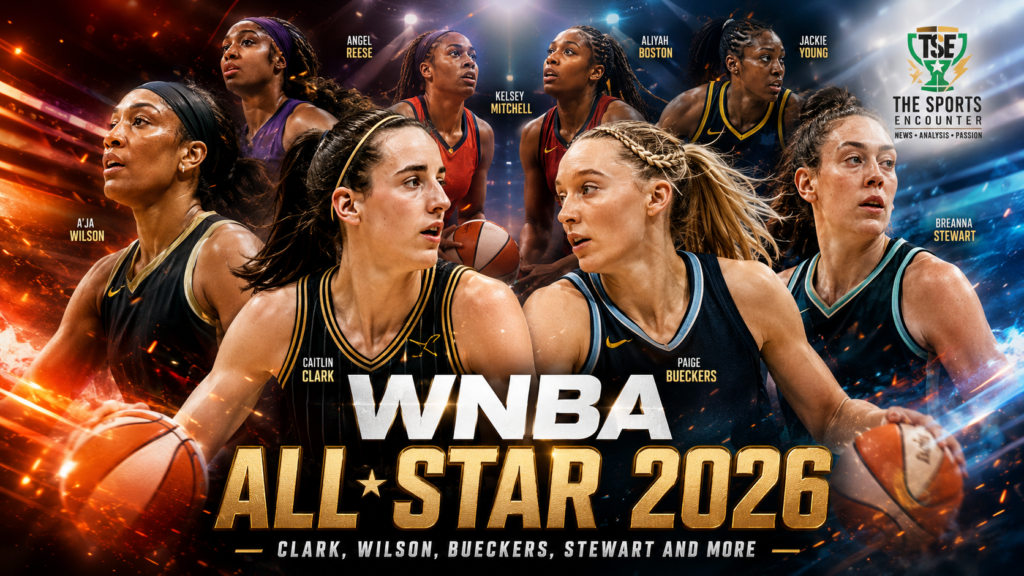
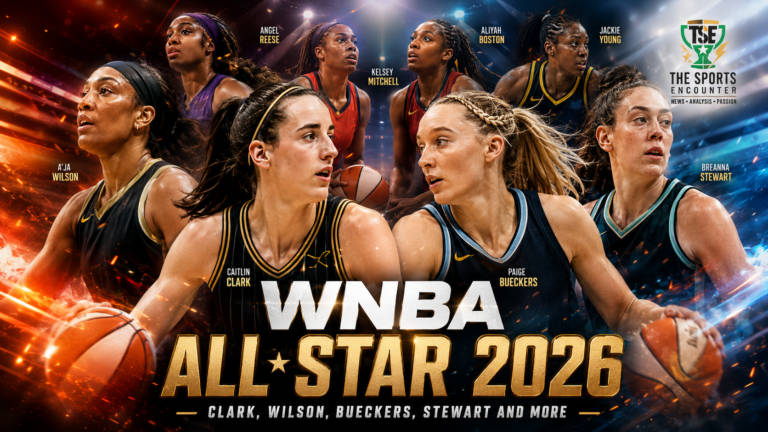
Caitlin Clark and A’ja Wilson will share the floor for Team Spoon against a Team Coop lineup led by Paige Bueckers and Breanna Stewart when the 2026 WNBA All-Star Game takes over Chicago on Saturday, July 25. The matchup brings together the league’s most popular young guards, two of the greatest forwards of their generation, several first-time All-Stars, established champions and teammates who will spend one night trying to beat each other.

The game also carries more weight than a typical midseason exhibition. It arrives during the WNBA’s 30th season, returns the event to Chicago for the second time, revives the league’s original red-and-blue visual identity and adds a $100,000 charity competition benefiting girls’ sports programs in the city.

This guide brings together the full 2026 WNBA All-Star rosters, draft order, selection rules, schedule, broadcast information, player statistics, tactical matchups, injury questions, first-time selections, historical milestones, Chicago events and the biggest fan debates heading into the game.

2026 WNBA All-Star Game at a Glance

DetailInformation
Event2026 AT&T WNBA All-Star Game
DateSaturday, July 25, 2026
Tipoff8:30 p.m. ET / 7:30 p.m. CT
VenueUnited Center, Chicago
U.S. broadcastABC
Pregame showWNBA Countdown at 8 p.m. ET on ABC
Postgame showWNBA Postgame at 10:30 p.m. ET on ABC
TeamsTeam Coop vs. Team Spoon
General managersCynthia Cooper and Teresa Weatherspoon
Head coachesBecky Hammon, Team Coop; Cheryl Reeve, Team Spoon
Leading fan vote-getterPaige Bueckers, 1,045,051 votes
Second-leading fan vote-getterCaitlin Clark, 1,023,321 votes
Charity prize pool$100,000
Winning-team charity award$70,000
Runner-up charity award$30,000

TL;DR: What Fans Need to Know

  • Paige Bueckers led WNBA All-Star fan voting and was assigned to Team Coop after Cynthia Cooper won a coin flip.
  • Caitlin Clark, the second-leading fan vote-getter, became the anchor of Team Spoon.
  • Teresa Weatherspoon used the first starter selection on A’ja Wilson, while Cooper answered with Breanna Stewart.
  • Team Coop will wear red and Team Spoon will wear blue, recalling the WNBA’s original 1997 colors.
  • Becky Hammon will coach Team Coop, while Cheryl Reeve will lead Team Spoon.
  • The weekend includes the 3-Point Contest, Kia WNBA Shooting Stars, WNBA Live and community events across Chicago.

Full 2026 WNBA All-Star Rosters

The official WNBA All-Star draft produced two balanced but very different teams. Cooper built around Bueckers, Stewart, shooting and transition play. Weatherspoon paired Clark with Wilson and surrounded them with size, rebounding and defensive flexibility.

Team Coop

General manager: Cynthia Cooper
Head coach: Becky Hammon, Las Vegas Aces
Uniform color: WNBA red
Charity: Angels Athletics

RolePlayerPositionWNBA team
StarterPaige BueckersGuardDallas Wings
StarterBreanna StewartForwardNew York Liberty
StarterKelsey MitchellGuardIndiana Fever
StarterNatasha HowardForwardMinnesota Lynx
StarterGabby WilliamsForwardGolden State Valkyries
ReserveAngel ReeseForwardChicago Sky
ReserveMarina MabreyGuardToronto Tempo
ReserveDominique MalongaCenterSeattle Storm
ReserveKelsey PlumGuardLos Angeles Sparks
ReserveJackie YoungGuardLas Vegas Aces
ReserveSonia CitronGuardWashington Mystics

Team Spoon

General manager: Teresa Weatherspoon
Head coach: Cheryl Reeve, Minnesota Lynx
Uniform color: WNBA blue
Charity: Girls in the Game

RolePlayerPositionWNBA team
StarterCaitlin ClarkGuardIndiana Fever
StarterA’ja WilsonForward/CenterLas Vegas Aces
StarterOlivia MilesGuardMinnesota Lynx
StarterAliyah BostonCenter/ForwardIndiana Fever
StarterJessica ShepardForwardDallas Wings
ReserveRhyne HowardGuardAtlanta Dream
ReserveAllisha GrayGuardAtlanta Dream
ReserveJonquel JonesCenterNew York Liberty
ReserveCourtney WilliamsGuardMinnesota Lynx
ReserveKiki IriafenForwardWashington Mystics
ReserveNneka OgwumikeForwardLos Angeles Sparks

How the 2026 WNBA All-Star Teams Were Selected

The selection process happened in several stages. Fans, current WNBA players and media members voted for the 10 starters. The league’s 15 head coaches then selected 12 reserves, voting for three guards, five frontcourt players and four players at either position. Coaches could not vote for players from their own teams.

Paige Bueckers finished first in fan voting with 1,045,051 votes. Caitlin Clark followed with 1,023,321. Because the league used honorary general managers instead of player captains, a coin flip decided which general manager would receive the leading vote-getter.

Cynthia Cooper won the flip and was assigned Bueckers. Teresa Weatherspoon received Clark. Weatherspoon then picked first from the remaining starters, while Cooper received the first selection from the reserve pool.

Weatherspoon chose four-time MVP A’ja Wilson with her first starter pick. Cooper responded with two-time MVP Breanna Stewart. The sequence created the headline pairing on each side before the rest of the draft filled out the tactical identities of both teams.

Complete 2026 WNBA All-Star Draft Order

RoundTeam SpoonTeam Coop
Assigned starsCaitlin ClarkPaige Bueckers
1A’ja WilsonBreanna Stewart
2Olivia MilesKelsey Mitchell
3Aliyah BostonNatasha Howard
4Jessica ShepardGabby Williams
5Rhyne HowardAngel Reese
6Allisha GrayMarina Mabrey
7Jonquel JonesDominique Malonga
8Courtney WilliamsKelsey Plum
9Kiki IriafenJackie Young
10Nneka OgwumikeSonia Citron

Why Caitlin Clark and A’ja Wilson Could Be the Game’s Most Dangerous Pairing

Clark and Wilson create the matchup every basketball fan wants to see. Clark stretches defenses far beyond the three-point line, plays with unusual pace and can turn defensive rebounds into scoring chances with one pass. Wilson brings elite finishing, screening, rim protection and midrange scoring.

The two-player game between them could be devastating in an exhibition setting. A high screen from Wilson forces defenders to choose between meeting Clark near the logo and giving Wilson a lane to the rim. Switching the action places a guard on Wilson. Dropping the center leaves Clark room to shoot or attack the space.

Clark entered the All-Star selection period averaging a career-high 21.2 points and 8.2 assists. She had also become the fastest player in league history to reach 1,000 points, 250 rebounds and 250 assists, doing so in 54 career games. Wilson entered the event as a four-time MVP and an eight-time All-Star, giving Team Spoon the most decorated interior force in the game.

Aliyah Boston adds another familiar screening and finishing partner for Clark. Their Indiana chemistry gives Team Spoon a ready-made offensive package that requires little practice time. Jessica Shepard’s passing and rebounding provide another route into half-court offense, while Olivia Miles gives the lineup a second creative guard.

Why Paige Bueckers and Breanna Stewart Fit So Naturally

Team Coop’s leading duo has a different shape. Bueckers thrives through timing, balance and decision-making. Stewart can score over smaller defenders, pull centers away from the basket and defend across multiple positions.

Bueckers led fan voting after winning the 2025 Rookie of the Year award. At the time the starters were announced, she ranked eighth in the WNBA in scoring at 19.9 points per game and seventh in assists at 5.9. Her ability to operate efficiently without dominating every possession makes her an ideal All-Star guard.

Stewart entered her eighth All-Star selection as a two-time MVP, three-time WNBA champion and two-time Finals MVP. She was averaging 19.2 points and 8.5 rebounds when the starters were named. Her skill set allows Cooper to play almost any style, from a five-out offense to lineups built around movement, transition and switching defense.

Kelsey Mitchell supplies another elite scorer. Gabby Williams adds pace, defense and open-floor pressure, while Natasha Howard gives the starting unit a productive interior presence. Team Coop can play quickly without becoming small.

The Indiana Fever Teammate Twist

Three Indiana Fever players earned starting selections, but the draft split them. Clark and Boston landed on Team Spoon, while Kelsey Mitchell joined Team Coop.

That separation adds one of the night’s most entertaining subplots. Mitchell knows Clark’s passing tendencies, Boston’s screening angles and Indiana’s preferred actions. Clark and Boston understand how Mitchell creates space and where she wants the ball.

Mitchell was averaging 21.6 points when the starters were announced, ranking third in the league at that stage. She had already produced 11 games with at least 20 points and earned her fourth consecutive All-Star selection. Her first official starting berth gives Team Coop another player capable of taking over a short stretch.

The First-Time All-Stars Who Changed the Player Pool

Four players earned their first WNBA All-Star selections in 2026: Olivia Miles, Jessica Shepard, Marina Mabrey and Dominique Malonga.

Olivia Miles

Miles became an All-Star during her rookie season after Minnesota selected her second overall in the 2026 WNBA Draft. She was averaging 18.2 points and 5.7 assists when the starters were announced, leading all rookies in both categories. Her arrival adds another chapter to the league’s growing class of young guards, a trend also visible across the wider 2026 basketball draft conversation.

Jessica Shepard

Shepard’s selection rewarded one of the season’s biggest individual breakthroughs. The Dallas forward was averaging 14.3 points, 11.5 rebounds and 5.4 assists when the starters were selected. She also led the league with two triple-doubles and had recorded 11 double-doubles.

Marina Mabrey

Mabrey reached her first All-Star Game in her eighth season. She ranked fifth in league scoring at 21.1 points per game when reserves were announced. Her 53-point performance against Los Angeles tied the WNBA single-game scoring record, while her nine made three-pointers matched another league record.

Dominique Malonga

Malonga became a first-time All-Star in her second WNBA season. The 6-foot-6 Seattle center was leading the Storm in scoring and rebounding, averaging 15.9 points, 7.4 boards and 1.2 blocks.

Veteran Milestones: Ogwumike, Wilson and Stewart Add to Their Legacies

Nneka Ogwumike’s 11th All-Star selection ties Diana Taurasi for the second-most in WNBA history. Only Sue Bird, with 13, has more. Ogwumike also entered the season among the league’s top four in career points and rebounds, adding historical weight to Team Spoon’s reserve group.

Wilson and Stewart each reached eight All-Star selections, the most among the 2026 starters. Their presence gives the game a direct connection between the WNBA’s current era and the championship standard that has defined much of the past decade.

Jonquel Jones earned her sixth All-Star selection. Kelsey Plum and Jackie Young reached five each, while Aliyah Boston and Kelsey Mitchell were selected for the fourth time.

Angel Reese Returns to the Chicago Spotlight

Angel Reese enters the All-Star Game as one of the central figures in the Chicago crowd’s emotional landscape. The Chicago Sky forward earned her third All-Star selection in as many seasons and led the WNBA in rebounding at 11.8 per game when reserves were announced.

Reese also became the fastest player in league history to reach 1,000 career rebounds, achieving the milestone in 79 games and beating Tina Charles’ previous mark of 89.

Her role on Team Coop should suit the game’s tempo. Bueckers, Mitchell, Plum and Mabrey can create shots and draw defenders away from the paint. Reese can attack the offensive glass, run the floor and generate extra possessions without needing the offense built around her.

Team Coop vs. Team Spoon: Tactical Comparison

AreaTeam CoopTeam Spoon
Primary creatorsBueckers, Mitchell, Plum, MabreyClark, Miles, Courtney Williams
Interior starsStewart, Howard, Reese, MalongaWilson, Boston, Jones, Ogwumike
Three-point threatExcellentStrong
ReboundingStrongPotentially dominant
Transition playBueckers, Gabby Williams and Plum raise the paceClark’s passing can create immediate scoring chances
Defensive flexibilityStewart, Howard, Williams and YoungWilson, Boston, Jones, Gray and Howard
Built-in chemistryUConn connections and multiple elite guardsIndiana, Minnesota and Atlanta teammate combinations

Team Coop appears better equipped for sustained perimeter scoring. Bueckers, Mitchell, Plum, Mabrey and Young can all handle the ball and shoot. Stewart’s spacing prevents opponents from simply loading up against the guards.

Team Spoon owns the more imposing collection of interior players. Wilson, Boston, Jones, Shepard, Ogwumike and Iriafen can control the glass and finish inside. Clark’s ability to find runners and cutters could turn that size into quick offense.

The All-Star setting usually favors shooting and pace, which gives Team Coop an obvious argument. Team Spoon can counter with efficient paint scoring and second-chance opportunities. The game could ultimately turn on which side treats defense seriously for the final five minutes.

Who Coaches Team Coop and Team Spoon?

Becky Hammon will coach Team Coop, while Cheryl Reeve will lead Team Spoon. The assignments came from the league standings after games on July 10.

Las Vegas and Minnesota both held 16-6 records at that checkpoint. Hammon secured the top coaching position because the Aces had won the head-to-head meeting with the Lynx. The coach in the top slot was assigned to the team containing the leading fan vote-getter, Paige Bueckers. Reeve therefore went to Clark’s Team Spoon.

The arrangement creates amusing cross-team dynamics. Hammon will coach Bueckers, Stewart and Jackie Young against her Las Vegas centerpiece, Wilson. Reeve will work with Clark and Wilson while coaching against Minnesota players Natasha Howard and Gabby Williams.

Caitlin Clark Injury Watch

Clark’s availability and physical condition remain among the most closely watched issues heading into All-Star weekend. Any late injury designation should be checked against the official WNBA injury report and Indiana Fever updates before publication or game day.

Her importance stretches beyond the All-Star result. Clark’s shooting range, passing and popularity influence ticket demand, television interest and the shape of Team Spoon’s offense. A healthy Clark gives the event its clearest marquee guard matchup against Bueckers.

The Fever also have larger priorities after the break. Indiana must balance the appeal of the All-Star stage against the need to protect Clark for the playoff race. If her status changes, WNBA Commissioner Cathy Engelbert has authority to name a replacement.

2026 WNBA All-Star Weekend Schedule

DateEventVenueTime and broadcast
Thursday, July 23WNBA LiveMcCormick Place5 p.m. to 9 p.m. CT
Friday, July 24WNBA LiveMcCormick Place10 a.m. to 7 p.m. CT
Friday, July 24Kia WNBA Shooting Stars and State Farm WNBA 3-Point ContestWintrust Arena8 p.m. ET on ESPN
Saturday, July 25WNBA LiveMcCormick Place10 a.m. to 7 p.m. CT
Saturday, July 25WNBA CountdownABC8 p.m. ET
Saturday, July 252026 WNBA All-Star GameUnited Center8:30 p.m. ET on ABC
Saturday, July 25WNBA PostgameABC10:30 p.m. ET

WNBA Live and the Wider Chicago Fan Experience

WNBA Live returns for its fifth year and expands into a three-day event at McCormick Place. The league describes the festival as a meeting point for basketball, music, fashion, technology, merchandise and player access.

Fans can expect player and legend appearances, panel discussions, basketball activities, sponsor activations and exclusive products. The WNBA Events App will carry the latest schedule, interactive maps, ticket information and reminders for appearances.

Chicago’s role goes beyond the United Center and Wintrust Arena. The league has also planned media, practice, youth and community programming at the Obama Presidential Center. The broader significance of that decision is explored in The Sports Encounter’s report on the WNBA’s Obama Center All-Star initiative.

Activities include All-Star Media Day and practice, Changemaker Day and Jr. WNBA programming. Many will take place inside Home Court, the Obama Presidential Center’s 60,000-square-foot athletic building.

What the Charity Prize Pool Adds to the Game

The WNBA introduced a $100,000 charity pool for the 2026 All-Star Game. The winning team will direct $70,000 to its affiliated organization, while the runner-up will secure $30,000.

Team Coop is playing for Angels Athletics, which encourages girls to participate in sports while developing confidence and life skills. Team Spoon supports Girls in the Game, a Chicago organization offering sports, health and leadership programs through schools, parks and community centers.

The money does not turn the exhibition into a playoff game, but it gives the closing minutes a clearer purpose. Players will know that the result changes the amount delivered to organizations working directly with girls in Chicago.

Why the Red and Blue Uniforms Matter

Team Coop will wear red. Team Spoon will wear blue. The colors recall the WNBA’s original visual identity from 1997 and connect the league’s 30th season with its first generation.

Cynthia Cooper and Teresa Weatherspoon deepen that bridge. Cooper won four consecutive championships and four Finals MVP awards with the Houston Comets. Weatherspoon became one of the league’s defining early guards, earning five All-Star selections and two Defensive Player of the Year awards.

Their involvement gives the event a stronger historical frame than a standard celebrity draft. Current stars are being organized by two figures who helped establish the league’s competitive identity.

How the 2026 Game Fits Into WNBA All-Star History

The first WNBA All-Star Game was played in 1999. Since then, the league has used several formats, including Eastern Conference vs. Western Conference, Team USA exhibitions during Olympic cycles and captain-led roster drafts.

The 2026 version continues the move away from conference restrictions. Cooper and Weatherspoon could select any available player regardless of position or team. That freedom produced combinations that regular-season basketball cannot offer, including Clark with Wilson and Bueckers with Stewart.

Chicago previously hosted the event in 2022, when Kelsey Plum scored 30 points and earned All-Star MVP honors. Plum returns in 2026 as a Team Coop reserve, giving her a chance to repeat the feat in the same city.

Biggest Fan Debates Before the Game

Does Team Coop have too much shooting?

Many fans favor Team Coop because of its guard depth. Bueckers, Mitchell, Plum, Mabrey and Young can all score from the perimeter. Stewart’s ability to stretch the floor creates even more room.

Can Team Spoon dominate the paint?

Team Spoon’s frontcourt is formidable. Wilson, Boston, Jones, Ogwumike, Shepard and Iriafen give Reeve multiple combinations with size, rebounding and finishing. That advantage could matter once the pace slows late.

Will Fever teammates compete seriously against each other?

Clark and Boston facing Mitchell offers a rare look at three Indiana starters on opposite sides. All-Star games usually begin loosely, but teammate matchups often produce a little more edge.

Could Angel Reese win MVP in Chicago?

Reese has a plausible path. Rebounding translates to any style, and Team Coop’s spacing could leave her free to clean up missed shots. A high-energy performance in front of the Chicago crowd would quickly build momentum.

Will Clark and Bueckers guard each other?

The matchup is too attractive to avoid entirely. Coaches may protect both from heavy defensive work, but fans should expect at least a few direct possessions between the two leading vote-getters.

Players Who Could Decide the Game Beyond the Four Headliners

Kelsey Mitchell: Team Coop already has star power, but Mitchell may be its most natural pure scorer. She can turn a two-minute stretch into a double-digit swing.

Rhyne Howard: Howard was averaging 18.9 points and leading the league in steals at 2.5 per game when reserves were announced. Her defense and three-point shooting fit Team Spoon perfectly.

Marina Mabrey: Any player capable of scoring 53 points and making nine threes in one game must be treated as an All-Star MVP threat.

Jessica Shepard: Her rebounding and passing can organize Team Spoon when the first option breaks down.

Gabby Williams: Williams can affect the game without needing shots. She runs, defends and connects possessions, making her valuable in a roster full of scorers.

Jonquel Jones: Jones gives Team Spoon another elite interior option and could punish smaller lineups if Team Coop leans heavily on guards.

What the All-Star Game Says About the WNBA in 2026

The rosters show a league with multiple generations operating at once. Wilson, Stewart and Ogwumike remain central. Clark and Bueckers drive enormous fan interest. Miles, Malonga, Citron and Iriafen represent the next wave. Reese, Boston, Mitchell, Plum and Howard sit between those groups as established stars with years ahead of them.

Expansion has also widened the league’s map. The Toronto Tempo and Golden State Valkyries have All-Star representation, while Chicago’s weekend programming reaches beyond the game itself. The league is building an event that functions as competition, fan festival, cultural showcase and community platform.

That evolution mirrors basketball’s wider push into new markets and ownership conversations, including Las Vegas’ growing ambitions as a basketball city. Readers can follow more professional basketball coverage through The Sports Encounter’s NBA and WNBA hub.

2026 WNBA All-Star Game Prediction

Team Coop has the cleaner perimeter structure. Bueckers can manage the game, Mitchell and Plum can score in bursts, and Stewart can solve almost any matchup. Williams, Howard and Young give the roster enough defense to prevent the game from becoming a pure shooting contest.

Team Spoon has the best potential two-player combination in Clark and Wilson, plus the stronger collection of rebounders. If Clark is fully healthy and Team Spoon controls the glass, Reeve’s team can dictate the game even without matching every three.

Early prediction: Team Coop by four points. Its guard depth and spacing look slightly better suited to the All-Star format. Team Spoon has the more intimidating interior group and could easily reverse that call if Wilson controls the paint.

Frequently Asked Questions

When is the 2026 WNBA All-Star Game?

The game will be played Saturday, July 25, 2026, at 8:30 p.m. ET.

Where is the 2026 WNBA All-Star Game?

The United Center in Chicago will host the game.

What channel is the WNBA All-Star Game on?

ABC will broadcast the game in the United States. WNBA Countdown begins at 8 p.m. ET.

Who is on Team Coop?

Team Coop is led by Paige Bueckers and Breanna Stewart. Its roster also includes Kelsey Mitchell, Natasha Howard, Gabby Williams, Angel Reese, Marina Mabrey, Dominique Malonga, Kelsey Plum, Jackie Young and Sonia Citron.

Who is on Team Spoon?

Team Spoon is led by Caitlin Clark and A’ja Wilson. The roster also includes Olivia Miles, Aliyah Boston, Jessica Shepard, Rhyne Howard, Allisha Gray, Jonquel Jones, Courtney Williams, Kiki Iriafen and Nneka Ogwumike.

Who coaches Team Coop?

Las Vegas Aces head coach Becky Hammon will coach Team Coop.

Who coaches Team Spoon?

Minnesota Lynx head coach Cheryl Reeve will coach Team Spoon.

Who received the most WNBA All-Star fan votes in 2026?

Paige Bueckers led fan voting with 1,045,051 votes. Caitlin Clark finished second with 1,023,321.

Why are Caitlin Clark and Kelsey Mitchell on different teams?

The honorary general managers drafted players without regard to their regular-season teams or conferences. Clark was assigned to Team Spoon, while Cooper selected Mitchell for Team Coop.

What are the 2026 WNBA All-Star uniform colors?

Team Coop will wear red and Team Spoon will wear blue, recalling the WNBA’s original 1997 colors.

How much charity money is attached to the game?

The total charity pool is $100,000. The winning team’s organization receives $70,000, while the runner-up’s organization receives $30,000.

What other events are part of WNBA All-Star Weekend?

The weekend includes the State Farm WNBA 3-Point Contest, Kia WNBA Shooting Stars, WNBA Live, media day, practice and several youth and community programs.

Final Word

The 2026 WNBA All-Star Game has the right mix of star power, fresh combinations and genuine stakes. Clark and Wilson offer a dream partnership. Bueckers and Stewart give Team Coop a polished inside-out foundation. Mitchell faces her Indiana teammates, Reese returns to the Chicago spotlight, four first-time All-Stars arrive on the stage and two league legends shape the rosters during the WNBA’s 30th season.

The result will matter for the charities involved, but the weekend’s larger value lies in what it shows about the league. The WNBA now has enough established greatness, young talent, market reach and fan attention to make All-Star weekend feel like a major sports event rather than a pause in the schedule.

This article will be updated with official injury news, 3-Point Contest participants, Shooting Stars lineups, replacement selections, final scores, MVP results and postgame analysis as information becomes available.

Miley Rumer is The Sports Encounter’s U.S. correspondent for American sports coverage, focusing on the NHL, NBA, NFL, MLB, MLS, and major sporting stories across North America. Her coverage tracks the moments that shape games, seasons, rivalries, and fan conversations, with a sharp eye on performance, pressure, team identity, and the human stories behind the scoreboard. Based in St. Clairsville, Ohio, Miley brings a grounded American sports voice to The Sports Encounter’s coverage, helping readers follow the biggest developments from arenas, stadiums, locker rooms, and fan communities across the country.

Editor's Choice

France vs England: The 2026 World Cup Game Nobody Wanted, But Won’t Want to Miss

France and England meet in the 2026 World Cup third-place playoff in Miami after painful semifinal defeats. The bronze final brings Golden Boot implications for Kylian Mbappé, possible rotation from both teams, Didier Deschamps’ final match as France manager, and another chapter in a long international rivalry.

Miley Rumer | The Sports Encounter

Published

on

Kylian Mbappé faces Harry Kane and Jude Bellingham in a dramatic France vs. England World Cup 2026 third-place playoff poster with national flags and the tagline “Pride on the Line.”

“None of our players and none of the French players want to play this match.” That is how England manager Thomas Tuchel described Saturday’s World Cup third-place playoff, and he was not being diplomatic about it. Yet the France vs England bronze final at Miami’s Hard Rock Stadium is shaping up to be one of the most fascinating, star-studded, and emotionally loaded matches of the entire 2026 World Cup, a collision of wounded pride, Golden Boot math, and a legendary manager’s last dance. Here is everything you need to know before kickoff.

🥉 Third-Place Match: Quick Facts

MatchFrance vs. England
StageFIFA World Cup 2026 Third-Place Playoff (“Bronze Final”)
DateSaturday, July 18, 2026
Kickoff5:00 p.m. ET / 2:00 p.m. PT
VenueHard Rock Stadium (“Miami Stadium”), Miami Gardens, Florida
CapacityApproximately 65,000
TV (USA)FOX, Fox One, Telemundo
StreamingFubo, YouTube TV, FOX Sports app
What’s on the LineThird-place finish, Golden Boot implications for Mbappe
Extra Time/PenaltiesYes, this match must produce a winner

Why This Match Exists (and Why Nobody Wants to Play It)

Both France and England arrived in North America with genuine designs on lifting the trophy. Instead, they will spend Saturday evening fighting for bronze, a fixture that has become notorious across World Cup history for feeling like an afterthought to the very players competing in it. Tuchel did not hide his frustration when asked about the game following England’s gut-wrenching semi-final exit. “None of these players, none of the French players want to play this match,” he said. “They want to play in the final. We gave everything to be in the final.” He added that England would go into Saturday with one fewer day of recovery than France, “but we will do it professionally.”

France manager Didier Deschamps struck a more resigned, professional tone. “There’s a third-place finish to play for, so we’ll do everything we can to get it,” Deschamps said. “We’re not where we wanted or expected to be. The disappointment matches our ambitions, but we have to accept it. We have no other choice.” Tuchel, pressed further on the fixture’s existence, offered a broader reflection on England’s tournament: “We’ll have to wait four years before participating in another World Cup. Reaching the semi-finals is already an achievement in itself, of course. Many great footballing nations are eliminated before the semi-finals. It’s an achievement, but nobody wants to hear that at the moment, myself included, because we’re very demanding of ourselves.”

How Both Teams Got Here: Contrasting Semi-Final Heartbreaks

France’s tournament fell apart in a way nobody saw coming. Didier Deschamps’ side had been the most ruthless team in the competition heading into the final four, outscoring opponents 16-2 across their first six matches without a single defeat. Kylian Mbappe was in imperious form throughout, and Les Bleus dispatched Morocco 2-0 in the quarter-finals to set up a semi-final against European champions Spain. What followed was a shock: Spain completely dismantled France’s attack, winning 2-0 in a performance so dominant that France could not establish sustained possession or organize an effective press for long stretches.

England’s exit was the more painful of the two, if only because of how close they came. Anthony Gordon’s 55th-minute goal put the Three Lions ahead of Argentina in Atlanta, seemingly on course for their first World Cup final since 1966. Instead, Tuchel’s decision to retreat into a back five invited pressure that Argentina, inspired by Lionel Messi, eventually converted into two late goals from Enzo Fernandez and Lautaro Martinez, sending England home 2-1 and reigniting fierce criticism of Tuchel’s in-game management.

📊 The Road to Miami: Tournament Form Comparison

MetricFranceEngland
Matches unbeaten before semi-final6 (won all 6)Mixed results, multiple close calls
Goals scored / conceded (pre-semi)16 scored / 2 concededLess dominant, more chaotic path
Round of 32n/aBeat DR Congo 2-1
Round of 16Beat Paraguay 1-0Beat Mexico 3-2
Quarter-finalBeat Morocco 2-0Beat Norway 2-1 after extra time
Semi-final resultLost 2-0 to SpainLost 2-1 to Argentina (led 1-0 late)
Leading scorerKylian Mbappe (8 goals, 3 assists)Split between Kane and Bellingham (6 goals each)
Standout creatorMichael Olise (tournament-high 5 assists)Jude Bellingham (advanced midfield influence)

Didier Deschamps’ Farewell: The End of an Era

Saturday will carry extra emotional weight for France, marking the final match of Didier Deschamps’ 14-year reign as national team manager. Deschamps announced back in January that he would step down at the conclusion of the 2026 World Cup, closing out a tenure that began in 2012 and delivered France’s 2018 World Cup title, a runner-up finish in 2022, and the 2021 UEFA Nations League crown. Across his World Cup career alone, Deschamps holds the all-time record for most manager victories at the tournament with 20, along with a record 10 knockout-stage wins, marks that will not be easily matched.

Aime Jacquet, the man who handed Deschamps the captain’s armband during France’s 1998 World Cup triumph, offered an emotional tribute ahead of the tournament, telling France Inter radio, “The French national team is part of your identity.” Deschamps came agonizingly close to a storybook ending, having already guided France to back-to-back finals once before, in 2018 and 2022, when Les Bleus became just the first nation since Brazil in 2002 to reach consecutive finals. This year’s semi-final exit means his final match in charge will be fought not for gold, but for bronze, and possibly one final win to send him off in style.

🎖️ Didier Deschamps: By the Numbers

AchievementDetail
Years as France manager14 (2012-2026)
World Cup titles won1 (2018)
World Cup finals reached2 (2018, 2022)
All-time World Cup manager wins20 (record)
All-time World Cup knockout-stage wins10 (record)
Other major titles2021 UEFA Nations League
Final match in chargeSaturday’s bronze final vs. England

The Golden Boot Race Adds Real Stakes

Here is the twist that turns an “unwanted” fixture into must-watch television: goals scored in the third-place playoff officially count toward the adidas Golden Boot standings. Kylian Mbappe enters Saturday locked at eight goals, tied with Lionel Messi for the tournament lead, even though his own team has already been eliminated from title contention. Because Messi will be occupied playing in Sunday’s final against Spain rather than adding to his tally on Saturday, the bronze final represents Mbappe’s very last opportunity to score the goal that could hand him a second career Golden Boot, following his 2022 triumph in Qatar.

Complicating matters further, England’s Harry Kane and Jude Bellingham both sit on six goals apiece, meaning a big performance from either player on Saturday could realistically vault them into podium contention for the award as well, even with Argentina and Spain both alive in Sunday’s final. As one tournament preview put it, the third-place game has a long history of being a surprisingly high-scoring, loose affair, since neither team is playing with the same suffocating tactical caution that defines a World Cup final, making Saturday a genuine four-way audition for football’s most prestigious individual scoring prize.

🥾 Golden Boot Race Ahead of the Bronze Final

PlayerCountryGoalsAssistsStill Playing?
Kylian MbappeFrance83Yes, in bronze final
Lionel MessiArgentina84Yes, in Sunday’s final
Harry KaneEngland6n/aYes, in bronze final
Jude BellinghamEngland6n/aYes, in bronze final

Note: Messi will not add to his tally on Saturday since Argentina play in Sunday’s final instead, making this Mbappe’s last realistic chance to pull clear at the top before the tournament ends.

Team News and Predicted Lineups

Rotation is the word of the week in both camps, though for very different reasons. Deschamps, with an extra day of rest compared to England and nothing left to lose in his farewell match, is expected to make changes while still fielding a competitive side capable of giving him the send-off he deserves, with names like Desire Doue, Manu Kone, and Ibrahima Konate in contention for recalls. Mbappe, given the Golden Boot race, is virtually certain to start regardless of any broader rotation.

Predicted France lineup (4-2-3-1): Maignan; Kounde, Upamecano, Lacroix, T. Hernandez; Kone, Rabiot; Dembele, Cherki, Doue; Mbappe.

England face a tighter turnaround, having played their semi-final in Atlanta on July 15 versus France’s quarter-final on July 14, leaving Tuchel’s squad with one fewer recovery day. Harry Kane, who has barely rested throughout the tournament, is considered a candidate to drop to the bench in favor of Ollie Watkins leading the line, while Jude Bellingham, who has “run himself to the ground” trying to drag England to the final, could also be rotated out. Bukayo Saka may be protected as well, with Morgan Rogers retained on the right and Eberechi Eze shifting into the number 10 role behind Marcus Rashford.

Predicted England lineup (4-2-3-1): Pickford; Spence, Guehi, Konsa, O’Reilly; Mainoo, Anderson; Rogers, Eze, Rashford; Watkins.

📋 Predicted Starting Lineups

#France (4-2-3-1)England (4-2-3-1)
GKMike MaignanJordan Pickford
DEFJules Kounde, Dayot Upamecano, Wesley Lacroix, Theo HernandezDjed Spence, Marc Guehi, Ezri Konsa, Callum O’Reilly
MIDManu Kone, Adrien RabiotKobbie Mainoo, Elliot Anderson
ATTOusmane Dembele, Maghnes Cherki, Desire DoueMorgan Rogers, Eberechi Eze, Marcus Rashford
FWDKylian MbappeOllie Watkins

The Extra Twist: This Match Cannot End in a Draw

Unlike a normal end-of-tournament exhibition, the third-place playoff carries real competitive teeth. If the score is level after 90 minutes, the match proceeds to a full 30 minutes of extra time and, if necessary, a penalty shootout to determine which nation officially finishes third and which settles for fourth. That possibility of an additional half hour of football is one more reason both managers may lean toward rotation, particularly England, who are already carrying the shorter recovery window into Saturday.

France vs England: A Rivalry Steeped in History

Saturday’s meeting adds another chapter to one of international football’s oldest and most storied rivalries. England and France have met 31 times in official matches since their first encounter in 1923, with the head-to-head split telling two very different stories depending on which era you look at. England holds the historical edge overall with 17 wins to France’s 9, with 5 draws, but the momentum has shifted dramatically in the modern era. England enjoyed a strong run from 1966 to 1982, winning three straight meetings including two World Cup contests in both of those very years. Since then, however, France has flipped the script almost completely: England have won just three of their last 13 meetings, and only one of the last nine, with that solitary victory coming in a November 2015 friendly at Wembley, a match overshadowed by the Paris terror attacks that had occurred just four days earlier.

Most painfully for England fans, the two nations’ most recent competitive meeting came at the 2022 World Cup, when France eliminated England 2-1 in the quarter-finals, extending an unbeaten competitive run against the Three Lions to four matches (including draws at Euro 2012, Euro 1992, and a 2-1 France win at Euro 2004). That defeat still stings for English supporters, and Saturday offers a rare chance at a measure of revenge, even if the stakes are considerably lower than a quarter-final.

🇫🇷 vs 🏴 All-Time Head-to-Head

StatTotal
Total meetings (all competitions)31
England wins17
France wins9
Draws5
England’s last win2-0 (friendly, Wembley, November 2015)
France’s last win2-1 (World Cup quarter-final, Qatar, 2022)
France’s unbeaten competitive run vs. England4 matches (2004, 2012, 2022)
Biggest England win5-0 (Euro qualifier, Wembley, December 1982)

What’s at Stake Beyond Bronze

There is more historical texture on the line than just a medal. Had they made Sunday’s final, France would have become just the third nation ever to reach three consecutive World Cup finals, joining West Germany’s run from 1982 to 1990 and Brazil’s from 1994 to 2002. That chance is now gone, but a win Saturday would still let Deschamps depart with his fourth-best possible World Cup finish in five tournaments in charge.

For England, third place would represent their second-best World Cup finish in history, behind only their 1966 title win, and would improve on their previous third-place playoff experience, a loss to Belgium in the 2018 edition in Russia. That 2018 defeat, coincidentally, also featured a Golden Boot subplot: Harry Kane entered that match as the tournament’s leading scorer and used it as his “final push” before eventually winning the award outright, a piece of history he will be well aware of as he prepares for Saturday’s rematch of that dynamic, this time chasing Mbappe rather than protecting a lead.

Fan and Media Reaction: A Game Nobody Asked For, But Everyone’s Talking About

The public reaction to this fixture has been a mixture of resignation and genuine intrigue. Much of the pre-match media conversation has centered squarely on Tuchel’s blunt admission that the players themselves do not want to be here, with outlets across England and France running variations of the “nobody wants to play” quote as their primary headline framing for the match. That candor has actually fueled discussion rather than dampened it, with fans debating whether Tuchel’s honesty reflects poor man-management or simply refreshing transparency after a brutal tournament exit.

Golden Boot speculation has become the dominant secondary storyline driving fan engagement, with supporters across all four contending nations (France, England, Argentina, and by extension Spain) closely tracking how Saturday’s result could reshape the individual scoring race before Sunday’s final is even played. Discussion has also focused heavily on the emotional angle of Deschamps’ farewell, with French football media treating the match as a proper send-off occasion regardless of the stakes, drawing comparisons to how other legendary managers have exited the international stage.

For England supporters still processing the manner of the semi-final collapse against Argentina, Saturday’s match is being widely framed as an opportunity for a handful of underused squad players, along with potentially Kane and Bellingham, to salvage some pride and end the tournament on a positive individual note, even if the collective disappointment of missing out on a first final since 1966 will linger regardless of Saturday’s outcome.

Prediction: What to Expect

Betting markets and expert previews have generally leaned toward France, largely on the strength of their superior overall tournament form heading into the semi-final and the presence of a fully motivated Mbappe chasing individual history. Third-place playoffs have a well-documented tendency to be higher-scoring, more open affairs than the tightly contested matches that preceded them, since neither manager is playing with the tactical caution that defines a true knockout decider. Expect goals, expect heavy rotation from at least one side, and expect Mbappe to be directly involved in the outcome, whether or not it is enough to catch Messi in the Golden Boot race before Sunday’s final settles the only prize that ultimately matters more.

Frequently Asked Questions About France vs. England

When is the France vs. England World Cup 2026 third-place playoff?

France and England will meet on Saturday, July 18, 2026, in the FIFA World Cup third-place playoff.

What time does France vs. England start?

Kickoff is scheduled for 5:00 p.m. ET and 2:00 p.m. PT.

Where will the France vs. England bronze final be played?

The match will take place at Hard Rock Stadium in Miami Gardens, Florida. FIFA refers to the venue as Miami Stadium during the tournament.

How can fans watch France vs. England in the United States?

FOX, Fox One, and Telemundo will carry television coverage. Streaming options include the FOX Sports app, Fubo, and YouTube TV.

Why are France and England playing for third place?

France lost 2-0 to Spain in the semifinal, while England were beaten 2-1 by Argentina after conceding two late goals.

Will Kylian Mbappé play against England?

Mbappé is expected to feature because the match gives him one final opportunity to improve his position in the Golden Boot race.

Can Kylian Mbappé win the 2026 World Cup Golden Boot?

Yes. Mbappé enters the third-place playoff level with Lionel Messi on eight goals. Any goal against England could move him ahead before Argentina play Spain in the final.

Could Harry Kane or Jude Bellingham still win the Golden Boot?

Both England players enter the match on six goals. They would need a major scoring performance and favorable results elsewhere to challenge Mbappé and Messi.

Will Harry Kane start for England?

Kane could be rested because of England’s short recovery period and his heavy workload during the tournament. Ollie Watkins is among the players who could start instead.

Is France vs. England Didier Deschamps’ final match as France manager?

Yes. Deschamps is expected to step down after the tournament, making the third-place playoff the final game of his 14-year tenure.

Who is favored to win France vs. England?

France are generally considered slight favorites because of their stronger tournament form, extra recovery time, and Mbappé’s scoring threat.

What is the all-time head-to-head record between France and England?

England hold the historical advantage with 17 wins from 31 meetings, while France have won nine and five matches have ended in draws.

When did England last beat France?

England’s most recent victory over France came in a 2-0 friendly win at Wembley in November 2015.

What happened in the last competitive meeting between France and England?

France defeated England 2-1 in the quarterfinals of the 2022 FIFA World Cup.

Can the third-place playoff go to extra time and penalties?

Yes. If the score is level after 90 minutes, the match will go to extra time and then a penalty shootout if necessary.

Why is the third-place playoff sometimes called the bronze final?

The winning team receives bronze medals and officially finishes third in the tournament, while the losing team ends in fourth place.

Do goals in the third-place playoff count toward the Golden Boot?

Yes. Goals scored in the bronze final count toward the official tournament scoring standings.

What is at stake beyond third place?

France can give Didier Deschamps a winning farewell, while England can secure one of their best World Cup finishes and restore some pride after their semifinal collapse.

Continue Reading

Editor's Choice

Argentina vs. Spain World Cup 2026 Final: Messi, Yamal, Team News and Full Build-Up

Argentina and Spain meet in the 2026 FIFA World Cup final at MetLife Stadium, with Lionel Messi chasing a historic fourth title and Lamine Yamal leading Spain’s bid for a second crown. Here is the full build-up, including team news, injuries, ticket prices, odds, head-to-head history, fan reaction, and the biggest storylines before kickoff.

Marcos Wetherfield | The Sports Encounter

Published

on

Lionel Messi and Lamine Yamal headline the Argentina vs. Spain 2026 World Cup final preview, with MetLife Stadium, the trophy, ticket prices, travel demand, injury updates, and The Sports Encounter logo.

The 2026 FIFA World Cup final is set, and the world is already reorganizing itself around it. Lionel Messi’s Argentina will face Lamine Yamal’s Spain on Sunday, July 19, at MetLife Stadium in East Rutherford, New Jersey, in what promises to be one of the most-watched sporting events in history.

In the 72 hours since Argentina’s stunning 2-1 comeback win over England and Spain’s clinical 2-0 dismantling of France, the build-up has exploded into a story that stretches far beyond the pitch: sold-out charter flights, record-shattering ticket prices, a sitting U.S. president confirming his attendance, a Louis Vuitton-designed trophy trunk, and two national federations quietly managing injury concerns in their biggest stars.

Here is the complete, deeply reported picture of everything happening in the countdown to Argentina vs Spain.

🏆 2026 World Cup Final: Quick Facts

MatchArgentina vs. Spain
DateSunday, July 19, 2026
Kickoff3:00 p.m. ET / 12:00 p.m. PT
VenueMetLife Stadium (branded “New York New Jersey Stadium”), East Rutherford, NJ
CapacityApproximately 82,500
TV (English)FOX, Fox One, FoxSports.com
TV (Spanish)Telemundo, Peacock
Argentina’s PathDefending champions, beat England 2-1 in the semi-final
Spain’s PathEuropean champions, beat France 2-0 in the semi-final
What’s at StakeArgentina chasing a 4th title and first repeat since Brazil (1962); Spain chasing a 2nd title

Argentine Fans Are Emptying Their Wallets to Get to New Jersey

Nothing captures the emotional stakes of this final quite like what happened in Buenos Aires within hours of the final whistle in Atlanta. Argentina’s state-run carrier, Aerolineas Argentinas, released two special charter flights from Buenos Aires to New York late on Wednesday night. Both sold out completely by Thursday morning, filling all 540 available seats, with economy fares running around $5,000 and business-class seats commanding roughly $10,000, several multiples above typical transatlantic-style pricing for that route.

The demand did not stop there. Aerolineas’ own website showed zero available seats on its New York-bound services through July 21, and the carrier’s flights to Miami, often used as a stopover en route to the New York area, were also completely sold out. Other international carriers, including American Airlines, Copa, and LATAM, were still advertising Buenos Aires-to-New York and Buenos Aires-to-Miami fares on Thursday, though mostly through connecting itineraries rather than direct charter service.

Perhaps the most staggering data point came from Despegar, a major Latin American travel booking platform, which reported that searches for flights to New York spiked by 6,000 percent in the hours immediately following Argentina’s semi-final win. For a country whose relationship with its national football team borders on religious devotion, the message was clear: cost is not the deciding factor when Lionel Messi is one win away from history.

✈️ Argentina’s Flight Frenzy: By the Numbers

MetricFigure
Charter seats sold (Aerolineas Argentinas)540 (sold out in under 24 hours)
Economy fare (charter)Approximately $5,000
Business-class fare (charter)Approximately $10,000
Spike in NY flight searches (Despegar)6,000% increase
New York-bound availability by ThursdaySold out through July 21
Miami-bound availabilitySold out

The Most Expensive World Cup Final in History

If flights to the final are eye-watering, tickets to actually sit inside MetLife Stadium are on another planet entirely. According to secondary ticket marketplace TickPick, the average resale price for a final ticket has climbed to $11,327, officially making Argentina vs Spain the most expensive single ticketed sporting event ever hosted on American soil, surpassing the Super Bowl and the NBA Finals. The get-in price, meaning the cheapest available seat, sits at $6,943, only a modest drop from the roughly $7,200 get-in price the match commanded before Argentina had even confirmed their spot in the final.

Other data services paint an even more dramatic picture. SeatPick’s resale tracking put the average final ticket price at around $13,700, with some premium seats listed close to $200,000. On FIFA’s own official resale marketplace, at least one listing for a final ticket reportedly reached $230,000 earlier in the tournament cycle. FIFA does not set resale prices directly but collects a 30 percent commission on every resale transaction, a business model that has drawn sustained criticism from supporter groups.

For context on just how far prices have climbed compared to recent tournaments, fans applying for World Cup final tickets through their own national football associations, historically the cheapest and most accessible route, are now looking at a minimum spend of roughly £3,119 (about $4,028), compared to just £450 for the equivalent tier at the 2022 World Cup in Qatar. That is nearly a sevenfold increase in the cheapest official price point in a single tournament cycle.

💰 World Cup Final Ticket Prices: 2022 vs 2026

Pricing Tier2022 Qatar Final2026 New Jersey Final
Value / Cheapest Tier£450 (~$605)£3,119 (~$4,028)
Standard Tier£747 (~$1,005)£4,162 (~$5,600)
Premium Tier£1,197 (~$1,610)£6,615 (~$8,900)
Most Expensive Official Ticket~$1,600Category 1 listed at $8,680 (dynamic pricing)
Average Resale PriceNot comparable$11,327-$13,700
Highest Recorded Resale ListingN/AUp to $230,000

Fan advocacy group Football Supporters Europe has been openly critical of FIFA’s approach throughout the tournament, with executive director Ronan Evain telling reporters he believes “a significant proportion of tickets that are sold and put on the resale platform are there just for profit.” FIFA president Gianni Infantino has defended the pricing structure, pointing out that dynamic pricing and legal resale markets are standard practice under U.S. law, and has insisted that every one of the tournament’s 104 matches will effectively sell out regardless of price.

For fans priced out of the primary and secondary markets entirely, ticket costs for the third-place match between France and England in Miami on Saturday sit dramatically lower, with a get-in price near $900, underlining just how much of a category of its own the Argentina-Spain final has become.

Spain’s Injury Watch: Yamal and Porro Train Apart

While the commercial frenzy builds around them, both finalists are quietly managing fitness concerns heading into the biggest match of the tournament. Spain’s Lamine Yamal and Pedro Porro trained separately from the rest of Luis de la Fuente’s squad on Thursday at Red Bull New York’s training facility in East Hanover, New Jersey, with both players seen lying on the pitch during the session.

The Spanish football federation (RFEF) confirmed to Reuters that both players are expected to be available for Sunday’s final, describing the separate training as a precautionary workload-management measure rather than a sign of serious injury. Porro’s situation is the more concerning of the two: de la Fuente confirmed after Spain’s semi-final win over France that the full back had picked up a knock, which Reuters understands is a hamstring strain, though the issue is not considered serious. Yamal’s case appears more routine. De la Fuente said the 19-year-old phenom had “nothing” structurally wrong after the France match, but visible aches and bruises the following day reflected the physical toll of his duel with French defenders Lucas Digne and Theo Hernandez.

With three days to recover before kickoff, Spain’s entire camp is focused on freshness. The squad trained in humid conditions of around 30 degrees Celsius (86 degrees Fahrenheit) on Thursday, a preview of the kind of heat management both finalists will need to navigate, given that Sunday’s final will be just the second fully outdoor match Spain has played in the tournament.

🩹 Spain Injury Report Ahead of the Final

PlayerPositionIssueStatus
Pedro PorroRight backHamstring strain (per Reuters)Expected to play
Lamine YamalForwardGeneral soreness/bruising, no structural damageExpected to play

Trump Confirms Attendance as White House Talks Up “Most Secure” World Cup

The final’s political dimension grew even larger on Thursday when White House press secretary Karoline Leavitt confirmed that U.S. President Donald Trump will attend the World Cup final in person on Sunday. “We look forward to the final match on Sunday, and I know the president looks forward to attending,” Leavitt told reporters, adding that his presence “will cap what has been the most watched, most secure, and most successful World Cup in American history.” Leavitt said she was unsure whether the president has a favorite in the final, joking that reporters should ask him directly, predicting “he’ll have a fun answer for you.”

Trump’s Sunday appearance will follow a separate FIFA reception scheduled for Friday at Trump Tower in New York City. His attendance adds another layer of security planning and media attention to a final that was already shaping up to be the most heavily scrutinized single sporting event held on U.S. soil this decade.

Trump Confirms Attendance as White House Talks Up Most Secure World Cup

A Trophy Worthy of a Runway: Louis Vuitton’s Bespoke Trunk

Even the World Cup trophy itself is getting the red-carpet treatment. For the fifth consecutive tournament, following 2010, 2014, 2018, and 2022, French luxury house Louis Vuitton has designed the bespoke trunk that will transport the trophy to MetLife Stadium on final day. The case features a golden “V” for both “Victory” and “Vuitton” across the front, the brand’s signature monogram pattern, and gold-plated brass corner protectors, with an interior lined in beige leather and a patch commemorating the Louis Vuitton-FIFA partnership.

Louis Vuitton CEO and Chairman Pietro Beccari called the partnership emblematic of a shared “unwavering commitment to excellence,” noting the two organizations’ “shared belief in sport’s power to inspire and bring people together.” The collaboration sits within a broader trend of luxury brands embedding themselves in elite sport, echoing Tiffany & Co.’s decades-long role crafting the Vince Lombardi Trophy for the Super Bowl (since 1967) and Louis Vuitton’s own decade-long trophy-trunk partnership with Formula 1. Under normal circumstances, the actual World Cup trophy resides at the FIFA Museum in Zurich, making its journey to New Jersey, inside its couture luggage, a genuine spectacle in its own right.

Two Very Different Roads to New Jersey

Beyond the spectacle, the final itself is shaping up as a genuine clash of footballing philosophies. Spain arrive as the tournament’s most statistically dominant team, conceding just a single goal across seven matches, a defensive record built on suffocating semi-final performances against elite attacking talent. Their dismantling of France in the semi-final was built on a defense that limited joint-tournament-top-scorer Kylian Mbappe to only two shots, neither on target, while conceding an expected-goals value of just 0.31 for the entire match. Mikel Oyarzabal has emerged as Spain’s talisman in front of goal, leading the side with five tournament goals, while Nico Williams has returned from injury to add depth to an already dangerous attack.

Argentina, by contrast, have won the hard way. Rather than dominating games from start to finish, Lionel Scaloni’s side have made a habit of finding a way when it matters most, surviving scares against Cape Verde, needing three late goals to see off Egypt in the round of 16, needing extra time to eliminate ten-man Switzerland in the quarter-finals, and then producing their most dramatic escape yet against England, scoring twice in the final seven minutes to complete a 2-1 win. Messi has been the connective tissue running through nearly every one of those moments, sitting at eight goals and four assists heading into the final, with three of those assists coming in Argentina’s last two knockout matches alone.

⚔️ Path to the Final: Argentina vs. Spain Compared

CategoryArgentinaSpain
Semi-final resultBeat England 2-1 (comeback win)Beat France 2-0
Goals scored in tournament19Not directly comparable; defense-led run
Goals conceded in tournament71 (across 7 matches)
Style of playResilient, comeback specialists, Messi-centricPossession-based, defensively suffocating
Golden Boot leader on rosterLionel Messi (8 goals, co-leader)Mikel Oyarzabal (5 goals, team leader)
Key returning playerN/ANico Williams (back from injury)
Defending title statusDefending champions (won 2022)Chasing 2nd title (won 2010)
Historic milestone on the lineFirst repeat champion since Brazil (1962)First European team to win on U.S. soil

The Head-to-Head History Between Argentina and Spain

This will be just the second competitive World Cup meeting between these two nations at the tournament’s showpiece stage, and it comes with real historical texture. The two sides have met 14 times previously, with each side winning six matches and two ending level, though nearly all of those encounters have come in friendlies rather than high-stakes tournament football. Their most recent meeting came in a March 2018 exhibition in Madrid, which Spain won in emphatic fashion, 6-1, with Isco scoring a hat-trick against an Argentina side that was then managed by a different regime entirely. Argentina’s only win in that same span came in a 2010 friendly in Buenos Aires, a 4-1 result. Sunday’s final will be the first time the two nations have met in a genuinely consequential match in nearly a decade, and the first time ever with a World Cup trophy directly on the line between them.

🇦🇷 vs 🇪🇸 Head-to-Head Snapshot

StatTotal
All-time meetings15 (including Sunday’s final)
Argentina wins6
Spain wins6
Draws2
Most recent meetingSpain 6-1 Argentina (friendly, Madrid, March 2018)
Last Argentina winArgentina 4-1 Spain (friendly, Buenos Aires, 2010)
Previous World Cup final meetings0 (first-ever)

What the Odds Say

Bookmakers have installed Spain as favorites heading into Sunday, a notable reversal given that Argentina entered the tournament as reigning champions with Messi still on the roster. According to FanDuel Sportsbook lines circulating this week, Spain sit around +130 on the 90-minute money line (implying they are favored), with Argentina priced at roughly +255 to +270 and a draw at approximately +190 to +200. At BetMGM, Spain opened as -175 favorites to lift the trophy outright, with Argentina a +125 underdog. On the prediction market Kalshi, Spain’s implied win probability sits at 58 percent compared to 42 percent for Argentina.

Notably, the odds have shifted dramatically over the course of the tournament. Spain actually opened the World Cup at +450 to win it all, only marginally ahead of France, meaning oddsmakers now view Sunday’s version of this Spain team as significantly stronger than the pre-tournament version, a testament to how thoroughly they have dominated opponents defensively across seven matches.

📈 Betting Odds Snapshot (via FanDuel/BetMGM, as of July 16)

MarketSpainArgentinaDraw
90-minute money line+130+255 to +270+190 to +200
To lift the trophy (BetMGM)-175 (favorite)+125 (underdog)N/A
Kalshi win probability58%42%N/A
Anytime goal scorer favoriten/aMessi (+130)n/a

Star Power: Messi’s Farewell vs. Yamal’s Coronation

No storyline captures the emotional pull of this final better than the generational contrast at its center. At 39 years old, Lionel Messi is widely expected to be playing in his final World Cup match on Sunday, a farewell that ESPN’s own tournament coverage has explicitly framed as “com[ing] full circle against Spain.” Standing opposite him is 19-year-old Lamine Yamal, the most electric young talent in world football, playing in the biggest match of his young career for a Spain side built increasingly around his creativity.

The dynamic has not gone unnoticed by fans and media alike, with pre-final coverage repeatedly framing Sunday’s match as a passing-of-the-torch moment as much as a championship decider. As one preview summarized it, this final represents “a clash of eras: 19-year-old phenom Lamine Yamal and a relentless Spain machine against Lionel Messi and Argentina” in what could be the Argentine legend’s last dance on the sport’s biggest stage.

Halftime Show Fit for a Global Audience

FIFA is leaning fully into the spectacle of hosting a World Cup final in the United States, confirming the tournament’s first-ever dedicated halftime show, an 11-minute production curated by Coldplay frontman Chris Martin. The lineup announced so far includes Justin Bieber, Madonna, Shakira, BTS, and Burna Boy, positioning the final’s intermission as a genuine Super Bowl-style entertainment event rather than a simple pause in play, another signal of just how aggressively FIFA and its American broadcast partners are marketing this final to a mainstream U.S. audience beyond traditional soccer fandom.

Fan and Media Reaction: A Final Six Decades in the Making

Reaction across both fanbases has been electric, if colored by very different emotional registers. Argentine supporters, still riding the high of a stoppage-time miracle against England, have flooded social media with tributes to Messi’s late-career magic, with much of the conversation centered on the idea that this genuinely could be his last World Cup appearance. The scenes of Argentina’s charter flights selling out within hours echo the country’s historic devotion to the national team, a fanbase that has previously turned World Cup triumphs into some of the largest public gatherings in modern history, with an estimated five million people packing the streets of Buenos Aires after Argentina’s 2022 title win in Qatar.

On the Spanish side, the mood is one of quiet, data-backed confidence rather than triumphalism. Coverage has repeatedly emphasized Spain’s defensive numbers, just one goal conceded in seven matches, as the foundation for genuine belief that “La Roja” can win their second title and first since 2010. ESPN’s own panel of experts leaned toward Spain in their published predictions, with one writer picking a 3-1 Spain win and explicitly acknowledging Argentina will likely have the overwhelming crowd support inside MetLife Stadium regardless of the neutral U.S. venue.

Neutral fans, meanwhile, have gravitated toward the fairy-tale framing of the matchup: the sport’s greatest-ever number 10 chasing an unprecedented fourth title and a historic repeat-champion status not achieved since Brazil in 1962, against a Spanish side built for the modern era’s next global superstar in Yamal. Whatever the result, most previews agree on one thing: Sunday’s final in East Rutherford is shaping up to be remembered as one of the defining matches in World Cup history, on and off the pitch.

Final Thoughts: What to Watch For on Sunday

As kickoff approaches, three storylines will define the coverage of Argentina vs Spain. First, Spain’s suffocating defense against Argentina’s newfound gift for late drama, a matchup of styles that has defined both teams’ entire tournaments. Second, the human story of Messi’s presumed final World Cup appearance colliding with Yamal’s emergence as the sport’s next great singular talent. And third, the unprecedented commercial scale of the event itself, from record ticket prices and sold-out charter flights to a sitting U.S. president in attendance and a star-studded halftime show, all combining to make this the most-watched, most-discussed, and most expensive World Cup final in the tournament’s 96-year history.

Whichever team lifts the trophy on Sunday evening, the 2026 World Cup final has already secured its place as a landmark moment, not just for football, but for the broader cultural and commercial future of the sport in the United States. Follow The Sports Encounter’s FIFA World Cup 2026 coverage.

Frequently Asked Questions About the 2026 World Cup Final

When is the Argentina vs. Spain World Cup 2026 final?

The 2026 FIFA World Cup final between Argentina and Spain will be played on Sunday, July 19, 2026.

What time does the 2026 World Cup final start?

Kickoff is scheduled for 3:00 p.m. ET and 12:00 p.m. PT.

Where will Argentina vs. Spain be played?

The final will take place at MetLife Stadium in East Rutherford, New Jersey. FIFA refers to the venue as New York New Jersey Stadium during the tournament.

How can fans watch Argentina vs. Spain in the United States?

FOX, Fox One, and FoxSports.com will carry English-language coverage. Telemundo and Peacock will provide Spanish-language coverage.

How did Argentina reach the 2026 World Cup final?

Argentina reached the final after beating England 2-1 in the semifinal. Enzo Fernández equalized in the 85th minute before Lautaro Martínez scored the winner in stoppage time, with Lionel Messi assisting both goals.

How did Spain reach the 2026 World Cup final?

Spain qualified for the final by defeating France 2-0 in the semifinal. Their run has been built around possession, defensive control, and strong performances from Lamine Yamal, Mikel Oyarzabal, and the back line.

Is Lionel Messi playing in the 2026 World Cup final?

Messi is expected to start for Argentina unless a late injury or team decision changes his status. At 39, the match could be his final appearance at a FIFA World Cup.

Will Lamine Yamal play against Argentina?

Spain expects Lamine Yamal to be available. He trained separately from the main group as a precaution after the semifinal but was not reported to have suffered structural damage.

What is the latest Pedro Porro injury update?

Pedro Porro has been managing a hamstring issue, but Spain expects him to be available for the final. His fitness will remain under observation before kickoff.

Which team is favored to win the World Cup final?

Spain entered the final as the betting favorite after conceding only one goal during the tournament. Argentina remain a dangerous underdog because of their experience, resilience, and Lionel Messi’s influence.

What is Argentina trying to achieve in the final?

Argentina are chasing a fourth World Cup title and the first successful title defense since Brazil won consecutive tournaments in 1958 and 1962.

What is Spain trying to achieve?

Spain are seeking their second men’s World Cup title after winning the tournament in 2010. A victory would also make them the first European team to win a men’s World Cup staged in the United States.

How much do tickets for Argentina vs. Spain cost?

Secondary-market prices have reached historic levels. The cheapest resale seats have been listed around $6,943, while average resale prices have ranged from approximately $11,327 to $13,700. Some premium listings have approached or exceeded $200,000.

Why are so many Argentine fans flying to New York?

Demand surged after Argentina’s semifinal victory. Special charter flights from Buenos Aires sold out quickly, while searches for New York flights reportedly increased by 6,000 percent.

Will Donald Trump attend the World Cup final?

The White House confirmed that U.S. President Donald Trump plans to attend the final at MetLife Stadium.

Will there be a halftime show at the 2026 World Cup final?

FIFA has announced an 11-minute halftime production curated by Coldplay frontman Chris Martin. The announced lineup includes several major international music stars.

Who has the better head-to-head record, Argentina or Spain?

The teams have a closely balanced history, with six wins each and two draws before the 2026 final. Spain won their most recent meeting 6-1 in a 2018 friendly, while Argentina’s last victory came in 2010.

Could the World Cup final go to extra time or penalties?

Yes. If the score is level after 90 minutes, the match will move to two 15-minute periods of extra time. If the teams remain tied, the champion will be decided by a penalty shootout.

Continue Reading

Editor's Choice

What Went Wrong for England in the World Cup 2026 Semi-Final Defeat to Argentina

England led Argentina through Anthony Gordon’s second-half goal but surrendered control as Enzo Fernández and Lautaro Martínez completed a dramatic late comeback. We examine Thomas Tuchel’s tactical retreat, Lionel Messi’s two assists, the decisive match statistics, reaction from pundits and supporters, and the Falklands banner controversy that followed the final whistle.

Miley Rumer | The Sports Encounter

Published

on

Thomas Tuchel and dejected England players react after a 2-1 World Cup 2026 semi-final defeat as Lionel Messi and Argentina celebrate in the background.

For 55 minutes in Atlanta, England dared to dream. Then, in the space of seven second-half minutes, six decades of hurt found a new chapter, and Thomas Tuchel’s Three Lions became the latest England side to watch a World Cup final slip through their fingers.

This is the full story of how England lost 2-1 to Argentina in the 2026 World Cup semi-final, what went wrong tactically, what Tuchel and his players said afterward, how the football world reacted, and why a controversial banner turned a football story into a diplomatic one.

Readers can revisit the buildup, rivalry and tactical questions in our Argentina vs. England World Cup semi-final preview.

England vs. Argentina: Match at a Glance

DetailInformation
CompetitionFIFA World Cup 2026, Semi-final, Match 102
DateJuly 15, 2026
VenueAtlanta Stadium, Atlanta, Georgia, USA
Final ScoreEngland 1-2 Argentina
England ScorerAnthony Gordon, 55th minute
Argentina ScorersEnzo Fernández, 85th minute; Lautaro Martínez, 90+2
Messi’s InvolvementAssisted both Argentina goals
ResultArgentina advanced to the final against Spain on July 19
England’s Next MatchThird-place playoff against France

The Result: England 1-2 Argentina

England and Argentina met at Atlanta Stadium on July 15, 2026, in the second World Cup semi-final, with a place in Sunday’s final against Spain on the line.

After a goalless, cagey first half, Anthony Gordon broke the deadlock in the 55th minute, tapping home a pinpoint cross from Morgan Rogers to send England into dreamland. For a while, it looked like the Three Lions were 35 minutes away from their first World Cup final appearance since winning the tournament on home soil in 1966.

It did not last.

Argentina, driven by Lionel Messi, laid siege to England’s penalty area for the rest of the match. Alexis Mac Allister crashed a header off the inside of the post before Enzo Fernández leveled the score in the 85th minute with a strike from outside the penalty area.

In the second minute of stoppage time, Lautaro Martínez rose to head home Messi’s cross and complete a devastating comeback. Argentina won 2-1 and moved on to defend their title against Spain.

The complete result, goals and official match information are available in the FIFA England vs. Argentina semi-final report.

Spain had secured the other place in the final by beating France 2-0. Our report on how Spain controlled France in the first World Cup semi-final explains why Argentina will face a very different tactical challenge in the title match.

The match statistics tell their own brutal story. Argentina finished with 56 percent possession and attempted 15 shots, while England produced only five. Argentina registered five attempts on target compared with England’s two.

Perhaps the most damaging number emerged from the post-match data. Between the 72nd and 92nd minutes, England completed just two passes in the opposition half, compared with Argentina’s 111.

England stopped controlling the ball, stopped moving the game away from their penalty area and allowed Argentina to dictate every phase. The defending champions eventually made that pressure count.

Full Match Statistics: England vs. Argentina

StatisticEnglandArgentina
Possession35%56%
Total Shots515
Shots on Target25
Shots off Target18
Attempts Inside Penalty Area27
Attempts Outside Penalty Area38
Goals Scored12
Assists12
Passes in Opposition Half, 72nd-92nd minute2111

Source: FIFA official match statistics and post-match reporting.

England vs. Argentina Goal Timeline

MinutePlayerTeamWhat Happened
0-54NoneBothA physical and cautious first half ended goalless.
55Anthony GordonEnglandGordon converted Morgan Rogers’ right-wing cross.
55-84NoneArgentina pressureEngland retreated, while Argentina dominated possession and territory.
Early 80sAlexis Mac AllisterArgentinaHis header struck the inside of the post.
85Enzo FernándezArgentinaFernández equalized from outside the area after another sustained attack.
90+2Lautaro MartínezArgentinaMartínez headed in Messi’s cross to complete the comeback.

The Tactical Collapse: How England Threw Away the Lead

The central storyline out of Atlanta was not simply Argentina’s brilliance. England’s decision-making after Gordon’s goal played an equally important role.

As soon as England went ahead, Thomas Tuchel moved his side toward a back five. The intention was clear: reduce the spaces between defenders, deal with Argentina’s crossing and protect the lead.

The change produced the opposite effect.

Instead of controlling the game through possession, England invited Argentina to camp inside their half. The defensive line dropped, the midfield became disconnected from the attackers and England lost any reliable route out of pressure.

Argentina repeatedly recycled possession around the penalty area. Every clearance came back. Messi found more freedom to move across the pitch, while Mac Allister, Fernández and the fullbacks kept England pinned close to Jordan Pickford’s goal.

ESPN’s analysis of Tuchel’s England substitutions against Argentina examined how the personnel changes reinforced the retreat instead of restoring control.

Zlatan Ibrahimović, working as a television analyst, summarized the problem bluntly.

“England stopped playing when they scored the goal. I don’t know why. Tuchel made some changes, he went too defensive. Scaloni went more offensive. They did not panic. They kept pushing by putting more offensive players in. The best team won.”

Former England and Manchester City defender Micah Richards also questioned the game management. Tuchel had been appointed partly because of his reputation for making decisive tactical interventions during major matches. England instead repeated the same conservative pattern that has damaged previous tournament campaigns.

Journalists were even harsher. The Guardian’s analysis argued that England were in a stronger position than they had been against Croatia in the 2018 semi-final, yet voluntarily surrendered the initiative after scoring.

Other commentators described the change as close to indefensible for a coach hired specifically to help England cross the final barrier at major tournaments.

Thomas Tuchel Accepts England Became Too Passive

Tuchel did not avoid the central criticism after the match.

“We’re disappointed. We were so close, but we got too passive after we scored and conceded a lot of chances. We could not turn the ball possession around and then conceded so many crosses, chances and shots. We were close but couldn’t keep the level up after we scored.”

The England manager defended the reasoning behind moving to a back five.

“We conceded a chance straight away and we decided to go to a back five because the gaps were far too open. They won every header. They kept crossing and crossing, so we went to a back five to close the gaps inside and be strong in the air.”

The explanation made tactical sense in isolation. England were struggling to defend crosses, while Argentina had increased the number of attacking players around the area.

The deeper failure came from what England sacrificed. The additional defender did not stop Argentina from generating chances, and it left England with even fewer players capable of carrying or retaining the ball farther upfield.

Tuchel later accepted responsibility for the passivity, while maintaining that the structure itself was not the only problem. The Guardian’s report on Tuchel’s reaction to the semi-final collapse provides further context on his decisions and England’s inability to manage the lead.

What Pundits and Journalists Said

VoiceReaction
Zlatan Ibrahimović“England stopped playing when they scored the goal. The best team won.”
Jack Pitt-BrookeArgued that the collapse was worse than England’s 2018 defeat because Tuchel’s side had better options and a stronger position.
Miguel DelaneyQuestioned whether the tactical decision was serious enough to place Tuchel’s position under scrutiny.
Alan PardewSuggested fear and a negative mindset took over once England moved ahead.
Thomas TuchelAdmitted England became too passive and could not regain control of possession.
Jacob SteinbergArgued that Tuchel’s reputation as a tactical problem-solver suffered badly during the second half.

England’s Deeper Structural Problem

Tuchel pointed to something more fundamental than one formation or substitution pattern.

“In this moment, my feeling was no structure in the world could have helped us.”

He then addressed a broader issue in England’s football identity.

“I think ball possession plays a crucial role. It’s maybe not in our DNA like it is in Spanish DNA or in Argentinian-Brazilian DNA, to take the ball and control the game with the ball.”

That comment reaches the heart of England’s long-running tournament problem.

English football has produced outstanding attacking players, technically gifted midfielders and elite Premier League performers. Yet the national team continues to struggle to dictate high-pressure knockout matches through sustained possession.

When opponents increase the tempo, England often respond by retreating rather than using the ball to slow the match. That tendency appeared against Croatia in 2018, Italy in the Euro 2020 final and Argentina in Atlanta.

England’s route to the semi-final had already exposed similar weaknesses. They survived a difficult knockout match against Mexico and needed Jude Bellingham’s two goals to beat Norway after extra time.

Our report on England’s tense quarter-final victory over Norway showed how Bellingham’s finishing covered periods when the team lacked control.

Much of England’s scoring burden during the tournament rested on Harry Kane and Bellingham. Gordon’s semi-final goal gave England another contributor, but the team could not build on it.

Tuchel’s England Timeline and Tournament Expectations

Tuchel took the England job in January 2025, his first position in international football after a club career that included winning the Champions League with Chelsea.

The Football Association presented him as the coach capable of delivering a second star on England’s shirt, a reference to the country’s only World Cup victory in 1966.

His timeline remains short when compared with coaches who eventually won the World Cup.

CoachCountryTime in Role Before Winning
Aimé JacquetFrance, 1998Approximately five years
Didier DeschampsFrance, 2018Approximately six years
Thomas TuchelEnglandApproximately 18 months before his first World Cup

Reaching the semi-final matched Gareth Southgate’s achievement in 2018. That benchmark no longer satisfies a fanbase that has watched England reach the Euro 2020 final, the Euro 2024 final and two World Cup semi-finals without winning a trophy.

England’s Pattern of Tournament Heartbreak

TournamentStageResultContext
1966 World CupFinalBeat West Germany 4-2England’s only senior men’s World Cup title
2018 World CupSemi-finalLost 2-1 to CroatiaEngland scored first but lost after extra time
Euro 2020FinalLost to Italy on penaltiesEngland scored first
Euro 2024FinalLost 2-1 to SpainSpain scored the late winner
2026 World CupSemi-finalLost 2-1 to ArgentinaEngland led until the 85th minute

Lionel Messi Was the Uncontrollable Variable

If England’s tactics formed one side of the story, Lionel Messi supplied the other.

Remarkably, the semi-final was the first time Messi had faced England at senior international level. He made the occasion count.

Both Argentina goals came through his creativity. He helped draw England’s defense before the equalizer and then delivered the cross from which Lautaro Martínez scored the winner.

The two assists strengthened Messi’s position in the Golden Boot race. He and Kylian Mbappé were level on eight goals, but Messi moved ahead through the competition’s assist tiebreaker.

Our ranking of the top performers at the FIFA World Cup 2026 tracked how Messi’s goals, assists and leadership drove Argentina through the knockout rounds.

Thierry Henry, Messi’s former Barcelona teammate, offered one of the most vivid descriptions of his mentality.

“Sometimes, don’t wake up the beast. I’ve seen him in training. He switches. He goes and gets the ball and scores three goals in a row. This guy writes history with his feet.”

England’s retreat gave Messi the type of platform he understands better than almost anyone: tired defenders, repeated possession around the area and space to move laterally until the right passing lane appeared.

As he shifted toward the right side, England struggled to decide whether a midfielder, wingback or central defender should follow him. That uncertainty contributed to both decisive attacks.

Golden Boot Race After the Semi-Finals

PlayerCountryGoalsPosition After Semi-finals
Lionel MessiArgentina8Led through assists
Kylian MbappéFrance8Trailed Messi on the assist tiebreaker

Argentina’s Habit of Surviving Difficult Moments

It would be inaccurate to describe the result entirely as an England collapse. Lionel Scaloni’s Argentina have repeatedly found solutions during difficult moments.

Cape Verde pushed the defending champions during the group stage. Egypt forced them into a dramatic Round of 16 match. Switzerland took their quarter-final into extra time before Argentina finally broke clear.

Our report on Argentina’s extra-time win over Switzerland examined another match in which Scaloni’s side survived pressure before delivering decisive late goals.

The Argentina manager explained the mentality after beating England.

“I think that this team plays the best when we are facing a difficult situation, with adversity. We had a challenging game and a challenging situation. There was blood in the water, and we went for it.”

Argentina now stand one victory away from becoming the first country to retain the men’s World Cup since Brazil won consecutive titles in 1958 and 1962.

Argentina’s Road to the World Cup Final

RoundOpponentResultKey Story
Round of 16EgyptArgentina advancedThree late goals were needed to survive
Quarter-finalSwitzerlandArgentina won after extra timeSwitzerland were reduced to 10 players
Semi-finalEnglandArgentina won 2-1Two goals arrived in the final seven minutes

Fan Reaction to England’s Semi-Final Collapse

The online reaction was immediate and severe.

Supporters repeatedly focused on England’s failure to chase a second goal. Many compared the retreat with previous tournament defeats and questioned why a squad containing several elite attacking players spent the closing period defending so close to its own goal.

Journalist Jacob Steinberg wrote that Tuchel’s image as a tactical genius had been damaged by the second half. He also warned that the reaction in England could become toxic quickly.

The frustration built on an already complicated relationship between Tuchel and sections of the support. Earlier in his tenure, he criticized the atmosphere during an England match at Wembley. Traveling fans later responded with chants questioning whether they were loud enough for him.

The Argentina defeat gave those tensions a far more serious context. Supporters are now asking whether Tuchel can restore belief before England’s next major tournament.

The Falklands Banner Turns Football Into a Diplomatic Story

England’s football disappointment was followed by a political controversy.

After the final whistle, Argentina players Lisandro Martínez and Giovani Lo Celso were pictured with a banner reading “Las Malvinas Son Argentinas,” which translates as “The Malvinas Are Argentine.”

The message restated Argentina’s claim over the Falkland Islands, the British Overseas Territory that Argentina calls the Malvinas.

The islands were at the center of the 1982 Falklands War, in which 649 Argentine military personnel, 255 British personnel and three Falkland Islanders were killed.

The UK government subsequently urged FIFA to investigate the Argentina banner.

The incident raised questions under the official FIFA World Cup 2026 Stadium Code of Conduct, which regulates political, offensive and discriminatory signs, banners and other material inside tournament venues.

FIFA had previously fined the Argentine federation over a similar display. Any further disciplinary action would likely depend on the match officials’ reports, the location of the banner, how the players obtained it and the governing body’s interpretation of its political-content rules.

Falklands Banner Controversy: Key Facts

IssueInformation
What HappenedArgentina players displayed a “Las Malvinas Son Argentinas” banner after the match
Players IdentifiedLisandro Martínez and Giovani Lo Celso
Potential Rule IssueFIFA rules restrict political and ideological messaging at tournament venues
UK ResponseThe government urged FIFA to investigate
Historical ContextThe Falkland Islands remain a British Overseas Territory claimed by Argentina
1982 War Death Toll649 Argentine personnel, 255 British personnel and three Falkland Islanders
Possible OutcomeFIFA investigation and a potential financial or disciplinary sanction

What Comes Next for England and Argentina?

England’s wait for a second World Cup title will now extend to at least 2030.

The Three Lions must first complete their 2026 campaign in the third-place playoff against France. The fixture carries less emotional weight than a final, but it gives Tuchel and his players an opportunity to finish the tournament with a victory.

Argentina turn their full attention to Spain at New York New Jersey Stadium on July 19. Official kickoff details, results and tournament information are available through the FIFA World Cup 2026 fixtures and results page.

Spain will present a different challenge. Their route to the final has been built around possession, positional discipline, defensive control and the creativity of Lamine Yamal.

Argentina bring resilience, experience and Messi’s ability to decide games from areas opponents believe they have already protected.

For Tuchel, the inquest is only beginning. His contract extension gives the Football Association little immediate reason to make a change, but the tactical questions raised in Atlanta will remain.

England reached another semi-final. They also surrendered another lead in a major tournament match by retreating when the pressure increased.

The loss will be remembered for Gordon’s goal, Argentina’s late surge and Messi’s two assists. Above all, it will be remembered as the night England stood close enough to see another World Cup final and then stopped playing the football that had taken them there.

This article will be updated with official FIFA disciplinary decisions, further England reaction and developments before the third-place playoff.

Continue Reading

Breaking News