Connect with us
Jawad Hussain | The Sports Encounter

Published

on

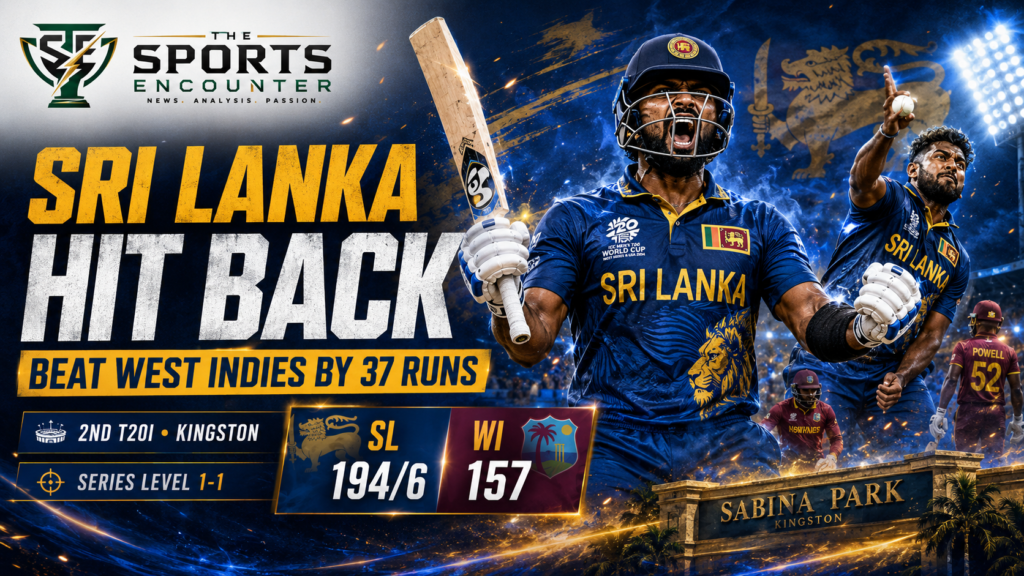
Sri Lanka needed a response. They got one with power and nerve of Dasun Shanaka, and a bowling performance that never allowed West Indies to turn a big chase into a proper finish.

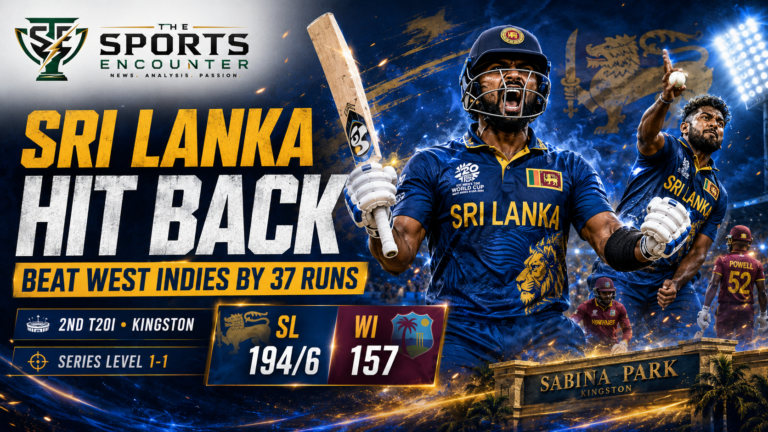
After losing the first T20I, Sri Lanka bounced back strongly at Sabina Park, beating West Indies by 37 runs in the second T20I to level the three-match series 1-1. The visitors posted 194/6 in 20 overs, then bowled West Indies out for 157 in 18.1 overs.

For more international cricket coverage, follow The Sports Encounter’s Cricket Hub.

This was not only a comeback win. It was Sri Lanka’s reminder that they can still hurt teams in short bursts when their middle order fires and their attack finds rhythm.

Match Summary

Sri Lanka: 194/6 in 20 overs
West Indies: 157 all out in 18.1 overs
Result: Sri Lanka won by 37 runs
Venue: Sabina Park, Kingston
Series: Three-match T20I series level 1-1
Player of the Match: Dasun Shanaka

West Indies won the toss and chose to field first, backing themselves to chase under lights. For a while, that decision looked reasonable. Sri Lanka needed stability, then acceleration. They found both in the middle and death overs.

By the end of the night, the target had grown too heavy for a West Indies batting lineup that lost shape after the powerplay.

Dasun Shanaka Changes the Match Tempo

Every T20 game has a moment where the rhythm changes. In Kingston, that moment arrived when Dasun Shanaka took control.

Sri Lanka were building, but they needed a final push to move from competitive to dangerous. Shanaka supplied it. His hitting changed the scoreboard pressure and turned the West Indies chase into a bigger test than the home side would have expected after choosing to bowl first.

Shanaka did not just score quickly. He shifted the emotional weight of the match.

West Indies had to chase almost 10 an over from the start. That changes how batters think. It turns good balls into pressure balls. It turns dot balls into mini-wickets. It forces risks earlier than planned.

ALSO READ: Jason Holder Propels West Indies to T20I win over Sri Lanka

That was the hidden value of Shanaka’s innings. He made West Indies chase the game before they had properly started chasing the target.

Kamil Mishara Gives Sri Lanka the Base

Sri Lanka’s total was not built on late hitting alone.

Kamil Mishara played a key role in giving the innings enough structure before the finish. His half-century helped Sri Lanka avoid the stop-start pattern that can ruin T20 innings in the Caribbean, especially when the surface offers enough variation to keep bowlers interested.

Mishara’s role mattered because Sri Lanka needed someone to hold the innings together while the power hitters prepared to launch.

That combination worked beautifully. Mishara provided the runway. Shanaka took off.

Together, they gave Sri Lanka the type of total that forced West Indies into a high-risk chase.

West Indies Start Fast, Then Lose Control

West Indies did not begin like a side short on belief.

Rovman Powell gave the chase life with an aggressive 43, and the home side had enough power in the lineup to keep the crowd interested. In T20 cricket, 195 is a hard chase, but never an impossible one when West Indies are swinging freely.

The problem was control.

West Indies lost early wickets. The required rate kept climbing. Every recovery was followed by another setback. Once Sri Lanka’s bowlers found their lines, the chase became less about timing the assault and more about surviving long enough to make one possible.

That never really happened.

A chase like this needs two things: one batter going deep and enough support around him. West Indies got glimpses, not a full innings. Against a Sri Lankan attack that sensed weakness, glimpses were not enough.

Sri Lanka’s Bowlers Finish the Job

The batting gave Sri Lanka a strong chance. The bowlers made sure it became a win.

Dushmantha Chameera and Wanindu Hasaranga were central to the squeeze. Chameera’s pace and wicket-taking threat gave Sri Lanka early control, while Hasaranga’s middle-over threat kept West Indies from settling into a clean rhythm.

Once the chase fell behind, Sri Lanka’s fielders could attack the ball, the bowlers could protect bigger boundaries, and West Indies had to keep forcing shots.

That is when Sri Lanka looked most comfortable.

They did not allow the chase to drift. They kept taking wickets at the right time, broke partnerships before they became dangerous, and made West Indies pay for every mistimed shot.

Why This Win Matters for Sri Lanka and Dasun Shanaka

This result matters because Sri Lanka had already made a strong statement in the ODI leg of the tour.

They won the ODI series 1-0 after rain washed out the second and third matches, ending a long wait for a series win in the Caribbean. But T20 cricket brings a different challenge. West Indies are traditionally dangerous in this format, especially at home.

That is why this response matters.

After losing the first T20I, Sri Lanka could have let the series slip away quickly. Instead, they reset. They batted with more intent, defended with discipline, and made sure the final T20I will now carry real weight.

The tour has already shown that Sri Lanka are becoming harder to put away. This win adds another layer to that pattern.

You can also connect this article internally to The Sports Encounter’s earlier coverage of Bangladesh’s rise and Australia’s narrow escape in Dhaka, as both stories fit the broader theme of Asian sides pushing stronger narratives in international cricket.

What Went Wrong for West Indies?

West Indies will look at this match with frustration.

They had the toss. They had home conditions. They had power in the batting lineup. Yet they were never fully in control after Sri Lanka crossed 190.

What Went Wrong for West Indies Against Sri Lanka?

The bowling allowed Sri Lanka too much momentum at the back end. The batting then failed to build one decisive partnership. Powell gave them a chance, but nobody turned the chase into a long, controlled assault.

That is where the match slipped.

In T20 cricket, losing by 37 runs after chasing 195 means the problem was not only the target. It was the inability to stay close enough for the final overs to matter.

West Indies did not lose because one thing went wrong. They lost because several small failures stacked up quickly.

Key Takeaways

Sri Lanka’s middle order won the night.
Mishara set the base and Shanaka gave the innings its explosion.

Dasun Shanaka’s impact went beyond runs.
His acceleration changed the pressure equation and forced West Indies into a risky chase.

West Indies lacked a deep chase anchor.
Powell fought hard, but the home side needed one batter to bat longer.

Sri Lanka’s bowlers protected the total smartly.
They took wickets regularly and stopped West Indies from turning pressure into momentum.

The series is alive.
With the T20I series level at 1-1, the final match now becomes a proper decider.

FAQs

Who won the West Indies vs Sri Lanka 2nd T20I?

Sri Lanka won the second T20I by 37 runs at Sabina Park in Kingston.

What was the West Indies vs Sri Lanka 2nd T20I score?

Sri Lanka scored 194/6 in 20 overs. West Indies were bowled out for 157 in 18.1 overs.

Who was Player of the Match?

Dasun Shanaka was named Player of the Match.

What is the series score after the second T20I?

The three-match T20I series is level 1-1.

Why was Sri Lanka’s win important?

Sri Lanka’s win kept the T20I series alive and showed strong character after losing the first match.

Final Verdict

Sri Lanka did more than win a T20I in Kingston.

They answered a setback.

They batted with authority, defended with discipline, and forced West Indies into a chase that never quite found its shape. Shanaka gave the innings its punch. Mishara gave it stability. The bowlers gave it meaning.

West Indies will feel they missed a chance to seal the series early. Sri Lanka will feel they have turned the pressure back on the hosts.

One match left.

Everything to play for.

Head of Content Operations. Jawad Hussain oversees content operations, editorial planning, publishing structure, and long-form storytelling for The Sports Encounter. His focus is on building a credible sports media platform with clear categories, strong editorial standards, consistent publishing, and fan-focused analysis. Coverage areas: content operations, cricket, sports analysis, editorial features, global tournaments, publishing strategy.

Cricket

Tim Robinson Explodes as Unicorns Thump Vipers to Enter the Global Super League Final

Tim Robinson struck an unbeaten 68 as San Francisco Unicorns defeated Desert Vipers by eight wickets in the Global Super League Qualifier, setting up a final against Guyana Amazon Warriors.

Marcos Wetherfield | The Sports Encounter

Published

on

San Francisco Unicorns turned one of their most painful defeats of the Global Super League into the performance that saved their tournament.

Four days after Desert Vipers dismantled them by nine wickets at Providence, the Unicorns returned to the same ground, controlled the Qualifier from the opening overs, and completed a commanding eight-wicket victory with 23 balls remaining.

Tim Robinson anchored the chase with an unbeaten 68 from 54 deliveries as San Francisco reached 126 for two in 16.1 overs, comfortably overhauling the Vipers’ modest 122 for seven.

The result sends the Unicorns into the Global Super League final against defending champions Guyana Amazon Warriors, giving the Major League Cricket representatives an immediate opportunity to avenge another earlier defeat.

Robinson was named Player of the Match after combining his composed half-century with two catches in the field. His innings contained eight fours and one six, but its real value came from the calm he brought after San Francisco lost two wickets in three balls.

Oliver Peake finished unbeaten on 33 from 31 deliveries and shared an unbroken 97-run third-wicket partnership with Robinson. Together, they turned what could have become a nervous chase into a controlled procession.

Readers can follow the tournament, franchise cricket, and international match coverage through The Sports Encounter’s Cricket Hub.

Global Super League Qualifier Match Summary

Match detail Information
Competition Global Super League 2026, Qualifier
Match Desert Vipers vs San Francisco Unicorns
Venue Providence Stadium, Guyana
Date July 31, 2026
Desert Vipers 122/7 in 20 overs
San Francisco Unicorns 126/2 in 16.1 overs
Result San Francisco Unicorns won by eight wickets
Balls remaining 23
Player of the Match Tim Robinson, 68 not out from 54 balls and two catches
Best bowling Fabian Allen, 3/20
Key partnership Tim Robinson and Oliver Peake, unbeaten 97
Next match Global Super League final against Guyana Amazon Warriors

Unicorns Respond to Their Earlier Humiliation

This was more than a routine knockout victory.

When the teams met during the league stage, Desert Vipers restricted San Francisco to 151 for seven before chasing the target in only 16.1 overs for the loss of one wicket.

Shadab Khan dominated that match with four wickets for 13 runs, while 19-year-old Zachary Carter struck 55 from 29 deliveries during a nine-wicket victory that revived the Vipers’ tournament.

The Sports Encounter documented how Shadab and Carter rescued the Desert Vipers’ GSL campaign through one of the most complete performances of the league stage.

The Qualifier produced an almost complete reversal.

San Francisco won the toss, chose to field, squeezed the Vipers through the middle overs, and completed their chase in exactly 16.1 overs, the same point at which the Vipers had finished their earlier pursuit.

That symmetry told the story of a team that had learned quickly.

Hassan Khan’s side did not allow the previous defeat to dictate the rematch. The Unicorns changed the pace of the contest, attacked with spin, held their catches, and forced the Vipers into a style of batting that never suited the pressure of a knockout match.

Vipers Lose Momentum Before They Can Build It

Desert Vipers never found a stable tempo after being asked to bat first.

Andries Gous fell for eight in the third over, caught by Peter Siddle off Fabian Allen. Rilee Rossouw briefly threatened to increase the scoring rate with 11 from seven balls, including a four and a six, but Anirudh Immanuel removed him with the total on 29.

The innings then became trapped between survival and acceleration.

Zachary Carter made 15 from 23 deliveries, while captain Shadab Khan required 24 balls for his 14. Their partnership occupied valuable time without creating the platform required for a strong finish.

Carter’s strike rate of 65.21 and Shadab’s 58.33 left the middle and lower order with too much repair work. By the time Kyle Mayers was dismissed for 15 in the 13th over, the Vipers were only 61 for four.

San Francisco understood that wickets were more valuable than chasing dot-ball perfection. The bowlers offered few easy boundary deliveries and kept inviting the batters to force shots against a Providence surface that rewarded patience and changes of pace.

The Vipers reached only 81 for six after Bevon Jacobs fell in the 17th over.

At that point, a total near 110 appeared possible.

Vriitya Aravind prevented a complete collapse with an unbeaten 29 from 20 balls. His five boundaries gave the innings some late life, while Khary Pierre contributed eight from six and Sanjay Pahal struck five from two deliveries.

The Vipers scored 41 runs from their final 23 balls, but the late recovery could not disguise the damage caused earlier.

A total of 122 left almost no room for defensive mistakes.

Fabian Allen Changes the Match

Fabian Allen delivered the most influential bowling performance of the night.

The left-arm spinner finished with three for 20 from four overs, dismissing Gous, Shadab, and Jacobs. Those wickets came at three different stages of the innings and prevented the Vipers from developing any meaningful continuity.

Allen removed Gous before the opener could settle, returned to dismiss Shadab when the captain was attempting to rebuild, and then ended Jacobs’ effort just as the batter threatened to accelerate.

His economy rate of five runs per over was impressive, but the timing of his wickets mattered more.

Hassan Khan also produced an outstanding spell, conceding only 14 runs from four overs and removing Mayers. Immanuel matched those figures with one for 14, while Karima Gore needed only one over to claim Carter’s wicket for four runs.

Together, Allen, Hassan, Immanuel, and Gore bowled 13 overs for 52 runs and took all six wickets credited to bowlers.

That collective return decided the match.

Peter Siddle and Callum Stow conceded 70 runs between them from seven overs without taking a wicket, yet the pressure created by the slower bowlers ensured those expensive overs never became part of a sustained Vipers surge.

San Francisco’s attack demonstrated an important T20 principle: every bowler does not need to dominate when the team’s strongest matchup is used correctly and for long enough.

Early Wickets Give the Vipers Brief Hope

A target of 123 should have been comfortable, but the Vipers briefly created an opening.

Connor Esterhuizen began aggressively, striking 17 from 10 balls with two fours and a six. His intent helped San Francisco move quickly to 29, reducing the pressure on Robinson.

Khary Pierre then changed the atmosphere.

The spinner bowled Esterhuizen for 17 and dismissed captain Hassan Khan for a two-ball duck later in the same over. San Francisco had lost two wickets without adding a run.

At 29 for two after 4.4 overs, the Vipers had their only genuine chance to make the chase uncomfortable.

Another wicket could have exposed a middle order that had experienced collapses earlier in the tournament.

Robinson and Peake refused to offer it.

Robinson Chooses Control Over Drama

Robinson’s innings was built for the situation rather than the highlight reel.

He had already scored 48 against the Vipers in the league-stage defeat, making him San Francisco’s leading batter in both meetings between the teams. This time, he converted his start and remained at the crease until the match was finished.

His half-century came from 48 balls, reflecting the measured nature of the chase. With the required rate barely above six runs per over, there was no reason to manufacture risks against Pierre or attack every delivery from the other spinners.

Robinson waited for errors, rotated the strike, and punished width when it appeared.

Thirty-eight of his 68 runs came in boundaries. The remaining 30 were accumulated through running and strike management, an important detail on a night when the chase required discipline more than explosive power.

Peake played the supporting role intelligently.

The young Australian scored 33 from 31 balls, hitting two fours and two sixes. He did not attempt to match Robinson shot for shot. Instead, he absorbed pressure, targeted selected bowlers, and ensured the Vipers could not create another opening.

Their unbeaten partnership added 97 runs after the double strike at 29.

San Francisco passed 50 in 7.1 overs, reached 78 for two at the halfway stage, and crossed 100 at the end of the 14th over. By then, the outcome had become a matter of timing rather than uncertainty.

Robinson completed the chase in the 17th over, delivering the controlled finish his team had lacked in several earlier passages of the tournament.

Shadab’s Difficult Night Captures the Vipers’ Decline

Shadab Khan had been the central figure in the Vipers’ league-stage victory over San Francisco.

In the Qualifier, his influence disappeared.

He scored 14 from 24 balls, failed to hit a boundary, and conceded 41 runs from four wicketless overs. The Unicorns targeted his bowling more successfully than any other part of the Vipers’ attack.

Shadab’s economy rate of 10.25 was the most expensive among the specialist bowlers who completed four overs.

The contrast with his earlier four-wicket performance was striking.

San Francisco appeared better prepared for his variations, avoided giving him easy dismissals, and forced him to bowl under the pressure of defending a small total. Robinson and Peake were content to wait when the delivery was difficult and attack whenever the length became hittable.

Pierre offered the Vipers some resistance with two for 22, but he could not bowl from both ends.

Vitel Lawes conceded 27 from four overs, Carter gave away 25 from 3.1, and the Unicorns never allowed the required rate to become a factor.

Desert Vipers’ Tournament Ends After a Dramatic Recovery

The Vipers’ elimination will feel particularly painful because they had fought their way back into contention after a difficult start.

They lost their first two matches before Shadab and Carter inspired the nine-wicket victory over San Francisco.

Rilee Rossouw then scored a vital half-century as the Vipers survived Akeal Hosein’s four-wicket spell to defeat Perth Scorchers XI by one wicket. That final-over thriller kept their qualification hopes alive and demonstrated the resilience of a side that had appeared close to elimination.

The full story of that escape can be revisited in The Sports Encounter’s report on how the Vipers survived Akeal Hosein and Perth in a one-wicket GSL thriller.

The Qualifier presented a different challenge.

San Francisco’s slower bowlers denied Rossouw and Shadab the influence they had enjoyed earlier in the tournament. Aravind’s late effort offered hope, but the Vipers had already conceded too much control during the first 16 overs.

San Francisco’s Tournament Has Been Built on Recovery

The Unicorns’ path to the final has rarely been comfortable.

They lost their opening encounter against Guyana Amazon Warriors by three wickets under the DLS method after making 156 for six.

The hosts recovered from 107 for seven to complete the chase, with Rovman Powell remaining unbeaten on 29 and Matthew Forde striking the winning boundary.

That dramatic opening meeting is covered in The Sports Encounter’s report on how Rovman Powell carried Guyana past San Francisco in a rain-shortened chase.

The Unicorns then survived a five-run thriller against Perth Scorchers.

Hammad Azam rescued the innings with an unbeaten 64 after San Francisco slipped to 46 for four, while Ghulam Mudassar took four wickets to defend 152.

Their nine-wicket league-stage defeat to the Vipers exposed major weaknesses, particularly against Shadab and during the middle overs. The Qualifier showed how effectively the team responded.

This has become a campaign defined by repair.

Different players have carried the side at different moments. Hammad rescued them against Perth. Mudassar defended a modest total. Robinson then controlled the most important chase of their GSL campaign.

That variety gives San Francisco a credible chance in the final.

Guyana Amazon Warriors Await in the Final

The Unicorns will now face the tournament’s strongest and most settled team.

Guyana Amazon Warriors entered the competition as defending champions and secured direct qualification for the final by finishing at the top of the league standings.

The competition format awarded the leading team automatic entry into the championship match, while the second- and third-placed sides contested the Qualifier to determine the other finalist.

Schedules, results, tournament information, and official updates are available through the official Global Super League website.

The Warriors have already beaten San Francisco once, but that earlier meeting also showed that the hosts can be placed under severe pressure.

The Unicorns reduced Guyana to 107 for seven before allowing the chase to escape. Their challenge in the final will be to finish the moments they created in the league game.

Providence will bring another layer of difficulty.

Guyana will have the local crowd, greater familiarity with the conditions, and the confidence of defending champions. San Francisco, however, enter the final with fresh evidence that earlier results do not have to define knockout matches.

They have already reversed a nine-wicket defeat against the Vipers.

Now they must attempt the same transformation against the Warriors.

Guyana’s Final League Match Exposed a Possible Weakness

Guyana may have finished at the top of the table, but their passage into the final was not flawless.

Perth Scorchers XI defeated the Warriors by 14 runs after recovering from 78 for eight to score 135. Brody Couch made 43 from 29 balls before Perth’s spinners bowled Guyana out for 121 in 16.1 overs.

The Sports Encounter’s report on how Perth’s spin attack silenced Guyana at Providence provides San Francisco with a useful tactical reference before the final.

Guyana’s top order can be dangerous, particularly when Rahmanullah Gurbaz establishes an early tempo. However, the Perth defeat showed that their batting can unravel when several spin options operate accurately through the middle overs.

San Francisco’s performance against the Vipers suggests they possess the resources to test that vulnerability.

Allen, Hassan, Immanuel, and Gore combined for six wickets and conceded only 52 runs from 13 overs in the Qualifier. Repeating that level of control against Guyana would give the Unicorns a genuine route to the title.

What San Francisco Must Do Differently in the Final

The league-stage meeting with Guyana offered San Francisco both encouragement and warning.

Robinson attacked early, Hammad Azam built an unbeaten 61, and the Unicorns reached 156 for six. Their bowlers then reduced the Warriors to seven wickets down.

The decisive problem was their inability to close the match.

Powell remained calm while wickets fell around him, and San Francisco conceded enough boundaries during the final phase to lose with three deliveries remaining.

The Unicorns must improve in four areas:

  • Protect wickets during the powerplay: Losing two or three early wickets would allow Guyana’s experienced spinners to dictate the middle overs.
  • Attack the middle overs selectively: Robinson and Peake showed against the Vipers that controlled batting can be more valuable than constant aggression.
  • Use spin as the primary pressure weapon: Guyana’s defeat to Perth and the Qualifier both showed how effective slower bowling can be at Providence.
  • Finish the chase or defense: Creating pressure will not be enough if Powell or another experienced Guyana batter remains at the crease.

Providence Continues to Reward Adaptability

The 2026 Global Super League has repeatedly shown that Providence cannot be approached with a single batting formula.

Lahore Qalandars began the tournament by scoring 171 for seven before defeating Perth by 16 runs. The Sports Encounter covered how Farhan Yousaf announced his arrival in the GSL opener with an explosive half-century.

A day later, Michael Bracewell and Usama Mir helped Lahore defeat the Vipers by 38 runs. That performance, detailed in our report on how Bracewell led Lahore from the front at Providence, demonstrated how quickly an innings can collapse once spin gains control.

Later matches produced totals of 112, 122, 135, and 152, reinforcing the importance of reading the pitch rather than relying on a fixed target.

San Francisco handled that challenge correctly in the Qualifier. They recognized that 123 did not require reckless acceleration, absorbed Pierre’s double strike, and allowed Robinson to pace the chase around the required rate.

The final may demand a different approach.

San Francisco Carry Major League Cricket Experience

The Unicorns also bring experience from a highly competitive American franchise system.

Major League Cricket’s recent season produced several close finishes, including a one-run championship match won by Los Angeles Knight Riders.

The Sports Encounter’s report on the Los Angeles Knight Riders’ dramatic MLC final victory highlighted how small tactical decisions can determine a title match.

San Francisco will need the same awareness at Providence.

One loose over, a missed catch, or an unnecessary middle-over dismissal could separate the champion from the runner-up. The Unicorns’ Qualifier performance showed they can execute under pressure, but Guyana will present a deeper batting order and a more experienced bowling attack.

Key Statistics From the Qualifier

  • San Francisco Unicorns won by eight wickets with 23 balls remaining.
  • Tim Robinson scored an unbeaten 68 from 54 balls, including eight fours and one six.
  • Oliver Peake made 33 not out from 31 deliveries.
  • Robinson and Peake shared an unbeaten 97-run third-wicket partnership.
  • Fabian Allen took three wickets for 20 runs from four overs.
  • Hassan Khan and Anirudh Immanuel each conceded only 14 runs from four overs.
  • Vriitya Aravind top-scored for the Vipers with an unbeaten 29 from 20 balls.
  • Shadab Khan scored 14 from 24 balls and conceded 41 runs from four wicketless overs.
  • Khary Pierre claimed both San Francisco wickets and finished with two for 22.
  • The Unicorns reached their target at a run rate of 7.79 per over.

Final Verdict

The scorecard will show an eight-wicket victory completed with 23 balls remaining.

The deeper story is how thoroughly San Francisco corrected the failures of their previous meeting with Desert Vipers.

Their spinners controlled the innings. Allen delivered wickets at crucial stages. Robinson absorbed the pressure created by Pierre’s double strike. Peake stayed with him, and the chase never drifted into panic.

Desert Vipers will regret the 70 deliveries consumed by Carter, Shadab, and Mayers for only 44 runs. Aravind’s late assault gave the total some respectability, but knockout cricket rarely forgives an innings that spends too long searching for momentum.

The Unicorns were sharper, calmer, and more adaptable.

They arrived at Providence carrying the memory of a heavy defeat and left with a place in the Global Super League final.

Guyana Amazon Warriors are next, and San Francisco have already learned the most valuable lesson of their campaign: in a knockout match, the first result does not get a vote.

Frequently Asked Questions

Who won the Global Super League Qualifier between Desert Vipers and San Francisco Unicorns?

San Francisco Unicorns defeated Desert Vipers by eight wickets in the Global Super League Qualifier at Providence Stadium. The Unicorns chased 123 in 16.1 overs with 23 balls remaining.

Who was Player of the Match in the Vipers vs Unicorns Qualifier?

Tim Robinson was named Player of the Match after scoring an unbeaten 68 from 54 balls and taking two catches during the Desert Vipers innings.

How many runs did Tim Robinson score against Desert Vipers?

Tim Robinson scored 68 not out from 54 deliveries, including eight fours and one six. He also shared an unbeaten 97-run partnership with Oliver Peake.

What was the key partnership in San Francisco Unicorns’ chase?

Tim Robinson and Oliver Peake added an unbeaten 97 runs for the third wicket after San Francisco had slipped to 29 for two.

Who was the best bowler for San Francisco Unicorns?

Fabian Allen was the leading bowler for the Unicorns, taking three wickets for 20 runs from four overs. Hassan Khan and Anirudh Immanuel also conceded only 14 runs each from their four-over spells.

Why did Desert Vipers score only 122?

The Vipers struggled to build momentum through the middle overs. Zachary Carter, Shadab Khan, and Kyle Mayers consumed 70 balls for only 44 runs combined, leaving the lower order with too much work to do late in the innings.

Who top-scored for Desert Vipers?

Vriitya Aravind top-scored with an unbeaten 29 from 20 balls. His late boundaries helped the Vipers recover from 81 for six to 122 for seven.

How did Khary Pierre perform in the Qualifier?

Khary Pierre took both San Francisco wickets and finished with figures of two for 22 from four overs. He dismissed Connor Esterhuizen and Hassan Khan in the same over.

Why was Shadab Khan unable to influence the Qualifier?

Shadab struggled with both bat and ball. He scored 14 from 24 deliveries without a boundary and conceded 41 runs from four wicketless overs.

Who will San Francisco Unicorns face in the Global Super League final?

San Francisco Unicorns will face Guyana Amazon Warriors in the Global Super League final.

Why did Guyana Amazon Warriors qualify directly for the final?

Guyana Amazon Warriors finished at the top of the league standings. Under the tournament format, the first-placed team advanced directly to the final, while the second- and third-placed teams contested the Qualifier.

Where will the Global Super League final be played?

The final will be played at Providence Stadium in Guyana, the main venue for the 2026 Global Super League.

When is the Global Super League final?

The final is scheduled for Sunday, with San Francisco Unicorns facing defending champions Guyana Amazon Warriors.

Did Desert Vipers beat San Francisco Unicorns earlier in the tournament?

Yes. Desert Vipers defeated San Francisco Unicorns by nine wickets during the league stage before the Unicorns reversed the result in the Qualifier.

Has San Francisco Unicorns already played Guyana Amazon Warriors in GSL 2026?

Yes. Guyana Amazon Warriors defeated San Francisco by three wickets under the DLS method during the league stage.

What must San Francisco Unicorns improve before the final?

The Unicorns must protect early wickets, use their spin attack effectively, and finish decisive moments more clinically than they did in their earlier defeat to Guyana.

Continue Reading

Cricket

Marcus Stoinis Turns 128 Into History as Southern Brave Finally Break Through Against Birmingham Phoenix

Southern Brave finally broke their losing run as Marcus Stoinis and a disciplined bowling attack defended 128 against Birmingham Phoenix at the Utilita Bowl.

Published

on

Marcus Stoinis celebrates Southern Brave’s 12-run victory over Birmingham Phoenix after scoring 34 and taking 2 for 16 in The Hundred 2026 at Southampton.

Southern Brave had spent the opening phase of The Hundred 2026 discovering increasingly painful ways to lose.

They had been beaten on the same Southampton ground by Welsh Fire, then carried MI London to the final ball without finding the finish. Their batting remained uncertain, their points column stayed empty, and another modest total against Birmingham Phoenix appeared to have left them exposed once again.

This time, Brave refused to let the game slip.

Marcus Stoinis scored 34 from 26 balls before producing a remarkably controlled spell of 2 for 16 as Southern Brave defended 128 for eight to defeat Birmingham Phoenix by 12 runs in Match 13 of The Hundred 2026 at the Utilita Bowl.

Phoenix needed only 129 from 100 balls, a required rate of 1.29 runs per delivery. They never truly controlled the chase. Regular wickets, poor tempo through the middle, and 60 dot balls across the innings left them stranded on 116 for nine.

The result gave Southern Brave their first men’s victory of the season and created a piece of tournament history. Their total of 128 became the lowest successfully defended score in the men’s competition.

For a side that had repeatedly fought without reward, the relief around Southampton was understandable.

TL;DR

  • Southern Brave defeated Birmingham Phoenix by 12 runs at the Utilita Bowl.
  • Brave scored 128 for eight from their 100 balls.
  • Phoenix finished on 116 for nine despite needing fewer than 1.3 runs per ball.
  • Marcus Stoinis was named Match Hero after scoring 34 and taking 2 for 16.
  • Luke Wood claimed 3 for 24, including two wickets in the final five balls.
  • Jofra Archer conceded only 21 runs and delivered 12 dot balls.
  • Rehan Ahmed took 3 for 25 during Brave’s innings.
  • Will Smeed top-scored for Phoenix with 35 from 28 balls.
  • Brave’s 128 was the lowest successful defense in the history of the men’s Hundred.
  • Southern Brave collected four points, while Birmingham Phoenix received none.

Southern Brave vs Birmingham Phoenix Match Summary

Match DetailInformation
CompetitionThe Hundred Men’s Competition 2026
MatchMatch 13
DateJuly 30, 2026
VenueUtilita Bowl, Southampton
TossBirmingham Phoenix elected to field
Southern Brave128/8 from 100 balls
Birmingham Phoenix116/9 from 100 balls
ResultSouthern Brave won by 12 runs
Match HeroMarcus Stoinis, 34 and 2/16
Attendance11,181
PointsSouthern Brave 4, Birmingham Phoenix 0

Brave’s Batting Never Looked Comfortable

Birmingham Phoenix captain Donovan Ferreira chose to field first, a decision that appeared sensible almost immediately.

The Southampton surface looked fresh, but it did not reward free-flowing stroke play. The ball gripped, held in the pitch, and occasionally arrived more slowly than the batters expected. Southern Brave had already learned how demanding the Utilita Bowl could be during their earlier defeat to Welsh Fire, when Phil Salt adapted better than anyone else to another awkward chase.

Jamie Smith began positively with a boundary but fell after five balls, caught by Mitchell Owen off Ben Dwarshuis for six.

Ben McKinney offered a brief burst of aggression. His 18 from nine balls included two fours and a six, and he helped Brave reach 38 for one at the end of the 25-ball powerplay.

The innings did not accelerate from there.

McKinney fell to Owen at 40, while Tom Abell struggled to turn a start into momentum. Abell made 22 from 19 balls before Rehan Ahmed had him stumped by Joe Clarke.

Brave were 55 for three after 44 deliveries. Their scoring rate remained manageable, but there was no clear path toward a total that looked safe.

Stoinis Builds the Only Substantial Innings

Stoinis entered with Brave needing control and enough power to prevent the innings from drifting.

He provided both, although the conditions never allowed him to dominate completely.

The Australian all-rounder scored 34 from 26 balls, striking two fours and two sixes. His innings was the highest score of the match for Brave and represented the closest thing either side produced to a complete batting performance.

Stoinis did not simply swing at every ball. He accepted the difficulty of the surface, waited for hittable lengths, and tried to preserve enough wickets for the final phase.

He added 32 with Abell before joining David Miller in another useful partnership. Brave reached 87 for three after 64 balls, which placed them in position to push toward 145 if one batter could stay until the end.

Rehan Ahmed prevented that possibility.

Stoinis attempted to attack the leg-spinner and was caught by Ferreira for 34. Rehan then removed Tristan Stubbs for five, completing a highly effective middle-overs spell.

His 3 for 25 from 20 balls was the best bowling return of the first innings. The performance continued Rehan’s growing influence as an all-rounder, although his later dismissal during the chase would become one of several moments when Phoenix lost control.

Miller Cannot Find a Final Surge

David Miller occupied the crease for 21 balls but never fully escaped the pressure created by Phoenix’s slower bowlers and boundary protection.

He made 24 without hitting a four, with his only six providing a rare release. His strike rate of 114.28 was understandable in the conditions, yet Brave needed someone to find 15 or 20 more runs during the closing phase.

Instead, the innings stalled badly.

Chris Jordan fell for three, Miller was dismissed at 116, and Jofra Archer was run out two balls later without scoring. Brave had slipped from 104 for four to 116 for eight.

Luke Wood’s late 10 from five balls, including a six, lifted the total to 128. Those runs appeared minor at the time. By the end of the evening, they looked invaluable.

Brave finished with only 11 boundaries across the innings: seven fours and four sixes. Phoenix produced an excellent collective bowling display, with Dwarshuis taking 2 for 18 and conceding only 0.90 runs per ball.

Usman Tariq also impressed without taking a wicket, allowing only 17 runs from 20 balls. Owen conceded four from his five, while Ferreira gave up seven from five.

The contrast with Birmingham’s explosive opening win over Trent Rockets could hardly have been sharper. In that match, Phoenix produced one of the season’s most entertaining batting displays, a performance explored in The Sports Encounter’s report on their early Hundred campaign.

At Southampton, they were asked to win through patience instead.

A Target That Should Have Been Manageable

A chase of 129 from 100 balls should offer a team several routes to victory.

Phoenix did not need one batter to score 70. They did not require constant six-hitting or a reckless powerplay. A controlled sequence of partnerships, with the required rate held close to one run per ball, should have been enough.

The match instead became a lesson in how dot balls and regular wickets can distort even a modest chase.

Jofra Archer and Luke Wood immediately established the tone. Archer’s pace and hard lengths made scoring uncomfortable, while Wood attacked the stumps and used changes of pace effectively.

Joe Clarke managed only seven from 10 balls before Stoinis removed him, caught by Stubbs. Phoenix completed the powerplay on 28 for one, exactly 10 runs behind Brave’s powerplay score.

The difference was not decisive. The lack of rhythm was more concerning.

Smeed Starts, Then Leaves Too Soon

Will Smeed played the most substantial Phoenix innings, scoring 35 from 28 balls with three fours and a six.

He looked capable of controlling the chase once he settled, but his dismissal arrived before Phoenix had established a secure platform.

Wood removed him at 52 after 47 balls, with Miller taking the catch. Phoenix still needed 77 from 53 deliveries, an entirely achievable equation with nine wickets initially available.

Rehan Ahmed joined Smeed in a 24-run partnership but scored only 16 from 16 balls. His innings included one six but no four, an indication of how difficult it was to rotate the strike cleanly.

Chris Jordan dismissed Rehan at 64, and three balls later the chase suffered its sharpest blow.

Ferreira was bowled by Archer for one.

Phoenix had lost two wickets for one run and slipped to 65 for four after 61 balls.

The game had not escaped them yet. They needed 64 from 39 balls. The required rate remained below 1.65 runs per ball, but every new batter now had to begin against a bowling attack that fully understood the pitch.

Stoinis Uses His Batting Knowledge With the Ball

Stoinis later explained that batting first had helped him understand which areas were hardest to score from.

That knowledge shaped his bowling.

Rather than searching for dramatic movement or excessive variation, he relied on consistency and subtle changes of pace. He targeted difficult lengths, denied the batters room, and forced Phoenix to manufacture shots.

His dismissal of Laurie Evans was especially important.

Evans had accelerated with 18 from 11 balls, including three fours. He appeared capable of giving the chase the momentum it had lacked. Stoinis removed him at 83 after 70 balls, with Jamie Smith taking the catch.

That wicket left Phoenix needing 46 from 30.

Stoinis completed his full 20-ball allocation with 13 dot balls, two wickets, and only 16 runs conceded. His economy of 0.80 runs per ball was extraordinary in a match where Phoenix’s target should have allowed them to attack selectively.

His all-round contribution also continued the form he had shown in Southern Brave’s last-ball defeat to MI London, when he took 3 for 17 and nearly rescued another low total. The Sports Encounter analyzed that earlier performance in its report on Will Jacks holding MI London together against Brave.

This time, Stoinis had enough support to finish the job.

Rashid Tightens the Middle Overs

Adil Rashid’s figures were almost as influential as Stoinis’.

The experienced leg-spinner conceded only 18 from 20 balls, delivered 10 dots, and dismissed Mitchell Owen for seven.

Owen tried to break the pressure with a six but was bowled soon afterward. Phoenix were 89 for six after 77 balls, leaving them 40 runs short with 23 balls remaining.

Sean Dickson remained, and his unbeaten 20 from 13 gave Birmingham a faint route back into the game. His innings included one four and two sixes, providing the late power that had been missing earlier.

Dickson found little support.

Dwarshuis made four from eight balls. The lower order could not rotate the strike, while Wood continued attacking the stumps and forcing mistakes.

The Final Five Balls Confirm Brave’s Breakthrough

Phoenix reached 115 for six after 95 balls, requiring 14 from the final five.

The equation remained difficult but not impossible, particularly with Dickson at the crease.

Wood removed Dwarshuis on ball 96, caught by Miller. Scott Currie was then caught behind from the next delivery without scoring.

Saqib Mahmood was run out on ball 98, with Rashid completing the fielding play.

Three wickets had fallen without the score moving.

Phoenix managed only one run from the last two balls and closed on 116 for nine.

Wood finished with 3 for 24 from 20 balls. His final set turned a tense defense into a decisive 12-run victory.

Why Phoenix Lost a Chase They Should Have Controlled

Birmingham’s failure cannot be explained by one dismissal.

The larger problem was tempo.

Phoenix faced 60 dot balls across the innings. That meant three-fifths of their chase produced no run. In a pursuit of 129, the target should have allowed them to avoid desperate hitting, but the accumulation of dots kept transferring pressure to the next delivery and the next batter.

Only Evans and Dickson scored at better than 1.5 runs per ball. Clarke, Rehan, Ferreira, Owen, Dwarshuis, Currie, and Mahmood combined for 35 runs from 49 balls.

Phoenix also failed to build one defining partnership.

Their best stand was 24 between Smeed and Rehan. Southern Brave did not allow any pair to settle long enough to take ownership of the chase.

The contrast with other successful chases in the tournament is significant. Nicholas Pooran and Sam Curran added an unbeaten 93 from 40 balls when MI London recovered from early trouble against Sunrisers Leeds. Phil Salt stayed to the end against Brave, while Will Jacks anchored MI London’s tense chase in Southampton.

Phoenix had starts. They lacked a batter willing and able to remain until the target was almost finished.

Brave’s Bowlers Win Through Collective Control

BowlerBallsRunsWicketsDot Balls
Luke Wood202437
Jofra Archer2021112
Marcus Stoinis2016213
Adil Rashid2018110
Chris Jordan203515

The figures show how completely Brave controlled the game.

Archer, Stoinis, and Rashid conceded a combined 55 runs from 60 balls while delivering 35 dots. Wood supplied the wickets at the end. Jordan was the only bowler to concede more than 1.2 runs per delivery, but he still removed Rehan at an important stage.

Brave’s attack understood that the pitch rewarded patience. They did not chase magic balls or allow the frustration of defending 128 to affect their plans.

That composure was missing in earlier defeats. It was the central reason they finally reached the points column.

Marcus Stoinis Deserved the Match Hero Award

Stoinis’ score of 34 may not appear spectacular beside the usual standards of modern franchise cricket.

Context made it invaluable.

He scored more than a quarter of Brave’s total, struck two of their four sixes, and helped prevent the innings from collapsing before the final phase.

His bowling then changed the match. Clarke and Evans represented different threats: Clarke was an opener who could have settled into the chase, while Evans had already started accelerating. Stoinis removed both and conceded fewer runs than any bowler who completed 20 balls.

After the match, he admitted Brave were relieved to finally close out a tight contest.

“We’re pumped, we needed that,” Stoinis said. “We’ve had close games but got over the line.”

He also explained the difficulty of setting a target on a fresh surface.

“It’s hard batting first, fresh wicket today, hard to know what a good score is,” he said. “An extra 10 runs might have made that a lot easier.”

His most revealing comments concerned the advantage gained from batting before bowling.

“You know how to bowl on it,” Stoinis said. “As an allrounder you know what felt hard to hit. On a wicket like this, it was just consistency and subtle changes.”

The performance was not based on one dramatic over. It came from reading the conditions better than the opposition and repeating a simple plan without losing nerve.

What the Result Means for Southern Brave

Southern Brave collected four points and finally gave themselves a route back into the men’s competition.

The victory does not solve every problem.

Their batting remains fragile. Brave have repeatedly failed to turn reasonable positions into strong totals, while too much responsibility has fallen on Stoinis, Miller, Smith, and Stubbs.

Still, this defense can change the mood around the squad.

Previous close matches ended with Brave regretting missed opportunities. Against MI London, they defended 129 until the final ball but lost. Against Phoenix, they improved their control at the most important moments and protected an even smaller score.

That difference matters psychologically.

A team sitting near the bottom can quickly lose belief when tight games repeatedly go the other way. Brave now have evidence that their bowling attack can win matches even when the batting leaves almost no margin.

They face London Spirit next at Lord’s on August 1, according to the official Southern Brave fixture schedule. Another victory would turn a poor start into a genuine recovery.

What the Defeat Means for Birmingham Phoenix

Phoenix will view this as a missed opportunity.

Their bowlers restricted Brave to 128, took eight wickets, and created a chase that should have suited a deep batting order.

Instead, their batters allowed the surface and scoreboard pressure to dictate the game.

Phoenix now need to recover quickly before facing Welsh Fire at Edgbaston on August 1. Their opening victory over Trent Rockets showed how dangerous the batting can be when Clarke, Smeed, and the middle order attack with freedom.

This defeat exposed the other side of that approach.

When boundaries became harder to find, Birmingham lacked enough strike rotation and failed to identify one batter who could manage the chase from beginning to end.

The same issue has appeared in several matches during the opening phase of the tournament. The wider concern over the competition’s crowds and changing identity was recently explored in The Sports Encounter’s analysis of whether The Hundred is losing popularity among English cricket fans. Matches like this still show the format’s sporting value. A target that looked routine became tense because every ball carried tactical importance.

Helix Trophy Boost for Southern Brave

The victory also carried value beyond the men’s table.

Southern Brave Women had already continued their excellent start by moving to four wins from four. The combined results placed the franchise at the top of the joint Helix Trophy standings.

The Helix Trophy rewards the combined performance of the men’s and women’s teams, giving every double-header additional meaning.

Brave’s women have provided consistency. The men finally added the result their performances had threatened without delivering.

That balance gives the Southampton franchise one of the strongest combined positions in the tournament, even though the men still have significant work ahead.

Key Turning Points

MomentWhy It Mattered
Stoinis reaches 34 from 26 ballsHis innings gave Brave enough substance to reach a defendable total.
Rehan Ahmed removes Abell, Stoinis, and StubbsPhoenix prevented Brave from building toward 145 or more.
Luke Wood scores 10 from five ballsHis late runs lifted Brave from 116 to 128 and ultimately widened the winning margin.
Smeed falls for 35Phoenix lost the only top-order batter who had begun to settle.
Rehan and Ferreira fall within three ballsPhoenix slipped from a controlled chase into a rebuilding situation.
Stoinis dismisses EvansThe fastest-scoring Phoenix batter was removed before he could take over the chase.
Wood takes two wickets in two ballsThe final threat disappeared as Phoenix lost three wickets without adding a run.

Final Verdict: Brave Finally Learn How to Finish

Southern Brave did not suddenly solve their batting problems.

They won because their bowlers refused to let a poor total define the result.

Stoinis read the pitch as a batter, then used that information to control the chase. Archer removed Ferreira and delivered 12 dot balls. Rashid squeezed the middle overs. Wood finished the match with three wickets.

Phoenix never needed a heroic chase. They needed calm partnerships, regular rotation, and one batter to remain deep into the innings. Instead, they allowed dots to accumulate, lost wickets whenever momentum appeared, and finished 12 runs short of a target that had initially looked modest.

For Brave, the importance of the victory extends beyond four points.

They had fought hard in earlier matches. They had threatened comebacks. They had taken one chase to the final delivery. None of it had produced a win.

At the Utilita Bowl, 128 was finally enough.

The lowest successful defense in the men’s Hundred became Southern Brave’s first victory of 2026, and the man who had nearly rescued them three nights earlier finished the job this time.

Marcus Stoinis gave Brave the runs, the wickets, and the control they had been missing.

Continue Reading

Cricket

Is The Hundred Losing Its Oomph Among English Cricket Fans?

Ben Duckett has questioned falling Hundred crowds despite higher playing standards, raising concerns over rebrands, scheduling, fan identity, and the tournament’s long-term appeal.

Published

on

A live Hundred cricket match unfolds under floodlights before largely empty stands, with the punchline “Where Did the Fans Go?” highlighting falling attendance in 2026.

The quality of cricket has risen. The star power has increased. Yet rows of empty seats have created an uncomfortable early question for The Hundred: are English fans beginning to lose interest?

Ben Duckett raised the issue after guiding Trent Rockets to a nine-wicket victory over Welsh Fire in Cardiff. The England opener, who has started the 2026 competition with three consecutive strong innings, said he was surprised by the number of empty seats around several grounds.

His frustration came from a simple contradiction. The Hundred now allows four overseas players in each starting XI, giving teams deeper international quality, but total attendance is already a few thousand below the equivalent stage of the 2025 season.

The fall is not catastrophic. The competition remains only slightly more than one-third complete, and several matches have attracted healthy crowds. Still, the early numbers matter because The Hundred was created as much for spectators as for television. Its identity depends on busy grounds, families, music, color, and a sense that every match is an event.

When that atmosphere weakens, the tournament loses part of the product it was designed to sell.

Fans can follow ongoing results through The Sports Encounter’s Cricket Hub, including reports from across the 2026 Hundred season.

TL;DR

  • The Hundred’s total attendance is slightly below the same stage of the 2025 season.
  • Ben Duckett said the smaller crowds surprised him because the standard of cricket has improved.
  • Changes to team names, ownership, colors, and branding may have weakened fan familiarity.
  • Midweek daytime scheduling has also contributed to some low attendances.
  • The ECB expects final ticket sales to finish slightly below last year.
  • The tournament still attracts strong crowds for major evening fixtures.
  • The larger concern is whether operational disruption has damaged the emotional connection between teams and local supporters.

The Hundred 2026 Attendance Picture

FactorCurrent Position
Overall attendanceA few thousand below the equivalent stage of 2025
Projected season outcomeSlightly lower ticket sales than 2025
Cardiff attendance7,399 for Welsh Fire vs Trent Rockets
Cardiff opening matchdayRecord crowd of 11,796 against MI London
Trent Bridge attendance11,699 for Trent Rockets vs London Spirit
Main operational concernChanges to ownership, names, branding, and team colors
Playing standardStrengthened by a fourth overseas player in each XI

Official schedules, tickets, team information, and competition updates are available through The Hundred’s official website and the England and Wales Cricket Board.

Duckett Sees Better Cricket but Fewer Spectators

Duckett’s argument deserves attention because it comes from someone performing at the center of the tournament.

He has opened the campaign with scores of 49, 75, and an unbeaten 52, becoming the leading run-scorer at this stage. His latest innings helped Trent Rockets comfortably defeat Welsh Fire after the Cardiff side failed to create a competitive contest.

Duckett said the strength of the opposition attacks made the reduced crowds difficult to understand. He pointed to players such as Marco Jansen, Chris Woakes, Lockie Ferguson, and Sam Cook as evidence that spectators are seeing genuine international quality.

The quality argument is supported by several early performances. Nicholas Pooran produced a devastating assault as MI London defeated Sunrisers Leeds, while Phil Salt adapted brilliantly on a difficult pitch when Welsh Fire beat Southern Brave.

Liam Livingstone also produced one of the tournament’s best all-round performances during London Spirit’s narrow defeat to Manchester Super Giants.

The problem, therefore, is not an obvious shortage of talent.

Team Rebrands May Have Weakened Local Identity

The Hundred entered 2026 after major ownership and branding changes. New investors gained control of franchises, while some teams changed their names, colors, and visual identities.

Those moves may create stronger commercial opportunities over time, but they also carry an immediate cost. Fans who spent five years learning one team identity were suddenly asked to accept another.

Manchester Originals became Manchester Super Giants. Northern Superchargers became Sunrisers Leeds. Oval Invincibles became MI London. Other teams also entered the season with changes driven by new ownership structures.

A sports brand cannot rely only on logos and player quality. Support develops through repetition, local recognition, familiar colors, and the belief that a team belongs to its city rather than to a distant ownership group.

The new identities may eventually settle. For now, they have introduced confusion at the exact moment the competition needs emotional continuity.

Scheduling Still Shapes the Crowd

The Cardiff attendance of 7,399 looked disappointing beside the size of the stadium, but the match began at 3 p.m. on a Wednesday.

That scheduling matters.

Families may be on school holidays, but many adults still work. Traveling supporters face additional difficulty, while casual fans are less likely to organize their day around an afternoon group match.

Welsh Fire had attracted a record 11,796 spectators for their Saturday night opener against MI London. The contrast suggests that demand has not disappeared. The product becomes easier to sell when the time, opponent, and atmosphere align.

The tournament’s early matches have already shown that the format can produce close finishes. Will Jacks held a difficult chase together before MI London beat Southern Brave from the final ball.

Those moments are valuable, but they cannot fully compensate for inconvenient scheduling.

The Missing Test-Series Boost

The Hundred has historically benefited when it follows a major men’s Test series against Australia or India.

Those contests dominate national sports coverage, draw casual viewers into cricket, and create a natural bridge into the domestic short-format competition.

Total attendance reached roughly 580,000 in both 2023 and 2025, compared with approximately 500,000 in 2022 and 540,000 in 2024. The stronger years followed major Test summers that kept cricket firmly in the public conversation.

Duckett himself entered The Hundred after an excellent international summer, including a record 141 when England defeated India in the ODI series decider.

Without the same level of national momentum flowing directly into the tournament, The Hundred must work harder to generate its own urgency.

Is The Hundred Actually in Decline?

It is too early to declare that fans have rejected the competition.

Several thousand fewer spectators across the country represents a warning, not a collapse. Evening games at major grounds remain attractive, star players continue to produce high-quality cricket, and broadcast audiences may tell a different story from stadium totals.

The greater concern is direction.

If ticket sales fall again in 2027, the current dip will look less like temporary operational disruption and more like weakening demand. The ECB and franchise owners must therefore treat this season as a test of how quickly supporters accept the new structure.

They should also avoid assuming that more overseas players automatically create stronger fan attachment. Star names attract attention, but local loyalty keeps people returning.

Final Verdict: The Hundred Has Not Lost Its Oomph, but It Has Made Life Harder for Itself

The early attendance decline does not prove that English cricket fans have turned against The Hundred.

It does show that the competition cannot take its audience for granted.

The cricket is strong. Duckett is right about that. The opening weeks have produced major performances, tense finishes, and lineups containing international quality throughout.

The problem lies around the cricket.

Rebrands have disrupted familiarity. New ownership has changed how some teams look and feel. Daytime weekday matches remain difficult to sell, while the absence of a major Test-series boost has reduced the tournament’s natural national momentum.

The Hundred still has enough quality and recognition to recover during the second half of the season. The real challenge is rebuilding a sense of ownership among supporters.

Fans will watch elite players. They return consistently when the team feels like theirs.

Continue Reading

FIFA World Cup 2026 Hub

Cinematic tribute to Neymar Jr.’s World Cup journey, showing his Brazilian flair and rainbow-flick skill on one side and his pain, injuries and emotional heartbreak on the other, with the headline “Skill. Pain. Legacy.” and The Sports Encounter logo. Cinematic tribute to Neymar Jr.’s World Cup journey, showing his Brazilian flair and rainbow-flick skill on one side and his pain, injuries and emotional heartbreak on the other, with the headline “Skill. Pain. Legacy.” and The Sports Encounter logo.
Editor's Choice5 hours ago

Neymar’s World Cup Career: Skill, Pain, and the Rainbow Flick Legacy

Neymar carried Brazil’s World Cup hopes across four tournaments, producing unforgettable goals while enduring injuries, criticism and elimination heartbreak. His...

Cinematic FIFA World Cup 2030 graphic showing the golden trophy at the center of a global football revolt, with protesting delegates, distressed executives, collapsing financial charts, torn investment documents, and the headline “World Cup 2030: Not for Sale?” alongside The Sports Encounter logo. Cinematic FIFA World Cup 2030 graphic showing the golden trophy at the center of a global football revolt, with protesting delegates, distressed executives, collapsing financial charts, torn investment documents, and the headline “World Cup 2030: Not for Sale?” alongside The Sports Encounter logo.
Editor's Choice5 hours ago

Is the FIFA World Cup 2030 Not for Sale Anymore?

FIFA’s proposal to sell a minority stake in a $20 billion World Cup commercial company appears to have collapsed after...

A cinematic World Cup 2030 graphic compares a 48-team format with a proposed 64-team expansion, surrounded by national teams, global flags, the trophy, and contrasting calls to grow or protect the tournament. A cinematic World Cup 2030 graphic compares a 48-team format with a proposed 64-team expansion, surrounded by national teams, global flags, the trophy, and contrasting calls to grow or protect the tournament.
Editor's Choice10 hours ago

FIFA Explores 64-Nation World Cup for 2030: Is Another Expansion Worth It?

FIFA is examining whether the 2030 World Cup should expand from 48 to 64 teams. The proposal could increase global...

Gianni Infantino faces mounting internal opposition at FIFA as Carlos Cordeiro resigns and Kevin Lamour publicly challenges the proposed World Cup stake sale. Gianni Infantino faces mounting internal opposition at FIFA as Carlos Cordeiro resigns and Kevin Lamour publicly challenges the proposed World Cup stake sale.
Editor's Choice11 hours ago

FIFA Revolt Moves Inside Infantino’s Office as Cordeiro Quits and Kevin Lamour Condemns World Cup Selloff

FIFA’s World Cup stake crisis has moved inside the organization. Carlos Cordeiro has resigned in protest, while chief operating officer...

Gianni Infantino faces mounting opposition to FIFA’s proposed World Cup stake sale as UEFA officials threaten a boycott and private investors circle the tournament’s commercial future. Gianni Infantino faces mounting opposition to FIFA’s proposed World Cup stake sale as UEFA officials threaten a boycott and private investors circle the tournament’s commercial future.
Editor's Choice11 hours ago

Infantino’s World Cup Selloff Crisis Deepens as Adviser Quits and UEFA Backs FIFA Boycott

Gianni Infantino’s plan to bring private investors into a $20 billion FIFA commercial company has triggered a global soccer revolt....

Cinematic VFX-style featured image showing a cracked FIFA World Cup trophy chained at the center beneath a fractured globe as CONCACAF rejects FIFA’s World Cup stake sale proposal. A CONCACAF flag with a red “Rejected” stamp faces a FIFA flag in a storm-lit stadium, with the headline “CONCACAF Rejects FIFA Stake Plan” and the official The Sports Encounter logo in the top-left. Cinematic VFX-style featured image showing a cracked FIFA World Cup trophy chained at the center beneath a fractured globe as CONCACAF rejects FIFA’s World Cup stake sale proposal. A CONCACAF flag with a red “Rejected” stamp faces a FIFA flag in a storm-lit stadium, with the headline “CONCACAF Rejects FIFA Stake Plan” and the official The Sports Encounter logo in the top-left.
Editor's Choice1 day ago

CONCACAF Rejects FIFA’s World Cup Stake Plan as Infantino Faces a Global Governance Revolt

CONCACAF has unanimously rejected FIFA’s proposal to bring private investors into a new company controlling the commercial business of the...

Cinematic graphic showing a cracked World Cup trophy between UEFA and FIFA, symbolizing Europe’s boycott threat and the possibility of a rival international tournament. Cinematic graphic showing a cracked World Cup trophy between UEFA and FIFA, symbolizing Europe’s boycott threat and the possibility of a rival international tournament.
Breaking News1 day ago

Could UEFA Create Its Own World Cup? Kaveh Solhekol’s Warning Shows How Far the FIFA Crisis Could Go

UEFA’s threat to boycott FIFA competitions has opened a much bigger question for world soccer: if Europe walks away from...

European football representatives confront FIFA’s World Cup investment proposal across a fractured stadium pitch, with the headline “Europe Draws the Line.” European football representatives confront FIFA’s World Cup investment proposal across a fractured stadium pitch, with the headline “Europe Draws the Line.”
Breaking News1 day ago

UEFA Votes 55-0 for FIFA Boycott as Infantino’s World Cup Plan Sparks Open Revolt

UEFA’s 55 member associations have unanimously threatened to withdraw their national teams from FIFA competitions unless Gianni Infantino abandons plans...

Cinematic illustration of a global football trophy caught between passionate fans and private investors, symbolizing FIFA’s proposed $20 billion World Cup commercial stake sale. Cinematic illustration of a global football trophy caught between passionate fans and private investors, symbolizing FIFA’s proposed $20 billion World Cup commercial stake sale.
Editor's Choice2 days ago

Why FIFA Selling Stakes in the World Cup Isn’t a Good Idea

FIFA plans to raise up to $4.2 billion by selling minority stakes in a new commercial company valued at $20...

Cinematic FIFA vs UEFA confrontation with rival soccer executives facing off across a fractured pitch as global federation delegates gather around the World Cup trophy. Cinematic FIFA vs UEFA confrontation with rival soccer executives facing off across a fractured pitch as global federation delegates gather around the World Cup trophy.
Breaking News3 days ago

FIFA and UEFA at Loggerheads: Could the $20 Billion World Cup Plan Trigger a Global Soccer Revolt?

UEFA has opened a direct confrontation with FIFA over its proposed $20 billion World Cup company. The decisive battle will...

VFX cinematic featured image showing Cape Verde’s Sidny Lopes Cabral-inspired footballer celebrating a dramatic long-range goal against Argentina, with The Sports Encounter logo and the headline “Goal of a Nation.” VFX cinematic featured image showing Cape Verde’s Sidny Lopes Cabral-inspired footballer celebrating a dramatic long-range goal against Argentina, with The Sports Encounter logo and the headline “Goal of a Nation.”
Breaking News4 days ago

Sidny Lopes Cabral’s World Cup Wonder Goal Gave Cape Verde a Moment No One Can Take Away

Sidny Lopes Cabral’s stunning 25-yard strike against Argentina gave Cape Verde its defining World Cup 2026 moment. The 23-year-old left-back...

Gianni Infantino angrily addresses reporters at a tense press conference as cameras flash, alongside The Sports Encounter logo and the headline “FIFA Fires Back.” Gianni Infantino angrily addresses reporters at a tense press conference as cameras flash, alongside The Sports Encounter logo and the headline “FIFA Fires Back.”
Editor's Choice4 days ago

Gianni Infantino Defends FIFA World Cup 2026 Decisions in an Open Letter

Gianni Infantino says critics allowed hate to obscure the joy of FIFA World Cup 2026. Fans, players, officials, and national...

FIFA World Cup 2026 Final Viewership Confirms Soccer’s Rise in the US FIFA World Cup 2026 Final Viewership Confirms Soccer’s Rise in the US
Editor's Choice1 week ago

FIFA World Cup 2026 Final Viewership Confirms Soccer’s Rise in the US

The FIFA World Cup 2026 final drew nearly 63 million U.S. viewers across Fox, Telemundo, and Peacock. The record audience,...

Back view of the 11 players selected in the fan-voted FIFA World Cup 2026 Dream Team walking toward the trophy under stadium lights. Back view of the 11 players selected in the fan-voted FIFA World Cup 2026 Dream Team walking toward the trophy under stadium lights.
Editor's Choice1 week ago

Who Made It to the Fan-Voted Dream Team of the FIFA World Cup 2026?

The fan-voted FIFA World Cup 2026 Dream Team features standout performers from Spain, France, Argentina, England, Norway, and Cape Verde,...

Lamine Yamal kisses the FIFA World Cup trophy as his Spain teammates celebrate behind him under gold confetti and bright stadium lights. Lamine Yamal kisses the FIFA World Cup trophy as his Spain teammates celebrate behind him under gold confetti and bright stadium lights.
Editor's Choice2 weeks ago

How Youngster Lamine Yamal Came of Age in the FIFA World Cup 2026

Lamine Yamal arrived at the FIFA World Cup 2026 as football’s most celebrated teenager. He left as a world champion...

Kylian Mbappé celebrates a FIFA World Cup 2026 goal in his signature crossed-arms pose as France teammates and fans react inside a packed stadium. Kylian Mbappé celebrates a FIFA World Cup 2026 goal in his signature crossed-arms pose as France teammates and fans react inside a packed stadium.
Editor's Choice2 weeks ago

Meet the Top 10 Goal Scorers of the FIFA World Cup 2026

Kylian Mbappé’s speed, movement, and ruthless finishing produced 10 goals and another Golden Boot, but the FIFA World Cup 2026...

Rodri lifts the FIFA World Cup 2026 trophy as Spain’s players celebrate on the winners’ podium beneath gold confetti and stadium lights. Rodri lifts the FIFA World Cup 2026 trophy as Spain’s players celebrate on the winners’ podium beneath gold confetti and stadium lights.
Editor's Choice2 weeks ago

Why FIFA Picked Rodri as the Best Player of the FIFA World Cup 2026

Rodri did not lead the FIFA World Cup 2026 scoring charts, but Spain’s captain controlled the spaces, passing lanes, defensive...

Breaking News2 weeks ago

From Johannesburg to New Jersey: Spain’s Two World Cup Heroes

Separated by sixteen years and two different generations, Andrés Iniesta and Ferran Torres delivered the goals that defined Spain's two...

Ferran Torres Ends Argentina’s Resistance as Spain Rule the World Again Ferran Torres Ends Argentina’s Resistance as Spain Rule the World Again
Breaking News2 weeks ago

Ferran Torres Ends Argentina’s Resistance as Spain Rule the World Again

Ferran Torres struck in extra time as Spain’s relentless control overwhelmed Argentina, ended Lionel Messi’s title defense, and delivered La...

Saka Hat-Trick Outshines Mbappé Record in World Cup Bronze Match Saka Hat-Trick Outshines Mbappé Record in World Cup Bronze Match
Breaking News2 weeks ago

Saka Hat-Trick Outshines Mbappé Record in World Cup Bronze Match

Bukayo Saka scored a hat-trick as England survived a fierce French comeback to win a record-breaking 6-4 World Cup third-place...

ASEAN Championship 2026

English Premier League 2026

NHL 2026

The Hundred 2026

Wimbledon 2026

French Open 2026

Lanka Premier League 2026

Global Super League 2026

The World of LeBron James

NFL 2026-27

Boxing Gloves On

US Open 2026

Breaking News