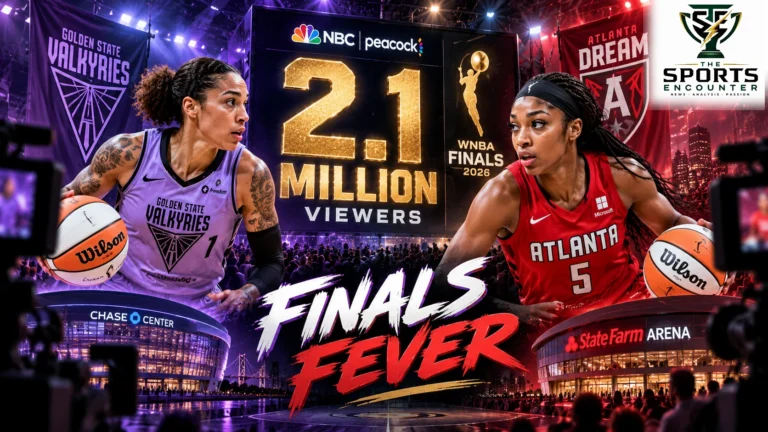
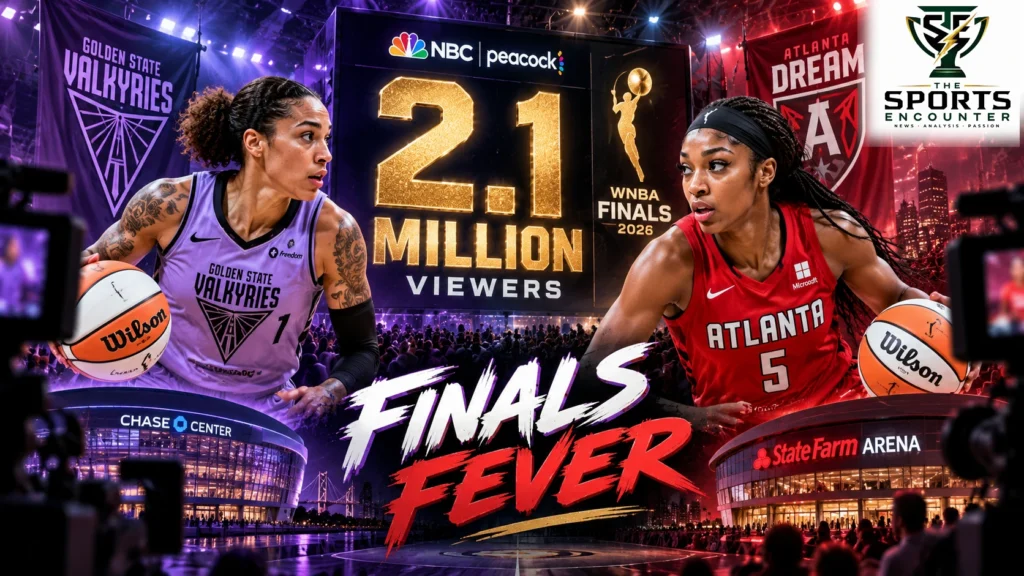
STAMFORD, United States, October 21, 2026: The 2026 WNBA Finals opened with a record television audience of 2.1 million viewers across NBC and Peacock, even though neither of the league’s most commercially recognizable franchises reached the championship series. NBC Sports announced Wednesday that the Golden State Valkyries’ 68-64 victory over the Atlanta Dream on October 17 was the most-watched WNBA Finals Game 1 on record, surpassing the previous year’s opener by 11 percent.
The audience peaked at 3 million during the closing stages of a tense opening game, according to NBC’s analysis of Nielsen Big Data + Panel and Adobe Analytics measurements. The result arrives at an important moment for the WNBA. Golden State and Atlanta are pursuing their first championships, the series is tied 1-1, and its next two games move to Atlanta’s substantially larger State Farm Arena. Together, the television and arena developments provide a useful measure of whether the league’s recent growth is extending beyond its biggest individual attractions.
WNBA Finals 2026: The Audience Record at a Glance
| Audience Measure | Reported Figure | Context |
|---|---|---|
| Game 1 average audience | 2.1 million | NBC and Peacock combined |
| Change from 2025 Finals Game 1 | Up 11% | Year-over-year comparison reported by NBC |
| Peak Game 1 audience | 3.0 million | Closing 10-minute window |
| Peak viewing period | 5:45–5:55 p.m. ET | October 17, 2026 |
| Previous Finals Game 1 audience | Approximately 1.9 million | 2025 Las Vegas–Phoenix series |
| 1997 championship audience | 2.85 million | One-game, winner-take-all championship |
| Game 1 result | Golden State 68, Atlanta 64 | October 17 at Chase Center |
| Current Finals position | Tied 1-1 | Atlanta won Game 2 on October 19 |
The figures come from NBC Sports’ October 21 audience announcement. Its average reflects total audience delivery across television and streaming, rather than the number of viewers watching simultaneously at the game’s peak.
What Exactly Did NBC’s WNBA Finals Record Measure?
The distinction between the different television records is important.
Story at a glance
WNBA Finals 2026: The Audience Record at a Glance
The figures come from NBC Sports’ October 21 audience announcement. Its average reflects total audience delivery across television and streaming, rather than the number of viewers watching simultaneously at the game’s peak.
What Exactly Did NBC’s WNBA Finals Record Measure?
The distinction between the different television records is important.
Why a Record Without Caitlin Clark or A’ja Wilson Matters
The most revealing aspect of the announcement is the identity of the two finalists.
How the 2026 WNBA Finals Compare With Earlier Audience Benchmarks
The comparison illustrates how close this year’s Finals opener came to the average audience for the dramatic deciding game between New York and Minnesota in 2024.
Gabby Williams and Angel Reese Have Given the Finals a Competitive Identity
The matchup was already compelling before NBC’s ratings were announced.
NBC described the October 17 broadcast as the most-watched WNBA Finals Game 1 ever. That is a specific claim about opening games in the championship series, not an assertion that no WNBA championship broadcast has ever attracted a larger audience.
In 1997, the WNBA decided its inaugural championship through a single winner-take-all game. That contest averaged 2.85 million viewers on NBC.
The league adopted a championship series format the following season. Consequently, the 1997 audience is historically relevant but is not directly equivalent to the first game of a multigame Finals series.
The previous Game 1 benchmark came from the 2025 championship between Las Vegas and Phoenix, which attracted approximately 1.9 million viewers on ESPN. The 2026 figure represents an increase of roughly 200,000 viewers, with NBC reporting the precise change as 11 percent.
Another qualification concerns measurement. NBC’s 2026 result combines Nielsen’s television measurement with Adobe Analytics digital data. Comparisons between broadcasts distributed on different television and streaming services require attention to their reported measurement methods.
These limitations do not erase the audience increase. They explain what the record actually represents.
Why a Record Without Caitlin Clark or A’ja Wilson Matters
The most revealing aspect of the announcement is the identity of the two finalists.
The Indiana Fever, led by Caitlin Clark, did not reach the championship series. Neither did the Las Vegas Aces, featuring A’ja Wilson, or the New York Liberty, led by established stars including Breanna Stewart and Sabrina Ionescu.
Yet a Finals opener involving the Golden State Valkyries and Atlanta Dream averaged more than two million viewers.
That provides evidence that a substantial national audience is willing to follow championship basketball even when the league’s most heavily promoted players are not participating.
It does not prove that individual superstar appeal has become irrelevant. The 2026 regular-season data showed how strongly certain teams, particularly Indiana, continued to influence television demand.
In its investigation of the WNBA’s 2026 viewership and attendance records, The Sports Encounter examined the gap between league-wide audience growth and the commercial importance of its most recognizable individual players.
The Finals opener adds another useful data point to that discussion.
Its performance suggests that championship stakes, emerging franchise identities, market interest and compelling games can also attract audiences of meaningful scale.
However, a single broadcast cannot establish how many viewers have become regular followers of the league or how much of the audience came specifically because of Golden State or Atlanta.
How the 2026 WNBA Finals Compare With Earlier Audience Benchmarks
| Event | Audience | What the Figure Represents |
|---|---|---|
| 1997 WNBA championship game | 2.85 million | Single-game championship |
| 2024 WNBA Finals Game 5 | 2.15 million | Deciding championship game |
| 2025 WNBA Finals Game 1 | Approximately 1.9 million | Previous opening-game benchmark |
| 2026 WNBA Finals Game 1 | 2.1 million | New opening-game record |
| 2026 Game 1 closing audience peak | 3.0 million | Peak audience, not a full-game average |
The comparison illustrates how close this year’s Finals opener came to the average audience for the dramatic deciding game between New York and Minnesota in 2024.
The two broadcasts are not identical commercial products. One opened a best-of-seven series; the other determined a championship.
Even so, reaching a comparable average without the immediate possibility of crowning a champion is a meaningful indicator of television interest.
It is also notable that Game 1 ended in a tight 68-64 result, with Golden State’s Gabby Williams producing a 26-point performance. As the contest approached its conclusion, the reported audience grew to 3 million.
That closing peak suggests viewers remained interested in the competitive outcome, although audience measurements alone cannot establish precisely why each household was watching.
Gabby Williams and Angel Reese Have Given the Finals a Competitive Identity
The matchup was already compelling before NBC’s ratings were announced.
Golden State reached its first WNBA Finals in only its second season, while Atlanta returned to the championship stage for the first time since 2013.
Williams led Golden State to the opening victory with 26 points, helping the Valkyries survive a game in which Atlanta struggled to score during the final quarter.
Two nights later, Angel Reese changed the direction of the series.
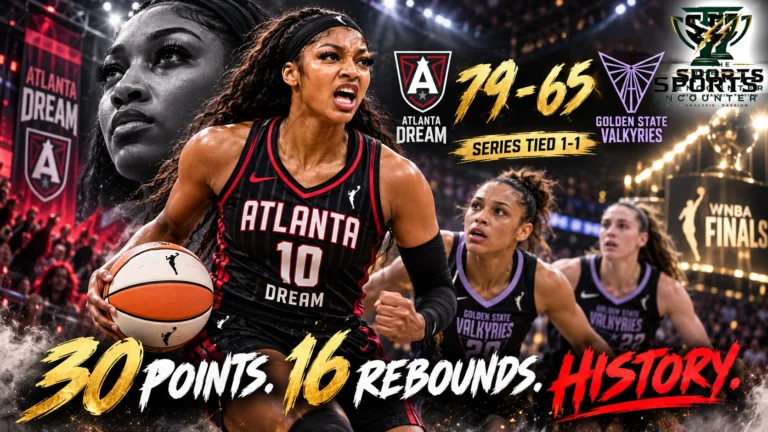
Reese scored 30 points and collected 16 rebounds as Atlanta defeated Golden State 79-65 in Game 2. The performance made her the youngest player to record at least 30 points and 15 rebounds in a WNBA Finals game.
Our detailed Game 2 report explains how Reese’s interior scoring and Atlanta’s defensive pressure changed the contest.
| Game | Winner | Score | Leading Individual Performance |
|---|---|---|---|
| Game 1, October 17 | Golden State Valkyries | 68-64 | Gabby Williams: 26 points |
| Game 2, October 19 | Atlanta Dream | 79-65 | Angel Reese: 30 points, 16 rebounds |
These performances have given television audiences contrasting stories to follow.
Golden State has demonstrated the impact of disciplined defense and late-game execution. Atlanta has shown how interior dominance and turnover pressure can change a matchup.
The Sports Encounter’s Finals tactical preview examined the difference between the Valkyries’ bench production and Atlanta’s defensive approach before the series began.
That contrast remains relevant with the teams level after two games.
Six of the players named to the WNBA’s 2026 All-Defensive teams represent the two finalists, reinforcing the quality of the defensive matchup.
Our analysis of the All-Defensive selections identified Reese, Williams, Rhyne Howard, Jordin Canada, Veronica Burton and Kiah Stokes among the players whose individual defensive strengths could shape the Finals.
Which American Markets Watched the WNBA Finals Opener?
NBC’s announcement also included local television ratings for six leading markets.
| Market | Reported Local Rating |
|---|---|
| San Francisco | 4.49 |
| New Orleans | 3.04 |
| Richmond | 2.12 |
| Hartford–New Haven | 2.07 |
| San Antonio | 2.06 |
| Atlanta | 2.02 |
San Francisco recorded the highest rating among those listed, consistent with the strong local response to the Valkyries’ remarkable expansion-era success.
However, a local television rating is not the same as an audience count in millions. The figures describe the relative proportion of a market’s television households represented in the rating measurement.
The presence of New Orleans, Richmond, Hartford–New Haven and San Antonio among the leading markets is noteworthy because the Finals do not feature teams from those cities.
It offers evidence of interest beyond the two participating franchises, although the published market table alone cannot establish how those viewers became engaged with the series.
Atlanta’s Larger Arena Gives the Finals Another Commercial Test
The next stage of the series offers a different measure of demand.
Atlanta’s first two home Finals games have been moved to State Farm Arena, the much larger home of the NBA’s Atlanta Hawks, after scheduling and capacity difficulties surrounding the Dream’s usual venue.
State Farm Arena has room for approximately 17,000 spectators for basketball, compared with fewer than 4,000 at Gateway Center Arena.
The move provides thousands of additional potential seats for Games 3 and 4.
That matters because interest can only translate into attendance when enough appropriate seating is available.
The Sports Encounter previously examined the venue arrangements and soaring ticket demand in its report on WNBA Finals ticket prices.
Still, the television and ticket metrics should not be merged. A strong national audience does not automatically establish how many tickets will be sold in Atlanta, and secondary-market ticket prices do not represent direct team revenue.
Taken together, the two developments show that the league has opportunities to serve viewers and spectators through different commercial channels.
The Bigger Picture: WNBA’s 2026 Growth Was Already Breaking Records
The Finals audience follows a regular season in which the WNBA reported more than 90 million unique national television viewers across its broadcast partners.
The league also reported 51 games averaging at least one million viewers, compared with 19 the previous season.
Attendance reached approximately 3.8 million, and 212 regular-season games sold out.
Those numbers, published in the WNBA’s official 30th-season growth report, provide important context for the new Finals record.
The championship broadcast is therefore part of a broader upward trend rather than an isolated television result.
At the same time, the figures measure different things. More than 90 million unique viewers over a season is not directly comparable with a 2.1 million average audience for one game. The season-long figure measures reach across multiple broadcasts, while the Finals number represents average delivery during a single event.
The commercial implications also extend to the WNBA’s newest franchises.
Golden State’s rapid rise has already helped the Bay Area secure the 2027 WNBA All-Star Game. Our report on San Francisco’s All-Star hosting selection examined how the franchise’s strong early support helped make the region an increasingly important women’s basketball market.
Meanwhile, Atlanta’s Finals appearance reflects personnel decisions made well before the playoffs.
The Sports Encounter’s analysis of the 2026 WNBA Executive of the Year award examined how Atlanta and Golden State built championship contenders through different roster-development approaches.
How NBC’s Return to WNBA Coverage Fits the Audience Story
Game 1 was NBC Sports’ first WNBA Finals telecast since August 31, 2002.
The network’s renewed involvement has brought the WNBA to another major national television platform while also expanding its streaming distribution through Peacock.
NBC reported that its seven regular-season WNBA broadcasts on NBC and Peacock averaged 1.8 million viewers, a 35 percent increase over comparable coverage the previous year.
The broadcaster’s Finals announcement therefore reflects a broader investment in women’s basketball rather than a single championship broadcast.
However, television-rights value, advertising revenue and subscriber growth cannot be calculated directly from the reported game audience. Those measures depend on commercial agreements and other information that NBC has not supplied in this announcement.
For advertisers, the record establishes that a WNBA championship opener can deliver an audience exceeding two million on the combined NBC and Peacock distribution. For the league, it adds another measurable result to its expanding broadcast relationships.
WNBA Finals Game 3: When and Where Will Atlanta Face Golden State?
The best-of-seven championship series resumes Wednesday, October 21, at State Farm Arena in Atlanta.
Game 3 is scheduled for 8 p.m. Eastern Time. The series is tied 1-1.
Atlanta will also host Game 4 on Saturday, October 24, at 1 p.m. Eastern Time. NBC and Peacock will carry Game 4, while Game 3 is part of USA Network’s coverage with streaming availability through Peacock.
The NBC Sports playoff schedule provides the remaining game dates and broadcast arrangements.
For Golden State, the challenge is to recover from its Game 2 defeat and regain the offensive control that helped the team win the opener.
Atlanta has an opportunity to take its first lead in the Finals with the support of a significantly larger home crowd.
The league will also gain another measure of how the two finalists perform as national television attractions.
Continue the NBA Story


Frequently Asked Questions About the 2026 WNBA Finals TV Ratings
How many people watched Game 1 of the 2026 WNBA Finals?
NBC reported an average audience of 2.1 million viewers across NBC and Peacock for the October 17 game between Golden State and Atlanta.
Was Game 1 the most-watched WNBA Finals game ever?
It was the most-watched Finals Game 1 on record, according to NBC. The 1997 single-game championship averaged 2.85 million viewers, and other Finals games have drawn larger audiences.
How much did WNBA Finals Game 1 viewership increase?
NBC reported an 11 percent increase compared with the 2025 Finals opener between Las Vegas and Phoenix.
What was the peak audience for the opening game?
Viewership peaked at approximately 3 million during the final ten minutes, from 5:45 to 5:55 p.m. Eastern Time.
Which teams are playing in the 2026 WNBA Finals?
The Golden State Valkyries and Atlanta Dream are contesting the best-of-seven championship series.
Who won the first two games of the Finals?
Golden State won Game 1 by 68-64 on October 17. Atlanta won Game 2 by 79-65 on October 19.
What is the WNBA Finals series score?
As of October 21, before Game 3, the series is tied 1-1.
Where will Game 3 of the WNBA Finals be played?
Game 3 will be played at State Farm Arena in Atlanta on Wednesday, October 21, at 8 p.m. Eastern Time.
Why is Atlanta playing at State Farm Arena?
The larger venue accommodates substantially more spectators than Gateway Center Arena. The move followed scheduling and capacity concerns over the Dream’s usual home venue.
Why This Ratings Record Matters for the WNBA’s Future
The most useful conclusion from NBC’s announcement is not simply that one broadcast attracted more viewers than its predecessor.
The league has reached a point where a championship series featuring two first-time finalists can attract a national opening-game audience above two million.
That is relevant to the WNBA’s long-term efforts to develop successful franchises, increase media exposure and connect fans with a wider range of players.
The championship’s commercial value is still shaped by familiar factors: competitive games, recognizable personalities, broadcast distribution, market interest and the ability to accommodate paying spectators.
The 2026 Finals currently brings those elements together in an unusually revealing way.
Golden State’s expansion success has created a powerful new market. Atlanta has built a contender capable of ending its long championship drought. Williams and Reese have supplied the most visible individual performances, while NBC has documented substantial interest in watching their teams compete.
What remains to be established is whether subsequent Finals games can sustain or expand that audience.
The opening broadcast has already demonstrated something important: a WNBA championship does not need to feature every one of the league’s best-known stars to become a major national television event.
Editorial methodology: Audience figures are attributed to NBC Sports’ October 21, 2026 release, which uses Nielsen Big Data + Panel and Adobe Analytics. Historic championship comparisons, WNBA growth figures and the Finals schedule were checked against published broadcaster and league information. Ratings, attendance, ticket demand and commercial revenue are treated as separate measures.