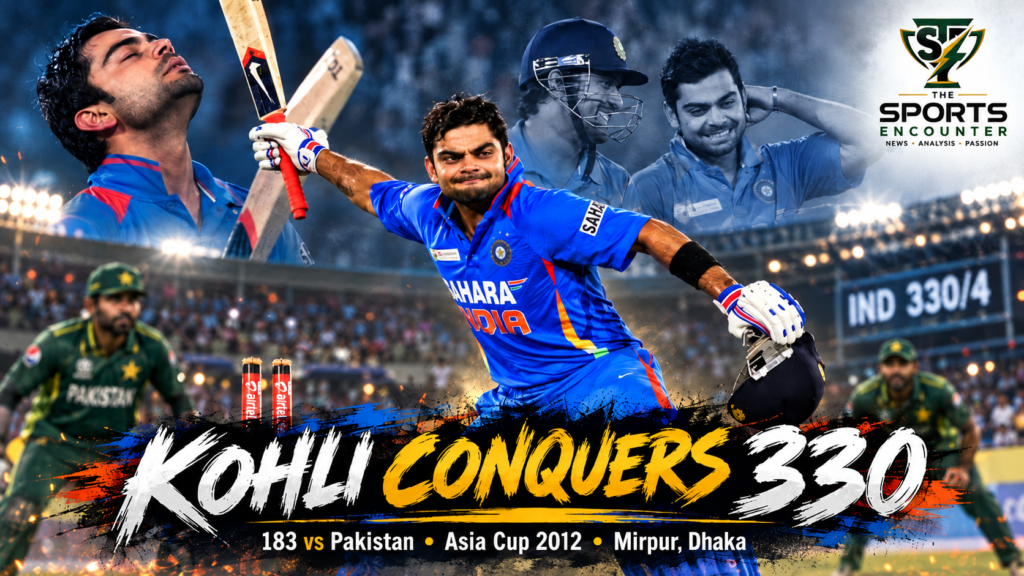
DHAKA, Bangladesh, March 18, 2012: Pakistan had scored 329 for 6, their openers had shared 224 runs, and India’s chase began with Gautam Gambhir falling for a duck in the first over. At the Sher-e-Bangla National Cricket Stadium, Pakistan appeared to have established the perfect conditions for another memorable victory over their greatest rival. Virat Kohli had other ideas. The 23-year-old produced a breathtaking 183 from 148 deliveries, leading India to 330 for 4 in 47.5 overs and completing a six-wicket victory that rewrote the country’s ODI chasing record.
The extraordinary result overshadowed centuries from Mohammad Hafeez and Nasir Jamshed, whose opening partnership had placed Pakistan in command. Sachin Tendulkar’s 52 and Rohit Sharma’s 68 provided Kohli with essential support, but the young batter dominated the contest through relentless scoring and exceptional running between the wickets. Yet India’s triumph carried an unexpected consequence. Despite defeating Pakistan and registering their highest successful ODI chase at the time, India still depended on another result to qualify for the Asia Cup final. Bangladesh eventually eliminated them.
Kohli’s innings became one of the defining performances of his international career.
The magnitude of his achievement becomes clearer when the match situation is examined.
Story at a glance
Mohammad Hafeez’s 105 Establishes Pakistan’s Authority
Mohammad Hafeez gave Pakistan the kind of disciplined opening innings required to build a formidable ODI total.
Nasir Jamshed’s 112 Powers a Record Opening Partnership
Nasir Jamshed was the more aggressive partner during Pakistan’s opening stand.
Younis Khan’s 52 Gives Pakistan the Late Acceleration
Younis Khan provided Pakistan’s strongest middle-order contribution.
Ashok Dinda’s Two Wickets Interrupt Pakistan’s Momentum
Ashok Dinda emerged as India’s most economical specialist pace bowler.
Gautam Gambhir’s Duck Makes India’s 330-Run Chase Even More Difficult
India’s pursuit began with the worst possible setback.
Pakistan had not reached 329 through a frantic late recovery. Their openers had dominated India’s bowling for nearly 36 overs, scoring centuries and constructing a partnership that promised an even larger total.
India then lost a wicket before scoring a run.
The target was intimidating, the pressure substantial and Pakistan possessed an attack featuring Umar Gul, Saeed Ajmal, Shahid Afridi and Wahab Riaz.
Kohli responded by dismantling that advantage through a combination of boundary hitting, controlled accumulation and two decisive partnerships.
The result earns its place as Match 56 in The Sports Encounter’s A Celebration of 5000 ODIs, a series revisiting matches that have shaped the history of one-day international cricket.
There is another reason to remember the encounter.
It was Sachin Tendulkar’s final ODI appearance, marking the end of an extraordinary chapter in Indian cricket while Kohli delivered a performance that pointed toward the future.
Pakistan vs India 2012 Asia Cup: Match Summary
| Match detail | Information |
|---|---|
| Tournament | 2012 Asia Cup |
| Match | Fifth match, round-robin stage |
| Date | March 18, 2012 |
| Venue | Sher-e-Bangla National Cricket Stadium, Mirpur, Dhaka |
| Toss | Pakistan won and elected to bat |
| Pakistan | 329/6 in 50 overs |
| India | 330/4 in 47.5 overs |
| Result | India won by six wickets |
| Deliveries remaining | 13 |
| Player of the Match | Virat Kohli |
| India’s leading scorer | Virat Kohli, 183 |
| Pakistan’s leading scorer | Nasir Jamshed, 112 |
| Pakistan’s second centurion | Mohammad Hafeez, 105 |
| Best bowling figures | Umar Gul, 2/65 |
| Pakistan’s opening partnership | 224 runs |
| India’s second-wicket partnership | 133 runs |
| India’s third-wicket partnership | 172 runs |
| Tournament consequence | India remained dependent on Bangladesh’s final group result |
Mohammad Hafeez’s 105 Establishes Pakistan’s Authority
Mohammad Hafeez gave Pakistan the kind of disciplined opening innings required to build a formidable ODI total.
He scored 105 from 113 deliveries, striking nine fours and one six.
His contribution was particularly valuable because he allowed Nasir Jamshed to attack without exposing Pakistan to unnecessary early risks.
The pair negotiated India’s opening bowlers and gradually increased the scoring rate.
Pakistan reached 50 without loss after ten overs.
They passed 100 in the 18th over and 150 after 25 overs.
By the 33rd over, the scoreboard showed 200 without loss.
Hafeez reached his century from 103 deliveries.
His batting illustrated the value of controlling the first 35 overs in a 50-over contest.
Rather than attempting to score at an extraordinary rate immediately, he focused on building a platform from which the middle order could accelerate.
Pakistan were positioned to make a total approaching 350.
However, Hafeez’s dismissal came at an unfortunate moment.
Nasir Jamshed departed at 224 in the 36th over, and Hafeez followed almost immediately, trapped lbw by Ashok Dinda.
Pakistan were 225 for 2 after 36.2 overs.
The opening pair had done almost everything required to establish a match-winning total.
The challenge now belonged to the middle order.
Nasir Jamshed’s 112 Powers a Record Opening Partnership
Nasir Jamshed was the more aggressive partner during Pakistan’s opening stand.
He made 112 from 104 balls, hitting ten fours and one six.
His strike rate of 107.69 helped Pakistan maintain pressure on India’s bowlers throughout the first 36 overs.
Jamshed reached his half-century from 47 deliveries and completed his century from 98.
His ability to score boundaries prevented India from controlling the innings through defensive fields.
He was especially effective in finding gaps and turning loose deliveries into scoring opportunities.
Together, Jamshed and Hafeez added 224 runs for the first wicket.
The partnership became Pakistan’s highest opening stand against India in ODI cricket.
It was an exceptional achievement against an Indian bowling attack containing experienced international players.
Yet the partnership also created a tactical challenge for Pakistan.
With so many overs consumed by the openers, the middle order needed to accelerate immediately after their dismissals.
There was little opportunity for new batters to spend several overs settling.
Jamshed eventually fell to Ravichandran Ashwin, caught by Irfan Pathan.
The dismissal ended Pakistan’s domination of the opening phase.
It also gave India’s bowlers their first opportunity to attack a new batter after almost 36 overs.
Younis Khan’s 52 Gives Pakistan the Late Acceleration
Younis Khan provided Pakistan’s strongest middle-order contribution.
He scored 52 from just 34 deliveries, including six boundaries.
His strike rate of 152.94 was particularly important because Pakistan needed to accelerate after losing both opening centurions.
Younis played aggressively and helped maintain a strong scoring rate.
Umar Akmal contributed 28 from 24 balls.
Their partnership added 48 runs, carrying Pakistan from 225 for 2 to 273 for 3.
Younis subsequently added another 40 with Shahid Afridi.
Pakistan reached 313 for 4 in the 48th over.
However, the innings lacked a sustained final assault.
Afridi made nine from 15 deliveries, while Hammad Azam contributed four.
Younis was dismissed during the penultimate over, caught by Suresh Raina off Praveen Kumar.
Pakistan finished on 329 for 6.
The total was substantial, but the contrast between the first 36 overs and the closing stages was important.
Pakistan had reached 224 without loss, with more than 14 overs remaining.
They added 105 runs after the first wicket fell.
That was enough to establish a demanding target, but the dismissal of both openers in quick succession limited the possibility of a substantially larger total.
Ashok Dinda’s Two Wickets Interrupt Pakistan’s Momentum
Ashok Dinda emerged as India’s most economical specialist pace bowler.
He returned 2 for 47 from eight overs, including one maiden.
His victims were Hafeez and Hammad Azam.
The dismissal of Hafeez was particularly important because Pakistan’s opening partnership had already been broken.
Dinda struck before the new batting pair could establish another lengthy stand.
The wicket forced Pakistan to rebuild its momentum at a stage when the innings should ideally have been accelerating.
Praveen Kumar also took two wickets, removing Umar Akmal and Younis Khan.
However, Praveen conceded 77 runs from ten overs.
Irfan Pathan returned 1 for 69, while Ashwin claimed 1 for 56.
India’s bowling performance was expensive.
The visitors struggled to break the opening partnership and were forced to chase 330 as a consequence.
Nevertheless, India’s bowlers deserve some credit for preventing Pakistan from exploiting all ten wickets during the closing overs.
Six wickets remained down at the end of the innings, suggesting Pakistan had retained batting resources that were not fully converted into runs.
Gautam Gambhir’s Duck Makes India’s 330-Run Chase Even More Difficult
India’s pursuit began with the worst possible setback.
Gautam Gambhir was trapped lbw by Mohammad Hafeez from the second delivery of the innings.
India were 0 for 1.
Pakistan had immediately strengthened its position.
A chase requiring 330 already demanded an average scoring rate of 6.6 runs per over.
The early loss of an established opener threatened to place even greater responsibility on India’s remaining batters.
Sachin Tendulkar was joined by Virat Kohli.
The partnership would fundamentally change the match.
Pakistan’s early breakthrough also shaped Kohli’s innings.
He could not afford to spend a prolonged period defending.
India needed boundaries and consistent strike rotation to prevent the required rate from climbing.
Kohli recognized those demands immediately.
Rather than becoming preoccupied with the early wicket, he began building a partnership that would restore India’s scoring momentum.
Sachin Tendulkar’s 52 Sets Up the Chase in His Final ODI
Sachin Tendulkar played an important role in the recovery.
He scored 52 from 48 deliveries, striking five fours and one six.
His innings was valuable because he helped India maintain a scoring rate above six runs per over while Kohli settled.
The pair added 133 runs for the second wicket.
By the time Tendulkar departed in the 20th over, India had reached 133 for 2.
The chase was very much alive.
Tendulkar’s innings was also historically significant.
The match became the final One-Day International of his extraordinary career.
The Indian batting legend would announce his retirement from ODI cricket later that year, having played 463 matches and scored 18,426 runs.
Those records gave his final appearance special importance.
There was also a striking generational connection.
Tendulkar had helped define India’s batting identity for more than two decades.
Kohli was now emerging as the country’s next great ODI batter.
Their partnership against Pakistan offered a memorable transition between those eras.
Tendulkar was eventually dismissed by Saeed Ajmal, caught by Younis Khan.
India still needed 197 runs.
The responsibility passed to Kohli and Rohit Sharma.
Virat Kohli’s 183 Produces the Innings of His Young Career
Virat Kohli was 23 years old when he produced one of the finest ODI innings of his generation.
He scored 183 from 148 deliveries, striking 22 boundaries and one six according to contemporary ICC reporting.
His innings demonstrated an exceptional understanding of how to chase a substantial target.
Kohli rarely allowed the required rate to become overwhelming.
He collected singles and twos, punished loose deliveries and maintained pressure on Pakistan’s fielders.
His ability to run aggressively between the wickets was particularly valuable.
Pakistan’s bowlers struggled to control the scoring because Kohli repeatedly found ways to rotate the strike even when boundaries were temporarily unavailable.
How Kohli Constructed His 183
Kohli reached his half-century from 52 deliveries.
His hundred came from 97 balls.
He subsequently accelerated, passing 150 from 131 deliveries.
The progression illustrates the structure of his innings.
He scored his first 100 from 97 balls.
The next 83 came from only 51 deliveries.
That acceleration was decisive because India still needed a substantial number of runs during the closing stages.
Kohli’s innings contained 94 runs in boundaries if assessed using the ICC’s 22 fours and one six tally.
The remaining 89 came through running between the wickets.
That balance explains why Pakistan struggled to restrict him.
He could score through conventional strokeplay without relying exclusively on aerial hitting.
The match also demonstrated his extraordinary fitness and ability to maintain running intensity deep into a lengthy innings.
How Kohli’s 183 Changed India’s ODI Record
India reached 330 for 4 in 47.5 overs.
It was the country’s highest successful ODI chase at the time.
The previous record had been 326 for 8 against England in the 2002 NatWest Series final at Lord’s.
The Sports Encounter has already revisited that famous victory, when Yuvraj Singh and Mohammad Kaif rescued India from 146 for 5.
The comparison is revealing.
In 2002, India needed an extraordinary lower-order recovery after its top order collapsed.
In 2012, Kohli controlled the chase through two substantial partnerships.
Both matches demonstrated India’s ability to pursue totals considered formidable for their respective periods.
Kohli’s 183 subsequently became his career-best ODI score, a mark that remained unmatched throughout his playing career to that point.
The performance also contributed to his recognition as the ICC ODI Cricketer of the Year in 2012.
The ICC’s official account of Kohli’s 2012 award specifically identified his 183 against Pakistan as his highest score during the award period.
Rohit Sharma’s 68 Allows Kohli to Attack Without Losing Control
Rohit Sharma played a supporting role that deserves greater recognition.
He made 68 from 83 deliveries, striking five fours and one six.
Rohit joined Kohli when India were 133 for 2.
The chase still required 197 runs.
Pakistan had an opportunity to attack a new batter and disrupt India’s recovery.
Instead, Rohit gradually established himself.
He rotated the strike effectively and avoided unnecessary risks while Kohli accelerated.
Their third-wicket partnership added 172 runs.
By the time Rohit departed, India had reached 305 for 3 after 45.5 overs.
Only 25 runs remained.
The partnership was decisive because it prevented Pakistan from exposing India’s middle order while the target was still demanding.
Kohli provided the dominant scoring contribution.
Rohit ensured that pressure did not return through another wicket.
The pair also demonstrated how a demanding ODI chase can become manageable through sustained partnerships rather than a reckless pursuit of boundaries.
Rohit was eventually caught by Shahid Afridi off Umar Gul.
His dismissal gave Pakistan a late opening, but India had already moved within striking distance.
Umar Gul’s Two Wickets Arrive Too Late to Rescue Pakistan
Umar Gul was Pakistan’s leading wicket-taker.
He returned 2 for 65 from 8.5 overs.
His wickets included Rohit Sharma and Kohli.
Both dismissals occurred late in the chase.
Rohit fell with India on 305.
Kohli departed at 318, caught by Hafeez.
Pakistan briefly threatened to create late uncertainty.
However, the remaining target was too small for those breakthroughs to change the outcome.
Gul’s wickets nevertheless prevented Kohli from carrying his bat through the innings.
The Indian batter departed for 183, leaving the final runs to Suresh Raina and MS Dhoni.
Hafeez and Ajmal had taken India’s earlier wickets.
Hafeez finished with 1 for 42 from nine overs.
Ajmal returned 1 for 49 from nine.
Both were more economical than Pakistan’s other principal bowlers.
The problem was that Pakistan could not maintain wicket-taking pressure during the middle overs.
India’s second and third-wicket partnerships accounted for 305 runs between them.
That left the bowling attack with very little opportunity to expose India’s lower middle order.
Suresh Raina and MS Dhoni Complete India’s Record Chase
Suresh Raina and MS Dhoni ensured the chase ended without further difficulty.
Raina scored an unbeaten 12 from six deliveries.
Dhoni struck the winning boundary, finishing unbeaten on four from one ball.
India reached 330 for 4 after 47.5 overs.
The victory came with 13 deliveries remaining.
It was an emphatic finish considering the size of Pakistan’s total and India’s early loss of Gambhir.
Kohli received the Player of the Match award.
His 183 had supplied more than half of India’s runs from the bat and transformed the contest.
Raina and Dhoni’s finishing contributions were brief, but they ensured India did not allow Pakistan another opportunity to build pressure.
Four Turning Points That Decided the 2012 Asia Cup Encounter
1. Hafeez and Jamshed Add 224 Without Losing a Wicket
Pakistan’s opening partnership dominated the first 35.5 overs.
Hafeez scored 105, while Jamshed made 112.
The stand established a formidable platform and forced India to contemplate a chase of more than 300.
However, losing both opening batters at 224 and 225 disrupted Pakistan’s acceleration.
The team still reached 329, but its final 14 overs did not produce the total that had appeared possible while both centurions remained unbeaten.
2. Gambhir Falls for a Duck Before Kohli and Tendulkar Add 133
Hafeez trapped Gambhir lbw from the second ball.
Pakistan appeared to have strengthened its advantage immediately.
However, Tendulkar and Kohli responded through a 133-run partnership.
Their recovery prevented Pakistan from attacking India’s middle order during the opening 20 overs.
By the time Tendulkar departed, India’s chase was progressing at the required rate.
3. Kohli and Rohit Add 172 for the Third Wicket
India were 133 for 2 when Rohit joined Kohli.
The pair carried the score to 305 for 3.
Their 172-run partnership was decisive because it combined Kohli’s acceleration with Rohit’s stability.
Pakistan’s bowlers could not break the partnership until India had moved within 25 runs of victory.
4. Kohli Accelerates After His Century
Kohli reached his hundred from 97 deliveries.
He scored his remaining 83 runs from 51 balls.
That increased scoring rate transformed a difficult final 15 overs into a controlled finish.
India crossed 300 in the 45th over and ultimately won with 13 balls remaining.
The decisive shift came when Kohli began converting an already substantial innings into an extraordinary one.
Why Pakistan Lost After Scoring 329
Pakistan’s defeat was particularly disappointing because both openers had scored centuries.
Hafeez and Jamshed added 224 and established a platform from which a total approaching 350 was possible.
Younis subsequently contributed a rapid 52.
Yet Pakistan failed to dismiss Kohli until India were almost home.
The bowling attack had several problems.
Aizaz Cheema conceded 60 runs from eight overs.
Wahab Riaz gave away 50 from only four.
Afridi conceded 58 without taking a wicket.
Those figures placed additional pressure on Hafeez, Ajmal and Gul to control the innings.
Pakistan also struggled to create sustained wicket-taking opportunities after Tendulkar’s dismissal.
Rohit and Kohli occupied the crease long enough to reduce the required rate steadily.
Even when Pakistan eventually dismissed them, the target had become manageable.
The contrast between Pakistan’s innings and India’s chase is significant.
Pakistan began with a 224-run opening partnership but lost six wickets while scoring its final 105 runs.
India lost a wicket immediately but constructed two lengthy partnerships that accounted for almost the entire chase.
India managed its batting resources more effectively.
Why India’s Victory Was More Impressive Than the Final Margin Suggests
A six-wicket victory with 13 balls remaining ordinarily suggests a relatively comfortable chase.
The circumstances at Mirpur were considerably more demanding.
Pakistan had scored 329.
India lost Gambhir without scoring.
Tendulkar then departed with 197 runs still required.
Kohli and Rohit were forced to construct a lengthy partnership while maintaining a scoring rate above six runs per over.
Their success transformed the scoreboard.
Kohli’s individual dominance was exceptional, but his partnerships were equally important.
Tendulkar provided early momentum.
Continue A Celebration of 5000 ODIs
 A Celebration of 5000 ODIsA Celebration of 5000 ODIs Match 55: Shoaib Akhtar Riles Harbhajan, but India’s No. 8 Has the Last Laugh With a Six Against Pakistan
 A Celebration of 5000 ODIsA Celebration of 5000 ODIs Match 54: England Escape 33/5, but McGrath’s Last Ball Denies Victory in a Tied NatWest Final
 A Celebration of 5000 ODIsA Celebration of 5000 ODIs Match 53: Pathan Has Pakistan Reeling at 27/3, but Yousuf’s 81 Breaks India’s Champions Trophy Hopes
Rohit supplied stability during the middle overs.
Raina and Dhoni completed the remaining task.
India’s victory demonstrated that even a target above 300 could be pursued through conventional batting, intelligent running and sustained partnerships.
Kohli had struck only one six.
His innings emphasized placement, timing and the ability to find boundaries along the ground.
That was a central reason Pakistan struggled to contain him.
Sachin Tendulkar’s Final ODI Adds Another Layer of History
The 2012 Asia Cup encounter would later assume greater historical significance because it became Tendulkar’s final ODI appearance.
He scored 52, helping India recover from Gambhir’s early dismissal.
At the time, the focus remained on India’s attempt to stay alive in the tournament.
However, the match has since become an important milestone in the changing leadership of India’s batting lineup.
Tendulkar had dominated international cricket for more than two decades.
Kohli was beginning to establish himself as a prolific century-maker capable of controlling major ODI chases.
Their partnership against Pakistan became a compelling representation of that transition.
Tendulkar contributed 52.
Kohli produced 183.
The senior batter helped stabilize the chase before the younger player delivered an innings that would remain one of his career’s defining performances.
The historical connection does not diminish Tendulkar’s contribution.
It adds meaning to a match already significant for its result and extraordinary batting performances.
The Cruel Twist: India’s Greatest Chase Was Not Enough to Reach the Asia Cup Final
India’s victory over Pakistan appeared to provide the perfect response to its earlier defeat against Bangladesh.
Kohli’s 183 had produced a record chase.
The team had defeated its greatest rival.
Qualification for the final, however, remained outside India’s control.
Pakistan had already secured its place in the championship match.
India needed Sri Lanka to defeat Bangladesh in the final round-robin fixture.
That result would have allowed India to progress.
Instead, Bangladesh defeated Sri Lanka by five wickets under the Duckworth-Lewis method on March 20.
Bangladesh and India finished level on eight points.
The hosts advanced because they had defeated India in their earlier head-to-head encounter.
India were eliminated.
The outcome created an unusual historical contradiction.
Kohli had produced India’s highest successful ODI chase, defeated Pakistan and scored the tournament’s highest individual innings.
Yet the team did not reach the final.
Pakistan subsequently defeated Bangladesh by two runs in the championship match on March 22, securing the Asia Cup title.
The irony is central to understanding Match 56.
India won the contest that produced the tournament’s most extraordinary batting performance.
Pakistan ultimately won the tournament.
Both achievements remain part of the same remarkable Asia Cup.
Why Match 56 Belongs in A Celebration of 5000 ODIs
The 2012 Asia Cup encounter deserves recognition for several reasons.
Pakistan’s openers constructed a remarkable 224-run partnership.
Both Hafeez and Jamshed scored centuries.
India lost a wicket before opening its account.
Tendulkar responded with a half-century in what became his final ODI.
Kohli then produced a career-best 183, transforming a demanding chase into a six-wicket victory.
Rohit’s 68 supported a decisive 172-run partnership.
India completed its highest successful ODI chase at the time.
But the victory could not prevent the team from exiting the tournament.
That final consequence separates the match from many other celebrated ODI chases.
It also links this contest to an earlier India-Pakistan encounter featured in the series.
In Match 55, Harbhajan Singh hit the winning six against Pakistan at Dambulla during the 2010 Asia Cup.
That contest was decided by a lower-order batter in the final over.
Two years later, India won through the sustained brilliance of a specialist batter who controlled the chase almost from its beginning.
There is also a compelling comparison with Match 53, when Mohammad Yousuf’s unbeaten 81 helped Pakistan defeat India in the 2004 ICC Champions Trophy.
Yousuf’s innings was built around patience during a difficult chase.
Kohli’s 183 combined patience with sustained acceleration.
Both performances demonstrated the value of a batter capable of remaining at the crease while partners contributed around him.
For Pakistan, Mirpur 2012 remains a painful reminder that even two opening centuries do not guarantee victory.
For India, it represents one of the great examples of individual brilliance failing to produce the ultimate tournament reward.
For Kohli, it remains an innings that announced his extraordinary ability to dominate ODI run chases.
That combination of records, rivalry, individual brilliance and an unexpected tournament consequence makes the match a deserving entry in The Sports Encounter’s celebration of 100 unforgettable ODIs.
5. Complete Match Scorecard
Scorecard based on the Pakistan Cricket Board’s official match record, cross-checked against contemporary ICC and BCCI reports. One boundary-count discrepancy is disclosed in the final verification notes.
Pakistan Innings: 329/6 in 50 Overs
| Batter | Dismissal | R | B | 4s | 6s | SR |
|---|---|---|---|---|---|---|
| Mohammad Hafeez | lbw b Ashok Dinda | 105 | 113 | 9 | 1 | 92.92 |
| Nasir Jamshed | c Irfan Pathan b Ashwin | 112 | 104 | 10 | 1 | 107.69 |
| Umar Akmal (wk) | c Gambhir b Praveen Kumar | 28 | 24 | 3 | 0 | 116.67 |
| Younis Khan | c Raina b Praveen Kumar | 52 | 34 | 6 | 0 | 152.94 |
| Shahid Afridi | c Kohli b Irfan Pathan | 9 | 15 | 0 | 0 | 60.00 |
| Hammad Azam | c Kohli b Dinda | 4 | 5 | 0 | 0 | 80.00 |
| Misbah-ul-Haq (c) | Not out | 4 | 5 | 0 | 0 | 80.00 |
| Umar Gul | Not out | 0 | 1 | 0 | 0 | 0.00 |
| Saeed Ajmal | Did not bat | |||||
| Wahab Riaz | Did not bat | |||||
| Aizaz Cheema | Did not bat | |||||
| Extras | 1 b, 3 lb, 10 w, 1 nb | 15 | ||||
| Total | 6 wickets, 50 overs | 329 |
Fall of wickets: 1-224 (Jamshed, 35.5), 2-225 (Hafeez, 36.2), 3-273 (Umar Akmal, 42.5), 4-313 (Afridi, 47.4), 5-323 (Younis, 48.5), 6-326 (Hammad Azam, 49.3).
India Bowling
| Bowler | O | M | R | W | Econ |
|---|---|---|---|---|---|
| Praveen Kumar | 10 | 0 | 77 | 2 | 7.70 |
| Irfan Pathan | 10 | 0 | 69 | 1 | 6.90 |
| Ashok Dinda | 8 | 1 | 47 | 2 | 5.88 |
| Suresh Raina | 2.2 | 0 | 15 | 0 | 6.43 |
| Rohit Sharma | 3 | 0 | 19 | 0 | 6.33 |
| Yusuf Pathan | 5 | 0 | 30 | 0 | 6.00 |
| Ravichandran Ashwin | 10 | 0 | 56 | 1 | 5.60 |
| Sachin Tendulkar | 1.4 | 0 | 12 | 0 | 7.20 |
India Innings: 330/4 in 47.5 Overs
| Batter | Dismissal | R | B | 4s | 6s | SR |
|---|---|---|---|---|---|---|
| Gautam Gambhir | lbw b Hafeez | 0 | 2 | 0 | 0 | 0.00 |
| Sachin Tendulkar | c Younis b Ajmal | 52 | 48 | 5 | 1 | 108.33 |
| Virat Kohli | c Hafeez b Umar Gul | 183 | 148 | 22* | 1 | 123.65 |
| Rohit Sharma | c Afridi b Umar Gul | 68 | 83 | 5 | 1 | 81.93 |
| Suresh Raina | Not out | 12 | 6 | 1 | 1 | 200.00 |
| MS Dhoni (c, wk) | Not out | 4 | 1 | 1 | 0 | 400.00 |
| Yusuf Pathan | Did not bat | |||||
| Irfan Pathan | Did not bat | |||||
| Ravichandran Ashwin | Did not bat | |||||
| Praveen Kumar | Did not bat | |||||
| Ashok Dinda | Did not bat | |||||
| Extras | 5 b, 1 lb, 4 w, 1 nb | 11 | ||||
| Total | 4 wickets, 47.5 overs | 330 |
Fall of wickets: 1-0 (Gambhir, 0.2), 2-133 (Tendulkar, 19.3), 3-305 (Rohit, 45.5), 4-318 (Kohli, 47.1).*The ICC and BCCI report Kohli’s innings as containing 22 fours and one six, while the PCB scorecard displays 21 fours and one six. The score and balls faced agree. The table follows the ICC figure, with this discrepancy flagged for final editorial review.
Pakistan Bowling
| Bowler | O | M | R | W | Econ |
|---|---|---|---|---|---|
| Mohammad Hafeez | 9 | 0 | 42 | 1 | 4.67 |
| Umar Gul | 8.5 | 0 | 65 | 2 | 7.36 |
| Aizaz Cheema | 8 | 0 | 60 | 0 | 7.50 |
| Saeed Ajmal | 9 | 0 | 49 | 1 | 5.44 |
| Shahid Afridi | 9 | 0 | 58 | 0 | 6.44 |
| Wahab Riaz | 4 | 0 | 50 | 0 | 12.50 |
Result: India won by six wickets with 13 deliveries remaining.
Player of the Match: Virat Kohli, 183 from 148 deliveries.
6. Frequently Asked Questions
Who Won the India vs Pakistan 2012 Asia Cup Match?
India defeated Pakistan by six wickets in Mirpur, Dhaka, on March 18, 2012, chasing 330 with 13 deliveries remaining.
How Many Runs Did Virat Kohli Score Against Pakistan?
Kohli scored 183 from 148 balls, his highest individual score in ODI cricket.
Who Was the Player of the Match?
Virat Kohli received the award for his match-winning 183.
How Many Runs Did Hafeez and Nasir Jamshed Add?
Mohammad Hafeez and Nasir Jamshed added 224 runs for Pakistan’s opening wicket.
Who Scored Centuries for Pakistan?
Nasir Jamshed scored 112 from 104 deliveries, while Mohammad Hafeez made 105 from 113.
Was This Sachin Tendulkar’s Last ODI?
Yes. Tendulkar scored 52 from 48 deliveries in what became his final One-Day International appearance.
Did India’s Victory Secure a Place in the Asia Cup Final?
No. Bangladesh subsequently defeated Sri Lanka and advanced ahead of India through the tournament’s head-to-head qualification rules.
Who Won the 2012 Asia Cup?
Pakistan defeated Bangladesh by two runs in the final on March 22, 2012.
Was 330 India’s Highest Successful ODI Chase?
Yes, at the time. It surpassed the 326 India successfully chased against England in the 2002 NatWest Series final.