JAKARTA, Indonesia, September 28, 2026: Malaysia played against 10 men for more than half the match.
They had the greater attacking freedom.
They had the clearer route to taking command of Group A.
They still could not find a way past Maarten Paes.
Story at a glance

Justin Hubner’s Disallowed Goal Nearly Changes the Derby Immediately
Indonesia almost turned the home crowd into a weapon within the opening minutes.
Arif Aiman Gives Malaysia Their First Real Threat
Malaysia’s strongest attacking outlet was again Arif Aiman.
Maarten Paes Becomes Indonesia’s Safety Net
Once Haye was sent off, Indonesia’s tactical plan changed completely.
Star Performer: Maarten Paes
Paes was the player who allowed Indonesia to survive the numerical disadvantage without conceding.
Thom Haye’s Red Card Changes Everything
The match turned in the 37th minute.
Indonesia survived Thom Haye’s 37th-minute red card, a series of Malaysian attacks and a tense second half to hold their neighbors to a 0-0 draw at Gelora Bung Karno.
For Indonesia, the point felt closer to a rescue.
For Malaysia, it felt like an opportunity left sitting on the table.
Justin Hubner had already seen an early Indonesia goal ruled out. Arif Aiman twice tested Paes before halftime. Haye was then sent off after a VAR review upgraded his yellow card to red.
Malaysia spent the rest of the match with a numerical advantage but never found the finish that would have given Harimau Malaya six points and clear control of the group.
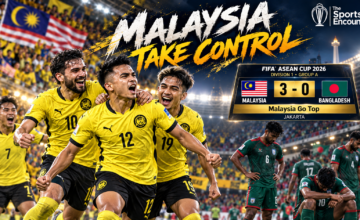
Instead, Malaysia and Indonesia remain level on four points.
Malaysia stay first because of their superior goal difference.
Indonesia remain second.
Singapore, after beating Bangladesh 1-0 earlier in the day, sit only one point behind them.
That means Group A will be decided on the final matchday.
The FIFA ASEAN Cup 2026 format leaves no room for comfort. Only the group winner reaches the final.
After two rounds, nobody in the top three has secured anything.
TL;DR
- Indonesia and Malaysia drew 0-0 in the FIFA ASEAN Cup 2026 Nusantara Derby.
- Indonesia had an early Justin Hubner goal ruled out.
- Arif Aiman forced Maarten Paes into an important save in the 12th minute.
- Thom Haye was sent off in the 37th minute after a VAR review.
- Indonesia played more than half the match with 10 men.
- Dean James nearly scored before halftime, but Syihan Hazmi saved.
- Elkan Baggott hit the post from the resulting corner.
- Malaysia introduced Paulo Josue after halftime to add a second attacking presence.
- Josue headed narrowly over.
- Fergus Tierney missed another major chance in the 74th minute.
- Maarten Paes remained the central figure in Indonesia’s resistance.
- Malaysia stay first in Group A with four points and a +3 goal difference.
- Indonesia remain second with four points and +2.
- Singapore are third with three points.
- Bangladesh are eliminated with zero.
- Malaysia face Singapore next.
- Indonesia face Bangladesh.
- Head-to-head cannot separate Malaysia and Indonesia after the 0-0 draw, so if they finish level on points again, later tiebreak criteria become crucial.
Indonesia vs Malaysia: Match at a Glance
| Detail | Information |
|---|---|
| Competition | FIFA ASEAN Cup 2026 |
| Division | Division 1 |
| Group | A |
| Match | Indonesia vs Malaysia |
| Date | September 28, 2026 |
| Venue | Gelora Bung Karno Stadium, Jakarta |
| Result | Indonesia 0-0 Malaysia |
| Indonesia red card | Thom Haye, 37′ |
| Disallowed goal | Justin Hubner, early first half |
| Indonesia goalkeeper | Maarten Paes |
| Malaysia goalkeeper | Syihan Hazmi |
| Malaysia next match | Singapore |
| Indonesia next match | Bangladesh |
| Malaysia points | 4 |
| Indonesia points | 4 |
| Main consequence | Malaysia remain first on goal difference; Indonesia stay second |
Justin Hubner’s Disallowed Goal Nearly Changes the Derby Immediately
Indonesia almost turned the home crowd into a weapon within the opening minutes.
Hubner found the net after a chaotic attacking sequence, but the goal was disallowed because of an infringement in the buildup.
That moment matters because the entire match would have changed had Indonesia taken an early lead.
Malaysia would have been forced to chase.
Indonesia could have played with greater compactness.
Instead, the game remained level and became increasingly physical.
The tone of the night was established early.
Every duel carried weight.
Every transition felt dangerous.
Arif Aiman Gives Malaysia Their First Real Threat
Malaysia’s strongest attacking outlet was again Arif Aiman.
The forward had already scored twice in the 3-0 opening victory over Bangladesh, and Indonesia knew exactly where the danger would come from.
That did not make him easy to contain.
In the 12th minute, Arif broke forward on a solo run and forced Paes into an important save.
He threatened again later from distance.
Malaysia did not lack dangerous positions.
They lacked the final action.
That became the story of the match.
Maarten Paes Becomes Indonesia’s Safety Net
Once Haye was sent off, Indonesia’s tactical plan changed completely.
The hosts could no longer think about controlling possession.
They had to protect territory.
Paes became central to that.
He handled Arif’s efforts before the red card and remained composed when Malaysia increased the pressure later.
The Indonesian goalkeeper did not need a spectacular penalty save or one impossible intervention to define his night.
His value came from control.
He caught what needed catching.
He pushed danger away when necessary.
He kept Indonesia calm when the match became chaotic.
That makes him the standout performer.
Star Performer: Maarten Paes
Paes was the player who allowed Indonesia to survive the numerical disadvantage without conceding.
That is the clearest measure of his impact.
Malaysia spent more than half the match with 11 against 10.
They introduced additional attacking players.
They pushed full-backs higher.
They attacked from wide areas.
Still, they could not break through.
Paes gave the defenders in front of him confidence.
He also erased several moments that could have turned the match.
Indonesia had needed a strong goalkeeper before the tournament began.
Against Malaysia, they got one.
Thom Haye’s Red Card Changes Everything
The match turned in the 37th minute.
Haye initially received a yellow card for his challenge on Arif Aiman.
VAR intervened.
The referee reviewed the incident.
The yellow became red.
Indonesia were down to 10 men.
The timing could hardly have been worse.
The match was still level.
Malaysia were already finding space.
Indonesia had to reorganize before halftime.
From that moment onward, the game stopped being an even tactical contest and became an exercise in survival.
Indonesia Nearly Score After Going Down to 10
One of the most surprising passages came immediately after the red card.
Indonesia should have been vulnerable.
Instead, they almost took the lead.
Dean James forced Syihan Hazmi into an excellent save during first-half stoppage time.
From the resulting corner, Elkan Baggott rose and headed against the post.
That sequence was crucial for two reasons.
First, it reminded Malaysia that the numerical advantage did not remove Indonesia’s counterattacking threat.
Second, it gave Indonesia belief.
They went into halftime with 10 men but without feeling completely trapped.
Elkan Baggott Gives Indonesia a Defensive and Set-Piece Threat
Baggott’s contribution deserves attention at both ends.
Defensively, his size and positioning helped Indonesia protect the penalty area once Malaysia began delivering more crosses.
At the other end, his header against the post came within inches of producing the game’s only goal.
That combination made him one of Indonesia’s most influential players.
With one fewer midfielder, Indonesia needed defenders willing to absorb repeated pressure.
Baggott did that.
Malaysia Change Shape After Halftime
Malaysia understood the situation.
One extra player.
Forty-five minutes.
A chance to move to six points.
Tan Cheng Hoe responded by increasing the attacking weight.
Paulo Josue entered in the 54th minute and moved closer to Bergson.
Malaysia now had more presence through the middle rather than relying only on wide attacks.
The idea was correct.
The execution remained incomplete.
Paulo Josue Comes Closest to Rewarding Malaysia’s Adjustment
Josue almost justified the tactical change.
He met Manuel Hidalgo’s delivery in the 64th minute.
The header went just over.
This was the kind of chance Malaysia needed to convert.
Indonesia’s defensive line had finally been stretched.
The cross arrived.
The striker found the space.
The finish missed.
Malaysia would create more opportunities.
The same problem kept appearing.
Fergus Tierney Misses Malaysia’s Biggest Second-Half Chance
Fergus Tierney entered later and received another major opportunity.
In the 74th minute, Bergson helped create the opening.
Tierney’s effort went over.
The miss captured Malaysia’s second-half frustration.
They had the numerical advantage.
They had attacking players in useful areas.
They had time.
What they did not have was precision.
A team trying to win a short group cannot afford to leave too many moments unfinished.
Malaysia left several unfinished.
Malaysia Control Territory but Not the Match
This distinction matters.
Malaysia had more possession after the red card.
They spent more time inside Indonesia’s half.
They delivered more balls into dangerous areas.
But territorial control is not the same as match control.
Indonesia still threatened occasionally.
Malaysia never created the volume of clean chances expected against 10 men.
The game remained one mistake away from swinging either direction.
That is why the draw feels more frustrating for Malaysia than Indonesia.
Indonesia’s Defensive Organization Saves the Point
Once reduced to 10, Indonesia became much more compact.
The spaces between defense and midfield shrank.
Wide players tracked deeper.
The team accepted that attacking volume would disappear.
That discipline frustrated Malaysia.
Every time the visitors entered the final third, they met numbers.
Malaysia could move the ball around the block.
Breaking through it was harder.
This was tournament football at its most pragmatic.
Indonesia stopped trying to win the style argument.
They focused on the scoreboard.
Malaysia’s Finishing Becomes the Main Concern
Malaysia scored three against Bangladesh.
They scored none against Indonesia.
The difference in opposition quality explains part of that.
The rest comes down to finishing.
Arif created danger.
Josue found a header.
Tierney found space.
Late pressure continued.
None became goals.
That is the issue Tan Cheng Hoe must solve before facing Singapore.
Singapore have already shown they can survive narrow matches.
Malaysia may not receive many chances.
The ones they get will need to count.
Syihan Hazmi Quietly Protects Malaysia’s Point
The focus naturally falls on Paes.
Malaysia’s goalkeeper also made an important contribution.
Dean James’ stoppage-time effort required a strong save.
Had Indonesia scored after going down to 10, the entire second half would have become much more difficult for Malaysia.
Syihan prevented that.
The save allowed Malaysia to continue attacking without chasing an equalizer.
His contribution was less dramatic than Paes’.
It still mattered.
Why the 0-0 Draw Helps Indonesia More Than Malaysia
Both teams get one point.
The value of that point is different.
Indonesia played with 10 men from the 37th minute.
They were protecting second place against the group leader.
Survival preserved their route into the final.
Malaysia spent more than half the night with a numerical advantage.
A victory would have taken them to six points and placed them in a commanding position.
Instead, they remain vulnerable.
Singapore are now only one point behind.
Indonesia are level with them.
Malaysia still lead.
They did not take control.
Updated FIFA ASEAN Cup 2026 Group A Table
Singapore’s 1-0 win over Bangladesh earlier in the day tightened the group before the derby even began.
The draw leaves three teams alive heading into the final round.
| Pos. | Team | P | W | D | L | GF | GA | GD | Pts |
|---|---|---|---|---|---|---|---|---|---|
| 1 | Malaysia | 2 | 1 | 1 | 0 | 3 | 0 | +3 | 4 |
| 2 | Indonesia | 2 | 1 | 1 | 0 | 2 | 0 | +2 | 4 |
| 3 | Singapore | 2 | 1 | 0 | 1 | 1 | 2 | -1 | 3 |
| 4 | Bangladesh | 2 | 0 | 0 | 2 | 0 | 4 | -4 | 0 |
Malaysia remain first because their overall goal difference is one better than Indonesia’s.
But the first tiebreak layer between Malaysia and Indonesia is now completely even because their head-to-head match ended 0-0.
That makes the final round much more interesting.
What the 0-0 Draw Means for Malaysia
Malaysia face Singapore on October 1.
They remain in the strongest immediate position.
A win takes them to seven points.
That guarantees at least a very strong chance of finishing first, but Indonesia can also reach seven by beating Bangladesh.
If both Malaysia and Indonesia finish level on seven points, their 0-0 head-to-head draw cannot separate them.
The tournament then moves deeper into the tiebreak criteria, including overall goal difference.
Malaysia currently hold a one-goal advantage there.
That makes every goal against Singapore potentially valuable.
The third goal against Bangladesh suddenly looks even more important.
What the 0-0 Draw Means for Indonesia
Indonesia face already-eliminated Bangladesh in Jakarta.
On paper, that is the more favorable final fixture.
But the mathematics are not entirely in their hands.
A win moves Indonesia to seven points.
If Malaysia fail to beat Singapore, that sends Indonesia above them and puts Garuda in position to win the group.
If Malaysia also win, the two teams remain level and tiebreakers become decisive.
Indonesia therefore have two objectives.
Beat Bangladesh.
Score enough to improve the margin.
That creates an unusual final-day pressure.
A 1-0 win may not feel like enough if Malaysia also win.
Indonesia may need to keep attacking even after taking the lead.
Singapore Are Still Very Much Alive
Singapore’s victory over Bangladesh changed everything.
The Lions now have three points.
A win over Malaysia takes them to six.
That means Singapore can still win the group if Indonesia fail to beat Bangladesh.
If Singapore beat Malaysia and Indonesia also win, Indonesia finish first and Singapore would still move above Malaysia into second.
That would send Singapore to the bronze final.
Their path is difficult.
It is not remote.
The Lions have already shown in recent competition that they can survive pressure matches, including the 1-1 draw that eliminated Indonesia from the ASEAN Championship.
Malaysia will know exactly what kind of opponent waits in Bandung.
Bangladesh Are Out, but They Can Decide the Group
Bangladesh cannot reach the top two.
They have zero points.
Malaysia and Indonesia already have four.
Their tournament hopes are gone.
Their influence is not.
If Bangladesh take points from Indonesia, Singapore suddenly gain a possible route into the final.
If Bangladesh lose heavily, Indonesia may improve the tiebreak position against Malaysia.
That means the eliminated team could still shape who reaches the championship match.
Tournament football often creates these strange final-day dynamics.
Group A now has one.
Three Turning Points That Defined Malaysia vs Indonesia
1. Justin Hubner’s Goal Is Ruled Out
Indonesia nearly struck immediately.
The decision kept the game level and prevented the hosts from turning the derby into a defensive exercise from the opening minutes.
2. Thom Haye Is Sent Off
This was the match’s central turning point.
Indonesia went from competing evenly to protecting space with 10 men.
Malaysia gained the advantage.
They failed to convert it.
3. Baggott Hits the Post Before Halftime
Indonesia came within inches of scoring after losing Haye.
Had the header gone in, Malaysia would have faced a very different second half.
Star Performer: Maarten Paes
Paes was the defining individual.
He protected Indonesia early.
He remained composed after Haye’s dismissal.
He dealt with Malaysia’s pressure without allowing the match to become frantic.
The clean sheet gave Indonesia a point that could eventually send them into the final.
In a 0-0 draw involving a team playing with 10 men, the goalkeeper deserves special attention.
Paes earned it.
Other Standout Performers
Arif Aiman
Arif was Malaysia’s most consistent attacking threat.
His movement, direct running and willingness to shoot caused Indonesia problems throughout the first half.
He also drew the challenge that led to Haye’s red card.
Elkan Baggott
Baggott helped organize Indonesia’s deeper defensive block and almost scored with a header off the post before halftime.
Syihan Hazmi
Malaysia’s goalkeeper made an important save from Dean James when Indonesia threatened immediately after losing Haye.
Dean James
James provided one of Indonesia’s best attacking moments and continued working defensively after the team dropped deeper.
What Malaysia Did Well
Malaysia recognized the numerical advantage and increased attacking pressure.
They used the wings.
They introduced another forward.
They moved Arif into dangerous positions.
They forced Indonesia deeper.
The process was largely correct.
The finish was missing.
That distinction matters because the performance was not poor.
The result was disappointing.
What Malaysia Must Improve Before Singapore
The final ball has to become sharper.
Malaysia cannot afford another game where promising situations end with shots over the bar or crosses without a clean finish.
Singapore will likely defend compactly.
They may also be comfortable with a match that remains 0-0 deep into the second half.
Malaysia need more patience around the box and more clinical finishing inside it.
The FIFA ASEAN Cup preview made clear before the tournament that three-match groups reward efficiency more than volume.
Malaysia are about to test that principle again.
What Indonesia Did Well
Indonesia adapted.
That is the biggest positive.
Before the red card, they attacked.
After the red card, they defended.
The team accepted a completely different game without losing organization.
That flexibility matters in tournament football.
The hosts also showed emotional discipline after Haye’s dismissal.
They did not collapse.
They protected the point.
What Indonesia Must Improve Before Bangladesh
The red card cannot be repeated.
Indonesia’s final match demands control.
Bangladesh are eliminated, which makes them dangerous in a different way.
They can play without qualification pressure.
Indonesia need to manage possession, avoid emotional decisions and create enough goals to improve their tiebreak position.
One goal may win the match.
More than one may matter in the table.
This Draw Extends a Familiar Pattern in the Regional Rivalry
Indonesia and Malaysia rarely produce quiet games.
The rivalry brings emotion, crowd pressure and physical intensity.
This match had all three.
The red card added another layer.
The 0-0 scoreline therefore does not tell the full story.
The game was tense rather than dull.
Indonesia survived.
Malaysia pushed.
Neither found the decisive goal.
That leaves the rivalry unresolved and the group undecided.
Malaysia Arrive at the Final Round With Recent Knockout Experience
Malaysia were semifinalists in the recent ASEAN Championship.
They reached that stage after Pavithran Gunalan delivered the winner against the Philippines.
Their run eventually ended against Vietnam, who completed a 4-0 aggregate semifinal victory.
That experience should help now.
The final group match will feel like another knockout.
Win and Malaysia stay firmly in control.
Fail, and the table could turn against them.
Indonesia Know What Final-Day Pressure Feels Like Too
Indonesia recently entered an ASEAN Championship final group game knowing qualification was on the line.
Singapore denied them with a 1-1 draw.
That result ended Indonesia’s semifinal hopes.
The experience should remain fresh.
This time, Garuda face Bangladesh rather than Singapore.
But the emotional challenge is similar.
They must win while also monitoring another match.
That is exactly the kind of pressure that exposes whether a team has learned from recent disappointment.
Final Group A Fixtures
| Date | Fixture | Main Stakes |
|---|---|---|
| October 1 | Indonesia vs Bangladesh | Indonesia chase seven points and potentially need goals for tiebreak advantage |
| October 1 | Malaysia vs Singapore | Malaysia protect first place; Singapore must win to stay in the final race |
Both games will shape the top two.
Both will be played with the other result in mind.
That is exactly what the tournament format was designed to create.
Continue the Soccer Story
 SoccerGulf Cup 27 Semifinals: Saudi Arabia’s Perfect Run Meets Qatar as UAE Face Oman’s Second Chance
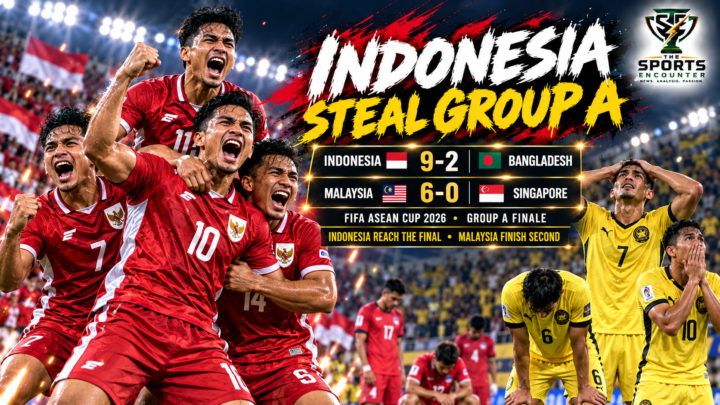
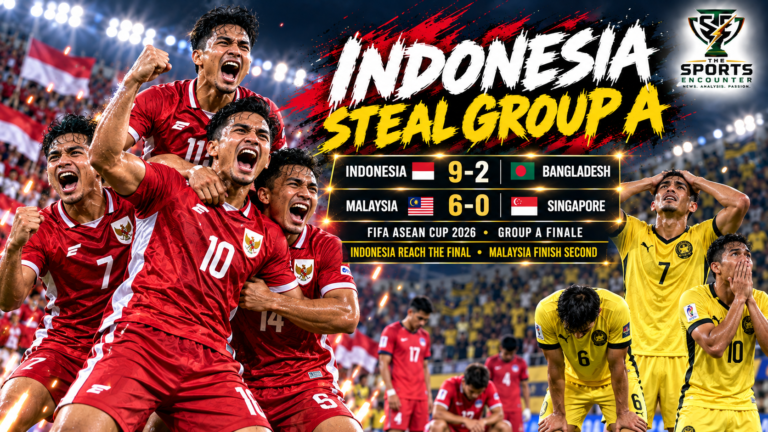 SoccerIndonesia Score Twice at the Death to Steal Group A as Malaysia’s 6-0 Singapore Rout Still Falls Short
 SoccerThailand Take Revenge on Vietnam as Sarach and Otton Seize Control of FIFA ASEAN Cup Group B
Frequently Asked Questions
What Was the Score Between Malaysia and Indonesia?
Malaysia and Indonesia drew 0-0 in their FIFA ASEAN Cup 2026 Group A match in Jakarta.
Who Was Sent Off?
Indonesia midfielder Thom Haye was sent off in the 37th minute after a VAR review upgraded his initial yellow card to red.
Who Was the Best Player?
Maarten Paes was Indonesia’s standout performer after keeping a clean sheet while his team played more than half the match with 10 men.
Did Indonesia Score?
Justin Hubner had an early goal disallowed.
Did Either Team Hit the Post?
Yes. Elkan Baggott hit the post with a header shortly before halftime.
Where Are Malaysia in Group A?
Malaysia are first with four points and a +3 goal difference.
Where Are Indonesia?
Indonesia are second with four points and a +2 goal difference.
Can Singapore Still Win Group A?
Yes. Singapore have three points and must beat Malaysia while also needing Indonesia to drop points against Bangladesh to reach the final.
Can Bangladesh Still Qualify?
No. Bangladesh cannot reach the top two after losing their first two matches.
Who Do Malaysia Play Next?
Malaysia face Singapore in Bandung on October 1.
Who Do Indonesia Play Next?
Indonesia face Bangladesh in Jakarta on October 1.
How Does the Group Tiebreak Work?
Teams level on points are first separated by results between the tied teams. Malaysia and Indonesia drew 0-0, so if they finish level again, later criteria such as overall goal difference can become decisive.
Where Can Readers Follow More Coverage?
Readers can follow the tournament through The Sports Encounter’s FIFA ASEAN Cup 2026 coverage and the wider TSE Soccer section.
Group A
- Gulf Cup 27 Semifinals: Saudi Arabia’s Perfect Run Meets Qatar as UAE Face Oman’s Second Chance
- Indonesia Score Twice at the Death to Steal Group A as Malaysia’s 6-0 Singapore Rout Still Falls Short
- Paes Saves 10-Man Indonesia as Malaysia Miss Chance to Seize Group A Control in 0-0 Nusantara Derby
- Spain Rebound From Mali Shock to Win Group A as Germany Send Mali Home
- Singapore Frustrate Vietnam in Hanoi as Group A Turns Into a Three-Team Fight