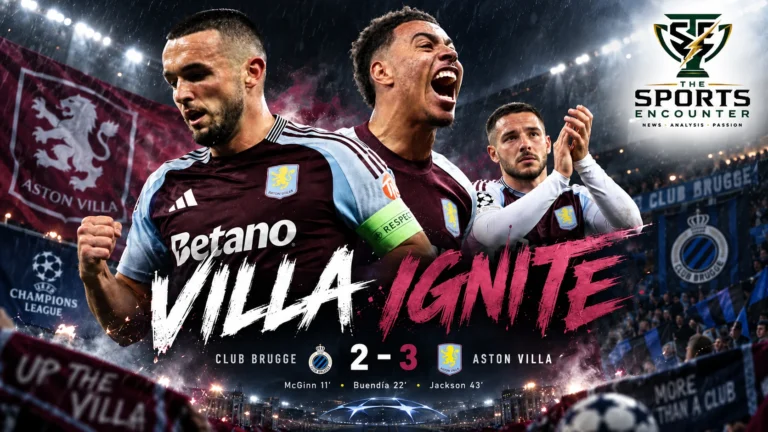
Bruges, Belgium: Aston Villa arrived in Belgium still searching for their first competitive victory of the season. Forty-three minutes into their UEFA Champions League opener, they had scored three times.
John McGinn, Emiliano Buendía and Nicolas Jackson struck during a frantic first half as Villa beat Club Brugge 3-2 at the Jan Breydel Stadium on Tuesday, surviving a late Belgian push to begin the 2026-27 Champions League league phase with three valuable away points.
Club Brugge controlled 62% of possession and completed 577 passes. Villa had only 38% of the ball and completed 334.
Yet Unai Emery’s side attempted 20 shots to Brugge’s 12, put nine on target to the hosts’ seven and scored three times before halftime.
Story at a glance
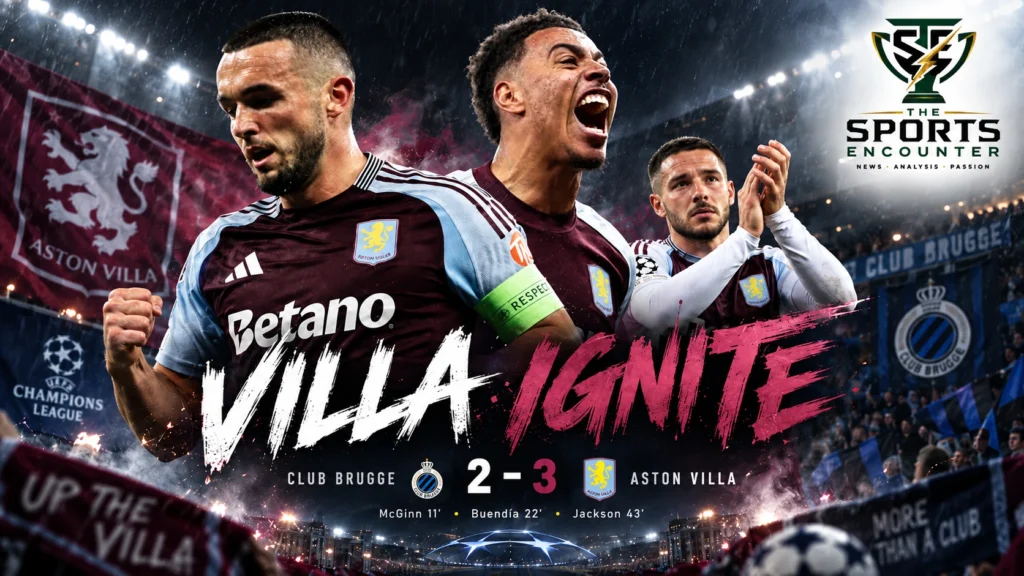
Club Brugge vs Aston Villa: Match at a Glance
The official UEFA match facts underline the recent European history between these teams. All three previous meetings came during the 2024-25 Champions League, when Brugge won the league-phase meeting before Villa eliminated them in the round of 16.
John McGinn Scores the First Champions League Goal of 2026-27
Villa’s captain needed only 11 minutes to put his name into another piece of club and competition history.
Club Brugge Respond Through Hugo Vetlesen
The lead lasted only eight minutes.
Buendía Restores the Lead Almost Immediately
Villa’s response to Vetlesen’s equalizer may have been the most encouraging feature of the first half.
Nicolas Jackson Opens His Aston Villa Account
The third goal added another important story to the night.
Those numbers reveal the real story of the night.
Villa did not need prolonged possession to create danger. They moved forward quickly, attacked spaces before Brugge could reset and produced considerably more shooting volume despite spending much less time on the ball.
The victory also carries wider significance after Villa’s difficult domestic start. They entered the Champions League having collected only one point from their opening three Premier League matches and without a league goal. Our report on Arsenal’s 1-0 win at Villa Park showed how badly Emery’s reshaped side had been struggling to convert possession and promising situations into goals.
Europe produced a very different version of Aston Villa.
Readers can follow the wider campaign through The Sports Encounter’s soccer coverage and our dedicated Premier League section.
Club Brugge vs Aston Villa: Match at a Glance
| Match Detail | Information |
|---|---|
| Competition | UEFA Champions League 2026-27 |
| Stage | League Phase, Matchday 1 |
| Result | Club Brugge 2-3 Aston Villa |
| Venue | Jan Breydel Stadium |
| City | Bruges, Belgium |
| Club Brugge scorers | Hugo Vetlesen 19′, Nicolò Tresoldi 61′ (pen.) |
| Aston Villa scorers | John McGinn 11′, Emiliano Buendía 22′, Nicolas Jackson 43′ |
| Possession | Club Brugge 62%-38% Aston Villa |
| Shots | Club Brugge 12-20 Aston Villa |
| Shots on target | Club Brugge 7-9 Aston Villa |
| Corners | Club Brugge 4-5 Aston Villa |
The official UEFA match facts underline the recent European history between these teams. All three previous meetings came during the 2024-25 Champions League, when Brugge won the league-phase meeting before Villa eliminated them in the round of 16.
John McGinn Scores the First Champions League Goal of 2026-27
Villa’s captain needed only 11 minutes to put his name into another piece of club and competition history.
McGinn scored the opening goal in Bruges and, because this was one of the two early Matchday 1 kickoffs, became the first scorer of the entire 2026-27 Champions League league phase.
UEFA officially confirmed McGinn as the season’s opening Champions League scorer.
The goal was also exactly what Villa needed emotionally.
Their Premier League attack had been under increasing scrutiny after a goalless opening stretch. Against Brugge, they immediately played with greater vertical intent.
McGinn’s influence went beyond the finish.
He gave Villa a platform from which they could attack the game instead of chasing it.
Club Brugge Respond Through Hugo Vetlesen
The lead lasted only eight minutes.
Hugo Vetlesen equalized in the 19th minute, restoring the balance and reminding Villa why Jan Breydel has historically been a difficult European ground for visiting teams.
Brugge entered Matchday 1 having lost only three of their previous 22 UEFA home matches.
They also carried direct experience of troubling Villa.
In November 2024, Brugge beat Emery’s side 1-0 at the same venue during the Champions League league phase.
Villa later reversed that matchup emphatically in the knockout rounds, winning both legs of their round-of-16 tie.
Tuesday therefore felt less like two unfamiliar opponents meeting on opening night and more like a continuation of unfinished European business.
Buendía Restores the Lead Almost Immediately
Villa’s response to Vetlesen’s equalizer may have been the most encouraging feature of the first half.
There was no prolonged period of hesitation.
Emiliano Buendía restored the advantage three minutes later.
That sequence mattered tactically and psychologically.
Club Brugge had worked their way back into the contest and could reasonably have expected the game to settle.
Instead, Villa accelerated again.
The ability to respond quickly after conceding is often a useful measure of an experienced European team because momentum can become especially powerful in hostile away stadiums.
Emery’s side refused to let Brugge build any.
Nicolas Jackson Opens His Aston Villa Account
The third goal added another important story to the night.
Nicolas Jackson scored in the 43rd minute to make it 3-1, registering his first goal for Aston Villa following his summer arrival.
Villa had undergone substantial attacking change during the transfer window, with Jackson among the players brought in as Emery rebuilt parts of the squad.
Our analysis of the Premier League’s record £3.46 billion summer window examined how quickly English clubs were remaking their squads, while Villa themselves entered the new campaign with several important relationships still developing.
Jackson’s timing could hardly have been better.
A striker joining a team struggling for domestic goals faces immediate scrutiny.
Scoring in the opening Champions League match changes the tone considerably.
Villa’s 20 Shots Tell a Better Story Than Their 38% Possession
| Statistic | Club Brugge | Aston Villa |
|---|---|---|
| Possession | 62% | 38% |
| Shots | 12 | 20 |
| Shots on target | 7 | 9 |
| Passes | 577 | 334 |
| Pass accuracy | 89% | 85% |
| Fouls | 17 | 14 |
| Yellow cards | 3 | 3 |
| Red cards | 0 | 0 |
| Offsides | 1 | 2 |
| Corners | 4 | 5 |
The contrast between possession and attacking output is striking.
Brugge completed 243 more passes.
Villa attempted eight more shots.
That is an enormous difference in attacking efficiency.
It suggests Emery was comfortable allowing Brugge to circulate the ball in areas where it did not immediately threaten Villa’s structure, then attacking faster once possession changed hands.
Villa averaged approximately one shot for every 16.7 completed passes.
Brugge needed roughly 48 completed passes for every attempt.
That simple comparison does not measure chance quality, but it illustrates how differently the teams used the ball.
Emery’s Villa Look More Comfortable When the Game Becomes Vertical
Villa’s domestic problems have often appeared when opponents allow them the ball and ask them to construct attacks against settled defensive blocks.
Champions League football can create different opportunities.
Club Brugge wanted possession.
That created transition spaces.
Villa suddenly had room for runners to attack rather than repeatedly trying to unlock 10 players positioned behind the ball.
This is why the result should not automatically be interpreted as proof that every attacking problem has disappeared.
It does, however, show something important about the current squad.
Villa remain extremely dangerous when the match allows Emery to use their speed, physicality and direct movement.
Tresoldi’s Penalty Turns a Comfortable Lead Into a Nervous Finish
At 3-1, Villa appeared to have created enough separation.
Nicolò Tresoldi changed that in the 61st minute.
The striker converted from the penalty spot to reduce Brugge’s deficit to one goal and transform the final half-hour.
The goal also forced Villa into another type of performance.
For much of the first half, their challenge had been exploiting space.
Now they had to protect it.
Brugge were already dominating possession and the penalty gave the home crowd another surge of belief.
That combination could easily have produced an equalizer.
Villa resisted.
Club Brugge Had Seven Shots on Target but Could Not Find the Third Goal
Brugge’s attacking numbers deserve credit.
Seven shots on target would be enough to win many Champions League matches.
The Belgian champions also forced Villa to defend far more deeply during stretches of the second half.
The difference was that Villa had already built enough first-half margin to survive the pressure.
This is an important distinction when evaluating the performance.
Villa were not defensively dominant.
They were efficient enough at both ends to make their earlier work count.
Villa’s First-Half Ruthlessness Was Missing in the Premier League
The contrast with their domestic start is difficult to ignore.
Villa opened the Premier League season struggling badly for goals.
They lost 1-0 to Arsenal at Villa Park and subsequently drew 0-0 away to Hull City.
The Sports Encounter’s Premier League 2026-27 preview had identified Villa’s midfield and attacking rebuild as one of the major variables surrounding their season.
Our ranking of the Premier League’s leading title contenders reached a similar conclusion: Villa possess enough quality to trouble elite opponents, but the new structure needed time to develop consistent relationships.
Bruges may have provided the first major sign of those relationships beginning to form.
Europe Has Become the Strongest Evidence of Villa’s Growth Under Emery
This is no longer a club simply happy to appear on Champions League nights.
Villa reached the Champions League quarterfinals in 2024-25.
They followed that by winning the Europa League in 2025-26.
That trophy ended a 44-year wait for another major European title and earned Villa a place in the UEFA Super Cup.
The Sports Encounter previewed that meeting in our PSG vs Aston Villa Super Cup preview.
Paris Saint-Germain eventually won 2-1, but Villa again showed they could compete with elite European opposition. Our full Super Cup final report documented how closely Emery’s side pushed the reigning European champions.
The result in Bruges continues that pattern.
A Difficult Champions League Draw Makes These Three Points More Valuable
Villa cannot afford to waste the more manageable parts of their league-phase schedule.
Their eight opponents include Barcelona away, Paris Saint-Germain at Villa Park, Borussia Dortmund at home and Galatasaray away.
The Sports Encounter’s full Champions League draw analysis identified Villa’s route as one containing several high-ceiling fixtures but relatively few comfortable nights.
The league-phase system makes every early point valuable.
Finishing in the top eight provides direct qualification to the round of 16.
Teams finishing ninth through 24th must survive an additional knockout play-off.
Starting with an away victory therefore gives Villa room that could become extremely useful later.
Fenerbahçe Come Next for Aston Villa
The schedule also gives Villa more than a month before their second Champions League match.
According to UEFA’s official league-phase fixture list, Aston Villa host Fenerbahçe on October 14.
Viking then visit Villa Park on October 21 before the difficulty increases considerably with Barcelona away in November.
That makes six points from the opening two matches a realistic early target.
Villa have already collected the first three.
Club Brugge’s Schedule Gives Them Little Time to Recover
The defeat is more damaging for Brugge because their next Champions League match is away to Inter.
Liverpool and Napoli also appear later in their league-phase schedule.
They therefore may look back at the Villa match as one of the home fixtures where points were particularly important.
Brugge had enough possession and created enough shots on target to take something from the game.
Their failure came in the periods where Villa attacked at speed.
The Numbers Show Why Villa Won
Possession favored Brugge.
Passing volume favored Brugge.
Pass accuracy slightly favored Brugge.
The statistics closest to the goal favored Aston Villa.
Twenty shots.
Nine on target.
Three goals.
That hierarchy matters.
Football increasingly provides enormous amounts of data, but not every statistic carries equal importance.
Villa used less of the ball and created more attempts with it.
McGinn Remains the Emotional Center of Emery’s Team
The summer brought major personnel changes around Villa.
McGinn remains.
That continuity matters when a club is rebuilding several parts of its lineup at once.
He opened the scoring on a difficult away European night and immediately gave a struggling team a different emotional reference point.
The fact that it became the opening goal of the entire Champions League season makes the moment more memorable.
The value to Villa was more immediate.
They needed someone to break the scoring drought.
The captain did it.
Jackson’s Goal Could Matter Beyond Matchday 1
For Jackson, the third goal may become the most personally important moment from the night.
Strikers entering new clubs are judged quickly.
That pressure becomes greater when the team itself is struggling to score.
Jackson now has his first Villa goal in the Champions League rather than a low-pressure domestic setting.
It gives Emery another attacking option with confidence attached.
Villa Have Turned a Difficult Opening Month in a Different Direction
One European victory does not repair a poor domestic start.
It can change the atmosphere around it.
Villa had entered the week needing evidence that their attacking structure could function.
They have now scored three goals away against the Belgian champions.
That does not make the Premier League problems imaginary.
It makes them look more solvable.
The Sports Encounter Verdict
Club Brugge had more of the ball.
Aston Villa did more with theirs.
That is the clearest way to understand a match in which 62% possession and 577 passes still ended in defeat.
McGinn changed the mood after 11 minutes.
Vetlesen responded.
Buendía restored Villa’s lead almost immediately.
Jackson made it three before halftime and announced his arrival at the club with his first goal.
Tresoldi’s penalty forced Emery’s team to survive rather than cruise through the closing stages, but survive they did.
Villa came to Bruges with questions surrounding their attack, their new squad and a winless opening to the campaign.
They leave with three Champions League goals and three Champions League points.
For a team facing Barcelona, PSG, Dortmund and Galatasaray later in the league phase, those points may become far more valuable than they look on opening night.
Continue the UEFA Champions League 2026-27 Story
 UEFA Champions League 2026-27Champions League: Nico Paz Tears Manchester United Apart as Galatasaray Explode in a 4-Goal Comeback
 UEFA Champions League 2026-27Champions League: Foden’s Hat-Trick, Liverpool Comeback and PSG’s Barcelona Rout Steal the Show
 UEFA Champions League 2026-27PSG Rattles City, Madrid Escapes Rome, Villa Hits Six as Champions League Serves Up 46 Goals
Frequently Asked Questions
What was the Club Brugge vs Aston Villa score?
Aston Villa defeated Club Brugge 3-2 in their opening UEFA Champions League 2026-27 league-phase match.
Who scored for Aston Villa against Club Brugge?
John McGinn scored in the 11th minute, Emiliano Buendía in the 22nd and Nicolas Jackson in the 43rd.
Who scored for Club Brugge?
Hugo Vetlesen scored in the 19th minute and Nicolò Tresoldi converted a penalty in the 61st.
Did Nicolas Jackson score his first Aston Villa goal?
Yes. Jackson’s 43rd-minute goal was his first for Aston Villa.
What was significant about John McGinn’s goal?
McGinn scored the first goal of the entire 2026-27 UEFA Champions League league phase.
How much possession did Club Brugge have?
Club Brugge finished with 62% possession compared with Aston Villa’s 38%.
How many shots did Aston Villa have?
Villa attempted 20 shots, with nine on target.
How many shots did Club Brugge have?
Club Brugge attempted 12 shots and placed seven on target.
Who do Aston Villa play next in the Champions League?
Aston Villa host Fenerbahçe on October 14 in their second league-phase fixture.
What are Aston Villa’s major Champions League fixtures this season?
Villa will face Barcelona away, Paris Saint-Germain and Borussia Dortmund at home, Galatasaray away, plus Fenerbahçe, Viking and Slavia Prague during the league phase.