Connect with us
Miley Rumer | The Sports Encounter

Published

on

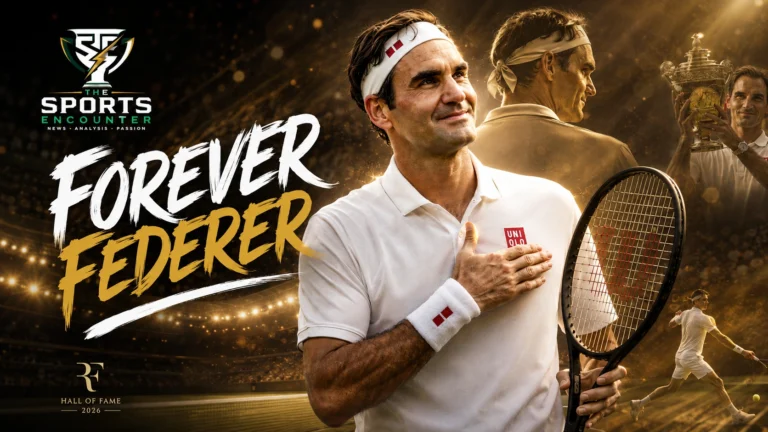
Roger Federer spent much of his career making difficult tennis look strangely simple.

The footwork rarely appeared rushed. The forehand seemed to arrive before opponents understood where the ball was going. His one-handed backhand could move from defense to attack in a single swing, while the serve disguised direction without relying on overwhelming speed.

That elegance became such a large part of Federer’s identity that it sometimes obscured the harder truth beneath it.

He was one of the most relentless winners tennis has ever produced.

Federer finished his career with 103 ATP Tour singles titles, 20 Grand Slam championships, six ATP Finals trophies, 28 Masters 1000 titles, 310 weeks as world No. 1, 1,251 tour-level victories and a record 237 consecutive weeks at the top of the rankings. Only Jimmy Connors finished the Open Era with more ATP singles titles and tour-level match wins. :contentReference[oaicite:1]{index=1}

On Saturday, August 29, Federer will officially enter the International Tennis Hall of Fame in Newport, Rhode Island, where the Class of 2026 will be honored on the historic Horseshoe Court. The ceremony begins at 6:30 p.m. ET. :contentReference[oaicite:2]{index=2}

The moment feels inevitable.

The career that led there never was.

Roger Federer’s Career at a Glance

Category Federer Record
ATP Tour singles titles 103
Grand Slam singles titles 20
Australian Open titles 6
Roland Garros titles 1
Wimbledon titles 8
US Open titles 5
ATP Masters 1000 titles 28
ATP Finals titles 6
Weeks at World No. 1 310
Consecutive weeks at No. 1 237
Tour-level match wins 1,251
Olympic medals Gold in doubles, silver in singles
Davis Cup titles 1

The International Tennis Hall of Fame also lists Federer as a six-time ATP Finals champion, a Davis Cup winner, Olympic doubles gold medalist, Olympic singles silver medalist and three-time Laver Cup champion. :contentReference[oaicite:3]{index=3}

The 20 Grand Slam Titles That Built the Federer Era

Federer’s 20 majors no longer stand as the men’s record. Novak Djokovic has 24 and Rafael Nadal finished with 22.

That later context should not diminish what Federer’s number meant when he built it.

When Federer won Wimbledon in 2009 for his 15th Grand Slam title, he moved past Pete Sampras’ then-record of 14. For a period, Federer had pushed the historical standard so far forward that the rest of men’s tennis appeared to be chasing a number that might not be reached for decades.

It was reached because Federer’s own rivals were historically exceptional.

Australian Open: Six Titles

Federer won in Melbourne in 2004, 2006, 2007, 2010, 2017 and 2018.

The first established him as the clear No. 1 of his generation.

The last two changed how his career was remembered.

By 2017, Federer was 35 years old, returning from six months away because of a knee injury, seeded 17th and entering his first competitive event since Wimbledon 2016.

He still reached the final.

Rafael Nadal was waiting.

Federer won 6-4, 3-6, 6-1, 3-6, 6-3, recovering from a break down in the final set to claim major No. 18. It was his first Grand Slam title since Wimbledon 2012. :contentReference[oaicite:4]{index=4}

A year later, he beat Marin Cilic for Australian Open title No. 6 and major No. 20.

He was 36.

Roland Garros: One Title That Meant More Than the Number

Federer reached four consecutive French Open finals from 2006 through 2009.

Rafael Nadal defeated him in the first three.

Then 2009 changed everything.

Robin Soderling stunned Nadal in the fourth round, removing the opponent who had blocked Federer repeatedly in Paris.

Federer still had to survive the tournament.

He eventually reached the final and beat Soderling 6-1, 7-6(1), 6-4.

The victory gave Federer his 14th major and completed the career Grand Slam, making him only the sixth man at the time to win all four majors. :contentReference[oaicite:5]{index=5}

Among Federer’s 20 majors, that one may have removed the largest historical question.

Wimbledon: Eight Titles and the Place Most Closely Connected to Federer

Federer won Wimbledon in 2003, 2004, 2005, 2006, 2007, 2009, 2012 and 2017.

Eight men’s singles titles remain a Wimbledon record.

The first came in 2003 against Mark Philippoussis.

It was Federer’s first Grand Slam championship.

Four years later, he had won five consecutive Wimbledon titles.

His eighth arrived in 2017 without dropping a set.

That title turned Centre Court into the clearest physical symbol of his career.

The relationship remains so strong that even when Novak Djokovic passed Federer’s Wimbledon men’s match-win record in 2026, Federer’s eight championships remained the standard Djokovic was still chasing. The Sports Encounter covered that milestone in our Wimbledon 2026 Day 7 report.

US Open: Five Consecutive Titles

Federer won the US Open every year from 2004 through 2008.

Five straight championships.

Forty consecutive match victories.

Six consecutive finals through 2009.

The Sports Encounter recently revisited that dynasty when Federer returned to Arthur Ashe Stadium for the farewell New York never properly received in our Federer US Open tribute.

The five finals Federer won came against Lleyton Hewitt, Andre Agassi, Andy Roddick, Novak Djokovic and Andy Murray.

That opponent list matters.

His New York dominance did not happen in a transitional vacuum.

Federer’s 103 Titles Were Built Across Every Surface

Federer’s 103 ATP Tour singles titles remain the second-highest total in Open Era men’s tennis, behind Connors’ 109. :contentReference[oaicite:6]{index=6}

The number came through dominance in very different conditions.

His Most Successful Tournaments

Tournament Federer Titles
Basel 10
Halle 10
Wimbledon 8
Cincinnati Masters 7
Australian Open 6
ATP Finals 6
US Open 5

ATP records identify Federer as the tournament record-holder for championships at Basel, Halle, Wimbledon and Cincinnati. :contentReference[oaicite:7]{index=7}

Basel had emotional significance because it was home.

Halle became his grass-court laboratory.

Wimbledon became his stage.

Cincinnati became one of the places where his attacking tennis worked with almost unnatural efficiency.

His seven Cincinnati titles remain more than he won at any other Masters 1000 tournament. :contentReference[oaicite:8]{index=8}

Six ATP Finals Titles Proved Federer Could Beat the Best Repeatedly

The ATP Finals are different from ordinary tournaments.

There is no early-round opponent ranked outside the elite.

Every match is against one of the season’s strongest players.

Federer won the event six times and recorded 59 victories there, both tournament records at the time of his retirement. He also reached 10 finals. :contentReference[oaicite:9]{index=9}

That part of the résumé matters because it confirms something the aesthetics can obscure.

Federer did not simply dominate weaker fields.

He repeatedly beat the best players in the world at an event designed specifically to gather them together.

Twenty-Eight Masters Titles Completed the Resume

Federer won 28 ATP Masters 1000 titles.

He became particularly dominant at Cincinnati and also built major championship runs at Indian Wells, Miami, Hamburg, Madrid and other elite stops.

In 2005, he won Indian Wells, Miami, Cincinnati and the US Open in the same season, completing a sweep of the four biggest American hard-court tournaments he played that year. :contentReference[oaicite:10]{index=10}

That season finished with an 81-4 record.

Those numbers are easier to understand when placed beside the eye test.

Federer’s peak was not merely beautiful.

It was brutally efficient.

The Rivalry With Rafael Nadal Changed Federer’s Career

Federer and Nadal played 40 times.

Nadal finished ahead 24-16. :contentReference[oaicite:11]{index=11}

The statistics tell one story.

The surfaces tell another.

Nadal led 14-2 on clay.

Federer led 11-9 on hard courts and 3-1 on grass.

Their styles could hardly have been more different.

Federer wanted to shorten points, take time away and move forward.

Nadal’s heavy left-handed forehand attacked Federer’s one-handed backhand relentlessly, particularly on clay.

That tactical imbalance became one of the defining problems of Federer’s career.

It also forced him to evolve.

2008 Wimbledon Final: The Loss That Became Part of Federer’s Legacy

Not every iconic Federer match was a victory.

The 2008 Wimbledon final against Nadal became one of the greatest matches ever played.

Nadal won 6-4, 6-4, 6-7, 6-7, 9-7.

Federer had been Wimbledon champion for five consecutive years.

The match ended that reign.

Its importance lies partly in what happened afterward.

Federer returned to New York weeks later and won his fifth consecutive US Open.

He then regained Wimbledon in 2009.

The losses mattered because they showed what the smoothness sometimes hid.

Federer absorbed enormous defeats and kept returning.

2017 Australian Open Final: Federer Finally Changes the Nadal Pattern

Melbourne 2017 may be the victory that best explains Federer’s late-career evolution.

He had lost six of their previous eight Grand Slam meetings.

He had not beaten Nadal at a major since Wimbledon 2007.

In the fifth set, Federer fell behind 3-1.

Then came five consecutive games.

The backhand, historically the side Nadal had targeted, became the shot Federer used to take time away.

The victory gave Federer his 18th major. :contentReference[oaicite:12]{index=12}

More importantly, it showed that a 35-year-old champion could still reengineer his game.

Novak Djokovic Became Federer’s Other Great Historical Problem

Federer and Djokovic played 50 times.

Djokovic finished ahead 27-23. :contentReference[oaicite:13]{index=13}

The rivalry developed differently from Federer-Nadal.

Nadal confronted Federer at his peak and challenged his tactical comfort.

Djokovic gradually became the player capable of absorbing Federer’s best tennis and still surviving the final few points.

They met in 19 finals, with Djokovic winning 13. :contentReference[oaicite:14]{index=14}

2007 US Open Final: Federer Beats the Rising Djokovic

Djokovic was already becoming a major force when Federer beat him in straight sets in the 2007 US Open final.

Federer’s victory completed his fourth consecutive New York championship.

At the time, the rivalry still belonged to the established champion.

It would not stay that way.

2011 Roland Garros: Federer Stops Djokovic’s Run

Djokovic entered the 2011 French Open semifinal undefeated for the season.

Federer beat him in four sets.

The victory remains one of Federer’s most important wins because it came against Djokovic during one of the Serbian’s most dominant seasons.

Federer did not win the tournament. Nadal beat him in the final.

The semifinal nevertheless remains one of the clearest examples of Federer producing elite tennis when the opponent appeared almost unbeatable.

2019 Wimbledon Final: The Match Federer Could Not Close

Federer held two championship points against Djokovic while serving at 8-7 in the fifth set.

He lost both.

Djokovic eventually won the final-set tiebreak.

Federer was 37 years old.

The defeat became one of the cruelest endings of his career.

It also became part of why fans connected so strongly with him late in his career.

The man associated with control had become visibly vulnerable to time, pressure and margins measured in inches.

Andy Roddick Was the Rival Federer Repeatedly Denied

The Federer-Roddick rivalry was statistically one-sided.

Its emotional importance was much larger.

Roddick had the serve, athleticism and personality to become the dominant American star of the post-Sampras and Agassi era.

Federer repeatedly stood in his way.

They met in four Grand Slam finals.

Federer won all four.

The last was the one everybody remembers.

2009 Wimbledon Final: 16-14 and Major No. 15

Roddick served magnificently.

Federer struggled to break him for almost the entire match.

The final reached 14-14 in the fifth set.

Federer eventually won 5-7, 7-6(6), 7-6(5), 3-6, 16-14.

It was his 15th major, moving him past Sampras’ record. :contentReference[oaicite:15]{index=15}

For Federer, it was history.

For Roddick, it became one of the most painful near-misses in tennis history.

The match remains iconic because both truths exist at once.

Pete Sampras Gave Federer the First Great Victory

Before Federer became Federer, Pete Sampras owned Wimbledon.

Sampras had won seven of the previous eight championships when the 19-year-old Swiss faced him in the fourth round in 2001.

Federer won in five sets.

The Hall of Fame describes that victory as one of the earliest signals of what was coming. :contentReference[oaicite:16]{index=16}

The symmetry became obvious later.

Federer defeated the seven-time Wimbledon champion before eventually winning eight Wimbledon titles himself.

The match became less important for what it achieved immediately and more important for what it revealed.

The 2009 French Open Completed the Missing Piece

The biggest pressure around Federer before 2009 was straightforward.

Could he win Roland Garros?

The debate followed him for years.

Nadal had denied him repeatedly.

Federer finally received a different opponent in the final and did not waste the opening.

Beating Soderling completed the career Grand Slam and removed the one obvious surface-based criticism of his résumé. :contentReference[oaicite:17]{index=17}

Weeks later, he won Wimbledon and broke Sampras’ major record.

No short stretch better captures Federer’s historical ambition than Paris and London in 2009.

2017 Was the Season Federer Was Supposed to Be Finished

Federer missed the second half of 2016 because of injury.

He returned at 35.

That should have been the beginning of a gradual farewell.

Instead, he won the Australian Open.

Then Indian Wells.

Then Miami.

Then Halle.

Then Wimbledon.

He finished the year with seven titles.

The backhand had become more aggressive. His court position moved forward. Points shortened.

Federer did not return by recreating his younger self.

He returned by changing what was necessary and protecting what remained elite.

That season may be the best evidence of his adaptability.

2019 Dubai: Title No. 100

Federer beat Stefanos Tsitsipas 6-4, 6-4 in the 2019 Dubai final to become only the second man in the Open Era to win 100 ATP Tour singles titles.

Tsitsipas had beaten Federer at the Australian Open only weeks earlier.

Federer answered in Dubai.

He later added three more trophies to finish with 103, with his final title appropriately coming in Basel. :contentReference[oaicite:18]{index=18}

Olympic Gold, Davis Cup and Playing for Switzerland

Federer’s career was built primarily around individual competition, but several of his most emotional achievements came while representing Switzerland.

He won Olympic doubles gold with Stan Wawrinka in Beijing in 2008.

Four years later, Federer won singles silver at the London Olympics.

Then came the Davis Cup.

Switzerland won the competition in 2014, giving Federer one of the few major team trophies missing from his résumé.

The Hall of Fame lists his Davis Cup record at 40-8 in singles and 12-10 in doubles. :contentReference[oaicite:19]{index=19}

Federer’s Records Once Looked Permanent

They were not.

Djokovic passed his Grand Slam total.

Nadal passed it first.

Djokovic later passed his weeks at No. 1.

In 2026, Djokovic moved beyond Federer’s Wimbledon men’s match-win total, a milestone The Sports Encounter covered during Wimbledon 2026.

That is what happens to statistical records.

Great players turn them into targets.

Federer’s legacy becomes more interesting when the conversation moves beyond which numbers survived.

Federer Changed the Standard Before Nadal and Djokovic Changed It Again

Federer, Nadal and Djokovic spent a combined 947 weeks at world No. 1.

The ATP describes their shared era as one of the defining periods in men’s tennis history. :contentReference[oaicite:20]{index=20}

Federer reached the top first.

From February 2004 through August 2008, he held the No. 1 ranking for 237 consecutive weeks.

No one has matched that streak. :contentReference[oaicite:21]{index=21}

Nadal forced Federer to confront a style built to attack his weaknesses.

Djokovic later created a different problem through return quality, movement, defense and mental resilience.

Federer’s numbers eventually became part of the chase that motivated both.

That is one reason evaluating the Big Three entirely through final totals misses something.

Federer changed the record book first.

Nadal and Djokovic then changed what seemed possible after him.

The Federer Style Became Its Own Form of Influence

Tennis players influence later generations through results.

Federer also influenced them through aspiration.

Young players wanted the forehand.

They wanted the one-handed backhand.

They wanted the serve motion.

They wanted to move through the court without appearing rushed.

The reality was more complicated.

Federer’s tennis worked because several unusual skills existed together: early ball recognition, foot speed, hand skills, disguise, serve placement, transition play and the confidence to take the ball earlier than most opponents.

Imitating the shape of the strokes was much easier than reproducing the system behind them.

His Longevity Changed the Meaning of a Tennis Prime

Federer won his first Wimbledon at 21.

He won his final major at 36.

He returned to world No. 1 at 36 years and 320 days, becoming the oldest man to hold the ranking at the time. :contentReference[oaicite:22]{index=22}

That second phase of his career mattered because it challenged the assumption that elite tennis had a narrow expiration date.

Federer’s late career depended on selective scheduling, shorter points and technical adaptation.

Modern veterans use similar principles now.

The Sports Encounter’s recent analysis of Novak Djokovic’s continuing late-career pursuit of Wimbledon history explored the same problem from the next generation in our Djokovic Wimbledon 2026 feature.

Federer Made Sportsmanship Commercially Powerful

Federer received the Stefan Edberg Sportsmanship Award 13 times.

Fans voted him ATP Fans’ Favourite for 19 consecutive years from 2003 through 2021. :contentReference[oaicite:23]{index=23}

Those awards matter because Federer’s public image became part of the sport’s global commercial expansion.

He could be presented equally comfortably in London, Shanghai, Dubai, New York, Melbourne or Basel.

His personality remained controlled without appearing distant.

His rivalry with Nadal developed into genuine friendship.

His retirement at the 2022 Laver Cup became unforgettable partly because Nadal sat beside him crying.

Competition had evolved into shared history.

The Laver Cup Became Part of Federer’s Post-Playing Legacy Before He Even Retired

Federer helped create the Laver Cup, giving men’s tennis a team event built around Europe against the rest of the world.

He played in the first three editions and was part of the winning Team Europe side each time.

His final competitive match came at the event in 2022, when he partnered Nadal in doubles.

That ending would have sounded almost artificially symbolic if it had been written years earlier.

The two defining rivals finished Federer’s career on the same side of the net.

Federer’s Career Also Changed the Business of Being a Tennis Star

The global appeal continued after retirement.

In 2026, ATP reported that Federer had joined Forbes’ World’s Billionaires List, reflecting the scale of the commercial empire built around endorsements, investments and business ventures after a career already worth hundreds of millions in prize money and partnerships. :contentReference[oaicite:24]{index=24}

That does not make him a greater tennis player.

It demonstrates how far his influence extended beyond matches.

Federer became a global sports brand without losing his connection to the sport itself.

New York Recently Gave Federer the Farewell It Missed

Federer’s relationship with tennis remains active.

Only days before his Hall of Fame induction, he returned to Arthur Ashe Stadium for a special US Open exhibition alongside Andy Roddick, Andre Agassi and John McEnroe.

The Sports Encounter described that event as the farewell New York never received because Federer’s final US Open appearance in 2019 passed without anyone knowing it would be his last.

Read our complete feature: Roger Federer Returns to Flushing Meadows for the Farewell New York Never Got.

The timing feels appropriate.

New York closed one unfinished chapter.

Newport will formalize the legacy.

Roger Federer’s Most Iconic Victories

Year Match Why It Matters
2001 Federer def. Pete Sampras, Wimbledon fourth round The breakthrough victory over the seven-time champion signaled a changing of generations.
2003 Federer def. Mark Philippoussis, Wimbledon final His first Grand Slam title.
2004 Federer def. Marat Safin, Australian Open final Helped establish Federer as world No. 1 and the dominant force of the era.
2005 Federer def. Rafael Nadal, Miami final Federer recovered from two sets down in an early classic of the rivalry.
2007 Federer def. Rafael Nadal, Wimbledon final Federer survived five sets to claim his fifth consecutive Wimbledon.
2007 Federer def. Novak Djokovic, US Open final Federer completed a fourth consecutive US Open title.
2009 Federer def. Robin Soderling, Roland Garros final Completed the career Grand Slam.
2009 Federer def. Andy Roddick, Wimbledon final Won 16-14 in the fifth set and broke Sampras’ major record with title No. 15.
2011 Federer def. Novak Djokovic, Roland Garros semifinal Stopped Djokovic during one of the most dominant starts to a season in tennis history.
2012 Federer def. Andy Murray, Wimbledon final Returned Federer to No. 1 and delivered his seventh Wimbledon title.
2017 Federer def. Rafael Nadal, Australian Open final Won major No. 18 after six months away and transformed the final phase of his career.
2017 Federer def. Marin Cilic, Wimbledon final Won a record eighth Wimbledon without dropping a set.
2018 Federer def. Marin Cilic, Australian Open final Claimed his 20th and final major at age 36.
2019 Federer def. Stefanos Tsitsipas, Dubai final Became the second Open Era man to reach 100 ATP singles titles.

Roger Federer’s Biggest Rivalries

Rival Final Head-to-Head What Defined It
Rafael Nadal Nadal 24-16 Contrasting styles, clay vs grass, repeated Grand Slam finals and one of sport’s defining friendships.
Novak Djokovic Djokovic 27-23 Elite shotmaking against extraordinary defense, return quality and mental pressure across 50 meetings.
Andy Roddick Federer dominated the series Federer repeatedly blocked America’s leading star from additional Grand Slam glory.
Andy Murray One of Federer’s key late-2000s and early-2010s matchups Variety, anticipation and tactical problem-solving, including major finals at the US Open, Australian Open and Wimbledon.
Lleyton Hewitt Federer turned an early rivalry into sustained dominance Hewitt represented the world No. 1 standard Federer had to pass before establishing his own era.

Federer’s Legacy Cannot Be Reduced to the GOAT Argument

The temptation is obvious.

Twenty majors versus 22.

310 weeks at No. 1 versus 428.

103 titles versus other historical totals.

Those comparisons matter.

They are not sufficient.

Federer’s role in tennis history was partly numerical and partly transformational.

He arrived after Sampras and Agassi had defined the previous era.

Then he accelerated everything.

He won majors at a rate that seemed unreasonable.

He held No. 1 for 237 consecutive weeks.

He made 23 consecutive Grand Slam semifinals and 36 consecutive quarterfinals.

He turned baseline tennis into attacking geometry while still remaining one of the last great serve-and-volley-capable champions.

Then Nadal arrived.

Then Djokovic.

The numbers changed again.

The standard never went backward.

The Most Important Federer Record May Be the One Nobody Can Measure

Federer made people want to watch tennis who were not necessarily tennis fans.

That matters.

Some athletes dominate their sport.

A smaller group expand its audience.

Federer’s appeal crossed geography, language and surface.

Fans who preferred Nadal still watched Federer.

Fans who later supported Djokovic still measured matches against the Federer era.

Young players copied the backhand even when coaches advised against it.

Tournaments marketed his presence as an event rather than an entry.

That kind of influence rarely survives in a statistical database.

Why the Hall of Fame Induction Feels Different From Retirement

Federer retired in 2022.

The emotional farewell has already happened.

Newport serves a different purpose.

The International Tennis Hall of Fame exists to turn careers into permanent historical record.

Federer will join the institution on August 29 alongside Mary Carillo, with the ceremony scheduled for 6:30 p.m. ET on the Horseshoe Court. :contentReference[oaicite:25]{index=25}

The Hall has described induction as tennis’ ultimate honor.

For Federer, it also completes a circle.

He spent his career openly respecting the history of tennis.

When he learned of his election, he said being recognized alongside the sport’s great champions was “deeply humbling.” :contentReference[oaicite:26]{index=26}

The Sports Encounter Verdict: Federer Changed What Greatness Looked Like

Roger Federer did not finish with every record.

That does not weaken the career.

It explains the era.

Federer raised the standard.

Nadal attacked it.

Djokovic pushed it further.

Together, they created the greatest sustained competitive period men’s tennis has seen.

Federer’s place inside that story remains distinct.

He was the first of the three to break the old record book open.

He was the player whose style made dominance look artistic.

He was the champion who lost some of the most painful matches imaginable and still returned to win majors in his mid-30s.

He won Wimbledon eight times.

He won the US Open five years in a row.

He completed the career Grand Slam.

He reached 100 titles before finishing with 103.

He stayed No. 1 for 237 consecutive weeks.

He won 1,251 matches without ever retiring from a singles match during his career. ATP records note that Federer never retired in any of his 1,526 singles or 224 doubles matches. :contentReference[oaicite:27]{index=27}

That final detail may say as much about him as any trophy.

Federer’s tennis was remembered for grace.

The career underneath it was built on durability, stubbornness, adaptation and an extraordinary appetite for competing again.

On Saturday in Newport, the trophies will already be known.

The records will already be written.

The rivalries will already belong to tennis history.

The Hall of Fame induction simply gives the sport a permanent place to put the name.

Roger Federer has belonged there for a very long time.

Frequently Asked Questions

When will Roger Federer be inducted into the International Tennis Hall of Fame?

Roger Federer will be inducted on Saturday, August 29, 2026, in Newport, Rhode Island. The ceremony is scheduled to begin at 6:30 p.m. ET.

How many titles did Roger Federer win?

Federer won 103 ATP Tour singles titles, the second-highest total in the Open Era behind Jimmy Connors’ 109.

How many Grand Slam titles did Roger Federer win?

Federer won 20 Grand Slam singles titles: six Australian Opens, one Roland Garros, eight Wimbledons and five US Opens.

How many Wimbledon titles did Roger Federer win?

Federer won eight Wimbledon men’s singles titles, a tournament record.

How many US Open titles did Federer win?

Federer won five consecutive US Open titles from 2004 through 2008.

Did Roger Federer win the career Grand Slam?

Yes. Federer completed the career Grand Slam by winning Roland Garros in 2009.

What was Federer’s record against Rafael Nadal?

Nadal led their final head-to-head series 24-16 across 40 matches.

What was Federer’s record against Novak Djokovic?

Djokovic finished their rivalry with a 27-23 advantage across 50 meetings.

What was Roger Federer’s most iconic victory?

Several qualify, but the 2017 Australian Open final against Rafael Nadal, the 2009 Roland Garros final against Robin Soderling and the 2009 Wimbledon final against Andy Roddick are among the strongest candidates.

How long was Federer world No. 1?

Federer spent 310 total weeks at world No. 1, including a record 237 consecutive weeks from February 2004 through August 2008.

Did Roger Federer win Olympic gold?

Yes. Federer won Olympic doubles gold with Stan Wawrinka at Beijing 2008. He also won singles silver at London 2012.

Did Federer win the Davis Cup?

Yes. Federer helped Switzerland win the Davis Cup in 2014.

What was Federer’s final Grand Slam title?

Federer’s 20th and final major came at the 2018 Australian Open, where he defeated Marin Cilic in the final.

What was Federer’s 100th ATP title?

Federer won his 100th tour-level title at Dubai in 2019 by defeating Stefanos Tsitsipas in the final.

Why is Roger Federer’s legacy important?

Federer combined historic results with technical influence, global popularity, longevity and sportsmanship. His dominance helped redefine the statistical standard of men’s tennis before Rafael Nadal and Novak Djokovic pushed that standard even further.

Miley Rumer is a St. Clairsville, Ohio-based sports journalist and The Sports Encounter’s U.S. correspondent, covering the NHL, NBA, NFL, MLB, MLS, and major sporting stories across North America. Her work focuses on player performance, team identity, rivalries, roster decisions, tournament developments, and the human stories that shape how fans experience sport. At The Sports Encounter, Miley contributes breaking news, match coverage, analysis, and feature stories across American and international sport, including major soccer and tennis events. Her reporting combines clear news judgment with performance context, historical perspective, and an understanding of the fan conversations surrounding teams and athletes. Based in the United States, she brings a grounded North American perspective to coverage of the leagues, competitions, and personalities driving global sports interest.

Athletics

Mondo Duplantis and Emmanouil Karalis Push Pole Vault Into New Territory in Zurich

Mondo Duplantis cleared 6.25m to win in Zurich, but Emmanouil Karalis’ Greek-record 6.20m turned the night into something bigger as both men attacked 6.32m.

Published

on

Mondo Duplantis and Emmanouil Karalis celebrate after clearing 6.25m and 6.20m in a historic men’s pole vault duel in Zurich.

Mondo Duplantis won again in Zurich on Thursday night.

That familiar headline barely explains what happened.

Emmanouil Karalis cleared 6.20 meters, breaking the Greek national record and forcing the world record holder into another contest at heights that until recently belonged almost entirely to Duplantis. The Swede responded by going higher, clearing 6.25m to establish a new Weltklasse Zurich meeting record.

Then both men turned their attention toward 6.32m.

Neither cleared it, but the fact that two athletes were attacking a height above the existing 6.31m world record on the same night tells the larger story.

Men’s pole vault is changing.

Duplantis remains the standard. Karalis is increasingly becoming the athlete who makes that standard move.

Only a week after they produced a historic duel in Lausanne, the pair went even higher in Zurich. What once looked like Duplantis competing against the bar is beginning to feel like an actual rivalry at six meters and beyond.

Zurich Diamond League Men’s Pole Vault: Key Facts

Detail Result
Meeting Weltklasse Zurich 2026
Date August 27, 2026
Venue Letzigrund Stadium, Zurich
Winner Mondo Duplantis, Sweden
Winning height 6.25m
Second Emmanouil Karalis, Greece
Karalis’ height 6.20m, Greek national record
Meeting record 6.25m, Duplantis
World record 6.31m, Duplantis
World-record height attempted 6.32m

The official World Athletics report from Zurich confirms Duplantis’ 6.25m victory and Karalis’ 6.20m national record on a night when several events reached extraordinary levels.

Karalis Cleared 6.20m and Changed the Competition

There is a difference between another athlete jumping six meters and another athlete following Duplantis into the 6.20m territory.

Karalis has crossed that line.

His 6.20m clearance in Zurich improved his own Greek record and strengthened his position as the second-highest pole vaulter in history behind Duplantis.

It also changed the competitive psychology of the event.

For much of Duplantis’ dominance, the pattern has been straightforward. He wins the competition, the rest of the field stops jumping, and he turns the remaining attempts into a private fight with a world-record height.

Karalis is increasingly refusing to disappear from that final stage.

He forced the competition through 6.20m in Zurich.

That matters because 6.20m is not simply another increment on a progression sheet. It is a height almost nobody in the history of the sport has been capable of clearing.

Karalis can now do it.

Duplantis Answered With 6.25m

Duplantis did what he has repeatedly done whenever another vaulter closes the distance.

He moved the bar again.

His 6.25m clearance secured victory and established a new Zurich meeting record, keeping a five-centimeter gap between himself and Karalis on the night.

The number deserves context.

Duplantis had already cleared 6.25m earlier this year when he won his fourth consecutive world indoor title. His 2026 season has also included the 6.31m world record that remains the global standard.

For almost any other athlete, 6.25m would represent a career-defining performance.

For Duplantis, it has become part of the working range from which he can begin thinking about another world record.

That distinction remains the strongest argument for why the competitive gap has not disappeared despite Karalis’ rise.

Both Men Then Looked at 6.32m

Once 6.20m and 6.25m had been cleared, the competition moved into territory where the target was no longer another meeting record.

It was the world record.

The bar went to 6.32m.

Both Duplantis and Karalis attacked it.

Neither succeeded.

The misses still matter because of who was making them.

World-record attempts in men’s pole vault have become familiar because Duplantis produces them so often. A second athlete joining him at that height changes the visual and competitive meaning of those final attempts.

Karalis was not watching from below.

He was participating.

The world record remains Duplantis’ 6.31m, set earlier in 2026. The next centimeter is still his to conquer, but Zurich suggested he may eventually have company while trying.

Lausanne Was Historic. Zurich Took the Rivalry Higher.

The significance of Zurich becomes clearer when placed beside what happened seven days earlier in Lausanne.

Duplantis cleared 6.21m there.

Karalis cleared 6.16m.

World Athletics described it as the first pole vault competition in history in which two men had cleared higher than 6.10m.

The official Lausanne report from World Athletics confirmed that Karalis’ 6.16m was the second-best clearance of his career at the time, behind his 6.17m best.

Zurich changed that immediately.

Karalis moved from 6.16m in Lausanne to 6.20m in Zurich.

Duplantis moved from 6.21m to 6.25m.

Meeting Duplantis Karalis What Changed
Lausanne 6.21m 6.16m First competition with two men above 6.10m
Zurich 6.25m 6.20m Karalis national record; Duplantis meeting record; both attack 6.32m

Two meetings.

Two five-centimeter gaps.

Both athletes higher the second time.

That is beginning to look less like an isolated spectacular competition and more like the development of a sustained rivalry.

Duplantis Said Competition Was Pushing Him Higher

The pattern was already visible after Lausanne.

Duplantis said after that competition: “I love competing against Manolo, especially when he is on his A-game.”

The quote came through the official Wanda Diamond League account of their Lausanne duel.

Zurich gave the comment more weight.

For years, the central question surrounding Duplantis was whether he could keep motivating himself after establishing such a large advantage over the rest of the event.

Karalis may be changing that equation.

Duplantis still wins.

He no longer has to create all of the pressure himself.

Karalis Is No Longer Competing for Second Place

This is where the rivalry has shifted.

Karalis finished second again in Zurich.

Describing him simply as runner-up misses the competitive change taking place.

A 6.20m clearance does not represent somebody hanging around behind Duplantis.

It represents an athlete forcing the competition into a height where Duplantis must remain exceptional to win.

That is new.

Karalis had already produced a 6.17m clearance before Zurich, placing him second on the all-time list. He then cleared 6.16m in Lausanne before raising his national record to 6.20m.

The progression is becoming more important than any one silver medal or second-place finish.

He is developing repeatability at heights beyond six meters.

That is the skill required before genuine world-record pressure becomes possible.

Birmingham Showed the Gap. Lausanne and Zurich Have Narrowed It.

The contrast with the European Championships only strengthens the story.

Duplantis won his fourth consecutive European outdoor title in Birmingham earlier this month with 6.15m.

Karalis took silver with 6.00m.

The Sports Encounter’s complete Birmingham 2026 review documented how Duplantis emerged from a difficult summer to regain control with another championship record.

At that point, the difference between the pair on the night was 15 centimeters.

Lausanne reduced it to five.

Zurich kept it at five while both moved four centimeters higher.

That does not mean Karalis has caught Duplantis.

It means the distance between the world’s two best vaulters has become competitive enough to influence how both men approach their next heights.

Duplantis’ Difficult Summer Makes This Run More Impressive

The 2026 outdoor season has not been a seamless victory tour for Duplantis.

He suffered a rare Diamond League defeat earlier in the summer.

He also withdrew from the London Diamond League and arrived at Birmingham describing the preceding weeks as difficult.

Then came the European title.

Then 6.21m in Lausanne.

Then 6.20m at Silesia.

Now 6.25m in Zurich.

The progression matters because Duplantis is not simply maintaining form deep into the summer.

He appears to be improving as the season approaches its final major stretch.

The Sports Encounter’s guide to the inaugural World Athletics Ultimate Championship examined how Budapest will provide athletics with another major global stage in September.

Duplantis is approaching that championship with his event moving faster than it was only weeks ago.

Six Meters Is Becoming the Start of the Conversation

This may be the most revealing shift in elite men’s pole vault.

Six meters remains an extraordinary athletic achievement.

At the very top of this particular field, it is becoming a checkpoint rather than the finish line.

Duplantis has normalized the impossible to such an extent that audiences now wait for what happens after 6.00m.

Karalis is beginning to do the same.

That should not reduce the significance of six meters.

It should highlight how exceptional this generation has become.

The Sports Encounter has seen a similar effect in other athletics disciplines this summer. At the European Championships’ record-packed Birmingham session, multiple champions pushed marks that would ordinarily dominate an entire meeting.

Zurich took that trend further.

The Technical Difference at 6.20m Is Enormous

A five-centimeter increase in pole vault can look trivial on a results sheet.

It is anything but.

At these heights, athletes are already operating near the limits of runway speed, pole stiffness, takeoff timing, body position and clearance efficiency.

A slightly imperfect plant can end an attempt.

A small loss of speed can leave the hips below the bar.

A successful vault can still fail because an arm, chest or leg brushes the bar during descent.

That is why repeat performances matter.

One spectacular clearance proves an athlete can reach a height.

Repeatedly returning to the neighborhood tells us the performance has become part of the athlete’s actual level.

Karalis’ recent sequence is increasingly showing the second pattern.

Duplantis Still Owns the Most Important Advantage

The excitement around Karalis should not obscure the central reality.

Duplantis remains ahead.

His world record is 6.31m.

He cleared 6.25m in Zurich after Karalis reached 6.20m.

His career contains a depth of six-meter performances and world records that no other active vaulter approaches.

The gap has narrowed competitively.

The hierarchy has not yet changed.

This distinction matters when evaluating emerging rivalries in individual sports.

The challenger does not need to become better immediately for the rivalry to become valuable.

He needs to become good enough to force the favorite to respond.

Karalis is doing that now.

Zurich’s Pole Vault Was Part of an Extraordinary Athletics Night

The men’s pole vault could have been the defining event at most Diamond League meetings.

In Zurich, it shared the night with performances that rewrote athletics history.

Alison dos Santos broke the men’s 400m hurdles world record.

Masai Russell broke the women’s 100m hurdles world record.

Audrey Werro came within touching distance of one of track’s oldest world records in the women’s 800m.

Julien Alfred matched Saint Lucia’s national record in the women’s 100m.

Kenny Bednarek produced a season-leading performance over 200m.

Emmanuel Wanyonyi delivered the year’s fastest men’s 800m.

Duplantis and Karalis then supplied a field-event counterpart to that track explosion.

The Sports Encounter had already followed Zurich’s buildup through Keely Hodgkinson’s late withdrawal and Audrey Werro’s changing 800m position.

The meeting ultimately exceeded even those expectations.

Karalis’ Rise Gives Pole Vault Something Duplantis Alone Could Not

Duplantis has given pole vault global visibility through dominance.

A genuine rival offers something different.

Uncertainty.

That is valuable.

Fans understand that Duplantis can break world records.

The suspense increasingly comes from whether anybody can remain alive in the competition long enough to affect when and how he attacks them.

Karalis is now doing exactly that.

This is not a manufactured rivalry built around personality or marketing.

The heights are creating it.

The World Record Has Become a Moving Target

Duplantis has transformed the men’s pole vault world record from a once-in-a-generation event into something spectators actively anticipate whenever he is in elite form.

That can create a strange distortion.

A 6.25m win can somehow feel incomplete because 6.32m did not follow.

It should not.

Six meters and 25 centimeters remains one of the greatest heights ever cleared by a human being.

The same phenomenon has long surrounded Usain Bolt’s sprinting legacy.

The Sports Encounter recently revisited Bolt’s 9.69-second breakthrough in Beijing and how repeated exposure to extraordinary performances can alter what audiences consider normal.

Duplantis has done something similar in pole vault.

The remarkable development is that Karalis is beginning to influence those expectations too.

What Comes Next for Duplantis and Karalis?

The Wanda Diamond League season now moves toward its final in Brussels on September 4 and 5.

Duplantis is seeking another Diamond League title, while the wider season then moves toward the inaugural World Athletics Ultimate Championship in Budapest from September 11 to 13.

The late-season schedule therefore gives this rivalry more room to develop almost immediately.

There is no need to wait until next year.

If Karalis continues operating around 6.15m to 6.20m, Duplantis may repeatedly find himself needing heights above six meters before the competition has even been won.

That changes strategy.

It changes fatigue.

It changes pole selection.

Most importantly, it changes pressure.

The Bigger Athletics Context

The pole vault rivalry also fits a wider pattern visible throughout this European summer.

The level across several disciplines is rising simultaneously.

Audrey Werro’s 800m breakthrough has altered expectations around one of athletics’ oldest world records. Amy Hunt has emerged as a major sprint force after an historic European campaign, documented in The Sports Encounter’s analysis of her rare 100m-200m double.

European field events have also produced championship records and deep competition, from Kristjan Čeh’s discus performances to Angelica Moser’s pole vault success, covered in our Birmingham Day 4 review.

Zurich showed what happens when those trends converge in one stadium.

Why 6.32m Now Feels Different

The world-record attempt at 6.32m would have been compelling regardless of who remained in the competition.

Zurich made it more interesting because Karalis was still part of the conversation.

The mark no longer represented only Duplantis trying to improve himself by one centimeter.

It became a shared target for the world’s two leading vaulters.

That does not make their chances equal.

Duplantis has already cleared 6.31m.

Karalis’ new national record is 6.20m.

Eleven centimeters remains a substantial gap at this level.

But world records begin to feel vulnerable when more than one athlete believes the height belongs in the competition.

TSE Pole Vault Scorecard

Category Mondo Duplantis Emmanouil Karalis
Zurich result 1st 2nd
Zurich best 6.25m 6.20m
Zurich significance Meeting record Greek national record
Career world-record territory 6.31m world record Now firmly above 6.15m level
Current advantage Depth, consistency and record ceiling Rapid progression and growing pressure
Zurich verdict Still the standard Now the genuine challenger

The Detail That Matters

Mondo Duplantis cleared 6.25m.

That is extraordinary.

Emmanouil Karalis clearing 6.20m may ultimately be the more important development for the event.

Duplantis has spent years proving how high one athlete can take pole vault.

Karalis is beginning to ask what happens when somebody else follows him there.

Lausanne offered the first historic clue.

Zurich strengthened it.

Duplantis remains the world record holder, the champion and the athlete everybody is chasing.

For perhaps the first sustained period of his extraordinary reign, however, somebody is beginning to chase him at heights high enough for Duplantis to notice.

That is why Zurich mattered.

The story was not simply another Mondo victory.

It was the night 6.20m became part of a two-man competition.

Frequently Asked Questions

How high did Mondo Duplantis jump in Zurich?

Mondo Duplantis cleared 6.25 meters to win the men’s pole vault at the 2026 Weltklasse Zurich meeting and establish a new meeting record.

How high did Emmanouil Karalis jump in Zurich?

Karalis cleared 6.20 meters, setting a new Greek national record and finishing second behind Duplantis.

Did Duplantis break the world record in Zurich?

No. Duplantis won with 6.25m. The world record remains his 6.31m mark, and 6.32m was attacked in Zurich without a successful clearance.

What is Mondo Duplantis’ world record?

Duplantis holds the men’s pole vault world record at 6.31 meters.

Did Karalis attempt the world record in Zurich?

Yes. After clearing a Greek record of 6.20m, Karalis joined the attack on 6.32m during the extraordinary closing stages of the competition.

Is Emmanouil Karalis the second-highest pole vaulter in history?

Yes. Karalis is second on the men’s all-time pole vault list behind Duplantis and strengthened that position by clearing 6.20m in Zurich.

What happened between Duplantis and Karalis in Lausanne?

Duplantis cleared 6.21m in Lausanne while Karalis reached 6.16m. It became the first pole vault competition in history in which two men cleared higher than 6.10m.

Who won the European pole vault title in 2026?

Duplantis won his fourth consecutive European outdoor title in Birmingham with a championship-record 6.15m. Karalis won silver with 6.00m.

Why is the Duplantis-Karalis rivalry important?

Duplantis has dominated men’s pole vault for years, but Karalis is now repeatedly clearing heights above 6.10m and reached 6.20m in Zurich. That is forcing elite competitions to remain alive deeper into heights previously dominated almost exclusively by Duplantis.

When is the 2026 Diamond League Final?

The Wanda Diamond League Final is scheduled for September 4-5, 2026, in Brussels.

Continue Reading

Breaking News

US Open 2026 Draw: Alcaraz and Sabalenka Face Brutal Paths as Venus Gets Kenin

The US Open 2026 singles draws are set, with Carlos Alcaraz and Aryna Sabalenka facing difficult routes, Novak Djokovic chasing a 25th major, and Venus Williams drawing Sofia Kenin in Round 1.

Marcos Wetherfield | The Sports Encounter

Published

on

US Open 2026, Carlos Alcaraz, Aryna Sabalenka, Novak Djokovic, Venus Williams

The 2026 US Open singles draws have turned the final Grand Slam of the season into a test of recovery, momentum and survival before the first main-draw ball has even been struck.

Carlos Alcaraz returns to singles after five months out with a right wrist injury and immediately faces Roman Safiullin, one of the few players in the field who has already beaten him. Aryna Sabalenka begins her pursuit of a third consecutive US Open title against Camila Osorio, but Wimbledon champion Linda Noskova and an in-form Jessica Pegula could block her route before the final.

Novak Djokovic has landed in Alcaraz’s half while chasing a record-setting 25th Grand Slam singles title. Alexander Zverev has inherited the No. 1 seed following Jannik Sinner’s withdrawal. Coco Gauff arrives as Cincinnati champion with a dangerous bottom-half path, and 46-year-old Venus Williams will face former Australian Open champion Sofia Kenin in one of the tournament’s most compelling opening matches.

Then there is Arthur Fils.

The Cincinnati champion has been drawn against Stefanos Tsitsipas in Round 1 and sits inside the same quarter of the draw as Alcaraz and Ben Shelton. That turns a section already shaped by Alcaraz’s fitness into one of the men’s tournament’s most unpredictable zones.

The official US Open men’s singles draw and US Open women’s singles draw now define the routes to the September finals.

The Sports Encounter’s complete US Open 2026 curtain-raiser was published before injuries and the North American hard-court swing substantially changed the competitive picture. The draw has now provided the final piece.

US Open 2026 Draw: Key Storylines at a Glance

Player Seed First-Round Opponent Major Draw Storyline
Carlos Alcaraz 2 Roman Safiullin Returns to singles after five months out; Djokovic and Medvedev are in his half
Alexander Zverev 1 Lorenzo Sonego Elevated to top seed after Jannik Sinner’s withdrawal
Novak Djokovic 4 Mariano Navone Chasing a record-setting 25th Grand Slam singles title
Arthur Fils 10 Stefanos Tsitsipas Cincinnati champion lands immediately in a dangerous first-round match
Aryna Sabalenka 1 Camila Osorio Chasing a third consecutive US Open title
Jessica Pegula 3 Elena-Gabriela Ruse Could face the Venus Williams-Kenin winner in Round 2
Coco Gauff 4 Drawn in bottom half Arrives in New York after winning Cincinnati
Venus Williams Wild card Sofia Kenin 46-year-old two-time US Open champion meets another American major winner

Carlos Alcaraz’s Title Defense Begins With a Real Test

Alcaraz could have drawn an opponent who allowed him to settle gently back into best-of-five-set singles.

He got Safiullin instead.

The Russian reached the Wimbledon fourth round earlier this summer, beating Andrey Rublev and Joao Fonseca before losing to Djokovic in four sets.

More importantly, Safiullin has already beaten Alcaraz.

That victory came at the 2023 Paris Masters, when Safiullin defeated the Spaniard while Alcaraz was ranked No. 2 in the world. Alcaraz responded by beating him at the Paris Olympics the following year, leaving their head-to-head level at one victory each.

Under ordinary circumstances, Alcaraz would still begin as a heavy favorite.

These are not ordinary circumstances.

The defending champion has not played a singles match since April after a right wrist injury forced him out of Roland Garros, Wimbledon and the major North American warm-up tournaments.

He did return to competition during the US Open’s mixed doubles event alongside Serena Williams. The Sports Encounter followed that comeback through our report on Serena Williams and Alcaraz’s partnership and their subsequent mixed doubles run and quarterfinal exit.

Those matches gave Alcaraz useful Arthur Ashe Stadium exposure.

They did not reproduce the physical demands of men’s Grand Slam singles.

That is why Safiullin matters.

Alcaraz is being asked to find his movement, timing, serve rhythm and five-set endurance against an opponent who has enough power to punish rust immediately.

Alcaraz Has Landed in the Stronger Men’s Half

The opening match is only the first problem.

Alcaraz sits in the bottom half of the men’s draw alongside several former US Open champions:

  • Novak Djokovic
  • Daniil Medvedev
  • Stan Wawrinka
  • Marin Cilic

Ben Shelton is the projected quarterfinal opponent by seeding.

Arthur Fils is also in that quarter.

A potential semifinal could eventually bring Djokovic, Medvedev or another player who survives that part of the bracket.

This is where the injury changes the meaning of the draw.

An active, fully match-ready Alcaraz would probably welcome a demanding route because his best tennis tends to strengthen as tournaments become more difficult.

The 2026 version enters New York needing to rediscover competitive rhythm while simultaneously defending the title.

The draw offers very little time for that process.

Sinner’s Withdrawal Has Changed the Entire Men’s Tournament

Jannik Sinner was originally expected to enter New York as world No. 1.

His knee injury removed him from the tournament.

That decision promoted Alexander Zverev to the No. 1 seed and fundamentally altered both halves of the draw.

The Sports Encounter first tracked the problem when Sinner withdrew from Cincinnati because of the knee injury.

The subsequent US Open withdrawal created the largest opening in the men’s field.

Sinner had become one of the two defining players at the top of men’s tennis alongside Alcaraz. Removing him means the defending champion no longer has his most obvious rival in the bracket.

It also means Zverev, Djokovic, Shelton, Fils and the wider group of contenders all gained theoretical opportunity.

The word “theoretical” matters.

Sinner’s absence does not make the draw easy.

It redistributes the danger.

Zverev Has the No. 1 Seed and a More Manageable Route

Alexander Zverev opens against Lorenzo Sonego.

The French Open champion could then encounter Lorenzo Musetti in the fourth round, Alex de Minaur in the quarterfinals and Felix Auger-Aliassime in the semifinals if the major seeds advance.

Compared with Alcaraz’s half, the route looks cleaner.

That does not make it comfortable.

Zverev has spent years carrying the burden of being one of the best players of his generation without a Grand Slam championship. Roland Garros finally removed that question earlier this season.

New York now tests whether winning one major changes the psychology of chasing another.

His position as the No. 1 seed gives him an opportunity to enter the tournament without immediately encountering Djokovic, Alcaraz or Medvedev.

He still has to convert that advantage.

Djokovic’s 25th Major Chase Runs Through a Dangerous Section

Novak Djokovic begins against Argentina’s Mariano Navone.

The opening round itself should be manageable by Djokovic’s standards.

Round 2 could become far more interesting.

Stan Wawrinka faces Matteo Berrettini in another first-round match, and the winner is positioned to meet Djokovic if the Serbian advances.

That creates several layers of history.

Wawrinka beat Djokovic in the 2016 US Open final.

Berrettini is a former Wimbledon finalist with the serve and forehand to make an early-round match uncomfortable.

Djokovic, meanwhile, is attempting to become the first singles player in tennis history to reach 25 Grand Slam championships.

He already owns four US Open titles.

The Sports Encounter tracked his difficult North American preparation through Cincinnati, where his return raised physical questions after a long competitive break. That broader build-up is covered in our analysis of Cincinnati’s biggest disappointments.

Djokovic’s Grand Slam experience makes it dangerous to draw too much from Masters results.

At 39, however, recovery between five-set matches matters more than it once did.

A draw involving Medvedev before a possible semifinal with Alcaraz offers little room for wasted energy.

Arthur Fils vs Stefanos Tsitsipas Is the Men’s First-Round Match to Circle

Arthur Fils enters the US Open in the best form of his career.

He just won Cincinnati.

His reward is Stefanos Tsitsipas.

The matchup is far more dangerous than the seeding difference suggests.

Fils arrives as the No. 10 seed and one of the hottest players in the field. Tsitsipas is no longer operating at the ranking level that once took him to No. 3, but he remains a two-time Grand Slam finalist with the ability to make a best-of-five match complicated.

The Sports Encounter examined how dramatically Cincinnati changed the men’s race when Fils captured the Cincinnati title.

That championship established him as more than a dangerous outsider.

The US Open draw now asks him to prove it immediately.

There is another reason this match matters.

Fils is positioned inside Alcaraz’s quarter.

If he carries Cincinnati form into New York, the projected Alcaraz-Shelton quarterfinal is no certainty.

Other Men’s First-Round Matches Carry Real Upset Potential

Several opening matches deserve more attention than a routine draw summary usually gives them.

Match Why It Matters
Arthur Fils vs Stefanos Tsitsipas Cincinnati champion meets a two-time Grand Slam finalist
Stan Wawrinka vs Matteo Berrettini Wawrinka begins his final US Open; winner could face Djokovic
Andrey Rublev vs Marin Cilic Current seed against the 2014 US Open champion
Lorenzo Musetti vs Arthur Fery Musetti faces a Briton who reached the Wimbledon semifinals
Carlos Alcaraz vs Roman Safiullin Defending champion returns after five months against a player who has beaten him

The strength of these first-round matchups reflects the unusual state of the men’s field.

Several former elite players have slipped in the rankings.

Younger players have risen quickly.

Injuries have disrupted the normal seeding hierarchy.

The result is a draw where reputation and ranking are not always aligned.

Aryna Sabalenka Is Chasing History With Little Margin for Error

Sabalenka has owned the US Open for the last two years.

She won in 2024.

She defended the title in 2025.

A third consecutive championship would put her into rare modern company.

The official US Open women’s draw analysis places Sabalenka in the top half alongside Jessica Pegula and reigning Wimbledon champion Linda Noskova.

Sabalenka opens against Camila Osorio.

The early path could then include Renata Zarazua, Barbora Krejcikova and Diana Shnaider before a projected quarterfinal against Noskova.

That is not an ideal sequence for a defending champion whose North American hard-court swing has been less convincing than expected.

Sabalenka remains the player everyone else must remove.

The draw has made sure several opponents capable of doing it are nearby.

Linda Noskova Is No Longer a Surprise Draw

Noskova’s name changes the meaning of Sabalenka’s quarter.

Six months ago, seeing Noskova in a projected Grand Slam quarterfinal might have looked like opportunity for the higher seed.

She is now the Wimbledon champion.

The Sports Encounter followed her transformation through the grass-court season, including the historic all-Czech Wimbledon final created by Noskova and Karolina Muchova.

Noskova has since added a Cincinnati doubles championship with Marie Bouzkova.

That does not guarantee another deep singles run.

It does mean Sabalenka’s projected quarterfinal opponent arrives with evidence that she can handle Grand Slam pressure.

The psychological dynamic has changed.

Noskova is no longer trying to discover whether she belongs in the final rounds of majors.

She already knows.

Jessica Pegula May Control the Top Half Before Sabalenka Sees Her

Pegula opens against Elena-Gabriela Ruse.

The draw then gives her an unusual second-round possibility.

If Pegula wins, she will face either Venus Williams or Sofia Kenin.

That means one of the tournament’s biggest American stories could move directly into another all-American match.

Pegula is also the projected semifinal opponent for Sabalenka.

Her recent form makes that particularly relevant.

She reached two US Open tune-up finals during the North American swing.

Even without winning either title, repeated deep runs indicate that Pegula arrives match-ready and accustomed to hard-court pressure.

A semifinal against Sabalenka would carry obvious history because Pegula reached the US Open final in 2024.

Venus Williams vs Sofia Kenin Is Much Bigger Than a Wild-Card Match

Venus Williams is 46.

Sofia Kenin is 27.

Both are Grand Slam champions.

Both entered the US Open through wild cards.

They have never played one another at tour level.

That combination alone makes the match worth watching.

The surrounding story is even stranger.

The USTA initially held one final women’s singles wild card while Serena Williams considered whether to enter singles after returning to competitive tennis this year.

Serena ultimately chose doubles only.

The remaining wild card went to Kenin.

The draw then paired Kenin with Venus.

Had Serena taken that place instead, the random draw could have produced a Williams sisters first-round singles meeting.

Instead, Venus gets another American major champion.

Kenin won the 2020 Australian Open and has recently slipped outside the top 100, while Venus enters with a career that includes two US Open singles titles and five Wimbledon championships.

This is a first-round match built around two players at completely different stages of their careers but with the same immediate requirement.

Win once.

Pegula may be waiting next.

Coco Gauff Arrives With the Best Possible Momentum

Gauff’s US Open preparation could hardly have ended better.

She won Cincinnati.

The Sports Encounter’s analysis of Gauff’s Cincinnati championship examined why the timing mattered more than the trophy itself.

Gauff enters New York as the No. 4 seed and former US Open champion with a projected quarterfinal against Amanda Anisimova.

She shares the bottom half with Iga Swiatek, Elena Rybakina and French Open champion Mirra Andreeva.

That makes the path difficult.

Her form makes it manageable.

Gauff’s 2023 Cincinnati title became the launch point for her first US Open championship weeks later.

Three years later, she returns with the same tournament trophy and a much larger body of Grand Slam experience.

The comparison will be unavoidable throughout the opening week.

The Women’s Bottom Half May Be Stronger Than It First Appears

The headline names are Gauff, Rybakina, Swiatek and Andreeva.

The styles make the section even more interesting.

Rybakina brings elite serve-plus-one tennis.

Swiatek can overwhelm opponents with return pressure and movement when her hard-court timing is settled.

Gauff arrives with confidence and elite defensive coverage.

Andreeva has already shown she can win the biggest matches after capturing Roland Garros earlier this year.

The projected quarterfinals are Rybakina vs Swiatek and Gauff vs Andreeva.

Neither should be treated as inevitable.

Women’s Grand Slam draws have become increasingly unstable.

The Sports Encounter saw that during Wimbledon, when early exits transformed the tournament before Noskova eventually took the title.

Sabalenka’s Three-Peat Attempt Carries a Different Kind of Pressure

Winning a major is difficult.

Defending it is harder.

Winning it three consecutive times creates a different psychological environment altogether.

Every opponent knows exactly what is at stake.

Every tight match becomes framed through the possibility of the streak ending.

Sabalenka also enters New York without a Grand Slam title in 2026 despite remaining near the top of the women’s game.

That gives the tournament a strange dual pressure.

She is defending one of the strongest active major streaks in tennis while trying to win her first Slam of the season.

The draw has not protected her from either problem.

Projected Men’s Quarterfinals

Projected Quarterfinal What Could Disrupt It
Alexander Zverev vs Alex de Minaur Lorenzo Musetti sits in Zverev’s route
Felix Auger-Aliassime vs Flavio Cobolli One of the most open quarters among the leading seeds
Carlos Alcaraz vs Ben Shelton Arthur Fils and Alcaraz’s fitness could reshape the section
Novak Djokovic vs Daniil Medvedev Wawrinka or Berrettini could challenge Djokovic early

Projected Women’s Quarterfinals

Projected Quarterfinal Main Storyline
Aryna Sabalenka vs Linda Noskova Two-time defending champion against reigning Wimbledon champion
Jessica Pegula vs Karolina Muchova Pegula’s hard-court consistency against Muchova’s variety
Elena Rybakina vs Iga Swiatek Two major champions with very different first-strike patterns
Coco Gauff vs Mirra Andreeva Former US Open champion against reigning French Open champion

Wawrinka’s Final US Open Has Been Given a Properly Difficult Beginning

Stan Wawrinka’s presence deserves more than a footnote.

The 2016 champion has announced that 2026 will be his final season.

He received a late wild card into the main draw after initially appearing likely to miss the tournament entirely.

The Sports Encounter covered that development in our August 26 US Open wrap.

Wawrinka now faces Berrettini.

The winner is likely to see Djokovic next.

There is something fitting about the draw.

Wawrinka’s greatest US Open memory came from defeating Djokovic in the 2016 final.

A decade later, his final New York run could lead back toward the same opponent within days.

The Draw Has Exposed How Much Cincinnati Changed the Tournament

Cincinnati now looks less like a warm-up event and more like the final force that reshaped several sections of the US Open.

Fils won the men’s title.

Gauff won the women’s title.

Noskova added a doubles championship.

Several leading players left Ohio with injury or form concerns.

Alcaraz and Sinner never played singles there.

That means New York begins with an unusual contrast.

Some contenders arrive battle-tested.

Others arrive rested.

Alcaraz arrives almost entirely untested in singles.

The draw determines how much time each player has to correct that imbalance.

TSE Men’s Draw Winners

Alexander Zverev

Zverev benefits most directly from Sinner’s absence.

He receives the No. 1 seed, avoids Alcaraz, Djokovic and Medvedev until the final and enters with a route that looks difficult without being overloaded.

Felix Auger-Aliassime

His quarter lacks the density of former champions found in the bottom half.

That creates a genuine opportunity for another deep major run.

Ben Shelton

Drawing Alcaraz is never ideal.

Drawing an Alcaraz returning from a five-month singles absence is different.

If Shelton reaches the projected quarterfinal, the timing may offer a better chance than the seed numbers suggest.

TSE Men’s Draw Losers

Carlos Alcaraz

The defending champion’s injury recovery is already difficult.

Safiullin, Fils, Shelton and a potential semifinal involving Djokovic or Medvedev make the competitive path equally demanding.

Stefanos Tsitsipas

Drawing the Cincinnati champion in Round 1 is a brutal assignment for an unseeded former world No. 3 trying to rebuild.

Novak Djokovic

The opening match is favorable, but a potential sequence involving Wawrinka or Berrettini, Medvedev and Alcaraz is physically demanding for a 39-year-old chasing history.

TSE Women’s Draw Winners

Coco Gauff

There are dangerous players in her half, but Cincinnati form gives Gauff the clearest momentum of any leading American contender.

Jessica Pegula

Pegula has a manageable opening match and avoids Gauff, Swiatek and Rybakina in her half. Sabalenka is the major obstacle if both reach the semifinals.

Elena Rybakina

Rybakina’s route is demanding, but being opposite Sabalenka gives her a clear championship path without facing the defending champion before the final.

TSE Women’s Draw Losers

Aryna Sabalenka

The opening round is manageable. Noskova and Pegula make the second week far more complicated.

Linda Noskova

Winning Wimbledon moved Noskova into a new competitive category. Her reward at the next Slam could be Sabalenka in the quarterfinals.

Venus Williams

Kenin is a difficult opening opponent for any 46-year-old wild card, and Pegula could follow immediately.

Ten First-Week Matches and Paths Worth Watching

  1. Carlos Alcaraz vs Roman Safiullin because the defending champion has not played singles for five months.
  2. Arthur Fils vs Stefanos Tsitsipas because Cincinnati’s champion gets no warm-up round.
  3. Venus Williams vs Sofia Kenin because two American major champions meet with Pegula likely waiting.
  4. Stan Wawrinka vs Matteo Berrettini because Wawrinka begins his final US Open against another dangerous veteran.
  5. Novak Djokovic’s second round because Wawrinka or Berrettini could be waiting.
  6. Aryna Sabalenka’s quarter because Linda Noskova has become a genuine Grand Slam threat.
  7. Coco Gauff’s bottom-half run because Cincinnati momentum has changed expectations.
  8. Zverev’s top-half opportunity because Sinner’s withdrawal has opened the No. 1 seed’s path.
  9. Ben Shelton’s quarter because Alcaraz’s injury uncertainty changes the mathematics.
  10. Rybakina vs Swiatek territory because two former major champions could collide before the semifinals.

The Detail That Matters

The obvious draw story is that Alcaraz and Sabalenka received difficult routes.

The more important story is why those routes matter differently in 2026.

Alcaraz is defending the title without five months of singles competition behind him.

Sabalenka is defending a two-year New York dynasty without a Grand Slam title this season.

Zverev arrives as a Grand Slam champion and unexpected No. 1 seed after Sinner’s withdrawal.

Djokovic enters with history available but less physical margin than ever.

Gauff arrives with Cincinnati momentum.

Fils arrives with the biggest title of his career.

Noskova enters as Wimbledon champion rather than an emerging prospect.

Venus Williams returns at 46 and immediately draws another Grand Slam champion.

That is what makes the 2026 US Open draw unusually rich.

Almost every major section contains a player whose current identity has changed within the last few months.

The tournament is not beginning from a stable hierarchy.

It is beginning while the hierarchy is moving.

Frequently Asked Questions

Who does Carlos Alcaraz play in the first round of the 2026 US Open?

Carlos Alcaraz will face Roman Safiullin. The two have split their previous two meetings, with Safiullin beating Alcaraz at the 2023 Paris Masters and Alcaraz winning at the 2024 Paris Olympics.

Why is Alexander Zverev the No. 1 seed at the 2026 US Open?

Zverev became the top seed after world No. 1 Jannik Sinner withdrew from the tournament because of a knee injury.

Who does Novak Djokovic play in the first round?

Djokovic opens against Argentina’s Mariano Navone. He could then face either Stan Wawrinka or Matteo Berrettini in Round 2.

How many Grand Slam singles titles is Djokovic chasing?

Djokovic is attempting to win a record-setting 25th Grand Slam singles championship.

Who does Aryna Sabalenka play first at the US Open?

The two-time defending champion opens against Colombia’s Camila Osorio.

Who could Sabalenka face in the quarterfinals?

If the leading seeds advance, Sabalenka could meet reigning Wimbledon champion Linda Noskova in the quarterfinals.

Who does Venus Williams play in the first round?

Venus Williams faces fellow American and former Australian Open champion Sofia Kenin.

How old is Venus Williams at the 2026 US Open?

Williams is 46 and received a wild card into the women’s singles main draw.

Who does Arthur Fils play in the first round?

The Cincinnati champion faces former world No. 3 and two-time Grand Slam finalist Stefanos Tsitsipas.

Who are the projected men’s US Open quarterfinalists?

The seeded projections are Alexander Zverev vs Alex de Minaur, Felix Auger-Aliassime vs Flavio Cobolli, Carlos Alcaraz vs Ben Shelton, and Novak Djokovic vs Daniil Medvedev.

Who are the projected women’s US Open quarterfinalists?

The seeded projections are Aryna Sabalenka vs Linda Noskova, Jessica Pegula vs Karolina Muchova, Elena Rybakina vs Iga Swiatek, and Coco Gauff vs Mirra Andreeva.

When does the 2026 US Open singles main draw begin?

Main-draw singles action begins Sunday, August 30, at the USTA Billie Jean King National Tennis Center in New York.

Continue Reading

Breaking News

Connor Hellebuyck Trade Request Puts Winnipeg Jets at a Franchise Crossroads

Connor Hellebuyck has confirmed that he asked the Winnipeg Jets for a trade months ago. The three-time Vezina winner’s request now forces Winnipeg to confront its future, his long-term contract, and the value of moving one of the NHL’s defining goaltenders.

Ruben Santos | The Sports Encounter

Published

on

Connor Hellebuyck in Winnipeg Jets colors as his trade request raises major questions about the franchise’s future.

Connor Hellebuyck has spent more than a decade giving the Winnipeg Jets stability at the hardest position in hockey. Now the franchise has to decide what life without him would look like.

Hellebuyck publicly confirmed Thursday that he asked Winnipeg for a trade several months ago, ending the uncertainty that had followed him through the offseason and placing one of the NHL’s most accomplished goaltenders firmly on the market as training camp approaches.

The request itself is major news. The timing and circumstances make it much bigger.

Hellebuyck is not an aging backup searching for one final opportunity. He is a three-time Vezina Trophy winner, a Hart Trophy winner, an Olympic gold medalist and a goaltender with five seasons remaining on a major contract. He has also played every game of his 11-season NHL career for Winnipeg.

Trading him would therefore involve far more than changing the name above the crease.

It would force the Jets to confront where they are heading after missing the Stanley Cup Playoffs only one season after producing the NHL’s best regular-season record.

For continuing NHL trades, contracts, player stories and team analysis, readers can follow The Sports Encounter’s NHL Hub.

Connor Hellebuyck Trade Request: Key Facts

Detail Information
Player Connor Hellebuyck
Team Winnipeg Jets
Position Goaltender
Age 33
Trade request Made privately several months ago, confirmed publicly August 27, 2026
Contract Seven years, $59.5 million
Average annual value $8.5 million
Contract signed October 9, 2023
Seasons remaining Five
Vezina Trophies 2020, 2024, 2025
Hart Trophy 2025
2026 Olympic result Gold medal with Team USA
2025-26 NHL record 23-23-11
2025-26 save percentage .895
2025-26 goals-against average 2.86

Hellebuyck Says His Position Has Not Changed

Hellebuyck released the statement through his agent after months of speculation surrounding his future.

He confirmed that the request had not been made impulsively in response to one bad week, one contract dispute or one difficult conversation.

It had been sitting privately inside the organization for months.

“Several months ago, I privately requested a trade,” Hellebuyck said in the statement published by the NHL’s official website.

He also made clear that going public did not represent a change in direction.

His preferred outcome remains a move away from Winnipeg.

That matters because public trade requests change leverage.

The Jets no longer control the narrative quietly. Other teams know Hellebuyck wants out. Winnipeg knows training camp is approaching. Hellebuyck knows every interview and every practice will begin with the same question if no deal is completed.

The situation can still be resolved professionally.

It is no longer private.

Winnipeg Already Knew This Was Coming

General manager Kevin Cheveldayoff confirmed that Hellebuyck had been open with the organization about wanting a change.

The Jets did not dispute the request.

They did not accuse Hellebuyck of blindsiding them.

They did not announce that he was unavailable.

That distinction tells us the organization has already spent considerable time evaluating what comes next.

Winnipeg had publicly acknowledged in June that it was listening to trade offers for Hellebuyck, even before the goaltender formally confirmed the request to the wider hockey world.

The clock has therefore been running for much longer than Thursday’s announcement suggests.

This Is Not a Normal Star Trade

Hellebuyck’s contract makes this fundamentally different from moving an expiring veteran.

He is in the third season of a seven-year, $59.5 million agreement carrying an $8.5 million annual cap hit.

Five seasons remain.

Any acquiring team would therefore be taking on a long-term starting goaltender rather than renting one for a playoff run.

That creates both value and difficulty.

A team trading meaningful assets for Hellebuyck receives cost certainty through 2030-31.

It also inherits a substantial commitment to a goalie who will turn 34 during the coming season.

Goaltender economics are particularly complicated because elite performance can change quickly with age, workload, defensive environment and injury.

The Sports Encounter recently examined the wider financial landscape in our ranking of the highest-paid NHL players in history, where modern salary-cap growth has pushed franchise commitments to levels that were difficult to imagine only a few seasons ago.

Hellebuyck’s $8.5 million cap hit is no longer at the extreme top of the league’s salary structure.

It remains significant enough that a potential buyer must believe he can still provide elite value for several years.

The 2025 Hart and Vezina Season Still Defines His Ceiling

Anyone evaluating Hellebuyck has to begin with what happened only one season before Winnipeg’s collapse.

In 2024-25, he went 47-12-3 with a 2.00 goals-against average, a .925 save percentage and eight shutouts in 63 games.

He won the Vezina Trophy for the third time.

He also won the Hart Memorial Trophy as the NHL’s most valuable player.

The NHL confirmed Hellebuyck’s Hart victory made him only the fourth goaltender in the expansion era to win the award.

That season also helped Winnipeg win the Presidents’ Trophy with the league’s best regular-season record.

This is why trade value cannot be measured only by what happened last season.

Hellebuyck has already shown an ability to produce a season good enough to make him the most valuable player in the entire league.

Then Winnipeg Fell From First Overall to Outside the Playoffs

The contrast is remarkable.

Winnipeg went from the NHL’s best regular-season team in 2024-25 to a 35-35-12 record in 2025-26.

The Jets finished outside the Stanley Cup Playoffs.

Hellebuyck’s numbers fell with them.

His record dropped to 23-23-11.

His goals-against average rose to 2.86.

His save percentage fell to .895, the lowest full-season mark of his NHL career.

It is easy to look at that decline and frame the trade request as a star abandoning a struggling team.

Hellebuyck’s own comments at the end of the season suggest something more complicated.

He spoke openly about complacency and said Winnipeg could not simply put the same product back on the ice and expect different results.

That frustration now looks less like an emotional post-season reaction and more like an early warning that his relationship with the franchise’s direction had changed.

The Olympics Complicate Any Claim That Hellebuyck Is Declining

Hellebuyck’s NHL season was disappointing.

His Olympics were extraordinary.

He helped the United States win gold at Milano Cortina 2026, producing a tournament-best 1.18 goals-against average and .956 save percentage across five games.

He also made 41 saves in the gold-medal victory over Canada.

USA Hockey’s official Olympic tournament record confirms that Hellebuyck was named the competition’s best goaltender and selected to the media all-star team.

That matters when evaluating his current value.

The same goalie who struggled through a difficult NHL season also produced elite performances against international lineups filled with the best players in the world.

The evidence therefore does not support a simple conclusion that Hellebuyck suddenly stopped being an elite goalie.

It suggests the Winnipeg environment, workload, team performance and individual form all need to be considered together.

His Career Workload Is Enormous

Since entering the NHL in 2015-16, Hellebuyck has played 625 games and started 615.

No NHL goaltender has played more during that period.

He has 345 victories.

Among goaltenders with at least 300 appearances over that span, his .916 career save percentage remains among the league’s best.

His career goals-against average sits at 2.58.

Those numbers explain why Winnipeg cannot simply replace him by promoting the next goalie in the system and expect the structure to remain unchanged.

Hellebuyck has spent years absorbing a workload few modern goaltenders are asked to carry.

The Sports Encounter’s story on Jet Greaves’ $15 million deal with Columbus recently examined how valuable even emerging starting-goalie stability has become around the NHL.

Winnipeg could now be trying to replace something much rarer.

The Jets Quietly Added Stuart Skinner Before This Became Public

One of the most important offseason details may prove to be Winnipeg’s July 1 signing of Stuart Skinner.

The Jets gave Skinner a two-year, $7.5 million contract carrying a $3.75 million annual cap hit.

Cheveldayoff said at the time that Hellebuyck’s uncertain future was not the reason Winnipeg signed him.

That may be true.

The practical consequence remains the same.

The Jets now have an established NHL goaltender under contract if Hellebuyck leaves.

That does not make Skinner an equal replacement.

It does mean Winnipeg is not entering trade negotiations with an empty depth chart.

Domenic DiVincentiis Is Not Yet a Ready-Made Answer

Winnipeg’s other important name is Domenic DiVincentiis.

The 22-year-old is regarded as the organization’s leading goaltending prospect, but he has not played an NHL game.

He went 13-16-2 with a 3.03 goals-against average and .896 save percentage in 34 AHL games with Manitoba last season.

Those numbers do not eliminate his long-term potential.

They underline why throwing him directly into Hellebuyck’s workload would be a significant gamble.

A post-Hellebuyck Winnipeg crease could therefore begin with Skinner carrying the immediate responsibility while DiVincentiis develops rather than expecting the prospect to become a franchise goalie overnight.

Winnipeg Cannot Treat This as a Goalie-for-Goalie Transaction

The Jets’ real question is not simply who plays in net next.

It is what they want in return.

Hellebuyck’s résumé should command meaningful value.

His age and remaining contract complicate the market.

Winnipeg may prefer young NHL talent, premium draft capital or prospects capable of helping reshape the roster.

A team acquiring him may argue that taking on five more seasons of salary reduces the asset package it should surrender.

That negotiation will determine whether this becomes a hockey trade designed to keep Winnipeg competitive or the first clear step toward a broader retool.

The difference matters enormously.

Is Winnipeg Still Trying to Win Now?

This is the franchise-level question beneath the trade request.

Winnipeg has not behaved like a team deliberately entering a full rebuild.

The Jets have important players under contract and recently committed five years and $30 million to Cole Perfetti.

They also added Skinner rather than turning the crease entirely over to prospects.

At the same time, trading Hellebuyck would remove one of the organization’s two defining pillars from the last decade.

Long-term commitments can reveal a franchise’s direction before management explains it publicly. That is something The Sports Encounter examined recently through Pittsburgh’s eight-year investment in Ville Koivunen and the Penguins’ extension for Tommy Novak.

Winnipeg now faces the opposite exercise.

Instead of deciding whom to commit to, the Jets must decide what losing a cornerstone says about the rest of their competitive window.

Hellebuyck Has Already Given Winnipeg Almost Everything Except the Cup

He was selected in the fifth round, No. 130 overall, in the 2012 NHL Draft.

He developed into one of the best draft outcomes in franchise history.

Three Vezina Trophies followed.

A Hart Trophy followed.

Hundreds of starts followed.

The missing achievement is obvious.

Winnipeg has never reached the Stanley Cup Final during Hellebuyck’s career.

The Jets reached the Western Conference Final in 2018, but have never returned to that stage.

That history gives his request a different emotional tone from a star leaving shortly after arriving.

Hellebuyck has spent 11 seasons trying to make Winnipeg a champion.

His conclusion appears to be that another route now gives him a better chance.

The Playoff Record Will Become Part of Every Trade Debate

Hellebuyck’s regular-season résumé is unquestionably elite.

His playoff history is less convincing.

He carries a 24-34 career playoff record.

Winnipeg has won four playoff series during his career and advanced beyond the second round only once.

During his Hart and Vezina season in 2024-25, he went 6-7 in the postseason with a 3.08 goals-against average and .866 save percentage.

Those numbers will be used by anyone arguing against paying an enormous trade price.

They should not erase the workload he has carried or the team context around those results.

They do matter.

An acquiring team is unlikely to trade for Hellebuyck merely to improve its regular season.

The point would be to win playoff rounds.

His Olympic Run Gives the Other Side of the Argument

The strongest counterargument arrived in February.

Hellebuyck faced elite international competition under enormous pressure and was outstanding.

He helped the United States end a 46-year Olympic gold-medal drought.

His 41-save performance against Canada came in the kind of elimination environment critics say has exposed him in the NHL postseason.

That does not erase his Stanley Cup playoff record.

It does show that he is fully capable of producing elite goaltending when the stakes are at their highest.

For Winnipeg, Timing Is Now Part of the Asset

There is another reason this cannot drift indefinitely.

Training camp begins next month.

Winnipeg opens the regular season against Boston on October 2.

If Hellebuyck remains with the Jets when camp starts, every practice becomes a trade story.

Every Skinner appearance becomes a depth-chart discussion.

Every media session creates another opportunity to ask Cheveldayoff whether negotiations have changed.

The Jets can choose patience if the offers are poor.

They cannot eliminate the distraction that patience would create.

Why Winnipeg Should Not Trade Him Simply to End the Story

Public pressure can create bad trades.

The Jets still control an asset under contract for five more seasons.

That gives them something teams dealing with pending unrestricted free agents do not have: time.

If the trade market fails to reflect Hellebuyck’s value, Winnipeg does not have to accept the first package placed on the table simply because the request is public.

The challenge is managing the human side if Hellebuyck remains after clearly stating that moving on is his preferred path.

This is where Cheveldayoff’s decision becomes difficult.

Hold too long and the situation can dominate the season.

Move too quickly and Winnipeg may lose one of the most valuable players it has ever developed without receiving enough back.

A Hellebuyck Trade Would Mark the End of an Era

Modern NHL careers rarely stay tied to one organization forever.

The Sports Encounter recently examined that rarity through Anze Kopitar’s 20-season career with the Los Angeles Kings.

Hellebuyck seemed capable of becoming Winnipeg’s version of that one-franchise relationship.

When he signed his long-term extension in 2023, the contract appeared to settle the biggest question facing the Jets.

He was staying.

Mark Scheifele was staying.

Winnipeg had retained its two central veterans and kept its competitive window open.

Less than three years later, one of those pillars has asked to leave.

That is why this story reaches beyond a transaction.

The NHL Market Has Changed Since Hellebuyck Signed

Salary-cap growth has changed what star contracts look like.

Elite forwards now command annual values approaching or exceeding $18 million.

Young players are receiving enormous extensions before reaching unrestricted free agency.

The Sports Encounter’s coverage of the NHL’s rapidly rising contract market showed how quickly the economic ceiling has moved.

Against that backdrop, Hellebuyck’s $8.5 million cap hit can be viewed differently than it was when he signed.

If he returns to elite form, the annual cost may look reasonable for a franchise goaltender.

If last season represents the beginning of age-related decline, five remaining years become much more intimidating.

That risk-reward calculation will define his market.

The Jets Still Have to Think About Their Identity

Hellebuyck has been one of the easiest answers Winnipeg could give whenever asked what the franchise was built around.

Reliable goaltending.

Heavy workload.

Regular-season consistency.

A chance to win any night because one of the league’s best goalies was behind the defense.

Remove him and the identity shifts.

Winnipeg can still be competitive.

The Jets may even use the return to address weaknesses elsewhere.

They would no longer begin every season knowing the most important position was solved.

What Happens Next?

There are three realistic paths.

  1. Winnipeg completes a trade before training camp. This creates the cleanest separation and allows both sides to begin the season with clarity.
  2. Hellebuyck reports while trade talks continue. The Jets retain leverage but accept that his future will dominate camp.
  3. No acceptable deal materializes and Winnipeg keeps him longer. Contract control allows this, but the relationship would need careful management.

No trade had been announced when this article was prepared.

That distinction matters.

Hellebuyck has requested a move.

He has not yet been moved.

The Detail That Matters

The easiest version of this story is that Connor Hellebuyck wants out of Winnipeg.

The more important version asks why one of the greatest players in Jets history reached that conclusion with five seasons still left on his contract.

One year ago, Winnipeg had the NHL’s best record and Hellebuyck was the league MVP.

Last season, the Jets missed the playoffs and their franchise goaltender posted the worst save percentage of his career.

In between, Hellebuyck went to the Olympics and reminded everyone that elite performance had not disappeared.

That combination makes this trade request unusually difficult to evaluate.

Winnipeg is not selling a player whose best days are clearly gone.

It is not trading an expiring contract.

It is potentially moving a three-time Vezina winner who has been the foundation of the franchise’s competitive identity for more than a decade.

The return cannot simply replace Connor Hellebuyck.

It has to help Winnipeg decide what comes after him.

Readers can follow every major development through The Sports Encounter’s NHL news and analysis section, including contracts, trades, player legacies and the league’s changing competitive landscape.

Frequently Asked Questions

Did Connor Hellebuyck request a trade from the Winnipeg Jets?

Yes. Hellebuyck publicly confirmed on August 27, 2026, that he had privately requested a trade several months earlier.

Why does Connor Hellebuyck want to leave Winnipeg?

Hellebuyck has said he believes moving on is the best path forward for himself and his family. He had also expressed frustration after Winnipeg missed the 2026 playoffs, arguing that the team could not simply bring back the same product and expect different results.

Has Connor Hellebuyck been traded yet?

No. At the time this article was prepared, the Jets had acknowledged his trade request but had not announced a deal.

How long is Connor Hellebuyck under contract?

Hellebuyck signed a seven-year, $59.5 million contract in October 2023. Five seasons remain on the agreement.

What is Connor Hellebuyck’s salary-cap hit?

His contract carries an average annual value and salary-cap hit of $8.5 million.

How many Vezina Trophies has Connor Hellebuyck won?

Hellebuyck has won the Vezina Trophy three times, in 2020, 2024 and 2025.

Has Connor Hellebuyck won the Hart Trophy?

Yes. He won the Hart Memorial Trophy as NHL MVP for the 2024-25 season.

What were Connor Hellebuyck’s 2025-26 statistics?

He went 23-23-11 with a 2.86 goals-against average and .895 save percentage in 57 games.

Did Connor Hellebuyck win Olympic gold?

Yes. Hellebuyck helped the United States win the men’s hockey gold medal at the 2026 Winter Olympics and was named the tournament’s best goaltender.

Who could replace Connor Hellebuyck in Winnipeg?

Winnipeg signed Stuart Skinner to a two-year contract in July. Prospect Domenic DiVincentiis is also part of the organization, although he has not yet played an NHL game.

How long has Connor Hellebuyck played for Winnipeg?

He has played all 11 seasons of his NHL career with the Jets after Winnipeg selected him in the fifth round of the 2012 NHL Draft.

What is Connor Hellebuyck’s career playoff record?

Hellebuyck has a 24-34 career record in Stanley Cup playoff games. Winnipeg has reached the Western Conference Final once during his tenure.

When does Winnipeg begin the 2026-27 NHL season?

The Jets are scheduled to open the regular season against the Boston Bruins on October 2, 2026, at Canada Life Centre.

Continue Reading

FIFA World Cup 2026 Hub

Leandro Paredes and Argentina players during the fallout from the 2026 FIFA World Cup final as FIFA announces suspensions and disciplinary sanctions. Leandro Paredes and Argentina players during the fallout from the 2026 FIFA World Cup final as FIFA announces suspensions and disciplinary sanctions.
Breaking News6 days ago

FIFA Hits Argentina with Heavy World Cup Sanctions as Paredes Gets 10-Game Ban

FIFA has handed Argentina major disciplinary sanctions after the 2026 World Cup final brawl, including a 10-game suspension for Leandro...

Gianni Infantino at the center of a cinematic FIFA power struggle as UEFA, AFC and CONCACAF weigh a possible no-confidence move against the FIFA president. Gianni Infantino at the center of a cinematic FIFA power struggle as UEFA, AFC and CONCACAF weigh a possible no-confidence move against the FIFA president.
Breaking News1 week ago

Can FIFA Oust Gianni Infantino? Regional Powerhouses Now Weigh Historic No-Confidence Vote

Gianni Infantino is facing the most serious political challenge of his FIFA presidency as UEFA, the AFC and CONCACAF discuss...

AFC President Sheikh Salman and Qatar football officials depicted in a dramatic split-screen graphic as the Gianni Infantino crisis deepens divisions inside Asian football. AFC President Sheikh Salman and Qatar football officials depicted in a dramatic split-screen graphic as the Gianni Infantino crisis deepens divisions inside Asian football.
Editor's Choice1 week ago

AFC-Qatar Rift Deepens as Infantino Crisis Divides Asian Football

AFC President Sheikh Salman bin Ebrahim Al-Khalifa has hit back at Qatar after its football federation challenged the confederation’s stance...

Kevin Lamour and Gianni Infantino feature in a FIFA governance graphic highlighting Lamour’s departure after criticism of the abandoned World Cup investment plan. Kevin Lamour and Gianni Infantino feature in a FIFA governance graphic highlighting Lamour’s departure after criticism of the abandoned World Cup investment plan.
Breaking News1 week ago

Why FIFA COO Kevin Lamour Was Shown the Exit Way

FIFA COO Kevin Lamour has left the organization weeks after accusing staff of being deceived over the abandoned FIFA Forward...

Gianni Infantino pictured against an Ireland football backdrop as the FAI withdraws support for his FIFA re-election campaign. Gianni Infantino pictured against an Ireland football backdrop as the FAI withdraws support for his FIFA re-election campaign.
Breaking News2 weeks ago

Ireland Turns on Infantino as FIFA Election Revolt Spreads Beyond Europe’s Heavyweights

Ireland has withdrawn its support for Gianni Infantino’s re-election as FIFA president, adding another national association to a widening governance...

Donald Trump backs Gianni Infantino as UEFA, AFC and CONCACAF intensify pressure on the FIFA president ahead of the 2027 election. Donald Trump backs Gianni Infantino as UEFA, AFC and CONCACAF intensify pressure on the FIFA president ahead of the 2027 election.
Breaking News2 weeks ago

Donald Trump Comes to Gianni Infantino’s Rescue as FIFA Crisis Turns Political

Donald Trump has thrown his support behind Gianni Infantino as UEFA, AFC and CONCACAF deepen their challenge to the FIFA...

Gianni Infantino appears under intense scrutiny as UEFA, AFC and CONCACAF challenge his FIFA leadership over the abandoned World Cup commercial rights stake-sale plan. Gianni Infantino appears under intense scrutiny as UEFA, AFC and CONCACAF challenge his FIFA leadership over the abandoned World Cup commercial rights stake-sale plan.
Editor's Choice3 weeks ago

UEFA, AFC and CONCACAF Turn on Infantino as FIFA Crisis Becomes a Fight for His Presidency

UEFA, the AFC and CONCACAF have jointly accused FIFA President Gianni Infantino of breaking trust over the abandoned World Cup...

Gianni Infantino stands under intense scrutiny in a cinematic FIFA leadership crisis scene, surrounded by press cameras, officials, global football imagery, and the headline “Infantino Under Pressure.” Gianni Infantino stands under intense scrutiny in a cinematic FIFA leadership crisis scene, surrounded by press cameras, officials, global football imagery, and the headline “Infantino Under Pressure.”
Editor's Choice3 weeks ago

FIFA Says Infantino Is Being Undermined as Leadership Crisis Turns Into a Battle Over Legitimacy

FIFA has escalated its defense of Gianni Infantino, warning of a concerted effort to undermine its president as the fallout...

Lionel Messi raises both index fingers toward the sky in Argentina’s No. 10 jersey during a match, illustrating the uncertainty around when the 39-year-old legend will retire from international football. Lionel Messi raises both index fingers toward the sky in Argentina’s No. 10 jersey during a match, illustrating the uncertainty around when the 39-year-old legend will retire from international football.
Editor's Choice3 weeks ago

When Will Lionel Messi Retire? Argentina President Says Only Messi Has the Answer

Lionel Messi’s retirement remains an open question after his eight-goal 2026 World Cup. Argentina president Claudio Tapia says only Messi...

Cinematic FIFA governance graphic showing a somber football executive at a FIFA Congress podium, a glowing FA letter stamped “Support Withdrawn,” the headline “FA Turns Against Infantino,” international flags, a connected globe, and The Sports Encounter logo. Cinematic FIFA governance graphic showing a somber football executive at a FIFA Congress podium, a glowing FA letter stamped “Support Withdrawn,” the headline “FA Turns Against Infantino,” international flags, a connected globe, and The Sports Encounter logo.
Breaking News3 weeks ago

English FA Turns Its Back on Gianni Infantino, Withdraws Support for Re-Election

The English FA has formally withdrawn its support for Gianni Infantino’s bid for another term as FIFA president, adding major...

A suited FIFA official bows at a crisis meeting beneath a fractured world football graphic, surrounded by delegates, torn $4.2 billion deal papers and the headline “World Cup Not for Sale.” A suited FIFA official bows at a crisis meeting beneath a fractured world football graphic, surrounded by delegates, torn $4.2 billion deal papers and the headline “World Cup Not for Sale.”
Editor's Choice3 weeks ago

FIFA President Apologizes to Member Nations After FIFA World Cup Selloff Plan Fails to Inspire

FIFA has apologized to its member associations after abandoning a controversial plan to sell a 20% stake in a new...

Gianni Infantino stands under pressure as FIFA officials hold crisis talks in Morocco following the rejected World Cup commercial stake sale proposal. Gianni Infantino stands under pressure as FIFA officials hold crisis talks in Morocco following the rejected World Cup commercial stake sale proposal.
Breaking News3 weeks ago

Infantino in Survival Mode After World Cup Stake Sale Idea Results in Global Revolt

Gianni Infantino’s abandoned World Cup commercial rights proposal has triggered an internal FIFA revolt, lost European support, and drawn a...

Gianni Infantino stands isolated at a FIFA podium as Arsène Wenger, Mattias Grafstrom, Prince Ali and divided football officials surround him, with fractured blue-and-red VFX imagery, The Sports Encounter logo, and the headline “Allies Break Ranks.” Gianni Infantino stands isolated at a FIFA podium as Arsène Wenger, Mattias Grafstrom, Prince Ali and divided football officials surround him, with fractured blue-and-red VFX imagery, The Sports Encounter logo, and the headline “Allies Break Ranks.”
Editor's Choice3 weeks ago

Crisis Plagues FIFA as Wenger, Grafstrom and Federations Break Ranks

Gianni Infantino’s grip on FIFA is under growing pressure after senior officials, European federations and former allies distanced themselves from...

Gianni Infantino stands between representatives of smaller football nations and the rejected UEFA and CONCACAF blocs, with a glowing world map, voting imagery, and the headline “Small Nations, Big Power” beneath The Sports Encounter logo. Gianni Infantino stands between representatives of smaller football nations and the rejected UEFA and CONCACAF blocs, with a glowing world map, voting imagery, and the headline “Small Nations, Big Power” beneath The Sports Encounter logo.
Editor's Choice4 weeks ago

Infantino Looks to Smaller Nations After UEFA, CONCACAF Snub

Gianni Infantino’s FIFA future may depend on smaller and emerging nations after UEFA and CONCACAF lost confidence in his leadership....

Gianni Infantino appears under a fractured World Cup trophy as UEFA, AFC, and other football stakeholders reject FIFA’s failed private investment stake plan. Gianni Infantino appears under a fractured World Cup trophy as UEFA, AFC, and other football stakeholders reject FIFA’s failed private investment stake plan.
Editor's Choice4 weeks ago

FIFA’s World Cup Stake Plan Failed in Three Days. The Damage to Gianni Infantino May Last Much Longer

FIFA’s attempt to sell a 20% stake in a new World Cup commercial entity collapsed within days after a global...

Cinematic tribute to Cristiano Ronaldo’s World Cup career, showing his rise, record-breaking goals and six-tournament journey on one side, and his emotional final farewell with Portugal on the other, under the headline “Goals. Records. Farewell.” with The Sports Encounter logo. Cinematic tribute to Cristiano Ronaldo’s World Cup career, showing his rise, record-breaking goals and six-tournament journey on one side, and his emotional final farewell with Portugal on the other, under the headline “Goals. Records. Farewell.” with The Sports Encounter logo.
Editor's Choice4 weeks ago

Cristiano Ronaldo’s World Cup Career: Goals, Records and Final Farewell

Cristiano Ronaldo became the first man to score in six FIFA World Cups, but football’s greatest tournament never gave him...

Cinematic VFX featured image showing fictionalized World Cup legend silhouettes walking toward a glowing stadium tunnel, with farewell confetti, The Sports Encounter logo, and the headline “The Last Dance: World Cup Legends Say Goodbye.” Cinematic VFX featured image showing fictionalized World Cup legend silhouettes walking toward a glowing stadium tunnel, with farewell confetti, The Sports Encounter logo, and the headline “The Last Dance: World Cup Legends Say Goodbye.”
Editor's Choice4 weeks ago

The Golden Generation Saying Goodbye After the FIFA World Cup 2026

The 2026 World Cup did more than crown a champion. It marked the emotional farewell of a generation that shaped...

Cinematic tribute to Neymar Jr.’s World Cup journey, showing his Brazilian flair and rainbow-flick skill on one side and his pain, injuries and emotional heartbreak on the other, with the headline “Skill. Pain. Legacy.” and The Sports Encounter logo. Cinematic tribute to Neymar Jr.’s World Cup journey, showing his Brazilian flair and rainbow-flick skill on one side and his pain, injuries and emotional heartbreak on the other, with the headline “Skill. Pain. Legacy.” and The Sports Encounter logo.
Editor's Choice4 weeks ago

Neymar’s World Cup Career: Skill, Pain, and the Rainbow Flick Legacy

Neymar carried Brazil’s World Cup hopes across four tournaments, producing unforgettable goals while enduring injuries, criticism and elimination heartbreak. His...

Cinematic FIFA World Cup 2030 graphic showing the golden trophy at the center of a global football revolt, with protesting delegates, distressed executives, collapsing financial charts, torn investment documents, and the headline “World Cup 2030: Not for Sale?” alongside The Sports Encounter logo. Cinematic FIFA World Cup 2030 graphic showing the golden trophy at the center of a global football revolt, with protesting delegates, distressed executives, collapsing financial charts, torn investment documents, and the headline “World Cup 2030: Not for Sale?” alongside The Sports Encounter logo.
Editor's Choice4 weeks ago

Is the FIFA World Cup 2030 Not for Sale Anymore?

FIFA’s proposal to sell a minority stake in a $20 billion World Cup commercial company appears to have collapsed after...

A cinematic World Cup 2030 graphic compares a 48-team format with a proposed 64-team expansion, surrounded by national teams, global flags, the trophy, and contrasting calls to grow or protect the tournament. A cinematic World Cup 2030 graphic compares a 48-team format with a proposed 64-team expansion, surrounded by national teams, global flags, the trophy, and contrasting calls to grow or protect the tournament.
Editor's Choice4 weeks ago

FIFA Explores 64-Nation World Cup for 2030: Is Another Expansion Worth It?

FIFA is examining whether the 2030 World Cup should expand from 48 to 64 teams. The proposal could increase global...

ASEAN Championship 2026

English Premier League 2026

NHL 2026

The Hundred 2026

Wimbledon 2026

French Open 2026

Lanka Premier League 2026

Global Super League 2026

The World of LeBron James

NFL 2026-27

Boxing Gloves On

US Open 2026

Breaking News