Connect with us
Marcos Wetherfield | The Sports Encounter

Published

on

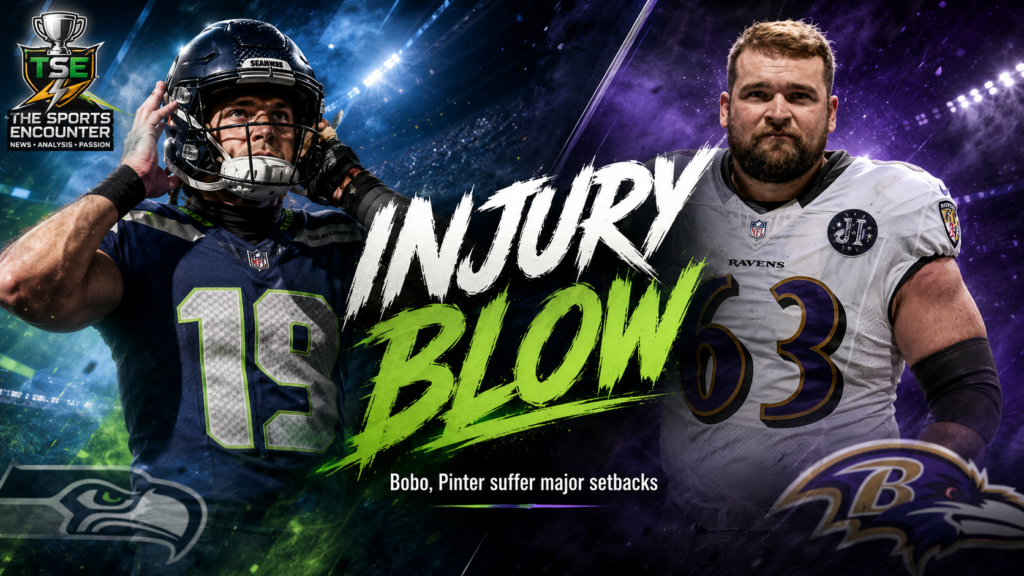
SEATTLE/BALTIMORE, August 22, 2026: Two NFL teams were dealt significant training-camp blows within 48 hours as Seattle Seahawks wide receiver Jake Bobo suffered a serious right knee injury and Baltimore Ravens center Danny Pinter sustained a torn patellar tendon that is expected to sideline him for an extended period.

The injuries affect very different parts of two rosters, but both carry consequences beyond losing a single player.

Seattle may have lost one of its most trusted depth receivers and special-teams contributors just weeks before beginning its Super Bowl title defense. Baltimore, meanwhile, could be forced to rethink one of the most important positions on its offensive line after Pinter had emerged as a leading candidate to start at center.

The timing is particularly cruel.

Both injuries happened during joint practices, the exact environment teams use to simulate regular-season intensity without exposing starters to a full preseason game.

Instead, Seattle and Baltimore now leave those sessions with significant roster problems to solve.

Jake Bobo and Danny Pinter Injuries: What We Know

PlayerTeamInjuryCurrent Status
Jake BoboSeattle SeahawksSerious right knee injuryPotentially long-term absence
Danny PinterBaltimore RavensTorn right patellar tendonExpected to miss extended time, with reports indicating the season could be lost

The Seattle Seahawks confirmed that Bobo suffered the injury during Friday’s joint practice with the Tennessee Titans.

Baltimore has also confirmed that Pinter will miss extended time following his injury during the Ravens’ joint practice with the Minnesota Vikings.

Jake Bobo’s Injury Looked Serious Immediately

Bobo went down while attempting to make a catch near the sideline during Seattle’s practice with Tennessee.

He required a cart to leave the field.

Seahawks head coach Mike Macdonald later described the injury as serious and indicated that the team feared a potentially long-term absence.

A full timetable will depend on additional medical evaluation, but Seattle’s public reaction made clear that this was not being treated as a minor preseason setback.

That distinction matters because Bobo has built his NFL career around availability, reliability and doing several jobs well enough to earn repeated trust from the coaching staff.

Bobo’s Numbers Do Not Fully Explain His Value

Looking only at Bobo’s regular-season receiving production can make his role appear relatively small.

Since entering the league in 2023, he has recorded 34 receptions for 323 yards and three touchdowns across 45 regular-season games.

Those numbers do not tell the whole story.

Bobo has been useful as a blocker, special-teams contributor and situational receiver.

He has also delivered important catches when his opportunities have increased.

Last season, he appeared in 11 regular-season games and remained part of Seattle’s postseason rotation.

His most memorable contribution came on the biggest stage.

Bobo caught a touchdown during the Seahawks’ Super Bowl LX victory over the New England Patriots.

That alone helps explain why Seattle valued him enough to keep him during the offseason.

Seattle Had Already Invested in Keeping Bobo

Bobo’s place in Seattle’s plans became clearer earlier this year.

Jacksonville reportedly offered him a contract worth $5.5 million, but Seattle matched the offer to retain him.

That was not the type of move teams make for a player they consider expendable.

The Seahawks clearly saw Bobo as part of their depth structure entering a season in which expectations are naturally higher after winning the Super Bowl.

Now that plan may have to change before Week 1.

Seattle’s Problem Is Bigger Than Replacing Receptions

If Bobo misses significant time, the Seahawks will not simply need somebody to reproduce a handful of catches.

They will need to replace several layers of roster value.

  • Wide receiver depth
  • Blocking from the receiver position
  • Special-teams snaps
  • Red-zone and situational receiving experience
  • Postseason-tested depth

Players who occupy those roles are rarely the biggest names on a roster, but they become important over a 17-game season when injuries, matchups and special-teams requirements constantly change personnel usage.

Seattle’s coaching staff now has to decide whether the replacement can come internally or whether the front office needs to look outside the organization.

The Super Bowl Champions Are Learning How Quickly Depth Can Change

Seattle enters 2026 in a different position from a year ago.

The Seahawks are no longer simply building toward contention.

They are defending a championship.

That changes the importance of every depth decision.

A roster built to survive four playoff games and win a Super Bowl needs capable players beyond the starting 22.

Bobo had become part of that structure.

His potential absence immediately forces younger receivers and special-teamers to take on responsibilities that Seattle may not have expected them to carry this early.

The Sports Encounter has been tracking how quickly injuries can reshape NFL depth charts during August. Our recent NFL training camp roundup examined similar problems for Chicago, Denver and Jacksonville after injuries forced teams to reconsider both immediate practice reps and longer-term roster construction.

Danny Pinter’s Injury Creates a More Direct Starting-Lineup Problem

Baltimore’s situation may be even more urgent.

Pinter suffered a torn patellar tendon in his right leg during a joint practice with Minnesota.

The injury is severe enough that reports indicate he is likely to miss the entire 2026 season, although the Ravens have publicly described the timeline more broadly as an extended absence.

Pinter had been doing far more than competing for a backup role.

He had been taking the majority of Baltimore’s first-team center repetitions and was considered a leading candidate to replace Pro Bowl center Tyler Linderbaum.

That makes the injury a structural problem for the offense.

Why Center Matters So Much to Baltimore

Center is one of the least glamorous positions in football and one of the most important.

The player must snap the ball cleanly, identify fronts, communicate protections and help organize the interior offensive line before almost every play.

That responsibility becomes even more important for a team with championship ambitions.

Baltimore cannot afford persistent communication breakdowns or interior pressure because the center position remains unsettled.

Pinter had spent training camp building that chemistry.

Those repetitions are now gone.

Pinter Had Put Himself in Position to Start

The 30-year-old entered Baltimore with meaningful NFL experience.

Originally selected by Indianapolis in the fifth round of the 2020 NFL Draft, Pinter appeared in 77 games with 10 starts from 2020 through 2025.

He missed the entire 2023 campaign after suffering a broken ankle but returned and played all 17 games for the Colts last season.

That experience helped make him a realistic candidate for Baltimore’s starting center job rather than simply emergency depth.

He started the Ravens’ preseason opener and had continued receiving significant work with the first-team offense.

The competition now changes completely.

Baltimore’s Immediate Center Options

The Ravens still have alternatives.

Veteran Ethan Pocic becomes an obvious candidate.

Pocic has substantial NFL starting experience after previous spells with Seattle and Cleveland.

Baltimore can also evaluate Jovaughn Gwyn and other interior linemen during the remaining preseason period.

Center OptionWhat He Offers
Ethan PocicExtensive NFL starting experience and immediate veteran stability
Jovaughn GwynYounger internal option with opportunity to earn additional reps
External signingPotential veteran competition if Baltimore is not satisfied internally

The presence of Pocic prevents the situation from becoming a complete emergency.

It does not erase the disruption.

Pinter had already accumulated first-team repetitions and developed communication with the rest of Baltimore’s offensive line.

Whoever replaces him effectively has to restart part of that process with the regular season approaching.

A Patellar Tendon Tear Is a Major Injury for an Offensive Lineman

Pinter’s injury is particularly serious because offensive-line play depends so heavily on lower-body power.

Centers must explode out of their stance, absorb contact from defensive tackles and redirect their weight almost immediately after snapping the football.

A torn patellar tendon directly affects that chain of movement.

Even beyond the immediate recovery period, rebuilding strength, balance and confidence can require significant rehabilitation.

That is why reports pointing toward a season-long absence are unsurprising.

Baltimore will have to plan as though Pinter may not be available in 2026.

Joint Practices Are Becoming One of August’s Biggest Risk-Reward Decisions

Both injuries occurred during joint practices.

That coincidence highlights one of the NFL preseason’s most uncomfortable realities.

Coaches increasingly value joint practices because they can control situations more precisely than preseason games.

Teams can schedule red-zone periods.

They can repeat third-down situations.

Starters can receive high-quality repetitions without playing through an entire game.

Coaches can stop a period if tempers rise or workloads become excessive.

The physical risk never disappears.

Bobo was injured during a football action near the sideline.

Pinter was injured while preparing against another NFL defensive front.

Neither team was being reckless simply by practicing.

Football itself carries the risk.

August Injuries Hurt Differently Because Rosters Are Still Being Built

An injury in October usually forces a team to adjust a roster whose hierarchy is already established.

August is different.

Position battles remain open.

Young players are still being evaluated.

Coaches are deciding which combinations work.

The final 53-man roster has not yet settled.

One major injury can therefore alter several decisions at once.

Seattle may have to change how many receivers it carries.

Baltimore may have to reconsider which interior offensive linemen make the roster.

Practice repetitions will immediately be redistributed.

Front offices may begin calling available veterans.

The Sports Encounter’s earlier NFL injury roundup showed the same dynamic with Green Bay, New York and Tennessee, where even less severe training-camp injuries immediately affected preseason planning.

Bobo’s Injury Could Create Opportunity for Seattle’s Younger Receivers

Every injury creates an unwanted opening.

For Seattle’s younger receivers, Bobo’s absence means additional practice snaps and preseason opportunities.

Those repetitions matter.

A receiver who previously needed several injuries to reach the active gameday group may suddenly be fighting for a meaningful role.

Special teams will be equally important.

A young receiver who can contribute only offensively may struggle to replace Bobo’s roster value.

A player capable of covering kicks, blocking and handling rotational receiving snaps becomes much more attractive.

Baltimore’s Center Decision Will Affect More Than the Offensive Line

The Ravens’ replacement decision could influence the entire offense.

A center who communicates protections confidently allows the quarterback to operate faster.

A center who struggles with assignments can force additional adjustments before the snap.

Interior pressure is also one of the fastest ways to disrupt an offense because quarterbacks have less space to escape when defenders penetrate directly through the middle.

Baltimore therefore cannot treat this as merely filling an empty starting spot.

The replacement must become part of the offense’s communication system.

Why Veteran Experience May Win Baltimore’s Competition

That is where Pocic’s experience becomes valuable.

He has spent nine NFL seasons working in different offensive systems and has extensive experience as a starter.

At this stage of the calendar, experience can matter more than developmental upside.

The Ravens do not have months to teach somebody how to organize an NFL offensive line.

They need the position stabilized before Week 1.

If Pocic performs adequately through the remainder of camp, Baltimore may prefer continuity over searching aggressively outside the organization.

The Injuries Also Show Why NFL Depth Cannot Be Judged in June

Offseason depth charts often look comfortable.

There are multiple players at every position.

Young prospects appear ready to develop.

Veterans provide insurance.

Then training camp begins.

One injury removes a receiver.

Another removes a potential starting center.

A third injury elsewhere forces another roster decision.

By September, the depth chart can look entirely different from the version discussed after the draft.

That is why teams continue signing players throughout August even when their rosters appear full.

The Sports Encounter examined that process in our NFL roster and injury roundup, where teams were already making late personnel adjustments in response to season-ending setbacks.

TSE Analysis: Baltimore Faces the Bigger Tactical Problem

Both injuries hurt.

Baltimore’s may be more difficult to absorb structurally.

Seattle has lost a valuable depth player, but Bobo was not expected to be the primary receiver in the offense.

The Seahawks can distribute his receiving snaps while replacing his special-teams work across multiple players.

Baltimore potentially lost its starting center.

That is one position with one player on every offensive snap.

There is no committee solution once the ball is placed at the line of scrimmage.

Someone must make the snap.

Someone must handle protection communication.

Someone must deal with powerful interior defenders play after play.

The Ravens have experienced alternatives, which protects them from panic.

They still lost valuable preparation time at one of the offense’s most communication-heavy positions.

Seattle’s Concern Is More About Depth Over a Full Season

The Seahawks face a different problem.

Championship defenses often depend on surviving attrition.

Seattle knows this after navigating an entire postseason last season.

Bobo was the type of player who could move between supporting roles without demanding offensive touches.

Those players become particularly valuable when injuries occur later in the year.

Losing one before the season begins reduces Seattle’s margin for error before the first regular-season snap.

The Human Cost Should Not Be Lost in Roster Analysis

Training-camp injury stories quickly become depth-chart discussions.

There is another side to them.

Bobo had earned his place in Seattle’s plans after developing from an undrafted player into a Super Bowl contributor.

Pinter had worked back from a broken ankle that cost him an entire season and positioned himself for another opportunity to start.

Both players entered August with meaningful roles ahead of them.

One practice changed everything.

For coaches and fans, the next question is who replaces them.

For the players, the next question is rehabilitation.

What Happens Next for Jake Bobo?

Seattle will wait for the full medical diagnosis before establishing a formal rehabilitation timetable.

Macdonald’s initial assessment suggests the Seahawks are preparing for a substantial absence.

If further testing confirms a major structural knee injury, Seattle could place Bobo on injured reserve and explore additional receiver depth.

The club will also spend the remaining preseason practices evaluating which players can absorb his special-teams responsibilities.

What Happens Next for Danny Pinter?

Baltimore’s approach is more immediate.

The Ravens must redistribute starting-center repetitions now.

Pocic and Gwyn should receive additional opportunities while coaches evaluate whether an external addition is necessary.

Because a torn patellar tendon typically requires surgery and lengthy rehabilitation, Baltimore has little reason to wait before preparing for the season without Pinter.

The final decision will likely depend on how comfortable the coaching staff becomes with its existing options over the next several practices.

Another Warning From a Brutal NFL August

The 2026 preseason has already produced several significant injuries across the league.

Matt Henningsen suffered another Achilles tear in Denver.

Jalon Walker was lost for the season in Atlanta.

Other teams have managed injuries involving important starters, rookies and depth players throughout camp.

Bobo and Pinter now join that list.

August games may not count in the standings.

August injuries count immediately.

Final Verdict

Seattle and Baltimore leave this week facing two very different tests of roster depth.

The Seahawks must determine how to replace a trusted receiver and special-teams contributor whose value became especially visible during their Super Bowl run.

The Ravens must solve a more fundamental problem after losing the player who had been taking most of the first-team repetitions at center.

Neither injury should be treated as a reason to dramatically change expectations for the season by itself.

Both expose how quickly those expectations can become more difficult to meet.

Seattle matched a $5.5 million offer to keep Bobo because it understood his value.

Baltimore gave Pinter substantial first-team work because it believed he could become its starting center.

Those plans lasted until training camp contact turned into medical uncertainty.

Now the Super Bowl champions need another depth player to emerge, while the Ravens need someone capable of taking control of the middle of their offensive line before the games begin to matter.

The NFL season is still approaching.

For Bobo and Pinter, it has already changed dramatically.

Frequently Asked Questions

What happened to Jake Bobo?

Seattle Seahawks wide receiver Jake Bobo suffered a serious right knee injury during a joint practice with the Tennessee Titans on August 21. He was carted from the field, and head coach Mike Macdonald indicated the injury could require a long-term recovery.

How long will Jake Bobo be out?

Seattle has not announced a definitive recovery timetable. The Seahawks have described the injury as serious, and further medical evaluation will determine how long Bobo is unavailable.

Did Jake Bobo play in Super Bowl LX?

Yes. Bobo contributed during Seattle’s postseason run and caught a touchdown in the Seahawks’ Super Bowl LX victory over the New England Patriots.

What happened to Danny Pinter?

Baltimore Ravens center Danny Pinter suffered a torn patellar tendon in his right leg during a joint practice with the Minnesota Vikings.

Will Danny Pinter miss the 2026 NFL season?

Reports indicate that Pinter is likely to miss the season because of the torn patellar tendon. The Ravens have publicly said he will miss extended time.

Was Danny Pinter expected to start for Baltimore?

Pinter was a leading candidate for the Ravens’ starting center position and had been taking most of the first-team repetitions during training camp.

Who could replace Danny Pinter at center?

Veteran Ethan Pocic is one of Baltimore’s leading internal options, while Jovaughn Gwyn can also receive additional repetitions. The Ravens could explore the veteran market if they want more competition.

How serious is a torn patellar tendon?

A torn patellar tendon is a major lower-body injury that generally requires significant rehabilitation. For an offensive lineman, it directly affects the explosive leg strength and stability required for blocking.

Why are NFL teams using joint practices?

Joint practices allow teams to create controlled competitive situations against another roster, including red-zone, third-down and two-minute drills. They can provide valuable preparation while allowing coaches more control than a preseason game, although injury risk remains.

Where can fans follow official updates on the injuries?

The latest confirmed information will be available through the Seattle Seahawks and Baltimore Ravens official websites as medical evaluations and roster decisions continue.


Marcos Wetherfield is a Boca Raton-based fitness expert and sports writer covering WWE, soccer, baseball, NHL, NBA, and major American sports. His background in fitness gives him a specialist perspective on athletic conditioning, strength, mobility, recovery, injury prevention, performance habits, and the physical demands athletes face across long and demanding seasons. At The Sports Encounter, Marcos combines sports reporting with performance-focused analysis, covering breaking news, player development, injuries, roster decisions, major competitions, and the physical factors that can influence careers and results. His work looks beyond statistics to examine how athletes train, recover, adapt, and maintain performance under pressure. Based in Florida, he also brings a strong perspective on American sports culture while covering major leagues, athletes, and global sporting stories.

Breaking News

Mitchell Starc Takes Five Wickets in 22 Balls: The 10 Fastest Five-Fers in Test Cricket History

Mitchell Starc ripped through Bangladesh with five wickets in 22 balls in Mackay, but it was not the fastest Test five-for ever. We rank the 10 quickest five-wicket hauls in Test cricket history.

Nadine Mills - The Sports Encounter

Published

on

Mitchell Starc celebrates during Australia’s Test against Bangladesh in Mackay, highlighting his 22-ball five-wicket haul and the fastest five-fers in Test cricket history.

Mitchell Starc needed only 22 balls to take five Bangladesh wickets on the opening day of the second Test in Mackay on Saturday, August 22, 2026. It was one of the fastest five-wicket hauls Test cricket has ever seen, but it was not the record. Starc himself owns that.

Just over a year earlier, the Australian left-arm quick had destroyed West Indies at Sabina Park in Kingston, completing a five-wicket haul with his first 15 deliveries. That remains the fastest five-for from the start of a bowling spell in men’s Test cricket.

Starc’s Mackay burst places him sixth on the all-time list. Only his own 15-ball world record, three separate 19-ball five-fors and Shane Watson’s 21-ball demolition of South Africa were quicker.

Against Bangladesh, Starc reached five wickets after only 3.4 overs, equivalent to 22 legal deliveries, as Australia ripped through the tourists on the opening morning at Great Barrier Reef Arena.

The spell was particularly significant because Bangladesh had arrived in Mackay carrying enormous momentum after beating Australia by nine wickets in Darwin, their first Test victory on Australian soil.

The Sports Encounter had examined the significance of this tour before it began in our Australia vs Bangladesh Test series preview. Mackay quickly demonstrated how violently the momentum of a Test series can change.

Starc’s latest burst also gives us the perfect opportunity to revisit one of Test cricket’s most spectacular statistical categories.

Who has taken five wickets fastest in men’s Test history?

What Does the Fastest Five-Wicket Haul Record Actually Measure?

This distinction is important because there are two different ways to measure rapid five-wicket bursts.

The record used in this article measures the fewest deliveries a bowler required to reach five wickets after first coming on to bowl in an innings.

That is the category in which Starc holds the world record with 15 balls against West Indies in Kingston in 2025.

There is another statistical category measuring five wickets taken within a particularly short sequence during a longer spell.

Jacques Kallis, for example, took five Bangladesh wickets within a 12-ball sequence at Potchefstroom in 2002. That does not mean he completed his five-for within his first 12 deliveries of the spell.

In the measurement used for this ranking, Kallis reached five wickets after 27 balls from the time he first came on to bowl.

Keeping those two categories separate prevents one of the most common misunderstandings around the fastest five-for record.

10 Fastest Five-Wicket Hauls in Men’s Test Cricket

Rank Bowler Team Opponent Balls to Five Wickets Venue Year
1 Mitchell Starc Australia West Indies 15 Kingston 2025
2 Ernie Toshack Australia India 19 Brisbane 1947
3 Stuart Broad England Australia 19 Nottingham 2015
4 Scott Boland Australia England 19 Melbourne 2021
5 Shane Watson Australia South Africa 21 Cape Town 2011
6 Mitchell Starc Australia Bangladesh 22 Mackay 2026
7 Hugh Trumble Australia England 23 Melbourne 1904
8 Vernon Philander South Africa New Zealand 25 Cape Town 2013
9 Josh Hazlewood Australia India 25 Adelaide 2020
10 Jacques Kallis South Africa Bangladesh 27 Potchefstroom 2002

Note: Harbhajan Singh also reached five wickets in 27 balls against West Indies at Kingston in 2006. Because Kallis achieved the 27-ball mark four years earlier, Kallis occupies the final place in a strict chronological top 10.

1. Mitchell Starc vs West Indies, Kingston 2025: 15 Balls

No bowler in men’s Test cricket has reached five wickets quicker after first coming on to bowl.

Starc produced the record at Sabina Park during his 100th Test.

West Indies had been set 204 to win the third Test against Australia, but any realistic hope of a successful chase disappeared almost immediately.

Starc dismissed John Campbell with the first delivery of the innings.

Four balls later, he trapped Kevlon Anderson lbw. Brandon King was bowled with the following delivery.

Three wickets had disappeared inside Starc’s opening over.

He returned to remove Mikyle Louis for his 400th Test wicket before dismissing Shai Hope to complete the five-for with his 15th ball.

Starc had broken a record that previously stood at 19 deliveries.

He eventually finished with 6 for 9 as West Indies were bowled out for 27, the second-lowest completed total in men’s Test history.

Australia won by 176 runs and completed a 3-0 series sweep.

Starc also became only the fourth Australian after Shane Warne, Glenn McGrath and Nathan Lyon to reach 400 Test wickets.

The performance already looked extraordinary at the time. His 22-ball demolition of Bangladesh in 2026 has made it even more significant because Starc has now produced two of the six fastest five-fors ever recorded by this measurement.

The Sports Encounter has explored the demands placed on modern fast bowlers in our analysis of whether modern workload management has changed Test fast bowling.

2. Ernie Toshack vs India, Brisbane 1947: 19 Balls

For almost seven decades, Ernie Toshack’s record appeared almost untouchable.

The Australian left-arm medium pacer needed only 19 deliveries to take five wickets against India at the Gabba in December 1947.

Toshack finished with extraordinary figures of 5 for 2.

The match was played during the era of eight-ball overs in Australia, meaning his five wickets arrived after only 2.3 overs under the scoring system used at the time.

India were confronting an Australian team captained by Don Bradman and packed with some of the finest players of the era.

Toshack’s spell accelerated a collapse and established a benchmark that survived until Stuart Broad matched it in 2015.

Scott Boland equaled the mark in 2021.

Starc finally broke it in Kingston in 2025.

The remarkable part of Toshack’s achievement is how long it survived through dramatic changes in pitches, equipment, training, batting methods and professional cricket.

3. Stuart Broad vs Australia, Nottingham 2015: 19 Balls

Stuart Broad’s 19-ball five-for came during one of the most famous opening sessions in Ashes history.

Australia arrived at Trent Bridge for the fourth Test of the 2015 series and were dismantled almost immediately.

Broad removed Chris Rogers, Steve Smith, Shaun Marsh, Adam Voges and captain Michael Clarke within his first 19 deliveries.

He had matched Toshack’s Test record.

Broad continued attacking and finished with 8 for 15.

Australia were bowled out for only 60 in 18.3 overs.

England eventually won by an innings and 78 runs and regained the Ashes.

The spell became one of the defining performances of Broad’s career, which eventually produced 604 Test wickets.

Few spells better illustrated his ability to sense vulnerability in a batting lineup and turn early pressure into a complete collapse.

4. Scott Boland vs England, Melbourne 2021: 19 Balls

Scott Boland matched Toshack and Broad under circumstances that made his performance even more remarkable.

It was his Test debut.

Australia selected the experienced domestic fast bowler for the Boxing Day Test against England at the Melbourne Cricket Ground during the 2021-22 Ashes.

Boland then produced one of the great debut spells.

He completed his five-wicket haul in 19 balls and collected a sixth wicket two deliveries later.

His final figures were 6 for 7 from four overs.

England were dismissed for 68 and Australia won by an innings and 14 runs.

Boland’s accuracy around off stump was devastating. He rarely needed extravagant movement because England were repeatedly forced to play deliveries they could not control.

His performance remains one of the clearest examples of how accuracy, movement and relentless pressure can be as destructive as outright pace.

That distinction has always been central to discussions around great fast bowling. The Sports Encounter explored the same theme when ranking Pakistan’s most lethal fast bowlers.

5. Shane Watson vs South Africa, Cape Town 2011: 21 Balls

Shane Watson is remembered primarily as a powerful opening batter and all-rounder, but one afternoon at Newlands showed how dangerous his seam bowling could become.

Watson took five South African wickets within 21 deliveries during the first Test in Cape Town in November 2011.

He finished with 5 for 17.

At the time, only Toshack had reached five wickets quicker.

The match itself became one of the strangest Tests of the modern era.

Australia were later bowled out for 47 in their second innings, having collapsed to 21 for nine at one stage.

South Africa successfully chased 236 and won by eight wickets.

Watson therefore produced one of the fastest five-fors in Test history in a match Australia still lost comfortably.

It remains a useful reminder that an extraordinary individual spell does not necessarily determine the final result of a Test.

6. Mitchell Starc vs Bangladesh, Mackay 2026: 22 Balls

This is the performance that reopened the fastest-five-for debate.

Australia entered the second Test in Mackay needing a response after Bangladesh’s remarkable nine-wicket victory in Darwin.

The tourists had never previously won a Test in Australia.

Great Barrier Reef Arena was hosting men’s Test cricket for the first time, but Starc did not require long to understand the conditions.

He struck immediately and then kept attacking.

Shadman Islam, Tanzid Hasan, Najmul Hossain Shanto, Mominul Haque and Litton Das became his first five victims.

By the time the fifth wicket fell, Starc had bowled only 3.4 overs.

Twenty-two legal deliveries.

Five wickets.

Bangladesh had collapsed to 12 for five.

The spell places Starc sixth on the all-time list for fewest balls required to reach five wickets after first coming on to bowl.

It also makes him the only bowler with two entries inside the top six.

That is what makes Mackay more than another destructive Starc spell.

His Kingston record could have been remembered as the extraordinary product of a perfect combination of conditions, form and opposition vulnerability.

Mackay showed that he could reproduce almost the same level of destruction against another batting lineup in a completely different match situation.

The Sports Encounter identified the unusual intensity of the current Test calendar in our coverage of August’s remarkable run of consecutive Test cricket.

7. Hugh Trumble vs England, Melbourne 1904: 23 Balls

Hugh Trumble takes the list back more than 120 years.

The Australian off-spinner produced his extraordinary spell against England at the Melbourne Cricket Ground in March 1904.

Trumble took seven wickets as England were dismissed for 101 while chasing 320.

He reached his fifth wicket after 23 deliveries.

His final figures were 7 for 28.

Australia won the Test by 218 runs.

Trumble’s appearance on a list otherwise dominated by modern fast bowlers is striking because he operated in a radically different version of Test cricket.

Pitches were uncovered, protective equipment was primitive, bowling workloads were enormous and tactical conventions differed from those used today.

The basic challenge remained the same: create enough uncertainty that a batting lineup begins losing wickets faster than it can recover.

8. Vernon Philander vs New Zealand, Cape Town 2013: 25 Balls

Vernon Philander rarely relied on extreme pace.

He did not need it.

Accuracy, seam position and relentless control made him one of the most difficult Test bowlers of his generation.

New Zealand discovered that at Newlands in January 2013.

Philander reached five wickets after only 25 balls.

Martin Guptill, Brendon McCullum, Dean Brownlie, Kane Williamson and BJ Watling were among the batters caught in the collapse.

New Zealand fell to 27 for five and were eventually dismissed for 45.

Philander finished with 5 for 7 from six overs.

South Africa won by an innings and 27 runs.

His performance demonstrated that devastating fast bowling is not always about raw speed. The ability to make a batter play repeatedly in uncertain conditions can produce equally violent collapses.

South Africa has produced many variations of elite pace bowling. The Sports Encounter compared three of the country’s greatest in our analysis of Allan Donald, Shaun Pollock and Dale Steyn.

9. Josh Hazlewood vs India, Adelaide 2020: 25 Balls

Josh Hazlewood matched Philander’s 25-ball mark during one of the most dramatic batting collapses in modern Test cricket.

India entered the third morning of the Adelaide Test in December 2020 with an opportunity to take control.

Instead, their second innings disappeared.

Hazlewood completed his five-for in 25 deliveries and finished with 5 for 8.

Pat Cummins supported him with 4 for 21.

India were bowled out for 36, their lowest completed Test innings total.

No Indian batter reached double figures.

Australia won the match by eight wickets.

The broader series became famous because India responded from that humiliation, overcame an extraordinary injury list and eventually won the series 2-1 after victory at the Gabba.

Hazlewood’s Adelaide spell still stands as one of the clearest examples of what happens when elite Test bowling combines movement, accuracy and scoreboard pressure.

10. Jacques Kallis vs Bangladesh, Potchefstroom 2002: 27 Balls

Jacques Kallis is usually remembered first for his batting.

His bowling was good enough to put him inside this list.

Against Bangladesh at Potchefstroom in October 2002, Kallis completed a five-wicket haul after 27 deliveries from the time he first came on to bowl.

He finished with 5 for 21 as Bangladesh were dismissed for 107 in their second innings.

South Africa won by an innings and 160 runs.

The spell contains one of the most interesting statistical quirks anywhere on this list.

Kallis’ final five wickets came within a sequence of only 12 balls.

That 12-ball burst is often quoted when discussing the fastest collection of five wickets in Test cricket.

It does not replace Starc’s 15-ball world record because the two statistics measure different things.

Kallis had already bowled earlier deliveries before beginning the 12-ball wicket burst.

Measured from the point at which he first came on to bowl until collecting his fifth wicket, Kallis required 27 balls.

That places him 10th in this ranking.

Harbhajan Singh Also Reached Five Wickets in 27 Balls

Kallis is not alone on 27 deliveries.

Harbhajan Singh matched the figure against West Indies at Sabina Park in Kingston in 2006.

The Indian off-spinner finished with 5 for 13 as West Indies were dismissed for 103 in a difficult low-scoring Test.

India had made only 200 in their first innings, but Harbhajan’s intervention gave them a significant advantage.

India eventually won by 49 runs.

Harbhajan does not appear in the strict top 10 above because Kallis achieved the 27-ball benchmark first, in 2002.

If tied performances are grouped rather than separated chronologically, both men share the same statistical position.

Why the Kallis 12-Ball Statistic Does Not Beat Starc’s 15-Ball Record

This is the point most likely to cause confusion when readers search for the fastest five wickets in Test cricket.

Kallis took five wickets within a 12-ball sequence against Bangladesh.

Waqar Younis has also produced an extremely short five-wicket burst, while several other bowlers have taken clusters of wickets within tiny stretches of a longer spell.

Those statistics measure the distance between wickets within an existing bowling spell.

Starc’s record asks a different question:

How many balls did the bowler require from the moment he first came on to bowl until he had taken five wickets?

For Starc in Kingston, the answer was 15.

For Kallis at Potchefstroom, the answer was 27.

Within those 27 deliveries, however, Kallis’ five dismissals happened to be compressed into an extraordinary 12-ball sequence.

Both statistics are legitimate. They should simply never be presented as though they measure the same record.

Australia Dominates the Fastest Five-For Rankings

One pattern jumps out immediately from the list.

Australian bowlers dominate it.

Starc appears twice.

Toshack, Boland, Watson, Trumble and Hazlewood also feature.

Seven of the first nine performances belong to Australian bowlers.

Conditions partly explain that concentration.

Australian pitches have historically produced pace, bounce and periods in which a batting lineup can lose wickets extremely quickly once a high-quality bowler finds movement.

The deeper explanation concerns the attacks around those bowlers.

Starc has spent much of his Test career alongside Cummins, Hazlewood and Nathan Lyon.

Boland has frequently entered the same attack.

Hazlewood has benefited from Starc and Cummins creating pressure from the other end.

Earlier Australian generations built similar attacks around different combinations.

A five-for belongs statistically to one bowler, but collapses are often created collectively.

The batter cannot simply survive one dangerous spell if another elite bowler is waiting at the opposite end.

Starc Is the Only Bowler With Two of the Six Fastest Five-Fers

This is the most important historical consequence of what happened in Mackay.

Starc does not simply own the record.

He now appears twice among the six quickest five-fors in men’s Test history.

His 15-ball destruction of West Indies remains No. 1.

His 22-ball spell against Bangladesh sits at No. 6.

Both performances came late in a career already defined by longevity, pace and wicket-taking ability.

That combination matters when assessing Starc’s place among Australia’s greatest fast bowlers.

Career wicket totals reward durability.

Bowling averages measure efficiency.

Strike rates show how frequently wickets arrive.

These rapid five-fors reveal something slightly different: the ability to destroy half a batting lineup before it has time to adjust.

Starc still possesses that ability deep into his Test career.

Why Left-Arm Pace Makes Starc So Dangerous During a Collapse

Starc’s angle creates problems before swing or pace are even considered.

Right-handed batters must account for a ball beginning from outside their natural line of vision and moving toward the stumps.

When Starc swings the ball back into them, lbw and bowled become immediate threats.

When the delivery holds its line or moves away, the outside edge enters the game.

His pace gives batters less time to decide which movement they are seeing.

Bounce adds another layer.

Once the first wicket falls, a new batter has to solve all of those problems immediately.

That is often where Starc becomes most dangerous.

He does not always need six overs of setup work. His best spells can become destructive before a batting lineup has properly settled.

This ability helps explain why fast-bowling memories remain such a powerful part of cricket culture. The Sports Encounter explored that fascination through our analysis of why Asia still romanticizes Pakistan’s fast-bowling past.

Fast Does Not Automatically Mean Greatest

The fastest five-for list should not be confused with a ranking of the greatest bowling performances in Test history.

Some of cricket’s most celebrated spells required far more deliveries.

Jim Laker took 10 for 53 against Australia at Old Trafford in 1956.

Anil Kumble dismissed all 10 Pakistan batters in Delhi in 1999.

Ajaz Patel took 10 wickets in an innings against India in Mumbai in 2021.

Malcolm Marshall, Curtly Ambrose, Wasim Akram, Waqar Younis, Dale Steyn and Glenn McGrath produced countless match-winning spells that do not appear near this particular record.

The fastest-five-for statistic measures the speed of destruction.

It does not account fully for pitch difficulty, opposition quality, match situation, workload or the importance of the wickets.

A bowler who takes five wickets in 22 deliveries has produced a remarkable collapse.

A bowler who takes five wickets across 25 overs on a flat fifth-day surface may have delivered the more difficult performance.

Context still matters.

The Five-For Remains One of Cricket’s Cleanest Bowling Milestones

Modern cricket has become increasingly sophisticated in how it measures bowling.

Analysts track release points, seam movement, swing, expected wickets, pitch maps, speeds, workload, false-shot percentages and matchup data.

The five-wicket haul remains beautifully simple.

One bowler has dismissed half the opposition.

The Sports Encounter saw another example of the importance of a five-for when Justin Greaves took five wickets against Pakistan during the West Indies series.

That spell did not challenge Starc’s delivery-count record, but it changed the direction of the match.

That is why five-fors continue to carry weight even in an era filled with more complicated metrics.

TSE Analysis: Mackay Makes Kingston More Impressive

Starc’s 22-ball spell does something unusual to the way his world record should now be remembered.

It strengthens it.

Kingston could have been dismissed as one of those almost impossible mornings when conditions, rhythm, opposition vulnerability and luck aligned perfectly.

Mackay makes that explanation harder to sustain.

Different opponent.

Different country.

Different pitch.

Different series situation.

Almost the same result.

The common factor was Starc attacking new batters before they could establish themselves.

That ability has always been central to his value.

His best spells do not simply create pressure. They compress the time available for a batting lineup to respond.

Once wickets begin falling, the next batter is immediately exposed to pace, angle, movement and an opponent whose confidence is rising with every delivery.

Bangladesh experienced that in Mackay.

West Indies experienced an even more extreme version in Kingston.

So, Is Mitchell Starc’s 22-Ball Five-For the Fastest Ever?

No.

Starc himself holds the record.

He needed only 15 balls to take five wickets against West Indies in Kingston in 2025.

Ernie Toshack, Stuart Broad and Scott Boland share the next mark at 19 balls.

Shane Watson follows with 21 balls.

Starc’s Bangladesh five-for came in 22 balls.

That places his Mackay performance sixth among the fastest five-wicket hauls in men’s Test cricket when measured from the moment a bowler first comes on to bowl.

Only five performances have reached five wickets quicker.

Two of those six performances now belong to Mitchell Starc.

Frequently Asked Questions

What is the fastest five-wicket haul in men’s Test cricket?

Mitchell Starc holds the record for the fewest balls required to reach five wickets after first coming on to bowl. He took five wickets in 15 balls against West Indies at Kingston in 2025.

How many balls did Mitchell Starc need for five wickets against Bangladesh in Mackay?

Starc completed his five-wicket haul in 22 legal deliveries, equivalent to 3.4 overs, during the second Test against Bangladesh in Mackay on August 22, 2026.

Where does Starc’s 22-ball five-for rank in Test history?

It ranks sixth among the fastest men’s Test five-wicket hauls measured from the time a bowler first comes on to bowl.

Who took five wickets in 19 balls in Test cricket?

Ernie Toshack against India in Brisbane in 1947, Stuart Broad against Australia at Nottingham in 2015 and Scott Boland against England at Melbourne in 2021 all reached five wickets in 19 balls.

Who held the fastest five-for record before Mitchell Starc?

The previous record was 19 balls, shared by Ernie Toshack, Stuart Broad and Scott Boland. Starc reduced the record to 15 balls against West Indies in 2025.

How fast was Shane Watson’s five-wicket haul?

Watson took five wickets in 21 balls against South Africa at Cape Town in 2011.

How many balls did Hugh Trumble need to take five wickets?

Trumble reached five wickets in 23 balls against England at Melbourne in 1904.

How quickly did Vernon Philander take five wickets against New Zealand?

Philander needed 25 balls to reach five wickets against New Zealand at Cape Town in 2013.

How quickly did Josh Hazlewood take five wickets against India?

Hazlewood completed his five-wicket haul in 25 deliveries during India’s collapse for 36 at Adelaide in 2020.

Why is Jacques Kallis listed at 27 balls if he took five wickets in 12 balls?

Kallis took his five wickets within a 12-ball sequence during a larger spell against Bangladesh at Potchefstroom in 2002. However, he had already bowled deliveries before that sequence began. Measured from the time he first came on to bowl until his fifth wicket, he required 27 balls.

Did Harbhajan Singh also take a five-for in 27 balls?

Yes. Harbhajan reached five wickets in 27 deliveries against West Indies at Kingston in 2006. Kallis appears in the strict top 10 because he achieved the same mark earlier, in 2002.

Which bowler appears twice among the six fastest five-fors in Test cricket?

Mitchell Starc is the only bowler with two entries among the six fastest. He holds the record with 15 balls against West Indies in 2025 and is sixth with 22 balls against Bangladesh in 2026.

Continue Reading

Breaking News

Al-Wahda Hit Historic Low as Chris Bedia Sends Al-Nasr Up the UAE Pro League Table

Chris Bedia’s second-half penalty gave Al-Nasr a 1-0 win over Al-Wahda, leaving the Abu Dhabi side without a point after two ADNOC Pro League matches.

Published

on

Chris Bedia and Al-Wahda players featured in a cinematic match graphic after Al-Nasr beat Al-Wahda 1-0 in the ADNOC Pro League.

Chris Bedia converted a second-half penalty as Al-Nasr defeated Al-Wahda 1-0 at Al Maktoum Stadium, leaving the Abu Dhabi club without a point after the opening two rounds of the 2026-27 ADNOC Pro League season.

The decisive moment arrived in the 54th minute when Bedia scored from the penalty spot after Al-Nasr had already endured the frustration of seeing an earlier penalty sequence wiped out following a VAR review.

Al-Wahda tried to respond with a wave of second-half changes, but Al-Nasr protected the lead and completed their first league victory of the campaign after opening with a 2-2 draw against Kalba.

The result moves Al-Nasr onto four points from two matches. Al-Wahda remain on zero after following their opening 3-2 home defeat to Ajman with another loss in Dubai.

For an Al-Wahda side expected to compete much higher up the table, the concern is already bigger than the points total. Two matches have exposed problems at both ends of the pitch, and the pressure to respond will now increase quickly.

Follow The Sports Encounter’s soccer coverage for more football news, match analysis and stories from across the Middle East and the wider game.

Al-Nasr 1-0 Al-Wahda: Match at a Glance

  • Competition: ADNOC Pro League, Matchweek 2
  • Result: Al-Nasr 1-0 Al-Wahda
  • Venue: Al Maktoum Stadium, Dubai
  • Goal: Chris Bedia, 54′ penalty
  • Al-Nasr points: 4 from two matches
  • Al-Wahda points: 0 from two matches
  • Al-Wahda opening result: Lost 3-2 to Ajman
  • Al-Nasr opening result: Drew 2-2 with Kalba

Chris Bedia Makes the Difference From the Spot

The match was decided by a penalty, but Al-Nasr’s route to that moment was more complicated than the final score suggests.

The hosts had already been awarded a spot kick before halftime. Abdoulaye Touré saw the penalty saved, and Zayed Sultan converted the rebound, only for the goal to be cancelled after a VAR review because of an infringement during the penalty sequence.

That could easily have become a turning point in Al-Wahda’s favor.

Instead, Al-Nasr kept their composure.

Nine minutes into the second half, another penalty decision gave them a second opportunity. This time Bedia stepped up and converted, putting the Dubai club ahead in the 54th minute.

Sharjah 24 confirmed Bedia as the scorer of the only goal in the 1-0 Al-Nasr victory.

Al-Wahda Had the Ball but Could Not Find the Goal

The scoreline alone does not explain why this defeat should concern Al-Wahda.

They were not completely overwhelmed. The visitors produced 13 attempts compared with Al-Nasr’s nine and created enough possession around the final third to believe an equalizer was possible.

The problem was what happened once those attacks reached the decisive areas.

Only two of Al-Wahda’s attempts were on target. Omar Khribin provided creativity and movement around the attacking third, while Renne Rivas and Asher Agbinone also tried to stretch the hosts, but the pressure rarely became the type of clear chance that forces a goalkeeper into repeated emergency saves.

Al-Nasr, by comparison, generated fewer attempts but four of them tested the target.

That difference in efficiency ultimately mattered more than the overall shot count.

Al-Wahda’s Opening Two Matches Have Exposed a Bigger Problem

The opening defeat to Ajman already raised questions.

Al-Wahda conceded after only five minutes in that match, fell 2-0 behind early in the second half and eventually lost 3-2 despite late goals from Mohammad Ghorbani and Brahima Diarra.

Ajman striker Victor Henrique scored twice, including what proved to be the decisive third goal in the 83rd minute. Sharjah 24 described the result as a historic opening victory for Ajman against Al-Wahda.

The first game therefore highlighted defensive vulnerability.

The second exposed the other side of the problem.

Al-Wahda conceded only once against Al-Nasr, yet still could not take anything from the game because their attacking possession produced no goal.

When those two performances are placed together, the concern becomes clearer. Al-Wahda have already experienced one match in which they could not control the damage defensively and another in which they could not convert pressure into a response.

Omar Khribin Can Create, but Al-Wahda Need More Around Him

Khribin remains one of Al-Wahda’s most important attacking players.

His ability to find pockets between midfield and defense, connect passes around the penalty area and create opportunities gives the Abu Dhabi club a dependable source of attacking intelligence.

Against Al-Nasr, however, individual creativity was not enough.

Khribin registered several key passes but could not turn the match himself. Christian Benteke was also unable to find the equalizer as Al-Wahda searched for a way through a compact Al-Nasr defense.

The broader challenge is creating better connections between the midfield, wide areas and central striker.

Al-Wahda can have technically capable players around the box and still struggle if their attacks become predictable. Possession needs movement ahead of the ball, quicker combinations and more players arriving in scoring positions.

That was missing too often in Dubai.

Al-Nasr Showed Why Game Management Matters

Al-Nasr deserve credit for more than Bedia’s penalty.

After taking the lead, the hosts managed the game with greater discipline than Al-Wahda managed the chase.

They defended the central areas, reduced the quality of the visitors’ shooting opportunities and avoided turning the closing stages into a chaotic exchange.

That matters because Al-Nasr had experienced a very different type of meeting with Al-Wahda only a few months earlier.

In April, the same fixture ended 2-2 after Cheickna Doumbia scored in the 98th minute to rescue Al-Nasr at Al Maktoum Stadium. The UAE Pro League’s official report from that match noted that Al-Wahda had led 2-1 before being denied at the end.

This time, Al-Nasr controlled the decisive phase more effectively.

Four Points Give Al-Nasr a Useful Early Platform

Four points from two matches will not define Al-Nasr’s season, but it gives them a useful foundation.

The opening 2-2 draw with Kalba meant this game carried additional importance. Another failure to win would have left them chasing momentum immediately.

Instead, Bedia’s goal turned a solid start into an encouraging one.

The result also matters in the wider context of a league where Al Ain, Shabab Al Ahli, Al Wasl and several other clubs have ambitions near the top of the table.

The official UAE Pro League website is tracking another competitive season after defending champions Al Ain entered 2026-27 seeking to protect the title they won last term.

Every early point matters because the margin for recovering from a slow opening can disappear quickly once the stronger teams build rhythm.

TSE Analysis: The Bigger Warning Is Al-Wahda’s Lack of a Clear Identity

Two defeats do not make a crisis, but they can reveal whether a team already understands what it wants to be.

That is the uncomfortable question facing Al-Wahda.

Against Ajman, they chased the game after allowing an opponent to build a two-goal advantage. Against Al-Nasr, they had enough territory to compete but lacked the final action needed to turn possession into goals.

Those are different types of defeats.

That makes them more concerning.

A team can fix one specific weakness more easily than a group showing different structural problems from week to week.

Al-Wahda now need to establish whether they want to dominate through possession, play more directly toward Benteke, use Khribin closer to goal or create more aggressively through the wide areas.

Until those roles become clearer, the individual names in the lineup may matter less than expected.

Al-Wahda’s Recent League Form Adds to the Pressure

The difficult start also follows an uneven end to last season.

Al-Wahda finished the 2025-26 ADNOC Pro League campaign in fifth place with 40 points after losing 1-0 to Al Dhafra on the final day.

That defeat allowed Al Dhafra to secure survival, while Al-Wahda closed the season outside the league’s leading positions. The UAE Pro League’s official report confirmed Karim El Berkaoui’s 82nd-minute goal as the decisive moment.

There had been better performances before that, including a 2-0 victory over Sharjah in April, but the new campaign was supposed to provide a fresh start.

Instead, Al-Wahda have lost their first two matches and already find themselves needing a response.

Middle East Football Is Becoming a Bigger Part of the Regional Sports Story

The result also deserves attention beyond the UAE because Gulf club football is becoming increasingly interconnected.

The Sports Encounter has been following that development across the region, including Al-Ittihad’s 1-0 victory over Al-Qadsiah, where Tijjani Reijnders made his Saudi Pro League debut after joining from Manchester City.

Saudi recruitment remains one of the biggest forces reshaping the regional market. Thomas Partey’s move to Al-Shabab provided another example of experienced European-based players moving into Gulf football.

At Al-Nassr, Cristiano Ronaldo has returned to competitive action, scoring as the champions beat Al-Riyadh 4-0 to continue their perfect start.

The UAE’s clubs will also intersect directly with Saudi football in Asia. Al Ain and Shabab Al Ahli are part of the broader AFC Champions League Elite picture, increasing the importance of domestic form before continental fixtures begin.

The regional stakes extend beyond club competition. The Sports Encounter has also examined the evolving political balance inside Asian football through the AFC-Qatar dispute surrounding Gianni Infantino and the wider FIFA leadership struggle involving the AFC, UEFA and CONCACAF.

Together, those developments show why Gulf football can no longer be viewed as a collection of isolated domestic leagues.

What Comes Next for Al-Wahda?

Al-Wahda’s next league match now carries more pressure than anyone at the club would have wanted this early in the season.

The immediate priority is simple: get points on the board.

How they do it will matter almost as much.

A narrow win would ease the table pressure, but a more convincing performance would provide evidence that the tactical problems exposed in the first two rounds are being addressed.

Al-Wahda need better defensive control than they showed against Ajman and greater attacking efficiency than they produced against Al-Nasr.

That balance will determine whether this opening becomes an early-season warning or the beginning of something more difficult.

What Comes Next for Al-Nasr?

Al-Nasr leave this match in a much healthier position.

Four points from two games provides momentum, and Bedia’s decisive contribution gives the attack an early focal point.

The next test will show whether this victory represents progress or simply a useful home result.

Al-Nasr will eventually be judged against the teams expected to fight for the championship and continental positions. For now, however, they have avoided the type of poor start that can create pressure before a season has properly settled.

Readers can follow more regional football through The Sports Encounter’s Soccer section and visit The Sports Encounter homepage for the latest sports news, analysis and match coverage.

Frequently Asked Questions

Who won Al-Nasr vs Al-Wahda?

Al-Nasr defeated Al-Wahda 1-0 in Matchweek 2 of the 2026-27 ADNOC Pro League.

Who scored for Al-Nasr against Al-Wahda?

Chris Bedia scored the only goal of the match from the penalty spot in the 54th minute.

Where was Al-Nasr vs Al-Wahda played?

The match was played at Al Maktoum Stadium in Dubai.

How many points do Al-Nasr have?

Al-Nasr have four points from their opening two ADNOC Pro League matches after drawing with Kalba and beating Al-Wahda.

How many points do Al-Wahda have?

Al-Wahda remain without a point after losing their first two league matches against Ajman and Al-Nasr.

What happened in Al-Wahda’s opening match?

Al-Wahda lost 3-2 at home to Ajman in Matchweek 1 despite scoring twice during the closing stages.

Did Al-Nasr have another penalty against Al-Wahda?

Yes. Al-Nasr had an earlier penalty saved, with the subsequent rebound goal cancelled after a VAR review. Bedia later converted the second penalty in the 54th minute.

Who are the defending ADNOC Pro League champions?

Al Ain entered the 2026-27 season as defending ADNOC Pro League champions after winning their 15th league title in 2025-26.

Continue Reading

Breaking News

Shakhtar at Stamford Bridge: How War Has Turned Chelsea’s Home Into a Champions League Lifeline

Shakhtar Donetsk will stage their 2026-27 Champions League home matches at Stamford Bridge, adding another extraordinary chapter to a decade of displacement from Donetsk while Chelsea sit outside Europe.

Published

on

Shakhtar Donetsk players in a cinematic Stamford Bridge setting ahead of their 2026-27 Champions League home matches in London.

LONDON, August 22, 2026: Stamford Bridge will host Champions League football this season after all, but Chelsea will not be the team playing it.

Shakhtar Donetsk have confirmed that they will stage their 2026-27 UEFA Champions League league-phase home matches at Stamford Bridge, subject to the required regulatory approvals.

The arrangement gives the Ukrainian champions a high-profile European base in London after more than a decade of displacement from their true home.

Shakhtar have not been able to play at the Donbas Arena in Donetsk since 2014. Russia’s full-scale invasion of Ukraine in 2022 deepened that displacement, forcing the club to build an extraordinary European existence across different cities, countries and temporary home grounds.

Now, one of the most recognizable stadiums in English football will become the latest stop in that journey.

The symbolism is difficult to miss.

Chelsea finished 10th in the Premier League last season and failed to qualify for Europe. Their absence has created the stadium availability that Shakhtar now need. At the same time, Stamford Bridge carries its own complicated history with Ukraine because Chelsea spent nearly two decades under Roman Abramovich before his ownership ended following UK sanctions imposed after Russia’s invasion.

For Shakhtar, however, the immediate issue is much simpler.

They need somewhere capable of feeling like a European home.

Stamford Bridge may be the closest thing they have found in years.

Shakhtar at Stamford Bridge: What Has Been Confirmed?

DetailConfirmed Information
ClubShakhtar Donetsk
CompetitionUEFA Champions League 2026-27
Temporary home venueStamford Bridge, London
Matches coveredChampions League league-phase home games
Venue ownerChelsea Football Club
Chelsea in Europe this season?No
Shakhtar’s true home stadiumDonbas Arena, Donetsk
Unable to play there since2014
Regulatory statusSubject to approvals

Chelsea officially announced the arrangement, saying the club would work closely with Shakhtar to ensure that matchdays run safely and smoothly for the Ukrainian side and its supporters.

Shakhtar described the opportunity as special and said playing at Stamford Bridge would provide memorable experiences for Ukrainian and English supporters.

This Is the Latest Chapter in Shakhtar’s Long Search for a Home

Shakhtar’s displacement did not begin in 2022.

It began much earlier.

The club stopped playing at Donbas Arena in 2014 after conflict reached the Donetsk region.

Since then, Shakhtar have been forced to build an identity that most major European clubs never have to contemplate.

A normal Champions League club develops rhythms around the same stadium.

Players know the dressing room.

Supporters know the routes to the ground.

Families attend from the same neighborhoods.

Commercial partners build matchday activation around the same city.

Home advantage becomes partly psychological because thousands of tiny routines repeat every season.

Shakhtar lost all of that.

Over the years, they have staged home fixtures in cities including Kyiv, Lviv, Warsaw, Hamburg, Gelsenkirchen, Krakow and Ljubljana.

That history turns Stamford Bridge into more than a rental agreement.

It becomes another attempt to manufacture stability in a situation where stability has been almost impossible.

Why Stamford Bridge Makes Sense

There are practical reasons for choosing London.

Stamford Bridge is a Champions League-standard venue with established security, broadcast, hospitality and operational infrastructure.

It is located in one of Europe’s largest football markets.

London also has a significant Ukrainian community and a large international population capable of supporting European matchdays involving a neutral or visiting club.

Most importantly, Chelsea do not have European home fixtures to accommodate this season.

The Sports Encounter’s Premier League 2026-27 preview documented the unusual position Chelsea find themselves in after finishing 10th last season and missing European qualification despite another extensive rebuild.

That failure has now created an unexpected opportunity for Shakhtar.

Chelsea’s Absence From Europe Creates a Strange Contrast

Stamford Bridge has spent much of the modern era associated with elite European nights.

Chelsea have won the Champions League twice.

The stadium has hosted some of the most dramatic knockout matches of the competition’s modern era.

This season, however, Chelsea will watch another club carry the Champions League branding into their own ground.

That contrast says a great deal about Chelsea’s current position.

The Sports Encounter’s ranking of the Premier League title contenders placed Chelsea outside the leading championship group precisely because the club is still trying to turn enormous talent into reliable results.

The squad is expensive.

The ambition remains enormous.

European football is absent.

For several months, Stamford Bridge will therefore host Champions League football that Chelsea supporters cannot call their own.

Shakhtar Earned Their Champions League Place

Shakhtar are not entering the league phase through a special exemption created by their displacement.

They qualified through UEFA’s competition structure.

UEFA confirmed in May that Shakhtar received automatic entry into the 2026-27 Champions League league phase following competition rebalancing.

That decision was based on UEFA’s access system and club coefficient rules after the 2025-26 Champions League finalists had already qualified domestically.

Shakhtar therefore arrive in London as a legitimate Champions League participant with substantial European history.

The club won the UEFA Cup in 2009 and has spent much of the last two decades competing regularly against Europe’s strongest teams.

Their official UEFA Champions League profile again lists them in the 2026-27 competition.

Playing Away From Home Changes More Than the Atmosphere

The sporting effect of displacement can be difficult to quantify because there is no single statistic for what a club loses when its home disappears.

The disadvantages accumulate.

Travel becomes more complicated.

Support becomes less predictable.

Training and match logistics change.

Commercial operations must adjust repeatedly.

Players can spend seasons representing a city where they rarely perform.

Young supporters grow up without the same matchday relationship previous generations experienced.

Shakhtar have managed to remain competitive despite those conditions.

That deserves more attention than it usually receives.

Can Stamford Bridge Actually Become a Home Advantage?

That is the sporting question worth watching.

A famous stadium does not automatically become a home ground simply because one team is listed first on the fixture sheet.

Shakhtar will need people inside it.

A Champions League evening with 35,000 to 40,000 engaged supporters would feel very different from a sparsely attended neutral-site fixture.

London offers a better chance of building that atmosphere than many temporary locations.

Ukrainian supporters living in Britain can attend.

Neutral football fans may be attracted by the chance to watch Champions League football at Stamford Bridge.

Supporters of Shakhtar’s opponents already based in England or Western Europe may also travel easily.

That last point creates a potential complication.

Some nights could become unusually balanced in the stands.

Shakhtar may be the home team administratively without enjoying the overwhelming crowd advantage normally associated with one.

The London Factor Could Help Shakhtar Commercially

The arrangement also carries a business dimension.

Champions League exposure in London places Shakhtar inside one of football’s richest media and sponsorship markets.

Corporate hospitality at Stamford Bridge is already designed around elite football.

International sponsors understand the venue.

Broadcasters understand the logistics.

Potential partners can reach the stadium far more easily than many of Shakhtar’s previous temporary homes.

For a displaced club trying to sustain elite European operations, those factors matter.

Football discussions about temporary stadiums often focus only on crowd noise.

The financial ecosystem around the venue can be just as important.

Chelsea’s Own Transformation Adds Another Layer

The Stamford Bridge of 2026 is also not the Stamford Bridge of the Abramovich era.

Chelsea’s ownership structure changed dramatically in 2022.

The club has since pursued an aggressive recruitment model centered heavily on young players, long contracts and future resale value.

The Sports Encounter has followed that evolution through stories such as Chelsea’s long-term move for Geovany Quenda and our analysis of the Premier League’s most expensive transfers, which included Chelsea’s record investment in Morgan Rogers.

The scale of the rebuild makes the absence of European football even more striking.

Shakhtar will enter Stamford Bridge as Champions League participants while Chelsea’s latest squad focuses exclusively on domestic competitions.

The Abramovich History Makes the Venue Choice Unavoidably Symbolic

It would be artificial to discuss Shakhtar playing at Stamford Bridge without acknowledging the history surrounding the stadium.

Roman Abramovich bought Chelsea in 2003 and transformed the club into one of Europe’s dominant football powers.

His ownership ended in 2022 after the UK government imposed sanctions following Russia’s invasion of Ukraine.

Chelsea were subsequently sold to an American-led ownership group.

The Sports Encounter recently examined another part of that previous era when Chelsea received a £10 million fine and suspended transfer ban over Abramovich-era agent payments.

Four years after the ownership change, a Ukrainian club displaced by war will now use Stamford Bridge for Champions League home matches.

No one at either club needs to exaggerate the symbolism.

It is already there.

Football Has Been Forced to Adapt to War Before

Shakhtar’s situation is unusually prolonged, but football has repeatedly been affected by political conflict, security concerns and national emergencies.

Matches have been moved.

Teams have played behind closed doors.

National sides have adopted temporary home grounds.

Competitions have adjusted qualification and scheduling systems.

What makes Shakhtar different is the length of the displacement.

More than a decade has passed since their last normal season at Donbas Arena.

That means temporary arrangements are no longer a short emergency phase.

They have become part of the club’s modern identity.

Shakhtar Have Maintained European Relevance Despite Everything

The most remarkable part of the story may be that Shakhtar remain here at all.

UEFA’s historical records show a club that has continued appearing in European competitions across multiple generations.

Shakhtar reached the Champions League quarterfinals in 2010-11 and have repeatedly advanced from group or league-stage competition since.

They have developed and sold high-level international players while continuing to compete domestically under circumstances no comparable major Western European club has experienced.

That resilience is why Stamford Bridge should not be treated as a novelty story.

It is the latest mechanism keeping a displaced football institution connected to the highest level of the sport.

London Supporters Could See Unexpected Champions League Matchups

The league-phase draw will determine exactly who visits Stamford Bridge.

That creates genuine intrigue for London-based football supporters.

Shakhtar could draw some of Europe’s biggest clubs.

Each home fixture would then become a strange combination of neutral spectacle, Shakhtar home match and London Champions League event.

The atmosphere could be especially compelling if Shakhtar draw a club with a large supporter base in Britain.

There is also the possibility of facing English opposition.

If that happens, Stamford Bridge could host a Champions League match involving a Premier League club while Chelsea themselves remain outside Europe.

Could Chelsea Benefit From the Arrangement?

The agreement is primarily designed to help Shakhtar, but Chelsea also gain something.

Stamford Bridge remains active on European nights.

The club maintains operational experience around UEFA-level matchdays.

The venue generates additional use during a season without European fixtures of its own.

Chelsea also gain reputational value from providing infrastructure to a displaced club.

None of those factors will compensate supporters for missing the Champions League themselves.

They do make the arrangement rational from Chelsea’s perspective.

The Deal Reflects a Broader Change in European Football

Modern elite football increasingly operates across borders.

Domestic clubs play league matches overseas during preseason.

European competitions use new formats designed around expanded commercial reach.

Owners control multi-club networks.

Global fanbases often exceed local ones.

Shakhtar’s case is different because the movement is not strategic expansion.

It is forced displacement.

Still, it illustrates how football infrastructure can now be shared across countries when political reality makes ordinary home-and-away structures impossible.

The Sports Encounter’s broader soccer coverage has increasingly followed these institutional questions alongside matches and transfers because modern football cannot always be understood only through what happens on the pitch.

UEFA’s Competition Structure Made Shakhtar’s Return Possible

Shakhtar’s direct place in the league phase also reflects the growing importance of UEFA coefficients under the expanded Champions League format.

UEFA awarded the Ukrainian champions the available league-phase berth because of their position within the access-list rebalancing system.

That decision removed the uncertainty of qualification rounds and gave Shakhtar more time to solve the practical problem of where their home games would be played.

For a club already dealing with extraordinary logistical complexity, automatic league-phase qualification carried value beyond sporting prestige.

TSE Analysis: Stamford Bridge Cannot Replace Donetsk

That is the most important distinction in this story.

Stamford Bridge is a world-class stadium.

London is an outstanding football city.

The arrangement makes logistical and commercial sense.

None of it turns west London into Donetsk.

A club’s home is not simply the building where UEFA permits it to play.

It is geography, memory, routine and community.

Shakhtar lost that normality years ago.

Every temporary stadium since has solved the practical problem without solving the emotional one.

Stamford Bridge will be no different in that respect.

But temporary homes can still matter.

They can provide a crowd.

They can preserve revenue.

They can give players a stable environment.

They can keep a club visible internationally.

Most importantly, they allow Shakhtar to continue behaving like the elite European club they were before displacement changed everything around them.

This Could Become One of the Season’s Most Human Champions League Stories

The league phase will eventually be dominated by the usual questions.

Who finishes in the top eight?

Which giants struggle?

Which players score?

Who survives the playoff round?

Shakhtar’s matches at Stamford Bridge will carry another question underneath all of those.

What does home mean when a football club has spent more than a decade without one?

That gives every Shakhtar night in London a context much larger than the result.

What It Means for Chelsea Supporters

For Chelsea fans, the situation will inevitably feel unusual.

The club has spent heavily and rebuilt again under Xabi Alonso, yet its stadium will host the Champions League without Chelsea participating.

Our full Premier League season preview identified Chelsea’s lack of Europe as both an embarrassment and a potential competitive advantage domestically.

Alonso will have more uninterrupted training weeks than several rivals.

Shakhtar, meanwhile, will bring European football back to the Bridge on selected nights.

The visual will be familiar.

The badge on the home dressing-room door will not be.

The Arrangement Also Highlights Chelsea’s Fall and Opportunity

There is another side to Chelsea missing Europe.

Fewer matches mean fewer scheduling complications.

No Champions League travel means more training time.

A squad that finished 10th gets an unusual opportunity to rebuild without continental fatigue.

The Sports Encounter’s title-race assessment still viewed Chelsea as an outsider because of the size of the gap they need to close.

If Alonso turns the lighter calendar into a major domestic improvement, Chelsea could return to Europe quickly.

Until then, Shakhtar will temporarily occupy the European stage at their stadium.

What Happens Next?

The arrangement remains subject to the necessary regulatory approvals.

Once those processes are completed, attention will shift to the Champions League league-phase draw and the identity of Shakhtar’s opponents.

UEFA’s official Shakhtar competition page will carry the club’s fixtures, results and standings throughout the tournament.

Chelsea and Shakhtar will also need to coordinate ticketing, security, supporter access, hospitality, staffing and stadium branding before the first European night.

Those details are routine for Stamford Bridge.

The identity of the home club is anything but routine.

Final Verdict

Shakhtar Donetsk playing Champions League football at Stamford Bridge is one of those stories that initially sounds strange and then makes more sense the longer it is examined.

Chelsea have the stadium.

Shakhtar need one.

London offers infrastructure, supporters, commercial access and a venue already built for Champions League nights.

The practical logic is strong.

The emotional reality remains complicated.

Shakhtar have lived without their true home since 2014.

They have crossed borders, changed stadiums and rebuilt matchday life repeatedly while remaining competitive enough to keep qualifying for European football.

Stamford Bridge is another temporary solution.

It may also become one of the best temporary solutions they have found.

For Chelsea, the sight will be uncomfortable in a different way. Champions League branding will return to Stamford Bridge months after the club’s own 10th-place finish removed them from Europe.

For Shakhtar, those same nights will represent survival, continuity and the determination to remain connected to elite football despite circumstances far beyond anything happening on the pitch.

The Champions League is built around the idea of Europe’s best clubs defending their homes.

Shakhtar have spent more than a decade proving that sometimes the bigger achievement is continuing to compete when home itself has been taken away.

Frequently Asked Questions

Why are Shakhtar Donetsk playing at Stamford Bridge?

Shakhtar cannot currently play Champions League matches at their traditional Donbas Arena in Donetsk. Chelsea have made Stamford Bridge available for Shakhtar’s 2026-27 Champions League league-phase home fixtures, subject to regulatory approvals.

Will Chelsea play in the Champions League in 2026-27?

No. Chelsea finished 10th in the 2025-26 Premier League season and did not qualify for European competition.

When did Shakhtar last play regularly at Donbas Arena?

Shakhtar have been unable to play regularly at Donbas Arena since 2014 because of conflict in the Donetsk region.

Where have Shakhtar played home matches since leaving Donetsk?

Shakhtar have staged matches in several cities and countries, including Kyiv, Lviv, Warsaw, Hamburg, Gelsenkirchen, Krakow and Ljubljana.

Did Shakhtar qualify directly for the 2026-27 Champions League league phase?

Yes. UEFA confirmed that Shakhtar received an automatic league-phase place through Champions League access-list rebalancing and their club coefficient position.

How many Champions League home matches will Shakhtar play at Stamford Bridge?

The agreement covers Shakhtar’s league-phase home matches. The exact fixtures will depend on the Champions League draw and UEFA scheduling.

Can Shakhtar supporters attend the Stamford Bridge matches?

The clubs expect supporters to attend, with detailed ticketing and matchday arrangements to be confirmed closer to the fixtures.

Why is Stamford Bridge available?

Chelsea did not qualify for European competition in 2026-27, leaving the stadium without its usual midweek UEFA schedule.

Has Shakhtar played European matches outside Ukraine before?

Yes. The club has repeatedly used temporary venues outside Ukraine while continuing to participate in UEFA competitions.

Where can fans follow Shakhtar’s Champions League fixtures?

Fixtures, results and competition standings will be available through UEFA’s official Champions League pages and Shakhtar’s club channels once the league-phase schedule is confirmed.

Continue Reading

FIFA World Cup 2026 Hub

Leandro Paredes and Argentina players during the fallout from the 2026 FIFA World Cup final as FIFA announces suspensions and disciplinary sanctions. Leandro Paredes and Argentina players during the fallout from the 2026 FIFA World Cup final as FIFA announces suspensions and disciplinary sanctions.
Breaking News4 hours ago

FIFA Hits Argentina with Heavy World Cup Sanctions as Paredes Gets 10-Game Ban

FIFA has handed Argentina major disciplinary sanctions after the 2026 World Cup final brawl, including a 10-game suspension for Leandro...

Gianni Infantino at the center of a cinematic FIFA power struggle as UEFA, AFC and CONCACAF weigh a possible no-confidence move against the FIFA president. Gianni Infantino at the center of a cinematic FIFA power struggle as UEFA, AFC and CONCACAF weigh a possible no-confidence move against the FIFA president.
Breaking News1 day ago

Can FIFA Oust Gianni Infantino? Regional Powerhouses Now Weigh Historic No-Confidence Vote

Gianni Infantino is facing the most serious political challenge of his FIFA presidency as UEFA, the AFC and CONCACAF discuss...

AFC President Sheikh Salman and Qatar football officials depicted in a dramatic split-screen graphic as the Gianni Infantino crisis deepens divisions inside Asian football. AFC President Sheikh Salman and Qatar football officials depicted in a dramatic split-screen graphic as the Gianni Infantino crisis deepens divisions inside Asian football.
Editor's Choice4 days ago

AFC-Qatar Rift Deepens as Infantino Crisis Divides Asian Football

AFC President Sheikh Salman bin Ebrahim Al-Khalifa has hit back at Qatar after its football federation challenged the confederation’s stance...

Kevin Lamour and Gianni Infantino feature in a FIFA governance graphic highlighting Lamour’s departure after criticism of the abandoned World Cup investment plan. Kevin Lamour and Gianni Infantino feature in a FIFA governance graphic highlighting Lamour’s departure after criticism of the abandoned World Cup investment plan.
Breaking News4 days ago

Why FIFA COO Kevin Lamour Was Shown the Exit Way

FIFA COO Kevin Lamour has left the organization weeks after accusing staff of being deceived over the abandoned FIFA Forward...

Gianni Infantino pictured against an Ireland football backdrop as the FAI withdraws support for his FIFA re-election campaign. Gianni Infantino pictured against an Ireland football backdrop as the FAI withdraws support for his FIFA re-election campaign.
Breaking News1 week ago

Ireland Turns on Infantino as FIFA Election Revolt Spreads Beyond Europe’s Heavyweights

Ireland has withdrawn its support for Gianni Infantino’s re-election as FIFA president, adding another national association to a widening governance...

Donald Trump backs Gianni Infantino as UEFA, AFC and CONCACAF intensify pressure on the FIFA president ahead of the 2027 election. Donald Trump backs Gianni Infantino as UEFA, AFC and CONCACAF intensify pressure on the FIFA president ahead of the 2027 election.
Breaking News2 weeks ago

Donald Trump Comes to Gianni Infantino’s Rescue as FIFA Crisis Turns Political

Donald Trump has thrown his support behind Gianni Infantino as UEFA, AFC and CONCACAF deepen their challenge to the FIFA...

Gianni Infantino appears under intense scrutiny as UEFA, AFC and CONCACAF challenge his FIFA leadership over the abandoned World Cup commercial rights stake-sale plan. Gianni Infantino appears under intense scrutiny as UEFA, AFC and CONCACAF challenge his FIFA leadership over the abandoned World Cup commercial rights stake-sale plan.
Editor's Choice2 weeks ago

UEFA, AFC and CONCACAF Turn on Infantino as FIFA Crisis Becomes a Fight for His Presidency

UEFA, the AFC and CONCACAF have jointly accused FIFA President Gianni Infantino of breaking trust over the abandoned World Cup...

Gianni Infantino stands under intense scrutiny in a cinematic FIFA leadership crisis scene, surrounded by press cameras, officials, global football imagery, and the headline “Infantino Under Pressure.” Gianni Infantino stands under intense scrutiny in a cinematic FIFA leadership crisis scene, surrounded by press cameras, officials, global football imagery, and the headline “Infantino Under Pressure.”
Editor's Choice2 weeks ago

FIFA Says Infantino Is Being Undermined as Leadership Crisis Turns Into a Battle Over Legitimacy

FIFA has escalated its defense of Gianni Infantino, warning of a concerted effort to undermine its president as the fallout...

Lionel Messi raises both index fingers toward the sky in Argentina’s No. 10 jersey during a match, illustrating the uncertainty around when the 39-year-old legend will retire from international football. Lionel Messi raises both index fingers toward the sky in Argentina’s No. 10 jersey during a match, illustrating the uncertainty around when the 39-year-old legend will retire from international football.
Editor's Choice2 weeks ago

When Will Lionel Messi Retire? Argentina President Says Only Messi Has the Answer

Lionel Messi’s retirement remains an open question after his eight-goal 2026 World Cup. Argentina president Claudio Tapia says only Messi...

Cinematic FIFA governance graphic showing a somber football executive at a FIFA Congress podium, a glowing FA letter stamped “Support Withdrawn,” the headline “FA Turns Against Infantino,” international flags, a connected globe, and The Sports Encounter logo. Cinematic FIFA governance graphic showing a somber football executive at a FIFA Congress podium, a glowing FA letter stamped “Support Withdrawn,” the headline “FA Turns Against Infantino,” international flags, a connected globe, and The Sports Encounter logo.
Breaking News2 weeks ago

English FA Turns Its Back on Gianni Infantino, Withdraws Support for Re-Election

The English FA has formally withdrawn its support for Gianni Infantino’s bid for another term as FIFA president, adding major...

A suited FIFA official bows at a crisis meeting beneath a fractured world football graphic, surrounded by delegates, torn $4.2 billion deal papers and the headline “World Cup Not for Sale.” A suited FIFA official bows at a crisis meeting beneath a fractured world football graphic, surrounded by delegates, torn $4.2 billion deal papers and the headline “World Cup Not for Sale.”
Editor's Choice2 weeks ago

FIFA President Apologizes to Member Nations After FIFA World Cup Selloff Plan Fails to Inspire

FIFA has apologized to its member associations after abandoning a controversial plan to sell a 20% stake in a new...

Gianni Infantino stands under pressure as FIFA officials hold crisis talks in Morocco following the rejected World Cup commercial stake sale proposal. Gianni Infantino stands under pressure as FIFA officials hold crisis talks in Morocco following the rejected World Cup commercial stake sale proposal.
Breaking News2 weeks ago

Infantino in Survival Mode After World Cup Stake Sale Idea Results in Global Revolt

Gianni Infantino’s abandoned World Cup commercial rights proposal has triggered an internal FIFA revolt, lost European support, and drawn a...

Gianni Infantino stands isolated at a FIFA podium as Arsène Wenger, Mattias Grafstrom, Prince Ali and divided football officials surround him, with fractured blue-and-red VFX imagery, The Sports Encounter logo, and the headline “Allies Break Ranks.” Gianni Infantino stands isolated at a FIFA podium as Arsène Wenger, Mattias Grafstrom, Prince Ali and divided football officials surround him, with fractured blue-and-red VFX imagery, The Sports Encounter logo, and the headline “Allies Break Ranks.”
Editor's Choice2 weeks ago

Crisis Plagues FIFA as Wenger, Grafstrom and Federations Break Ranks

Gianni Infantino’s grip on FIFA is under growing pressure after senior officials, European federations and former allies distanced themselves from...

Gianni Infantino stands between representatives of smaller football nations and the rejected UEFA and CONCACAF blocs, with a glowing world map, voting imagery, and the headline “Small Nations, Big Power” beneath The Sports Encounter logo. Gianni Infantino stands between representatives of smaller football nations and the rejected UEFA and CONCACAF blocs, with a glowing world map, voting imagery, and the headline “Small Nations, Big Power” beneath The Sports Encounter logo.
Editor's Choice3 weeks ago

Infantino Looks to Smaller Nations After UEFA, CONCACAF Snub

Gianni Infantino’s FIFA future may depend on smaller and emerging nations after UEFA and CONCACAF lost confidence in his leadership....

Gianni Infantino appears under a fractured World Cup trophy as UEFA, AFC, and other football stakeholders reject FIFA’s failed private investment stake plan. Gianni Infantino appears under a fractured World Cup trophy as UEFA, AFC, and other football stakeholders reject FIFA’s failed private investment stake plan.
Editor's Choice3 weeks ago

FIFA’s World Cup Stake Plan Failed in Three Days. The Damage to Gianni Infantino May Last Much Longer

FIFA’s attempt to sell a 20% stake in a new World Cup commercial entity collapsed within days after a global...

Cinematic tribute to Cristiano Ronaldo’s World Cup career, showing his rise, record-breaking goals and six-tournament journey on one side, and his emotional final farewell with Portugal on the other, under the headline “Goals. Records. Farewell.” with The Sports Encounter logo. Cinematic tribute to Cristiano Ronaldo’s World Cup career, showing his rise, record-breaking goals and six-tournament journey on one side, and his emotional final farewell with Portugal on the other, under the headline “Goals. Records. Farewell.” with The Sports Encounter logo.
Editor's Choice3 weeks ago

Cristiano Ronaldo’s World Cup Career: Goals, Records and Final Farewell

Cristiano Ronaldo became the first man to score in six FIFA World Cups, but football’s greatest tournament never gave him...

Cinematic VFX featured image showing fictionalized World Cup legend silhouettes walking toward a glowing stadium tunnel, with farewell confetti, The Sports Encounter logo, and the headline “The Last Dance: World Cup Legends Say Goodbye.” Cinematic VFX featured image showing fictionalized World Cup legend silhouettes walking toward a glowing stadium tunnel, with farewell confetti, The Sports Encounter logo, and the headline “The Last Dance: World Cup Legends Say Goodbye.”
Editor's Choice3 weeks ago

The Golden Generation Saying Goodbye After the FIFA World Cup 2026

The 2026 World Cup did more than crown a champion. It marked the emotional farewell of a generation that shaped...

Cinematic tribute to Neymar Jr.’s World Cup journey, showing his Brazilian flair and rainbow-flick skill on one side and his pain, injuries and emotional heartbreak on the other, with the headline “Skill. Pain. Legacy.” and The Sports Encounter logo. Cinematic tribute to Neymar Jr.’s World Cup journey, showing his Brazilian flair and rainbow-flick skill on one side and his pain, injuries and emotional heartbreak on the other, with the headline “Skill. Pain. Legacy.” and The Sports Encounter logo.
Editor's Choice3 weeks ago

Neymar’s World Cup Career: Skill, Pain, and the Rainbow Flick Legacy

Neymar carried Brazil’s World Cup hopes across four tournaments, producing unforgettable goals while enduring injuries, criticism and elimination heartbreak. His...

Cinematic FIFA World Cup 2030 graphic showing the golden trophy at the center of a global football revolt, with protesting delegates, distressed executives, collapsing financial charts, torn investment documents, and the headline “World Cup 2030: Not for Sale?” alongside The Sports Encounter logo. Cinematic FIFA World Cup 2030 graphic showing the golden trophy at the center of a global football revolt, with protesting delegates, distressed executives, collapsing financial charts, torn investment documents, and the headline “World Cup 2030: Not for Sale?” alongside The Sports Encounter logo.
Editor's Choice3 weeks ago

Is the FIFA World Cup 2030 Not for Sale Anymore?

FIFA’s proposal to sell a minority stake in a $20 billion World Cup commercial company appears to have collapsed after...

A cinematic World Cup 2030 graphic compares a 48-team format with a proposed 64-team expansion, surrounded by national teams, global flags, the trophy, and contrasting calls to grow or protect the tournament. A cinematic World Cup 2030 graphic compares a 48-team format with a proposed 64-team expansion, surrounded by national teams, global flags, the trophy, and contrasting calls to grow or protect the tournament.
Editor's Choice3 weeks ago

FIFA Explores 64-Nation World Cup for 2030: Is Another Expansion Worth It?

FIFA is examining whether the 2030 World Cup should expand from 48 to 64 teams. The proposal could increase global...

ASEAN Championship 2026

English Premier League 2026

NHL 2026

The Hundred 2026

Wimbledon 2026

French Open 2026

Lanka Premier League 2026

Global Super League 2026

The World of LeBron James

NFL 2026-27

Boxing Gloves On

US Open 2026

Breaking News