Connect with us

Published

on

Published: August 11, 2026

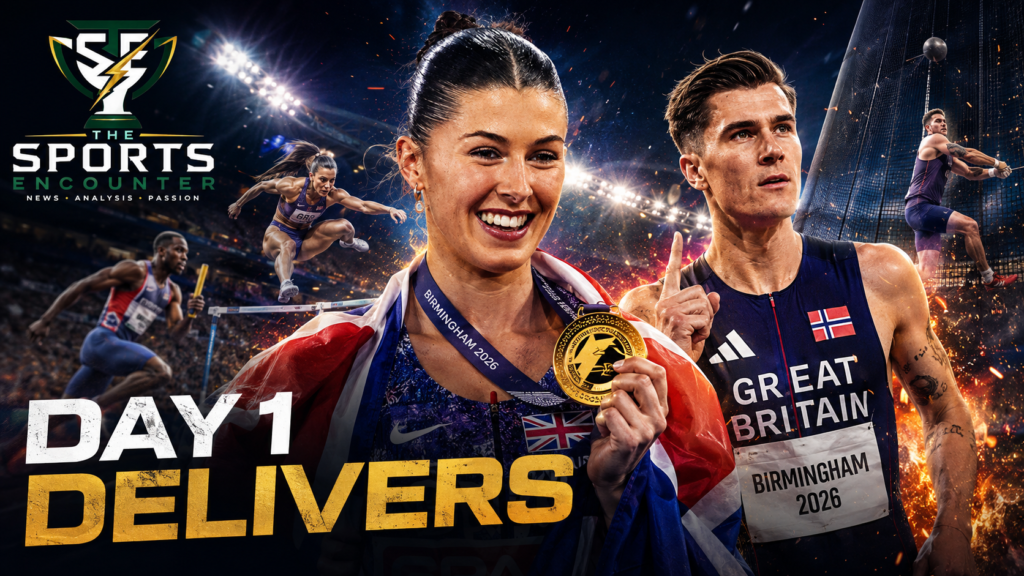
Birmingham waited 92 years to host the European Athletics Championships. It needed only one night to produce a home champion, a remarkable comeback, two successful shot put title defenses and a relay finish that sent Norway to the top of the first medal table.

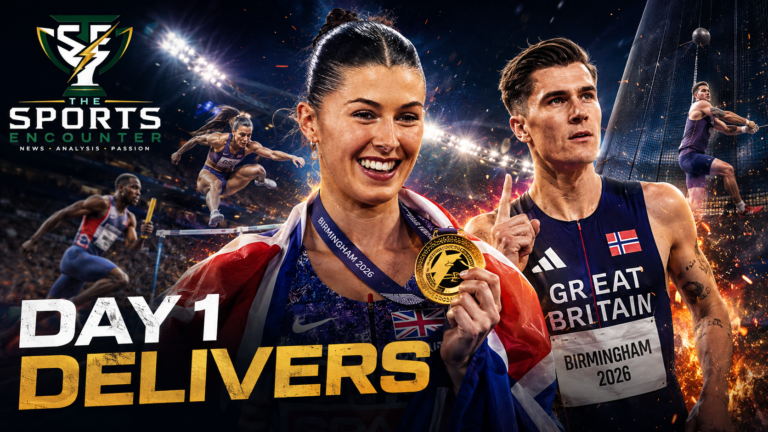
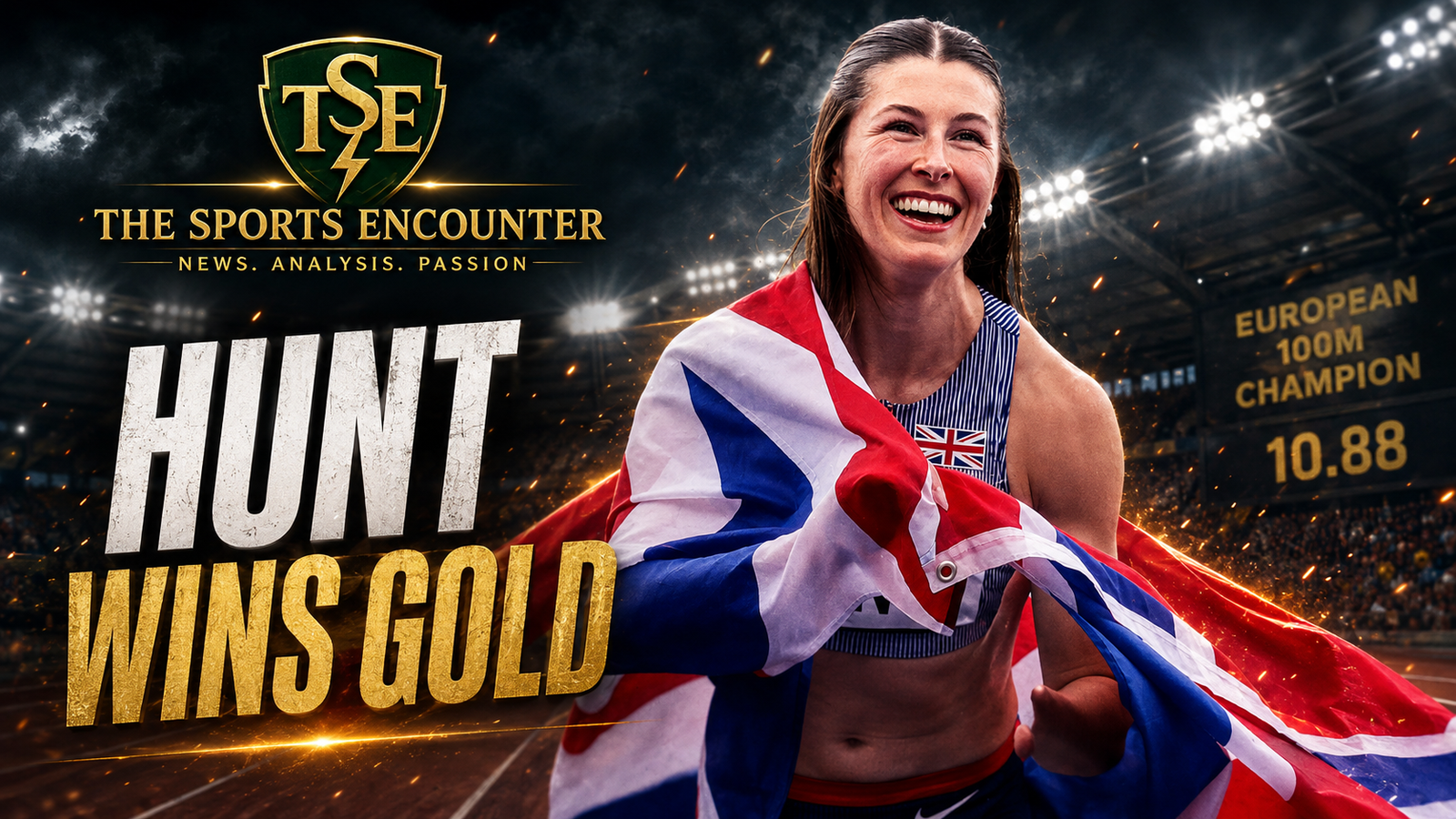
Amy Hunt delivered the moment the British crowd had been waiting for, charging through the second half of the women’s 100m final to win her first major senior individual title in 11.00 seconds. Poland’s Ewa Swoboda finished just 0.02 seconds behind, Belgium’s Delphine Nkansa took bronze in 11.06, and defending champion Dina Asher-Smith finished fifth.

Earlier, Jakob Ingebrigtsen completed an extraordinary return from a lengthy injury layoff by winning the men’s 5000m in 13:15.29. Norway then added the mixed 4x400m relay title in 3:09.62, while Jessica Schilder retained the women’s shot put crown and Leonardo Fabbri successfully defended the men’s title. :contentReference[oaicite:0]{index=0}

Five finals. Five very different stories.

The first night at Alexander Stadium established the rhythm for a championship that will run through Sunday, August 16, and already gave Birmingham 2026 several performances that could still feature prominently when the event is remembered at the end of the week. The official timetable, live results and medal standings can be followed through the European Athletics Birmingham 2026 results center. :contentReference[oaicite:1]{index=1}

Birmingham 2026 Day 1 at a Glance

Event Gold Medalist Winning Mark Day 1 Story
Women’s 100m Amy Hunt, Great Britain 11.00 First major senior individual title
Men’s 5000m Jakob Ingebrigtsen, Norway 13:15.29 Golden return after long injury absence
Mixed 4x400m relay Norway 3:09.62 Late surge from Henriette Jæger secures gold
Women’s shot put Jessica Schilder, Netherlands 20.73m Third consecutive European title
Men’s shot put Leonardo Fabbri, Italy 22.31m Dominant successful title defense

Amy Hunt Gives Birmingham Its First Great Home Moment

The final event of the opening night produced its loudest reaction.

Hunt had already signaled her form by running 10.99 in the semifinal, the fastest qualifying performance of the evening. That made her more than a home medal hope. She entered the final carrying the expectation of a favorite. :contentReference[oaicite:2]{index=2}

Swoboda started quickly and immediately applied pressure.

Hunt did not panic.

Her strength emerged once the race entered the upright phase. She began eating into Swoboda’s advantage, stayed relaxed through the final 30 meters and reached the line in 11.00, two hundredths ahead of the Polish sprinter. Nkansa followed in 11.06 to secure bronze. :contentReference[oaicite:3]{index=3}

For Hunt, the victory completes a remarkable sequence of progress.

She had already won Commonwealth 100m silver in Glasgow, where New Zealand’s Zoe Hobbs ran 10.93. The Sports Encounter covered that breakthrough in our Glasgow 2026 Day 5 wrap-up.

Birmingham changed the medal color.

Hunt had also beaten Asher-Smith at the British Championships earlier this summer. Winning again at the same stadium, this time with a continental title at stake, makes the result considerably more significant than a one-night upset.

Asher-Smith’s European reign ends

Asher-Smith reached the final after running a season-best 11.10 in the semifinal, but she could not recreate the form that carried her to European gold in Rome two years ago. She finished fifth in 11.10. :contentReference[oaicite:4]{index=4}

The result should not be interpreted as the end of Asher-Smith’s relevance. Her record remains far beyond anything Hunt has yet built.

But the current British 100m hierarchy has changed.

Hunt has now beaten Asher-Smith at the national championships and succeeded her as European champion.

The next question is no longer whether Hunt can become Britain’s leading female sprinter.

It is how far this version of Amy Hunt can go internationally.

Jakob Ingebrigtsen Returns From the Unknown With Another European Gold

If Hunt provided the emotional home story, Ingebrigtsen delivered the night’s most compelling comeback.

The Norwegian had gone almost a year without racing after Achilles problems and surgery disrupted his career. He arrived in Birmingham with only a relatively short period of uninterrupted training behind him.

Yet the tactical instincts remained intact.

The men’s 5000m unfolded slowly enough to keep a large group involved, increasing the danger for a runner returning from injury. Ingebrigtsen entered the final bend boxed behind Germany’s Florian Bremm and France’s Jimmy Gressier.

Then the gap appeared.

Ingebrigtsen accelerated through it and produced the decisive final sprint, winning in 13:15.29. Bremm claimed silver in 13:15.60, while Etienne Daguinos of France secured bronze. :contentReference[oaicite:5]{index=5}

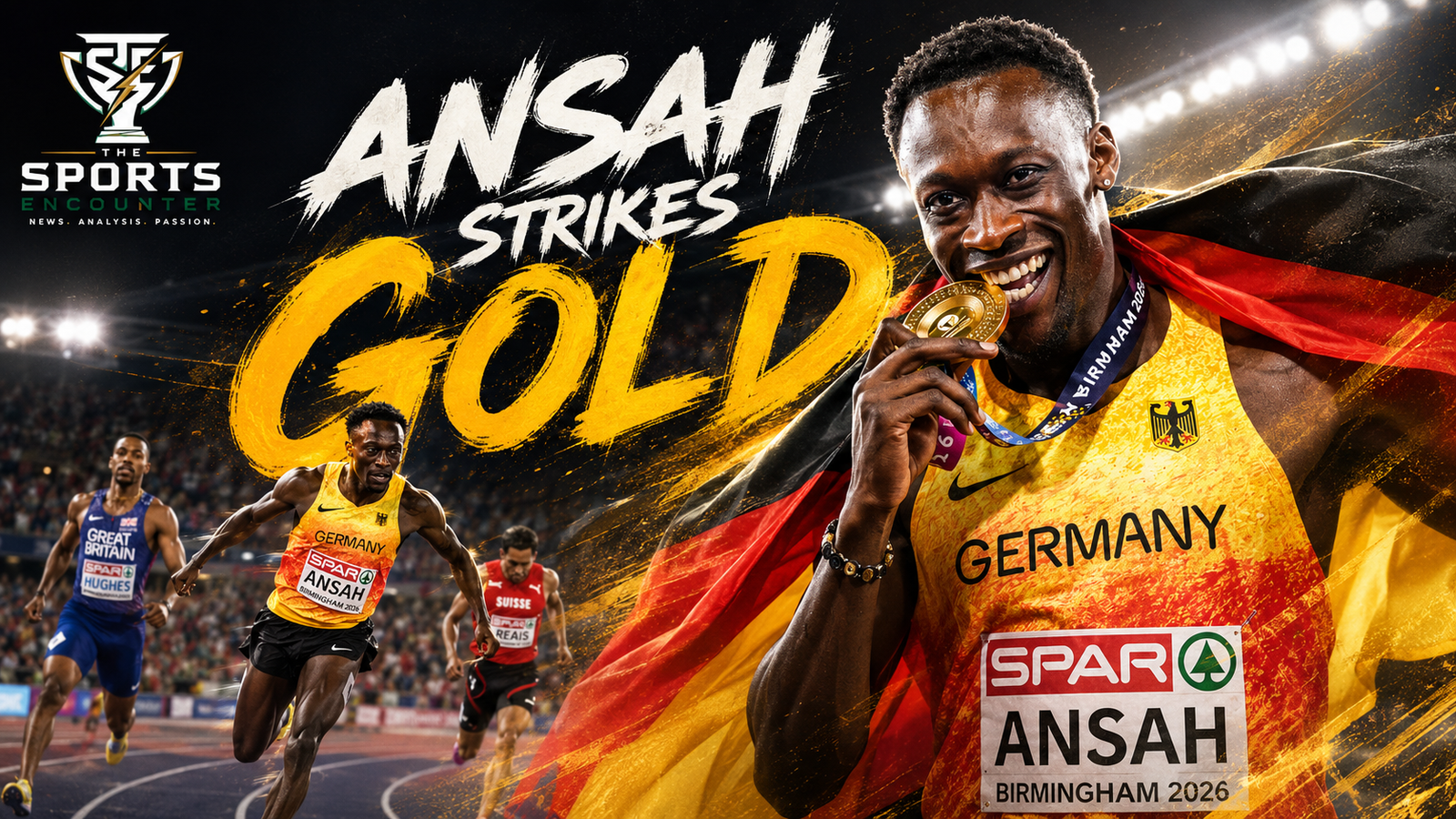
It was Ingebrigtsen’s fourth consecutive European 5000m title and seventh outdoor European gold overall. :contentReference[oaicite:6]{index=6}

The time mattered less than the body language

The 13:15.29 did not tell the full story.

Ingebrigtsen had spent months wondering whether his body would allow him to compete at this level again. After the race, he acknowledged that simply feeling healthy and recognizably like himself again had been the objective of the previous year. :contentReference[oaicite:7]{index=7}

For Norway, the victory immediately placed a gold medal on the board.

For Ingebrigtsen, it restored something more important: proof that he can still execute a championship race under pressure.

Norway Turns One Gold Into Two in the Mixed 4x400m

Norway did not have to wait long for another celebration.

The mixed 4x400m relay became one of the most dramatic races of the opening night.

Karsten Warholm gave Norway a powerful start, but the Netherlands moved into a strong position after Lieke Klaver’s leg. Great Britain remained involved, setting up a three-team battle entering the final lap. :contentReference[oaicite:8]{index=8}

Yemi Mary John surged past Dutch anchor Myrte van der Schoot and briefly appeared capable of stealing gold for the hosts.

Henriette Jæger had one more acceleration.

The Norwegian anchor produced a devastating final straight and carried her team to victory in 3:09.62. Great Britain took silver and the Netherlands bronze. :contentReference[oaicite:9]{index=9}

The victory meant Norway finished Day 1 with two gold medals, more than any other nation.

Why the relay mattered tactically

The mixed relay is especially unforgiving because teams must balance male and female athletes across four legs while accounting for traffic, exchange positioning and the strengths of rival lineups.

Norway built its strategy around two elite 400m performers in Warholm and Jæger.

That gave them quality at both ends of the race.

The Netherlands briefly appeared to have broken the contest open, while Britain timed its challenge well enough to threaten on the final bend.

Jæger’s closing speed ultimately decided everything.

Jessica Schilder Starts Birmingham 2026 With a Throwing Statement

The first gold medal of Birmingham 2026 went to a familiar champion.

Jessica Schilder won the women’s shot put with 20.73m, producing her best throw with the final attempt of the competition.

The Dutch star had already led with 20.52m from round three. Rather than protect the victory, she improved again after the medals were effectively decided. :contentReference[oaicite:10]{index=10}

Jorinde van Klinken completed a Dutch one-two with a personal-best 19.64m, while Germany’s Yemisi Mabry took bronze at 19.50m. The podium was identical in order to the one from Rome 2024. :contentReference[oaicite:11]{index=11}

Schilder’s victory was her third consecutive European outdoor title.

That is the real measure of her dominance.

Athletics champions frequently survive one cycle. Schilder has now controlled the European event across several seasons while the chasing group has changed around her.

Her final throw also underlined the difference between simply winning and continuing to attack a championship when the gold is already secure.

Leonardo Fabbri Leaves No Argument in the Men’s Shot Put

Fabbri’s title defense was even more decisive.

The Italian won with 22.31m, more than a meter ahead of compatriot Zane Weir’s 21.12m. Sweden’s Wictor Petersson took bronze with 20.97m, while Great Britain’s Scott Lincoln suffered another painful fourth-place finish with 20.81m. :contentReference[oaicite:12]{index=12}

Fabbri entered Birmingham as the clear favorite after producing a world-leading 22.74m earlier in the season. The final confirmed that the gap between him and the rest of Europe remains substantial. :contentReference[oaicite:13]{index=13}

The Italian did not need his absolute best.

His 22.31m was enough to control the competition decisively, and by the time Petersson and Weir took their final attempts, Fabbri already knew the title belonged to him.

Italy gets a one-two, Britain gets another fourth

Weir’s silver gave Italy both of the top two positions.

Lincoln’s fourth place was more painful.

He finished only 0.16m behind Petersson and once again found himself immediately outside the medals at a major championship.

For Britain, Hunt’s gold and the mixed relay silver softened that disappointment considerably.

Opening Morning Produces Important British Progress

The medal finals dominated the evening, but Day 1 began much earlier.

Max Burgin won his men’s 800m heat in 1:45.80 after recovering from illness, while fellow Brit Ben Pattison also progressed. Ireland’s Mark English won his own heat. :contentReference[oaicite:14]{index=14}

Those results matter because the men’s 800m is one of the deepest events of the championships.

Burgin and Pattison remain part of Britain’s medal conversation, but surviving the early round efficiently is essential when multiple races are required across several days.

Britain also made progress elsewhere.

Lina Nielsen won her women’s 400m hurdles heat comfortably, Archie Yeo secured a place in the men’s long jump final, and Jake Norris qualified ninth for the men’s hammer final. :contentReference[oaicite:15]{index=15}

Elise Thorner produced another encouraging home performance in the women’s 3000m steeplechase, controlling her heat and qualifying comfortably for Thursday’s final. Defending champion Alice Finot also advanced. :contentReference[oaicite:16]{index=16}

Not Every British Hope Survived Day 1

Opening rounds always produce casualties.

Emma Nwofor missed qualification for the women’s 100m hurdles semifinals after running 13.04. She ultimately finished outside the 12 fastest athletes needed to advance. :contentReference[oaicite:17]{index=17}

Sarah Tait also failed to reach the women’s 3000m steeplechase final after finishing 12th in her heat.

Those eliminations are easy to lose beneath the medals, but they matter in a seven-day championship where every missed progression reduces a host nation’s later medal opportunities.

Norway Leads the First Birmingham 2026 Medal Table

With five finals completed, Norway ended the opening night on top.

RankNationGoldSilverBronzeTotal
1Norway2002
2Netherlands1113
3Great Britain1102
3Italy1102

Norway’s lead came through two very different forms of excellence: Ingebrigtsen’s tactical 5000m victory and the speed of its mixed relay team.

The Netherlands collected the most medals of any nation on Day 1, taking gold and silver in the women’s shot put plus bronze in the relay.

Great Britain ended the night with Hunt’s 100m title and mixed relay silver, while Italy’s entire medal haul came from its men’s shot put strength. :contentReference[oaicite:18]{index=18}

TSE Analysis: Day 1 Was About Champions Who Already Knew How to Win and One Who Finally Did

There was a clear pattern running through the five finals.

Schilder retained her title.

Fabbri retained his title.

Ingebrigtsen retained his 5000m crown.

Norway used experienced elite athletes to win the mixed relay.

Then Hunt changed the script.

The 24-year-old had already accumulated major medals, national titles and sub-11-second performances. What she lacked was an individual senior championship gold.

Birmingham gave her that medal at home.

That contrast gave the opening night its character.

The established champions showed why removing them from the top requires more than a strong season. Hunt showed what happens when a rising athlete finally converts form into championship authority.

The Birmingham Crowd Was Strongest When Britain Gave It Something to Believe In

Alexander Stadium was not completely full on the opening evening, although later sessions in the week are expected to draw larger crowds. :contentReference[oaicite:19]{index=19}

The atmosphere changed noticeably when British athletes entered decisive moments.

Hunt’s final was the clearest example.

The home crowd had watched her progress through the semifinal and understood that a genuine gold-medal opportunity existed. The reaction at the finish provided the first signature crowd moment of the championships.

That matters beyond Birmingham.

Britain is also bidding to host the 2029 World Athletics Championships in London. The Sports Encounter recently examined the proposal in London’s £400 million World Athletics Championships bid.

Nairobi has now entered that same race, seeking to become the first African host of the senior World Championships. Our analysis of the competing vision can be found in Nairobi’s 2029 World Athletics Championships bid.

Successful home championships provide Britain with another piece of evidence when arguing that major athletics still has a strong audience in the country.

From Glasgow to Birmingham: Britain’s Athletics Summer Keeps Moving

Birmingham began only eight days after the Commonwealth Games concluded in Glasgow.

That compressed calendar creates an unusual challenge for British athletes who competed at both championships.

Hunt has managed it superbly.

Her Commonwealth silver became European gold.

Several other athletes now face the same problem of recovering physically and mentally from Glasgow before competing again against Europe’s best.

The Sports Encounter followed that Commonwealth campaign throughout the competition, including our Day 4 report, Day 6 wrap-up, Day 7 analysis and Day 9 report.

Glasgow showed how quickly athletes can build momentum during a major championship.

Birmingham now asks whether they can do it again.

Day 2: Hodgkinson Enters and the Men’s 100m Takes Center Stage

The second day shifts attention toward another set of major British medal hopes.

Olympic champion Keely Hodgkinson begins her women’s 800m campaign, starting a path toward what may become one of the most anticipated races of the championships later in the week.

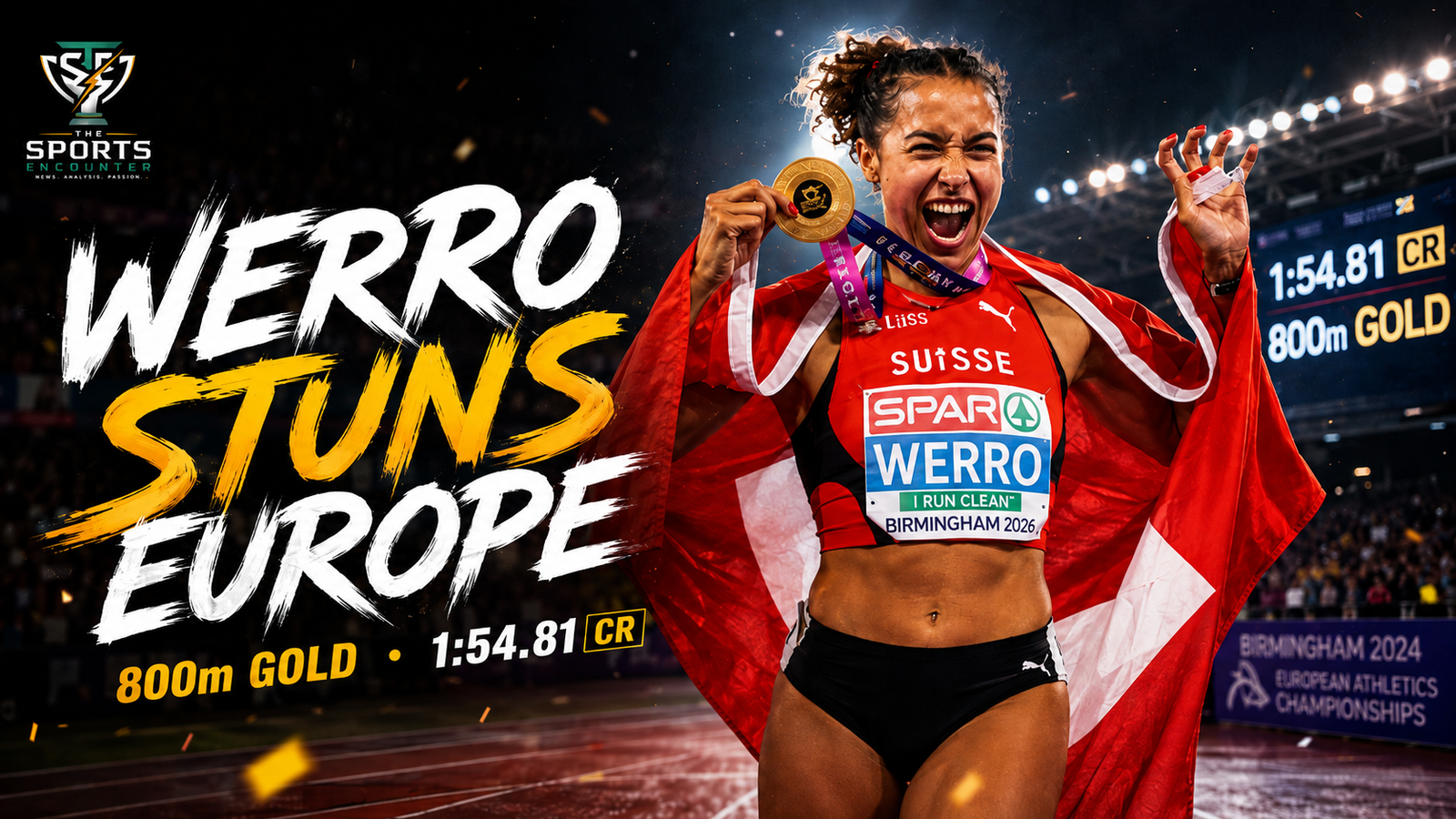
Her main long-term rivals include Switzerland’s Audrey Werro, who ran 1:53.98 earlier this season, and Femke Bol, now competing as Femke Broeders-Bol, whose move into the 800m has created one of Birmingham’s most fascinating experiments. :contentReference[oaicite:20]{index=20}

The men’s 100m final should provide Tuesday evening’s headline sprint event.

Defending champion Marcell Jacobs will attempt to retain his title, while Britain’s Romell Glave is among the principal home challengers. :contentReference[oaicite:21]{index=21}

The women’s 100m hurdles will also move toward its medal conclusion.

After Hunt’s opening-night gold, expectations around the British team will inevitably rise.

That can help athletes.

It can also create pressure.

Day 1 Winners and Medalists

Women’s 100m

  1. Amy Hunt, Great Britain – 11.00
  2. Ewa Swoboda, Poland – 11.02
  3. Delphine Nkansa, Belgium – 11.06

Men’s 5000m

  1. Jakob Ingebrigtsen, Norway – 13:15.29
  2. Florian Bremm, Germany – 13:15.60
  3. Etienne Daguinos, France – Bronze

Mixed 4x400m Relay

  1. Norway – 3:09.62
  2. Great Britain – Silver
  3. Netherlands – Bronze

Women’s Shot Put

  1. Jessica Schilder, Netherlands – 20.73m
  2. Jorinde van Klinken, Netherlands – 19.64m
  3. Yemisi Mabry, Germany – 19.50m

Men’s Shot Put

  1. Leonardo Fabbri, Italy – 22.31m
  2. Zane Weir, Italy – 21.12m
  3. Wictor Petersson, Sweden – 20.97m

Final Verdict: Birmingham Gets the Opening Night It Needed

A major championship opening day has two jobs.

It must introduce the event.

It must also give people a reason to come back tomorrow.

Birmingham succeeded on both fronts.

Hunt produced the home gold.

Ingebrigtsen turned his first race in almost a year into another European title.

Norway transformed individual success into relay dominance.

Schilder demonstrated that European women’s shot put still belongs to her.

Fabbri showed the scale of the gap he has opened over the rest of the continent.

And beneath those five gold medals, qualifiers and eliminations quietly began shaping the finals that will define the rest of the week.

The first night did not settle Birmingham 2026.

It established the standard.

For official results, athlete profiles, schedules and medal standings, visit European Athletics and the World Athletics competition calendar and results center. :contentReference[oaicite:22]{index=22}

Frequently Asked Questions About Birmingham 2026 Day 1

Who won the women’s 100m at Birmingham 2026?

Great Britain’s Amy Hunt won the European women’s 100m title in 11.00 seconds. Ewa Swoboda of Poland took silver in 11.02 and Belgium’s Delphine Nkansa won bronze in 11.06.

Where did Dina Asher-Smith finish in the 100m final?

Defending champion Dina Asher-Smith finished fifth in 11.10 seconds.

Who won the men’s 5000m?

Norway’s Jakob Ingebrigtsen won in 13:15.29 on his return from a lengthy injury absence.

How many gold medals did Norway win on Day 1?

Norway won two gold medals. Ingebrigtsen won the men’s 5000m before Norway claimed the mixed 4x400m relay.

Who won the women’s shot put?

Jessica Schilder of the Netherlands won with 20.73m, securing her third consecutive European outdoor title.

Who won the men’s shot put?

Italy’s Leonardo Fabbri successfully defended his European title with 22.31m.

Who leads the Birmingham 2026 medal table after Day 1?

Norway leads on gold medals with two. The Netherlands collected three medals overall, while Great Britain and Italy each finished the opening day with one gold and one silver.

When does Birmingham 2026 end?

The European Athletics Championships run through Sunday, August 16, 2026.

What are the biggest events on Day 2?

Keely Hodgkinson begins her women’s 800m campaign, while the men’s 100m and women’s 100m hurdles are among the main medal events on Tuesday.

Kimberly Statton is a London-based sports writer covering cricket, soccer, basketball, hockey, and major international competitions. Her work spans breaking news, match reports, tournament developments, player performances, team decisions, and the wider stories influencing professional sport across different leagues and regions. At The Sports Encounter, Kimberly contributes across competitions including The Hundred, the Premier League, NBA, NHL, and major international sporting events. Her coverage combines timely reporting with match context, performance analysis, and a clear focus on the consequences behind results, transfers, injuries, and team decisions. She writes for readers who want more than the headline, connecting individual performances and breaking developments with the broader competitive picture shaping teams, players, and tournaments.

Birmingham 2026

Hudson-Smith Makes History as Records Fall on Day 3 of Birmingham 2026

Matthew Hudson-Smith made European 400m history on home soil as Silja Kosonen, Emma Zapletalová and Jason Joseph won gold and Birmingham 2026 set up a loaded Day 4.

Published

on

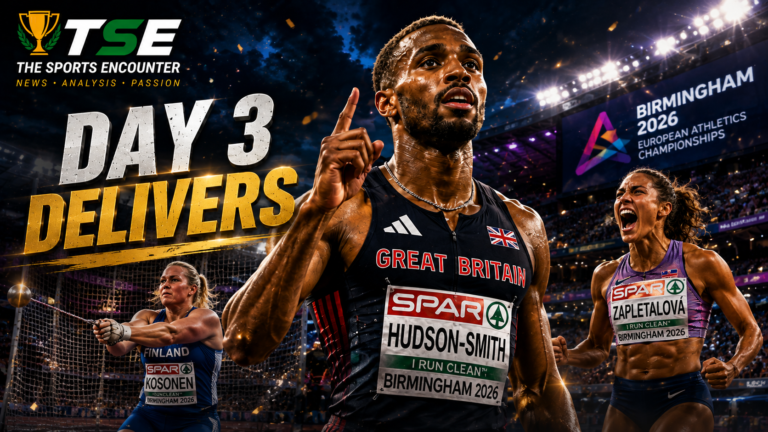
Matthew Hudson-Smith leads a Birmingham 2026 Day 3 featured image alongside Silja Kosonen and Emma Zapletalová, highlighting a night of European Athletics titles, records, and home-track success at Alexander Stadium.

Matthew Hudson-Smith turned Alexander Stadium into his own stage, Silja Kosonen finally converted years of promise into senior European gold, Emma Zapletalová delivered Slovakia a historic title, Jason Joseph closed the night with a Swiss sprint-hurdles triumph, and the women’s 200m field sharpened into one of Birmingham 2026’s most anticipated finals.

Day 3 of the 2026 European Athletics Championships did more than award four gold medals.

It changed the tone of the championship.

The opening two days had already produced British sprint success, major title defenses and standout field performances. Wednesday added something different: deeper historical significance, national breakthroughs and semifinal performances that may ultimately prove as important as some of the finals.

Hudson-Smith became the first man to win three individual European 400m titles. Kosonen claimed the first major senior gold of her career. Zapletalová became the first Slovakian woman to win European Athletics Championship gold. Joseph upgraded his previous continental bronze to victory.

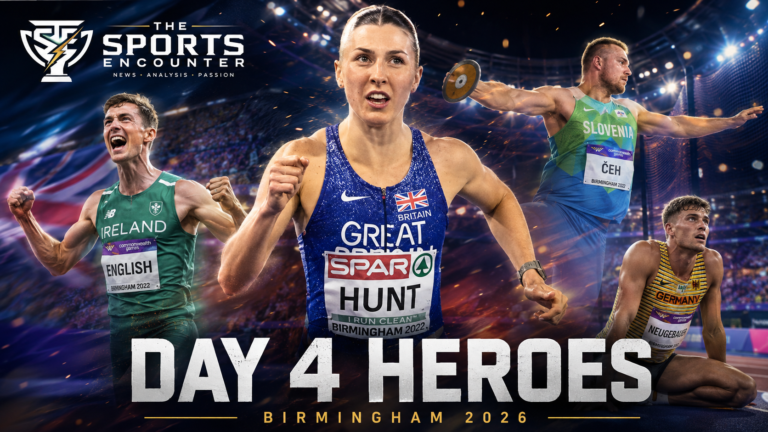
Meanwhile, Mark English ran 1:43.49 to break a championship record that had survived since 1978, Rhasidat Adeleke won her women’s 200m semifinal in 22.43, Amy Hunt qualified fastest in 22.37, and Leo Neugebauer ended the opening day of the decathlon in front despite a difficult final 400m.

For readers catching up from the beginning, The Sports Encounter’s Birmingham 2026 Day 1 wrap-up covered Amy Hunt’s 100m gold, Jakob Ingebrigtsen’s winning return and Norway’s mixed relay triumph, while our Day 2 report followed Romell Glave, Nadia Battocletti, Nadine Visser, Miltiadis Tentoglou and Bence Halász.

Birmingham 2026 Day 3 at a Glance

EventGold MedalistWinning MarkMain Story
Women’s HammerSilja Kosonen, Finland76.28mFirst major senior title
Men’s 400mMatthew Hudson-Smith, Great Britain44.17First man to win three European 400m titles
Women’s 400m HurdlesEmma Zapletalová, Slovakia52.91First Slovakian woman to win European gold
Men’s 110m HurdlesJason Joseph, Switzerland13.12Season-best finish secures first European outdoor title

Official schedules, results and championship information are available through the European Athletics Birmingham 2026 results center.

Hudson-Smith Turns Lane Nine Into a Homecoming

Matthew Hudson-Smith’s victory was always likely to dominate the evening.

The circumstances made it even bigger.

He started from lane nine, outside the visual reference of almost every rival, on the same Alexander Stadium track where he trained during the early years of his career.

Hudson-Smith attacked the race aggressively, reached 200 meters in 20.86 and 300 meters in 31.80, and then fought through the final straight as Muhammad Abdallah Kounta and Jonas Phijffers closed behind him.

He reached the line in 44.17.

Kounta took silver for France in 44.40, while Phijffers broke the Dutch national record with 44.41 for bronze.

PositionAthleteCountryTime
1Matthew Hudson-SmithGreat Britain44.17
2Muhammad Abdallah KountaFrance44.40
3Jonas PhijffersNetherlands44.41 NR

The victory gave Hudson-Smith his third individual European 400m title after previous wins in 2018 and 2022.

No man had done that before.

It also took his European Championship medal collection to eight, matching Christophe Lemaitre’s men’s championship record.

The emotional layer came from the venue itself.

A temporary stand at Alexander Stadium bears Hudson-Smith’s name, and the Wolverhampton athlete has spent years racing and training on the track.

The Sports Encounter examined the full significance of that homecoming in our Birmingham 2026 coverage.

Hudson-Smith’s performance also extended Great Britain’s remarkable sprint run after Hunt’s women’s 100m title and Glave’s men’s 100m victory. Our feature on Amy Hunt’s breakthrough gold showed how quickly the home sprint hierarchy began changing on the opening night.

Zapletalová Converts World-Leading Form Into Gold

Emma Zapletalová arrived in Birmingham carrying the kind of season that creates expectations.

She left with the title.

The Slovakian won the women’s 400m hurdles in 52.91, confirming the form that had already made her one of the fastest athletes in the world this year.

Great Britain’s Emily Newnham produced the race of her life behind her.

Newnham finished second in 53.33, a personal best that moved her to second on the British all-time list behind Sally Gunnell.

Portugal’s Fatoumata Binta Diallo completed the podium in a national-record 53.55.

PositionAthleteCountryTime
1Emma ZapletalováSlovakia52.91
2Emily NewnhamGreat Britain53.33 PB
3Fatoumata Binta DialloPortugal53.55 NR

Zapletalová’s victory carries national significance.

She became the first Slovakian woman to win gold at the European Athletics Championships.

That alone would make the result important.

The manner of the victory added another layer.

She moved decisively into control around the eighth hurdle and maintained enough rhythm through the closing section to prevent Newnham’s strong finish from becoming a genuine challenge for gold.

Newnham’s silver was still one of the most encouraging British performances of the evening.

She had been sixth with two hurdles remaining and used her closing strength to move through the field.

That is the kind of race that can change an athlete’s confidence quickly.

Kosonen Finally Wins the Senior Title Her Career Had Been Building Toward

Silja Kosonen has spent several years collecting evidence that she belonged among Europe’s best hammer throwers.

Wednesday finally produced the senior gold medal.

The 23-year-old Finn threw 76.28m in the second round and never surrendered the lead.

Defending champion Sara Fantini opened with 74.35m and held silver, while Norway’s Beatrice Nedberge Llano produced 72.88m for bronze.

PositionAthleteCountryMark
1Silja KosonenFinland76.28m
2Sara FantiniItaly74.35m
3Beatrice Nedberge LlanoNorway72.88m

Kosonen had already won European U20, European U23 and world U20 titles, but senior championship podiums had repeatedly remained just out of reach.

That changed in Birmingham.

The biggest surprise came from the other Finnish favorite.

Krista Tervo entered the championship with a world-leading 77.35m and looked capable of giving Finland two medals.

She struggled badly in the final, recorded only one legal throw at 67.74m and finished 11th.

Anita Włodarczyk, one of the greatest hammer throwers in history, finished fourth with 72.37m.

Ireland’s Nicola Tuthill produced another strong championship result, finishing fifth with 70.33m.

At 22, she was the youngest athlete in the final and improved from ninth at the previous European Championships.

Her performance fits a wider Irish athletics pattern in Birmingham: athletes are increasingly reaching finals and forcing themselves into serious continental conversations.

Jason Joseph Saves His Best Finish for the Final

The men’s 110m hurdles ended the stadium program with one of the night’s cleanest races.

Jason Joseph won in a season-best 13.12, using his trademark closing speed to move clear after the final barrier.

France’s Just Kwaou-Mathey took silver in 13.16, while Poland’s Jakub Szymański claimed bronze in 13.26.

PositionAthleteCountryTime
1Jason JosephSwitzerland13.12 SB
2Just Kwaou-MatheyFrance13.16
3Jakub SzymańskiPoland13.26

Joseph had won bronze at the previous European Championships.

Birmingham gave him the upgrade.

His race was built around control.

He avoided the barrier trouble that disrupted several rivals in the semifinals, stayed technically clean and then accelerated through the final meters.

Great Britain’s Sam Bennett had produced a personal-best 13.26 in the semifinal and looked capable of challenging for a medal.

The final did not unfold as smoothly.

Bennett finished seventh in 13.62.

Even so, the semifinal performance moved him to equal eighth on the British all-time list and established him as another developing sprint-hurdles option for the host nation.

Mark English Breaks a Championship Record Older Than Most of the Field

Some of Day 3’s biggest performances did not produce medals.

Mark English delivered the clearest example.

The Irish middle-distance runner won his men’s 800m semifinal in 1:43.49.

That broke the European Championships record of 1:43.84 set by East Germany’s Olaf Beyer in Prague in 1978.

The old mark had survived for 48 years.

English removed it in a semifinal.

That says something about the quality of the current European 800m field.

Ben Pattison finished behind him in 1:43.72, while France’s Corentin le Clézio ran a personal-best 1:43.80.

Max Burgin also progressed from the other semifinal, giving Britain multiple serious options in Thursday’s final.

English now enters that final carrying more than sentimental momentum.

He has a legitimate championship-winning performance already on the board.

His race will also attract Irish attention after a summer in which national athletes have repeatedly produced championship-level breakthroughs.

The Sports Encounter saw similar middle-distance intensity at Glasgow 2026, where Georgia Hunter Bell won the Commonwealth women’s 800m title during one of the strongest athletics nights of those Games.

Adeleke, Hunt and Asher-Smith Set Up Thursday’s 200m Final

The women’s 200m semifinals created the next major sprint storyline.

Amy Hunt qualified fastest in 22.37.

Rhasidat Adeleke won her semifinal in 22.43.

Dina Asher-Smith won hers in 22.49.

Three performances, three different narratives.

Hunt is chasing a sprint double after winning the 100m.

Adeleke is rebuilding an injury-disrupted season and now looks increasingly comfortable at championship speed.

Asher-Smith carries the experience of a former world champion and remains capable of transforming completely between semifinal and final.

Britain also placed Success Eduan into the final through a qualifying time.

That gives the host nation three athletes in the medal race.

Adeleke’s progression deserves particular attention.

She had suffered two hamstring injuries earlier in the season and needed a late 22.80 performance at the Irish Championships simply to secure her Birmingham place.

Now she has won a European semifinal.

The change in trajectory has been rapid.

Hunt, meanwhile, continues to look increasingly comfortable carrying the expectations created by her 100m gold.

Neugebauer Leads the Decathlon Despite a Difficult Finish

World champion Leo Neugebauer ended the first day of the men’s decathlon in front with 4,483 points.

Jeff Tesselaar of the Netherlands sits second on 4,412, with Sander Skotheim third on 4,382.

Position After Day 1AthleteCountryPoints
1Leo NeugebauerGermany4,483
2Jeff TesselaarNetherlands4,412
3Sander SkotheimNorway4,382

Neugebauer’s position is notable because the final event of the day looked uncomfortable.

He struggled badly over the closing stages of the decathlon 400m and finished last in his heat.

His earlier work was strong enough to keep him ahead overall.

The second day now becomes much more interesting.

Tesselaar is only 71 points behind, while Skotheim remains close enough to apply pressure across the remaining five disciplines.

The decathlon concludes Thursday with the 110m hurdles, discus, pole vault, javelin and 1500m.

At Glasgow 2026, The Sports Encounter followed another multi-event championship battle when Kate O’Connor won the Commonwealth heptathlon, showing how dramatically standings can change during the second half of a combined event.

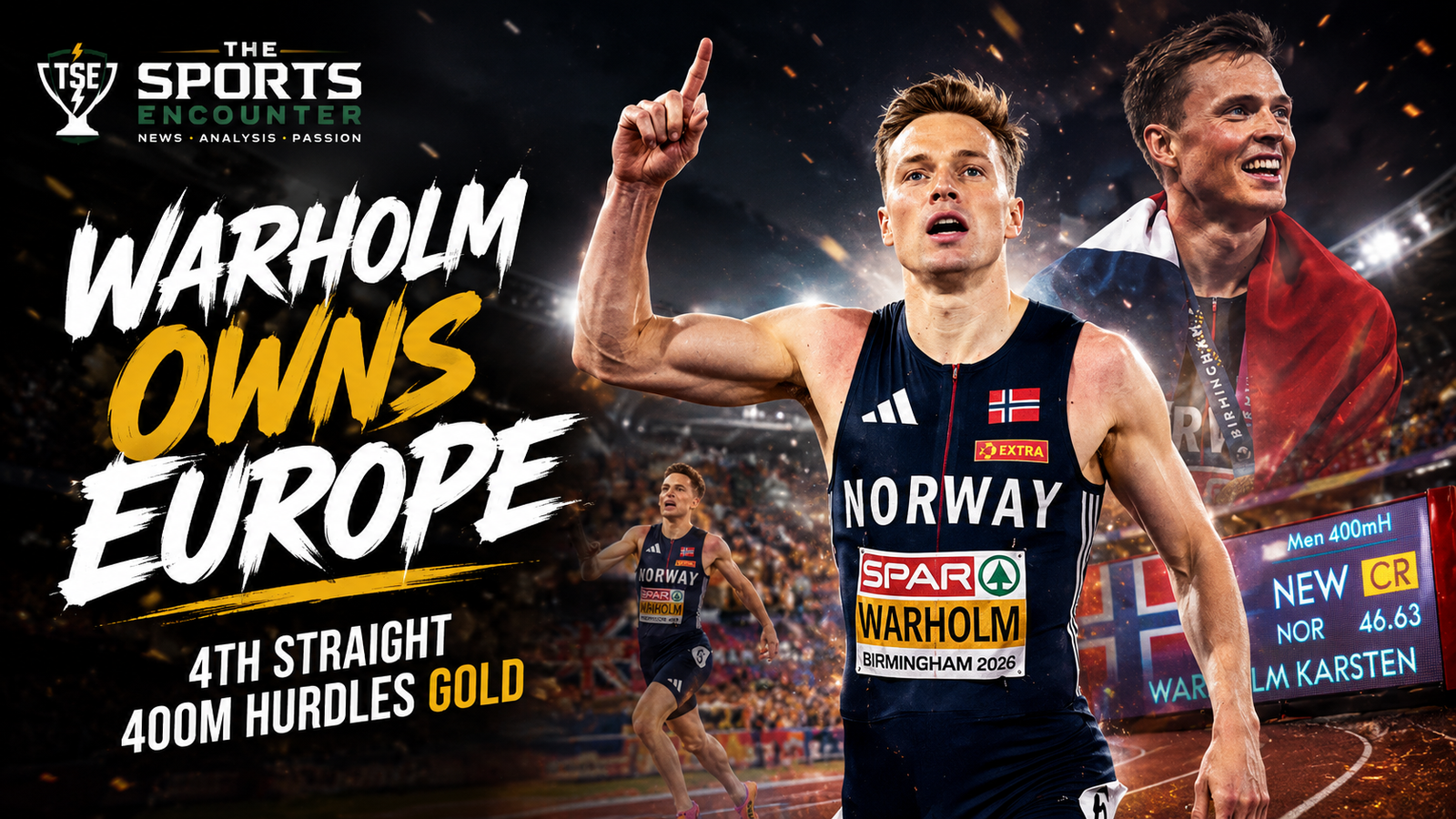
Warholm Stays on Course for a Fourth European 400m Hurdles Title

Karsten Warholm remains firmly in the men’s 400m hurdles title picture.

The Norwegian world-record holder won his semifinal in 48.01 and progressed comfortably.

Sweden’s Carl Bengtström Edlund produced one of the strongest performances of the round with a national-record 47.81.

That gives Friday’s final a more interesting shape than a routine Warholm coronation.

Warholm still possesses the championship pedigree.

The semifinal round showed that he will not enter the final without serious opposition.

Birmingham has already demonstrated several times that reputation alone does not guarantee control.

Great Britain Moves to the Top of the Medal Table

Hudson-Smith’s gold and Newnham’s silver pushed Great Britain to the top of the championship standings after three days.

RankCountryGoldSilverBronzeTotal
1Great Britain3306
2Italy2215
3Netherlands2125
4Norway2013
5Switzerland1102

Britain’s advantage comes from a pattern rather than one isolated breakthrough.

Hunt won the women’s 100m.

Glave won the men’s 100m.

Hudson-Smith added the 400m.

Azu, the mixed 4x400m relay team and Newnham supplied silver medals.

That gives the host nation a broad sprint-centered foundation entering the second half of the championships.

At Glasgow 2026, The Sports Encounter watched medal-table momentum shift repeatedly across disciplines. Our Day 5 Commonwealth Games wrap-up, Day 7 report and Day 8 analysis showed how quickly one strong athletics session can reshape a national campaign.

Birmingham is beginning to show the same pattern.

What Day 3 Revealed About Birmingham 2026

The strongest insight from Wednesday is that this championship has stopped relying on individual headline names.

It now has depth.

Hudson-Smith’s gold was the obvious home story.

Zapletalová’s victory gave Slovakia a landmark moment.

Kosonen’s breakthrough rewarded years of junior and age-group dominance.

Joseph changed Switzerland’s medal count.

English rewrote a championship record without even reaching the final yet.

Adeleke changed the conversation around her season.

Newnham moved into rare British company.

Tuthill confirmed that Ireland’s throwing program continues to produce finalists.

These stories matter because they widen the championship beyond the most famous athletes.

That is usually the point when a major event begins to feel established.

What to Watch on Birmingham 2026 Day 4

Thursday now carries several finals with genuine momentum from Wednesday.

The women’s 200m may be the most anticipated.

Hunt has the fastest semifinal time and the confidence of a European 100m title.

Adeleke looks increasingly dangerous after an injury-disrupted build-up.

Asher-Smith has championship experience few athletes in the field can match.

The men’s 800m final also looks exceptional after English’s championship record.

Neugebauer will try to protect his decathlon lead through five demanding events.

The women’s pole vault, women’s triple jump, women’s 3000m steeplechase and men’s discus will also award medals.

Day 4 therefore has something Day 3 created very effectively.

Expectation.

TSE Verdict: Day 3 Made the Championship Feel Bigger

Birmingham 2026 needed no help producing famous names.

It already had Olympic champions, world champions and European record holders.

Day 3 showed why championships become memorable for reasons beyond the entry list.

Hudson-Smith turned local history into European history.

Zapletalová gave Slovakia a first.

Kosonen finally reached the senior podium’s top step.

Joseph found the clean race he needed.

English broke a record that had survived since 1978.

Adeleke transformed an injury-hit season into a medal opportunity.

Newnham ran faster than every British woman in history except Sally Gunnell.

Neugebauer survived a difficult ending and still leads the decathlon.

That is the real measure of Day 3.

The night did not simply produce four champions.

It created several stories that will still matter when Birmingham 2026 reaches its final weekend.

Follow The Sports Encounter’s Birmingham 2026 hub for daily results, medal-table movement, records, tactical analysis and athlete stories throughout the European Athletics Championships.

Frequently Asked Questions

Who won the men’s 400m at Birmingham 2026?

Matthew Hudson-Smith won the European men’s 400m title in 44.17 seconds, becoming the first man to win three individual European titles in the event.

Who won the women’s hammer?

Finland’s Silja Kosonen won with 76.28 meters, earning the first major senior title of her career.

Who won the women’s 400m hurdles?

Emma Zapletalová of Slovakia won in 52.91 seconds. Great Britain’s Emily Newnham took silver in a personal-best 53.33, while Portugal’s Fatoumata Binta Diallo won bronze in a national-record 53.55.

Who won the men’s 110m hurdles?

Switzerland’s Jason Joseph won in a season-best 13.12 seconds ahead of Just Kwaou-Mathey and Jakub Szymański.

What record did Mark English break?

English ran 1:43.49 in the men’s 800m semifinal, breaking the European Championships record of 1:43.84 set by Olaf Beyer in 1978.

Did Rhasidat Adeleke reach the women’s 200m final?

Yes. Adeleke won her semifinal in 22.43 seconds and advanced to Thursday’s final.

Who qualified fastest for the women’s 200m final?

Amy Hunt qualified fastest in 22.37 seconds.

Who leads the decathlon after Day 1?

Germany’s Leo Neugebauer leads with 4,483 points, ahead of Jeff Tesselaar on 4,412 and Sander Skotheim on 4,382.

Who leads the Birmingham 2026 medal table after Day 3?

Great Britain leads with three gold and three silver medals for six overall.

When is the women’s 200m final?

The women’s 200m final is scheduled for Thursday, August 13 at Alexander Stadium.

Where can fans follow the full Birmingham 2026 results?

Official schedules, live results and medal standings are available through European Athletics, while The Sports Encounter continues daily analysis and wrap-up coverage throughout the championships.

Continue Reading

Birmingham 2026

Rhasidat Adeleke Is Back: Irish Star Storms Into European 200m Final After Injury-Hit Season

Rhasidat Adeleke won her European 200m semifinal in 22.43 seconds to reach Thursday’s final in Birmingham, continuing an impressive comeback from an injury-hit season.

Published

on

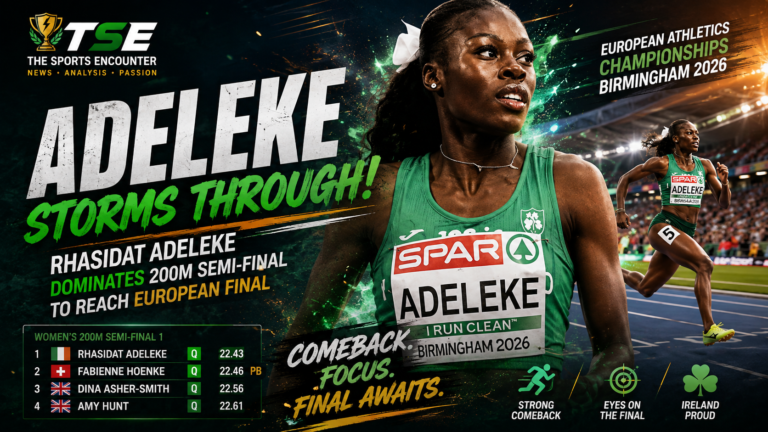
Rhasidat Adeleke celebrates reaching the women’s 200m final at the 2026 European Athletics Championships in Birmingham after winning her semifinal in 22.43 seconds for Ireland.

Rhasidat Adeleke has turned an injury-disrupted season into a shot at European gold after winning her women’s 200m semifinal in 22.43 seconds at the 2026 European Athletics Championships in Birmingham.

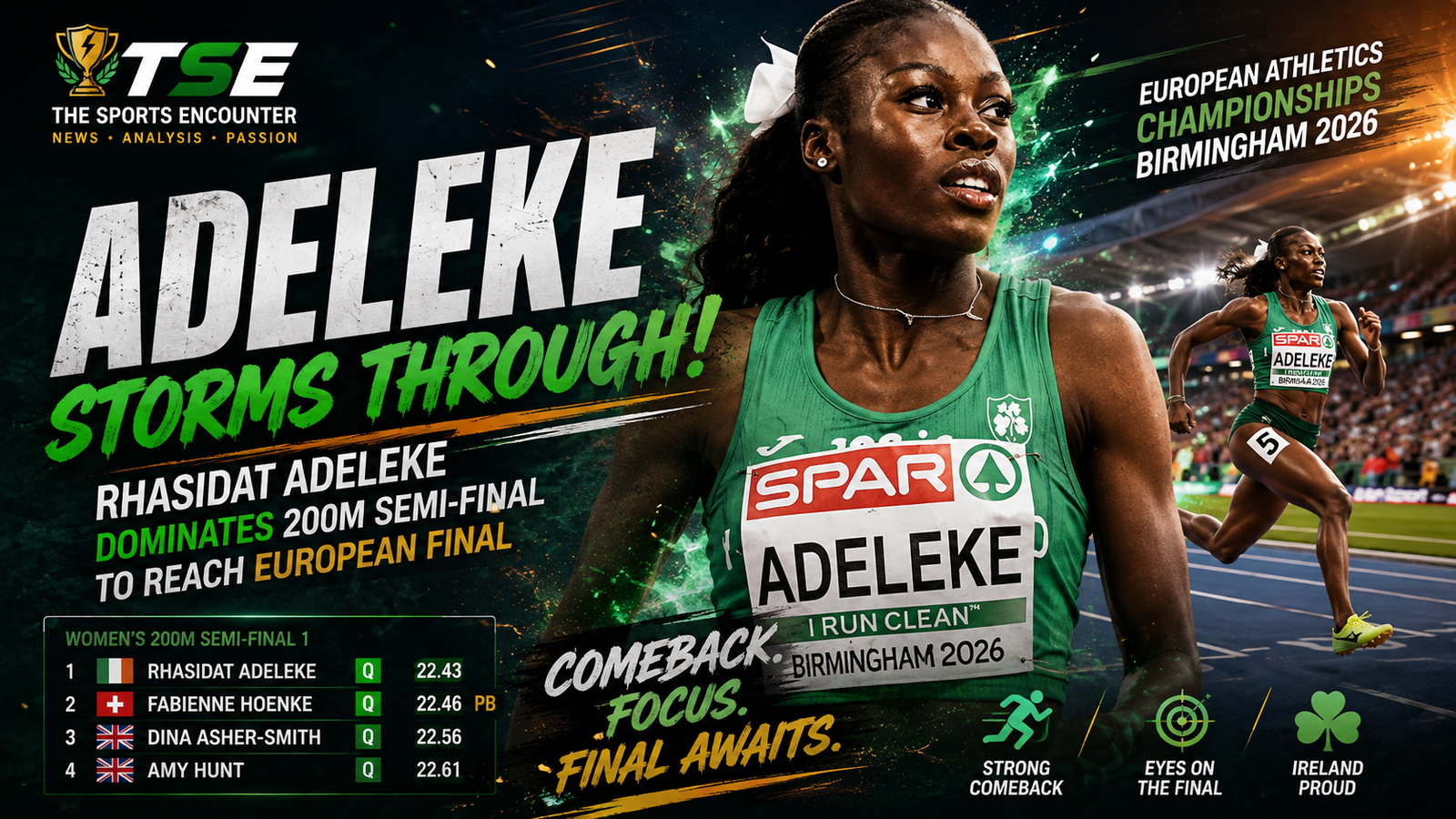
The Irish star produced a controlled performance at Alexander Stadium on Wednesday evening, holding off Switzerland’s Fabienne Hoenke, who ran a personal-best 22.46, to secure automatic qualification for Thursday’s final.

For Adeleke, the result carried significance far beyond winning a semifinal.

Her 2026 season has repeatedly been interrupted by injury. Only a few weeks ago, her place at the European Championships was still uncertain. She eventually qualified at the final opportunity by winning the Irish 200m title in 22.80 seconds at Morton Stadium.

Now she is one race away from a European medal.

“I’m having fun,” Adeleke said after reaching the final, reflecting a noticeably relaxed mood after months spent managing setbacks.

The final promises considerably greater pressure. Adeleke will face a high-quality field that includes Britain’s Amy Hunt and Dina Asher-Smith, giving Irish fans another major medal race to anticipate in Birmingham.

Rhasidat Adeleke’s 200m Semifinal Result

PositionAthleteNationTimeStatus
1Rhasidat AdelekeIreland22.43Qualified
2Fabienne HoenkeSwitzerland22.46PB, Qualified
3Dina Asher-SmithGreat Britain22.56Qualified

The official championship schedule, results and competition information are available through European Athletics.

Adeleke Looks Like Herself Again

The time mattered.

The victory mattered.

Yet perhaps the most encouraging part of Adeleke’s semifinal was how comfortable she appeared while producing it.

She ran the bend with control, entered the straight in contention and maintained enough speed through the closing stages to resist Hoenke’s challenge.

Adeleke did not have to chase qualification desperately at the line. She remained composed as the race developed around her.

Afterward, she explained why the performance felt different.

“It’s probably the first race this year that I’ve been able to just go out there and execute,” Adeleke told reporters after the semifinal.

That may be the most important sentence attached to her Birmingham campaign so far.

For much of 2026, Adeleke has been trying to get healthy enough to compete.

Now she can start thinking about how to win.

Two Hamstring Injuries Changed Adeleke’s 2026 Season

The road to Birmingham became much more difficult than expected.

Adeleke suffered two separate hamstring injuries during the season, disrupting her training and competition schedule.

Each setback cost valuable preparation time.

For a 200m and 400m athlete, hamstring problems are particularly damaging because sprinting depends on repeatedly producing force at high speed. Returning to competition involves more than becoming pain-free. An athlete also has to rebuild confidence in acceleration, top speed and the ability to attack a bend without subconsciously protecting the injured area.

Adeleke therefore entered the summer without the smooth progression normally expected before a major championship.

Her qualification position became increasingly uncertain.

Eventually, everything came down to one race in Dublin.

22.80 in Dublin Saved Her European Championships

On July 25, Adeleke lined up for the women’s 200m at the Irish National Track and Field Championships at Morton Stadium knowing she needed a performance.

The European qualifying standard was 22.85 seconds.

Adeleke ran 22.80.

She did it into a 1.1 meters-per-second headwind.

The performance gave her the Irish title and, more importantly, secured her place in Birmingham.

It came at almost the final possible moment.

That context changes the way her 22.43 semifinal should be viewed.

In less than three weeks, Adeleke moved from fighting simply to reach the European Championships to winning a semifinal against some of the continent’s best sprinters.

The improvement from 22.80 to 22.43 does not provide a perfect direct comparison because wind, track conditions and race circumstances differ.

It does show that her speed is moving in the right direction at exactly the right time.

Fabienne Hoenke Makes Adeleke Work for It

Adeleke did not receive an easy semifinal.

Hoenke produced the fastest 200m of her career, stopping the clock at 22.46.

The Swiss sprinter stayed close enough to keep Adeleke working through the finish rather than allowing the Irishwoman to shut down significantly before the line.

That may ultimately prove useful.

Championship semifinals are about qualification, but athletes also want enough competitive intensity to prepare their bodies for the final.

Adeleke received exactly that.

Hoenke finished only 0.03 seconds behind her.

Asher-Smith followed in 22.56.

All three advanced.

Amy Hunt Raises the Standard Ahead of the Final

Adeleke’s semifinal victory does not automatically make her the favorite for gold.

Amy Hunt made that clear elsewhere in the semifinals.

The British sprinter produced the fastest semifinal performance of the round, clocking 22.37 seconds.

Hunt already has momentum at Alexander Stadium after winning the European women’s 100m title earlier in the championships.

That victory established her as one of the central figures of Birmingham 2026 and gives her the opportunity to chase a sprint double in front of the home crowd.

The Sports Encounter has been following Britain’s sprint success throughout the championships, including Amy Hunt’s European 100m gold and the host nation’s wider breakthrough during the opening days.

Adeleke now becomes part of the next major chapter.

Dina Asher-Smith Adds Championship Experience

Dina Asher-Smith presents a different type of challenge.

She finished behind Adeleke and Hoenke in the semifinal, but few athletes in the field possess comparable championship experience.

The British sprinter has won world and European medals across the 100m, 200m and 4x100m relay during a long international career.

Her semifinal time of 22.56 was enough to move her into another European final.

That means Adeleke cannot judge Thursday’s race only from Wednesday’s finishing order.

Finals often change athletes.

Some runners conserve energy during qualifying rounds. Others respond differently when medals replace qualification places as the objective.

Asher-Smith knows that environment extremely well.

Adeleke’s 400m Reputation Makes Her 200m Dangerous

Adeleke is best known internationally for the 400m.

She became the first Irish woman to reach an Olympic sprint final when she contested the 400m final at Paris 2024.

Her ability over one lap helps explain why she can be particularly dangerous during the closing stages of a 200m race.

Pure 200m specialists often build their advantage through acceleration and bend speed.

Adeleke brings another weapon.

Strength.

Her 400m background means she is accustomed to maintaining form while fatigue increases dramatically.

That can become particularly valuable during the final 50 meters of a championship 200m.

If Adeleke remains close coming off the bend on Thursday, her ability to maintain speed through the line could put her directly into the medal fight.

The 200m May Be Exactly What Adeleke Needed in Birmingham

There is another interesting aspect to her decision to focus on the shorter sprint.

A difficult season can change what an athlete needs from a championship.

Adeleke has spent years carrying major expectations in the 400m. Every race brings comparisons with her Irish record, Olympic performances and the fastest quarter-milers in the world.

The 200m creates a slightly different challenge.

She can race aggressively.

She can rediscover speed.

Most importantly, she can compete without every performance being measured against her established 400m identity.

Her comments after the semifinal suggest that freedom may be helping.

From Fighting the Calendar to Fighting for a Medal

Adeleke’s championship position has changed remarkably quickly.

In July, the concern was qualification.

Would she recover?

Could she race?

Would she achieve the standard before the deadline?

Those questions disappeared when she ran 22.80 in Dublin.

Birmingham then introduced another set.

Could she reproduce that form against stronger opposition?

Could her hamstring tolerate championship rounds?

Could she move closer to her best?

Wednesday provided encouraging answers.

A 22.43 semifinal victory means the conversation has moved again.

Now the question is whether she can win a European medal.

Ireland’s Birmingham Momentum Keeps Growing

Adeleke’s qualification continued an encouraging championship for Ireland.

Mark English also advanced to the men’s 800m final on Wednesday, while Nicola Tuthill finished fifth in the women’s hammer.

Athletics Ireland described it as an excellent third evening for the national team.

That momentum stretches beyond Alexander Stadium.

At the European Aquatics Championships in Paris, Ellen Walshe won the women’s 400m individual medley in an Irish record 4:34.42, while Mona McSharry collected silver in the women’s 100m breaststroke.

The Sports Encounter covered Ireland’s European swimming performances as part of a remarkable week for the country’s athletes across two major championships.

Adeleke now has the opportunity to add another major result.

What Adeleke Needs to Get Right in the Final

The women’s 200m final will likely be decided by tiny margins.

Her semifinal demonstrated that.

Only 0.03 seconds separated Adeleke and Hoenke.

Hunt was just 0.06 quicker than Adeleke across the semifinal round.

At that level, the race can turn on execution rather than raw ability.

Adeleke’s start will matter because she cannot afford to give Hunt and the strongest bend runners too much ground.

Her transition off the curve will be equally important.

The 200m frequently changes at that point. Athletes who attack the bend too aggressively can tighten as they enter the straight. Those who remain too conservative can leave themselves too much work.

Adeleke’s task is to arrive in the final 80 meters close enough to use her greatest strength.

Her ability to keep running when others begin to shorten.

Semifinal Times Give Us a Preview, Not a Prediction

It would be tempting to rank Thursday’s contenders simply by semifinal time.

Championship sprinting rarely works that neatly.

Hunt’s 22.37 establishes her form.

Adeleke’s 22.43 establishes hers.

Hoenke’s 22.46 shows she is capable of challenging the favorites.

Asher-Smith carries experience that cannot be captured by one semifinal clocking.

Lane assignments, wind, reaction times and how aggressively each athlete ran the semifinal will all influence what happens next.

The important conclusion for Ireland is simpler.

Adeleke belongs in the race.

A Medal Would Transform the Story of Her Season

Elite sport can change its narrative remarkably quickly.

A few weeks ago, Adeleke’s 2026 season looked defined by interruption.

Two hamstring injuries had taken away training time and competition opportunities.

Her European Championships place remained uncertain until the Irish Nationals.

A medal in Birmingham would reshape the entire year.

The injuries would remain part of the story, but they would become the obstacle rather than the ending.

That possibility explains why Thursday’s final carries so much weight.

Adeleke has already rescued her European campaign.

Now she can turn it into something memorable.

Birmingham 2026 Has Become a Championship of Comebacks and History

The third day at Alexander Stadium produced another series of significant performances.

Matthew Hudson-Smith won the men’s 400m in 44.17 seconds, becoming the first man to claim three individual European titles over the distance.

The Sports Encounter’s Birmingham 2026 hub is tracking the championship’s major results, records and athlete stories.

Hudson-Smith’s home-track victory showed how quickly a championship can turn years of work into one defining moment.

Adeleke now stands 200 meters away from her own opportunity.

TSE Verdict: Adeleke Has Changed the Question

The most encouraging part of Rhasidat Adeleke’s semifinal was not the 22.43 beside her name.

It was what the performance allowed everyone to stop asking.

The conversation no longer needs to revolve around whether she recovered quickly enough.

She has qualified.

It no longer needs to focus on whether the disrupted training left her too far behind Europe’s leading sprinters.

She just beat several of them.

Adeleke entered Birmingham trying to rebuild momentum after a season repeatedly interrupted by hamstring trouble.

She arrived at the Irish Championships needing 22.85 and delivered 22.80 into a headwind.

Less than three weeks later, she ran 22.43 to win a European semifinal.

That progression has put her exactly where she wanted to be.

Thursday night.

Alexander Stadium.

Eight finalists.

One European title.

For the first time in months, Adeleke can forget about recovering and simply race.

Frequently Asked Questions

Did Rhasidat Adeleke qualify for the European 200m final?

Yes. Adeleke won her semifinal at the 2026 European Athletics Championships in Birmingham and qualified automatically for the women’s 200m final.

What time did Rhasidat Adeleke run in the semifinal?

Adeleke won her semifinal in 22.43 seconds.

Who finished second behind Adeleke?

Switzerland’s Fabienne Hoenke finished second in a personal-best 22.46 seconds, only 0.03 behind Adeleke.

How did Dina Asher-Smith perform in Adeleke’s semifinal?

Asher-Smith finished third in 22.56 seconds and advanced to the final.

What was Amy Hunt’s semifinal time?

Hunt ran 22.37 seconds, the fastest performance across the women’s 200m semifinals.

When is the women’s 200m final at Birmingham 2026?

The women’s 200m final is scheduled for Thursday, August 13, at the European Athletics Championships in Birmingham.

Why was Adeleke’s place at the European Championships uncertain?

Her 2026 season was disrupted by two hamstring injuries, limiting her preparation and leaving her needing a late qualifying performance.

How did Adeleke qualify for Birmingham 2026?

She won the Irish national 200m title in 22.80 seconds on July 25, beating the European Championships qualifying standard of 22.85 despite running into a 1.1 m/s headwind.

Where can I follow more European Athletics Championships coverage?

Visit The Sports Encounter’s Birmingham 2026 coverage hub for results, records, athlete features and championship analysis.

Continue Reading

Birmingham 2026

Matthew Hudson-Smith Wins Historic Third European 400m Gold on Home Track in Birmingham

Matthew Hudson-Smith won a historic third European 400m title in 44.17 at Alexander Stadium, beating Muhammad Abdallah Kounta on the track where his career began.

Jovana Zlatova | The Sports Encounter

Published

on

Matthew Hudson-Smith celebrates winning his third European 400m title in 44.17 seconds at the 2026 European Athletics Championships in Birmingham, draped in the Union Jack on his home track at Alexander Stadium.

Matthew Hudson-Smith delivered the homecoming Birmingham wanted, winning the men’s 400m European title in 44.17 seconds at Alexander Stadium to become the first man in history to claim three individual European crowns over one lap.

Running from lane nine, the 31-year-old Wolverhampton sprinter held his nerve around the outside and powered through the home straight to beat France’s Muhammad Abdallah Kounta, who took silver in 44.40.

Jonas Phijffers completed the podium for the Netherlands in a national-record 44.41, finishing only 0.01 seconds behind Kounta.

For Hudson-Smith, however, the significance went far beyond another fast time.

He won at the stadium where he developed as a young athlete, in front of a stand carrying his name, and added another chapter to a European Championship career that now contains eight medals.

The victory also completed a remarkable return to the top of the continental 400m podium after his previous individual European titles in 2018 and 2022.

Fans can follow the rest of the competition through The Sports Encounter’s Birmingham 2026 coverage hub.

Matthew Hudson-Smith Wins European 400m Gold: Key Results

PositionAthleteNationTimeNotable Detail
1Matthew Hudson-SmithGreat Britain44.17Third European 400m title
2Muhammad Abdallah KountaFrance44.40European silver
3Jonas PhijffersNetherlands44.41National record

Official event results, schedules and championship information are available through European Athletics.

Lane Nine Could Not Hide Birmingham’s Favorite

Hudson-Smith started the final from lane nine, a position that creates a very different race from competing in the middle of the track.

From the outside lane, he had almost nobody immediately in front of him to judge.

That removes one of the usual visual references available to 400m runners. Athletes in the outside lanes often have to trust rhythm, race plan and internal pacing rather than react directly to rivals.

Hudson-Smith handled that problem with the confidence of a man who has spent years racing at the highest level.

He attacked the opening bend without forcing the pace, remained composed down the back straight and entered the final bend still running smoothly.

By the time the field began to straighten for home, the race had become increasingly clear.

Kounta was the biggest threat.

Hudson-Smith still had enough.

His 44.17 was not his European record, but championship racing asks a different question from record chasing.

The clock only matters after position has been secured.

Hudson-Smith secured first.

Kounta Pushes Hudson-Smith All the Way

Muhammad Abdallah Kounta gave France an excellent silver medal performance.

His 44.40 kept him close enough to punish any mistake from Hudson-Smith during the final 100 meters.

There was no mistake.

The French athlete finished 0.23 seconds behind the champion, while Phijffers crossed only another 0.01 seconds back.

That made the fight for silver even tighter than the race for gold.

Phijffers’ 44.41 also established a Dutch national record, giving the Netherlands another major performance during a championship that has already produced several national and world-leading marks.

Those margins matter because the 400m often exposes athletes in the final 40 meters.

The body has accumulated enormous lactate, stride length starts to deteriorate and runners can lose several tenths almost instantly.

Hudson-Smith remained technically strong enough to protect his advantage.

Three European 400m Titles Put Hudson-Smith in History

The Birmingham gold gives Hudson-Smith a record nobody else in the men’s European 400m had achieved.

He is now the first man to win the individual title three times.

His previous victories came in Berlin in 2018 and Munich in 2022.

That level of championship longevity is difficult to sustain in the 400m.

The event is brutally demanding physically, while the competitive landscape can change rapidly between championship cycles.

Four years can produce a completely new generation of sprinters.

Hudson-Smith has remained relevant through several of them.

He has developed from a promising British quarter-miler into an Olympic medalist, European record holder and one of the fastest 400m runners ever.

Birmingham now adds another layer.

He is also the most successful individual men’s 400m athlete in European Championship history.

Eight European Medals Match a Major Men’s Championship Record

Hudson-Smith’s latest gold also takes his overall European Championship medal collection to eight.

That puts him level with France’s Christophe Lemaitre for the men’s record for medals won at the championships.

The total reflects more than individual 400m success.

Hudson-Smith has also played an important role in British relay teams across multiple championships.

Relay medals sometimes receive less attention than individual titles, but they help reveal one of the defining qualities of his career.

He has remained useful to Great Britain across multiple championship cycles.

That durability has become increasingly rare in elite sprinting.

Athletes can lose entire seasons through injury, miss championship windows because of form, or gradually disappear as younger runners emerge.

Hudson-Smith has kept returning.

The Matthew Hudson-Smith Stand Made This Different

There was another layer to the final that no other athlete in the race could share.

Alexander Stadium includes a temporary stand named in Hudson-Smith’s honor for Birmingham 2026.

British Athletics announced the tribute earlier this summer, recognizing his connection with the West Midlands and his development at the venue.

Hudson-Smith grew up in Wolverhampton and trained at Alexander Stadium during the formative stages of his career.

Winning in front of supporters seated in the Matthew Hudson-Smith Stand therefore turned the final into something much more personal than another international appearance.

The crowd was watching a local athlete return to the same track as one of Europe’s greatest quarter-milers.

That is difficult to manufacture.

Major championships regularly promote home athletes as emotional centerpieces.

Hudson-Smith did not need the marketing.

The geography already told the story.

Birmingham Has Become Britain’s Sprint Championship

Hudson-Smith’s victory also extends an extraordinary few days for British sprinting.

Amy Hunt won the women’s 100m title on the opening night in 11.00 seconds, producing her first major senior individual gold medal.

One day later, Romell Glave won the men’s 100m, with Jeremiah Azu taking silver.

The Sports Encounter’s Birmingham 2026 Day 2 report examined how that result gave Britain both European 100m titles.

Now Hudson-Smith has added the men’s 400m crown.

That gives the host nation another championship-defining sprint moment at Alexander Stadium.

The pattern is becoming hard to ignore.

British athletes are not simply benefiting emotionally from competing at home.

They are converting the atmosphere into medals.

Hudson-Smith Had Already Survived Questions About His Fitness

The road to the final was not completely straightforward.

Hudson-Smith progressed through the earlier rounds while questions were raised publicly about whether he was operating at full fitness.

He ran 44.78 in the semifinal and finished second in his race.

That performance was enough to qualify, but it did not look like the kind of overwhelming semifinal that removes all doubt before a final.

The Sports Encounter noted those questions in its Day 2 championship analysis.

Hudson-Smith answered them the only way that truly matters at a championship.

He won the final.

His 44.17 represented a significant step forward from the semifinal and demonstrated that he had managed his effort across the rounds.

That is one of the key skills championship sprinters acquire with experience.

Qualification rounds exist to be survived.

Finals exist to be won.

Why 44.17 Matters Even Without a Record

Hudson-Smith owns the European 400m record at 43.44 seconds, set during the Paris 2024 Olympic final.

That makes 44.17 look modest when viewed only against his personal ceiling.

It should not.

A championship final is a different environment.

Athletes have already raced through earlier rounds, preparation is shaped by recovery rather than pure speed, and the objective is position rather than maximum time.

Hudson-Smith needed to beat seven finalists.

He did.

The gap between 43.44 and 44.17 is therefore far less important than the gap between first and second.

That was 0.23 seconds.

Gold medals are awarded on position.

Birmingham confirmed Hudson-Smith still understands that better than almost anyone in Europe.

From Paris Olympic Silver to Another European Gold

Hudson-Smith’s career reached another level at the Paris 2024 Olympics.

He ran 43.44 in the final, breaking his own European record and taking silver.

That performance placed him among the fastest 400m runners in history.

It also reinforced one of the unusual tensions in his career.

Hudson-Smith has repeatedly produced extraordinary times, yet major championship gold at global level has remained elusive.

Europe has been different.

He has consistently converted continental opportunities.

Berlin.

Munich.

Now Birmingham.

That sequence covers eight years of championship competition.

Few sprinters remain at the top of their discipline across such a long period.

The Home Crowd Has Already Shaped Birmingham 2026

Alexander Stadium has produced several emotionally charged home performances since the championships began.

The opening night delivered Hunt’s 100m victory, while The Sports Encounter’s Day 1 wrap-up also covered Jakob Ingebrigtsen’s 5000m return and Great Britain’s mixed 4x400m relay silver.

The crowd response to British athletes has been one of the clearest features of the championship.

Hudson-Smith amplified that because his connection with the venue predates Birmingham 2026 by years.

He was not discovering Alexander Stadium as a championship arena.

He was returning to it.

That difference explains why his victory felt particularly personal.

European Athletics Is Producing Different Forms of Dominance

Hudson-Smith’s third 400m title also fits a wider theme developing across Birmingham 2026.

Some champions are establishing new eras.

Others are extending old ones.

Miltiadis Tentoglou won a fourth consecutive men’s long jump title on Day 2.

Nadia Battocletti retained her women’s 5000m crown.

Jessica Schilder captured a third straight European outdoor shot put title.

Hudson-Smith now belongs firmly in that group of athletes whose championship record has moved beyond isolated success.

The difference is longevity.

Winning once proves an athlete can reach the top.

Winning across multiple editions proves they can remain there while the field changes around them.

The Sports Encounter’s Day 2 analysis explored the same theme through Tentoglou and Battocletti.

Hudson-Smith has now supplied another example.

His Journey Gives the Gold More Weight

Hudson-Smith’s career has contained far more than medals and records.

He has spoken publicly in the past about periods when injuries, financial difficulties and mental-health struggles pushed him into a very difficult place personally.

Those experiences became part of his wider story after he returned to elite competition and rebuilt his career.

That context makes Birmingham more meaningful.

The local athlete celebrated by the crowd did not travel through a straight line from talented teenager to established champion.

His career nearly disappeared before reaching its most successful phase.

Since then, Hudson-Smith has broken the European record multiple times, won Olympic silver, collected World Championship medals and continued adding European titles.

Birmingham represents continuity after disruption.

That may be the most impressive part.

Home Championships Can Change Athletes’ Careers

Competing at home can create pressure as easily as motivation.

Every family member wants tickets.

Media attention increases.

Expectations rise.

The athlete becomes part of the event’s marketing before the first round begins.

Hudson-Smith had another layer on top of that.

His name was literally attached to part of the stadium.

That could have become a distraction.

Instead, he used the setting.

This summer has already produced several examples of home athletes converting pressure into major performances.

At Glasgow 2026, local and British athletes repeatedly benefited from intense home support during medal events. The Sports Encounter followed those championship patterns through its Glasgow Day 5 report and Day 6 analysis.

Birmingham has extended the pattern.

A Different Kind of Legacy Is Taking Shape

Hudson-Smith’s legacy is increasingly difficult to describe through one achievement.

The European record matters.

The Olympic silver matters.

His World Championship performances matter.

Three European 400m titles matter.

Eight European Championship medals matter.

Put together, they describe something more substantial.

Hudson-Smith has become one of the defining European quarter-milers of his generation.

The Birmingham victory strengthens that claim because championship history often outlasts isolated fast times.

Records can eventually disappear.

Titles remain attached to names.

What Comes Next for Hudson-Smith?

The European title does not end Hudson-Smith’s 2026 ambitions.

Britain still has relay opportunities later in the championships, while the wider season continues beyond Birmingham.

His immediate challenge will be recovery.

The 400m is one of athletics’ most physically expensive sprint events.

Championship athletes who also compete in relays must recover quickly after multiple individual rounds.

Hudson-Smith’s experience will help, but the workload remains significant.

For Britain, his availability in relay competition could add another medal opportunity before Birmingham 2026 concludes on August 16.

The host nation has already built strong momentum through Hunt, Glave, Azu and Hudson-Smith.

There are more medals still available.

TSE Verdict: The Perfect Place for Hudson-Smith’s Third Title

Matthew Hudson-Smith could have won his third European 400m title anywhere and the achievement would still have been historic.

Birmingham made it something else.

He won at the track where part of his career began.

He raced beside a stand carrying his name.

He started from lane nine without the usual visual reference of chasing athletes ahead.

He carried questions about his condition into the final.

Then he ran 44.17 and beat everyone.

The result makes him the first man to win three European individual 400m titles and takes his championship medal total to eight.

Those numbers establish the historical significance.

The setting provides the emotion.

Hudson-Smith has spent years traveling around the world chasing medals, records and validation.

One of the defining victories of his career required a much shorter journey.

He came home.

And won.

Frequently Asked Questions

Who won the men’s 400m at the 2026 European Athletics Championships?

Great Britain’s Matthew Hudson-Smith won the men’s 400m European title in Birmingham with a time of 44.17 seconds.

Who finished second behind Matthew Hudson-Smith?

France’s Muhammad Abdallah Kounta won silver in 44.40 seconds.

Who won bronze in the men’s 400m?

Jonas Phijffers of the Netherlands took bronze in a national-record 44.41 seconds.

Which lane did Matthew Hudson-Smith run from?

Hudson-Smith ran the final from lane nine.

How many European 400m titles has Matthew Hudson-Smith won?

He has now won three individual European 400m titles, taking gold in 2018, 2022 and 2026.

Is Matthew Hudson-Smith the first man to win three European 400m titles?

Yes. His Birmingham victory made him the first man to win the European men’s 400m title three times.

How many European Championship medals does Hudson-Smith have?

Hudson-Smith now has eight European Championship medals, matching Christophe Lemaitre’s men’s championship record.

Where was the 400m final held?

The race took place at Alexander Stadium in Birmingham during the 2026 European Athletics Championships.

Why is Alexander Stadium important to Hudson-Smith?

Hudson-Smith grew up in Wolverhampton and trained at Alexander Stadium during his development as an athlete. A temporary stand at Birmingham 2026 has also been named in his honor.

What is Matthew Hudson-Smith’s European 400m record?

Hudson-Smith holds the European record of 43.44 seconds, set at the Paris 2024 Olympic Games.

Where can I follow more Birmingham 2026 stories?

Follow The Sports Encounter’s Birmingham 2026 hub for results, athlete stories, records and championship analysis.

Continue Reading

FIFA World Cup 2026 Hub

Donald Trump backs Gianni Infantino as UEFA, AFC and CONCACAF intensify pressure on the FIFA president ahead of the 2027 election. Donald Trump backs Gianni Infantino as UEFA, AFC and CONCACAF intensify pressure on the FIFA president ahead of the 2027 election.
Breaking News2 days ago

Donald Trump Comes to Gianni Infantino’s Rescue as FIFA Crisis Turns Political

Donald Trump has thrown his support behind Gianni Infantino as UEFA, AFC and CONCACAF deepen their challenge to the FIFA...

Gianni Infantino appears under intense scrutiny as UEFA, AFC and CONCACAF challenge his FIFA leadership over the abandoned World Cup commercial rights stake-sale plan. Gianni Infantino appears under intense scrutiny as UEFA, AFC and CONCACAF challenge his FIFA leadership over the abandoned World Cup commercial rights stake-sale plan.
Editor's Choice3 days ago

UEFA, AFC and CONCACAF Turn on Infantino as FIFA Crisis Becomes a Fight for His Presidency

UEFA, the AFC and CONCACAF have jointly accused FIFA President Gianni Infantino of breaking trust over the abandoned World Cup...

Gianni Infantino stands under intense scrutiny in a cinematic FIFA leadership crisis scene, surrounded by press cameras, officials, global football imagery, and the headline “Infantino Under Pressure.” Gianni Infantino stands under intense scrutiny in a cinematic FIFA leadership crisis scene, surrounded by press cameras, officials, global football imagery, and the headline “Infantino Under Pressure.”
Editor's Choice4 days ago

FIFA Says Infantino Is Being Undermined as Leadership Crisis Turns Into a Battle Over Legitimacy

FIFA has escalated its defense of Gianni Infantino, warning of a concerted effort to undermine its president as the fallout...

Lionel Messi raises both index fingers toward the sky in Argentina’s No. 10 jersey during a match, illustrating the uncertainty around when the 39-year-old legend will retire from international football. Lionel Messi raises both index fingers toward the sky in Argentina’s No. 10 jersey during a match, illustrating the uncertainty around when the 39-year-old legend will retire from international football.
Editor's Choice5 days ago

When Will Lionel Messi Retire? Argentina President Says Only Messi Has the Answer

Lionel Messi’s retirement remains an open question after his eight-goal 2026 World Cup. Argentina president Claudio Tapia says only Messi...

Cinematic FIFA governance graphic showing a somber football executive at a FIFA Congress podium, a glowing FA letter stamped “Support Withdrawn,” the headline “FA Turns Against Infantino,” international flags, a connected globe, and The Sports Encounter logo. Cinematic FIFA governance graphic showing a somber football executive at a FIFA Congress podium, a glowing FA letter stamped “Support Withdrawn,” the headline “FA Turns Against Infantino,” international flags, a connected globe, and The Sports Encounter logo.
Breaking News6 days ago

English FA Turns Its Back on Gianni Infantino, Withdraws Support for Re-Election

The English FA has formally withdrawn its support for Gianni Infantino’s bid for another term as FIFA president, adding major...

A suited FIFA official bows at a crisis meeting beneath a fractured world football graphic, surrounded by delegates, torn $4.2 billion deal papers and the headline “World Cup Not for Sale.” A suited FIFA official bows at a crisis meeting beneath a fractured world football graphic, surrounded by delegates, torn $4.2 billion deal papers and the headline “World Cup Not for Sale.”
Editor's Choice7 days ago

FIFA President Apologizes to Member Nations After FIFA World Cup Selloff Plan Fails to Inspire

FIFA has apologized to its member associations after abandoning a controversial plan to sell a 20% stake in a new...

Gianni Infantino stands under pressure as FIFA officials hold crisis talks in Morocco following the rejected World Cup commercial stake sale proposal. Gianni Infantino stands under pressure as FIFA officials hold crisis talks in Morocco following the rejected World Cup commercial stake sale proposal.
Breaking News1 week ago

Infantino in Survival Mode After World Cup Stake Sale Idea Results in Global Revolt

Gianni Infantino’s abandoned World Cup commercial rights proposal has triggered an internal FIFA revolt, lost European support, and drawn a...

Gianni Infantino stands isolated at a FIFA podium as Arsène Wenger, Mattias Grafstrom, Prince Ali and divided football officials surround him, with fractured blue-and-red VFX imagery, The Sports Encounter logo, and the headline “Allies Break Ranks.” Gianni Infantino stands isolated at a FIFA podium as Arsène Wenger, Mattias Grafstrom, Prince Ali and divided football officials surround him, with fractured blue-and-red VFX imagery, The Sports Encounter logo, and the headline “Allies Break Ranks.”
Editor's Choice1 week ago

Crisis Plagues FIFA as Wenger, Grafstrom and Federations Break Ranks

Gianni Infantino’s grip on FIFA is under growing pressure after senior officials, European federations and former allies distanced themselves from...

Gianni Infantino stands between representatives of smaller football nations and the rejected UEFA and CONCACAF blocs, with a glowing world map, voting imagery, and the headline “Small Nations, Big Power” beneath The Sports Encounter logo. Gianni Infantino stands between representatives of smaller football nations and the rejected UEFA and CONCACAF blocs, with a glowing world map, voting imagery, and the headline “Small Nations, Big Power” beneath The Sports Encounter logo.
Editor's Choice1 week ago

Infantino Looks to Smaller Nations After UEFA, CONCACAF Snub

Gianni Infantino’s FIFA future may depend on smaller and emerging nations after UEFA and CONCACAF lost confidence in his leadership....

Gianni Infantino appears under a fractured World Cup trophy as UEFA, AFC, and other football stakeholders reject FIFA’s failed private investment stake plan. Gianni Infantino appears under a fractured World Cup trophy as UEFA, AFC, and other football stakeholders reject FIFA’s failed private investment stake plan.
Editor's Choice1 week ago

FIFA’s World Cup Stake Plan Failed in Three Days. The Damage to Gianni Infantino May Last Much Longer

FIFA’s attempt to sell a 20% stake in a new World Cup commercial entity collapsed within days after a global...

Cinematic tribute to Cristiano Ronaldo’s World Cup career, showing his rise, record-breaking goals and six-tournament journey on one side, and his emotional final farewell with Portugal on the other, under the headline “Goals. Records. Farewell.” with The Sports Encounter logo. Cinematic tribute to Cristiano Ronaldo’s World Cup career, showing his rise, record-breaking goals and six-tournament journey on one side, and his emotional final farewell with Portugal on the other, under the headline “Goals. Records. Farewell.” with The Sports Encounter logo.
Editor's Choice2 weeks ago

Cristiano Ronaldo’s World Cup Career: Goals, Records and Final Farewell

Cristiano Ronaldo became the first man to score in six FIFA World Cups, but football’s greatest tournament never gave him...

Cinematic VFX featured image showing fictionalized World Cup legend silhouettes walking toward a glowing stadium tunnel, with farewell confetti, The Sports Encounter logo, and the headline “The Last Dance: World Cup Legends Say Goodbye.” Cinematic VFX featured image showing fictionalized World Cup legend silhouettes walking toward a glowing stadium tunnel, with farewell confetti, The Sports Encounter logo, and the headline “The Last Dance: World Cup Legends Say Goodbye.”
Editor's Choice2 weeks ago

The Golden Generation Saying Goodbye After the FIFA World Cup 2026

The 2026 World Cup did more than crown a champion. It marked the emotional farewell of a generation that shaped...

Cinematic tribute to Neymar Jr.’s World Cup journey, showing his Brazilian flair and rainbow-flick skill on one side and his pain, injuries and emotional heartbreak on the other, with the headline “Skill. Pain. Legacy.” and The Sports Encounter logo. Cinematic tribute to Neymar Jr.’s World Cup journey, showing his Brazilian flair and rainbow-flick skill on one side and his pain, injuries and emotional heartbreak on the other, with the headline “Skill. Pain. Legacy.” and The Sports Encounter logo.
Editor's Choice2 weeks ago

Neymar’s World Cup Career: Skill, Pain, and the Rainbow Flick Legacy

Neymar carried Brazil’s World Cup hopes across four tournaments, producing unforgettable goals while enduring injuries, criticism and elimination heartbreak. His...

Cinematic FIFA World Cup 2030 graphic showing the golden trophy at the center of a global football revolt, with protesting delegates, distressed executives, collapsing financial charts, torn investment documents, and the headline “World Cup 2030: Not for Sale?” alongside The Sports Encounter logo. Cinematic FIFA World Cup 2030 graphic showing the golden trophy at the center of a global football revolt, with protesting delegates, distressed executives, collapsing financial charts, torn investment documents, and the headline “World Cup 2030: Not for Sale?” alongside The Sports Encounter logo.
Editor's Choice2 weeks ago

Is the FIFA World Cup 2030 Not for Sale Anymore?

FIFA’s proposal to sell a minority stake in a $20 billion World Cup commercial company appears to have collapsed after...

A cinematic World Cup 2030 graphic compares a 48-team format with a proposed 64-team expansion, surrounded by national teams, global flags, the trophy, and contrasting calls to grow or protect the tournament. A cinematic World Cup 2030 graphic compares a 48-team format with a proposed 64-team expansion, surrounded by national teams, global flags, the trophy, and contrasting calls to grow or protect the tournament.
Editor's Choice2 weeks ago

FIFA Explores 64-Nation World Cup for 2030: Is Another Expansion Worth It?

FIFA is examining whether the 2030 World Cup should expand from 48 to 64 teams. The proposal could increase global...

Gianni Infantino faces mounting internal opposition at FIFA as Carlos Cordeiro resigns and Kevin Lamour publicly challenges the proposed World Cup stake sale. Gianni Infantino faces mounting internal opposition at FIFA as Carlos Cordeiro resigns and Kevin Lamour publicly challenges the proposed World Cup stake sale.
Editor's Choice2 weeks ago

FIFA Revolt Moves Inside Infantino’s Office as Cordeiro Quits and Kevin Lamour Condemns World Cup Selloff

FIFA’s World Cup stake crisis has moved inside the organization. Carlos Cordeiro has resigned in protest, while chief operating officer...

Gianni Infantino faces mounting opposition to FIFA’s proposed World Cup stake sale as UEFA officials threaten a boycott and private investors circle the tournament’s commercial future. Gianni Infantino faces mounting opposition to FIFA’s proposed World Cup stake sale as UEFA officials threaten a boycott and private investors circle the tournament’s commercial future.
Editor's Choice2 weeks ago

Infantino’s World Cup Selloff Crisis Deepens as Adviser Quits and UEFA Backs FIFA Boycott

Gianni Infantino’s plan to bring private investors into a $20 billion FIFA commercial company has triggered a global soccer revolt....

Cinematic VFX-style featured image showing a cracked FIFA World Cup trophy chained at the center beneath a fractured globe as CONCACAF rejects FIFA’s World Cup stake sale proposal. A CONCACAF flag with a red “Rejected” stamp faces a FIFA flag in a storm-lit stadium, with the headline “CONCACAF Rejects FIFA Stake Plan” and the official The Sports Encounter logo in the top-left. Cinematic VFX-style featured image showing a cracked FIFA World Cup trophy chained at the center beneath a fractured globe as CONCACAF rejects FIFA’s World Cup stake sale proposal. A CONCACAF flag with a red “Rejected” stamp faces a FIFA flag in a storm-lit stadium, with the headline “CONCACAF Rejects FIFA Stake Plan” and the official The Sports Encounter logo in the top-left.
Editor's Choice2 weeks ago

CONCACAF Rejects FIFA’s World Cup Stake Plan as Infantino Faces a Global Governance Revolt

CONCACAF has unanimously rejected FIFA’s proposal to bring private investors into a new company controlling the commercial business of the...

Cinematic graphic showing a cracked World Cup trophy between UEFA and FIFA, symbolizing Europe’s boycott threat and the possibility of a rival international tournament. Cinematic graphic showing a cracked World Cup trophy between UEFA and FIFA, symbolizing Europe’s boycott threat and the possibility of a rival international tournament.
Breaking News2 weeks ago

Could UEFA Create Its Own World Cup? Kaveh Solhekol’s Warning Shows How Far the FIFA Crisis Could Go

UEFA’s threat to boycott FIFA competitions has opened a much bigger question for world soccer: if Europe walks away from...

European football representatives confront FIFA’s World Cup investment proposal across a fractured stadium pitch, with the headline “Europe Draws the Line.” European football representatives confront FIFA’s World Cup investment proposal across a fractured stadium pitch, with the headline “Europe Draws the Line.”
Breaking News2 weeks ago

UEFA Votes 55-0 for FIFA Boycott as Infantino’s World Cup Plan Sparks Open Revolt

UEFA’s 55 member associations have unanimously threatened to withdraw their national teams from FIFA competitions unless Gianni Infantino abandons plans...

ASEAN Championship 2026

English Premier League 2026

NHL 2026

The Hundred 2026

Wimbledon 2026

French Open 2026

Lanka Premier League 2026

Global Super League 2026

The World of LeBron James

NFL 2026-27

Boxing Gloves On

US Open 2026

Breaking News