Connect with us

Published

on

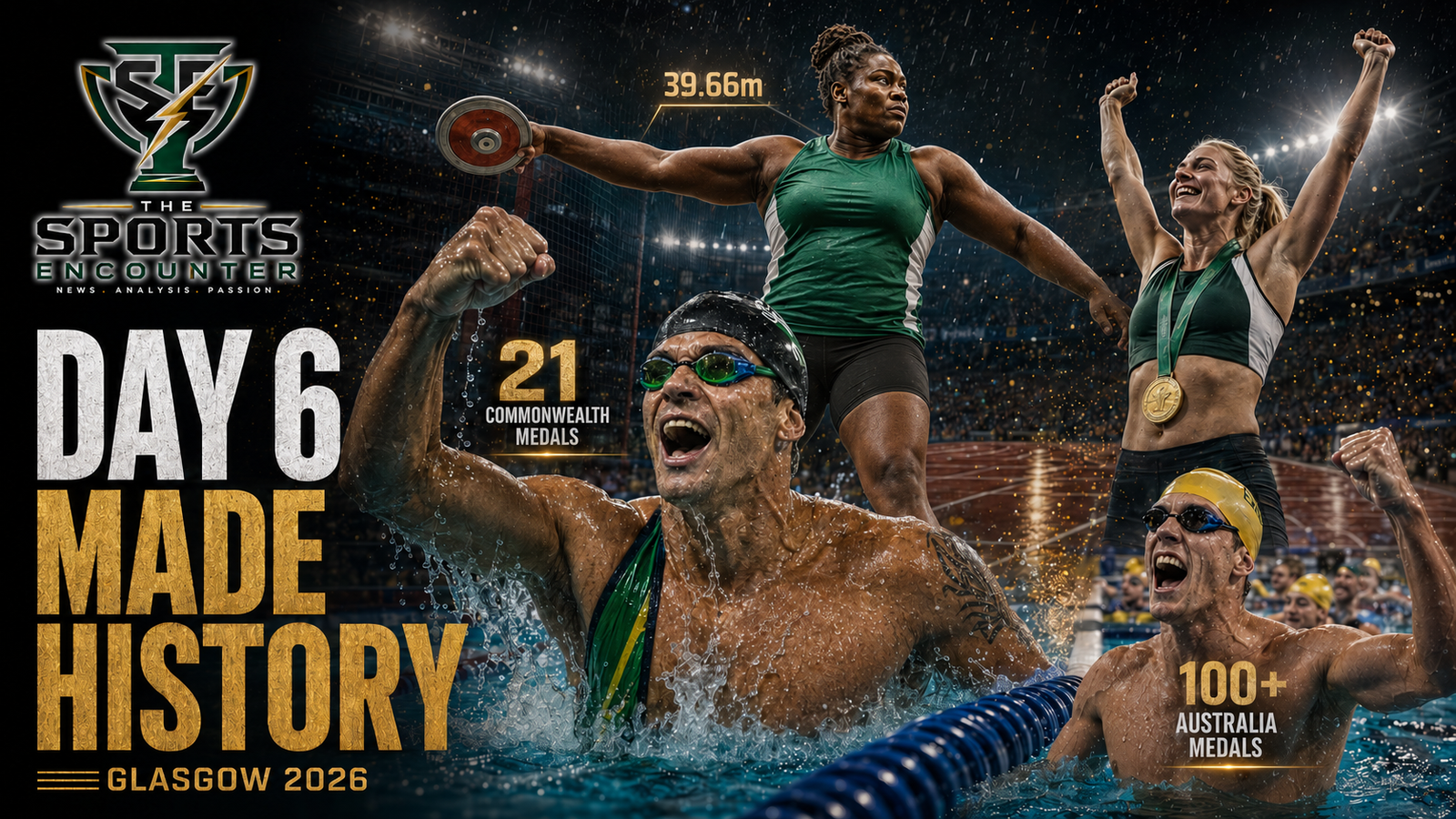
Australia passed 100 medals, Chad le Clos became the most decorated athlete in Commonwealth Games history, Goodness Nwachukwu shattered a world record, and four basketball championships were decided during an extraordinary sixth day of competition at Glasgow 2026.

Day 6 brought the swimming program to a spectacular conclusion at Tollcross, completed the 3×3 basketball tournaments at the SEC Centre, produced major Para athletics performances at Scotstoun Stadium, and extended Australia’s dominance of the overall medal table.

Australia finished the day with 47 gold, 21 silver and 35 bronze medals for a total of 103. Canada remained second on gold medals with 14, while England moved to 12 golds and 56 medals overall. Host nation Scotland strengthened its campaign through home victories and emotional podium finishes.

The raw totals capture Australia’s superiority but cannot explain everything that made the day important.

South Africa’s le Clos moved beyond Emma McKeon to stand alone with 21 career Commonwealth medals. Nigeria’s Nwachukwu improved her own world record by more than three meters. Northern Ireland’s Kate O’Connor completed a commanding heptathlon victory. Samoa and Malaysia added weightlifting titles, while India secured a Para athletics one-two.

England retained the men’s 3×3 basketball title and won women’s wheelchair basketball gold. Australia claimed the women’s able-bodied and men’s wheelchair competitions. Uganda’s Gazelles earned a historic silver medal during their first Commonwealth basketball campaign.

Readers can retrace how the medal race reached this point through The Sports Encounter’s complete Glasgow 2026 Day 5 report.

Glasgow 2026 Day 6 At A Glance

Category Day 6 Highlight Why It Mattered
Leading Nation Australia Passed 100 total medals and ended swimming with 76 medals
Historic Achievement Chad le Clos Became the most decorated Commonwealth Games athlete with 21 medals
Performance Of The Day Goodness Nwachukwu Broke the women’s Para discus world record with 39.66m
Home-Nation Highlight Melanie Woods Won Scotland’s women’s T54 1500m title in a Games record
Multi-Event Champion Kate O’Connor Won Northern Ireland’s first gold of Glasgow 2026 in the heptathlon
Swimming Milestone Australia Finished the meet with 37 gold medals and 76 medals overall
Basketball Breakthrough Uganda Women Won silver during their Commonwealth 3×3 debut
Weightlifting Breakthrough Seine Stowers Delivered Samoa’s first Glasgow 2026 gold
Medal-Table Milestone Australia Reached 103 medals after beginning Day 6 with 80

All 26 Medal Events Decided On Day 6

Sport Event Gold Medalist Leading Result
Swimming Men’s 100m Backstroke Pieter Coetze, South Africa Games record
Swimming Women’s 200m Breaststroke Angharad Evans, Scotland 2:23.79
Swimming Men’s 200m Freestyle Kai Taylor, Australia 1:45.22
Swimming Women’s 50m Freestyle Meg Harris, Australia Australian podium sweep
Swimming Men’s 50m Butterfly Kyle Chalmers and Ben Armbruster, Australia Joint Games record, 22.73
Para Swimming Women’s S9 100m Freestyle Lakeisha Patterson, Australia 1:02.99
Para Swimming Men’s S7 50m Freestyle Australia Final-session gold
Swimming Women’s 200m Butterfly Brittany Castelluzzo, Australia Beat Keanna MacInnes
Swimming Men’s 1500m Freestyle Sam Short, Australia Completed freestyle treble
Swimming Women’s 4x100m Medley Relay Australia 3:54.25
Swimming Men’s 4x100m Medley Relay Australia Games record, 3:28.71
Athletics Women’s Heptathlon Kate O’Connor, Northern Ireland Controlled competition after record javelin
Athletics Men’s Long Jump Tajay Gayle, Jamaica 8.15m
Athletics Women’s Shot Put Sarah Mitton, Canada 19.88m
Athletics Women’s 3000m Steeplechase Faith Cherotich, Kenya Games record
Para Athletics Women’s T54 1500m Melanie Woods, Scotland Games record, 3:33.39
Para Athletics Men’s T47 100m Dilip Mahadu Gavit, India India one-two
Para Athletics Women’s F42-44/F61-64 Discus Goodness Nwachukwu, Nigeria World record, 39.66m
Para Athletics Men’s F42-44/F61-64 Discus Day 6 champion Cross-classification final
Weightlifting Women’s 77kg Seine Stowers, Samoa 237kg total
Weightlifting Men’s 94kg Mohamad Syahmi Nor-Ghazali, Malaysia 347kg total
Weightlifting Women’s 86kg Eileen Cikamatana, Australia 248kg total
3×3 Basketball Men’s Final England Beat Australia 19-17
3×3 Basketball Women’s Final Australia Beat Uganda 21-11
Wheelchair 3×3 Basketball Men’s Final Australia Gold-medal victory
Wheelchair 3×3 Basketball Women’s Final England Beat Scotland 18-10

Chad Le Clos Stands Alone With 21 Commonwealth Medals

The final swimming race delivered the day’s most important career milestone.

South Africa finished third in the men’s 4x100m medley relay behind Australia and England. That bronze gave Chad le Clos his 21st Commonwealth Games medal, moving him beyond Australian swimming great Emma McKeon’s total of 20.

Le Clos had drawn level with McKeon earlier in the meet. His relay bronze placed him alone at the top of the all-time list.

The achievement spans several editions of the Games and reflects unusual durability in a sport where careers can turn quickly. Le Clos has competed against different generations of swimmers, adapted his program as his body changed, and remained valuable enough to contribute to South Africa’s medal-winning relay team.

His record also carries more weight because Commonwealth swimming attracts many of the strongest programs in the world. Australia, England, Canada, Scotland, South Africa and New Zealand regularly bring Olympic and world championship medalists.

Le Clos’ 21st medal did not arrive with another individual victory. The bronze still represented something larger: a career that has remained relevant across changing events, rivals and competitive cycles.

Australia Breaks The Men’s Medley Relay Games Record

Australia won the final race of the swimming program in 3:28.71, setting a Commonwealth Games record. England secured silver, while South Africa’s bronze completed le Clos’ historic collection.

The women’s relay produced another Australian title. The team clocked 3:54.25 to beat Scotland, with South Africa taking bronze.

Those victories completed an unbeaten Australian relay campaign. The country won every men’s, women’s and mixed relay available across freestyle and medley competition.

Relay supremacy demonstrates more than one exceptional athlete. A program requires depth across all four strokes, quality reserves for the heats, reliable exchanges, and enough fitness to survive a congested schedule.

Australia had every component.

Australia Finishes Swimming With 76 Medals

Australia ended the Glasgow swimming program with 37 gold, 16 silver and 23 bronze medals. Its total of 76 was more than three times South Africa’s second-best swimming return of 22.

Day 6 added another series of clean sweeps, records and breakthrough champions.

Meg Harris won the women’s 50m freestyle ahead of Alex Perkins and Shayna Jack, giving Australia all three medals. Harris completed the meet with six golds after succeeding in individual sprints and relays.

Kyle Chalmers and Ben Armbruster touched together in the men’s 50m butterfly at 22.73 seconds. Both received gold medals after matching the Games record, while Cameron McEvoy completed another Australian sweep with bronze.

Chalmers entered the event after losing the 100m freestyle title to younger teammate Flynn Southam. His 50m butterfly success showed that the established star could still respond within a team experiencing a generational shift.

Kai Taylor supplied one of the session’s finest surprises. Swimming from an outside lane, he won the men’s 200m freestyle in 1:45.22. England’s James Guy and Wales’ Matt Richards recorded the same 1:45.72 time behind him.

Taylor’s victory carried a family connection. His mother, Hayley Lewis, won five Commonwealth Games gold medals during her career. The younger Taylor earned his first senior individual international title by trusting his race from lane one and preventing the central favorites from controlling him.

Sam Short won the men’s 1500m freestyle ahead of Northern Ireland Olympic champion Daniel Wiffen and Australian teammate Benjamin Goedemans. The result completed a 400m, 800m and 1500m freestyle treble for Short.

Angharad Evans Gives Scotland A Breaststroke Double

Australia controlled the overall swimming table, but some of Tollcross’ loudest moments belonged to Scotland.

Angharad Evans won the women’s 200m breaststroke in 2:23.79, defeating South Africa’s Kaylene Corbett and Northern Ireland’s Ellie McCartney. The result completed a breaststroke double after Evans had already won the 100m title.

Her complete Glasgow return included two individual gold medals and bronze in Scotland’s mixed medley relay. The Sports Encounter’s profile of Angharad Evans’ second Commonwealth title examines her progression, technical strengths and growing international reputation.

Brittany Castelluzzo restored Australian control in the women’s 200m butterfly. Scotland’s Keanna MacInnes took silver, with Lizzy Dekkers earning bronze for Australia.

South Africa’s Pieter Coetze completed his sweep of the men’s backstroke events by winning the 100m in a Games record. England’s Oliver Morgan claimed silver and South Africa’s Ruard van Renen took bronze.

Lakeisha Patterson led an Australian one-two in the women’s S9 100m freestyle, beating Emily Beecroft. Scotland’s Toni Shaw collected bronze in front of the home crowd.

Why Australia’s Swimming Total Changed The Entire Medal Race

Australia began Day 6 with 35 gold medals and ended it with 47. Much of that movement came from the pool.

The country possessed leading contenders in almost every discipline, but its real advantage emerged through medal density. When Australia missed gold, another Australian frequently took it. When one swimmer won, teammates often filled the remaining podium positions.

This pattern limited the gains available to every rival. England, Scotland, South Africa and Canada could produce world-class performances and still collect only one medal from an event dominated by Australian depth.

The swimming program ended on Day 6, meaning Australia’s rate of accumulation will now slow. Its advantage has already become large enough to survive that transition.
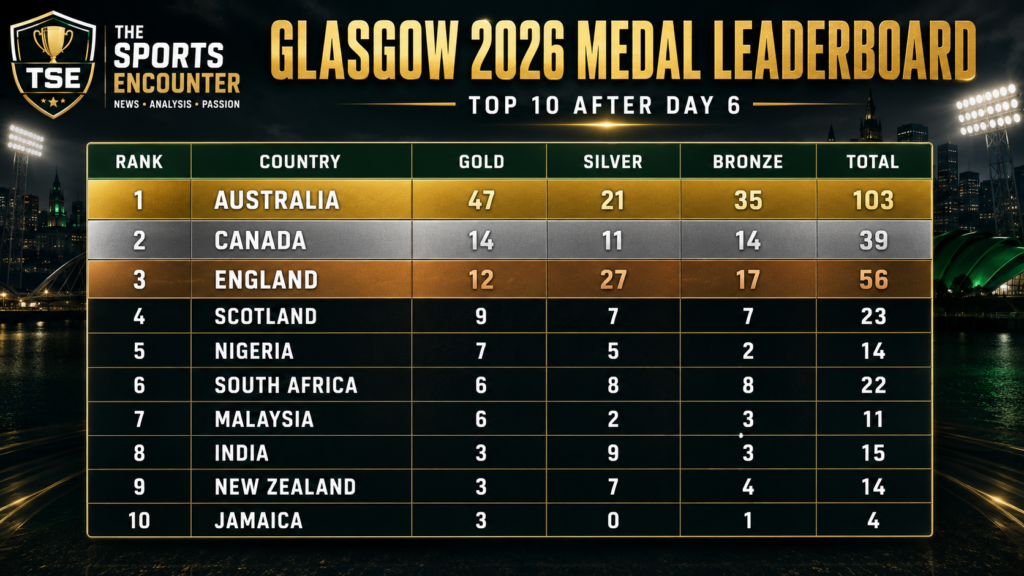
Glasgow 2026 Day 6 medal table showing the top 10 nations, led by Australia, Canada, and England, with each country’s gold, silver, bronze, and total medal count.

Goodness Nwachukwu Smashes Her Own World Record

Nigeria’s Goodness Nwachukwu produced the most statistically significant performance of the day in the women’s F42-44/F61-64 discus final.

Her final throw traveled 39.66m, improving her previous world record by more than three meters. Funmi Oduwaiye of Wales won silver, while Welsh teammate Bree Cronin took bronze.

Nwachukwu entered the competition as the defending Commonwealth champion and world-record holder. Those credentials created a different challenge. She was expected to win, leaving improvement as the main measure of her performance.

The Nigerian responded with the finest throw of her career.

Her world record strengthened Nigeria’s Glasgow campaign and confirmed the value of the integrated Para sport program. The result occupied the same evening session and medal-table space as the long jump, shot put, heptathlon and distance races.

A detailed account of the performance appears in The Sports Encounter’s report on Goodness Nwachukwu’s 39.66m world record.

Kate O’Connor Completes A Commanding Heptathlon Victory

Kate O’Connor delivered Northern Ireland’s first gold medal of Glasgow 2026 by winning the women’s heptathlon.

O’Connor began the second day with a narrow lead over England’s Jade O’Dowda. She then changed the shape of the competition through the long jump and javelin.

An outdoor personal best of 6.37m strengthened her position before she threw 52.85m in the javelin. That effort established a Commonwealth Games heptathlon record and gave her a 258-point advantage before the closing 800m.

The final race became a celebration rather than a desperate defense. O’Connor crossed the line first and secured gold, with O’Dowda taking silver and Australia’s Tori West earning bronze.

Her victory continued an exceptional multi-event sequence. O’Connor had won medals at five consecutive major championships before Glasgow, including world indoor bronze and Commonwealth silver.

The progression from Birmingham runner-up to Glasgow champion showed how effectively she had strengthened the events that once limited her overall total.

Melanie Woods Creates A Home Para Athletics Memory

Scotland’s Melanie Woods won the women’s T54 1500m in a Games-record 3:33.39.

The race was affected by contact and a crash behind the leader. Woods had positioned herself near the front, which kept her clear of the worst trouble and allowed her to maintain momentum.

Canadian Nandini Sharma initially finished second but was disqualified. England’s Ellis Kottas moved to silver, while Australia’s Mikaela Dingley received bronze.

Woods described the crowd’s roar along the back straight as a physical boost. Her victory became one of the clearest examples of home support influencing the emotional shape of a race without changing its competitive demands.

India also enjoyed a major Para athletics result. Dilip Mahadu Gavit won the men’s T47 100m, followed by compatriot Mohammed Basil Morssinganakath. England’s Kevin Santos took bronze.

Tajay Gayle And Faith Cherotich Deliver Major Athletics Titles

Jamaica’s Tajay Gayle won a high-quality men’s long jump final with a season-best 8.15m.

India’s Murali Sreeshankar led during the early rounds after jumping 8.09m. Gayle overtook him in the fourth round, while Scotland’s Stephen Mackenzie secured bronze with 8.08m.

The margins were extremely small. Six centimeters separated gold and silver, with Mackenzie finishing another centimeter behind Sreeshankar.

Gayle’s title added to Jamaica’s growing Glasgow athletics campaign. The former world champion entered the event with greater international pedigree than most of the field, but he still needed a late technical correction after an uneven opening sequence.

Faith Cherotich gave Kenya victory in the women’s 3000m steeplechase with a Games-record performance. Uganda’s Peruth Chemutai challenged through much of the race before England’s Elise Thorner passed her late to take silver. Chemutai finished with bronze.

Canada’s Sarah Mitton controlled the women’s shot put. Her winning throw of 19.88m placed her comfortably ahead of Nigeria’s Jessica Oji and Jamaica’s Lloydricia Cameron.

England And Australia Divide The 3×3 Basketball Titles

Four basketball finals produced two gold medals for England and two for Australia.

England retained the men’s 3×3 title by defeating Australia 19-17. The final remained undecided until the closing possession, with Australia still capable of forcing overtime through a successful two-point shot.

Dwayne Lautier-Ogunleye led England with seven points, while Jamell Anderson contributed a critical late dunk. England completed the tournament without losing and became champion for the second time in as many Commonwealth appearances.

The full tactical story appears in The Sports Encounter’s report on England’s 19-17 victory over Australia.

Scotland defeated New Zealand 18-16 in the bronze-medal game, giving the host nation its first men’s Commonwealth 3×3 medal.

Australia won the women’s final 21-11 against Uganda. Marena Whittle scored 15 points despite Australia entering the game without an available substitute following Emma Clarke’s injury.

Uganda’s silver carried enormous significance. The Gazelles were making their Commonwealth 3×3 debut and reached the final after defeating New Zealand in the semifinal.

The Sports Encounter’s analysis of Australia’s gold and Uganda’s historic silver explains how the final developed and why the result matters for African women’s basketball.

Wheelchair Basketball Adds Two Different Champions

England won the women’s wheelchair 3×3 final by beating Scotland 18-10. Joy Haizelden, Charlotte Moore, Jade Atkin and Lucy Robinson converted their defensive control into a clear victory.

Scotland’s silver still represented a successful home campaign and delivered another medal in front of an invested SEC crowd.

Australia won the men’s wheelchair title, completing its share of the four basketball championships. The split reflected the wider Day 6 pattern: Australia owned the medal volume, while England remained especially effective in high-pressure team finals.

Samoa, Malaysia And Australia Win Weightlifting Gold

Seine Stowers delivered Samoa’s first gold medal of Glasgow 2026 in the women’s 77kg competition.

The 18-year-old completed all six successful lifts and totaled 237kg through a 107kg snatch and 130kg clean and jerk. Both marks established Games records in the new weight category.

England’s Isabella Brown won silver with 229kg, while Wales’ Laura Hughes took bronze with 224kg.

Malaysia’s Mohamad Syahmi Nor-Ghazali won the men’s 94kg title through a dramatic one-kilogram margin. He totaled 347kg after lifting 150kg in the snatch and a Games-record 197kg in the clean and jerk.

Canada’s Alex Bellemarre finished second with 346kg, while Australia’s Oliver Saxton took bronze on 336kg.

Eileen Cikamatana completed Australia’s Day 6 weightlifting success by winning the women’s 86kg class with a 248kg total. England’s Madias Ngake led after a 108kg snatch but finished second with 239kg. Canada’s Rose Beaudoin earned bronze with 230kg.

Ngake’s silver completed one of the Games’ most compelling personal stories. She represented Cameroon at the London 2012 Olympics, left the national setup after facing persecution over her sexuality, spent years away from elite competition, and returned to the sport in Britain.

Boxing Creates New National Milestones

Day 6 boxing did not award gold medals, but its quarterfinals guaranteed a series of podium finishes.

England secured six medals through its successful quarterfinalists. Scotland’s Caitlin Rainey continued her historic campaign by ensuring the host nation would win its first Commonwealth women’s boxing medal.

Jasmine Daunakamakama defeated Sri Lanka’s Keshani Hansika in the women’s 57kg quarterfinal, becoming Fiji’s first female boxer to secure a Commonwealth Games medal.

Those results continued the widening medal story established on Day 5, when Pakistan’s Fatima Zahra became the first woman from her country to guarantee a Commonwealth boxing medal.

The importance of a quarterfinal victory in Commonwealth boxing differs from most sports. With two bronze medals awarded in each division, reaching the semifinal guarantees a place on the podium.

Netball Pool Races Tighten Before The Knockout Stage

Jamaica survived its sternest challenge from host nation Scotland, winning 45-43 after being forced to recover from a difficult start.

Scotland’s performance did not produce a victory, but it showed the progress made since finishing ninth at Birmingham 2022. The hosts matched one of the world’s strongest teams through defensive pressure, disciplined possession and an energized home crowd.

New Zealand defeated Wales 65-37 to retain control of its qualification route. The Silver Ferns gradually separated after Wales competed well during the opening stages.

England faced Tonga, while Australia and South Africa met in the central Pool A contest. The Diamonds were pushed harder than in their earlier victories, with a strong second quarter providing the platform for a 10-goal Australian win.

The result preserved Australia’s unbeaten record and reinforced its status as the tournament favorite. South Africa remained dangerous enough to make the later medal rounds far less predictable.

Glasgow 2026 Medal Table After Day 6

Australia added 23 medals to the 80 it held after Day 5, becoming the first nation to pass 100 at Glasgow 2026.

Rank Nation Gold Silver Bronze Total
1 Australia 47 21 35 103
2 Canada 14 11 14 39
3 England 12 27 17 56
4 Scotland 9 7 7 23
5 Nigeria 7 5 2 14
6 South Africa 6 8 8 22
7 Malaysia 6 2 3 11
8 India 3 9 3 15
9 New Zealand 3 7 4 14
10 Jamaica 3 0 1 4

Medal standings are ordered by gold medals, followed by silver and bronze. Canada therefore remained second despite England possessing 17 more medals overall.

Australia began the previous day with 35 golds and 80 total medals. Its Day 6 surge increased those numbers to 47 and 103, respectively.

The change from the Glasgow 2026 Day 4 standings, when Australia held 26 golds and 59 medals, demonstrates how rapidly swimming and the early athletics program transformed the competition.

Official schedules, complete results, medal standings and subsequent updates are available through the official Glasgow 2026 results platform.

What Day 6 Revealed About The Medal Race

Australia has effectively removed suspense from the contest for first place.

The more competitive questions concern the order behind it, the ability of smaller nations to convert limited opportunities into gold, and whether Scotland can remain inside the leading group after swimming ends.

Canada has built an efficient campaign through gymnastics, weightlifting, swimming and field events. England has greater overall depth but continues to collect more silver and bronze medals than golds.

Scotland’s nine titles represent a strong return for the host nation. The team has produced home champions in swimming, Para swimming, athletics and bowls while adding important team medals in basketball.

Nigeria and Malaysia remain among the most efficient delegations. Their medal totals are smaller than those of England, Canada, Scotland or South Africa, but weightlifting and Para sport have given both countries a high gold conversion rate.

Swimming accounted for 76 of Australia’s 103 medals. The end of that program changes the daily balance, although track cycling now gives Australia another traditionally strong discipline.

Fans can follow every daily report and athlete feature through The Sports Encounter’s Glasgow 2026 coverage hub.

Final Verdict: Records Gave Day 6 Its Identity

Australia owned the numbers again. Its swimmers finished with 76 medals, the national team passed 100 overall, and the gold total reached 47.

Day 6 will still be remembered through individual records and national breakthroughs.

Chad le Clos became the most decorated athlete in Commonwealth Games history. Goodness Nwachukwu extended the limits of her Para athletics classification. Kate O’Connor moved from Birmingham silver to Glasgow gold. Melanie Woods gave the home crowd another performance to keep.

England defended the men’s 3×3 basketball title, while Uganda’s Gazelles turned a debut campaign into a silver medal. Samoa found its first Glasgow champion through an 18-year-old weightlifter. Fiji entered a new chapter in women’s boxing.

The medal table showed a dominant nation extending its lead. The competition itself showed something broader.

A compact Commonwealth Games can still create space for established stars, new champions, smaller delegations and Para athletes to share the same stage without becoming secondary stories.

Day 6 offered the clearest evidence yet.

Frequently Asked Questions About Glasgow 2026 Day 6

Who Led The Glasgow 2026 Medal Table After Day 6?

Australia led the medal table with 47 gold, 21 silver and 35 bronze medals. Its overall total reached 103.

What Happened On Day 6 Of The Commonwealth Games 2026?

Day 6 included 26 medal events across swimming, Para swimming, athletics, Para athletics, weightlifting, 3×3 basketball and wheelchair 3×3 basketball. Boxing and netball also continued with quarterfinal and pool-stage competition.

Who Became The Most Decorated Commonwealth Games Athlete?

South African swimmer Chad le Clos became the most decorated athlete in Commonwealth Games history after winning his 21st career medal in the men’s 4x100m medley relay.

How Many Medals Did Australia Win In Swimming At Glasgow 2026?

Australia completed the swimming and Para swimming program with 76 medals: 37 gold, 16 silver and 23 bronze.

What World Record Was Broken On Glasgow 2026 Day 6?

Nigeria’s Goodness Nwachukwu set a women’s F42 discus world record of 39.66m in the combined F42-44/F61-64 final.

Who Won The Glasgow 2026 Women’s Heptathlon?

Kate O’Connor won the heptathlon for Northern Ireland. England’s Jade O’Dowda took silver and Australia’s Tori West earned bronze.

Who Won The Men’s 3×3 Basketball Gold Medal?

England defeated Australia 19-17 to retain the Commonwealth Games men’s 3×3 basketball title.

Who Won The Women’s 3×3 Basketball Final?

Australia defeated Uganda 21-11. Marena Whittle scored 15 points for the champions, while Uganda earned a historic silver medal.

Who Won The Glasgow 2026 Men’s Long Jump?

Jamaica’s Tajay Gayle won gold with a jump of 8.15m. India’s Murali Sreeshankar took silver with 8.09m, and Scotland’s Stephen Mackenzie won bronze with 8.08m.

Who Won The Women’s 200m Breaststroke At Glasgow 2026?

Scotland’s Angharad Evans won in 2:23.79, completing a Glasgow breaststroke double after also winning the 100m event.

How Many Gold Medals Did Meg Harris Win At Glasgow 2026?

Meg Harris completed the swimming meet with six gold medals, including the women’s 50m and 100m freestyle titles and several relay victories.

Who Won The Men’s 1500m Freestyle?

Australia’s Sam Short won gold ahead of Northern Ireland’s Daniel Wiffen and Australian teammate Benjamin Goedemans. Short completed a 400m, 800m and 1500m freestyle treble.

Which Country Was Second In The Medal Table After Day 6?

Canada ranked second with 14 gold medals. England had more medals overall but ranked third because it had won 12 golds.

When Did Australia Pass 100 Medals At Glasgow 2026?

Australia passed 100 total medals during Day 6. It finished the day with 103 medals.

Where Can Fans Find The Official Glasgow 2026 Results?

Fans can find live schedules, event results and medal standings on the official Glasgow 2026 results platform.

What Sports Were Still To Come After Day 6?

Track cycling and Para track cycling were due to begin on the following competition day. Athletics, boxing, bowls, netball, weightlifting and later judo events also remained on the Glasgow 2026 program.


Editorial Note: Medal totals, competition results, race times, lifting totals, basketball scores and record information were checked against official Glasgow 2026 results, Commonwealth Sport reporting, World Athletics data, International Weightlifting Federation coverage and authoritative event reports available after the completion of Day 6.

The Sports Encounter’s Glasgow 2026 coverage focuses on verified results, tactical analysis, athlete stories, medal-table movement and the performances shaping Commonwealth sporting history.

Elma Victors is a London-based accounting professional and sports writer with a strong interest in tennis, soccer, cricket, and major international competitions. Her analytical background shapes a detail-oriented approach to sports coverage, helping her examine performances, statistics, trends, and the human stories behind important sporting events.

Cricket

Can Pakistan Bounce Back in the 2nd West Indies Test? What Will It Take?

Pakistan’s bowlers created a realistic path to victory in Tarouba, but another batting collapse handed West Indies a 90-run win. Can Babar Azam’s side recover at Queen’s Park Oval, or are the hosts too strong in Caribbean conditions?

Jawad Hussain | The Sports Encounter

Published

on

Babar Azam portrayed as a determined captain steering Pakistan’s cricket fleet through turbulent waters, with the words “Captain Into the Storm” and The Sports Encounter logo.

Pakistan can level the Test series against West Indies. Their bowlers have already proved that they can take 20 wickets in Caribbean conditions, while Babar Azam showed enough control during his unbeaten 58 to suggest that the home attack can be resisted.

The evidence also explains why Pakistan cannot enter the second Test as favorites.

West Indies won the opening match by 90 runs after scoring 311 and 181. Pakistan replied with 282 before collapsing to 120 while chasing 211. The visitors competed for long periods, produced the first centurion at the Brian Lara Cricket Academy, dismissed the hosts twice and still lost with considerable distance between the teams.

That contradiction captures Pakistan’s current Test problem. Strong individual performances rarely connect for long enough to produce victory.

Pakistan’s collective batting average since July 28, 2024, falls from 30.93 in first innings to 19.90 in second innings. No other World Test Championship side in the available comparison suffered a decline as large as Pakistan’s 11.03 runs.

The final Test begins at Queen’s Park Oval in Port of Spain on August 2. The historic venue offers Pakistan a different surface, a long and complicated connection with this rivalry, and one last opportunity to avoid their first Test-series defeat against West Indies since 2000.

West Indies need only a draw to win the series. Pakistan must win.

That difference will shape every selection call, toss decision, field setting, partnership and session.

Readers can follow the complete tour through The Sports Encounter’s cricket news and analysis hub.

West Indies vs Pakistan 2nd Test At A Glance

Detail Information
Match West Indies vs Pakistan, 2nd Test
Dates August 2–6, 2026
Venue Queen’s Park Oval, Port of Spain, Trinidad
Series Position West Indies lead 1-0
Pakistan Captain Babar Azam
West Indies Captain Roston Chase
Pakistan’s Requirement Must win to draw the series
West Indies’ Requirement A win or draw secures the series
First Test Result West Indies won by 90 runs
WTC Context Pakistan entered the Test at the bottom of the current standings

The Pakistan Cricket Board’s official series schedule confirms that the second Test will run from August 2 to 6 at Queen’s Park Oval.

Cricket West Indies named a 15-member squad led by Roston Chase, with Jomel Warrican as vice-captain. Alzarri Joseph was unavailable for selection because of personal reasons.

Can Pakistan Really Bounce Back?

Yes, but the route is narrow.

Pakistan do not need to discover a new bowling attack. Mohammad Abbas, Mohammad Ali, Khurram Shahzad and Aamer Jamal took all 20 West Indies wickets in the first Test. Abbas claimed eight in the match, including 5 for 22 in the second innings. Mohammad Ali collected 4 for 50 in the first.

Those performances reduced West Indies to 181 in their second innings and left Pakistan with a target of 211. A competent batting performance could have won the Test.

The required transformation concerns how Pakistan bat after losing a wicket, how they manage the first 25 overs, and whether their established players can build around Babar rather than leave him with the tail.

Pakistan have already recovered from losing the first Test of a Caribbean series. In 2021, they suffered a painful one-wicket defeat at Sabina Park before winning the second Test by 109 runs. Shaheen Shah Afridi took 10 wickets in the match as Pakistan squared the series 1-1.

That precedent matters because it proves that momentum in a two-Test series can change quickly. It offers inspiration rather than a tactical blueprint, however. The current side does not have Shaheen in the squad and must solve a more severe batting problem.

The first Test showed that Pakistan possess enough bowling skill to compete. The second will reveal whether the batting group has enough honesty and discipline to change its method within five days.

How Pakistan Lost A Test They Could Have Won

The scorecard explains the result, but the sequence explains the failure.

Innings Score Leading Performance What It Changed
West Indies First Innings 311 Shai Hope 92 Established a competitive total
Pakistan First Innings 282 Shan Masood 109 Conceded a 29-run deficit after reaching 244/4
West Indies Second Innings 181 Shamar Joseph 38 Raised the target to 211
Pakistan Second Innings 120 Babar Azam 58 not out Lost by 90 runs

Pakistan reached 244 for 4 in their first innings. Shan Masood had completed a determined century, while the deficit had almost disappeared. The visitors were one partnership away from controlling the match.

Justin Greaves then removed five batters during five consecutive wicket-maiden overs. Pakistan slipped from 244 for 4 to 259 for 8 and eventually finished on 282.

Greaves took 5 for 27 from 11 overs. His spell converted a possible Pakistan lead into a 29-run West Indies advantage. It also gave the hosts proof that Pakistan’s lower middle order could be removed through patience rather than extreme pace.

The Sports Encounter’s Day 3 analysis of Greaves’ five-wicket spell explains how Pakistan surrendered control after Masood had created their strongest position.

Pakistan’s bowlers responded. Abbas led a sustained fightback that reduced West Indies to 93 for 7. Yet Shamar Joseph attacked Aamer Jamal for 38 from 27 balls and added 61 with Kemar Roach.

Those lower-order runs carried the hosts to 181. The target moved from manageable to psychologically difficult.

Pakistan then lost three wickets for 25. Six were gone with only 53 on the board. By the time the score reached 71, nine batters had been dismissed.

Babar remained unbeaten on 58. Abbas made 23 and helped him add 49 for the final wicket. No other Pakistan batter reached 12.

The complete collapse is covered in The Sports Encounter’s first-Test match report.

Pakistan’s Second-Innings Crisis Is Now Measurable

The concern extends beyond Tarouba.

Since July 28, 2024, Pakistan’s batting average has fallen from 30.93 in first innings to 19.90 in second innings. Their 11.03-run decline is the largest among the World Test Championship teams included in the supplied data.

A pattern this broad cannot be attributed to one pitch or one bowler. Pakistan repeatedly lose structure when a match becomes older, the surface becomes less predictable, and the scoreboard begins to carry greater consequence.

Pakistan Batter Matches First-Innings Average Second-Innings Average Difference
Imam-ul-Haq 4 54.50 3.50 -51.00
Azan Awais 3 38.66 13.00 -25.66
Saud Shakeel 13 44.69 21.16 -23.53
Saim Ayub 7 38.00 17.16 -20.84
Mohammad Rizwan 14 49.00 26.92 -22.08
Shan Masood 14 42.14 30.53 -11.61
Abdullah Shafique 7 26.28 16.00 -10.28
Salman Ali Agha 14 38.00 31.66 -6.34
Aamer Jamal 6 17.33 27.00 +9.67
Babar Azam 11 23.81 40.20 +16.39

Imam-ul-Haq Must Change His Second-Innings Record

Imam’s difference is the most alarming. His first-innings average of 54.50 falls to 3.50 in second innings across the period shown.

That gap becomes even more important if Shan Masood cannot recover from his fractured finger. Pakistan may need Imam to become the senior opener and absorb the new ball beside a less experienced partner.

He does not need to score at a high rate. He must leave accurately, remain balanced against deliveries entering his pads, and avoid following the ball when Seales moves it away.

Saud Shakeel’s Absence Has Removed A Natural Stabilizer

Saud Shakeel’s second-innings average also falls sharply, from 44.69 to 21.16. Pakistan would still value his method against spin and his ability to occupy the crease, but he was unavailable for the West Indies tour because of fitness concerns.

His absence has pushed additional responsibility toward Salman Ali Agha, Rizwan and inexperienced middle-order options. That burden became obvious when Pakistan lost early wickets in Tarouba.

Mohammad Rizwan Must Bat Beyond The Rescue Phase

Rizwan averages 49.00 in first innings during the period but 26.92 in second innings. His dismissal for 11 during the chase left Babar without the established partner most capable of turning survival into a working partnership.

Pakistan often ask Rizwan to repair damage while keeping wicket for long periods. The physical load is real. So is his responsibility as one of the team’s most experienced batters.

A useful 25 will not be enough in Port of Spain. Pakistan need Rizwan to spend a full session with Babar, Salman or Masood and take the match beyond the first burst from the West Indies quicks.

Babar Azam Is The Important Exception

Babar’s second-innings average of 40.20 is substantially higher than his first-innings figure of 23.81. His unbeaten 58 confirmed that he remains Pakistan’s best option when the match becomes tense.

The innings was technically controlled. He left well outside off stump, defended close to his body and waited for scoring opportunities. His problem was isolation.

Pakistan cannot design another chase around Babar surviving while everyone else disappears. They need a second batter to remain with him for at least 25 overs.

For deeper context on his career and importance to the national team, read The Sports Encounter’s assessment of Babar Azam’s place among Pakistan’s finest batters.

Aamer Jamal’s Improvement Carries An Uncomfortable Message

Aamer Jamal is the other player whose second-innings average improves. His rise from 17.33 to 27.00 illustrates his lower-order value.

It also shows how often Pakistan’s recognized batters leave restoration work to an all-rounder and the tail. Jamal should strengthen the innings. He should not repeatedly be asked to rebuild it.

Why Pakistan Keep Losing Wickets In Clusters

Pakistan’s collapses tend to begin with one technically valid dismissal and continue through several avoidable ones.

A batter falls to a high-quality delivery. The replacement arrives with an urgent desire to score, becomes trapped on the crease, or plays at a ball that could have been left. The next player then enters under greater pressure. Within half an hour, a manageable problem becomes a crisis.

There are four recurring causes.

  • Poor emotional reset: New batters appear to inherit the anxiety of the previous dismissal.
  • Uncertain off-stump judgment: Pakistan’s right-handers frequently play at deliveries that are moving away.
  • Limited strike rotation: Dot-ball pressure allows the bowler to repeat the same plan without adjustment.
  • No collapse-control partnership: One batter may survive, but the player at the other end often attempts to change the match too quickly.

West Indies recognized this vulnerability. Greaves maintained a full length and attacked the stumps after observing how Abbas had bowled. Seales then repeated a disciplined line during the chase, taking 5 for 20 from 14.2 overs.

Pakistan should study the process rather than treat the dismissals as an inexplicable bad day. West Indies learned from Pakistan’s best bowler and applied the lesson more effectively against Pakistan’s batters.

How Pakistan Should Bat In Port Of Spain

Pakistan’s second-Test batting plan needs measurable checkpoints.

Phase Pakistan’s Target Why It Matters
First 10 Overs Lose no more than one wicket Prevents Seales and Roach from attacking new batters together
First Session Reach at least 70 with three or fewer wickets lost Removes the immediate threat of another collapse
First Innings Score 350 or more Creates room for the bowlers and reduces fourth-innings pressure
Partnership Standard Two stands of at least 75 runs Pakistan cannot depend on one century beside repeated failures
Lower-Order Contribution At least 60 runs from Nos. 7–11 West Indies gained a decisive advantage through Joseph and Roach
Second Innings Keep five wickets intact beyond 100 Allows Babar, Rizwan or Salman to manage the match

These are demanding targets, but Pakistan’s problem cannot be repaired through vague promises about “better intent.” The team needs a practical batting contract.

Early restraint should come before expansion. Boundaries will arrive when the bowlers tire and the ball softens. Chasing them before that point would serve West Indies.

What Makes The West Indies Pace Attack So Dangerous?

Jayden Seales Has Become The Main Strike Bowler

Seales’ 5 for 20 ended the first Test. His value came from control rather than spectacle.

He challenged the outside edge, brought lbw and bowled dismissals into play, and gave Pakistan few release deliveries. Six maidens in 14.2 overs ensured that the batters could not wait passively without feeling the scoreboard tighten around them.

Pakistan must force Seales to change his length. Soft hands, careful leaves and controlled scoring behind square can disrupt his preferred pattern. Driving on the rise would invite another collapse.

Justin Greaves Gives West Indies Tactical Flexibility

Greaves entered the match as an all-round option and finished as Player of the Match. His first-innings 5 for 27 and two second-innings wickets gave West Indies a bowler who could attack without weakening the batting order.

His historic sequence of five consecutive wicket-maiden overs exposed Pakistan’s inability to interrupt a bowler’s rhythm. Even a few singles could have changed the field and forced Greaves to reset.

Kemar Roach Still Controls The Difficult Overs

Roach’s role cannot be measured only through wickets. His experience allows the younger bowlers to attack from the other end.

He understands Caribbean surfaces, alters his angle without losing control and recognizes when a batter has stopped looking for runs. Imam’s early dismissal in the chase showed that Roach can still remove top-order players before they settle.

Shamar Joseph Can Change A Match With Bat And Ball

Joseph claimed one wicket during Pakistan’s collapse, but his 38 from 27 balls proved equally important. Four sixes turned a vulnerable West Indies position into a target that carried serious fourth-innings pressure.

Pakistan must plan for him as a lower-order aggressor. Their short-ball execution was poor in Tarouba, especially when Jamal allowed him to free his arms.

Jomel Warrican May Become More Influential

All 40 wickets in the first Test fell to fast bowlers. Queen’s Park Oval could bring Warrican into a much larger role, particularly if the surface dries and slows.

Pakistan have recent experience of his threat. During the 2025 series in Multan, the left-arm spinner took 19 wickets as West Indies recovered from losing the first Test to win the second by 120 runs.

That result should end any assumption that West Indies depend entirely on pace. The attack can change its method according to the surface.

Pakistan’s Bowlers Have Already Done Enough To Create Belief

Mohammad Abbas was Pakistan’s most complete performer in Tarouba.

He took 8 for 85 across the match, including 5 for 22 in the second innings, and then made 23 as the No. 11 batter during a 49-run stand with Babar. His accuracy repeatedly forced West Indies to defend.

Abbas remains particularly effective when the surface provides even minor seam movement. Queen’s Park Oval may offer him help early, although Pakistan must manage his workload if the pitch becomes slower.

Mohammad Ali supported him with 4 for 50 in the first innings. Khurram Shahzad supplied energy and movement, while Jamal offered a different angle and greater pace.

The attack’s next challenge involves finishing the innings. West Indies were 93 for 7 before Joseph and Roach added 61. Pakistan allowed a vulnerable total to grow into a winning one.

Removing the top order is only part of taking 20 wickets. Elite Test attacks also deny the lower order enough freedom to reshape the target.

The ICC Sanctions Make Discipline More Important

Abbas and Khurram Shahzad were sanctioned for Level 1 breaches of the ICC Code of Conduct following wicket celebrations during the opening Test. Khurram received a fine and a demerit point, while Abbas was officially reprimanded.

The offences do not remove either player from the second Test, but they offer a warning. Pakistan cannot afford unnecessary confrontations, penalties or emotional distractions in a match they must win.

Aggression should remain in the line, length and fielding intensity.

Shan Masood’s Injury Creates A Structural Problem

Masood made 109 from 184 balls in the first innings and became the first Test centurion at the Brian Lara Cricket Academy. His 155-run partnership with Imam restored Pakistan after an early wicket.

A fractured finger then prevented him from opening during the chase. He eventually entered at No. 8 and made three after Pakistan had fallen to 53 for 6.

His possible absence in Port of Spain creates three problems.

  1. Pakistan may lose the batter who adjusted best to the pace attack.
  2. Imam could be paired with another inexperienced opener.
  3. Babar may have to enter against a relatively new ball again.

Pakistan should select a replacement according to role rather than reputation. If Masood cannot play, the new opener must possess a reliable leave and the patience to face 100 balls. Adding an aggressive batter because the team wants “intent” would misunderstand the first Test.

Updates on the touring group and its original composition are available through the PCB’s official squad announcement.

Babar Azam Faces His First Major Test Since Returning As Captain

Babar’s unbeaten 58 strengthened his position as a batter. The result increased the pressure on him as captain.

His second stint began with a match in which Pakistan competed well but failed during the decisive passages. That description sounds uncomfortably similar to several defeats under Shan Masood.

Babar now has to show that the leadership change can alter how Pakistan respond when a match begins to turn.

His primary captaincy tasks include:

  • Using Abbas in short, attacking spells before the ball loses its hardness.
  • Keeping catchers in place when West Indies’ lower order arrives.
  • Giving Jamal protection without becoming immediately defensive.
  • Using spin earlier if the Queen’s Park Oval surface begins to grip.
  • Preventing over-rate problems and avoidable disciplinary incidents.
  • Creating a clear role for each batter if Masood is unavailable.

The broader leadership background is explored in The Sports Encounter’s article on Babar Azam’s return as Pakistan Test captain.

Babar does not need a theatrical response. He needs a controlled team performance in which Pakistan’s strongest periods connect across several sessions.

Why Queen’s Park Oval Changes The Contest

The Brian Lara Cricket Academy was hosting its first men’s Test. Queen’s Park Oval carries more than a century of international history.

The Port of Spain venue has staged more than 60 Tests and produced everything from batting records to collapses. Its historical first-innings average sits around 305, while the average fourth-innings total is much lower, approximately 167.

That decline tells Pakistan what matters most. Runs become harder to score as the match develops.

The surface can provide seam movement early, especially with cloud cover or moisture. As it dries, the pace often slows and the ball can grip. Uneven bounce may become a factor later.

Another fourth-innings target above 200 would therefore be dangerous. Pakistan should aim to bat first, score beyond 350 and create a lead large enough to attack West Indies before the pitch deteriorates.

Why The Toss Could Shape The Match

If the pitch appears dry, batting first should be the preferred option. The risk of early movement would be outweighed by the danger of batting last.

A greener surface or heavy morning moisture could complicate the decision. Babar must distinguish between temporary assistance and conditions likely to affect the entire match.

Winning the toss will not guarantee victory. Misreading the surface could make Pakistan’s task substantially harder.

Pace Early And Spin Later

Pakistan selected left-arm spinner Ali Usman in the first Test, but he remained wicketless on a surface dominated by seam. Queen’s Park Oval may offer him a clearer role.

Jomel Warrican’s importance should also increase. His accuracy and ability to attack right-handers’ pads could become particularly dangerous once footmarks develop.

Sajid Khan offers Pakistan a more experienced alternative if the surface looks likely to favor turn. The decision should follow the pitch rather than a desire to react dramatically to the first-Test defeat.

Weather And Outfield Conditions Must Be Monitored

Port of Spain weather can interrupt play, while Queen’s Park Oval has experienced drainage and outfield concerns during previous international matches.

Rain would change the strategic equation. West Indies could become more conservative because a draw wins the series. Pakistan might need to score faster or declare earlier to preserve enough time for 20 wickets.

Any final match preview should update the forecast, pitch report and confirmed playing elevens immediately before publication.

Pakistani Test batters in white kits stand in a circle on the cricket ground, joining their bats in a team vow beneath the words “A Vow to Fight Back,” with The Sports Encounter logo.

Pakistan’s Test History At Queen’s Park Oval

Pakistan have experienced victory, defeat and survival at the venue.

Year Match Context Result Historical Meaning
1958 Second Test West Indies won by 120 runs Pakistan fell short in a demanding chase
1958 Fifth Test Pakistan won by an innings and one run Wazir Mohammad scored 189
1977 Second Test West Indies won by six wickets Colin Croft took eight wickets in Pakistan’s first innings
1977 Fourth Test Pakistan won by 266 runs One of Pakistan’s finest Caribbean victories
1988 Second Test Drawn Pakistan finished 341/9 while chasing 372
1993 First Test West Indies won by 204 runs Pakistan were dismissed for 140 and 165

The 1958 Victory Remains A Powerful Reference

Pakistan lost their first Test at Queen’s Park Oval in February 1958 by 120 runs. They returned to the same venue in March and won by an innings and one run.

West Indies made 268. Pakistan replied with 496, led by Wazir Mohammad’s 189. Fazal Mahmood and Nasim-ul-Ghani then took six wickets apiece across the two West Indies innings.

The Cricket West Indies archive of Pakistan’s 1957-58 tour preserves the results from that foundational series.

The lesson remains relevant. Losing once at a venue or during a tour does not make the next result inevitable.

Pakistan’s 266-Run Win In 1977

Pakistan’s largest and most authoritative Queen’s Park Oval victory came during the 1977 series.

They scored 341 and 301 for 9 declared before dismissing West Indies for 154 and 222. The 266-run margin represented a complete performance against an opponent moving toward an era of global dominance.

Pakistan did not win the five-Test series, but the result showed that patience, substantial first-innings runs and sustained bowling pressure could overcome West Indies in Port of Spain.

The 1988 Draw Nearly Became An Historic Chase

West Indies set Pakistan 372 in the second Test of the 1988 series. Pakistan reached 341 for 9 and finished only 31 runs short with one wicket remaining.

Imran Khan took five wickets in the match as Pakistan remained competitive against a team that had dominated world cricket for years.

The larger meaning of that era appears in The Sports Encounter’s feature on Imran Khan’s extraordinary all-round influence during the 1980s.

Pakistan’s current batters should notice the method behind that 341 for 9. The chase survived because partnerships kept the innings alive. Individual resistance did not remain isolated.

Pakistan vs West Indies Test Rivalry By The Numbers

After the first Test of the current series, Pakistan and West Indies have met 57 times in Test cricket. Pakistan lead the overall head-to-head record with 22 victories, while West Indies have 20. Fifteen matches have ended in draws.

Category Pakistan West Indies
Tests Played 57
Wins 22 20
Draws 15
First Test Series Meeting 1957-58 in the West Indies
Most Recent Series Win In The Caribbean 2017 2000
Current Series Position Trailing 0-1 Leading 1-0

The overall record gives Pakistan a narrow historical advantage. The Caribbean record tells a more difficult story.

Pakistan have won only one complete Test series in the West Indies. That breakthrough arrived in 2017 under Misbah-ul-Haq. West Indies can now secure their first series victory over Pakistan since 2000.

The 1958 Series Created Two Immortal Innings

Pakistan’s first Caribbean tour produced two performances that remain central to Test history.

Hanif Mohammad batted for 970 minutes while scoring 337 at Bridgetown. Pakistan had been forced to follow on after making 106 in response to West Indies’ 579 for 9 declared. Hanif’s innings carried Pakistan to 657 for 8 and saved the match.

It remains one of cricket’s greatest displays of concentration.

Later in the series, Garry Sobers scored 365 not out at Sabina Park. It became the highest individual Test score at the time and remained the world record for more than 36 years.

The two innings represented different forms of greatness. Sobers expanded what an individual batter could achieve. Hanif showed how one player could absorb pressure long enough to rescue an entire team.

What Hanif Mohammad’s 337 Can Teach Pakistan

Modern cricket moves faster, but the principles behind Hanif’s innings remain valid.

  • Understand the match situation before choosing a scoring method.
  • Accept long periods without boundaries.
  • Make the bowler repeat a good delivery rather than offering a wicket.
  • Build survival through partnerships.
  • Treat time at the crease as a form of pressure on the opposition.

Pakistan do not need another 970-minute innings. They need batters willing to survive the first two hours without becoming impatient.

The 1977 And 1988 Tours Show Pakistan Can Challenge Caribbean Power

The 1977 series ended 2-1 to West Indies, with two draws, but Pakistan repeatedly competed with a side moving toward its most powerful era.

Majid Khan, Zaheer Abbas, Mushtaq Mohammad, Wasim Raja, Imran Khan and Sarfraz Nawaz gave Pakistan enough skill and character to extend the hosts across five Tests.

The 1988 tour carried even greater historical significance.

Pakistan won the first Test at Georgetown by nine wickets. West Indies recovered to win the third by two wickets, leaving the series tied 1-1. It was the closest any touring team came during that period to defeating the dominant West Indies in their own conditions.

Imran took 23 wickets at an average of 18.08. His performance combined pace, control, reverse swing and leadership against one of history’s strongest batting groups.

The current Pakistan team does not possess that level of proven greatness. It can still borrow the mindset: Caribbean conditions deserve respect, not surrender.

The Heartbreak Of Antigua In 2000

West Indies’ most recent Test-series victory over Pakistan came in 2000.

The first two Tests were drawn, leaving Antigua to decide the series. Pakistan set West Indies 216. The hosts slipped to 197 for 9 before Courtney Walsh and Jimmy Adams completed a one-wicket victory.

The ending remains controversial among Pakistan supporters because of disputed umpiring decisions, but the official result has stood for more than a quarter of a century.

West Indies can now end that 26-year wait without winning the second Test. A draw at Queen’s Park Oval would be enough.

That gives Roston Chase several strategic advantages. He can delay declarations, protect a lead and allow the match to lose time if rain intervenes. Babar does not have the same freedom.

Pakistan’s 2017 Breakthrough And The 2021 Recovery

Misbah’s Team Finally Won A Caribbean Series

Pakistan’s first Test-series victory in the West Indies arrived in 2017.

They won the opener at Sabina Park, lost the second at Bridgetown and reached the final day of the deciding Test in Dominica still needing wickets.

Yasir Shah dismissed Shannon Gabriel with only seven balls remaining. Pakistan won by 101 runs and took the series 2-1, giving Misbah-ul-Haq and Younis Khan a memorable farewell.

The victory rested on first-innings runs, patient bowling and the ability to remain composed as the final day moved toward a draw.

The 2021 Team Recovered From A Worse Emotional Defeat

Pakistan lost the opening Test of the 2021 series by one wicket. The defeat could easily have broken the touring side.

Instead, Pakistan scored 302 for 9 declared in the second Test, bowled West Indies out for 150, and eventually won by 109 runs. Shaheen took 6 for 51 and 4 for 43.

Cricket West Indies’ official 2021 match report records how Pakistan responded to square the series.

The current side faces the same mathematical task. It must win the final Test to finish level.

The difference is that Pakistan entered the 2021 second Test with a settled strike bowler operating near his peak. In 2026, the attack is collective, while the batting weakness is more deeply established.

The 2025 Multan Series Is West Indies’ Counterargument

Pakistan supporters can point toward 2021. West Indies can answer with 2025.

West Indies lost the first Test in Multan after Pakistan’s spinners controlled a heavily turning surface. The visitors adapted quickly and won the second by 120 runs.

Jomel Warrican finished the series with 19 wickets. His control exposed Pakistan’s technical and psychological problems against sustained spin.

The result matters because it shows that this West Indies group can learn during a short series. Greaves’ use of Abbas’ fuller length in Tarouba offered another example of that adaptability.

West Indies may lack the intimidating reputation of their predecessors, but they have already beaten Pakistan through pace, seam and spin across the last two series.

The hosts are dangerous because they do not need one particular type of surface.

Are West Indies Too Good For Pakistan In Their Backyard?

No. West Indies are better positioned, but the historical evidence does not make them unbeatable.

Pakistan have won Caribbean Tests in 1958, 1977, 1988, 2005, 2011, 2017 and 2021. The visitors have repeatedly found ways to compete through disciplined pace bowling, quality spin and patient top-order batting.

The current West Indies side also carries weaknesses.

  • Its top order was reduced to 93 for 7 in the second innings at Tarouba.
  • No batter scored a century in the opening Test.
  • The team relied on Joseph and Roach to stretch its lead.
  • Alzarri Joseph is unavailable.
  • A substantial Pakistan first-innings total could place a developing batting unit under pressure.

West Indies have the confidence, conditions and series advantage. Pakistan still have the bowling quality to expose them.

The Sports Encounter’s earlier West Indies vs Pakistan series preview examined why both teams entered the contest with significant red-ball questions.

The first Test answered one of them. West Indies handled the decisive moments better.

West Indies’ Main Batting Threats

Shai Hope Has Rebuilt His Test Value

Hope’s 92 was the highest West Indies score in the first Test. His control helped the hosts reach 311 and prevented Pakistan’s seamers from dominating the opening innings.

Pakistan must attack him before he settles. Abbas should target the corridor outside off stump, while the field should retain a third slip during his first 20 balls.

Roston Chase Provides Runs, Spin And Leadership

Chase gives West Indies balance. His presence allows the team to select multiple quicks while retaining a frontline spin option.

As captain, he can approach the second Test conservatively because a draw secures the series. Pakistan must prevent him from controlling the tempo through long defensive partnerships.

Kavem Hodge Can Absorb Pressure

Hodge’s technique and patience make him suited to a surface that may slow. He is less likely than some West Indies batters to attack immediately, which means Pakistan must remain disciplined when early wickets do not arrive.

Joshua Da Silva Can Extend An Innings

Da Silva has repeatedly shown the ability to bat with the lower order. Pakistan’s failure to finish West Indies efficiently in Tarouba makes his role especially relevant.

Greaves And Joseph Strengthen The Lower Order

West Indies’ lower order already changed the first Test. Pakistan must bowl to Greaves, Joseph, Warrican and Roach as genuine contributors rather than waiting for careless shots.

The hosts’ recent improvement was also visible in their victory over Sri Lanka, analyzed in The Sports Encounter’s report on West Indies’ complete Test performance against Sri Lanka.

Pakistan’s Possible Selection Decisions

The final XI should follow Masood’s fitness and the surface.

If Shan Masood Is Fit

Pakistan should retain him at the top with Imam. His century, knowledge of the attack and ability to occupy the crease outweigh the temptation to make changes after one defeat.

If Shan Masood Is Ruled Out

Pakistan need a specialist opening solution. Moving a middle-order player to the top without preparation could expose Babar too early.

The Spin Decision

Ali Usman offers left-arm variation, while Sajid Khan brings greater Test experience and an attacking off-spin option. Pakistan should inspect the hardness, moisture and visible footmarks before choosing.

The Fifth-Bowler Question

Four seamers worked in Tarouba because the pitch maintained movement. Queen’s Park Oval may require a more balanced attack.

Dropping a bowler to strengthen the batting would provide depth but increase the workload on Abbas and Mohammad Ali. Pakistan need 20 wickets, which makes excessive caution dangerous.

Suggested Pakistan Combination

Pakistan’s best-balanced structure would contain six recognized batters, Rizwan as wicketkeeper, one all-rounder, three specialist seamers and one specialist spinner. Jamal’s fitness and bowling control will determine whether the balance works.

Ten Things Pakistan Must Do To Level The Series

  1. Score at least 350 in the first innings. Their bowlers need scoreboard protection.
  2. Keep three wickets intact through the first session. Another early collapse would allow Seales and Roach to dictate the Test.
  3. Build two partnerships worth 75 or more. One isolated century cannot carry an entire innings.
  4. Rotate the strike against Greaves. Pakistan allowed him to repeat the same plan without interruption.
  5. Leave better outside off stump. The right-handers must force Seales to attack straighter.
  6. Dismiss West Indies’ last four wickets for fewer than 60 runs. Joseph and Roach cannot be allowed to change the target again.
  7. Use Abbas aggressively with the new ball. His best value comes while movement remains available.
  8. Select the spinner suited to the actual surface. Reputation and reaction should not replace observation.
  9. Stay disciplined. Pakistan cannot waste energy on sanctions, confrontations or over-rate problems.
  10. Avoid a substantial fourth-innings chase. Queen’s Park Oval becomes less reliable as the match progresses.

What A Pakistan Victory Would Mean

A win would draw the series 1-1 and prevent West Indies from recording their first series victory over Pakistan since 2000.

It would also end Pakistan’s run of eight consecutive away Test defeats and give Babar a first victory after returning as captain.

The impact would extend into the England tour. Pakistan are scheduled to play three Tests there after leaving the Caribbean. Traveling to England after another series defeat would place immediate pressure on Babar, the selectors and a technically vulnerable batting unit.

A win in Port of Spain would not repair Pakistan’s Test structure completely. It would provide evidence that the team can study a defeat, change its behavior and close a match overseas.

That would be meaningful progress.

Final Verdict: Does Pakistan Have What It Takes?

Pakistan have enough bowling quality to beat West Indies at Queen’s Park Oval. Abbas can trouble the top order, Mohammad Ali has already taken four wickets in an innings, and the attack dismissed the hosts for 181 after conceding a first-innings deficit.

The decisive uncertainty sits with the batting.

Pakistan’s average falls dramatically in second innings. Imam, Rizwan, Salman and the younger batters have struggled when surfaces deteriorate and match pressure rises. Babar remains the notable exception, but his unbeaten 58 in Tarouba showed the limits of individual resistance.

West Indies enter the second Test with more confidence, a varied attack and complete control of the series equation. Seales, Greaves, Roach, Joseph and Warrican offer different threats. Chase can pursue victory without taking reckless risks because a draw is sufficient.

Pakistan’s history in the Caribbean says that a comeback is possible. They recovered in 2021, won a series in 2017, challenged the world’s strongest team in 1988 and recorded major victories at Queen’s Park Oval in 1958 and 1977.

Their present form demands caution. Eight consecutive away Test defeats and the worst second-innings batting decline in the supplied WTC comparison cannot be dismissed as bad luck.

Pakistan’s task is therefore clear.

They must score beyond 350, build partnerships around Babar, protect the lower order from Greaves, neutralize Seales’ new-ball spell, remove West Indies’ tail efficiently and avoid chasing a substantial total on the final two days.

West Indies are not too good to beat in their backyard. They are currently more reliable when a match reaches its decisive phase.

Pakistan can level the series if they finally connect their best individual performances into one complete Test.

The first match showed that they have the skill. Queen’s Park Oval will decide whether they also have the discipline.

Frequently Asked Questions About West Indies vs Pakistan 2nd Test

When Is The West Indies vs Pakistan 2nd Test?

The second Test begins on August 2, 2026, and is scheduled to finish on August 6.

Where Will The West Indies vs Pakistan 2nd Test Be Played?

The match will be played at Queen’s Park Oval in Port of Spain, Trinidad.

Who Is Leading The West Indies vs Pakistan Test Series?

West Indies lead the two-match series 1-0 after winning the first Test by 90 runs.

Can Pakistan Win The Test Series Against West Indies?

Pakistan can no longer win the series. A victory in the second Test would produce a 1-1 draw. West Indies will win the series if they win or draw at Queen’s Park Oval.

Can Pakistan Bounce Back In The Second Test?

Pakistan can recover because their bowlers took all 20 West Indies wickets in the opening Test. Their chances depend on improving the batting, scoring at least 350 in the first innings and avoiding another fourth-innings collapse.

Why Did Pakistan Lose The First Test Against West Indies?

Pakistan lost because they collapsed in both innings. They fell from 244 for 4 to 282 in the first innings and were dismissed for 120 while chasing 211. West Indies won by 90 runs.

Who Was The Player Of The Match In The First Test?

Justin Greaves was named Player of the Match after taking 5 for 27 in Pakistan’s first innings, adding two more wickets in the second and contributing 20 runs.

How Many Wickets Did Jayden Seales Take In Pakistan’s Second Innings?

Jayden Seales took 5 for 20 from 14.2 overs as Pakistan were dismissed for 120.

How Many Wickets Did Mohammad Abbas Take In The First Test?

Mohammad Abbas took eight wickets in the match, including 5 for 22 in West Indies’ second innings.

Is Shan Masood Available For The Second Test?

Masood suffered a fractured finger during the opening Test. Pakistan will need to assess his recovery before confirming whether he can play at Queen’s Park Oval.

What Is Pakistan’s Test Record Against West Indies?

After the opening Test of the 2026 series, the teams have played 57 Tests. Pakistan have won 22, West Indies have won 20, and 15 have ended in draws.

Has Pakistan Ever Won A Test Series In The West Indies?

Yes. Pakistan won their first Test series in the Caribbean in 2017 under Misbah-ul-Haq, defeating West Indies 2-1.

When Did West Indies Last Win A Test Series Against Pakistan?

West Indies last won a Test series against Pakistan in 2000. A draw or victory in the second Test of the current series would end that 26-year wait.

Has Pakistan Won At Queen’s Park Oval?

Yes. Pakistan won at Queen’s Park Oval by an innings and one run in 1958 and by 266 runs in 1977.

Is Queen’s Park Oval Good For Batting Or Bowling?

The venue can assist seam bowling early before becoming slower and more favorable to spin. Historical fourth-innings scores are considerably lower than first-innings totals, making batting last difficult.

What Is Pakistan’s Biggest Weakness Before The Second Test?

Pakistan’s biggest weakness is second-innings batting. Their average across the supplied period falls from 30.93 in first innings to 19.90 in second innings.

Who Are West Indies’ Main Bowlers For The Second Test?

Jayden Seales, Justin Greaves, Kemar Roach and Shamar Joseph form the main pace threat. Jomel Warrican could play a larger role if the Queen’s Park Oval pitch favors spin.

Who Must Score Runs For Pakistan?

Babar Azam, Imam-ul-Haq and Mohammad Rizwan carry the greatest responsibility. Pakistan also need meaningful contributions from Salman Ali Agha and the lower order.

What Does Pakistan Need To Do To Win The Second Test?

Pakistan should score at least 350 in the first innings, produce two substantial partnerships, remove West Indies’ tail efficiently, stay disciplined in the field and avoid chasing a significant target on a deteriorating surface.

Continue Reading

Cricket

Stephen Fleming Expected to Become England Test Coach as ECB Chooses Experience for Red-Ball Rebuild

Stephen Fleming is expected to become England’s new Test coach after impressing the ECB during interviews, with the former New Zealand captain facing an immediate red-ball rebuild.

Luke Edelman The Sports Encounter

Published

on

Stephen Fleming stands inside a floodlit cricket stadium as England players gather behind him, illustrating his expected appointment as England Test coach, with “England’s Next Test?” and The Sports Encounter logo.

Stephen Fleming is expected to become England’s new Test head coach after emerging as the successful candidate from an extensive England and Wales Cricket Board recruitment process.

The former New Zealand captain has impressed ECB decision-makers during interviews and is now finalizing the terms of an appointment that would place him in charge of an England Test team facing its most significant leadership transition since 2022.

Fleming, 53, would replace Brendon McCullum as red-ball coach. McCullum lost the Test role following England’s 4-1 Ashes defeat in Australia, a 2-1 home series loss to New Zealand, and a run of seven defeats in nine Tests. He remains responsible for England’s white-ball teams under a contract running through the end of 2027.

The anticipated appointment carries a strong New Zealand connection, but it does not represent a simple continuation of McCullum’s methods. Fleming built his reputation through tactical restraint, long-term planning, role clarity, and one of the most stable team cultures in franchise cricket. England now need those qualities after a period shaped by declining results, disciplinary problems, and the retirement of former captain Ben Stokes.

An official announcement has yet to be made, and final contract discussions remain important. Fleming may also be unable to take charge before England begin their three-Test home series against Pakistan on August 19. Marcus Trescothick is considered the likely interim option if the permanent coach cannot begin immediately.

Whenever Fleming formally assumes control, he will inherit a team carrying unresolved questions about captaincy, selection, batting discipline, workload management, and the future of the aggressive approach that became known as Bazball.

Stephen Fleming’s Expected England Appointment At A Glance

Category Current Position
Expected Appointment England Men’s Test Head Coach
Coach Being Replaced Brendon McCullum
Appointment Status Expected, with final contract discussions reportedly continuing
Other Interviewed Candidates Jonathan Trott, Richard Dawson, and Tom Moody
Former Leading Candidate Andy Flower, who withdrew from consideration
Possible Interim Coach Marcus Trescothick
England’s Next Test Against Pakistan at Headingley, beginning August 19, 2026
Fleming’s Test Record 111 matches, 7,172 runs, average of 40.06
New Zealand Test Captaincy 80 matches, 28 victories
Major Coaching Titles Five IPL titles and two Champions League T20 titles
International Head-Coaching Experience None at senior national-team level

Readers can follow wider developments involving the national side through The Sports Encounter’s cricket news, match reports, and analysis hub.

Why The ECB Chose Stephen Fleming

England’s coaching search began with a broad list of candidates because the ECB needed someone capable of restoring results without removing every positive feature of the previous era.

Former England coach Andy Flower initially appeared to be a strong option. His knowledge of English cricket, international experience, and success across franchise competitions gave him a compelling profile. Flower decided to remain within franchise cricket, leaving Fleming as the candidate who most clearly combined leadership experience, tactical authority, and familiarity with England’s existing structure.

Jonathan Trott, Richard Dawson, and Tom Moody were among the other candidates interviewed. Trott has international head-coaching experience with Afghanistan, Dawson understands the English system, and Moody has worked across international and franchise environments. Fleming reportedly made the strongest impression during the interview process.

His candidacy also arrived at an ideal moment. Fleming stepped down as Chennai Super Kings head coach in July after an association that began during the inaugural Indian Premier League season in 2008. He played for the franchise before becoming its coach in 2009.

Leaving Chennai removed the largest obstacle to accepting a demanding international role. Fleming had previously resisted full-time national-team coaching because of family commitments and the year-round pressures attached to international cricket. Reports indicate that his personal circumstances have changed as his children have grown older, making the England position more practical.

The split-coaching arrangement may also help. McCullum will continue running the white-ball teams, allowing Fleming to focus primarily on Test preparation, red-ball selection, and long-term development.

That structure still carries potential tension. England have several important multi-format players, including Harry Brook, Joe Root, Jamie Smith, Jofra Archer, and Mark Wood. Test and white-ball priorities may collide during crowded periods. Fleming and McCullum will need clear authority, regular communication, and an agreed system for managing player availability.

Their existing relationship should make those conversations easier. Fleming captained McCullum for New Zealand, later became an influential mentor, and worked with him in business. Familiarity can support cooperation, although the ECB must ensure that the two coaches retain distinct responsibilities.

England Need A Rebuild After Bazball Lost Its Balance

McCullum and Stokes transformed England Test cricket when they took charge in 2022. The team won 10 of its first 12 Tests under their leadership and completed an extraordinary 3-0 series victory in Pakistan.

England attacked more freely, scored faster, and pursued results from situations that earlier teams might have accepted as draws. Players felt liberated, crowds responded, and Test cricket regained energy around the national side.

The Sports Encounter’s analysis of how Bazball changed and eventually exposed England explains how that original freedom gradually became vulnerable to predictability and poor decision-making.

Aggressive cricket works when players read conditions, bowlers, match situations, and risk. England increasingly treated aggression as an automatic response. Batters sometimes attacked without first earning control. Tactical errors received public protection rather than meaningful examination. Preparation also came under scrutiny as the schedule compressed and England’s results declined.

The 4-1 Ashes defeat in Australia exposed those weaknesses at the highest level. A home series loss to New Zealand then removed the sense that England’s problems belonged only to difficult overseas conditions.

England’s defeat in the second New Zealand Test, covered in The Sports Encounter’s report on New Zealand’s dominant victory and England’s growing pressure, showed how quickly matches could move away from a team that lacked control.

Fleming is unlikely to abandon positive cricket. His Chennai teams regularly backed experienced players, trusted instinct, and accepted calculated risk. His greater contribution may involve helping England separate purposeful aggression from impulsive shot selection.

What Fleming Could Change Without Removing England’s Identity

England do not need to return to fearful batting or defensive captaincy. Their strongest path lies between the caution of the pre-2022 period and the excesses that appeared during the later Bazball years.

Fleming can preserve scoring intent while demanding stronger match awareness. A batter can attack a weak bowler and still respect a difficult new-ball spell. A captain can pursue victory without sacrificing control of an entire session. Bowlers can use aggressive fields while retaining plans for containment and pressure.

His Chennai record suggests that he values clear roles. Players generally knew why they were selected, where they would bat, and how the team expected them to influence a game. England have sometimes shifted between instinct, loyalty, and short-term reaction when making selection decisions.

Fleming will also need to bring greater honesty to performance reviews. Confidence matters, but international teams improve when coaches identify tactical errors clearly and privately. England’s public messaging under McCullum occasionally made legitimate criticism sound like opposition to positive cricket.

A more measured culture could help players retain confidence while accepting responsibility for avoidable mistakes.

A New Coach Will Inherit England’s Captaincy Crisis

Fleming’s first major decision may involve the identity of England’s permanent Test captain.

Stokes retired from international cricket after the home series against New Zealand, ending one of the most influential captaincy periods in recent English history. His departure removed the emotional and tactical center of the team at the same time as McCullum lost the Test coaching position.

The full background to his decision appears in The Sports Encounter’s report on Ben Stokes’ retirement and England’s leadership crisis.

Joe Root offers experience and immediate stability. He captained England in a record 64 Tests and remains the side’s most accomplished batter. Returning to the position, however, would increase the burden on a player whose runs remain critical to England’s chances.

Harry Brook represents the longer-term option. His aggressive instincts fit the team’s established identity, and Stokes reportedly identified him as a possible successor. Brook already carries white-ball leadership responsibilities, raising serious workload questions in a calendar filled with overlapping formats.

Fleming’s arrival could influence the final decision. His record as New Zealand captain gives him the standing to mentor a younger leader. He may prefer to support Brook through a long-term transition, or he could recommend Root as a stabilizing captain while England prepare another candidate.

There is also public discussion about a possible Stokes return. His history includes reversing an ODI retirement, and Australia coach Andrew McDonald has described an Ashes comeback as a potential “fairytale.” England cannot plan around an uncertain reversal, but a new environment may leave the door open if Stokes changes his mind.

The Sports Encounter previously examined the pressures surrounding the former captain in The Curious Case of Ben Stokes and His Opponents.

Who Is Stephen Fleming And What Is His Cricket Record?

Stephen Paul Fleming is a former New Zealand opening batter, national captain, and one of the most successful coaches in franchise cricket history.

Born in Christchurch on April 1, 1973, Fleming made his Test debut against India in 1994. The left-hander played 111 Tests and scored 7,172 runs at an average of 40.06. His record included nine centuries, 46 fifties, and a highest score of 274 not out against Sri Lanka in Colombo in 2003.

Fleming became the first New Zealand batter to pass 7,000 Test runs. He also played 280 one-day internationals, scoring 8,037 runs with eight centuries and 49 fifties. His highest ODI score was an unbeaten 134 against South Africa during the 2003 World Cup.

His reputation extended far beyond his batting statistics. Fleming captained New Zealand in 80 Tests, winning 28, losing 27, and drawing 25. He remains the country’s most successful Test captain by victories.

In ODIs, he led New Zealand in 218 matches and recorded 98 wins. He also captained the Black Caps to the 2000 ICC KnockOut Trophy, later renamed the Champions Trophy. That victory gave New Zealand its first major ICC title.

Fleming rarely had access to the depth available to Australia, India, or South Africa during his captaincy years. He built competitive teams through tactical awareness, accurate use of limited resources, strong field placements, and a clear understanding of opposition weaknesses.

Shane Warne once described Fleming as the best captain in world cricket, recognition that reflected the New Zealander’s strategic reputation among his opponents.

Playing Category Stephen Fleming’s Record
Test Matches 111
Test Runs 7,172
Test Batting Average 40.06
Test Centuries 9
Test Fifties 46
Highest Test Score 274 not out
ODI Matches 280
ODI Runs 8,037
Tests As Captain 80
Test Wins As Captain 28
ODIs As Captain 218
ODI Wins As Captain 98

Stephen Fleming’s Coaching Record With Chennai Super Kings

Fleming joined Chennai Super Kings as a player in 2008 and became head coach the following year. His partnership with captain MS Dhoni developed into one of cricket’s most successful coach-captain relationships.

Chennai won five IPL titles under Fleming in 2010, 2011, 2018, 2021, and 2023. The franchise also claimed the Champions League T20 title in 2010 and 2014 and reached 10 IPL finals during his tenure.

He later extended his work across the Super Kings network, coaching Joburg Super Kings in South Africa’s SA20 and Texas Super Kings in Major League Cricket. Fleming also coached Melbourne Stars and Rising Pune Supergiant.

His success came from continuity rather than constant reinvention. Chennai often retained experienced players whom other teams considered too old, then placed them in clearly defined roles. Fleming and Dhoni created a calm environment in a tournament known for rapid change and intense scrutiny.

England will ask him to transfer parts of that culture into Test cricket. The formats differ greatly, but leadership principles involving trust, preparation, tactical clarity, and emotional control remain relevant.

Why Fleming’s Lack Of International Coaching Experience Matters

Fleming has never served as the full-time head coach of a senior international team. That gap will become the clearest question surrounding his appointment.

Franchise coaching involves shorter competitions, player drafts, overseas limits, and squads assembled for a defined window. International coaching demands year-round planning, coordination with domestic cricket, management of central contracts, and development across multiple Test cycles.

Test cricket also creates problems that a T20 franchise coach rarely faces. A five-day match can change through weather, pitch deterioration, player fatigue, and tactical pressure built across several sessions. The coach must prepare players to manage long periods without immediate reward.

Fleming’s playing and captaincy experience reduces that concern. He spent 14 years in international cricket and led New Zealand through 303 matches across formats. He understands national-team scrutiny and the emotional weight attached to Test results.

His challenge will involve translating that knowledge into modern England management. Players now move between Test cricket, white-ball internationals, the IPL, The Hundred, and other franchise leagues. Rest, injury management, and availability influence selection almost as heavily as form.

The ECB must give Fleming enough authority to make difficult decisions. A famous coach cannot repair structural problems if selection, scheduling, and workload policies pull in different directions.

Pakistan Series Creates An Immediate Deadline

England’s next Test assignment begins against Pakistan at Headingley on August 19. The teams then meet at Lord’s from August 27 and Edgbaston from September 9.

The series belongs to the 2025-27 ICC World Test Championship and gives England little time to settle its coaching and captaincy structure.

Pakistan will arrive under Babar Azam, who has returned for a second spell as Test captain. England must prepare for an opponent with strong batting experience, a varied bowling attack, and recent knowledge of the conditions.

If Fleming cannot begin before the series, Trescothick may lead the side on an interim basis. That arrangement would allow the ECB to complete contract discussions without rushing the permanent coach into a Test campaign with limited preparation.

It would also delay Fleming’s practical influence. England need to choose a captain, define the leadership group, assess player availability following The Hundred, and establish how much of the previous tactical philosophy should remain.

Official England fixtures, team announcements, and national-team information are available through the England and Wales Cricket Board’s official England Men website.

What Stephen Fleming’s Appointment Could Mean For Bazball

Fleming’s expected arrival should begin a period of refinement rather than an immediate tactical revolution.

England’s aggressive identity still has value. Root, Brook, Ben Duckett, Jamie Smith, and other established players have produced important performances within that environment. Removing freedom completely could create fresh uncertainty.

The new coach must add judgment to that freedom. England need batters who understand when a scoring opportunity carries acceptable risk. They need bowlers capable of defending a total as well as attacking for wickets. The captain must recognize when a match requires imagination and when it rewards patience.

Fleming’s career suggests that he will focus on adaptable cricket. His New Zealand teams competed through tactical intelligence, while Chennai succeeded by matching roles to conditions and personnel.

That approach could also reshape England’s selection policy. Loyalty helped players feel secure under Stokes and McCullum, but prolonged faith sometimes protected poor performance. Fleming has a reputation for backing experienced players, although his support usually operates within a defined tactical role.

England’s next phase should therefore be judged through clarity. Players need to know what the team expects, how selection decisions are made, and which standards apply when results decline.

The debate over England’s great all-rounders, including the scale of Stokes’ contribution, appears in The Sports Encounter’s comparison of Ben Stokes, Ian Botham, and Andrew Flintoff.

The McCullum Relationship Brings Opportunity And Risk

Fleming and McCullum share a long professional relationship. Fleming captained McCullum during his early international career and became a trusted mentor. Their familiarity could help England manage the division between Test and white-ball cricket.

Both coaches understand aggressive cricket, player confidence, and the pressures surrounding the modern international schedule. They should be able to discuss shared players without spending months developing trust.

The arrangement may become difficult when priorities conflict. A fast bowler preparing for an important Test series may also be needed for a white-ball tournament. Brook could emerge as Test captain while continuing to lead in limited-overs cricket. Fleming and McCullum may hold different views on rest, preparation, or tactical development.

Rob Key, England’s managing director of men’s cricket, will need to establish firm decision-making boundaries. Fleming must have authority over the Test program, while McCullum requires enough control to run the white-ball teams effectively.

The friendship between the two New Zealanders can support the structure, but governance must carry more weight than personal understanding.

Final Verdict

Stephen Fleming appears ready to accept the largest international coaching challenge of his career.

His playing record gives him credibility with elite Test cricketers. His captaincy record shows that he can build competitive teams without relying on overwhelming resources. Five IPL championships and two Champions League titles demonstrate sustained success across changing squads and competitive cycles.

England still present a difficult assignment. Results have deteriorated, Stokes has retired, McCullum has lost the Test role, and no permanent captain has been confirmed. The next series begins in less than a month, while a demanding 2027 calendar already waits beyond it.

Fleming’s first responsibility will involve restoring stability. England need a clear captaincy decision, honest performance assessment, stronger preparation, and an attacking philosophy guided by match awareness.

His expected appointment also tells us something about the ECB’s preferred direction. Decision-makers have chosen experience, calm leadership, and tactical depth over a complete cultural reset.

Fleming will inherit the energy created by Bazball and the damage caused when that philosophy lost its balance. His success will depend on whether he can preserve England’s courage while rebuilding discipline around it.

For a coach who spent years turning Chennai Super Kings into one of cricket’s most stable organizations, England now offer a very different test of the same leadership qualities.

The announcement may still be pending, but the red-ball rebuild appears to have found its preferred architect.

Frequently Asked Questions About Stephen Fleming And England

Is Stephen Fleming The New England Test Coach?

Stephen Fleming is expected to become England’s new Test head coach after impressing during the ECB’s interview process. An official appointment had not been announced at the time of publication, and final contract discussions were reportedly continuing.

Who Will Stephen Fleming Replace As England Test Coach?

Fleming is expected to replace Brendon McCullum, who was removed from the Test role after England lost seven of nine matches. McCullum remains England’s white-ball head coach.

Why Was Brendon McCullum Sacked As England Test Coach?

The ECB removed McCullum from the Test role following a prolonged decline that included a 4-1 Ashes defeat in Australia and a 2-1 home series loss to New Zealand. Questions also emerged around preparation, tactical discipline, and dressing-room culture.

When Will Stephen Fleming Start As England Coach?

A confirmed starting date has not been announced. Fleming may be unable to take charge before England’s first Test against Pakistan on August 19, leaving Marcus Trescothick as a possible interim coach.

Has Stephen Fleming Coached An International Team Before?

No. The England position would be Fleming’s first full-time head-coaching role with a senior international team. He has extensive experience as a New Zealand captain and franchise coach.

How Many IPL Titles Has Stephen Fleming Won As Coach?

Fleming coached Chennai Super Kings to five IPL championships in 2010, 2011, 2018, 2021, and 2023.

What Is Stephen Fleming’s Test Cricket Record?

Fleming played 111 Tests for New Zealand and scored 7,172 runs at an average of 40.06. He registered nine centuries, 46 fifties, and a highest score of 274 not out.

How Successful Was Stephen Fleming As New Zealand Captain?

Fleming captained New Zealand in 80 Tests and won 28, making him the country’s most successful Test captain by victories. He also led New Zealand to the 2000 ICC KnockOut Trophy.

Who Were The Other Candidates For The England Test Coach Job?

Jonathan Trott, Richard Dawson, and Tom Moody were among the candidates interviewed. Andy Flower had been viewed as a leading option but withdrew from consideration.

Will Brendon McCullum Continue Coaching England?

Yes. McCullum remains head coach of England’s ODI and T20I teams under his existing contract, which runs through 2027.

Are Stephen Fleming And Brendon McCullum Friends?

Fleming captained McCullum for New Zealand and later became a mentor and business associate. Their longstanding relationship may help England operate separate Test and white-ball coaching structures.

Who Will Be England’s Next Test Captain?

The ECB has not confirmed a permanent successor to Ben Stokes. Joe Root and Harry Brook are considered leading options, while Marcus Trescothick may support the team on an interim basis if required.

When Is England’s Next Test Match?

England are scheduled to face Pakistan at Headingley from August 19 to 23, 2026. Further Tests will follow at Lord’s and Edgbaston.

Will Stephen Fleming End Bazball?

Fleming is unlikely to remove England’s attacking approach completely. His greater task will be to add tactical control, preparation, and match awareness so that aggressive cricket becomes more adaptable.

Could Ben Stokes Return To Test Cricket Under Stephen Fleming?

Stokes has retired from international cricket, and England must plan without him. A future return remains possible because he previously reversed an ODI retirement, but neither Stokes nor the ECB has confirmed that he intends to resume his Test career.

Editorial Note: The expected appointment, candidate list, coaching structure, England’s recent results, Fleming’s playing record, captaincy statistics, franchise achievements, and upcoming Pakistan fixtures were checked against reporting and official information available on July 29, 2026. The article distinguishes clearly between an expected appointment and a completed ECB announcement.

The Sports Encounter’s cricket coverage combines verified reporting, tactical analysis, historical context, and reader-focused explanations of the decisions shaping international sport.

Continue Reading

Editor's Choice

England Beat Australia 19-17 To Defend Commonwealth Games 3×3 Gold

England defeated Australia 19-17 in a tense Glasgow 2026 men’s 3×3 basketball final to become back-to-back Commonwealth Games champions.

Published

on

England’s men’s 3x3 basketball team celebrates after defeating Australia 19-17 to win back-to-back Commonwealth Games gold at Glasgow 2026.

England held off Australia 19-17 in a tense Glasgow 2026 men’s 3×3 basketball final to win a second consecutive Commonwealth Games gold medal.

The defending champions entered the final minute with a four-point advantage before Australia launched one last attempt to reverse the result of the Birmingham 2022 gold-medal game. England’s defense survived the late pressure, Australia missed its final opportunities from behind the arc, and the closing buzzer confirmed another English title at the SEC Centre.

Dwayne Lautier-Ogunleye led England with seven points and five rebounds. Jamell Anderson contributed five points and three rebounds, Ashley Hamilton recorded four points and four boards, and Evan Walshe added three points as every member of the squad influenced the final.

The 19-17 result gave England an unbeaten tournament record and continued its perfect Commonwealth Games history in men’s 3×3 basketball. England won the inaugural title at Birmingham 2022 and successfully defended it four years later with only Anderson returning from the original championship squad.

Australia collected another silver medal after losing to England in the final for the second consecutive Games. The margin remained narrow throughout, and neither side led by more than three points until England created an 18-14 advantage during the final minute.

That short burst separated two teams whose physicality, defensive pressure, and familiarity with high-stakes basketball produced one of the closest finals of Glasgow 2026.

England Vs Australia 3×3 Final At A Glance

Category Final Details
Competition Glasgow 2026 Commonwealth Games
Event Men’s 3×3 Basketball Gold-Medal Game
Result England 19-17 Australia
Gold Medal England
Silver Medal Australia
Bronze Medal Scotland
England’s Leading Scorer Dwayne Lautier-Ogunleye, 7 points
England’s Leading Rebounder Dwayne Lautier-Ogunleye, 5 rebounds
Venue SEC Centre, Glasgow
Date July 29, 2026
Previous Men’s Champion England, Birmingham 2022
England’s Tournament Record Seven wins, no defeats

The final formed part of a busy sixth day of competition in Glasgow. Readers can follow the wider results, medal-table movement, and major performances through The Sports Encounter’s dedicated Glasgow 2026 coverage hub.

A Final Built On Patience, Contact And Defensive Pressure

The score remained low during the opening minutes because both teams understood the danger of allowing easy two-point attempts. Australia used its size and physical defense to disrupt England’s movement, while England stayed close enough to contest shots and protect the basket.

Neither team passed five points during the first four minutes. Possessions became physical around the arc, and every attempt to create separation met a switch, body contact, or help defender.

Australia’s approach suited a roster built around experience and strength. Jesse Wagstaff, Jonah Antonio, Jarred Bairstow, and Samuel McDaniel had already demonstrated their ability to control games through rebounding and direct offense. Wagstaff, a member of Australia’s Gold Coast 2018 five-on-five championship team, brought composure and a clear memory of losing the 2022 3×3 final to England.

England accepted the physical contest. Anderson later described that style of game as exactly what his team wanted. His assessment explained why England rarely appeared uncomfortable, even when Australia forced the champions into difficult possessions.

The score remained within one possession for most of the contest. Whenever either side threatened to move clear, a defensive stop or contested basket restored the balance.

England’s lineup gave the defending champions several ways to attack. Lautier-Ogunleye could drive, rebound, and finish through contact. Hamilton offered strength inside and shooting range outside the arc. Walshe brought movement and late-clock scoring, while Anderson’s size and experience helped England manage defensive switches.

That balance became decisive when fatigue increased. In 3×3 basketball, players have only 12 seconds to create a shot. The game also restarts almost immediately after a made basket, leaving little time to recover or reorganize.

England remained composed as the final entered its most important passage.

England’s Four-Point Burst Creates The Winning Gap

The final stayed close until England built an 18-14 lead during the last minute. It was the first time either team had moved more than three points ahead.

Walshe contributed to the surge before Anderson attacked the rim and finished with a powerful dunk. Lautier-Ogunleye then converted a layup, giving England the largest advantage of the game at precisely the right moment.

The sequence showed the value of England’s collective offense. Australia could not concentrate its defense on one scorer because all four English players had already contributed.

Lautier-Ogunleye’s seven points led the team, but the remaining 12 came from Anderson, Hamilton, and Walshe. Each player gave Australia a different problem to solve.

Anderson’s dunk carried particular significance. A successful shot inside the arc counts for only one point in 3×3, but his finish gave England more than a numerical advantage. It forced Australia to restart quickly while the English players carried fresh energy into the next defensive possession.

Lautier-Ogunleye’s layup extended the margin to four. With the clock approaching its final seconds, Australia needed to score quickly and consider the greater value of shots from behind the arc.

The Australians responded and reduced the deficit to 19-17. Suddenly, England’s apparently secure lead had become vulnerable. One successful Australian two-pointer could have tied the score and changed the entire final.

Australia created more than one late opportunity. England protected the basket, challenged the perimeter attempts, and trusted the defensive habits that had carried the team through the tournament.

The final shots missed their target. Time expired before Australia could complete the comeback, releasing the England players into another gold-medal celebration.

Why England Did Not Need To Reach 21

A 3×3 game can end in two ways during regulation. The first team to reach 21 points wins immediately, even if time remains. If neither side reaches 21, the team leading when the 10-minute clock expires wins.

England finished with 19 points but held a two-point lead at the end of regulation. The champions therefore secured the victory without reaching the automatic winning target.

The closing score reflected the quality of both defenses. England had reached 21 in six earlier games, while Australia had also passed the target repeatedly during its route to the final. Neither team allowed the other to produce the sustained scoring run required to end the championship game early.

Lautier-Ogunleye Delivers In His Commonwealth Games Debut

Dwayne Lautier-Ogunleye entered Glasgow without previous Commonwealth Games experience. He finished the tournament as England’s leading scorer and rebounder in the gold-medal game.

The London-born guard has built a varied professional career across Europe after playing college basketball at Bradley University in the United States. His experience includes basketball in Italy, France, Germany, the Netherlands, Austria, and Iceland.

Those different environments helped shape a skill set suited to 3×3. Lautier-Ogunleye can handle physical contact, defend multiple positions, create his own shot, and contribute on the boards despite operating primarily as a guard.

His five rebounds mattered almost as much as his seven points against Australia. Every defensive rebound prevented a second opportunity and allowed England to clear the ball beyond the arc before beginning another attack.

Lautier-Ogunleye also produced the layup that helped England move 18-14 ahead. The finish required control under pressure because an unsuccessful attempt would have offered Australia possession with enough time to attack the smaller margin.

His performance completed a strong knockout day. England had earlier defeated New Zealand 21-16 in the semifinal, with Lautier-Ogunleye contributing six points and four rebounds before converting the free throw that ended the contest.

Glasgow gave him the opportunity to represent England at senior Commonwealth level for the first time. He responded by becoming one of the central figures in a successful title defense.

Jamell Anderson Connects England’s Two Championship Teams

Jamell Anderson is the only player who appeared in England’s Birmingham 2022 and Glasgow 2026 men’s 3×3 gold-medal squads.

At Birmingham, England defeated Australia 17-16 in overtime after Myles Hesson made the title-winning two-pointer. Hesson, Jaydon Henry-McCalla, and Orlan Jackman did not return for Glasgow, leaving Anderson as the sole direct link between the two campaigns.

His presence gave the new roster practical knowledge of Commonwealth tournament basketball and the pressure associated with facing Australia for gold.

Before the Games, Anderson acknowledged that England had become a target for other nations. He also said he would be deeply disappointed if the team failed to win another gold medal. The comments carried accountability rather than empty confidence because England had rebuilt most of its squad.

Anderson scored five points and collected three rebounds in the final. His dunk formed part of the decisive late run, while his physical defense helped England survive Australia’s strength around the basket.

His second gold also confirmed that England’s success extends beyond one exceptional Birmingham lineup. England replaced three members of the original team, adjusted its tactical approach, and retained the title against an expanded 12-team field.

The ability to rebuild without losing competitive standards is a meaningful indicator of program strength. It suggests that England now possesses a broader group of players who understand the tactical and physical demands of international 3×3 basketball.

England Complete An Unbeaten Glasgow 2026 Campaign

England qualified for Glasgow through the Home Nations event and entered Pool B alongside Jamaica, Fiji, Kenya, Malaysia, and Singapore.

The defending champions won every group game and finished first, securing direct passage to the semifinals.

Stage Opponent Result
Pool Stage Jamaica England won 22-16
Pool Stage Fiji England won 21-16
Pool Stage Kenya England won 21-9
Pool Stage Malaysia England won 21-19
Pool Stage Singapore England won 21-13
Semifinal New Zealand England won 21-16
Gold-Medal Game Australia England won 19-17

The 21-19 result against Malaysia offered an early warning about the danger of short-format basketball. England had the stronger roster on paper, but Malaysia remained within one successful two-pointer of changing the game.

That experience became useful in the final. England had already faced a tight finish and understood how quickly possession, shot value, and the game clock could alter the pressure.

The champions scored at least 21 points in their first six games. Australia finally prevented them from reaching that mark, but England adapted and won through defense.

Their unbeaten run contributed another important result to England’s wider campaign. The Sports Encounter’s Glasgow 2026 Day 4 wrap-up and Day 5 results and medal-table analysis explain how the leading nations built momentum before the sixth day of competition.

New Zealand Push England Before A Late Semifinal Collapse

England’s place in the final was far from automatic. New Zealand recovered repeatedly during a fluctuating semifinal and tied the score at 16-16.

England had earlier led 6-2 and 15-11, but New Zealand answered both runs. Christian Martin scored eight points for the Tall Blacks and helped create the possibility of an upset.

Walshe changed the game during the closing passage. He scored four of England’s final five points as the champions moved from 16-16 to the brink of victory.

Lautier-Ogunleye then converted from the free-throw line to complete a 21-16 win. Hamilton led England with eight points, including two successful shots from behind the arc, while Walshe and Lautier-Ogunleye supplied the late control.

The semifinal strengthened England before the Australia game. New Zealand forced the defending champions to respond after surrendering two separate leads. England remained disciplined and closed the contest with five unanswered points.

Australia reached the final through a more commanding 21-14 semifinal victory over host nation Scotland. McDaniel scored 10 points as the Australians ended Scotland’s hopes of reaching the championship game.

Scotland recovered to beat New Zealand 18-16 in the bronze-medal game, securing the host nation’s first Commonwealth men’s 3×3 medal.

Australia Suffer Another Narrow Final Defeat Against England

Australia arrived in Glasgow carrying one of the clearest motivations in the tournament.

At Birmingham 2022, the Australians lost the final 17-16 in overtime after Hesson’s decisive long-range shot. Four years later, a completely reshaped England lineup defeated them by two points.

Wagstaff was part of the Australian team that won traditional five-on-five Commonwealth basketball gold at Gold Coast 2018. He also experienced the transition to 3×3 at Birmingham and returned for another attempt to reach the top of the podium.

The other members of the Glasgow roster, Antonio, Bairstow, and McDaniel, made their Commonwealth Games debuts. Together, the quartet brought size, experience, perimeter shooting, and a direct physical style.

Australia began its tournament strongly and reached the semifinal as one of the leading contenders. McDaniel’s 10-point performance against Scotland demonstrated the team’s scoring potential before England held the Australians to 17 in the final.

The silver represents another major international result, although the closeness of the defeat will make it difficult to absorb immediately. Australia had several late shots capable of tying the final and forcing overtime.

Those opportunities missed, leaving the program with consecutive Commonwealth silver medals and consecutive gold-medal defeats against England.

Australia still enjoyed major success in Glasgow basketball. Its women defeated Uganda 21-11 to win gold, a result examined in The Sports Encounter’s report on Australia’s women’s 3×3 triumph and Uganda’s historic silver.

Why Back-To-Back Gold Matters For English 3×3 Basketball

Basketball does not traditionally produce a large share of England’s Commonwealth medals. Consecutive men’s 3×3 titles therefore give the national program a clear area of international strength.

The sport rewards qualities that England has developed effectively: versatile players, physical guards, defensive switching, strong rebounding, and the ability to attack without requiring long tactical possessions.

Success also creates a more credible pathway for players who may sit outside the most visible five-on-five national-team structure. A four-player 3×3 roster offers fewer places, but specialists can build international careers through FIBA events, regional competitions, and major multisport Games.

England’s title defense carried additional value because the field expanded from eight teams at Birmingham to 12 in Glasgow. More countries brought dedicated squads, and group winners needed to survive a longer pool phase before reaching the medal games.

England handled seven opponents without losing. The champions scored freely when games opened up and defended effectively when Australia reduced the final to a physical struggle.

The result may encourage Basketball England and British basketball decision-makers to invest further in dedicated preparation, international competition, and player continuity.

Three-on-three basketball has been an Olympic sport since Tokyo 2020. Commonwealth success does not automatically translate into Olympic qualification because Great Britain competes as one nation at the Olympics, while England, Scotland, Wales, and Northern Ireland compete separately at the Commonwealth Games.

However, England’s results identify players capable of contributing to future Great Britain 3×3 programs. They also offer a tactical model for converting experienced professional basketball players into a cohesive short-format team.

How England’s Collective Approach Decided The Final

England’s scoring distribution provides the clearest explanation of the victory. Lautier-Ogunleye scored seven, Anderson five, Hamilton four, and Walshe three.

Australia could not isolate one primary scorer or force a single player to carry the offense. England could attack through drives, post mismatches, long-range shots, cuts, and offensive rebounds.

That variety becomes especially valuable under a 12-second shot clock. Teams rarely have enough time to reset a failed action, so every player must recognize space and make a quick decision.

England trusted four players to make those decisions. Their late scoring run emerged from different contributors and different types of finishes, forcing Australia to defend the entire half-court.

How 3×3 Basketball Works At The Commonwealth Games

Three players from each team compete on a half-court using one basket. Each squad includes a fourth player who can enter during a dead-ball situation.

A successful shot inside the arc earns one point. A shot from behind the arc counts for two, making perimeter accuracy especially valuable.

The first team to score 21 points wins immediately if it reaches that total within the 10-minute regulation period. If neither team reaches 21, the side leading when time expires wins.

A tied game moves into overtime, where the first team to score two points wins. England used that rule to defeat Australia 17-16 at Birmingham 2022.

The shot clock lasts only 12 seconds. After securing possession, a team must clear the ball beyond the arc before attempting to score. Following a made basket, the defending side collects the ball beneath the hoop and can begin its next possession almost immediately.

The rapid restart creates a continuous game with limited recovery time. Substitutions occur quickly, and teams must communicate defensive assignments without the regular stoppages available in five-on-five basketball.

Why Two-Point Shooting Changes Every Late-Game Decision

A shot from behind the arc is worth twice as much as an interior basket. That difference shapes strategy during the final minute.

When Australia trailed 18-14, a series of one-point attempts would have consumed too much time. Long-range shots provided the fastest route back into the game.

Australia reduced the deficit to 19-17 and created chances to tie the contest. England understood the threat and prioritized perimeter contests while avoiding an unnecessary foul that could have stopped the clock.

The final seconds captured the tension of 3×3 basketball. England held a two-point lead, but one Australian shot could still have forced overtime.

Glasgow Delivers Two Very Different 3×3 Champions

England’s men and Australia’s women claimed the two able-bodied 3×3 titles on the same day.

Australia’s women reached the 21-point target against Uganda with 54 seconds remaining. Marena Whittle scored 15 points despite Australia playing the final without an available substitute.

The men’s final followed a different pattern. Neither England nor Australia reached 21, and the championship remained undecided until the final possession.

Together, the two finals showed the range within 3×3 basketball. One game was decided by exceptional perimeter shooting and ended early. The other developed into a defensive contest in which two points separated the teams when time expired.

Glasgow’s broader program has produced significant individual performances alongside the team events. Nigeria’s Goodness Nwachukwu set a women’s F42 discus world record of 39.66m, covered in our report on Goodness Nwachukwu’s historic Commonwealth gold.

Scottish swimmer Angharad Evans also completed a breaststroke double, with her second victory detailed in The Sports Encounter’s story on Angharad Evans’ second Glasgow 2026 gold medal.

Final Verdict

England arrived in Glasgow as the defending men’s 3×3 champion and completed its campaign without losing a game.

The final demanded a different response from the free-scoring victories that came earlier in the tournament. Australia controlled the tempo, contested the perimeter, and used physical pressure to keep the score below 21.

England remained patient. Lautier-Ogunleye led the scoring and rebounding, Anderson supplied experience and a critical late dunk, Hamilton contributed at both ends, and Walshe added the movement and scoring required to stretch Australia’s defense.

The decisive run arrived during the final minute. England moved 18-14 ahead before Australia reduced the deficit and created multiple opportunities to force overtime.

England defended every remaining possession and watched the final Australian attempts miss. The 19-17 victory secured another gold medal and extended England’s perfect Commonwealth Games record in the format.

Australia must settle for silver again after another final decided by the smallest moments. Scotland’s victory over New Zealand completed the podium and gave the host nation a historic bronze.

For Anderson, the result delivered a second Commonwealth title with two different groups of teammates. For Lautier-Ogunleye, Hamilton, and Walshe, Glasgow provided gold on their first Commonwealth Games appearances.

Official schedules, results, basketball information, and Games updates are available through the official Glasgow 2026 basketball website.

Readers looking for broader basketball analysis can also explore The Sports Encounter’s evidence-led comparison of LeBron James, Michael Jordan, and Kareem Abdul-Jabbar.

Frequently Asked Questions About England Vs Australia 3×3 Basketball

Who Won The Glasgow 2026 Men’s 3×3 Basketball Gold Medal?

England won the men’s 3×3 basketball gold medal at the Glasgow 2026 Commonwealth Games. The defending champions defeated Australia 19-17 in the final.

What Was The England Vs Australia 3×3 Final Score?

England defeated Australia 19-17 in the men’s gold-medal game at the SEC Centre in Glasgow.

Who Scored The Most Points For England Against Australia?

Dwayne Lautier-Ogunleye led England with seven points. He also collected a team-high five rebounds.

Who Played For England In The Glasgow 2026 3×3 Final?

England’s championship squad featured Jamell Anderson, Ashley Hamilton, Dwayne Lautier-Ogunleye, and Evan Walshe.

Who Played For Australia In The Men’s 3×3 Final?

Australia’s Glasgow 2026 roster consisted of Jonah Antonio, Jarred Bairstow, Samuel McDaniel, and Jesse Wagstaff.

Did England Also Win 3×3 Basketball At Birmingham 2022?

Yes. England won the inaugural Commonwealth Games men’s 3×3 title at Birmingham 2022, defeating Australia 17-16 in overtime.

How Many Commonwealth 3×3 Gold Medals Has England Won?

England has won both men’s 3×3 basketball titles staged at the Commonwealth Games. The team claimed gold at Birmingham 2022 and Glasgow 2026.

Who Was The Only Returning Player From England’s 2022 Team?

Jamell Anderson was the only member of England’s Birmingham 2022 championship squad who returned for Glasgow 2026.

How Did England Reach The Glasgow 2026 Final?

England won all five Pool B games to advance directly to the semifinals. The team then defeated New Zealand 21-16 before beating Australia 19-17 in the final.

Who Won Bronze In Men’s 3×3 Basketball?

Scotland won bronze by defeating New Zealand 18-16. Kyle Jimenez led Scotland with nine points in the medal game.

How Long Is A 3×3 Basketball Game?

A regulation 3×3 basketball game lasts up to 10 minutes. It ends earlier if one team reaches 21 points.

Why Did England Win With Only 19 Points?

Neither team reached 21 before the 10-minute clock expired. England led 19-17 when regulation ended, so it won the game.

How Does Scoring Work In 3×3 Basketball?

Shots made inside the arc count for one point. Successful shots from behind the arc count for two points, while free throws are worth one point.

What Happens If A 3×3 Game Is Tied?

A tied game enters overtime. The first team to score two points during overtime wins.

Where Was The Glasgow 2026 3×3 Basketball Final Played?

The men’s final was played at the SEC Centre in Glasgow, Scotland, on July 29, 2026.

Can England’s Commonwealth Players Represent Great Britain At The Olympics?

Yes. England competes separately at the Commonwealth Games, but eligible English players can represent Great Britain in Olympic basketball. Olympic selection and qualification follow separate FIBA rules and Great Britain team processes.

Editorial Note: The final score, England player statistics, tournament route, rosters, semifinal results, medalists, competition format, and Birmingham 2022 context were checked against official Glasgow 2026 information, Basketball England reporting, Team England records, and Basketball Australia coverage available on July 29, 2026.

The Sports Encounter’s Glasgow 2026 coverage focuses on verified results, tactical analysis, athlete stories, medal-table movement, and the performances shaping Commonwealth sporting history.

Continue Reading

FIFA World Cup 2026 Hub

Cinematic illustration of a global football trophy caught between passionate fans and private investors, symbolizing FIFA’s proposed $20 billion World Cup commercial stake sale. Cinematic illustration of a global football trophy caught between passionate fans and private investors, symbolizing FIFA’s proposed $20 billion World Cup commercial stake sale.
Editor's Choice6 hours ago

Why FIFA Selling Stakes in the World Cup Isn’t a Good Idea

FIFA plans to raise up to $4.2 billion by selling minority stakes in a new commercial company valued at $20...

Cinematic FIFA vs UEFA confrontation with rival soccer executives facing off across a fractured pitch as global federation delegates gather around the World Cup trophy. Cinematic FIFA vs UEFA confrontation with rival soccer executives facing off across a fractured pitch as global federation delegates gather around the World Cup trophy.
Breaking News1 day ago

FIFA and UEFA at Loggerheads: Could the $20 Billion World Cup Plan Trigger a Global Soccer Revolt?

UEFA has opened a direct confrontation with FIFA over its proposed $20 billion World Cup company. The decisive battle will...

VFX cinematic featured image showing Cape Verde’s Sidny Lopes Cabral-inspired footballer celebrating a dramatic long-range goal against Argentina, with The Sports Encounter logo and the headline “Goal of a Nation.” VFX cinematic featured image showing Cape Verde’s Sidny Lopes Cabral-inspired footballer celebrating a dramatic long-range goal against Argentina, with The Sports Encounter logo and the headline “Goal of a Nation.”
Breaking News2 days ago

Sidny Lopes Cabral’s World Cup Wonder Goal Gave Cape Verde a Moment No One Can Take Away

Sidny Lopes Cabral’s stunning 25-yard strike against Argentina gave Cape Verde its defining World Cup 2026 moment. The 23-year-old left-back...

Gianni Infantino angrily addresses reporters at a tense press conference as cameras flash, alongside The Sports Encounter logo and the headline “FIFA Fires Back.” Gianni Infantino angrily addresses reporters at a tense press conference as cameras flash, alongside The Sports Encounter logo and the headline “FIFA Fires Back.”
Editor's Choice2 days ago

Gianni Infantino Defends FIFA World Cup 2026 Decisions in an Open Letter

Gianni Infantino says critics allowed hate to obscure the joy of FIFA World Cup 2026. Fans, players, officials, and national...

FIFA World Cup 2026 Final Viewership Confirms Soccer’s Rise in the US FIFA World Cup 2026 Final Viewership Confirms Soccer’s Rise in the US
Editor's Choice1 week ago

FIFA World Cup 2026 Final Viewership Confirms Soccer’s Rise in the US

The FIFA World Cup 2026 final drew nearly 63 million U.S. viewers across Fox, Telemundo, and Peacock. The record audience,...

Back view of the 11 players selected in the fan-voted FIFA World Cup 2026 Dream Team walking toward the trophy under stadium lights. Back view of the 11 players selected in the fan-voted FIFA World Cup 2026 Dream Team walking toward the trophy under stadium lights.
Editor's Choice1 week ago

Who Made It to the Fan-Voted Dream Team of the FIFA World Cup 2026?

The fan-voted FIFA World Cup 2026 Dream Team features standout performers from Spain, France, Argentina, England, Norway, and Cape Verde,...

Lamine Yamal kisses the FIFA World Cup trophy as his Spain teammates celebrate behind him under gold confetti and bright stadium lights. Lamine Yamal kisses the FIFA World Cup trophy as his Spain teammates celebrate behind him under gold confetti and bright stadium lights.
Editor's Choice1 week ago

How Youngster Lamine Yamal Came of Age in the FIFA World Cup 2026

Lamine Yamal arrived at the FIFA World Cup 2026 as football’s most celebrated teenager. He left as a world champion...

Kylian Mbappé celebrates a FIFA World Cup 2026 goal in his signature crossed-arms pose as France teammates and fans react inside a packed stadium. Kylian Mbappé celebrates a FIFA World Cup 2026 goal in his signature crossed-arms pose as France teammates and fans react inside a packed stadium.
Editor's Choice1 week ago

Meet the Top 10 Goal Scorers of the FIFA World Cup 2026

Kylian Mbappé’s speed, movement, and ruthless finishing produced 10 goals and another Golden Boot, but the FIFA World Cup 2026...

Rodri lifts the FIFA World Cup 2026 trophy as Spain’s players celebrate on the winners’ podium beneath gold confetti and stadium lights. Rodri lifts the FIFA World Cup 2026 trophy as Spain’s players celebrate on the winners’ podium beneath gold confetti and stadium lights.
Editor's Choice1 week ago

Why FIFA Picked Rodri as the Best Player of the FIFA World Cup 2026

Rodri did not lead the FIFA World Cup 2026 scoring charts, but Spain’s captain controlled the spaces, passing lanes, defensive...

Breaking News1 week ago

From Johannesburg to New Jersey: Spain’s Two World Cup Heroes

Separated by sixteen years and two different generations, Andrés Iniesta and Ferran Torres delivered the goals that defined Spain's two...

Ferran Torres Ends Argentina’s Resistance as Spain Rule the World Again Ferran Torres Ends Argentina’s Resistance as Spain Rule the World Again
Breaking News1 week ago

Ferran Torres Ends Argentina’s Resistance as Spain Rule the World Again

Ferran Torres struck in extra time as Spain’s relentless control overwhelmed Argentina, ended Lionel Messi’s title defense, and delivered La...

Saka Hat-Trick Outshines Mbappé Record in World Cup Bronze Match Saka Hat-Trick Outshines Mbappé Record in World Cup Bronze Match
Breaking News2 weeks ago

Saka Hat-Trick Outshines Mbappé Record in World Cup Bronze Match

Bukayo Saka scored a hat-trick as England survived a fierce French comeback to win a record-breaking 6-4 World Cup third-place...

Wall mural of an iconic Argentina No. 10 footballer raising his arms as fans wave national flags beneath the slogan “Greatest Athlete of All Time,” with The Sports Encounter logo in the lower-left corner. Wall mural of an iconic Argentina No. 10 footballer raising his arms as fans wave national flags beneath the slogan “Greatest Athlete of All Time,” with The Sports Encounter logo in the lower-left corner.
Editor's Choice2 weeks ago

Is Lionel Messi the Greatest Athlete Ever? The Case, By the Numbers

Lionel Messi’s case reaches far beyond football. From a World Cup title and eight Ballon d’Or awards to 900 career...

Lionel Messi and Lamine Yamal during a 2007 UNICEF charity photoshoot. Photo Credit: Joan Monfort Lionel Messi and Lamine Yamal during a 2007 UNICEF charity photoshoot. Photo Credit: Joan Monfort
Editor's Choice2 weeks ago

From Messi to Yamal, 19 years ago

From Lionel Messi’s rise as Barcelona’s young prodigy to Lamine Yamal’s emergence as football’s next sensation, this story explores the...

Kylian Mbappé faces Harry Kane and Jude Bellingham in a dramatic France vs. England World Cup 2026 third-place playoff poster with national flags and the tagline “Pride on the Line.” Kylian Mbappé faces Harry Kane and Jude Bellingham in a dramatic France vs. England World Cup 2026 third-place playoff poster with national flags and the tagline “Pride on the Line.”
Editor's Choice2 weeks ago

France vs England: The 2026 World Cup Game Nobody Wanted, But Won’t Want to Miss

France and England meet in the 2026 World Cup third-place playoff in Miami after painful semifinal defeats. The bronze final...

Lionel Messi and Lamine Yamal headline the Argentina vs. Spain 2026 World Cup final preview, with MetLife Stadium, the trophy, ticket prices, travel demand, injury updates, and The Sports Encounter logo. Lionel Messi and Lamine Yamal headline the Argentina vs. Spain 2026 World Cup final preview, with MetLife Stadium, the trophy, ticket prices, travel demand, injury updates, and The Sports Encounter logo.
Editor's Choice2 weeks ago

Argentina vs. Spain World Cup 2026 Final: Messi, Yamal, Team News and Full Build-Up

Argentina and Spain meet in the 2026 FIFA World Cup final at MetLife Stadium, with Lionel Messi chasing a historic...

Thomas Tuchel and dejected England players react after a 2-1 World Cup 2026 semi-final defeat as Lionel Messi and Argentina celebrate in the background. Thomas Tuchel and dejected England players react after a 2-1 World Cup 2026 semi-final defeat as Lionel Messi and Argentina celebrate in the background.
Editor's Choice2 weeks ago

What Went Wrong for England in the World Cup 2026 Semi-Final Defeat to Argentina

England led Argentina through Anthony Gordon’s second-half goal but surrendered control as Enzo Fernández and Lautaro Martínez completed a dramatic...

Pelé’s blue No. 10 shirt from Brazil’s 1958 World Cup final is displayed at auction after selling for $4.9 million, with a young Pelé, the trophy celebration, and The Sports Encounter logo. Pelé’s blue No. 10 shirt from Brazil’s 1958 World Cup final is displayed at auction after selling for $4.9 million, with a young Pelé, the trophy celebration, and The Sports Encounter logo.
Breaking News2 weeks ago

Pelé’s 1958 World Cup Final Shirt Sells for $4.9 Million in Historic Sotheby’s Auction

Pelé’s blue No. 10 shirt from Brazil’s historic 1958 World Cup final victory over Sweden has sold for $4.9 million...

Messi Engineers Argentina’s Late Escape as England Falter in Atlanta Messi Engineers Argentina’s Late Escape as England Falter in Atlanta
Breaking News2 weeks ago

Messi Engineers Argentina’s Late Escape as England Falter in Atlanta

Lionel Messi created two late goals as Argentina punished England’s retreat, completed a dramatic 2-1 comeback in Atlanta, and reached...

VFX-style featured image showing ten FIFA World Cup 2026 footballers from behind with shirt names including Mbappe, Messi, Haaland, and Bellingham, standing in a dramatic stadium under The Sports Encounter logo. VFX-style featured image showing ten FIFA World Cup 2026 footballers from behind with shirt names including Mbappe, Messi, Haaland, and Bellingham, standing in a dramatic stadium under The Sports Encounter logo.
Editor's Choice2 weeks ago

Top 10 Players of the FIFA World Cup 2026

Mbappé leads the tournament in goal contributions, Messi keeps rewriting World Cup history, and Haaland transformed Norway. We rank the...

ASEAN Championship 2026

English Premier League 2026

NHL 2026

The Hundred 2026

Wimbledon 2026

French Open 2026

Lanka Premier League 2026

Global Super League 2026

The World of LeBron James

NFL 2026-27

Boxing Gloves On

US Open 2026

Breaking News