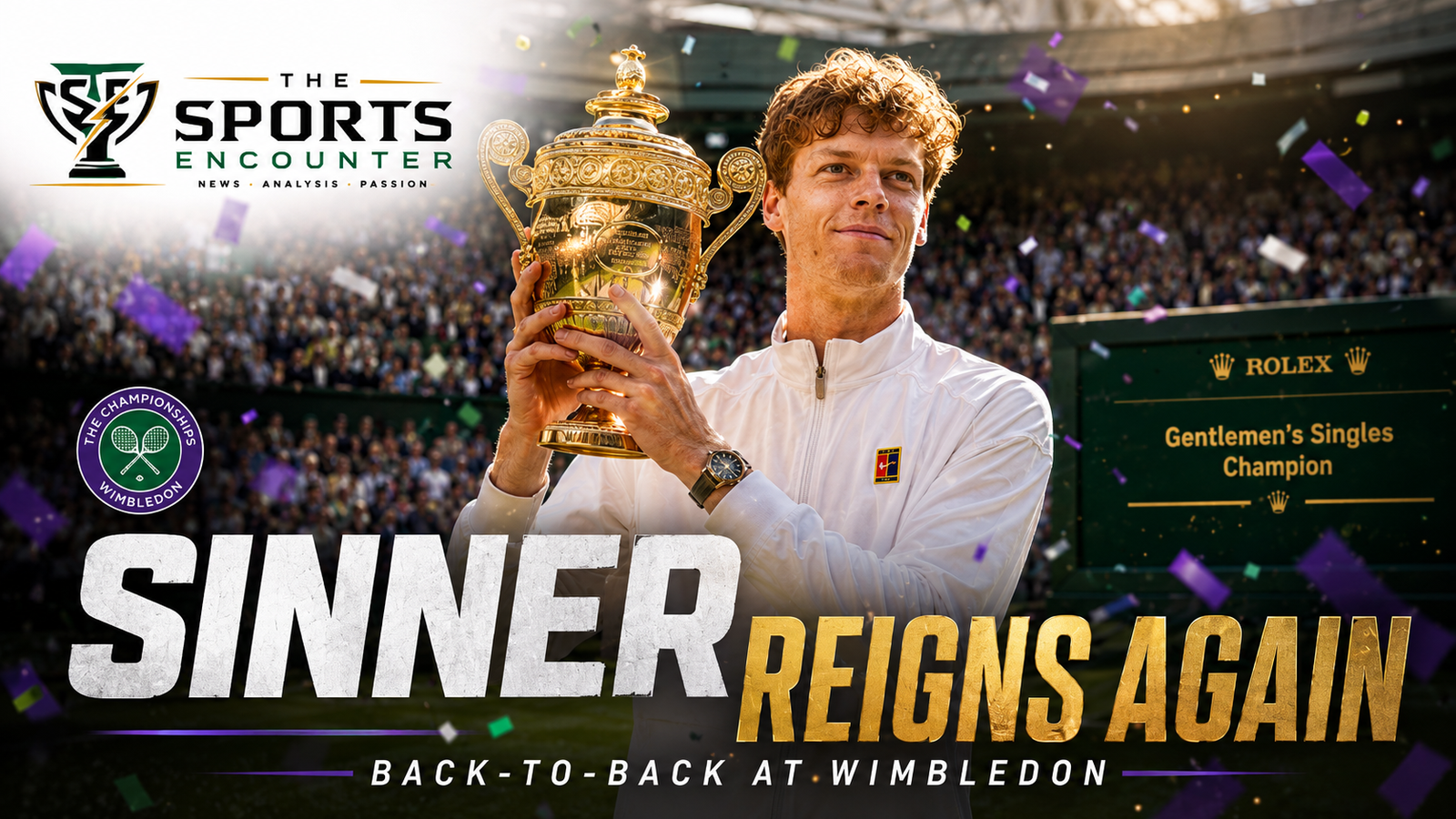
World number 8 Novak Djokovic of Serbia, local wild card entry Arthur Fery, French Open 2026 champion Alexander Zverev, and defending champion Jannik Sinner completed the last-four line-up in the Wimbledon 2026 at All England Club in London on Wednesday.
Novak Djokovic is chasing an eighth Wimbledon title and a 25th Grand Slam crown, but his road is now stacked with danger. He must first face defending champion Jannik Sinner after surviving Felix Auger-Aliassime in the longest Wimbledon quarter-final in history. On the other side of the draw, Alexander Zverev is chasing back-to-back Grand Slam titles after winning the French Open, while British wildcard Arthur Fery is trying to turn a fairytale run into one of Wimbledon’s greatest title stories.
Key Facts: Wimbledon 2026 Men’s Semi-Final Picture
| Player | Route to Semi-Final | Wimbledon 2026 Storyline | Biggest Threat |
|---|---|---|---|
| Novak Djokovic | Beat Felix Auger-Aliassime 7-6(10), 3-6, 6-3, 6-7(4), 7-6(10-4) | Chasing eighth Wimbledon title and 25th Grand Slam | Recovery after five-hour quarter-final |
| Jannik Sinner | Defending champion into last four | Trying to protect his Wimbledon crown | Pace, timing and baseline control |
| Alexander Zverev | Beat Taylor Fritz 6-4, 6-4, 6-2 | Chasing back-to-back Grand Slam titles after French Open win | Serve, reach and major-winning confidence |
| Arthur Fery | Beat Flavio Cobolli 6-4, 7-6(4), 6-0 | British wildcard chasing history | Crowd energy and fearless tennis |
Wimbledon Has Put Djokovic Back in Familiar Territory, but This Time It Feels Different
Novak Djokovic has spent so much of his career standing near the end of Grand Slam tournaments that his presence in another Wimbledon semi-final can almost look routine.
It is not routine anymore.
Story at a glance

Wimbledon Has Put Djokovic Back in Familiar Territory, but This Time It Feels Different
Novak Djokovic has spent so much of his career standing near the end of Grand Slam tournaments that his presence in another Wimbledon semi-final can almost look routine.
Djokovic’s Quarter-Final Was Historic, but It Also Raised a Bigger Question
Djokovic reached the semi-final after beating Felix Auger-Aliassime 7-6(10), 3-6, 6-3, 6-7(4), 7-6(10-4) in a five-hour, 15-minute battle. Reuters reported it as the longest Wimbledon quarter-final in history, and Djokovic later said he won it with “a racket and a lot of heart” in its Djokovic vs Auger-Aliassime match report.
Why Sinner Is the Most Direct Threat to Djokovic’s Title Chase
Sinner is not simply another semi-final opponent. He is the defending Wimbledon champion and the player most capable of making Djokovic’s body pay for every long exchange.
Zverev Has Finally Brought Major-Winning Confidence to Grass
Alexander Zverev’s Wimbledon quarter-final was not just a win. It was a message.
Fery Is No Longer Just a Fairytale
Arthur Fery entered Wimbledon ranked 114th in the world and holding a wildcard. At the start of the tournament, that made him a local interest story. Now it makes him one of the most compelling players left in the draw.
This is a 39-year-old champion trying to pull one more historic title from a draw that is no longer bending around his reputation. Djokovic is still here, still alive, still two wins away from an eighth Wimbledon title, but the tournament has changed shape around him.
Jannik Sinner is waiting as the defending champion. Alexander Zverev is carrying the confidence of a French Open winner. Arthur Fery has turned a wildcard entry into the emotional story of British tennis this summer.
That is what makes this Wimbledon different.
Djokovic is no longer only chasing records. He is trying to prove that the old Centre Court authority still works when the next generation, the form player and the fairytale all arrive at once.
The Sports Encounter’s Wimbledon 2026 curtain raiser framed this tournament as a stage where tennis power could shift again. That warning now feels real. The men’s semi-final lineup is no longer a simple contest of rankings. It is a test of eras, bodies and belief.
Djokovic’s Quarter-Final Was Historic, but It Also Raised a Bigger Question
Djokovic reached the semi-final after beating Felix Auger-Aliassime 7-6(10), 3-6, 6-3, 6-7(4), 7-6(10-4) in a five-hour, 15-minute battle. Reuters reported it as the longest Wimbledon quarter-final in history, and Djokovic later said he won it with “a racket and a lot of heart” in its Djokovic vs Auger-Aliassime match report.
The line sounded emotional. It also sounded honest.
Djokovic had to survive more than a strong opponent. He had to survive the kind of match that follows a player into the next round. Five sets on grass can drain the calves, hips, shoulders and concentration. Five hours and 15 minutes at 39 is not background detail. It is part of the semi-final story.
Auger-Aliassime pushed him through two extended tiebreaks, took the second set, forced a fourth-set tiebreak and made the final set feel like a test of nerve rather than form. Djokovic still found the answer in the deciding match tiebreak, winning it 10-4.
That was classic Djokovic.
The concern is what comes next.
The Serbian has already made history at this tournament. The Sports Encounter covered how Djokovic broke Roger Federer’s Wimbledon match-wins record earlier in the tournament, reaching 106 victories at the All England Club. Now he has added another milestone by reaching an eighth straight Wimbledon semi-final.
But records do not reduce fatigue.
Djokovic must now recover quickly enough to face the one opponent least likely to give him recovery time inside the match.
Why Sinner Is the Most Direct Threat to Djokovic’s Title Chase
Sinner is not simply another semi-final opponent. He is the defending Wimbledon champion and the player most capable of making Djokovic’s body pay for every long exchange.
His game is clean, fast and suffocating. He takes the ball early, protects the baseline and rarely lets opponents settle into slow tactical patterns. Against Djokovic, that matters because the semi-final may turn less on experience and more on who controls the first shot after the serve.
Djokovic cannot afford to spend too much of this match defending from the corners. If Sinner locks into rhythm, the rallies will become physical early. That would test Djokovic’s recovery after the Auger-Aliassime marathon and force him to win points the hard way.
The official Wimbledon website lists the path through the last four in its gentlemen’s singles draw, and the Djokovic-Sinner semi-final is the heavyweight question in the top half. One man is trying to protect the present. The other is trying to stretch the past into one more title run.
The Sports Encounter’s Wimbledon 2026 title preview identified Djokovic’s durability and Sinner’s title defense as two of the tournament’s defining themes. They now meet directly.
Djokovic still has tools that Sinner cannot copy. His return remains one of the best pressure weapons tennis has ever seen, his tiebreak nerve is still elite, and his ability to read momentum and change pace can unsettle even the cleanest ball-strikers.
Still, Sinner can make this match uncomfortable if he does three things: serve efficiently, attack Djokovic’s second serve and stretch rallies long enough to turn recovery into a live issue.
That is why this semi-final may decide more than a finalist.
It may decide whether Djokovic still has enough physical margin to win two more matches at Wimbledon.
Zverev Has Finally Brought Major-Winning Confidence to Grass
Alexander Zverev’s Wimbledon quarter-final was not just a win. It was a message.
He beat Taylor Fritz 6-4, 6-4, 6-2 to reach the semi-finals, ending a seven-match losing run against the American. Fritz had troubled him repeatedly, including at Wimbledon in 2024, but this time Zverev played with control from the opening set and never allowed the old pattern to take over.
Reuters’ Wimbledon coverage noted that Zverev snapped that losing streak while reaching his first Wimbledon semi-final. The performance also mattered because he arrived in London as the French Open champion, trying to prove that his major-winning momentum could travel from clay to grass.
That is a huge shift in Zverev’s career story.
For years, the question around him at Grand Slams was whether he could finish. In 2026, after winning the French Open, the question has changed. Now it is whether he can stack titles and become a genuine multi-surface major force.
Against Fritz, Zverev looked like a player carrying new authority. He broke early, protected his serve and grew more aggressive after Fritz received treatment for a right knee issue early in the second set. By the third set, the German was controlling the rhythm and stepping into the court with purpose.
His backhand winner to seal a double break at 4-1 in the third set captured the performance. It was clean, direct and final.
The Sports Encounter’s analysis of Wimbledon 2026 top seeds and title favorites asked whether Zverev could carry his 2026 breakthrough into the grass season. The answer is now stronger than it was a week ago.
If he beats Fery, Zverev could enter the final with something Djokovic knows well: the calm that comes from already having won the biggest matches.
That makes him dangerous.
Fery Is No Longer Just a Fairytale
Arthur Fery entered Wimbledon ranked 114th in the world and holding a wildcard. At the start of the tournament, that made him a local interest story. Now it makes him one of the most compelling players left in the draw.
Fery beat ninth seed Flavio Cobolli 6-4, 7-6(4), 6-0 to reach the semi-finals. Reuters reported in its Fery vs Cobolli quarter-final report that he became one of the rare men’s wildcards to reach the last four at a Grand Slam.
That fact gives the run historical weight. The emotional weight comes from how he did it.
Fery did not stumble into the semi-finals. He played with clarity. Cobolli had early chances, including a break point at 3-3 in the first set, but Fery held firm. When Cobolli served at 4-5, the Italian double-faulted and then missed a forehand wide. Fery took the opening set and with it a measure of control.
The second set should have been the danger zone. Fery dropped serve early, recovered and then played a composed tiebreak to move two sets ahead. The third set became a statement. He broke early, fought off break points in the following game and then watched Cobolli’s resistance disappear.
He closed the match with an ace.
That finishing detail matters because it shows how far his mindset had travelled. A wildcard trying to survive may tighten at the end. Fery attacked the finish.
Arthur Fery vs Goran Inavisevic
His run has naturally drawn comparisons with Goran Ivanisevic, who won Wimbledon as a wildcard in 2001. Fery is still two wins away from matching that miracle, but the comparison has become unavoidable because Wimbledon loves stories that feel too strange to script.
The Sports Encounter’s Wimbledon 2026 Day 6 report showed how quickly this tournament could turn volatile. Fery has now taken that volatility and placed it in the men’s semi-finals.
The Four Men Left Have Turned Wimbledon Into Four Competing Stories
This is why the final weekend feels unusually rich.
Djokovic is chasing history.
Sinner is defending his crown.
Zverev is chasing back-to-back Grand Slam titles.
Fery is trying to turn a wildcard into a Wimbledon legend.
Each player carries a different pressure.
What Each Semi-Finalist Brings to Wimbledon 2026
| Player | Biggest Strength | Biggest Pressure | What It Means for Djokovic |
| Djokovic | Experience, return game and tiebreak nerve | Recovery after a five-hour quarter-final | Must manage energy better than emotion |
| Sinner | Baseline timing and defending champion confidence | Protecting his Wimbledon title | Can turn the semi-final into a physical test |
| Zverev | Serve, reach and French Open momentum | Proving he can win majors on different surfaces | Could be a dangerous final opponent |
| Fery | Freedom, crowd energy and fearless shot-making | First Grand Slam semi-final pressure | Would bring chaos and home support into a possible final |
That table explains the real shape of the tournament.
Djokovic has the richest history, but he may not have the easiest path. Sinner can test his legs. Zverev can test his serving patterns and baseline tolerance. Fery can test the emotional temperature of Centre Court if the British crowd turns the final into a national event.
What Djokovic Must Get Right Against Sinner
Novak Djokovic’s semi-final plan must be disciplined.
The Serb needs a high first-serve percentage because too many second serves will allow Sinner to step in early. He needs short points whenever possible, especially in the opening set, because he cannot afford another match that becomes physically expensive before the final. He also needs to control the middle of the court with depth rather than chase Sinner’s pace from behind the baseline.
The first set may be decisive emotionally.
If Djokovic wins it, Sinner has to carry the pressure of defending his title against the sport’s greatest problem-solver. If Sinner wins it, Djokovic may have to decide how much physical debt he is willing to create for a possible final.
That is the hidden tension of this match.
Djokovic can win a five-set war against Sinner. The question is whether he can win the tournament after doing it.
Can Zverev or Fery Change the Final Before It Even Starts?
The bottom-half semi-final between Zverev and Fery carries a different kind of intrigue.
Zverev will be expected to win. He is the second seed, the French Open champion and the more experienced player at this stage. He also has a serve and backhand built to control grass-court points when he is confident.
Fery has a different weapon: freedom.

He has already gone further than expected. The pressure that normally traps underdogs may not feel the same for him. If he starts well, the Centre Court crowd could become part of the match. That can make even experienced opponents play tighter.
Zverev must treat Fery as a semi-finalist, not a story.
If he does, his game should give him enough structure to reach the final. If he lets the occasion breathe too much, Fery’s confidence could grow into something harder to stop.
That is the danger of fairytales. They often look harmless until they start changing scoreboards.
Verdict: Djokovic Can Still Win His 8th Wimbledon Title, but the Field Finally Has Real Answers
Djokovic can still win Wimbledon 2026, but this is no longer a title chase built only around his name, memory and Centre Court authority.
That is what makes the final stretch so compelling.
For years, Djokovic has made Wimbledon pressure look like a private language only he fully understood. He has won long matches, broken younger opponents, solved different generations and turned impossible scorelines into another chapter of his own control.
This time, the draw has given him three very different problems.
Sinner is the most immediate threat because he can make the semi-final physical from the first game. He is the defending champion, plays with clean baseline authority and has the kind of timing that can force Djokovic into one extra defensive step again and again. After a five-hour, 15-minute quarter-final against Felix Auger-Aliassime, that matters.
Zverev is dangerous because he is no longer chasing proof in the same way. His French Open 2026 title changed the emotional weight around him. After beating Taylor Fritz in straight sets and ending a seven-match losing run against the American, he looks like a player who has carried major-winning confidence onto grass.
Fery is the wild card in every sense. He entered Wimbledon ranked 114th, received a wildcard and has now reached the semi-finals with the British crowd behind him. If he beats Zverev, the final would become something very different: Djokovic or Sinner against a home story with nothing to lose and a crowd ready to believe.
Can Djokovic Win his 8th Wimbledin Title in 2026?
That is why Novak Djokovic’s eighth Wimbledon title bid feels so heavy.
The Serb still has the return game. He still has the tiebreak nerve. He still has the experience no one else in this draw can match. But Sinner has the crown, Zverev has the momentum and Fery has the story.
If Djokovic lifts the trophy again, it will not feel like another familiar triumph.
It will feel like one of the hardest Wimbledon titles of his career, won against youth, recovery, form and emotion all at once.
The next two matches will decide whether the tournament belongs to the present, the future, the fairytale, or the man who has spent two decades refusing to let anyone else write the ending.
Continue the Wimbledon Story
 TennisJannik Sinner Ends 2026 Season With Knee Injury as Alexander Zverev Closes on Year-End No. 1
 China OpenDjokovic Refuses to Lose as De Minaur, Medvedev, and Hurkacz Complete China Open Final Four
 China OpenNovak Djokovic Wins Seventh China Open Title After 11 Years, Extends Hard-Court Record to 73
FAQs
Can Novak Djokovic win his eighth Wimbledon title in 2026?
Yes, Novak Djokovic can still win his eighth Wimbledon title in 2026. He is two wins away from the trophy, but he must first beat defending champion Jannik Sinner in the semi-final. If he reaches the final, he will face either Alexander Zverev or Arthur Fery.
Who will Novak Djokovic face in the Wimbledon 2026 semi-final?
Novak Djokovic will face Jannik Sinner in the Wimbledon 2026 men’s semi-final. Sinner is the defending champion and one of the toughest possible opponents for Djokovic after his five-set quarter-final win over Felix Auger-Aliassime.
Why is Djokovic’s Wimbledon 2026 campaign historic?
Djokovic’s Wimbledon 2026 campaign is historic because he is chasing an eighth Wimbledon title, which would equal Roger Federer’s men’s singles record at the All England Club. He is also trying to win a 25th Grand Slam singles title.
How long was Djokovic’s quarter-final against Felix Auger-Aliassime?
Djokovic’s quarter-final against Felix Auger-Aliassime lasted five hours and 15 minutes. Reuters reported it as the longest Wimbledon quarter-final in history.
Can Jannik Sinner stop Djokovic at Wimbledon 2026?
Yes, Sinner can stop Djokovic. He is the defending champion, plays fast from the baseline and can make the semi-final physically demanding. That matters because Djokovic is coming off a five-set quarter-final.
Can Alexander Zverev win back-to-back Grand Slam titles?
Yes, Zverev can still win back-to-back Grand Slam titles. He won the French Open in 2026 and reached the Wimbledon semi-finals by beating Taylor Fritz in straight sets.
Why is Arthur Fery’s Wimbledon run special?
Arthur Fery’s Wimbledon run is special because he entered the tournament as a wildcard ranked 114th in the world. By reaching the semi-finals, he placed himself among the rare men’s wildcards to go this deep at a Grand Slam.
Has a wildcard ever won Wimbledon?
Yes. Goran Ivanisevic won Wimbledon as a wildcard in 2001. Arthur Fery’s run has drawn comparisons because he is trying to turn a wildcard entry into a historic Wimbledon title campaign.
Who are the Wimbledon 2026 men’s semi-finalists?
The Wimbledon 2026 men’s semi-finalists are Novak Djokovic, Jannik Sinner, Alexander Zverev and Arthur Fery.
What is the biggest storyline in the Wimbledon 2026 men’s draw?
The biggest storyline is whether Djokovic can still win an eighth Wimbledon title while Sinner defends his crown, Zverev chases back-to-back Grand Slam titles and Fery tries to complete a wildcard miracle.