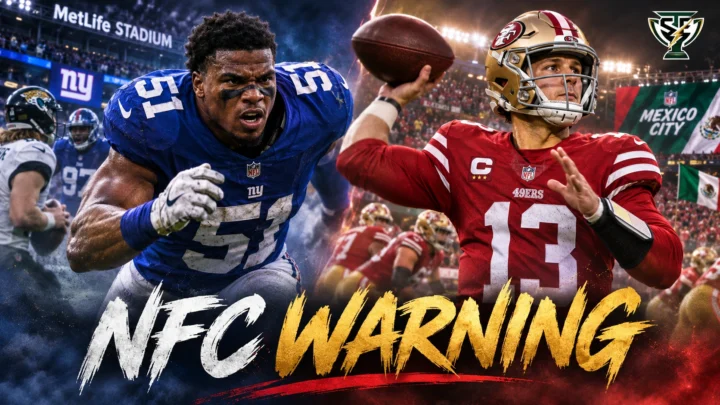
NEW YORK, United States, November 24, 2026: The New York Giants have reached 6-3-1, beaten one of the AFC’s strongest teams and climbed into the top-ten conversation in the NFL power rankings. Yet the most revealing question about John Harbaugh’s team remains unanswered: can a defense capable of disrupting elite quarterbacks compensate for an offense that still struggles to sustain drives?
The Giants’ 23-18 victory over Jacksonville Jaguars transformed their standing among analysts, particularly after a difficult loss to Washington Commanders had raised doubts about their consistency. Edge rusher Abdul Carter delivered two sacks and relentless pressure on Trevor Lawrence, while New York’s secondary helped contain an offense that had averaged 36.5 points over its previous four games.
Key Takeaways
- The New York Giants have reached 6-3-1, beaten one of the AFC’s strongest teams and climbed into the top-ten conversation in the NFL power rankings.
- The Giants’ 23-18 victory over Jacksonville Jaguars transformed their standing among analysts, particularly after a difficult loss to Washington Commanders had raised doubts about their consistency.
- Elsewhere, San Francisco 49ers strengthened their position among the NFL’s leading Super Bowl contenders by overwhelming Minnesota Vikings 35-10 in Mexico City.
- San Francisco’s commanding victory over Minnesota offered one of the clearest demonstrations of elite team performance during Week 11.
Elsewhere, San Francisco 49ers strengthened their position among the NFL’s leading Super Bowl contenders by overwhelming Minnesota Vikings 35-10 in Mexico City. Buffalo Bills continued their impressive campaign, Denver Broncos gained further recognition, and Pittsburgh Steelers suffered another damaging setback.
Story at a glance
Why the NFL Power Rankings Are Changing So Dramatically
Power rankings are editorial evaluations rather than official league standings. They attempt to assess the relative strength of teams using recent results, underlying performance and expectations for upcoming games.
New York Giants: A 6-3-1 Record That Demands a Closer Look
New York’s victory over Jacksonville was its most convincing evidence yet that the team can defeat an established contender.
What the Giants’ Defensive Improvement Still Cannot Hide
The biggest obstacle to treating New York as an established championship contender is offensive consistency.
How the Giants Compare With the NFL’s Strongest Contenders
New York’s record places the team firmly in the playoff conversation. Its overall performance, however, remains different from that of San Francisco and Buffalo.
San Francisco 49ers: The Benchmark New York Still Needs to Reach
San Francisco’s commanding victory over Minnesota offered one of the clearest demonstrations of elite team performance during Week 11.
The changing hierarchy reflects a broader truth about the season. Records matter, but the quality of opposition, efficiency on both sides of the ball and the ability to win under pressure are becoming increasingly important as the playoff race develops.
Why the NFL Power Rankings Are Changing So Dramatically
Power rankings are editorial evaluations rather than official league standings. They attempt to assess the relative strength of teams using recent results, underlying performance and expectations for upcoming games.
Consequently, two teams with similar records can occupy different positions in a ranking.
A team producing dominant victories against strong opponents may be viewed more favorably than one accumulating narrow wins while consistently struggling in important statistical areas.
That distinction is central to the debate surrounding New York.
The Giants have a winning percentage of .650 and lead the NFC East, yet their season has included narrow victories, defensive breakdowns and an offense that remains below average by several efficiency measures.
The NFL’s official Week 12 power rankings analysis recognizes New York’s improvement following the Jacksonville victory, while also examining the changing positions of San Francisco, Denver and Pittsburgh.
For the Giants, the latest results provide a stronger argument for postseason relevance. Whether that translates into championship credibility remains a separate question.
New York Giants: A 6-3-1 Record That Demands a Closer Look
New York’s victory over Jacksonville was its most convincing evidence yet that the team can defeat an established contender.
The Jaguars entered the matchup with a 7-2 record and one of the NFL’s most productive offenses.
They had scored more than 30 points in each of their previous four games, making the Giants’ defensive performance particularly significant.
Jacksonville managed only 18 points at MetLife Stadium.
Lawrence was intercepted twice, pressured repeatedly and prevented from establishing a consistent offensive rhythm for much of the contest.
The Giants also restricted Jacksonville to five successful third-down conversions in 15 attempts.
Those numbers provide stronger evidence of New York’s defensive progress than its winning margin alone.
The Sports Encounter’s detailed examination of the Giants’ victory and San Francisco’s Mexico City performance explained how two very different approaches produced major results against playoff-caliber opposition.
New York’s task now is to demonstrate that its defensive success can be repeated.
Abdul Carter Is Becoming the Giants’ Most Influential Player
Carter’s performance against Jacksonville represented a substantial individual breakthrough.
The former first-round draft selection finished with two sacks, five quarterback hits, four tackles and two tackles for loss.
NFL Next Gen Stats credited him with 12 pressures, including six generated in less than 2.5 seconds.
That distinction matters because defensive pressure does not always appear in a conventional box score.
A quarterback may avoid a sack but still be forced into an inaccurate throw, an early release or an unfavorable decision.
Carter’s ability to disrupt Lawrence therefore influenced Jacksonville’s passing game beyond his two recorded sacks.
He also benefited from coverage support provided by New York’s secondary, which made it more difficult for the Jaguars to find reliable passing options.
The Giants’ official statistical review confirms Carter’s production and the contributions of Deonte Banks, Paulson Adebo and Dru Phillips.
What the Giants’ Defensive Improvement Still Cannot Hide
The biggest obstacle to treating New York as an established championship contender is offensive consistency.
The Giants scored 23 points against Jacksonville despite receiving numerous opportunities to extend their advantage.
Quarterback J.J. McCarthy produced a touchdown pass to Malik Nabers, but sustained offensive drives remained difficult to establish.
Kicker Dominic Zvada accounted for 11 of New York’s points, illustrating how frequently the team depended on field goals rather than touchdowns.
That strategy can produce regular-season victories when the defense performs exceptionally well.
It becomes more difficult to sustain against opponents capable of scoring rapidly or forcing a team to abandon its preferred game plan.
New York also entered the week with its offense ranked 22nd in DVOA, an opponent-adjusted efficiency measure.
Although one ranking cannot fully define a team, it supports the broader observation that the Giants’ offensive production has not consistently matched their record.
Winning the Turnover Battle Is Not a Complete Offensive Strategy
New York’s defense created valuable opportunities against Jacksonville through interceptions and pressure.
However, forcing turnovers is not always predictable from one week to the next.
Opposing quarterbacks differ in their ability to recognize pressure, protect the football and exploit defensive coverage.
If a future opponent avoids interceptions and converts more third downs, the Giants may need significantly greater offensive production to remain competitive.
The limitations became evident during their 24-21 defeat against Washington, when the Commanders scored a late touchdown despite throwing two fourth-quarter interceptions.
TSE’s report on the Washington comeback documented how New York failed to protect a narrow advantage in a game that carried important NFC East consequences.
The Jacksonville win was an encouraging response, but the Washington defeat remains relevant when evaluating the Giants’ reliability under pressure.
How the Giants Compare With the NFL’s Strongest Contenders
New York’s record places the team firmly in the playoff conversation. Its overall performance, however, remains different from that of San Francisco and Buffalo.
| Team | Record | Key Strength | Main Question |
|---|---|---|---|
| San Francisco 49ers | 9-1 | Efficient, versatile offense | Maintaining health and defensive consistency |
| Buffalo Bills | 9-1 | Strong offense and improving defense | Maintaining performance against leading AFC opponents |
| Denver Broncos | 8-2 | Ability to win competitive games | Offensive consistency against elite defenses |
| New York Giants | 6-3-1 | Pass rush and defensive playmaking | Sustained scoring and late-game execution |
| Pittsburgh Steelers | 6-4 | Defensive talent and competitive division record | Offensive reliability and discipline |
Records reflect completed games through Week 11. This table compares selected teams rather than assigning an independent numerical ranking to all 32 franchises.
The official NFL standings confirm the developing divisional and conference positions.
The more useful question is whether New York can produce the same quality of performance against different types of opponents.
San Francisco 49ers: The Benchmark New York Still Needs to Reach
San Francisco’s commanding victory over Minnesota offered one of the clearest demonstrations of elite team performance during Week 11.
The 49ers entered their Mexico City encounter at 8-1, facing a Vikings defense renowned for aggressive blitzing and disguised coverage.
Quarterback Brock Purdy responded with exceptional efficiency.
He completed 21 of 26 passes for 255 yards and three touchdowns, finishing with a passer rating of 146.0.
George Kittle caught two touchdown passes, while Mike Evans contributed six receptions for 109 yards and another score.
The defense supported that offensive production by restricting Minnesota to 10 points.
San Francisco’s 35-10 victory improved its record to 9-1.
That combination of offensive efficiency and defensive control distinguishes the 49ers from many teams with respectable records.
Earlier, The Sports Encounter analyzed San Francisco’s 46-40 victory over Dallas, when Purdy threw for 389 yards and the 49ers overcame repeated defensive challenges.
The Minnesota result demonstrated a different level of control, producing a comfortable win against an opponent with legitimate NFC ambitions.
Why the Giants’ Upcoming Game Against San Francisco Matters
The two teams are scheduled to meet at MetLife Stadium on December 6.
That matchup will place Carter and the Giants’ improving pass rush against a quarterback who just dismantled one of the NFL’s most aggressive defensive systems.
Minnesota attempted to create uncertainty through pressure.
Purdy repeatedly identified the coverage and exploited the spaces available to his receivers.
For New York, the challenge will be to pressure him without compromising its coverage responsibilities.
The Giants may also need considerably more offensive production than they required against Jacksonville.
San Francisco have demonstrated the ability to score quickly and consistently. A succession of field goals may not be sufficient against an offense of that quality.
The game should therefore provide a useful test of whether New York’s current formula can survive against one of the league’s leading teams.
Buffalo Bills Continue to Build a Strong AFC Case
Buffalo’s 9-1 start places the Bills among the NFL’s most credible championship contenders.
Josh Allen remains central to their offensive success, while the defense has produced an impressive run of results.
Buffalo have now won six consecutive games.
The team’s ability to combine scoring production with improved defensive performance has strengthened its position in the AFC.
The distinction between Buffalo and New York is important.
Both teams have benefited from defensive contributions, but the Bills possess a more established offense capable of overcoming difficult situations through Allen’s passing and running ability.
The Giants are still attempting to demonstrate that their quarterback play and overall scoring efficiency can reach a comparable level.
Buffalo’s strong record does not guarantee playoff success. However, its combination of offensive production, defensive progress and experience gives the team a more complete foundation.
Denver Broncos Are Proving That Winning Close Games Has Value
Denver have emerged as another important reference point in the debate about how much weight power rankings should place on winning margins.
The Broncos are 8-2 and have repeatedly demonstrated the ability to survive close contests.
Like the Giants, they have attracted skepticism because their underlying performances have not always appeared as convincing as their record.
However, repeated success in competitive games is itself meaningful.
It can demonstrate disciplined game management, defensive execution and an ability to capitalize on small opportunities.
Denver’s rise shows why analysts should avoid dismissing teams solely because they do not win by large margins.
The crucial distinction is whether those narrow victories are supported by repeatable strengths or depend heavily on unusual events.
For both Denver and New York, the remaining schedule will provide more evidence.
Pittsburgh Steelers Are Moving in the Opposite Direction
While the Giants have gained credibility, Pittsburgh’s recent results have raised increasingly difficult questions.
The Steelers fell to 6-4 after another damaging defeat against Philadelphia.
The performance followed a 38-18 loss to Cincinnati, exposing problems that have become increasingly difficult to overlook.
Wide receiver DK Metcalf’s ejection against the Eagles added another disciplinary controversy to an already frustrating period.
The issue extends beyond one player’s conduct.
Pittsburgh must demonstrate that its offense can produce reliably against strong opponents while avoiding the mistakes that have contributed to consecutive defeats.
TSE’s investigation into Metcalf’s ejection examined the disciplinary questions and the wider offensive problems confronting the Steelers.
The contrast with New York is revealing.
The Giants have converted an uneven season into a division-leading record and a significant victory against Jacksonville.
Pittsburgh have experienced the opposite trajectory, allowing recent defeats to expose limitations that earlier victories had helped conceal.
Are the Giants Genuine Super Bowl Contenders?
There is an important difference between being a legitimate playoff contender and being one of the most likely teams to reach the Super Bowl.
The Giants have demonstrated enough to justify serious consideration for postseason qualification.
Their defense has produced decisive performances, their record is strong and they currently lead the NFC East.
However, Super Bowl contention requires a broader evaluation.
Teams advancing deep into the postseason often need to defeat several strong opponents consecutively, sometimes away from home.
That creates demands across passing efficiency, rushing production, pass protection, defensive adaptability and special teams.
The Giants have demonstrated encouraging progress in several areas but remain less convincing offensively than the strongest contenders.
The Sports Encounter’s assessment of all 32 teams’ Super Bowl prospects examined why roster balance, quarterback play and the ability to survive difficult matchups are central to championship credibility.
New York’s victory over Jacksonville strengthens its case, but the evidence remains insufficient to place the Giants alongside San Francisco and Buffalo as equally established contenders.
Continue the NFL Story

The NFC East Race Gives the Giants a Valuable Opportunity
New York’s 6-3-1 record is particularly significant because of the state of its division.
The Giants remain ahead of Dallas Cowboys, who improved to 5-6 after defeating Tennessee Titans 51-30.
Washington’s victory over New York earlier in the month also demonstrated that the NFC East race remains competitive.
Philadelphia’s uneven campaign has created additional opportunities for rivals to gain ground.
These circumstances give the Giants a realistic route toward the postseason, even if they are not yet performing at the same level as the conference’s leading teams.
However, their remaining opponents include several demanding matchups, making it important to secure victories before the schedule becomes more difficult.
New York Giants’ Next Tests: Colts, 49ers and the NFC Playoff Race
The immediate priority is a road game against Indianapolis Colts on November 29.
The Colts are 3-8, making the fixture an opportunity for New York to strengthen its position before facing a more demanding opponent.
However, the Giants cannot afford to assume that a favorable record guarantees a comfortable victory.
Their earlier defeat to Washington demonstrated the danger of failing to close out competitive games.
After Indianapolis, San Francisco visit MetLife Stadium on December 6.
| Fixture | Location | Main Question |
|---|---|---|
| Giants at Colts | Indianapolis | Can New York convert its defensive strength into a controlled road victory? |
| 49ers at Giants | East Rutherford | Can the Giants contain Purdy without compromising their secondary? |
The Colts matchup will test consistency against a struggling opponent.
The 49ers matchup will examine whether New York’s defensive improvement can withstand elite offensive execution.
Those tests carry greater predictive value than an isolated movement in an editorial ranking.
What Should NFL Power Rankings Actually Reward?
Power rankings serve a different purpose from standings.
Standings establish which teams have won, lost or tied games. Rankings attempt to evaluate relative strength and future competitiveness.
A credible assessment should therefore consider several factors.
| Evaluation Area | Why It Matters | Giants’ Current Position |
|---|---|---|
| Win-loss record | Measures completed results | Strong at 6-3-1 |
| Quality of opposition | Tests performance against stronger teams | Improved after Jacksonville victory |
| Offensive efficiency | Measures ability to sustain scoring | Still a concern |
| Pass rush and coverage | Disrupts opposing passing offenses | Major strength against Jacksonville |
| Late-game execution | Influences narrow contests | Mixed evidence after Washington and Jacksonville |
| Remaining schedule | Determines future opportunities and risks | Several demanding games ahead |
The Giants score well in several areas, but the complete picture remains uneven.
That explains why a team can rise significantly in the rankings without immediately becoming a leading championship favorite.
Why the Giants’ Rise Is One of the Most Important NFL Stories
New York’s season has changed the expectations surrounding the franchise.
Before the campaign, the Giants were widely regarded as a team still rebuilding after several frustrating seasons.
Now they lead the NFC East and have demonstrated an ability to defeat quality opposition.
Harbaugh deserves credit for building a competitive team, while Carter’s emergence has provided an increasingly influential defensive weapon.
The victory over Jacksonville was especially important because it supplied evidence against one of the strongest criticisms of the Giants: that their winning record had not been supported by victories over the NFL’s best teams.
Still, the next stage of development is more difficult.
New York must demonstrate that its defense can remain effective against different offensive systems and that McCarthy can produce enough sustained scoring to avoid placing excessive pressure on the defense.
Until those questions are answered, the Giants are best viewed as credible postseason contenders with the potential to become more dangerous, rather than established Super Bowl favorites.
The NFL Hierarchy Is Becoming Clearer, but the Giants Still Have More to Prove
San Francisco’s 9-1 record and comprehensive victory over Minnesota provide compelling evidence of a team capable of competing for a championship.
Buffalo possess similar credentials through a strong record, established quarterback play and improving defense.
Denver continue demonstrating that narrow victories can build a serious campaign, while Pittsburgh’s recent defeats have exposed significant weaknesses.
New York occupy an intriguing position between those groups.
The Giants have outperformed many expectations and earned the right to be evaluated as legitimate playoff contenders.
But their offense must improve before the team can be placed confidently among the NFL’s most complete contenders.
The Jacksonville victory showed what New York’s defense can accomplish. The Indianapolis game will test its consistency, and the upcoming matchup with San Francisco will provide a far more demanding examination.
For now, the Giants have answered one important question: their winning record deserves to be taken seriously.
The next question is whether they can sustain that success against opponents capable of punishing the weaknesses their defense has so often concealed.