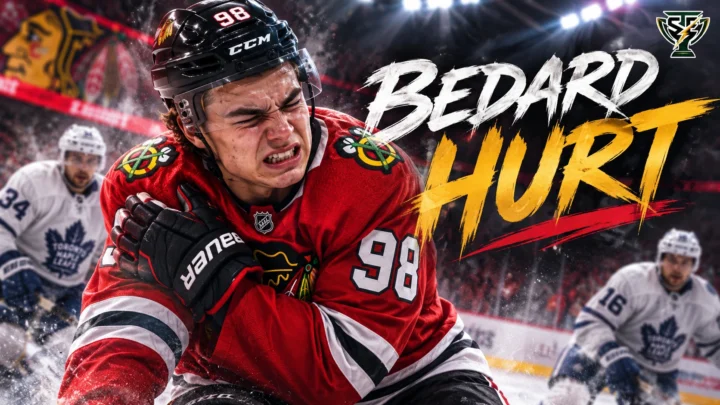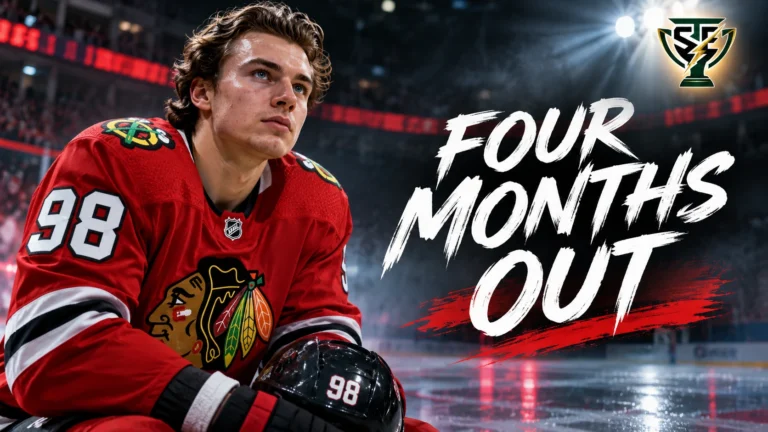
CHICAGO, United States, November 24, 2026: Chicago Blackhawks captain Connor Bedard has undergone successful surgery on his right shoulder and is expected to miss approximately four months, leaving the rebuilding NHL franchise without its most important offensive player for much of the regular season.
The 21-year-old center underwent surgery on Monday after injuring his shoulder during a faceoff against the Toronto Maple Leafs. Team physician Dr. Michael Terry expects a full recovery, although the projected rehabilitation period could keep Bedard sidelined until approximately late March.
Key Takeaways
- The 21-year-old center underwent surgery on Monday after injuring his shoulder during a faceoff against the Toronto Maple Leafs.
- Bedard underwent surgery on his right shoulder on November 23 after sustaining the injury during Chicago’s 6-3 victory over Toronto on November 17.
- Chicago signed Bedard to a five-year, $75 million extension in July, carrying an average annual value of $15 million through the 2030-31 season.
- The Blackhawks have won two consecutive games and carry an 8-14-2 record into their next scheduled contest against the Seattle Kraken.
For Chicago, the immediate loss is substantial. Bedard has seven goals and 11 assists in just 15 appearances, sharing the team scoring lead with Roman Kantserov despite already missing the beginning of the season following surgery on his other shoulder.
Story at a glance
Connor Bedard’s Surgery and Expected Return: What Is Confirmed?
Bedard underwent surgery on his right shoulder on November 23 after sustaining the injury during Chicago’s 6-3 victory over Toronto on November 17.
Why Two Faceoff Injuries Create a Different Problem for Chicago
The most concerning feature of Bedard’s latest injury is its resemblance to an earlier incident.
Three Shoulder Injuries in Less Than a Year: Bedard’s Medical Timeline
The sequence of injuries provides essential context for understanding why the Blackhawks face a difficult decision.
Chicago Has Lost 1.2 Points Per Game From Its Lineup
Bedard’s 18 points in 15 appearances represent an average of 1.20 points per game.
Anton Frondell, Frank Nazar and Patrick Kane Face a Bigger Responsibility
Chicago’s immediate response is likely to involve several players rather than a direct replacement for Bedard.
But the latest setback presents a more difficult problem than replacing 18 points. Bedard has now suffered three shoulder injuries in less than a year, including two involving faceoffs. That pattern raises important questions about how Chicago manages his responsibilities when he eventually returns.
The Blackhawks have committed five years and $75 million to their franchise cornerstone, named him captain and built much of their offensive identity around his development. His recovery now becomes one of the most consequential decisions in their rebuilding project.
Connor Bedard’s Surgery and Expected Return: What Is Confirmed?
Bedard underwent surgery on his right shoulder on November 23 after sustaining the injury during Chicago’s 6-3 victory over Toronto on November 17.
The incident occurred 54 seconds into the third period as Bedard prepared for a faceoff against Maple Leafs forward Nick Paul. Paul’s stick made contact with Bedard’s right hand while the Blackhawks center was lowering his own stick toward the ice.
Bedard immediately reacted in pain and left the game.
The NHL’s official report on Bedard’s surgery and recovery confirms that Dr. Terry expects him to recover fully in approximately four months.
That timetable points toward a possible return in late March, although it is a medical estimate rather than a confirmed date for his next NHL appearance.
| Key Detail | Confirmed Information |
|---|---|
| Player | Connor Bedard |
| Team | Chicago Blackhawks |
| Age | 21 |
| Position | Center |
| Injury | Right shoulder |
| Injury sustained | November 17 against Toronto |
| Surgery | November 23 |
| Recovery estimate | Approximately four months |
| Potential return window | Late March, subject to medical clearance |
| Season production | 7 goals, 11 assists, 18 points in 15 games |
| Team record | 8-14-2 |
Bedard was placed on injured reserve on November 22, retroactive to November 17.
The Blackhawks have not announced a specific return game, and the estimated recovery period should not be interpreted as a guarantee that he will resume competitive action immediately after four months.
Why Two Faceoff Injuries Create a Different Problem for Chicago
The most concerning feature of Bedard’s latest injury is its resemblance to an earlier incident.
On December 12, 2025, he injured the same shoulder while preparing for a faceoff against the St. Louis Blues.
That injury forced him to miss 12 games before returning against Washington on January 9. Even after resuming play, he did not take another faceoff in an NHL game until February 26.
His latest injury occurred during another faceoff, with contact between the players’ sticks preceding the shoulder problem.
Blackhawks coach Jeff Blashill has acknowledged the similarity between the incidents and discussed the possibility of adjusting Bedard’s technique.
That makes this a specific hockey problem rather than simply another unfortunate injury.
Why Faceoffs Matter to Bedard’s Role as a Center
A center is ordinarily expected to take faceoffs in offensive, defensive and neutral-zone situations.
Winning possession can determine whether a team establishes an attack, clears defensive pressure or controls the opening seconds of a power play.
Bedard’s role is particularly important because Chicago depends on his ability to create offense immediately after gaining possession.
Removing him from faceoff responsibilities could reduce exposure to the type of contact associated with his two right-shoulder injuries.
However, it would also require another player to handle draws while Bedard continues performing other center responsibilities.
That arrangement is possible in NHL hockey, but it creates additional tactical decisions about positioning, line combinations and defensive assignments.
Chicago must therefore decide whether changes to Bedard’s faceoff technique, selective use of another player or a broader adjustment to his responsibilities would be appropriate after rehabilitation.
Those decisions belong to the club’s medical and coaching staff. The available information does not establish that any particular technique caused the injuries or that one adjustment would prevent another occurrence.
The Real Question Is Whether Chicago Can Reduce Recurring Risk
Blashill has previously acknowledged that Bedard faced a meaningful risk of another shoulder problem after his earlier injury.
The latest setback demonstrates why the club cannot evaluate his return solely by asking whether he can skate, shoot and participate in contact drills.
His readiness must also account for the hockey situations that place demands on the shoulder, including faceoffs, puck battles and unexpected contact.
The distinction matters because a player can be physically capable of participating in a game while still requiring careful management of specific responsibilities.
Chicago has not publicly established the precise rehabilitation milestones Bedard must complete. It would therefore be inappropriate to predict when he will resume faceoffs or whether his role will permanently change.
Three Shoulder Injuries in Less Than a Year: Bedard’s Medical Timeline
The sequence of injuries provides essential context for understanding why the Blackhawks face a difficult decision.
| Period | Injury or Development | Consequences |
|---|---|---|
| December 2025 | Right-shoulder injury during a faceoff against St. Louis | Missed 12 games; returned January 9 |
| February 2026 | Resumed taking faceoffs after his earlier return | Gradual restoration of normal center duties |
| July 2026 | Left-shoulder injury during offseason training | Underwent surgery on July 8 |
| October 2026 | Returned to NHL action against Pittsburgh | Resumed season after missing six games |
| November 2026 | Right-shoulder injury during a faceoff against Toronto | Underwent surgery November 23; approximately four-month recovery projected |
The July injury affected Bedard’s left shoulder, while the December and November incidents involved his right shoulder.
That distinction is important. The sequence establishes repeated shoulder problems, but it does not prove that all three injuries share the same medical cause.
In July, Bedard underwent surgery after an injury sustained during offseason training in Vancouver.
The NHL’s earlier report on his left-shoulder surgery documented the original rehabilitation estimate and the impact on Chicago’s preparations.
Bedard returned on October 13, earlier than the initial November projection, and quickly resumed producing offense.
His latest surgery now creates another extended interruption before he has completed a sustained run of games.
Chicago Has Lost 1.2 Points Per Game From Its Lineup
Bedard’s 18 points in 15 appearances represent an average of 1.20 points per game.
That rate illustrates the scale of Chicago’s offensive problem.
Over a hypothetical 82-game schedule, the same pace would equal approximately 98 points. Such an extrapolation is a mathematical illustration, not a forecast of what Bedard would have achieved over a full season.
The more immediate concern is how Chicago replaces the scoring opportunities and offensive decisions he creates.
Bedard’s seven goals account for his finishing contribution, while his 11 assists reflect his ability to create chances for teammates.
His absence affects both areas.
Opponents no longer need to devote the same defensive attention to his shooting threat, potentially changing how they defend Chicago’s other forwards.
The Blackhawks must also find another player capable of controlling attacking possessions and making decisions under pressure.
That challenge is particularly significant for a team with an 8-14-2 record.
Why Roman Kantserov Cannot Be Expected to Replace Bedard Alone
Roman Kantserov has matched Bedard’s 18 points, recording 13 goals and five assists.
His production provides evidence that Chicago has another dangerous attacking player.
However, the distribution of those points is revealing.
Kantserov has contributed more through goals, while Bedard has generated a larger share of his production through assists.
That difference suggests their offensive responsibilities are not interchangeable.
Replacing Bedard requires more than finding someone to score at a similar rate. Chicago must also replace the puck movement, passing decisions and attacking opportunities that help other players score.
The Blackhawks could distribute those responsibilities among several forwards, but doing so will require adjustments to line combinations and special-teams deployment.
Anton Frondell, Frank Nazar and Patrick Kane Face a Bigger Responsibility
Chicago’s immediate response is likely to involve several players rather than a direct replacement for Bedard.
Anton Frondell Could Receive the Most Important Opportunity
Anton Frondell has been identified as a possible replacement at first-line center between Roman Kantserov and Tyler Bertuzzi.
The assignment would expose him to greater responsibility against opposing teams’ leading players.
It would also provide an opportunity to evaluate how effectively he handles the demands of a prominent NHL role.
However, Chicago must avoid turning Bedard’s absence into an unrealistic expectation that another young player immediately reproduces his offensive impact.
Frondell’s development should be judged through his decision-making, defensive responsibilities and ability to sustain effective play, not simply his point totals.
Frank Nazar Becomes Central to the Power Play
Blashill has indicated that Frank Nazar will take Bedard’s position on Chicago’s first power-play unit.
The planned configuration includes Nazar, Bertuzzi, Kantserov, Patrick Kane and defenseman Sam Rinzel.
Nazar’s right-handed shot offers a different attacking angle and allows Chicago to adjust its passing structure.
The challenge will be maintaining puck movement and shot creation without the defensive attention Bedard normally attracts.
Special-teams performance will provide an early measure of whether the adjustment is working.
Patrick Kane’s Return Has Become Even More Important
Kane’s return to Chicago was initially significant because it reunited the franchise with one of the central figures from its championship era.
Bedard’s injury has made the veteran forward’s presence more important from a practical standpoint.
Kane can help organize attacking possessions, provide experience during difficult games and support younger forwards adjusting to larger responsibilities.
His return and its implications for Chicago’s rebuilding strategy were examined in The Sports Encounter’s report on Kane’s Blackhawks reunion.
At the same time, Kane should not be expected to reproduce Bedard’s speed, playing style or full workload.
His greatest contribution may come from helping Chicago develop a more balanced attack that does not depend on one player creating most of its dangerous opportunities.
The $75 Million Contract Makes Bedard’s Long-Term Health a Franchise Priority
Chicago signed Bedard to a five-year, $75 million extension in July, carrying an average annual value of $15 million through the 2030-31 season.
The agreement reflected the organization’s confidence in the player selected first overall in the 2023 NHL Draft.
Bedard has accumulated 221 points, including 82 goals and 139 assists, through 234 NHL appearances.
Those numbers establish why Chicago regards him as the central figure in its competitive future.
But the financial commitment also changes how the organization must think about roster construction.
When one player occupies such an important role in the team’s sporting and financial plans, prolonged absences expose weaknesses that might otherwise remain hidden.
Chicago needs enough offensive depth to remain functional without its leading scorer, while ensuring that younger players continue developing around him.
The Sports Encounter previously examined the significance of that commitment when Bedard was appointed the Blackhawks’ captain.
His captaincy was an endorsement of his leadership and long-term importance.
The latest injury creates a different leadership test: how Chicago manages the responsibilities of its captain while he is unable to contribute on the ice.
Why the Blackhawks Must Avoid Rushing Bedard Back
The four-month recovery estimate creates a possible return window near the closing weeks of the regular season.
Chicago’s position in the standings will inevitably influence the competitive context surrounding that decision.
If the Blackhawks remain outside realistic playoff contention, the value of an early return would need to be weighed against the importance of completing rehabilitation.
If the team improves significantly, pressure to restore its captain could increase.
Neither situation changes the fundamental requirement for medical clearance.
The club’s doctors and rehabilitation staff must determine when Bedard is ready to resume the physical demands of NHL competition.
His recent injury history makes the quality of that assessment particularly important.
Continue the NHL Story

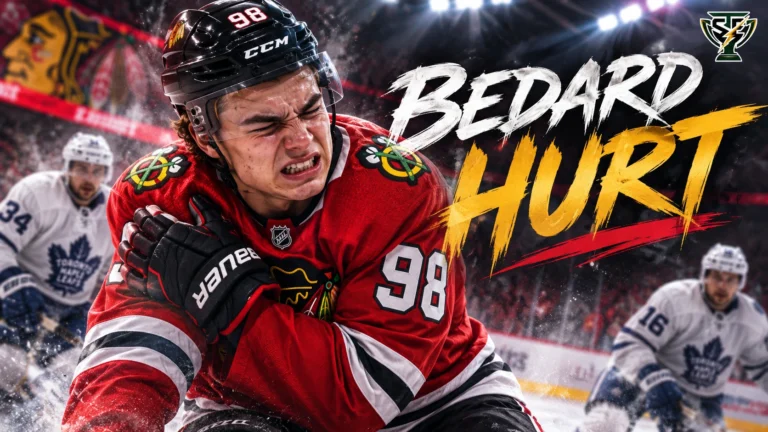

Chicago has already experienced the consequences of losing important players elsewhere in its lineup.
Earlier in the season, defenseman Bowen Byram was placed on injured reserve, creating additional pressure on the club’s depth.
TSE’s analysis of the Byram injury and its impact on Chicago examined how absences can disrupt a rebuilding team’s development.
Bedard’s situation is more consequential because his role combines elite offensive production, captaincy and long-term organizational importance.
Chicago’s Recent Results Show Both Progress and Vulnerability
The Blackhawks have won two consecutive games and carry an 8-14-2 record into their next scheduled contest against the Seattle Kraken.
They have also collected points in five of their previous six games, with a 4-1-1 record over that stretch.
Those results provide evidence that Chicago can compete without relying exclusively on Bedard.
However, a short run of improved performances does not establish that the team can sustain its progress over several months without him.
Opponents will have time to prepare for Chicago’s revised lineup, while Blashill must continue balancing the development of younger players against the need to win games.
The Blackhawks have already demonstrated how difficult it can be to protect leads and sustain momentum.
In an earlier meeting with Boston, Chicago surrendered a two-goal third-period advantage before losing in overtime.
The Sports Encounter’s analysis of that Bruins comeback examined Chicago’s defensive problems despite productive performances from Bedard and Anton Frondell.
Without Bedard, maintaining defensive discipline becomes even more important because the Blackhawks have less margin for error when generating offense.
What Bedard’s Injury Means for Chicago’s Rebuild
Chicago has spent several seasons assembling younger talent around Bedard.
The strategy depends on developing a competitive group capable of improving together over multiple seasons.
Bedard’s extended absence creates an opportunity to evaluate that supporting cast under more demanding circumstances.
Frondell may receive additional responsibility at center. Nazar can establish himself in a more prominent power-play role. Kantserov will face greater defensive attention. Kane can provide leadership and attacking creativity.
Those developments could reveal useful information about the team’s long-term structure.
But they will not compensate fully for the absence of a player who has been producing at a point-per-game rate above most of his teammates.
The Blackhawks must also avoid making major conclusions about their younger players solely from performances during an injury-disrupted season.
A rebuilding team needs patience, clear developmental priorities and enough experienced support to prevent promising players from being overwhelmed by responsibilities they are not yet prepared to carry.
That balance is now central to Blashill’s assignment.
What to Watch During Bedard’s Recovery
The next four months will provide several measurable indicators of Chicago’s progress and Bedard’s rehabilitation.
| Development | What to Monitor | Why It Matters |
|---|---|---|
| Medical recovery | Official rehabilitation updates and eventual clearance | Determines readiness to resume hockey activity |
| Faceoff responsibilities | Any announced changes to Bedard’s technique or deployment | Addresses a recurring feature of his right-shoulder injuries |
| First-line center | Frondell’s role and performance | Tests Chicago’s depth through the middle |
| Power play | Nazar’s deployment and Chicago’s conversion rate | Measures how effectively the team replaces Bedard’s creativity |
| Team results | Points percentage and position in the Central Division | Shows whether Chicago can sustain improvement |
| Return timetable | Updates approaching the projected late-March window | Clarifies whether a regular-season return remains realistic |
Chicago’s first immediate test comes against Seattle, where the revised lineup will have another opportunity to demonstrate how it functions without its captain.
The longer-term questions will take considerably more time to answer.
Bedard’s Recovery Could Define More Than Chicago’s Season
Connor Bedard’s latest surgery is a significant setback for a franchise that has invested heavily in his ability to lead its next competitive era.
His scoring production, leadership responsibilities and contract make him difficult to replace, but the recurring nature of his shoulder problems creates an additional challenge.
Chicago must determine how to protect his long-term availability while preserving the qualities that make him an elite offensive center.
The months ahead will also test whether the Blackhawks have developed enough supporting talent to remain competitive without their most important player.
Frondell, Nazar, Kantserov and Kane will have opportunities to assume greater responsibility. Their performances could influence Chicago’s roster decisions well beyond this season.
For Bedard, the immediate priority is recovery. For the Blackhawks, the larger responsibility is ensuring that their franchise cornerstone can return to a team capable of supporting him rather than depending on him to solve every problem.
The four-month timetable defines the expected length of his absence. How Chicago responds may help define the next several years of its rebuild.
Connor Bedard
- Connor Bedard’s Shoulder Surgery Forces Blackhawks to Rethink Their Future Around Their Franchise Star
- Connor Bedard Shoulder Injury Forces Blackhawks’ Surgery Decision
- Connor Bedard Shoulder Injury Leaves Blackhawks Facing Another Difficult Decision
- NHL Preview: Bedard Brings Belief, Detroit Seeks Home Relief, and Carolina Chases Seven
- Bedard Nears Early Return as Duchene’s Three-Month Absence Tests Two NHL Futures