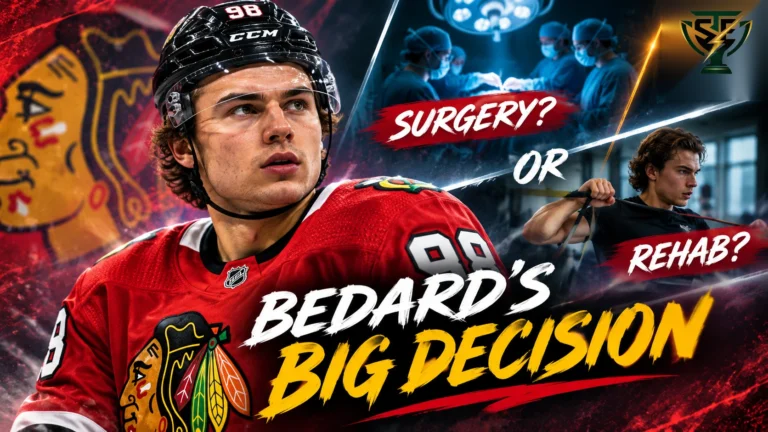
CHICAGO, United States, November 19, 2026: Connor Bedard will miss at least four Chicago Blackhawks games while the organization determines whether his latest right shoulder injury requires surgery or can be managed through rehabilitation. Coach Jeff Blashill confirmed that the 21-year-old captain will not play against the Columbus Blue Jackets or accompany Chicago on its upcoming three-game road trip. No recovery timetable has been established.
The Connor Bedard shoulder injury presents Chicago with a decision considerably more important than its next result. Bedard has now suffered three shoulder injuries in less than a year, including an earlier injury to the same right shoulder that healed without surgery and a separate left shoulder problem that required an operation in July. For a franchise that has invested $75 million and its leadership identity in Bedard, the question is how to protect his long-term availability while determining whether another operation is necessary.
Key Takeaways
- Connor Bedard will miss at least four Chicago Blackhawks games while the organization determines whether his latest right shoulder injury requires surgery or can be managed through rehabilitation.
- The Connor Bedard shoulder injury presents Chicago with a decision considerably more important than its next result.
- Blashill confirmed Thursday that the Blackhawks were still collecting medical information before determining the appropriate course of treatment.
- Bedard was injured 54 seconds into the third period of Chicago’s 6-3 victory over Toronto.
Connor Bedard Shoulder Injury: Surgery and Rehabilitation Both Under Consideration
Blashill confirmed Thursday that the Blackhawks were still collecting medical information before determining the appropriate course of treatment.
Story at a glance
Connor Bedard Shoulder Injury: Surgery and Rehabilitation Both Under Consideration
Blashill confirmed Thursday that the Blackhawks were still collecting medical information before determining the appropriate course of treatment.
Three Shoulder Injuries Have Changed the Blackhawks’ Risk Calculation
Bedard’s recent medical history explains why Chicago is taking time to consider its options.
The Faceoff Question Is Now Part of Bedard’s Long-Term Development
Bedard was injured 54 seconds into the third period of Chicago’s 6-3 victory over Toronto.
Bedard’s Absence Exposes How Much Chicago Has Built Around One Player
The Blackhawks’ concern extends beyond the loss of a leading scorer.
What Chicago’s Attack Loses Without Bedard
Bedard’s primary offensive contribution involves more than finishing scoring opportunities.
The coach’s comments established two important facts. Surgery is a possibility, but it has not been confirmed as necessary. Rehabilitation remains under consideration, but the organization has not announced that nonsurgical treatment will be sufficient.
That uncertainty makes it inappropriate to predict when Bedard will return.
Chicago has ruled him out for its next four games, which provides the first definite period of absence. It does not establish that he will be medically cleared immediately afterward.
The NHL’s official report on Chicago’s treatment decision confirms the planned absence and the ongoing evaluation.
The distinction between the two potential treatment paths matters because Bedard injured his right shoulder previously and recovered without an operation. That history is relevant to the current evaluation, but it does not determine the appropriate treatment this time.
What Doctors Must Establish Before Choosing a Treatment
The Blackhawks have not publicly disclosed a complete structural diagnosis. Without that information, nobody outside Bedard’s medical team can reliably determine whether surgery or rehabilitation is preferable.
In general, the choice may depend on the specific tissue affected, the severity of any damage, joint stability, functional limitations, previous injuries and the demands of returning to professional hockey.
For Bedard, the final consideration is especially important. His responsibilities include puck battles, shooting, physical contact and faceoffs, all of which can place different demands on the shoulders.
| Consideration | Rehabilitation | Surgery |
|---|---|---|
| Medical suitability | Depends on the precise injury and whether function and stability can be restored without an operation | Depends on whether the diagnosed injury warrants operative treatment |
| Recovery planning | Requires reassessment of symptoms, strength, stability and hockey-specific function | Requires postoperative healing and a structured rehabilitation program |
| Previous injury | Earlier nonsurgical recovery is relevant medical history | Prior injury may be relevant, but does not independently establish a need for surgery |
| Return to competition | Depends on medical clearance and ability to tolerate playing demands | Depends on the procedure, recovery and medical clearance |
| Current status | Under consideration | Under consideration |
This comparison describes general treatment considerations, not a recommendation for Bedard. No diagnosis, proposed surgical procedure or individualized recovery estimate has been publicly verified.
Three Shoulder Injuries Have Changed the Blackhawks’ Risk Calculation
Bedard’s recent medical history explains why Chicago is taking time to consider its options.
The first setback occurred in December 2025, when he injured his right shoulder during a late faceoff against the St. Louis Blues. He missed 12 games and recovered without surgery.
In July 2026, he injured his left shoulder during an offseason training session in Vancouver. That injury required surgery and forced him to miss the opening six games of the current campaign.
He returned earlier than the original projection, making his season debut against Pittsburgh on October 13.
The latest injury occurred November 17 against Toronto, again during a faceoff and again involving his right shoulder.
| Injury | Shoulder | Circumstances | Confirmed outcome |
|---|---|---|---|
| December 2025 | Right | Faceoff against St. Louis | Missed 12 games; recovered without surgery |
| July 2026 | Left | Offseason training in Vancouver | Surgery; missed first six games of the season |
| November 2026 | Right | Faceoff against Toronto | At least four games out; treatment undecided |
The NHL’s announcement of Bedard’s previous shoulder surgery documents the separate left shoulder injury and the original recovery expectations.
These incidents must not be confused. The shoulder operated on during the offseason is not the shoulder involved in the latest injury.
At the same time, the two right shoulder incidents occurred during comparable game situations. That connection makes Bedard’s future faceoff responsibilities a legitimate subject for the Blackhawks’ coaching and medical staff to examine.
It does not establish that the latest injury resulted from inadequate rehabilitation or that the earlier treatment decision was wrong.
The Faceoff Question Is Now Part of Bedard’s Long-Term Development
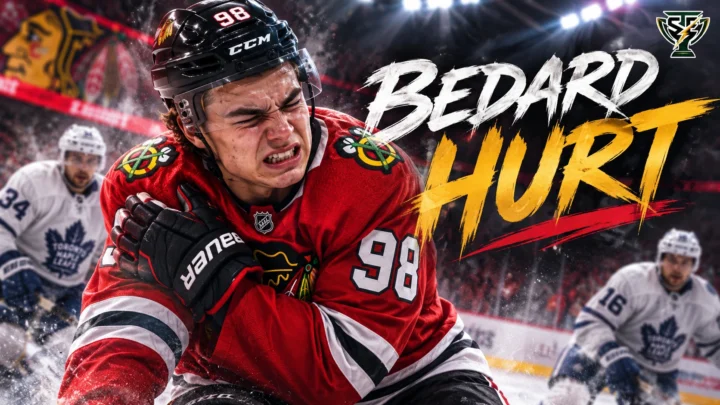
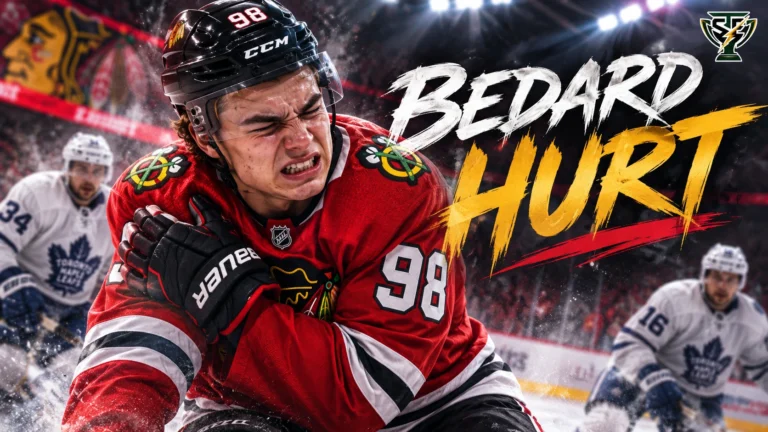
Bedard was injured 54 seconds into the third period of Chicago’s 6-3 victory over Toronto.
As he prepared to take a faceoff against Maple Leafs forward Nick Paul, their sticks made contact. Bedard immediately reacted in pain and left the ice.
The latest incident closely resembles the circumstances surrounding his previous right shoulder injury against St. Louis.
That history raises a practical question: should Chicago continue asking its most important offensive player to handle regular faceoffs after he eventually receives medical clearance?
The answer cannot come from the injury video alone.
Faceoffs are a significant part of a center’s duties, but a team’s deployment can be adjusted without necessarily removing the player from the middle of the ice during ordinary play.
Three Possible Ways to Manage Bedard’s Faceoff Workload
Retain his normal responsibilities: If the medical staff determines that Bedard can safely return to all competitive activities, Chicago could preserve his existing role. This would minimize changes to its offensive structure.
Assign selected draws to teammates: Another player could take some faceoffs while Bedard resumes his offensive responsibilities after the draw. The coaching staff would need to account for positioning and defensive assignments.
Consider more time on the wing: Moving Bedard to a wing position could reduce routine faceoff demands, but it would also change how Chicago uses his playmaking ability and distributes responsibility through the middle.
None of these adjustments has been established as a medically effective way to prevent another injury. They are tactical possibilities, not treatment recommendations.
The club must first understand the injury and determine what Bedard can safely tolerate.
Bedard’s Absence Exposes How Much Chicago Has Built Around One Player
The Blackhawks’ concern extends beyond the loss of a leading scorer.
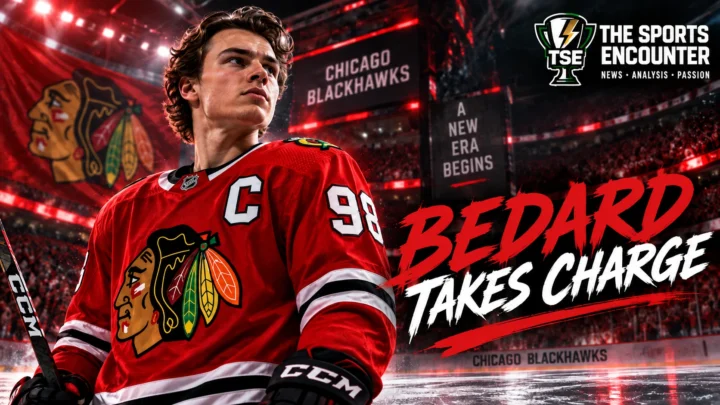
Bedard was named captain in September, becoming the 37th captain in franchise history and the second-youngest player to hold the position behind Jonathan Toews.
The decision represented Chicago’s confidence in him as the central figure of its rebuilding project.
As examined in The Sports Encounter’s analysis of Bedard’s appointment as captain, the franchise has connected his development to both its playing identity and long-term leadership.
Chicago reinforced that commitment by signing him to a five-year, $75 million extension carrying an average annual value of $15 million.
Bedard finished the previous season with career highs of 30 goals, 45 assists and 75 points in 69 games. Those numbers demonstrate the difficulty of replacing his production through ordinary lineup adjustments.
His wider career production also highlights the scale of Chicago’s investment. Through 234 NHL appearances, he has recorded 221 points, including 82 goals and 139 assists.
The Sports Encounter examined the financial significance of his extension in its ranking of the NHL’s highest-paid players.
However, the contract should not be used to suggest that Chicago must select surgery or rehabilitation for financial reasons. Treatment decisions must be based on medical evidence and the player’s health.
The business implication is different: a team building around one elite player must develop sufficient depth to remain competitive when that player is unavailable.
What Chicago’s Attack Loses Without Bedard
Bedard’s primary offensive contribution involves more than finishing scoring opportunities.
He can create chances through puck handling, passing and his shooting threat, forcing opponents to adjust defensive coverage.
His absence changes the assignments given to other Blackhawks forwards and affects how the team organizes possession in the attacking zone.
Frank Nazar becomes particularly important because he offers another young offensive presence capable of creating plays through the middle.
Tyler Bertuzzi provides a different profile, contributing through physical play, positioning around the net and scoring opportunities closer to goal.
Patrick Kane brings experience and creativity after returning to Chicago, giving the Blackhawks another player capable of organizing attacking possessions.
The importance of Kane’s return was examined in TSE’s analysis of his reunion with the Blackhawks.
The combination gives Chicago options, but none should be expected to reproduce Bedard’s complete contribution independently.
The coaching challenge is to distribute his responsibilities across the lineup without placing unrealistic expectations on another young player.
Chicago’s Six-Goal Performance Against Toronto Offers Hope, Not Proof
The Blackhawks’ victory over Toronto showed that they possess contributors capable of producing offense beyond their captain.
Bertuzzi recorded two goals and an assist, Nazar scored twice, and defenseman Sam Rinzel collected three assists.
Spencer Knight made 31 saves as Chicago secured a 6-3 victory and improved to 6-13-2.
Bedard also scored before leaving the contest, demonstrating why his removal remained a significant loss despite the result.
The Blackhawks’ official Toronto game report confirms the scoring contributions and circumstances of his departure.
One high-scoring game cannot establish that Chicago will sustain similar production without Bedard.
Opponents will have more time to prepare for a lineup without him, while Chicago must redistribute ice time and special-teams responsibilities.
The Blackhawks have also faced injuries elsewhere, including defenseman Bowen Byram’s absence. TSE previously examined the pressure that injury placed on Chicago’s defensive depth in its report on the Byram and Isaac Howard injury situations.
Bedard’s absence adds another problem to a squad already struggling to establish consistent results.
Four Games Without Bedard Create an Immediate Test for Jeff Blashill
Chicago will face Columbus without its captain before beginning a three-game road trip.
Continue the NHL Story

That confirmed absence provides an opportunity to evaluate how the Blackhawks function when their most important forward is unavailable.
The immediate issues include offensive-zone entries, power-play organization, forward combinations and the distribution of possession responsibilities.
Blashill must also manage the demands placed on Nazar and the other young forwards, particularly if Chicago struggles to create quality scoring chances.
The Blackhawks have shown occasional resilience this season. Bedard’s return in October initially offered renewed hope following the offseason injury.
The Sports Encounter examined his early influence in its analysis of Chicago’s improvement after his return.
The new challenge is to demonstrate that the team can maintain a recognizable attacking structure when he is absent.
That task cannot be reduced to whether Chicago wins its next game. The quality of chance creation, defensive support and lineup adaptation will provide more useful evidence over multiple contests.
Why Chicago Cannot Put a Date on Bedard’s Return
The four-game absence is the minimum period confirmed by the Blackhawks, not a promised recovery timeline.
If rehabilitation is selected, the medical team will need to assess how the shoulder responds and whether Bedard can regain the required function and stability.
If surgery is selected, the nature of the procedure and postoperative rehabilitation would determine the recovery process.
Neither path can be given a reliable timetable without details that have not been publicly disclosed.
The latest Connor Bedard shoulder injury therefore creates more uncertainty than an ordinary short-term absence.
The Blackhawks must make a decision about treatment before the coaching staff can meaningfully plan for his longer-term return.
That uncertainty also makes it inappropriate to compare the duration of the two earlier injuries and assume a similar outcome.
Even when incidents involve the same joint, the underlying damage and treatment requirements may differ.
What This Decision Means for Chicago’s Rebuild
Bedard’s importance to the franchise is already established through his scoring, leadership responsibilities and long-term contract.
The current situation tests whether Chicago’s planning extends far enough beyond its cornerstone player.
Nazar, Kane and Bertuzzi can help redistribute attacking responsibilities. Other forwards must improve their contributions, and the defensive group must support a team that may find it harder to maintain possession without its captain.
Chicago’s 6-13-2 record also limits the value of chasing short-term results at the expense of sensible longer-term decisions.
That does not mean Bedard’s recovery should be delayed unnecessarily. It means the timing of his return should follow the medical evidence rather than the urgency created by the standings.
The Blackhawks have already demonstrated their willingness to invest heavily in his future. The next test is ensuring that the same long-term perspective governs his treatment and eventual return to competition.
The Connor Bedard shoulder injury now leaves Chicago facing two separate challenges: choosing the appropriate medical treatment and proving the team can function more effectively without depending on one player to solve every offensive problem.
The four confirmed missed games are only the immediate consequence. The decision between rehabilitation and surgery, and the responsibilities Bedard carries when he returns, will matter much more to the Blackhawks’ future.
Connor Bedard
- Connor Bedard Shoulder Injury Forces Blackhawks’ Surgery Decision
- Connor Bedard Shoulder Injury Leaves Blackhawks Facing Another Difficult Decision
- NHL Preview: Bedard Brings Belief, Detroit Seeks Home Relief, and Carolina Chases Seven
- Bedard Nears Early Return as Duchene’s Three-Month Absence Tests Two NHL Futures
- Connor Bedard Gets the C as Chicago Finally Hands Him the Blackhawks’ Future