Key Takeaways
- The Norwegian Ice Hockey Association confirmed its position in a statement published on November 3.
- In its official November 3 announcement, the Norwegian federation reaffirmed its position that Russia should remain excluded from international championships while the war in Ukraine continues.
- Opposition to Russia’s return has been evident since the CAS judgment on October 30.
- Germany is scheduled to host the 2027 men’s championship in May, with competition preparations centered on Düsseldorf, Mannheim and Gelsenkirchen.
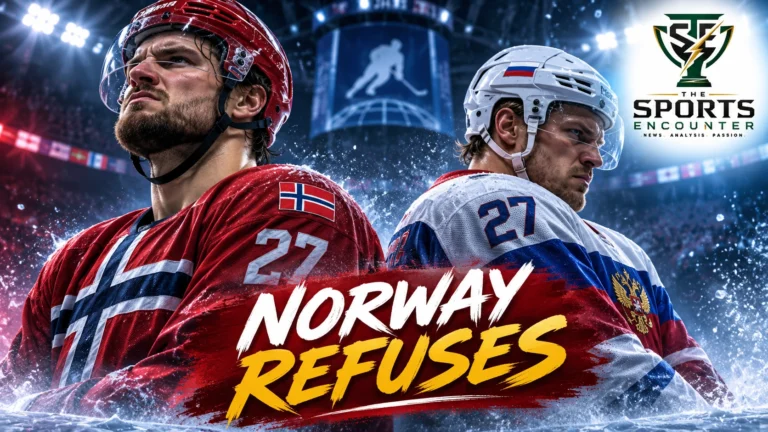
OSLO, Norway, November 3, 2026: Norway has announced that its national ice hockey team will refuse to play Russia at the 2027 IIHF Men’s World Championship in Germany, escalating an international dispute just four days after the Court of Arbitration for Sport overturned Russia’s exclusion from major hockey tournaments. The Norwegian Ice Hockey Association formally informed the International Ice Hockey Federation of its position on Monday, November 2, citing concerns about player safety, psychological welfare and the continuing war in Ukraine. Norway intends to contest its other group-stage matches normally.
The decision adds Norway to a growing group of European hockey nations resisting Russia’s return and creates an immediate test for the IIHF. Russia has secured a legal victory, but tournament organizers must now determine how to accommodate its participation while addressing opposition from competing federations, host authorities and commercial partners. Finland has also declared its refusal to face Russia, Germany has expressed serious reservations about hosting under the changed circumstances, and a longstanding World Championship sponsor has withdrawn. With the men’s tournament scheduled for May 2027 and the World Juniors beginning this December, the governing body faces difficult decisions about eligibility, fixtures, sporting fairness and potential forfeits.
Norway Refuses to Play Russia at the 2027 World Championship: What Has Been Confirmed?
The Norwegian Ice Hockey Association confirmed its position in a statement published on November 3.
Story at a glance
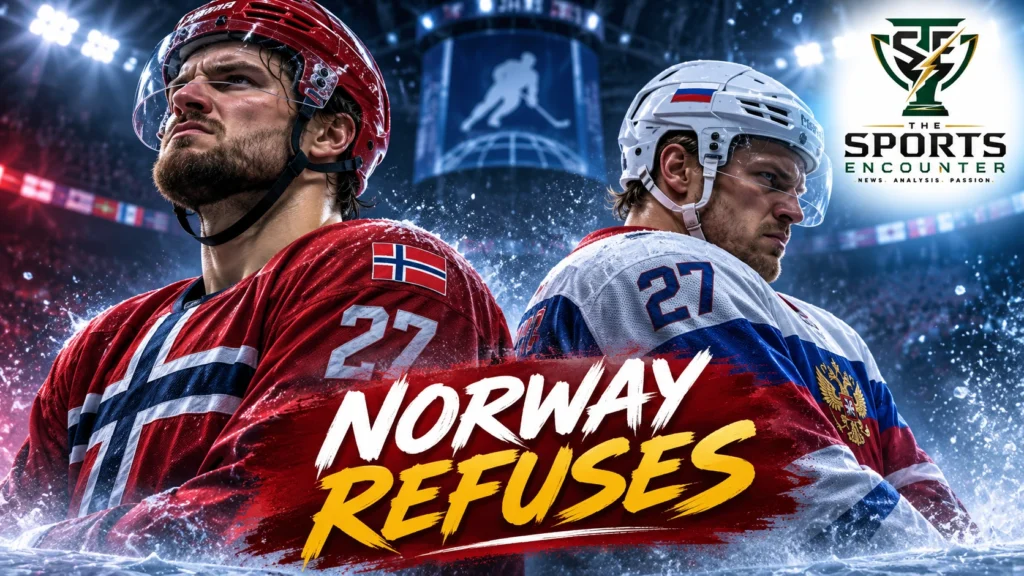
Norway Refuses to Play Russia at the 2027 World Championship: What Has Been Confirmed?
The Norwegian Ice Hockey Association confirmed its position in a statement published on November 3.
Why Norway’s Refusal Matters More Than Another Protest Statement
Opposition to Russia’s return has been evident since the CAS judgment on October 30.
How Did the Russia Hockey Dispute Reach This Point?
Russian national teams have been excluded from IIHF championships since 2022 following Russia’s full-scale invasion of Ukraine.
What Did CAS Decide, and What Did It Leave Unresolved?
The CAS decision changes Russia’s legal position within the IIHF competition system.
Finland Joins Norway in Refusing to Play Russia
Finland has adopted a similarly firm position.
The association said that, based on the current circumstances and the information available, Norway would not take part in a match against Russia at the World Championship in Germany.
It confirmed that the decision had been communicated to the IIHF board on November 2.
The statement also made a distinction that matters for the competition: Norway intends to play its remaining group-stage fixtures as normal.
In its official November 3 announcement, the Norwegian federation reaffirmed its position that Russia should remain excluded from international championships while the war in Ukraine continues.
It also emphasized its responsibility to protect the physical safety, mental well-being and personal security of players, team personnel and their families.
That means Norway’s position is not presented solely as a political protest. Its governing body has explicitly framed the decision as a player-welfare and security issue.
Norway’s Decision at a Glance
| Question | Confirmed Position |
|---|---|
| Will Norway play Russia? | No, under the current circumstances stated by its federation |
| Which tournament is affected? | 2027 IIHF Men’s World Championship |
| Host country | Germany |
| When was the IIHF informed? | November 2, 2026 |
| When was the decision announced publicly? | November 3, 2026 |
| Will Norway play other group matches? | Yes, according to its federation |
| Has a match been officially forfeited? | No confirmed forfeit |
| Has Norway been disqualified? | No confirmed disqualification |
| Has the IIHF finalized Russia’s entry arrangements? | Not established in the official statements reviewed |
The final three points are particularly important.
Norway has announced its intended conduct if required to face Russia. That does not mean the IIHF has already determined the disciplinary or competitive consequences.
Nor has a new Russia-Norway fixture been independently established through a finalized post-ruling schedule.
Why Norway’s Refusal Matters More Than Another Protest Statement
Opposition to Russia’s return has been evident since the CAS judgment on October 30.
Several national federations criticized the ruling, and host authorities raised concerns about the implications for upcoming championships.
Norway’s latest announcement goes further.
It states what the country intends to do if it is required to compete against Russia.
That moves the dispute beyond expressions of disagreement and into potential consequences for tournament operations.
The IIHF must consider how to uphold its obligations following the court ruling while administering a championship in which participating teams are expected to fulfill their scheduled fixtures.
The difficult question is whether those responsibilities can be reconciled without creating further disputes.
This is the central development since The Sports Encounter’s October 30 analysis of Russia’s successful CAS appeal.
That report examined Russia’s legal victory and the problems of implementation. Norway’s refusal now provides a concrete example of how those problems could affect competition.
How Did the Russia Hockey Dispute Reach This Point?
Russian national teams have been excluded from IIHF championships since 2022 following Russia’s full-scale invasion of Ukraine.
The exclusion was maintained through subsequent championship seasons, with the governing body repeatedly citing safety, security and competition-integrity concerns.
In 2026, the Russian Ice Hockey Federation challenged the continued restrictions.
An IIHF disciplinary decision in May required the governing body to reconsider the exclusion. The IIHF Council conducted another review and decided in July that Russia could not participate in several championships during the 2026-27 season.
Russia then pursued the matter before CAS.
On October 30, the court overturned the contested exclusions, finding that the evidence presented did not sufficiently justify maintaining them under the applicable framework.
The IIHF expressed disappointment but acknowledged that it must respect the judgment.
Timeline of the Dispute
| Date | Development | Consequence |
|---|---|---|
| February 2022 | Russia launches its full-scale invasion of Ukraine | Russian teams subsequently excluded from IIHF competitions |
| January 2026 | IIHF Council maintains restrictions | Russia challenges the exclusion |
| May 25, 2026 | IIHF disciplinary decision overturns the earlier Council decision | Further competition-specific review required |
| July 30, 2026 | IIHF announces event-by-event restrictions | Russian participation refused in several 2027 tournaments |
| October 30, 2026 | CAS overturns challenged exclusions | IIHF must consider implementation of Russian participation |
| November 2, 2026 | Norway informs IIHF it will not face Russia | Potential fixture-compliance dispute emerges |
| November 3, 2026 | Norway publicly confirms its position | International pressure on IIHF intensifies |
The legal and sporting dimensions must remain separate.
CAS overturned the restrictions under review. It did not declare that the war had ended or that every safety concern raised by participating federations was necessarily unfounded.
The judgment also did not resolve every practical condition governing Russia’s return.
What Did CAS Decide, and What Did It Leave Unresolved?
The CAS decision changes Russia’s legal position within the IIHF competition system.
Before the ruling, the governing body’s event-specific restrictions prevented Russia from participating in the affected championships.
The judgment overturned those decisions.
However, the court did not provide a complete operating plan for organizers.
The IIHF’s official October 30 response acknowledges the ruling while emphasizing that participant safety and the integrity of its championships remain central concerns.
The IIHF also warned that changes to competitions already in advanced preparation require extensive coordination with national associations and host authorities.
Legal Rights vs Tournament Responsibilities
| Issue | Established Position | Unresolved Question |
|---|---|---|
| Russia’s exclusion | CAS overturned the challenged IIHF restrictions | How will participation be implemented? |
| IIHF compliance | IIHF says it will respect the ruling | What arrangements will be adopted? |
| Norway’s position | Refusal to face Russia announced | Will a relevant fixture arise under the revised arrangements? |
| Player safety | Norway and IIHF have expressed concerns | What protective arrangements will satisfy applicable requirements? |
| National symbols | Not resolved by the judgment | Will Russian national symbols be permitted? |
| Sporting consequences | No new forfeit ruling established | How would a refusal be treated under the rules? |
| Championship structure | Existing planning was completed without Russia | What changes, if any, are necessary? |
There is a difference between recognizing a team’s eligibility and establishing the conditions under which every participant can compete safely and fairly.
The IIHF must now address both.
Finland Joins Norway in Refusing to Play Russia
Finland has adopted a similarly firm position.
Finnish hockey officials have said their national teams will not play Russia while the war in Ukraine continues.
They have also contacted other member federations to build opposition to Russia’s reinstatement.
This introduces the possibility of coordinated resistance rather than isolated national decisions.
Finland is one of international hockey’s established powers. Its stance therefore carries considerable sporting significance.
Norway is a smaller hockey nation, but its decision creates the same fundamental administrative question.
If either federation refuses to play a scheduled match, the IIHF will need to apply the governing rules and determine the consequences.
No automatic collective boycott, mass withdrawal or cancellation should be assumed from the statements currently available.
European Hockey’s Response to Russia’s Return
| Country or Stakeholder | Publicly Reported Position | Potential Consequence |
|---|---|---|
| Norway | Will not face Russia under current circumstances | Possible unplayed match if scheduled |
| Finland | Refuses games against Russia while war continues | Potential fixture and compliance dispute |
| Germany | Opposes Russia’s return and is reviewing hosting implications | Security, operational and financial questions |
| Sweden | Federation has criticized Russian reinstatement | Further position or action remains to be established |
| Czech Republic | Hockey authorities oppose the return under current circumstances | Additional complications for hosted competitions |
| Finland’s Turku city authorities | Oppose hosting the 2028 World Juniors with Russia participating | Possible loss of a host city |
| AJ Products | Announced withdrawal of 2027 sponsorship | Commercial consequence already announced |
The positions are not identical.
Some federations have expressed opposition in principle. Norway and Finland have gone further by indicating they will refuse to compete against Russia.
The distinction matters when assessing the likelihood of actual match disruption.
What Happens if Norway Refuses to Play a Scheduled Russia Match?
This is the most important unanswered sporting question.
International championships require teams to fulfill their fixtures under published competition rules.
When a team refuses to play, organizers may face questions about match results, discipline, standings and procedural fairness.
But a general understanding of tournament rules is not sufficient to declare the outcome of this particular case.
The IIHF has not announced a confirmed consequence for Norway’s November 3 declaration.
Nor has a verified revised fixture assigning Russia to play Norway been established in the sources reviewed.
Any consequences would depend on the final tournament arrangements, applicable regulations and decisions made by the competent authorities.
Possible Russia-Norway Match Scenarios
| Scenario | What Would Happen? | Verification Status |
|---|---|---|
| Russia and Norway are not scheduled to meet | No direct Russia-Norway group fixture needs to be played | Depends on revised competition arrangements |
| They are scheduled and Norway maintains refusal | IIHF must determine the treatment of the unplayed fixture | No ruling announced |
| IIHF adopts an arrangement avoiding the matchup | Potential fixture conflict is reduced, subject to rules and fairness | Hypothetical, not announced |
| Norway’s position changes after further arrangements | A scheduled match could proceed | No change to its current refusal announced |
| Multiple nations refuse scheduled fixtures | Broader standings, disciplinary and format questions arise | Conditional scenario only |
The scenarios should not be read as predictions or as equally likely outcomes.
They identify decisions that could become necessary once Russia’s entry and the final championship structure are established.
A points deduction, technical defeat or expulsion should not be presented as inevitable before the IIHF rules on the matter.
Could a Forfeit Change the 2027 World Championship Standings?
Potentially, yes, if a relevant fixture is scheduled and the competent authority determines that it must be forfeited.
But the actual standings impact cannot be calculated without a confirmed group, match schedule and disciplinary decision.
A single unplayed group game could influence the number of points available to competing teams, depending on how the result is treated.
That could affect qualification for the knockout stage or the competition’s lower positions.
There is also a wider fairness issue.
If some opponents play Russia while others do not, the IIHF must ensure that its treatment of the fixtures is consistent with the applicable regulations.
That is the real competitive consequence behind Norway’s refusal.
It is not simply a matter of whether one country objects to another. It concerns whether every team in a championship is evaluated under a clear and consistent set of rules.
Germany Faces a Difficult Hosting Decision
Germany is scheduled to host the 2027 men’s championship in May, with competition preparations centered on Düsseldorf, Mannheim and Gelsenkirchen.
The tournament is expected to draw international supporters, team delegations, media organizations and commercial partners.
Germany’s hockey authorities have expressed opposition to Russia’s return and warned of significant security, political and economic consequences.
That creates another complication for the IIHF.
Even if Russia is legally entitled to participate, the governing body still needs the practical cooperation of the organizations responsible for staging the event.
Security planning cannot be completed through a sporting judgment alone.
Transport, accommodation, venue access, accreditation and emergency arrangements require agreement among multiple authorities.
Germany has not been confirmed as having surrendered hosting rights. Nor has a replacement host been appointed in the official information reviewed.
The possibility of hosting changes is therefore an issue to monitor, not an established outcome.
Swedish Sponsor AJ Products Withdraws From the 2027 Championship
The implications are already extending beyond national-team participation.
Swedish company AJ Products, a longtime sponsor of the men’s World Championship, announced it would withdraw its sponsorship of the 2027 event following the ruling on Russia’s return.
The company had been associated with the championship since 1989.
Its decision provides a concrete commercial consequence of the dispute.
It does not establish how much revenue the championship will lose, whether a replacement sponsor will be secured or whether additional companies will follow.
Those financial questions require subsequent verified announcements.
Nevertheless, the withdrawal demonstrates why international federation decisions extend beyond competition eligibility.
Commercial partners, host cities, broadcasters and ticket holders can all be affected when a major event becomes the subject of a prolonged dispute.
Ukraine’s Participation Makes the 2027 Championship More Sensitive
Ukraine has qualified for the men’s World Championship, returning to the top division after a long absence.
The possibility of Russia and Ukraine participating in the same championship creates additional security and diplomatic concerns.
No specific Russia-Ukraine match should be described as scheduled solely because the CAS ruling opens the way for Russian participation.
Ukraine’s hockey authorities have opposed Russia’s reinstatement, while Ukrainian officials have called for continued isolation of Russian national teams during the war.
Russia and its sporting authorities, by contrast, have welcomed the ruling as a legal victory against continued exclusion.
These positions are fundamentally different.
For Ukraine, the issue concerns participation by the national representatives of a country conducting an ongoing invasion.
For Russia, it concerns the right of its federation and teams to compete under the applicable international sporting framework.
For the IIHF, the immediate responsibility is to implement the ruling lawfully while addressing participant safety and competition integrity.
The distinction between institutional restrictions and the eligibility of individual athletes has also been examined in TSE’s earlier analysis of Russia’s exclusion from global sporting events.
That opinion article argues for greater consideration of individual eligibility, while acknowledging the security and ethical concerns raised by Ukraine and other countries. It should not be confused with the IIHF’s official position.
Why Hockey’s Russia Dispute Differs From Neutral Participation in Individual Sports
There is no single international policy governing Russian athletes across every sport.
Different federations have adopted different approaches.
In skiing and snowboarding, participation under neutral conditions has been permitted through specific individual eligibility arrangements.
The Sports Encounter examined those requirements in its report on FIS rules for Russian and Belarusian winter-sport competitors.
Team competitions create a different problem.
A national ice hockey team competes as a collective representative of its federation. It is not simply a group of independently entered athletes.
The use of flags, anthems, uniforms and national designations can therefore have greater significance.
The same wider legal and governance questions appear in TSE’s coverage of Russian athletics challenging World Athletics restrictions.
These examples demonstrate the complexity of international sport’s response to Russia, but they do not establish that an eligibility policy adopted in one federation must automatically apply to another.
What Does the Ruling Mean for Russian NHL Players?
The CAS judgment concerns Russian national-team participation in IIHF competitions.
It does not automatically change the contractual status of Russian players in the National Hockey League.
Players such as Nikita Kucherov, Kirill Kaprizov and Alexander Ovechkin have remained prominent in North American hockey during Russia’s international exclusion.
Their possible participation in a future Russian national team would require separate decisions concerning eligibility, selection, health, club commitments and the timing of the NHL playoffs.
For context, our ranking of the leading NHL players in 2026-27 examines Kucherov and Kaprizov alongside the league’s other major stars.
Similarly, TSE’s analysis of Alexander Ovechkin’s final NHL season provides the career context behind one of Russia’s most recognizable hockey figures.
However, a star’s NHL status does not establish national-team availability.
Russia cannot be assigned a hypothetical roster containing every leading Russian NHL player without verified selection and participation decisions.
Five IIHF Championships Are Affected by the CAS Ruling
The court’s decision concerns more than the men’s World Championship in Germany.
The IIHF identified five competitions affected by Russia’s appeal.
Its July 30 competition-specific review explains how the federation previously evaluated safety, security, feasibility and sporting integrity.
The October 30 judgment has overturned the relevant restrictions, leaving the governing body to determine the necessary implementation measures.
Championships Facing Russia Participation Questions
| Competition | Scheduled Period | Primary Challenge |
|---|---|---|
| 2027 World Junior Championship | Begins December 26, 2026 | Very limited preparation time for participation changes |
| 2027 Men’s World Championship | May 2027, Germany | Norway and Finland’s refusals, host concerns and competition structure |
| 2027 Women’s World Championship | November 2027 | Future entry and security arrangements |
| 2027 Under-18 Men’s World Championship | 2027 | Entry procedures and tournament organization |
| 2027 Under-18 Women’s World Championship | 2027 | Entry procedures and host-country coordination |
The first immediate deadline is the World Junior Championship in Canada.
Its December 26 start gives the IIHF and organizers substantially less preparation time than the men’s tournament in Germany.
Any changes to participation must also be assessed against the impact on teams that have already prepared under the original arrangements.
Could Norway’s Decision Trigger a Wider Boycott of International Hockey?
It could encourage other federations to take similar positions, but a coordinated tournament boycott has not been established through the available official statements.
Finland’s effort to gather support from fellow associations demonstrates the possibility of collective action.
Germany’s concerns and the sponsorship withdrawal increase the pressure on the IIHF.
However, statements of opposition should not be counted as confirmed withdrawals.
There are important differences between refusing to face a particular opponent, withdrawing from an entire championship and declining to host an event.
Each decision may have different consequences under competition rules and contractual arrangements.
The IIHF must establish what has actually been decided by individual federations before it can assess the combined impact.
Can the IIHF Protect Sporting Fairness While Addressing Safety Concerns?
This is the difficult governance question at the center of the dispute.
The governing body must respect the legal consequences of the CAS judgment while administering competitions in a manner consistent with its published regulations.
It must also respond to safety concerns raised by participating countries.
Those responsibilities are not automatically incompatible, but reconciling them may require detailed arrangements and further consultation.
The challenge resembles other questions of competitive integrity in hockey, where a single result or headline statistic cannot fully explain the conditions underlying a team’s performance.
Our analysis of NHL goal differential and the weaknesses hidden by standings illustrates how results must be interpreted within their competitive context.
At international level, however, the issue goes beyond performance statistics.
Competition administrators need to establish who is eligible, what constitutes compliance with fixture obligations and how disputes will be resolved.
Without those answers, the meaning of the standings themselves could become contested.
What Should Hockey Fans Watch for Next?
The next important developments will come from the IIHF and the national associations involved.
Fans should look for an official plan covering Russian participation, confirmation of championship entry arrangements, and clarification of how tournament rules would apply to any refusal to play.
Announcements by Norway, Finland and Germany will also help establish whether current opposition translates into further formal action.
The international controversy is separate from the ongoing NHL schedule. Our 2026-27 NHL season preview explains the North American competition calendar and why NHL club commitments must be considered separately from IIHF eligibility.
Meanwhile, TSE’s November 3 NHL preview provides ongoing coverage of leading players and team performances.
For the international championship timetable, readers can also consult The Sports Encounter’s upcoming sports events calendar, with official IIHF announcements taking precedence if dates or arrangements change.
Continue the NHL Story
 NHLNHL Roundup: Colorado’s Five-Goal Rally, Detroit’s 45-Second Blitz and Boston’s Shootout Escape
 NHLMcDavid’s Historic Streak, Nugent-Hopkins’ Record and 11 Games That Could Affect the Stanley Cup Race
 NHLMcDavid’s Historic Start Continues, Hurricanes Trounce Jets 7-0 as Ducks Produce a Six-Goal Comeback
Frequently Asked Questions About Norway, Russia and the 2027 Hockey Worlds
Has Norway officially refused to play Russia at the 2027 Hockey World Championship?
Yes. The Norwegian Ice Hockey Association publicly announced the decision on November 3, 2026, after communicating it to the IIHF board on November 2.
Why will Norway not play Russia?
The federation cited Russia’s continuing war in Ukraine and concerns about the safety, welfare and mental health of its players, personnel and their families.
Will Norway withdraw from the entire tournament?
Norway has said its other group-stage matches will proceed normally. It has not announced a complete withdrawal.
Has Russia been reinstated by CAS?
CAS overturned the challenged IIHF exclusion decisions on October 30, 2026. Practical competition arrangements remain subject to implementation by the IIHF.
Is Russia already scheduled to play Norway?
No finalized post-ruling Russia-Norway fixture has been independently verified in the official sources reviewed.
Will Norway lose points for refusing to play?
No specific points deduction or forfeit has been officially established. Any consequence would require application of the relevant competition rules and decisions by the competent authorities.
Has Finland also refused to play Russia?
Yes. Finland’s hockey association has publicly stated that its national teams will not play Russia while the war in Ukraine continues.
Where is the 2027 IIHF Men’s World Championship being held?
Germany remains the designated host, with preparations involving Düsseldorf, Mannheim and Gelsenkirchen.
Could Germany lose the right to host the tournament?
German hockey authorities have raised concerns about the consequences of Russia’s return, but no confirmed transfer of hosting rights has been established.
Has the 2027 World Championship been canceled?
No. The tournament has not been officially canceled.
Are Russian NHL players affected by the CAS decision?
The ruling concerns IIHF national-team competitions. It does not automatically change NHL player contracts or guarantee national-team selection.
What happens next?
The IIHF must clarify Russia’s participation arrangements, consult affected stakeholders and explain how competition rules will apply if participating countries refuse scheduled fixtures.
Final Analysis: Russia Has Won in Court, but Norway Has Exposed Hockey’s Next Crisis
Norway’s refusal to face Russia is more than another expression of opposition to the CAS ruling.
It introduces the possibility of an international championship in which a legally eligible team cannot count on every opponent agreeing to compete.
Russia’s position has been strengthened by the court judgment.
Norway’s governing body has nevertheless concluded that playing against Russia under current circumstances would expose its delegation to unacceptable risks.
Finland has adopted a similar position, while Germany and other European hockey authorities have raised serious objections.
The IIHF must therefore make decisions that cannot be postponed indefinitely.
It needs to determine how Russia will enter the affected tournaments, whether additional participation conditions apply, how host authorities will address security concerns and what will happen if teams refuse to play.
Those are not interchangeable questions.
Legal eligibility, athlete welfare, sporting integrity and competition administration each require clear answers.
The court’s ruling resolved the validity of the challenged exclusions. It did not produce a complete championship schedule or determine how an actual match refusal should be treated.
For Norway, the declaration establishes a clear national position.
For Russia, it presents another obstacle to its proposed return.
For the IIHF, it creates an immediate governance test with consequences extending beyond the 2027 men’s tournament.
And for international hockey, it raises a fundamental question: can a world championship remain fair and workable when participating countries disagree so strongly over who should be allowed onto the ice?
The answer will depend on official decisions, not predictions. Until the IIHF publishes a workable response, Norway’s announcement remains one of the clearest signs that Russia’s legal victory has opened a new chapter of uncertainty rather than ending the dispute.