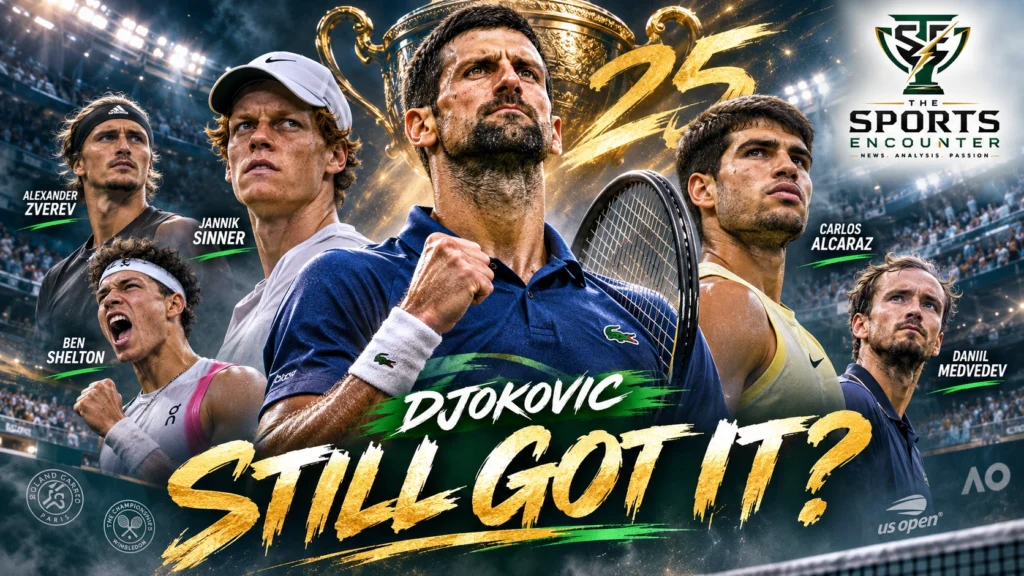
Key Takeaways
- If the argument for Djokovic’s decline rests on the assumption that he can no longer survive against Sinner, the 2026 Australian Open provides an important rebuttal.
- The phrase “mental block” is tempting because Djokovic has repeatedly fallen short of Slam No. 25.
- The most encouraging part of Djokovic’s second half of 2026 came at the China Open.
- Djokovic entered the Paris Masters ranked 11th in the ATP Race to Turin.
PARIS, France, November 3, 2026: Novak Djokovic is 39, has not won a Grand Slam since the 2023 US Open, and has spent much of this season fighting physical problems that have threatened to turn his pursuit of a record 25th major into an increasingly distant dream. Yet the man supposedly approaching the end of his tennis shelf life defeated Jannik Sinner in five sets at the Australian Open, pushed Carlos Alcaraz in the Melbourne final, and beat Alexander Zverev on his way to a 102nd career title in Beijing. As Djokovic prepares for the Paris Masters, the evidence presents an uncomfortable question for both his critics and admirers: is the greatest men’s Grand Slam champion of all time finished, or is he still capable of one extraordinary final act?
The answer lies somewhere between the brilliance of his Australian Open semifinal and the painful reality of his early exits at Roland Garros and the US Open. Djokovic remains tactically sophisticated enough to beat elite opponents on the right day. His difficulty is sustaining that level through seven demanding Grand Slam matches while younger rivals, including Sinner, Alcaraz, Ben Shelton, João Fonseca and Jakub Menšík, continue improving. Djokovic says his physical condition is becoming more manageable after a difficult year. Whether that improvement lasts could decide if he finishes his career with 24 majors or claims the unprecedented 25th title that still drives his ambitions.
Novak Djokovic in 2026: The Career Numbers That Matter
Before deciding whether Djokovic’s career is approaching its conclusion, it is worth separating what he has already accomplished from what he is still trying to achieve.
Story at a glance
Novak Djokovic in 2026: The Career Numbers That Matter
Before deciding whether Djokovic’s career is approaching its conclusion, it is worth separating what he has already accomplished from what he is still trying to achieve.
Does Novak Djokovic Still Have the Level to Win Another Grand Slam?
Yes, but producing championship-level tennis for one match and producing it throughout a Grand Slam are different demands.
The Australian Open Proved Djokovic Could Still Beat Sinner
If the argument for Djokovic’s decline rests on the assumption that he can no longer survive against Sinner, the 2026 Australian Open provides an important rebuttal.
Why Carlos Alcaraz Has Become Djokovic’s Most Difficult Grand Slam Obstacle
Djokovic’s rivalry with Carlos Alcaraz is one of the most revealing competitive relationships in modern tennis.
Jannik Sinner: Has the Student Finally Surpassed the Master?
Of all Djokovic’s modern rivals, Sinner may represent the most direct challenge to the foundation of his tennis identity.
Read next Alcaraz Makes Vienna His Own: De Minaur Overpowered as Perfect ATP 500 Season Reaches 16-0
| Career Measure | Djokovic’s Record | Historical Significance |
|---|---|---|
| Grand Slam singles championships | 24 | Men’s all-time record |
| Australian Open singles titles | 10 | Men’s tournament record |
| Roland Garros singles titles | 3 | Completed the Career Grand Slam three times |
| Wimbledon singles titles | 7 | One behind Roger Federer’s men’s record of eight |
| US Open singles titles | 4 | Joint Open Era men’s record |
| ATP singles titles | 102 | Third among Open Era men, behind Jimmy Connors and Roger Federer |
| Weeks at world No. 1 | 428 | Record in ATP rankings history |
| Year-end No. 1 finishes | 8 | ATP record |
| ATP Finals titles | 7 | Competition record |
| Olympic singles gold medals | 1 | Won at Paris 2024 |
| Most recent Grand Slam championship | 2023 US Open | Victory over Daniil Medvedev |
| Most recent ATP singles championship | 2026 China Open | 102nd tour-level singles title |
These records establish something important. Djokovic does not need another championship to become the most successful male Grand Slam singles player. He already holds that distinction.
Rafael Nadal finished with 22 major singles titles. Roger Federer won 20. Djokovic’s 24 have given him a lead that neither retired rival can reduce.
The unresolved historical question concerns the broader men’s and women’s singles record. Margaret Court also won 24 Grand Slam singles championships, including titles before the Open Era began in 1968.
A 25th major would put Djokovic alone on 25 singles titles across men’s and women’s tennis history.
There is another distinction worth preserving. Grand Slam totals are powerful evidence in historical comparisons, but they are not the only measure of tennis greatness. Longevity, competition, playing surfaces, ranking dominance, the strength of opponents and achievements outside the majors all contribute to how careers are judged.
Djokovic already possesses an exceptionally strong case in those categories. His remaining career is about extending the distance between himself and the rest of the men’s game.
Does Novak Djokovic Still Have the Level to Win Another Grand Slam?
Yes, but producing championship-level tennis for one match and producing it throughout a Grand Slam are different demands.
Djokovic’s 2026 results make that distinction unusually clear.
He reached the Australian Open final by defeating Sinner in five sets, then lost to Alcaraz after taking the opening set. At Roland Garros, he surrendered a two-set lead against 19-year-old João Fonseca in the third round. At Wimbledon, he survived a five-set quarterfinal against Félix Auger-Aliassime before losing to Sinner in straight sets. At the US Open, Mariano Navone eliminated him in the first round.
That range of performances would be difficult to explain through talent alone.
Djokovic’s Four Grand Slam Campaigns in 2026
| Grand Slam | Result | Opponent Who Ended His Run | Defining Development |
|---|---|---|---|
| Australian Open | Runner-up | Carlos Alcaraz | Beat Sinner in five sets before losing final 6-2, 2-6, 3-6, 5-7 |
| Roland Garros | Third round | João Fonseca | Lost 6-4, 6-4, 3-6, 5-7, 5-7 after leading by two sets |
| Wimbledon | Semifinal | Jannik Sinner | Lost 4-6, 4-6, 4-6 after a five-set quarterfinal |
| US Open | First round | Mariano Navone | Lost in five sets despite leading two sets to one |
Source: Djokovic’s official 2026 results archive, with match outcomes and rounds recorded through November 3, 2026.
The statistical picture is revealing.
Across the four majors, Djokovic recorded 12 completed match victories and four defeats. His Australian Open walkover against Jakub Menšík was not a completed match, while Lorenzo Musetti’s retirement during their quarterfinal counts as a Djokovic victory.
That produces a 75% Grand Slam match-winning percentage for 2026.
The same statistic can support two apparently competing conclusions. Winning three out of every four completed major matches at 39 is an exceptional accomplishment. Yet a player pursuing a Grand Slam title must win the entire tournament, and 12 victories distributed across four majors do not substitute for seven victories at one event.
There is another remarkable pattern.
In Djokovic’s two most damaging early Slam defeats, against Fonseca in Paris and Navone in New York, he lost after establishing substantial advantages. His problem was not reaching a competitive position. It was sustaining it long enough to finish.
That is the first major warning sign for anyone predicting a 25th championship.
The Australian Open Proved Djokovic Could Still Beat Sinner
If the argument for Djokovic’s decline rests on the assumption that he can no longer survive against Sinner, the 2026 Australian Open provides an important rebuttal.
Djokovic defeated the Italian 3-6, 6-3, 4-6, 6-4, 6-4 in the semifinal. Sinner entered Melbourne as the defending champion and one of the strongest players of the preceding two seasons.
Djokovic lost the first set, responded in the second, fell behind again, then won the final two sets.
The victory required far more than flashes of his old brilliance. He had to solve problems over five sets, absorb Sinner’s baseline pressure and maintain enough composure to make the Italian play difficult points late in the contest.
That is precisely the kind of match many observers believed had become beyond him.
His performance revealed three enduring strengths: exceptional reading of an opponent’s patterns, the ability to redirect pace without surrendering control of the rally, and the confidence to adjust tactics when his initial approach fails.
But it also exposed a problem that would reappear during the rest of the season. He had to produce another elite performance almost immediately to win the title.
Alcaraz was waiting.
Why Carlos Alcaraz Has Become Djokovic’s Most Difficult Grand Slam Obstacle
Djokovic’s rivalry with Carlos Alcaraz is one of the most revealing competitive relationships in modern tennis.
Their head-to-head record stands at 5-5 following the 2026 Australian Open final.
Djokovic has beaten Alcaraz at major events, including the 2025 Australian Open quarterfinal and the 2024 Paris Olympic final. Alcaraz has defeated him in three Grand Slam finals: Wimbledon in 2023 and 2024, followed by Melbourne in 2026.
The overall record is balanced. Their championship encounters have not been.
The ATP’s official rivalry history documents a series in which the older champion has repeatedly demonstrated tactical mastery, only for Alcaraz to produce some of his finest tennis on the biggest occasions.
What Changed in the 2026 Australian Open Final?
Djokovic began the final brilliantly, winning the opening set 6-2.
He took control of exchanges early, attacked with his forehand and prevented Alcaraz from settling into the aggressive patterns that make him so dangerous.
For one set, the 25th title appeared entirely realistic.
Alcaraz then increased his intensity, improved his depth and gradually took greater control of the baseline. He won the following three sets 6-2, 6-3, 7-5.
The fourth set was important because Djokovic remained competitive. This was not a player suddenly incapable of challenging the younger champion.
Yet Alcaraz found a decisive break in the final game.
At 22, Alcaraz completed the Career Grand Slam, becoming the youngest man in the Open Era to win all four major championships.
For Djokovic, the defeat was doubly painful. It ended his perfect record in Australian Open finals, which had stood at ten victories from ten appearances.
More importantly, it showed the difference between controlling an elite opponent for a set and keeping him under control long enough to win a major final.
How Can Djokovic Beat Alcaraz Again?
His strongest route probably begins with preventing Alcaraz from dictating the rhythm of rallies.
Alcaraz thrives when he can alternate explosive forehands, defensive scrambling, changes of direction and sudden approaches to the net.
Djokovic needs to shorten the amount of time the Spaniard has to organize his attack.
That means taking the ball early, using the backhand down the line judiciously, returning aggressively enough to prevent easy first-strike patterns, and attacking the net when he has already created an advantage.
He must also manage the physical cost of those decisions.
Trying to defeat a younger player in extended neutral rallies for four or five hours is a very different proposition from winning a tactical contest by controlling the first four or five shots.
Djokovic’s Olympic victory in 2024 demonstrated that he can still construct a winning plan against Alcaraz. His 2026 Melbourne defeat demonstrated how difficult that plan is to sustain.
Jannik Sinner: Has the Student Finally Surpassed the Master?
Of all Djokovic’s modern rivals, Sinner may represent the most direct challenge to the foundation of his tennis identity.
Djokovic built much of his supremacy around elite returning, consistent depth, exceptional balance and the ability to defeat aggressive opponents by making them play one additional ball.
Sinner has developed many of those qualities while adding enormous pace from both wings.
The Italian leads their head-to-head series 7-5, although Djokovic’s Australian Open victory in January interrupted a run of defeats.
At Wimbledon in July, Sinner won 6-4, 6-4, 6-4. The scoreline suggested a significantly more comfortable contest than Melbourne.
The full rivalry can be examined through the ATP’s Sinner-Djokovic match history.
Djokovic vs Sinner: The Recent Grand Slam Pattern
| Tournament | Winner | Score | What the Result Revealed |
|---|---|---|---|
| Wimbledon 2023 semifinal | Djokovic | 6-3, 6-4, 7-6(4) | Djokovic’s superior management of decisive points |
| Australian Open 2024 semifinal | Sinner | 6-1, 6-2, 6-7(6), 6-3 | Sinner’s growing dominance from the baseline |
| Roland Garros 2025 semifinal | Sinner | 6-4, 7-5, 7-6(3) | Sinner’s ability to control extended exchanges |
| Wimbledon 2025 semifinal | Sinner | 6-3, 6-3, 6-4 | Difficulty sustaining resistance against Sinner’s relentless pace |
| Australian Open 2026 semifinal | Djokovic | 3-6, 6-3, 4-6, 6-4, 6-4 | Djokovic’s tactical resilience remains capable of reversing the matchup |
| Wimbledon 2026 semifinal | Sinner | 6-4, 6-4, 6-4 | Sinner’s consistency and physical intensity remain formidable obstacles |
The six meetings show a 4-2 Grand Slam advantage for Sinner.
More revealingly, Sinner has won four of the five major encounters between them since the start of 2024.
Djokovic’s solitary victory during that period came in Melbourne this year.
That result prevents any reasonable analyst from claiming he has no chance against Sinner. The broader sequence still establishes the Italian as the more reliable favorite over recent seasons.
Sinner’s 2026 campaign was eventually interrupted by knee problems, forcing him to end his season after winning Wimbledon.
Our analysis of Sinner’s season-ending injury and the consequences for the ATP rankings explains how even the younger generation faces difficult choices about managing physical demands.
That is relevant to Djokovic because it challenges the assumption that youth guarantees uninterrupted dominance.
Sinner is younger, faster in many exchanges and more consistent across the recent head-to-head record. But he is also an athlete whose future success depends on remaining healthy.
Djokovic does not need Sinner to decline. He needs his own game to remain strong enough to exploit opportunities when they arise.
Alexander Zverev: The 2026 Breakthrough Changes the Grand Slam Equation
Alexander Zverev deserves special attention because 2026 has transformed his career.
For years, the German was one of the clearest examples of a player whose ATP success exceeded his Grand Slam achievements.
He had elite serving, outstanding backhand consistency, Masters titles and prolonged experience at the top of the rankings. Yet the major trophies remained elusive.
That changed when he won Roland Garros and the US Open in 2026.
Zverev subsequently became ATP world No. 1 for the first time on November 2.
The Sports Encounter examined his rise in our detailed report on Zverev’s historic ranking breakthrough.
His emergence creates another formidable obstacle for Djokovic.
At 29, Zverev has reached a point where his physical experience and tactical discipline are supported by actual major-winning confidence.
Yet their October meeting in Beijing demonstrated that Djokovic can still outmaneuver him.
What Djokovic’s Beijing Victory Over Zverev Tells Us
Djokovic defeated Zverev 4-6, 6-4, 6-4 in the China Open quarterfinal.
Zverev struck 19 aces and repeatedly challenged Djokovic with powerful first serves.
The Serbian responded by improving his own service-point execution, making the German play difficult return games and finding breaks late in the second and third sets.
What stood out was his willingness to adjust rather than simply wait for Zverev to miss.
That tactical performance was the subject of The Sports Encounter’s analysis of Djokovic’s Beijing quarterfinal victory.
There is also an important limitation to the result.
One successful ATP 500 quarterfinal does not establish that Djokovic would automatically defeat Zverev in a five-set Grand Slam contest.
Still, it proves the matchup remains competitive.
Djokovic’s strategic intelligence, return quality and ability to neutralize big serving remain valuable weapons.
Ben Shelton: Does Djokovic Still Have an Answer to America’s Explosive Challenger?
Ben Shelton is a different kind of threat.
His left-handed serve can create immediate scoreboard pressure. He can finish points quickly, generate enormous pace and turn a close match into a sequence of tiebreaks.
Djokovic defeated Shelton 6-3, 6-2, 7-6(4) in their 2023 US Open semifinal, their only tour-level meeting through the current reporting date.
But the Shelton of 2026 is more experienced than the young American who reached that semifinal.
He made his first Grand Slam final at the 2026 US Open after defeating Carlos Alcaraz in a five-set quarterfinal and Frances Tiafoe in the semifinal.
Zverev eventually stopped him in four sets.
Our complete report on Shelton’s US Open final against Zverev analyzed how the American’s improving composure has begun supporting his attacking game.
That development should concern Djokovic.
The Serbian has historically been one of the finest returners against powerful servers. His ability to neutralize pace and force extra shots gives him a tactical foundation against Shelton.
However, a match dominated by short service games can place extraordinary pressure on a player’s own serve.
A single loose game or a poor tiebreak can decide an entire set.
At 39, Djokovic cannot assume he will always be able to rescue those situations through extended physical battles.
Shelton has not yet proved he can defeat Djokovic. He has proved that he is now capable of defeating opponents who are central to Djokovic’s remaining title ambitions.
Daniil Medvedev: An Older Rival Who Still Tests Djokovic’s Endurance
Daniil Medvedev belongs to a slightly older generation than Alcaraz and Sinner, but he remains an important reference point for Djokovic’s current competitive level.
The Russian famously defeated Djokovic in the 2021 US Open final, ending his attempt to complete a calendar-year Grand Slam.
Djokovic responded by beating Medvedev in the 2023 US Open final, claiming his 24th major title.
Their rivalry therefore connects two of the most consequential Grand Slam matches of Djokovic’s career.
The Serbian leads their overall head-to-head record 11-5.
They met again in the 2026 China Open semifinals. Djokovic led 7-5, 5-3 when Medvedev was disqualified, meaning the match did not reach an ordinary completed finish.
That qualification matters. The result counts as a Djokovic victory, but it should not be described as a conventional straight-sets win.
Why Medvedev Remains Tactically Dangerous
Medvedev’s defensive positioning, deep returns and ability to absorb pace can make points unusually long.
He is capable of forcing Djokovic to generate his own attacking opportunities rather than simply redirect an opponent’s power.
That creates a physical challenge.
Djokovic can still outthink and outmaneuver Medvedev, as their historical record demonstrates. But the cost of winning exchanges becomes increasingly relevant as the tournament advances.
The Beijing match reinforces the broader conclusion: Djokovic remains effective against established elite opponents, yet isolated match results cannot answer whether his body can withstand repeated demanding contests.
The New Generation Is Growing Faster Than Djokovic’s Margin for Error
Djokovic’s Grand Slam ambitions are being challenged by more than the five established names dominating most tennis discussions.
Several younger players are gaining experience, collecting major victories and developing the confidence to compete against opponents they once viewed as untouchable.
João Fonseca: The Teenager Who Exposed Djokovic’s Most Dangerous Weakness
João Fonseca’s victory over Djokovic at Roland Garros may be the most important defeat to examine when assessing the Serbian’s future.
The Brazilian was 19 and facing a player with 24 major titles.
Djokovic won the opening two sets 6-4, 6-4.
Fonseca then took the next three 6-3, 7-5, 7-5, completing an extraordinary comeback in four hours and 53 minutes.
The official match statistics recorded 167 total points for Djokovic and 164 for Fonseca.
That creates a remarkable statistical contrast.
Djokovic won three more points overall than the man who eliminated him.
It demonstrates how little a final score necessarily tells us about the distribution of pressure, the timing of decisive points and the physical demands of a match.
Fonseca converted the opportunities that mattered most during the closing stages.
There is no reliable basis for claiming Djokovic lost because of a psychological block. However, a defeat after leading by two sets, followed by another five-set loss at the US Open, raises reasonable questions about his ability to sustain his best tennis deep into physically demanding matches.
Fonseca’s victory also showed that younger players no longer need to be intimidated by Djokovic’s record.
Jakub Menšík: The Young Man Who Already Beat Djokovic in a Masters Final
Jakub Menšík provides another example.
The Czech defeated Djokovic 7-6(4), 7-6(4) in the 2025 Miami Open final, winning his first ATP title against one of his childhood idols.
The result carried historical significance because Djokovic had been attempting to win his 100th career ATP singles championship.
Menšík subsequently reached the fourth round of the 2026 Australian Open before an abdominal injury prevented him from facing Djokovic.
That intended rematch never happened, and it would be wrong to draw conclusions about an encounter that was not played.
The threat remains evident. Menšík possesses a powerful serve, aggressive baseline game and the confidence of having already defeated Djokovic in a major final at Masters level.
Arthur Fils, Learner Tien and Rafael Jódar
Arthur Fils brings a different combination of power, athleticism and attacking ambition.
His ability to impose himself from the baseline could become increasingly difficult for Djokovic if rallies are played at sustained high intensity.
Learner Tien has impressed with his anticipation, composure and ability to redirect the ball. His game is less dependent on spectacular power than the approaches favored by some other rising stars.
That makes him particularly interesting as a future opponent for Djokovic, whose own tactical intelligence has long been one of his greatest assets.
Rafael Jódar represents another developing challenge.
The young Spaniard made rapid progress during 2026, reaching the ATP Top 100 in March and winning his first tour-level title in Marrakech.
None of those achievements guarantees that Jódar will become a Grand Slam champion. His rise shows how quickly a new opponent can emerge in a tour already rich with established talent.
Lorenzo Musetti, Jack Draper and Félix Auger-Aliassime
Not every threat is a teenager.
Lorenzo Musetti has developed into a dangerous all-surface competitor with a one-handed backhand, variation and improved physical resilience.
He challenged Djokovic at the Australian Open in January, winning the first two sets before retiring during the third.
Djokovic progressed, but Musetti had demonstrated that he could establish a convincing lead against him.
Jack Draper also defeated Djokovic at Indian Wells in March, recovering from a set down to win 4-6, 6-4, 7-6(5).
Auger-Aliassime came close to eliminating Djokovic at Wimbledon. The Canadian pushed him through five sets before the Serbian survived a deciding match tiebreak.
These encounters illustrate how broad the competitive field has become.
Djokovic’s Main Rivals: Who Represents the Biggest Threat to Slam No. 25?
| Player | Relevant Evidence | Main Tactical Threat | Djokovic’s Opportunity |
|---|---|---|---|
| Jannik Sinner | Leads Djokovic 7-5; won four of their last five major meetings | Relentless baseline pace and depth | Disrupt rhythm, redirect early and exploit tactical changes |
| Carlos Alcaraz | 5-5 head-to-head; won three Slam finals against Djokovic | All-court speed, variety and explosive transitions | Take time away and control the opening exchanges |
| Alexander Zverev | Won two Slams in 2026; lost to Djokovic in Beijing | Big serve, backhand stability and improved confidence | Apply return pressure and vary rally patterns |
| Daniil Medvedev | Djokovic leads 11-5 | Defensive endurance and deep positioning | Use changes of pace and controlled aggression |
| Ben Shelton | Reached 2026 US Open final | Left-handed serve and first-strike power | Neutralize serve and extend return games |
| João Fonseca | Beat Djokovic at Roland Garros 2026 | Fearless attacking tennis and powerful baseline hitting | Control match tempo before rallies become physically expensive |
| Jakub Menšík | Beat Djokovic in 2025 Miami Masters final | Serve and aggressive hard-court patterns | Make him defend and play under sustained scoreboard pressure |
| Arthur Fils | Established as a fast-rising ATP contender | Athleticism and explosive ball striking | Use tactical variety against raw power |
| Learner Tien | Part of the emerging Next Gen group | Anticipation and early ball control | Use experience to disrupt his preferred rhythm |
| Rafael Jódar | Rapid rise in 2026 and first ATP title | Improving confidence and aggressive court positioning | Exploit inexperience in major-pressure situations |
Threat assessments are TSE tactical analysis based on verified performances, not predicted match results or statistical win probabilities.
The principal lesson is clear.
Djokovic’s competitive problem has changed. In his prime, most tournaments could be approached with a relatively stable assumption that he would be among the physically and tactically strongest players remaining in the draw.
Today, several opponents can beat him through different styles.
That makes draw difficulty, recovery time, playing conditions and tactical preparation more consequential than ever.
Are Djokovic’s Injuries and Physical Problems Becoming His Biggest Opponent?
Djokovic’s athletic longevity has been extraordinary, but it would be misleading to describe his body as unaffected by nearly two decades of elite tennis.
He underwent elbow surgery in 2018 after a prolonged interruption to his career.
In 2024, a right-knee meniscus injury forced him to withdraw from Roland Garros. He returned to competition and subsequently won Olympic singles gold in Paris.
At the 2025 Australian Open, a left thigh problem forced him to retire after the opening set of his semifinal against Zverev.
In 2026, physical difficulties again affected his schedule and performances.
During the Paris Masters media availability in early November, Djokovic explained that much of his season had been dominated by efforts to feel physically comfortable on court.
He rejected the suggestion that his struggles were simply the consequence of inadequate training or preparation.
The Serbian also said he was approaching a solution to problems that had troubled him over an extended period.
Those comments matter because they offer the player’s own explanation rather than an outside diagnosis.
No responsible analysis can identify the precise medical cause of his latest difficulties from match results or public observations alone.
Djokovic has not disclosed enough detail to establish a new specific diagnosis, definitive recovery date or guaranteed return to peak condition.
The Physical Challenge Has Changed With Age
Grand Slam tennis requires more than the ability to play outstanding tennis for several hours.
Players must recover between matches, respond to changing conditions, manage repeated explosive movements and maintain concentration across potentially long contests.
Djokovic’s results suggest that those demands have become more difficult to manage consistently.
At the Australian Open, he survived a five-set battle against Sinner and remained competitive against Alcaraz in the final.
At Wimbledon, he won a demanding five-set quarterfinal against Auger-Aliassime but could not take a set from Sinner in the semifinal.
These sequences raise a reasonable endurance question. They do not establish that accumulated fatigue alone caused either defeat.
The distinction is important.
Age, health, opposition quality, tactical execution and preparation can all influence a result. Attributing every defeat to physical decline would ignore the performances of the opponents who beat him.
Is Djokovic Suffering From a Mental Block Against Younger Players?
The phrase “mental block” is tempting because Djokovic has repeatedly fallen short of Slam No. 25.
But it is not a diagnosis that can be established from losing important matches.
His record also offers substantial evidence against a simple psychological explanation.
He defeated Sinner from two sets to one down in the Australian Open semifinal.
He recovered from a set down against Zverev in Beijing.
He survived a five-set Wimbledon quarterfinal against Auger-Aliassime.
Those are not the performances of someone incapable of functioning under pressure.
Nevertheless, the circumstances surrounding major milestones can influence competitive decisions.
The failed calendar Grand Slam attempt in 2021, the pursuit of Olympic gold, the effort to surpass Federer and Nadal, and now the search for a 25th major have each carried unusually significant expectations.
Djokovic has often responded exceptionally well to those pressures.
What has changed is the relationship between his ambitions and the physical demands required to accomplish them.
Could the Search for No. 25 Become a Burden?
It could influence his preparation or decision-making, but there is no verified evidence that the record pursuit is currently causing a debilitating psychological problem.
What can be observed is that the last two seasons have repeatedly brought him close enough to imagine another title before an injury, an emerging opponent or a disappointing performance ended his campaign.
The danger is allowing every tournament to become a referendum on retirement.
For a player whose greatest strength has often been concentration on the immediate point, turning every defeat into a judgment on his career could become an unnecessary distraction.
His comments in Paris suggest he understands the importance of changing the emphasis.
He has spoken about physical well-being and enjoyment as the foundations from which improved performances can emerge.
That approach may prove more useful than treating every event as a final opportunity to establish his greatness.
Beijing 2026: The Best Evidence That Djokovic Still Knows How to Win Titles
The most encouraging part of Djokovic’s second half of 2026 came at the China Open.
He returned to Beijing for the first time since 2015 and won his seventh championship at the event.
The title took his ATP singles total to 102.
Our detailed analysis of Djokovic’s seventh Beijing championship examined the significance of the result and the unusual circumstances of his route to the trophy.
He defeated Nuno Borges and Yunchaokete Bu before coming from behind against Zverev in the quarterfinal.
His semifinal against Medvedev ended through disqualification while Djokovic was leading 7-5, 5-3.
The final against Alex de Minaur ended when the Australian retired early in the second set after Djokovic had won the opening-set tiebreak.
The championship was legitimate. Its route also deserves accurate context because two of the final three matches ended without a conventional completed finish.
Nevertheless, the Zverev victory was substantial evidence that Djokovic can still defeat a leading contender through tactical execution.
His ability to recover after dropping the opening set also demonstrated the resilience that has characterized his career.
Why Did Djokovic Struggle Again After Winning Beijing?
Beijing appeared to offer the beginning of a strong finish to the season.
Instead, Djokovic lost to Hubert Hurkacz in his opening Shanghai Masters match and suffered another setback against Jan-Lennard Struff at Basel.
The Struff defeat was particularly damaging to his ATP Finals qualification ambitions.
Djokovic had recovered from a set down against Ugo Humbert in his Basel opener. He then lost to Struff 6-7(4), 7-5, 7-6(5) despite saving match points.
Struff served 27 aces, repeatedly putting Djokovic under pressure in service games and eventually closing the deciding tiebreak.
Our report on Djokovic’s Basel defeat and the Turin qualification race examined the consequences of that setback.
What makes the result revealing is the contrast between Djokovic’s continued ability to compete in tight matches and the frequency with which those matches can now turn against him.
He remains dangerous in the decisive moments.
He is no longer guaranteed to control enough of them.
Does Djokovic Still Have a Chance of Qualifying for the 2026 ATP Finals?
Djokovic entered the Paris Masters ranked 11th in the ATP Race to Turin.
The eight highest-ranked eligible players normally qualify for the season-ending event, subject to the competition’s detailed rules and accepted participation.
Jannik Sinner’s decision to end his season because of a knee injury has created an additional opportunity for a player outside the usual top eight.
But the withdrawal does not automatically qualify Djokovic.
He must collect sufficient ranking points and finish in a qualifying position relative to the other eligible contenders.
The Paris Masters runs from November 2 to November 8, with the ATP Finals scheduled for November 15-22 in Turin.
Djokovic’s opening opponent in Paris is Valentin Vacherot, and his progression through the draw remains conditional on match results.
The Sports Encounter’s Paris Masters preview and tournament analysis explains how the leading contenders entered the final Masters event of the year.
What Does Djokovic Need From Paris?
A deep run would improve his chances considerably. Early elimination would leave him dependent on results elsewhere and any remaining opportunities to earn eligible ranking points.
The exact qualification requirement can change as rivals accumulate points, so a fixed threshold should not be treated as established without the corresponding live Race standings.
There is also a strategic question.
Would competing in the ATP Finals advance Djokovic’s pursuit of another Grand Slam, or would additional demanding matches create recovery problems before the next season?
That is a decision for Djokovic and his team, based on his condition and priorities.
Qualifying for Turin would strengthen the argument that he remains an elite competitor.
It would not by itself establish that he is ready to win seven Grand Slam matches.
Can Djokovic Win a 25th Grand Slam in 2027?
Yes, it remains possible. The difficulty is that possible does not mean probable, and no responsible analysis can assign a reliable championship percentage from the available evidence alone.
Djokovic is one extraordinary fortnight away from reaching 25.
That is a small numerical requirement and an enormous competitive task.
The Australian Open offers the strongest historical argument for his chances. He has won ten titles in Melbourne and reached the 2026 final.
Wimbledon also remains attractive because of his seven championships and ability to use accurate serving, returning and controlled aggression on grass.
Roland Garros presents a greater physical challenge. Long clay-court rallies and difficult sliding movement can make endurance particularly important.
The US Open offers another opportunity, but his first-round exit in 2026 showed how quickly a major campaign can end.
Djokovic’s Four Grand Slam Opportunities in 2027
| Tournament | Historical Strength | Current Concern | Requirement for a Title Run |
|---|---|---|---|
| Australian Open | Ten titles and 2026 runner-up | Recovery after long matches | Arrive healthy and preserve energy for the final rounds |
| Roland Garros | Three titles and outstanding career clay record | Physical demands and improving young clay specialists | Sustain movement and intensity through long matches |
| Wimbledon | Seven titles and 2026 semifinal | Sinner and other powerful grass-court opponents | Efficient serving, decisive returning and shorter points |
| US Open | Four titles and extensive hard-court success | Recent early exit and demanding North American schedule | Build competitive rhythm without excessive workload |
These are evidence-based strategic assessments, not numerical forecasts.
What Must Djokovic Change to Win Grand Slam No. 25?
1. Treat Physical Availability as the Foundation of the Season
The most important priority is maintaining the ability to compete without the persistent discomfort Djokovic described in Paris.
Training quality and tournament preparation cannot be separated from physical health.
His team must decide how much competitive exposure is necessary to maintain rhythm without increasing the burden of repeated matches.
There is no evidence-based reason to prescribe a particular treatment, medical intervention or recovery schedule. Those decisions belong to the player’s qualified medical team.
2. Reduce the Number of Physically Expensive Early-Round Matches
Djokovic’s greatest advantage in his prime was his ability to win difficult matches repeatedly.
At 39, conserving physical resources may be just as important as winning individual rallies.
That places greater value on first-serve effectiveness, disciplined shot selection and early breaks of serve.
Against lower-ranked opponents, the goal should be to establish control without unnecessarily extending matches.
A demanding five-set comeback can be heroic. Three efficient straight-sets victories may provide a better foundation for a championship run.
3. Become More Aggressive Without Abandoning His Defensive Identity
Djokovic cannot transform himself into an entirely different player, nor should he attempt to discard the qualities that made him successful.
But his best recent victories show the value of controlled aggression.
Against Zverev in Beijing, changing pace and using the net helped disrupt the German’s preferred patterns.
Against Sinner in Melbourne, Djokovic demonstrated that early ball striking and confident shot selection can change the balance of rallies.
The challenge is identifying when to attack rather than relying exclusively on endurance to create errors.
4. Prepare Different Tactical Plans for Sinner and Alcaraz
These opponents present different problems.
Against Sinner, Djokovic must avoid giving up too much court position. The Italian’s pace can become overwhelming when he consistently strikes from balanced positions inside or near the baseline.
Against Alcaraz, Djokovic must manage changes in speed, spin and court position without being drawn into uncontrolled exchanges.
A single generic strategy will not be sufficient.
Preparation must account for opponent, surface, playing conditions and the Serbian’s physical status.
5. Target the Events That Provide the Best Championship Opportunity
Djokovic no longer needs to chase every ATP ranking milestone.
His 428 weeks at No. 1 and eight year-end No. 1 finishes already define an extraordinary record.
Winning another Grand Slam should therefore take priority over maintaining a high tournament count if his physical condition demands a selective schedule.
There is a cost to that approach.
Playing fewer tournaments can reduce ranking points and potentially produce more difficult early Grand Slam draws.
The ideal schedule must balance ranking protection, preparation and recovery.
6. Accept That the Youngest Rivals Will Keep Improving
Djokovic cannot base his remaining ambitions on the idea that Sinner, Alcaraz, Shelton or Fonseca have already reached their ceilings.
They are still gaining experience and developing new ways to win.
Alcaraz has completed the Career Grand Slam.
Sinner has developed a sustained advantage in their recent rivalry.
Zverev has finally converted his ability into multiple major titles.
Shelton has reached a Grand Slam final.
Fonseca and Menšík have already defeated Djokovic in important tournaments.
The competition is becoming stronger, not more accommodating.
Djokovic’s response must be to preserve his own strengths while adapting intelligently to the new generation.
Could Djokovic Finish With 26 Grand Slams or More?
There is no mathematical rule preventing Djokovic from winning two or more additional majors.
The practical difficulty is much greater.
He has not won a Grand Slam since September 2023.
Since then, younger players have captured the championships that once appeared to be Djokovic’s natural territory.
Another major title would require a return to sustained excellence. Two more would require repeating that achievement across separate tournament campaigns, probably at an age when continued full-time competition is increasingly demanding.
Nothing in the current evidence establishes 26 as impossible.
But 25 is the more realistic immediate question because it requires one successful tournament rather than an extended sequence of championship campaigns.
There is also a difference between winning another Slam and finishing with the most Slam titles permanently.
Djokovic’s 24 provide a substantial lead over active rivals today. Yet Alcaraz, Sinner and others have many years in which to extend their own totals.
No retirement decision can guarantee that a record will remain untouched forever.
Continue the Tennis Story
 TennisAlcaraz Predicts a Three-Way Battle for ATP 2027 Title Alongside Zverev and Shelton
 TennisSix Kings Slam: Sinner Reverses 2026 Return Timeline as Riyadh’s $6 Million Showdown Gets December Dates
 TennisCarlos Alcaraz Returns to Paris as Musetti Survives Tiebreak Thriller to Challenge World No. 1 Zverev
Has Djokovic Already Secured His Place as the Greatest Male Tennis Player?
Djokovic has the strongest statistical claim in several of the most widely cited historical categories.
He leads men in Grand Slam singles titles, weeks at No. 1 and year-end No. 1 finishes.
He also owns the record for ATP Finals championships and completed the Career Golden Slam by winning Olympic singles gold in Paris.
His major titles came across three different decades and four playing surfaces or tournament environments that required different approaches to success.
He won during the era of Federer and Nadal and remained a major contender after the rise of Alcaraz and Sinner.
Those achievements justify describing him as one of the strongest candidates for the greatest male tennis player in history.
But the GOAT debate cannot be settled solely by declaring one statistical category superior to every other.
Federer’s influence on the sport, Nadal’s extraordinary clay-court dominance and the different competitive circumstances faced by earlier champions remain legitimate parts of the discussion.
Djokovic’s statistical lead does not require dismissing those contributions.
Nor does he need another Slam to make his career complete.
A 25th title would strengthen his historical position. It would not create his greatness from nothing.
Roger Federer, Rafael Nadal and the Records Djokovic Can Still Chase
Djokovic’s 102 ATP singles titles also place him within reach of another historic milestone.
Federer finished with 103 Open Era singles titles. Jimmy Connors holds the men’s record with 109.
One more championship would bring Djokovic level with Federer.
Two would move him ahead.
Reaching Connors would require seven additional titles, a much larger task at this stage of his career.
That pursuit became a prominent talking point when Djokovic returned to Basel in October.
The Sports Encounter examined the historical implications in our analysis of Djokovic’s Basel return and Federer’s 103-title benchmark.
Yet the comparison also creates a strategic dilemma.
Should Djokovic prioritize additional ATP titles at smaller tournaments, or reserve his physical resources for Grand Slam campaigns?
The answer depends on what he values most.
If Grand Slam No. 25 is the overriding objective, chasing every historical total could become counterproductive.
When Will Novak Djokovic Retire?
Djokovic has not announced a definitive retirement date.
Any claim that he will retire after a particular 2027 tournament would therefore be speculation.
His continued participation in major tournaments, the 2026 Beijing championship and his efforts to qualify for the ATP Finals all demonstrate an active commitment to competition.
However, there are legitimate reasons to discuss how his career may evolve.
He is approaching 40.
He has acknowledged prolonged physical difficulties.
He is competing against younger opponents whose best performances require exceptional physical intensity.
And he has already won nearly every major individual prize available to him.
The decisive retirement factors may include his health, family priorities, enjoyment of competition and belief that he can still challenge for Grand Slam titles.
Those considerations are personal. They should not be reduced to an arbitrary age threshold or a single disappointing result.
What Would a Successful Final Chapter Look Like Without Slam No. 25?
It is possible for Djokovic’s remaining career to be successful without another Grand Slam.
He could win additional ATP titles, remain competitive at major tournaments and contribute to the sport as a senior figure whose knowledge extends far beyond individual match results.
His Beijing victory illustrates why that possibility deserves serious consideration.
Even when his championship level is inconsistent, his ability to defeat leading opponents has not disappeared.
The closing phase of an elite athlete’s career does not always follow a simple progression from dominance to decline.
There can be recoveries, unexpected victories, disappointing tournaments and further breakthroughs.
Djokovic’s 2026 season has contained all of those elements.
The 2027 ATP Landscape May Offer Djokovic Both Danger and Opportunity
The men’s game is becoming more competitive at the top.
Alcaraz and Sinner remain central figures, but Zverev’s two Grand Slam titles in 2026 demonstrated that their recent dominance is not permanent.
Shelton has shown he can survive demanding major matches and defeat elite opponents.
Fonseca, Menšík, Fils, Tien and Jódar are developing their own reputations.
Carlos Alcaraz recently acknowledged the growing challenge from players beyond the sport’s two biggest young stars.
Our analysis of Alcaraz’s expectations for the 2027 ATP title race examines how Zverev and Shelton have altered the competitive picture.
This development works both ways for Djokovic.
More genuine contenders mean more dangerous possible opponents in his own draw.
But it also means Sinner and Alcaraz are not guaranteed to reach every semifinal or final.
A tournament in which several leading players eliminate one another could create an opportunity for a healthy, experienced Djokovic.
That is not a prediction or an argument that he requires other players to fail.
It is a recognition of how knockout tournament structures operate.
Djokovic’s best remaining chance may arise when preparation, fitness, tactical execution and the draw align over the same two-week period.
Djokovic’s Grand Slam No. 25: The Conditions That Would Change the Outlook
| Development | Effect on His Prospects | Evidence Needed |
|---|---|---|
| Sustained improvement in physical condition | Strong positive signal | Repeated complete matches and recovery across tournaments |
| Efficient early Grand Slam victories | Improves chances of reaching final rounds with more resources | Shorter matches and fewer extended physical battles |
| Competitive wins over Sinner or Alcaraz | Demonstrates elite tactical level | Results in demanding best-of-five-set matches |
| Another early major defeat after leading | Raises further questions about sustainability | Match evidence, fitness reports and tactical analysis |
| Improved serving and first-strike efficiency | Could reduce reliance on long defensive exchanges | Service-point statistics and match footage |
| Stable ranking and favorable tournament preparation | Could improve draw position and competitive readiness | Official ATP rankings and tournament entry lists |
| Recurring physical interruptions | Would make seven-match title runs more difficult | Verified withdrawals, medical statements and match availability |
The table represents conditional editorial analysis rather than a numerical forecasting model.
It also establishes the evidence that should guide future judgments.
A single comfortable victory at a Masters tournament will not prove Djokovic is ready to win a Slam.
One defeat against a top-ten opponent will not prove his career is over.
The meaningful question is whether his physical condition and high-level performance remain consistent over a complete tournament.
Novak Djokovic Frequently Asked Questions: Career, Retirement, Rivals and Grand Slam Records
How many Grand Slam titles has Novak Djokovic won?
Djokovic has won 24 Grand Slam men’s singles championships, the most in men’s tennis history.
When did Djokovic last win a Grand Slam?
His most recent major title came at the 2023 US Open, where he defeated Daniil Medvedev in the final.
Can Djokovic still win a Grand Slam at 40?
It remains possible, but his physical consistency, preparation and ability to defeat leading opponents over seven rounds will determine whether he can accomplish it. He turns 40 on May 22, 2027.
Why does Djokovic want a 25th Grand Slam?
A 25th singles major would move him ahead of Margaret Court’s 24 and establish a new overall record across men’s and women’s Grand Slam singles championships.
Who has more Grand Slams: Djokovic, Nadal or Federer?
Djokovic leads with 24, followed by Rafael Nadal with 22 and Roger Federer with 20.
Has Djokovic beaten Jannik Sinner recently?
Yes. Djokovic defeated Sinner in five sets in the 2026 Australian Open semifinal. Sinner subsequently beat him in straight sets at Wimbledon.
Who leads the Djokovic vs Sinner rivalry?
Sinner leads the head-to-head series 7-5 following their 2026 Wimbledon semifinal.
Who leads Djokovic vs Carlos Alcaraz?
The rivalry is tied 5-5 following Alcaraz’s victory in the 2026 Australian Open final.
Has Djokovic ever lost to Ben Shelton?
Through November 3, 2026, Djokovic leads their tour-level head-to-head 1-0, having beaten Shelton in the 2023 US Open semifinal.
Who is João Fonseca and why is he important to Djokovic’s future?
Fonseca is a Brazilian rising star who defeated Djokovic in five sets at Roland Garros in 2026 after trailing by two sets. The result demonstrated the increasing competitive threat from younger players.
Why did Djokovic struggle in 2026?
Djokovic has described persistent physical difficulties as a major obstacle during the season. Match results also show inconsistent performances against established rivals and emerging opponents. A single definitive cause cannot be established from public information.
Does Djokovic have a mental block in Grand Slam finals?
There is no verified evidence establishing a psychological condition. His recent victories over Sinner and Zverev demonstrate continuing competitive resilience, although pressure and physical condition remain legitimate areas of analysis.
What is Djokovic’s ATP singles title total?
He has won 102 tour-level singles championships as of November 3, 2026.
Can Djokovic overtake Roger Federer’s 103 ATP titles?
Yes. One more title would tie Federer, while two would take Djokovic beyond Federer’s total.
Has Djokovic announced his retirement?
No definitive retirement date has been announced. He continues to compete and has expressed optimism about improving his physical condition.
What is Djokovic’s best chance to win Grand Slam No. 25?
The Australian Open and Wimbledon offer particularly strong historical foundations. His actual prospects will depend on health, preparation, draw difficulty and his performance during the tournament.
Final Verdict: Has Novak Djokovic Still Got It, or Is His Shelf Life Over?
Novak Djokovic still has the tennis intelligence, competitive courage and technical ability to defeat the best players in the world.
His Australian Open victory over Sinner and Beijing comeback against Zverev establish that beyond reasonable sporting doubt.
His 2026 defeats establish something equally important.
He can no longer rely on the combination of endurance, consistency and intimidation that once made him the overwhelming favorite against almost everyone.
Alcaraz has beaten him in three Grand Slam finals. Sinner has developed a sustained advantage in their recent meetings. Zverev has become a multiple-major champion. Shelton is now a Grand Slam finalist. Fonseca and Menšík have demonstrated that younger opponents can defeat Djokovic without being overwhelmed by his reputation.
But writing his retirement story today would be premature.
Djokovic reached a Grand Slam final in 2026. He reached another semifinal. He won an ATP title and defeated leading opponents. Those achievements are far beyond what most professionals accomplish at any age.
His remaining problem is converting individual brilliance into a complete major-winning campaign.
That demands something he cannot manufacture through reputation: sustained physical readiness.
His comments in Paris suggest he believes progress is being made.
If that improvement continues, a 25th Grand Slam remains a legitimate ambition. If recurring physical difficulties prevent him from maintaining his best level across seven matches, the window will narrow further.
Djokovic has already won more men’s Grand Slam singles championships than anyone else. His 428 weeks at No. 1, eight year-end No. 1 finishes, seven ATP Finals titles and Olympic gold establish a career that needs no additional validation.
Yet the greatest competitors rarely stop measuring themselves against what remains possible.
That is why the 2027 Australian Open could become one of the most consequential tournaments of his extraordinary career.
The challenge is straightforward to understand and extraordinarily difficult to overcome.
Djokovic must arrive healthy, manage his opening matches efficiently, withstand the physical demands of a fortnight and find a way past opponents who have spent years studying how to beat him.
Can he do it once more?
His recent victories say yes, on the right day.
His recent defeats remind us how difficult it has become to turn that day into an entire championship.
The final judgment belongs to the matches still ahead. Djokovic’s greatest records are already secure, but the opportunity to write one more unforgettable chapter has not yet disappeared.
Novak Djokovic
- Has Novak Djokovic Still Got It? The Battle for Grand Slam No. 25 Against Tennis’s New Generation
- Carlos Alcaraz Returns to Paris as Musetti Survives Tiebreak Thriller to Challenge World No. 1 Zverev
- Djokovic’s Turin Dream Takes a Hit as Struff Fires 27 Aces to End Basel Comeback
- ATP Basel 2026: Djokovic Fights Back, Borges Ousts Ruud as Fritz, Shapovalov and Struff Advance
- Six Kings Slam: Sinner Reverses 2026 Return Timeline as Riyadh’s $6 Million Showdown Gets December Dates