Key Takeaways
- The official LaLiga Tenerife-Andorra match center records the score, goals, disciplinary events and abandoned status.
- Following the incident, Tenerife announced that De Miguel had been admitted to the intensive care unit at Hospital Universitario Nuestra Señora de Candelaria.
- The International Football Association Board’s Laws of the Game provide the framework governing referees’ decisions.
- Before the incident involving Owono and De Miguel, Tenerife and Andorra had already lost their first-choice goalkeepers’ normal playing balance.
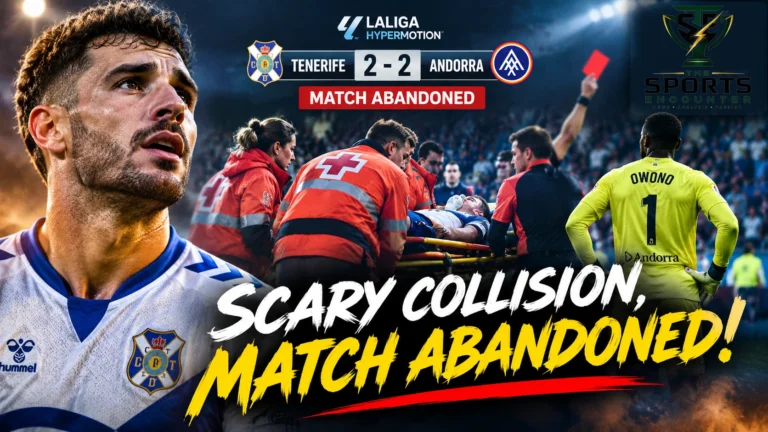
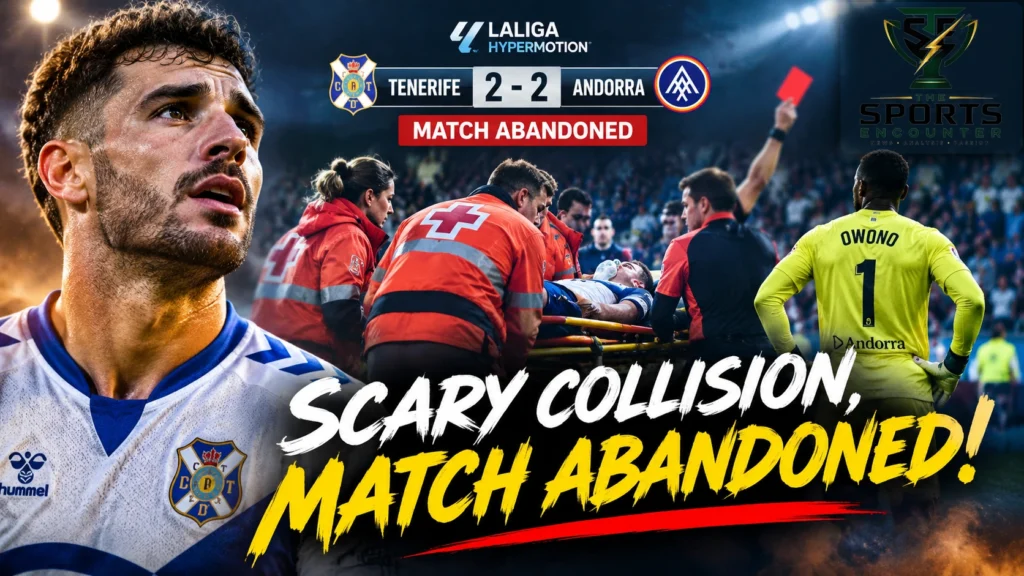
SANTA CRUZ DE TENERIFE, Spain, November 3, 2026: Tenerife striker Jesús de Miguel was admitted to intensive care after a serious collision with FC Andorra goalkeeper Jesús Owono forced their Spanish second-division match to be abandoned on Monday, November 2. The incident occurred seven minutes into second-half stoppage time at Estadio Heliodoro Rodríguez López, with the teams level at 2-2. Owono had rushed toward midfield to challenge for a long ball when he collided with the 30-year-old forward, who fell to the ground and lost consciousness. Players from both teams immediately called for medical assistance as the referee stopped proceedings and showed the Andorra goalkeeper a straight red card.
De Miguel received emergency attention before being transferred to Hospital Universitario Nuestra Señora de Candelaria. Tenerife later confirmed that he was in intensive care and stable despite the seriousness of his condition. Spanish media also reported a cardiorespiratory arrest and resuscitation efforts, although accounts differ about the exact sequence. The medical emergency brought an extraordinary contest to an abrupt conclusion after Tenerife had surrendered a 2-0 lead and both clubs had already lost a player to a red card. The official LaLiga match record identifies the fixture as abandoned, meaning the 2-2 score is not yet a certified final result. Competition authorities must determine how the unfinished match will be resolved.
Tenerife vs Andorra Abandoned: Match Details and Confirmed Facts
| Detail | Confirmed Information |
|---|---|
| Competition | LaLiga Hypermotion, 2026-27 |
| Matchday | 12 |
| Date | November 2, 2026 |
| Venue | Estadio Heliodoro Rodríguez López, Santa Cruz de Tenerife |
| Home team | CD Tenerife |
| Away team | FC Andorra |
| Score at abandonment | 2-2 |
| Interruption | Seventh minute of second-half stoppage time |
| Injured player | Jesús de Miguel, Tenerife |
| Goalkeeper involved | Jesús Owono, Andorra |
| Owono’s disciplinary action | Straight red card |
| Medical status announced by Tenerife | Intensive care, stable despite serious condition |
| Match outcome | Abandoned, pending competition decision |
| Official attendance | 13,018 |
The official LaLiga Tenerife-Andorra match center records the score, goals, disciplinary events and abandoned status.
Story at a glance
Tenerife vs Andorra Abandoned: Match Details and Confirmed Facts
The official LaLiga Tenerife-Andorra match center records the score, goals, disciplinary events and abandoned status.
What Happened to Jesús de Miguel in the 97th Minute?
The decisive incident began when a long ball was played into space near midfield.
Jesús de Miguel’s Health: What Has Tenerife Officially Confirmed?
Following the incident, Tenerife announced that De Miguel had been admitted to the intensive care unit at Hospital Universitario Nuestra Señora de Candelaria.
How Tenerife Lost a 2-0 Lead Before the Medical Emergency
The match had already produced considerable drama before the collision.
Why the 2-2 Score Cannot Yet Be Reported as a Final Result
One of the biggest potential reporting errors is to describe the abandoned match as a completed 2-2 draw.
The most important point is that the match was not completed normally.
Neither side has been credited with a confirmed victory from the unfinished fixture.
What Happened to Jesús de Miguel in the 97th Minute?
The decisive incident began when a long ball was played into space near midfield.
Andorra goalkeeper Jesús Owono advanced well outside his penalty area in an attempt to intervene.
De Miguel moved toward the same ball.
The two players collided, and the Tenerife striker went down.
Initial accounts varied about whether the primary contact was to his head, chest or both.
Without a definitive medical assessment and independently reviewed footage, it would be inappropriate to identify a precise injury mechanism as established fact.
What is confirmed is the seriousness of the response.
Players urgently summoned the medical team, and De Miguel required extended attention on the playing surface.
Owono received a straight red card for the challenge.
Why Did the Referee Abandon the Match?
The referee consulted representatives of both clubs after the medical emergency.
The match was then abandoned rather than restarted.
The decision was appropriate to examine separately from the red-card ruling.
The goalkeeper’s dismissal concerned the challenge itself.
The abandonment concerned whether the match could responsibly continue after a serious medical emergency.
Those are different decisions with different consequences.
Football’s rules recognize that protecting players from serious harm takes priority over completing a fixture.
Jesús de Miguel’s Health: What Has Tenerife Officially Confirmed?
Following the incident, Tenerife announced that De Miguel had been admitted to the intensive care unit at Hospital Universitario Nuestra Señora de Candelaria.
The club described the forward as stable despite the seriousness of his condition.
Its medical personnel remained at the hospital to monitor developments.
That statement is the strongest confirmed medical update available for this report.
It does not establish that he has recovered, been discharged or received clearance to return to training.
What About Reports of Cardiorespiratory Arrest?
Several Spanish news organizations reported that De Miguel experienced a cardiorespiratory arrest and required emergency resuscitation.
However, accounts differed about whether the emergency occurred on the field, during the ambulance transfer or during the broader sequence of emergency care.
Those differences should not be silently combined into one precise medical timeline.
The responsible distinction is between the club’s confirmed intensive-care status and additional details attributed to local reporting.
There is also no basis for diagnosing a particular neurological injury or estimating a recovery period from these reports.
How Tenerife Lost a 2-0 Lead Before the Medical Emergency
The match had already produced considerable drama before the collision.
Tenerife opened the scoring in the third minute through Christian Gomis.
Enric Gallego converted a penalty in the 39th minute to double the lead.
At halftime, the home side led 2-0 and appeared positioned to secure an important victory.
Andorra subsequently recovered.
Lautaro de León converted a penalty in the 83rd minute, and Stefan Golubović equalized five minutes later.
By the time the emergency occurred, both sides had scored twice.
| Minute | Incident | Score or Consequence |
|---|---|---|
| 3′ | Christian Gomis scores for Tenerife | 1-0 |
| 39′ | Enric Gallego converts a penalty | 2-0 |
| Halftime | Tenerife lead by two goals | 2-0 |
| 83′ | Lautaro de León converts Andorra penalty | 2-1 |
| Late second half | De León and Tenerife goalkeeper Dani Martín dismissed | Both teams reduced to ten men |
| 88′ | Stefan Golubović equalizes | 2-2 |
| 90+7′ | Owono collides with De Miguel and receives red card | Serious injury, medical intervention |
| Following treatment | Referee abandons fixture | No certified final result |
Why the Earlier Red Cards Matter
The encounter had already featured dismissals involving Tenerife goalkeeper Dani Martín and Andorra’s Lautaro de León.
That meant the teams were dealing with reduced numbers and an increasingly disrupted match.
Owono’s later red card added another disciplinary issue.
However, the officials’ decision to abandon the game should not be interpreted merely as a response to an unusually high number of dismissals.
The immediate reason for stopping the match permanently was the serious medical emergency.
Why the 2-2 Score Cannot Yet Be Reported as a Final Result
One of the biggest potential reporting errors is to describe the abandoned match as a completed 2-2 draw.
LaLiga’s official match record identifies the fixture as suspended or abandoned.
The score existed at the moment play stopped.
It was not established through normal completion of the match.
The competition authority must determine what happens to the remaining playing time.
Could Tenerife vs Andorra Be Resumed?
Resumption is a possible outcome, subject to the applicable competition regulations and an official ruling.
If authorities direct the teams to complete the remaining minutes, the arrangements would need to specify how play resumes and which disciplinary consequences carry forward.
The clubs would also need an authorized date and operational arrangements.
No such decision was confirmed in the material reviewed for this article.
Could the 2-2 Score Be Allowed to Stand?
That would depend on the governing regulations and a formal competition decision.
The fact that only a short period remained does not automatically turn an abandoned match into an official draw.
Similarly, the existence of three red cards does not automatically award a victory to either side.
| Possible Outcome | What It Would Mean | Current Status |
|---|---|---|
| Resume remaining minutes | Complete the fixture from an authorized point | Not confirmed |
| Register 2-2 as the result | Recognize the score at interruption | Not confirmed |
| Order a complete replay | Stage a new fixture under applicable rules | Not confirmed |
| Apply another regulatory decision | Resolve the match through a formal competition ruling | Not confirmed |
These are possible procedural outcomes, not predictions.
The governing authority’s eventual ruling is required before the final sporting consequences can be established.
What Do Football’s Laws Say About Serious Injuries and Match Abandonment?
The International Football Association Board’s Laws of the Game provide the framework governing referees’ decisions.
Law 5 requires officials to stop play when a player is seriously injured.
The rules also recognize exceptions allowing medical assessment and treatment on the field in serious circumstances.
The 2026-27 framework specifically addresses severe injuries, including head injuries and life-threatening events.
This distinction matters because routine injury-management procedures should not obstruct emergency treatment.
Read the IFAB’s official Law 5 guidance for the referee’s powers and duties.
Was the Referee Required to Finish the Final Minutes?
No sporting objective outweighs the need to respond appropriately to a serious medical emergency.
Referees can stop proceedings when conditions make continuing inappropriate.
The separate question of how the unfinished fixture is resolved belongs to the relevant competition authorities.
That is why the match could be abandoned even though the scheduled playing time was almost complete.
Why Emergency Medical Response Matters More Than the Remaining Minutes
The episode raises an important question about the operational readiness of professional football clubs and stadiums.
Medical staff must be able to reach an injured player rapidly, assess the situation and coordinate emergency transport when necessary.
For serious injuries, response times and communication among medical personnel, match officials and ambulance teams can become critical.
However, the publicly available material does not establish that Tenerife’s medical team breached any procedural requirement.
It would therefore be inappropriate to infer negligence solely from the seriousness of De Miguel’s condition.
The Sports Encounter’s explanatory feature on medical assistance for injured athletes explores how stadium treatment, hospital care, insurance coordination and rehabilitation involve different responsibilities.
That article is commercially disclosed sponsored content and should remain clearly identified as such.
Why a Red Card Does Not Automatically Establish Intent to Injure
Owono received a straight red card.
The disciplinary decision indicates that the referee considered the challenge serious enough to warrant dismissal.
But a red card does not by itself establish that a player deliberately intended to cause a life-threatening injury.
The actual disciplinary classification and any additional sanction depend on the referee’s report and the relevant authority’s decision.
Nor can the goalkeeper’s eventual suspension length be assumed from the fact of his dismissal alone.
That distinction is especially important in a case involving a seriously injured opponent.
The public discussion should remain anchored to verified actions and official decisions rather than speculation about personal intent.
How Does This Abandonment Compare With Other Interrupted Spanish Matches?
Spain has experienced other interrupted fixtures this season, but the causes have varied significantly.
In October, Rayo Vallecano’s match against Athletic Club was abandoned after supporters repeatedly threw objects onto the playing surface during protests.
TSE’s investigation into the Vallecas abandonment explained the subsequent fine and partial stadium closure.
That case involved crowd behavior and stadium security.
Tenerife’s match was abandoned after a medical emergency involving a player.
The outcomes may both require competition decisions, but the causes and possible disciplinary considerations are different.
How Weather-Related Postponements Differ
Earlier, Levante’s home match against Athletic Club was postponed after heavy rain flooded parts of the stadium and playing surface.
Our coverage of the Levante-Athletic postponement examined the conditions that prevented the game from beginning safely.
In the Tenerife case, play had already progressed deep into stoppage time before the referee intervened.
| Fixture | Reason for Interruption | Competitive Issue |
|---|---|---|
| Tenerife vs Andorra | Serious player injury | Unfinished match at 2-2 |
| Rayo Vallecano vs Athletic Club | Repeated crowd disturbances | Disciplinary sanctions and completion decision |
| Levante vs Athletic Club | Unsafe weather and flooded facilities | Fixture rescheduling |
The comparison reveals why football authorities cannot automatically apply identical administrative outcomes to every interrupted match.
What the Three Red Cards Reveal About an Already Chaotic Contest
Before the incident involving Owono and De Miguel, Tenerife and Andorra had already lost their first-choice goalkeepers’ normal playing balance.
Andorra had recovered from a two-goal deficit, and both teams were operating under disciplinary pressure.
The late dismissal of Owono further complicated the match situation.
But the decisive intervention was medical rather than tactical.
The game had stopped being about whether Tenerife could recover the lead or Andorra could complete its comeback.
The player’s welfare became the priority.
For a comparison of how red cards can change ordinary football tactics, TSE’s analysis of Real Sociedad’s 3-2 victory over Elche explains how a dismissal transformed that match’s momentum.
In Tenerife, the emergency prevented the contest from reaching an ordinary competitive conclusion.
Why Players and Coaches Need Time After a Traumatic Incident
Witnessing a teammate require emergency medical treatment can be distressing.
Reports from Tenerife described players reacting emotionally as medical personnel worked on De Miguel.
Both clubs subsequently expressed support for the forward and his family.
The situation highlights an aspect of professional sport that is often overlooked in ordinary match reporting.
Coaches must consider not only immediate tactical changes but also whether players are psychologically ready to continue competing.
It would be inappropriate, however, to diagnose trauma or other mental-health conditions in specific players from footage or photographs.
Those assessments require appropriate professional evaluation.
Football’s Wider Player-Welfare Challenge
Serious health incidents remain relatively uncommon compared with the enormous number of professional matches played worldwide.
But every occurrence reinforces the importance of effective emergency plans, trained medical personnel and clear communication.
Earlier this season, Bayern Munich coach Vincent Kompany required hospitalization after collapsing while observing training.
TSE’s report on Kompany’s subsequent hospital discharge distinguished confirmed medical updates from uncertain return-to-work timelines.
That incident involved different medical circumstances and should not be treated as directly comparable to De Miguel’s collision.
The common editorial principle is that confirmed clinical information must take precedence over speculation.
Why Return-to-Play Decisions Cannot Be Predicted
Professional players are sometimes able to resume training shortly after an injury, while others require prolonged rehabilitation.
Continue the Soccer Story
 Premier LeagueBarcelona vs Aston Villa: Can Emery Exploit Flick’s High Line in Champions League Showdown?
 FIFA World Cup 2026FIFA Opens Files on Scrapped $20B World Cup Deal, but UEFA’s Fight With Infantino Is Far From Over
 SoccerFIFA Rewrites the Rules for 189 Nations: Why Wenger’s Baku Experiment Could Change Youth Soccer
The difference depends on the actual injury, medical assessment, treatment and progression of recovery.
In De Miguel’s case, no credible return-to-play timetable has been established.
It would therefore be irresponsible to predict how many fixtures he might miss.
Recent North American football coverage offers another illustration of the importance of verified medical status.
Our November 1 MLS report distinguishes confirmed concussion-protocol absences from other injury-related availability questions.
Those principles are relevant across sports, even when their specific medical protocols differ.
What Happens to Tenerife and Andorra in the League Table?
Until the match receives an official final disposition, the most important distinction is between the score at interruption and the points eventually awarded.
A completed draw ordinarily gives each side one point.
But an abandoned fixture does not automatically provide that outcome.
If the competition authority orders a resumption and the score subsequently changes, the eventual points allocation may differ.
Similarly, any regulatory ruling could determine a different administrative outcome.
No precise new league-table calculation should be presented until that decision is confirmed.
Why the Remaining Minutes Still Matter
Even a short amount of playing time can change a football result.
A goal, penalty or further disciplinary event during the final minutes may influence which team takes points.
That is especially relevant to closely contested league standings.
However, describing the unfinished fixture as an automatic win, draw or loss would be premature.
The governing authority must resolve the match first.
Ten Questions Readers Are Asking About Tenerife vs Andorra
Why Was Tenerife vs Andorra Abandoned?
The match was abandoned after Tenerife striker Jesús de Miguel suffered a serious injury in a collision with Andorra goalkeeper Jesús Owono during stoppage time.
What Was the Score When the Match Stopped?
The teams were level at 2-2.
Who Is Jesús de Miguel?
He is a 30-year-old Spanish forward playing for CD Tenerife.
What Has Tenerife Said About His Condition?
The club confirmed that he had been admitted to intensive care and was stable despite the seriousness of his condition.
Did De Miguel Suffer a Cardiorespiratory Arrest?
Spanish media reported such an emergency and resuscitation efforts, but the precise medical sequence should remain attributed to those reports rather than treated as a complete official diagnosis.
Was Jesús Owono Sent Off?
Yes. The Andorra goalkeeper received a straight red card.
Who Scored for Tenerife?
Christian Gomis and Enric Gallego, with Gallego converting a penalty.
Who Scored for Andorra?
Lautaro de León scored a penalty and Stefan Golubović equalized.
Will the Match Be Replayed?
No confirmed replay or resumption decision was established at publication time. Competition authorities must decide.
Does the 2-2 Score Count as the Final Result?
The official LaLiga record identifies the fixture as abandoned. The score cannot yet be presented as a certified final result.
At Tenerife, the Result Became Secondary to a Player’s Safety
Before the final minutes, Tenerife and Andorra had produced an extraordinary football match.
The hosts scored twice before halftime.
Andorra recovered with two late goals.
Red cards had disrupted both teams, and the contest appeared capable of producing another decisive moment.
Instead, a collision near midfield brought the game to an immediate halt.
The players’ reactions and the extended medical response made the seriousness of the situation clear.
Officials abandoned the match, and De Miguel was transferred to hospital.
The sporting questions remain unresolved.
The competition must determine what happens to the unfinished fixture, and the disciplinary authorities may need to consider the goalkeeper’s dismissal under the applicable regulations.
Neither question should be confused with the player’s medical condition.
Tenerife has confirmed that De Miguel was stable despite the seriousness of his condition while receiving intensive care.
That is the information that matters most as the football community awaits further official updates.
Official reference material: The LaLiga match center confirms the incomplete 2-2 fixture, goals and disciplinary record. The IFAB Laws of the Game, Law 5 explain the referee’s injury-related responsibilities. The 2026-27 Laws of the Game document provides the relevant current-season framework.
Related analysis: For more context on disciplinary decisions, game interruptions and player availability, see TSE’s Getafe-Celta red-card analysis, our LaLiga injury and matchday review, and our analysis of Barcelona’s injury-disrupted defensive selection.