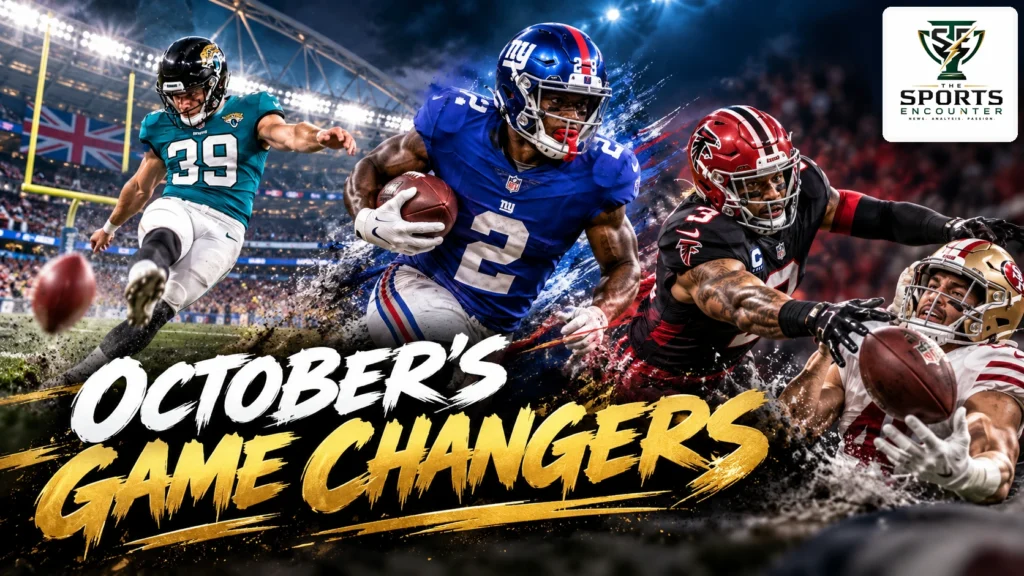
NEW YORK, United States, October 31, 2026: One second remained when Jacksonville kicker Cam Little lined up a 57-yard field goal in London. Deonte Banks needed 98 yards to turn a potential Arizona touchdown into six points for the New York Giants. Jessie Bates III needed only one perfectly placed punch to bring San Francisco’s unbeaten run to an end. Those three moments headline The Sports Encounter’s ranking of the five best NFL plays of October 2026, a month in which defensive instincts, special-teams execution and extraordinary athleticism repeatedly changed games.
The top five also includes Ja’Quan McMillian’s overtime interception that rescued Denver despite just 168 yards of offense, and Bo Nix’s electrifying 62-yard touchdown run against Arizona. These selections cover NFL games played through October 30 and are ranked for technical difficulty, competitive importance, context and lasting significance. The striking common thread is how many of October’s most memorable moments came from players whose contributions are often overshadowed by quarterbacks and star receivers.
The Top 5 NFL Plays of October 2026, Ranked
Highlight rankings are inherently subjective, but the circumstances surrounding a play can be checked. A breathtaking catch in the first quarter and a difficult kick on the final snap create different kinds of value. Both deserve consideration, provided the analysis distinguishes technical brilliance from competitive consequence.
Read next Bears Survive Patriots 30-24 as Cairo Santos’ 58-Yard Redemption Caps Caleb Williams’ 308-Yard Night
Story at a glance
The Top 5 NFL Plays of October 2026, Ranked
Highlight rankings are inherently subjective, but the circumstances surrounding a play can be checked. A breathtaking catch in the first quarter and a difficult kick on the final snap create different kinds of value. Both deserve consideration, provided the analysis distinguishes technical brilliance from competitive consequence.
No. 1: Cam Little’s 57-Yard Field Goal Wins a London Thriller With One Second Remaining
October 11, 2026 | Jacksonville Jaguars vs. Philadelphia Eagles | Tottenham Hotspur Stadium, London
No. 2: Deonte Banks Turns a Cardinals Scoring Threat Into a 98-Yard Giants Touchdown
October 4, 2026 | New York Giants vs. Arizona Cardinals
No. 3: Jessie Bates III Delivers the Punch That Ends San Francisco’s Perfect Start
October 25, 2026 | Atlanta Falcons vs. San Francisco 49ers
No. 4: Ja’Quan McMillian Intercepts Sam Darnold and Gives Denver an Overtime Escape
October 15, 2026 | Denver Broncos vs. Seattle Seahawks
| Rank | Player | Play | Opponent | Game Result |
|---|---|---|---|---|
| 1 | Cam Little, Jaguars | 57-yard winning field goal | Eagles | Jacksonville 19-17 Philadelphia |
| 2 | Deonte Banks, Giants | 98-yard interception return touchdown | Cardinals | New York 36-24 Arizona |
| 3 | Jessie Bates III, Falcons | Game-sealing forced fumble against George Kittle | 49ers | Atlanta 29-20 San Francisco |
| 4 | Ja’Quan McMillian, Broncos | Overtime interception of Sam Darnold | Seahawks | Denver 17-14 Seattle (OT) |
| 5 | Bo Nix, Broncos | 62-yard rushing touchdown | Cardinals | Denver 30-16 Arizona |
The ranking rewards plays that were difficult to execute and materially affected the game. No individual play is credited with causing an entire result unless the surrounding evidence establishes that relationship.
No. 1: Cam Little’s 57-Yard Field Goal Wins a London Thriller With One Second Remaining
October 11, 2026 | Jacksonville Jaguars vs. Philadelphia Eagles | Tottenham Hotspur Stadium, London
Jacksonville appeared to have lost a game it had somehow kept alive.
The Jaguars had taken a late lead when Trevor Lawrence found Parker Washington for a remarkable one-handed touchdown. But the ensuing extra-point attempt failed after another problematic snap, leaving Philadelphia within striking distance.
Jake Elliott then converted a 48-yard field goal to put the Eagles ahead 17-16 with eight seconds remaining.
The situation was unforgiving. Jacksonville needed an immediate field-position gain and a successful long-distance kick without a conventional offensive drive.
Ameer Abdullah Created the Opportunity That Little Converted
The crucial contribution began before Little approached the football.
Philadelphia’s kickoff reached Ameer Abdullah at Jacksonville’s eight-yard line. Abdullah found a running lane, accelerated through the coverage and returned the ball 53 yards to the Eagles’ 39.
The clock stopped with one second left.
Jacksonville now had the opportunity to attempt a 57-yard field goal.
Little delivered, sending the kick through the uprights to complete a 19-17 victory.
The Jaguars had moved from trailing with eight seconds remaining to winning on the final play. A kickoff return and a field goal had accomplished what an ordinary passing possession almost certainly could not have achieved in the time available.
There was another layer to the drama. Long snapper Ross Matiscik had suffered a first-quarter shoulder injury, forcing defensive tackle DaVon Hamilton into snapping duties. That disruption had already contributed to problems in Jacksonville’s kicking operation.
Little therefore had to perform under pressure after the special-teams unit had experienced an unusually difficult afternoon.
The Jaguars’ official breakdown of the London victory documents the special-teams sequence and its importance.
Why This Is Our No. 1 Play
Little’s kick combined technical execution with virtually maximum game leverage.
There was no time for a second attempt. A miss would have ended Jacksonville’s comeback immediately.
Yet the kick also belongs to Abdullah and the supporting special-teams personnel who made the attempt possible.
That collective achievement is why this ranks first. The final swing was dramatic, but the decisive sequence required multiple players to execute correctly under extraordinary pressure.
The loss also intensified questions surrounding Philadelphia’s late-game management. TSE previously explored those concerns in our analysis of Nick Sirianni and other NFL coaches under pressure after Week 5.
No. 2: Deonte Banks Turns a Cardinals Scoring Threat Into a 98-Yard Giants Touchdown
October 4, 2026 | New York Giants vs. Arizona Cardinals
The Giants were protecting a narrow lead when Arizona threatened to change the game.
Facing fourth-and-goal, the Cardinals needed a touchdown to transform the contest. Banks instead intercepted the pass and raced 98 yards in the opposite direction.
The result was one of October’s most spectacular defensive touchdowns.
New York won 36-24, with Banks’ interception return providing the decisive late separation.
How Fast Was Banks During the Interception Return?
According to NFL Next Gen Stats, Banks reached 21.85 mph during the return, the fastest recorded ball-carrier speed of the season at that point.
The interception was impressive in itself. Completing a 98-yard return after securing the ball added an entirely different athletic challenge.
Banks had to transition from pass coverage to ballcarrier, recognize the available running lane and maintain enough speed to defeat pursuing opponents.
The play transformed an Arizona scoring opportunity into a New York touchdown without requiring the Giants’ offense to take the field.
That is a particularly severe reversal because a team near the opponent’s goal line typically expects at least to retain a realistic chance of scoring.
Instead, Arizona surrendered seven points.
Banks subsequently received NFC Defensive Player of the Week recognition. The NFL’s official weekly awards announcement confirms the 98-yard return and recorded speed.
Why Banks’ Play Was More Than an Athletic Highlight
Interceptions near the goal line are valuable because they eliminate an immediate scoring threat.
Returning that interception for a touchdown doubles the significance. The defending team prevents the opponent from scoring and simultaneously adds points to its own total.
The play also illustrates why defensive backs must be assessed through more than tackles and passes defended. One perfectly timed interception can outweigh several earlier possessions of solid coverage.
Our NFL Week 4 review examined Banks’ contribution alongside other decisive performances from CeeDee Lamb, Tetairoa McMillan and Kenneth Walker III.
Banks earns second place because he combined a high-pressure defensive read, exceptional speed and a scoring reversal that settled the contest.
No. 3: Jessie Bates III Delivers the Punch That Ends San Francisco’s Perfect Start
October 25, 2026 | Atlanta Falcons vs. San Francisco 49ers
The Falcons had produced the kind of upset that can redefine the early-season conversation.
San Francisco arrived undefeated at 6-0, carrying an efficient offense and considerable confidence. Atlanta was less productive in total yardage, but repeatedly punished the 49ers for mistakes.
The final score was 29-20.
The defining defensive image came when Jessie Bates III forced a fumble from tight end George Kittle and teammate Kendal Daniels recovered the loose ball.
That play helped close the door on San Francisco’s comeback attempt.
Why the Peanut Punch Worked
The technique is often known as the Peanut Punch, associated with former NFL cornerback Charles Tillman.
Rather than relying solely on a conventional tackle, the defender targets the football with a controlled punching motion as the ballcarrier attempts to maintain possession.
The execution requires timing, precision and awareness. A poorly judged attempt can leave the defender out of position or allow the receiver to gain additional yardage.
Bates made contact with the football, dislodging it from Kittle.
Daniels completed the play by recovering the fumble.
The NFL’s official highlight of Bates’ forced fumble documents both players’ involvement.
The Overlooked Player Who Finished the Job
Bates rightly receives attention for creating the turnover, but the recovery deserves recognition.
A forced fumble does not automatically result in a change of possession. The ball remains live, and either team may recover it.
Daniels ensured that Atlanta retained possession and completed the defensive sequence.
That distinction reflects one of the most important lessons from the Falcons’ victory. Atlanta won the turnover battle 4-0 despite being outgained by 105 offensive yards.
San Francisco generated 400 yards compared with Atlanta’s 295, but the Falcons repeatedly prevented productive drives from becoming points.
Our Week 7 examination of the Falcons’ upset and the Seahawks’ victory over Kansas City reconstructs the turnovers and tactical consequences.
The victory also provided another meaningful chapter in Atlanta’s offensive development, which TSE had explored after the Falcons’ 45-24 defeat of New Orleans.
Bates ranks third because a technically precise defensive play helped seal the defeat of an unbeaten opponent.
No. 4: Ja’Quan McMillian Intercepts Sam Darnold and Gives Denver an Overtime Escape
October 15, 2026 | Denver Broncos vs. Seattle Seahawks
Denver had no convincing offensive reason to expect victory.
The Broncos generated only 168 total offensive yards and failed to score in the second half. Seattle gained 353 yards, collected 24 first downs and recovered from an 11-point deficit to force overtime.
Yet Denver won 17-14.
The reason was a defensive intervention at the moment Seattle appeared capable of completing its comeback.
How McMillian Turned an Interception Into a Winning Field Goal
McMillian read Sam Darnold’s pass and intercepted the ball at Seattle’s 43-yard line.
The interception changed Denver’s field position immediately.
Instead of needing to construct a long touchdown drive, the Broncos required only enough yardage to produce a realistic field-goal attempt.
Four plays later, Wil Lutz converted from 53 yards, securing the overtime victory.
The kick was an important part of the outcome, but McMillian’s interception created the opportunity.
That is why the defensive play earns the place in our top five rather than simply ranking another winning field goal.
The performance was particularly significant because Denver was missing important defensive personnel.
Earlier, Kris Abrams-Draine had also intercepted Darnold during regulation, contributing to the turnovers that kept Denver competitive.
Why 168 Offensive Yards Make This Play So Extraordinary
Denver won despite accumulating 185 fewer offensive yards than Seattle.
The Broncos also committed no turnovers, while Seattle surrendered possession three times.
That disparity explains how the game could be won by the less productive offense.
McMillian’s interception turned Denver’s defensive efficiency into the final scoring opportunity.
The Sports Encounter’s full analysis of Denver’s 17-14 overtime victory examines the extraordinary yardage discrepancy, the defensive pressure and the final sequence.
McMillian places fourth because his interception changed field position, stopped Seattle’s momentum and directly enabled the winning possession.
No. 5: Bo Nix Breaks Free for a 62-Yard Touchdown Against Arizona
October 25, 2026 | Denver Broncos vs. Arizona Cardinals
After four selections dominated by defensive plays and special teams, Bo Nix supplies a reminder that an individual offensive burst can still transform a game’s momentum.
The Denver quarterback produced a 62-yard rushing touchdown against Arizona, the longest touchdown run of his career at the time.
Denver won the game 30-16.
What Made Nix’s Run a Standout Offensive Play?
The value of a mobile quarterback extends beyond scrambling away from sacks.
When a defense is focused on limiting passing routes, an unexpected quarterback run can challenge its pursuit angles and expose open space.
Nix turned one rushing opportunity into a 62-yard touchdown.
The distance is notable because quarterback rushing touchdowns are often associated with short-yardage scrambles, designed keepers or plays near the goal line.
A scoring run of this length requires the quarterback to transition rapidly from passer to open-field runner.
It also forces defenders to adjust their responsibilities once the quarterback moves beyond the original pocket structure.
How the Run Fits Denver’s October Story
The touchdown offers an interesting contrast with Denver’s earlier overtime victory over Seattle.
Against the Seahawks, Denver needed a defensive takeaway and a field goal because its offense had produced so little yardage.
Against Arizona, Nix delivered an explosive scoring contribution himself.
Those two victories illustrate different ways the Broncos found points during October.
Our earlier NFL power rankings explored the challenge of judging contenders by their records alone. Denver’s contrasting victories reinforce the importance of examining how those results are actually achieved.
Nix ranks fifth because of the run’s length, athletic execution and the way it expanded Denver’s offensive possibilities.
October’s Best NFL Plays Compared: Distance, Type and Result
The five plays covered very different competitive situations. Comparing them requires more than measuring yards gained.
| Player | Play Type | Verified Distance | Immediate Value |
|---|---|---|---|
| Cam Little | Field goal | 57 yards | Winning three points on the final play |
| Deonte Banks | Interception return | 98 yards | Defensive touchdown and prevention of an Arizona score |
| Jessie Bates III | Forced fumble | Not meaningfully measured by gain | Turnover completed by Kendal Daniels’ recovery |
| Ja’Quan McMillian | Interception | Not ranked by return distance | Created favorable field position for Denver’s winning kick |
| Bo Nix | Quarterback rush | 62 yards | Explosive offensive touchdown |
The table shows why the ranking cannot be based on yardage alone.
Banks covered the greatest measured distance, but Little faced an immediate win-or-lose scenario. Bates’ intervention was shorter and less visually expansive, yet its competitive importance was enormous.
TSE Statistical Discovery: The Plays That Produced Points and Possessions
One way to evaluate these moments is to separate the points directly produced from the possession changes that created a later scoring opportunity.
| Play | Points Scored on Play | Possession Impact | Additional Context |
|---|---|---|---|
| Little’s field goal | 3 | Ended the game | Set up by Abdullah’s return |
| Banks’ pick-six | 6, before conversion | Intercepted Arizona’s possession | Turnover returned for touchdown |
| Bates’ forced fumble | 0 | Atlanta recovered | Stopped San Francisco’s comeback opportunity |
| McMillian’s interception | 0 | Denver gained possession | Winning field goal followed four plays later |
| Nix’s touchdown run | 6, before conversion | Completed offensive possession | 62-yard scoring play |
TSE analytical distinction: The five selected plays directly scored 15 points before any extra-point conversions, including three from Little’s field goal and six each from Banks and Nix. Bates and McMillian scored no points on their individual plays but created or protected the opportunities that helped their teams win.
The calculation does not assign additional touchdown credit to a turnover or treat a later field goal as points scored by the player who intercepted the pass.
This distinction helps explain why a forced fumble can be more important than a spectacular gain that occurs earlier in a game.
The Hidden Story: October’s Greatest Moments Were Built Around Supporting Players
Three of the top four selections prominently feature contributors whose work can disappear beneath the final headline.
Abdullah returned a kickoff 53 yards to make Little’s winning kick possible.
Daniels recovered the football after Bates forced it loose against Kittle.
Denver’s defense created the opening that allowed Lutz to finish the overtime victory.
Each example illustrates a different form of collective execution.
A successful play is often remembered through the athlete credited with the final statistical action. But the result may depend on blocking, coverage, positioning, a timely recovery or the sequence that preceded it.
That broader context also appeared earlier in the month when the Week 5 injury situation forced several teams to reconsider their protection, defensive assignments and personnel usage.
Jacksonville’s problem with its long snapper is a particularly revealing example. An injury to a player who normally receives little attention threatened to decide the game through special-teams execution.
Why the Circumstances of a Play Matter More Than Its Highlight Length
A long run is immediately measurable. A difficult interception or forced fumble can be harder to evaluate using one number.
For this ranking, the value of the moment rests partly on what the opponent was attempting to accomplish.
Arizona was threatening to score when Banks intercepted the football.
San Francisco was trying to preserve its unbeaten start when Bates dislodged the ball.
Seattle was attempting to complete an overtime comeback when McMillian produced his interception.
Philadelphia had taken the lead with eight seconds left before Abdullah and Little reversed the result.
The competitive stakes gave those plays a meaning that ordinary yardage statistics cannot capture.
The wider month included other important examples of calculated late-game execution. TSE’s Packers-Panthers Week 8 analysis examined how Green Bay survived turnovers and protected its lead with crucial defensive stops.
How October’s Top Plays Compare Across the Four Ranking Criteria
The editorial scores below are TSE judgments, not NFL measurements or proprietary league grades. They are included to make the ranking transparent rather than imply mathematical precision.
| Player | Execution / 5 | Game Leverage / 5 | Distinctiveness / 5 | Historical Interest / 5 | Total / 20 |
|---|---|---|---|---|---|
| Cam Little | 5 | 5 | 5 | 5 | 20 |
| Deonte Banks | 5 | 5 | 5 | 4 | 19 |
| Jessie Bates III | 5 | 5 | 4 | 4 | 18 |
| Ja’Quan McMillian | 5 | 5 | 4 | 3 | 17 |
| Bo Nix | 5 | 3 | 4 | 4 | 16 |
These ratings explain the selection rather than establish an objective scientific ordering. For example, Nix receives a lower leverage score because his touchdown did not decide the game on the final possession, while Little’s kick immediately determined the result.
What Changed Between the Moment Before Each Play and the Final Result?
The best evidence of a play’s importance comes from reconstructing the before-and-after game situation.
| Play | Before | After | Result |
|---|---|---|---|
| Little’s kick | Jacksonville trailing with one second remaining | Jaguars take two-point lead | Jacksonville wins 19-17 |
| Banks’ interception | Giants lead 30-24; Arizona threatens to score | Giants extend lead with a defensive touchdown | New York wins 36-24 |
| Bates’ punch | San Francisco pursuing a comeback | Atlanta recovers the fumble | Falcons win 29-20 |
| McMillian’s interception | Seattle has overtime possession | Denver gains advantageous field position | Broncos win 17-14 on Lutz kick |
| Nix’s touchdown | Denver on offense | 62-yard run delivers touchdown | Broncos win 30-16 |
Only Little’s kick directly ended the game. Banks’ return provided a major scoring reversal. Bates and McMillian created changes of possession, while Nix supplied an exceptional explosive offensive play.
These distinctions are essential when comparing highlights from different game situations.
Which Great October NFL Plays Narrowly Missed the Top Five?
The month produced several other serious candidates.
Parker Washington’s one-handed touchdown catch against Philadelphia was spectacular and could reasonably have earned a place among the five best. It was particularly important because it gave Jacksonville the late lead before the Eagles briefly went back ahead.
Its omission reflects a choice to feature Little’s game-winning sequence from the same matchup rather than give one contest two places in a five-play ranking.
Christian McCaffrey’s acrobatic touchdown against Washington, Trey McBride’s juggling touchdown catch against Cincinnati and Jonathan Taylor’s 38-yard touchdown run also deserve recognition for their athletic quality.
October offered significant quarterback performances as well. The earlier TSE examination of Patrick Mahomes, Dak Prescott and Seattle’s offensive development provides useful context for how individual playmaking has shaped the season beyond this month.
And the NFL’s record international audience in Rio offers an interesting companion to the London drama that occupies the top spot in this ranking.
Continue the NFL Story
 NFLLove’s Touchdowns Save Packers From Three Turnovers as Panthers’ Late Rally Falls Short at Lambeau
 NFLBears Survive Patriots 30-24 as Cairo Santos’ 58-Yard Redemption Caps Caleb Williams’ 308-Yard Night
 NFLNFL Week 8 Preview: Lamar Jackson Returns, Vikings Face Lions as Injuries Threaten Playoff Contenders
Frequently Asked Questions About the Best NFL Plays of October 2026
What was the best NFL play of October 2026?
The Sports Encounter ranks Cam Little’s 57-yard winning field goal against Philadelphia in London first, particularly because Jacksonville had only one second remaining after Ameer Abdullah’s 53-yard kickoff return.
Who scored the 98-yard interception touchdown in October?
New York Giants cornerback Deonte Banks returned an interception 98 yards for a touchdown against the Arizona Cardinals on October 4.
How fast was Deonte Banks on his touchdown return?
NFL Next Gen Stats recorded Banks at 21.85 mph during the return, the fastest ball-carrier speed reported at that point in the season.
How far was Cam Little’s winning field goal?
Little converted a 57-yard field goal against Philadelphia on October 11, securing Jacksonville’s 19-17 victory.
Who returned the kickoff before the Jaguars’ winning field goal?
Ameer Abdullah returned the kickoff 53 yards to the Philadelphia 39-yard line, leaving one second for the final attempt.
Who forced George Kittle’s late fumble against Atlanta?
Jessie Bates III forced the fumble, and Kendal Daniels recovered it as the Falcons defeated San Francisco 29-20.
Who intercepted Sam Darnold in Denver’s overtime victory?
Ja’Quan McMillian intercepted Darnold, creating the opportunity for Wil Lutz to kick the winning 53-yard field goal against Seattle.
How many offensive yards did Denver gain against Seattle?
Denver gained only 168 total offensive yards in its 17-14 overtime victory.
How long was Bo Nix’s touchdown run against Arizona?
Nix scored on a 62-yard run during Denver’s 30-16 victory on October 25.
Is this an official NFL ranking?
No. It is The Sports Encounter’s independent editorial ranking based on verified plays and their competitive context.
The Sports Encounter Verdict: October Belonged to the Players Who Seized One Moment
Five plays. Five very different demonstrations of how an NFL game can change.
Bo Nix supplied the explosive quarterback run. Ja’Quan McMillian gave Denver a second chance when its offense had produced almost nothing. Jessie Bates and Kendal Daniels finished an unbeaten team’s comeback hopes. Deonte Banks transformed a goal-line threat into a 98-yard touchdown.
But the defining image is Jacksonville’s final-second escape in London.
Ameer Abdullah produced the return. A disrupted kicking unit prepared for one final attempt. Cam Little delivered from 57 yards.
The Jaguars needed every part of that sequence, and all of it had to happen before the clock expired.
That combination of execution, pressure and consequence earns our No. 1 ranking.
October’s greatest highlights also reinforce why football cannot be understood solely through quarterback statistics or touchdown totals. Important plays begin with field position, coverage discipline, possession security and the readiness of players whose contributions often receive little attention.
Those are the details that separate a spectacular highlight from a moment that changes the result.