LONDON, United Kingdom, October 24, 2026: For 70 years, the Ballon d’Or has represented football’s highest individual honor, with ceremonies traditionally defined by prestige, carefully arranged presentations, and an unmistakably European sense of occasion. On Monday, October 26, that tradition faces an intriguing experiment. Thierry Henry and Kate Scott, the familiar faces of CBS Sports’ hugely popular Champions League coverage, will host the 70th Ballon d’Or ceremony at the London Palladium. Their appointment raises a fascinating question: can the spontaneous chemistry that makes their television partnership so entertaining survive the formal demands of football’s most prestigious awards night?
France Football and UEFA officially announced the pairing on October 19, confirming that Henry and Scott would lead the ceremony together for the first time. The decision brings two personalities known for conversational broadcasting into an environment where strict schedules, multilingual presentations, and carefully rehearsed transitions traditionally shape proceedings. The result could be a more accessible, engaging awards show, but only if the hosts find room for their natural chemistry without diminishing the occasion’s prestige.
The 2026 ceremony already carries considerable historical weight. London will host the Ballon d’Or for the first time, marking the award’s 70th anniversary in the country of its inaugural winner, Stanley Matthews. Adding Henry and Scott introduces another symbolic connection: two broadcasters whose partnership reflects the increasingly international way football is discussed, analyzed, and consumed.
Ballon d’Or 2026: A Historic London Ceremony With Familiar Faces
The ceremony takes place at the London Palladium on Monday, October 26, beginning at 8 p.m. British time.
Story at a glance

Ballon d’Or 2026: A Historic London Ceremony With Familiar Faces
The ceremony takes place at the London Palladium on Monday, October 26, beginning at 8 p.m. British time.
How the Ballon d’Or Reached This Unusual Moment
The Ballon d’Or’s history helps explain why the choice of hosts matters.
The Evolution of the Co-Host Dynamic: From Ruud Gullit to Thierry Henry
Kate Scott is no stranger to the Ballon d’Or stage.
Can the CBS Sports Formula Work at the London Palladium?
To understand the appeal of Henry and Scott’s appointment, one must examine the style that has made their CBS Sports appearances so recognizable.
The Prestige Problem: Entertainment Cannot Overshadow the Winners
One of the greatest challenges facing the hosts will be balancing entertainment with the historical importance of the award.
Since its creation by France Football in 1956, the Ballon d’Or has developed from a European football award into one of sport’s most recognized individual honors.
Its move to London celebrates that history while creating an opportunity to reconsider how the ceremony communicates with an increasingly global audience.
| Detail | Confirmed Information |
|---|---|
| Event | 70th Ballon d’Or ceremony |
| Date | Monday, October 26, 2026 |
| Venue | London Palladium, London, England |
| Official starting time | 8:00 p.m. GMT / 9:00 p.m. CET |
| Hosts | Thierry Henry and Kate Scott |
| Organizers | France Football and UEFA |
| Original award established | 1956 |
| Inaugural winner | Stanley Matthews |
| Host announcement | October 19, 2026 |
| Major broadcasting partner | DAZN, with territorial exceptions |
The official Ballon d’Or announcement confirmed the hosts’ appointment exactly one week before the ceremony.
That decision places significant responsibility on two presenters with very different professional backgrounds but an established understanding of each other’s broadcasting instincts.
Henry brings the credibility of an elite former footballer who won the 1998 FIFA World Cup with France, starred for Arsenal and Barcelona, and finished runner-up in the 2003 Ballon d’Or voting.
Scott brings years of experience presenting international football coverage and the ability to guide conversations between prominent personalities without allowing those exchanges to lose direction.
For the organizers, the challenge is to combine those strengths without transforming an international awards ceremony into an ordinary television studio discussion.
How the Ballon d’Or Reached This Unusual Moment
The Ballon d’Or’s history helps explain why the choice of hosts matters.
Its early identity centered on individual recognition within European football. Over time, the award developed into a global institution, bringing together outstanding performers from different leagues, countries, and football cultures.
The event’s production has changed alongside its international reach, although its ceremonial character remains central to its identity.
| Year | Development | Historical Importance |
|---|---|---|
| 1956 | Stanley Matthews wins the first Ballon d’Or | Beginning of the award’s seven-decade history |
| 2014 | Kate Scott hosts the ceremony | Part of her earlier Ballon d’Or presenting experience |
| 2015 | Scott returns as presenter | Strengthens her familiarity with the event |
| 2024 | UEFA and France Football begin co-organizing the awards | Establishes the current organizational partnership |
| 2025 | Scott co-hosts with Ruud Gullit in Paris | Continues her relationship with the ceremony |
| 2026 | Henry and Scott appointed for the London gala | Brings an established CBS Sports partnership to the 70th edition |
The 2026 ceremony also arrives after a competitive season featuring several outstanding individual performances.
Harry Kane, Erling Haaland, Lionel Messi, and other leading footballers have featured prominently in discussions surrounding the award.
The Sports Encounter’s analysis of the 2026 Ballon d’Or nominations examined the contenders and the broader range of categories being recognized.
Kane’s case is especially interesting for British audiences. The England striker’s remarkable goalscoring campaign, including his second European Golden Shoe, gives the London ceremony a strong connection to one of the country’s most prominent footballers.
His scoring achievements were examined in TSE’s detailed assessment of Kane’s 2026 Golden Shoe triumph.
The outcome of the Ballon d’Or voting remains unknown before Monday’s ceremony. But the quality of the contenders ensures that the presentation itself will attract attention from supporters across multiple football cultures.
The Evolution of the Co-Host Dynamic: From Ruud Gullit to Thierry Henry
Kate Scott is no stranger to the Ballon d’Or stage.
She previously presented the ceremony in 2014 and 2015, then returned in 2025 alongside Dutch football legend Ruud Gullit.
Those appearances gave her valuable experience handling the logistical demands of a major international awards event.
Such ceremonies operate differently from regular sports programming.
Presenters must maintain a schedule, introduce award categories, accommodate prepared presentations, and move smoothly between winners, presenters, speeches, and other participants.
Every transition matters because the audience extends far beyond a single country or language.
The 2025 partnership with Gullit worked within that established ceremonial structure. Scott guided the proceedings while the former Dutch international provided footballing authority and recognition.
The selection of Thierry Henry creates a different possibility.
Unlike two presenters assembled for a particular event, Henry and Scott already work together regularly on CBS Sports’ Champions League programming.
Their partnership is not based merely on professional familiarity. They have developed an on-air relationship built around timing, humor, analysis, and an understanding of when to let the other person speak.
That familiarity could allow them to move more naturally between formal introductions and unexpected moments.
Why Their Existing Chemistry Matters
During an interview published by British GQ on October 23, Scott explained the value of working with someone she already knows well:
“For me, it’s easy to work with somebody that you know well.”
She explained that her familiarity with Henry helps her recognize when he might want to contribute a joke or enter a conversation.
That observation goes directly to the heart of the experiment. The advantage is not simply that Henry can be funny or Scott can manage a live broadcast. It is that both understand each other’s rhythms.
In the October 23 GQ interview, Scott also discussed the significance of holding the ceremony in London and the excitement surrounding the nominees.
Yet familiarity alone does not guarantee an entertaining gala.
A football awards ceremony has a different rhythm from a post-match discussion, and both presenters must operate within the organizers’ production requirements.
Can the CBS Sports Formula Work at the London Palladium?
To understand the appeal of Henry and Scott’s appointment, one must examine the style that has made their CBS Sports appearances so recognizable.
The network’s Champions League coverage brings together Scott, Henry, Jamie Carragher, and Micah Richards.
Rather than presenting every discussion as a formal exchange between isolated experts, the program frequently allows its personalities to interact as familiar colleagues.
Scott guides the conversation. Henry provides the perspective of a former elite player. Carragher contributes direct analysis, while Richards brings energy and spontaneity.
Their discussions often move quickly between serious football analysis and affectionate teasing.
That combination gives the program a distinctive identity.
Viewers can follow technical conversations about pressing, defensive positioning, and individual performances while also enjoying the natural exchanges between presenters.
The program’s relevance comes from its connection to actual football events. Its presenters have the authority to analyze the sport, but they rarely appear uncomfortable when the discussion becomes informal.
Recent Champions League action has provided ample material for such conversations, including the developments covered in TSE’s October 20 Champions League roundup and our October 21 report on Real Madrid, Arsenal, and other European contenders.
Three Elements That Could Transform the Ceremony
1. A less rigid ceremonial voice. Major awards shows frequently rely on predetermined introductions and tightly controlled scripts. Scott’s broadcasting experience could allow her to maintain that structure while making transitions feel more conversational.
2. Peer-to-peer recognition. Henry’s achievements give him credibility when speaking about the nominated players. A former World Cup winner and Ballon d’Or runner-up can acknowledge the pressures of elite football from experience rather than simply reading an introduction.
3. The unscripted margin. An emotional acceptance speech, an unexpected player reaction, or a spontaneous moment between presenters can become the most memorable part of a ceremony. The hosts’ existing friendship may help them respond naturally without disrupting proceedings.
Those possibilities are attractive, but they are not guaranteed outcomes.
| Feature | Traditional Gala Approach | Potential Henry-Scott Approach |
|---|---|---|
| Presentation style | Formal, scripted introductions | Formal framework with more natural exchanges |
| Football expertise | Introduced through prepared segments | Henry may provide occasional firsthand perspective |
| Host chemistry | Professional collaboration developed for the event | Existing relationship established through CBS coverage |
| Unexpected moments | Handled within tightly managed transitions | Potential for more spontaneous responses |
| Primary challenge | Avoiding overly mechanical presentation | Maintaining dignity and staying within the schedule |
The comparison describes editorial possibilities, not confirmed changes to the 2026 ceremony’s production or script.
The Prestige Problem: Entertainment Cannot Overshadow the Winners
One of the greatest challenges facing the hosts will be balancing entertainment with the historical importance of the award.
The Ballon d’Or is not simply another television program.
For many players, receiving the trophy represents the culmination of years of dedication, sacrifice, and achievement.
The recognition can define a footballer’s career and influence how future generations remember an entire period of the sport.
Scott and Henry must therefore avoid allowing the hosts’ popularity to become more important than the people receiving the awards.
The ceremony’s strongest moments are likely to emerge when their personalities help the audience understand the emotional significance of a victory.
That is particularly important when the nominated players come from different football environments.
A striker’s extraordinary goalscoring season, a goalkeeper’s decisive performances, and a young player’s breakthrough each deserve a different kind of recognition.
Sports awards succeed when audiences understand what an achievement means, rather than simply learning who won.
The importance of individual recognition was evident in TSE’s analysis of Bruno Fernandes winning the 2026 PFA Player of the Year award, where the honor reflected both individual performance and wider questions about team achievement.
The same principle applies to the Ballon d’Or on a global scale.
Football’s Biggest Awards Require More Than One Type of Storytelling
Although the men’s Ballon d’Or usually attracts the greatest headlines, the ceremony recognizes achievement across men’s and women’s football.
The awards also acknowledge young players, goalkeepers, coaches, clubs, attacking performances, and contributions beyond the field.
Each category brings its own sporting significance.
| Award Category | Recognition |
|---|---|
| Men’s and Women’s Ballon d’Or | Outstanding individual football achievement |
| Men’s and Women’s Kopa Trophy | Young talent of the year |
| Men’s and Women’s Yashin Trophy | Goalkeeper of the year |
| Men’s and Women’s Johan Cruyff Trophy | Coach of the year |
| Men’s and Women’s Club of the Year | Outstanding team achievement |
| Men’s and Women’s Gerd Müller Trophy | Striker of the year |
| Sócrates Award | Social and humanitarian initiatives |
These different achievements give the hosts an opportunity to move beyond generic praise and introduce more meaningful context.
For example, a goalkeeper’s award can highlight the performances that changed crucial matches, while a young-player award can explain why a particular footballer is already influencing the sport’s future.
The ceremony must also recognize that memorable football stories are not confined to goals or individual highlights.
They involve resilience, leadership, tactical understanding, and the collective work that makes individual excellence possible.
Navigating the Corporate Divide: CBS Chemistry Without CBS Production
There is one important distinction that should not be overlooked.
Although Henry and Scott are widely recognized for their work on CBS Sports, their appointment does not mean CBS is producing or controlling the 2026 Ballon d’Or ceremony.
France Football and UEFA remain responsible for the event’s organization, and broadcast distribution involves separate rights holders.
The hosts are bringing their individual broadcasting experience and professional chemistry to the occasion, not transplanting the entire CBS production operation into the London Palladium.
That distinction limits how much of the familiar television formula can realistically appear.
A live Champions League studio program gives presenters time to develop conversations around match highlights and tactical situations.
An awards ceremony must accommodate presentation segments, prepared videos, speeches, technical transitions, and a multilingual international audience.
The event also follows an established production framework that cannot be abandoned simply because the hosts have an entertaining relationship.
That does not make spontaneous broadcasting impossible.
It means the strongest moments will probably emerge within the existing structure, rather than through wholesale changes to it.
Where to Watch the Ballon d’Or 2026: A Global Audience, Different Broadcasters
The ceremony will be distributed internationally, with DAZN serving as a major streaming partner across numerous markets.
UEFA’s published list identifies DAZN as the global streaming option outside territories with separate listed arrangements.
In France, L’Équipe holds the relevant coverage rights. Spain has a separate arrangement through Telefónica, while several other countries use designated national or regional broadcasters.
| Territory | Broadcaster or Platform | Viewing Context |
|---|---|---|
| United Kingdom | DAZN | Live streaming |
| United States | DAZN | Streaming access |
| France | L’Équipe | Official domestic broadcaster |
| Spain | Telefónica | Official rights holder |
| Norway | TV2 | Local broadcaster |
| Türkiye | Türk Telekom | Local rights holder |
| Other eligible territories | DAZN or designated regional partner | Rights vary by country |
Fans should consult the official UEFA Ballon d’Or broadcasting guide to confirm availability in their country.
This distribution structure illustrates how international football coverage is changing.
A ceremony rooted in French football culture must now communicate effectively with viewers whose expectations have been shaped by different networks, streaming services, and digital platforms.
Why the American Broadcasting Influence Matters
The influence of CBS Sports on football presentation extends beyond Henry and Scott’s popularity.
American sports broadcasting has a long tradition of combining expert analysis with personality-driven entertainment.
Studio presenters are often encouraged to explain complicated sporting events through accessible language, personal observations, humor, and debate.
The CBS Champions League team has successfully adapted elements of that tradition to European football.
The result is a style in which accomplished former players can discuss the sport seriously while also behaving like recognizable human personalities.
Its appeal has grown alongside broader changes in American interest in soccer.
TSE’s analysis of Premier League viewership growth in the United States documented the sport’s growing appeal among younger audiences.
Our examination of soccer’s American television audience following the 2026 World Cup explored the challenge of turning major-event attention into sustained interest.
Those trends offer useful context for the success of personality-driven football programming.
Viewers increasingly encounter football through social clips, interviews, tactical discussions, and highlights alongside traditional match broadcasts.
Presenters who can move comfortably between entertainment and expertise are well positioned to serve that audience.
The Wider Media Industry Is Moving Toward Personality and Presentation
The choice of Henry and Scott also reflects wider pressures on sports broadcasters.
Live rights remain central to sports media, but production quality and distinctive presentation can help broadcasters establish an identity in a crowded market.
As TSE’s report on the global sports media-rights market explained, the value of major sports properties has reached extraordinary levels, increasing the importance of attracting and retaining audiences.
The presentation surrounding sporting events has become more strategically important.
Studios and digital teams experiment with creative formats, distinctive personalities, and unusual visual concepts to capture viewers’ attention.
That wider appetite for creative presentation has also appeared in other sports, including the visual experimentation examined in our feature on Sky Sports Cricket’s retro-inspired AI promotional campaign.
But presentation techniques that work during a regular broadcast do not necessarily translate directly to a prestigious awards gala.
The Ballon d’Or organizers must decide how much personality can be introduced without allowing entertainment to diminish the achievement being celebrated.
The Multilingual Challenge: Connecting Different Football Cultures
One of the most demanding aspects of a global football ceremony is the need to communicate across different languages and cultural expectations.
Players, coaches, presenters, and guests may come from dozens of countries.
Speeches can involve translation, while conversations must accommodate participants whose first languages differ.
Henry’s career in France, England, Spain, and the United States gives him valuable international experience.
Scott’s background in major international football broadcasting also provides experience navigating diverse audiences and guests.
Their combined familiarity with different football cultures could help the ceremony feel more welcoming.
However, multilingual broadcasting also creates practical challenges.
Presenters must respect the time required for translation, avoid interrupting speakers, and ensure that spontaneous exchanges remain accessible to viewers unfamiliar with a particular language.
The goal should not be to eliminate formal translation or ceremonial procedures.
It should be to make those transitions feel less disruptive while allowing winners to express themselves naturally.
Will the Ballon d’Or Become More Entertaining Without Losing Its Identity?
The central tension surrounding the 2026 ceremony is between prestige and entertainment.
A traditional European awards gala communicates importance through formality, ceremony, and carefully organized presentations.
The CBS Sports style creates connection through recognizable personalities, spontaneous exchanges, and conversational authority.
Neither approach is inherently superior.
An excessively rigid ceremony can feel distant to audiences accustomed to more interactive coverage.
But an awards show dominated by jokes and informal exchanges risks undermining the achievement of the people being honored.
Henry and Scott must find the balance between those two possibilities.
Their best opportunity may come from allowing the emotional moments to lead.
A young player receiving a major award for the first time needs a different introduction from a veteran celebrating a lifetime of achievement.
A goalkeeper describing a difficult season deserves space to speak seriously.
A winner reacting with unexpected joy may benefit from presenters who can recognize the moment rather than immediately return to a prepared script.
These are the situations in which existing chemistry can become valuable.
Scott can maintain the ceremony’s structure while Henry contributes the understanding of someone who has experienced football at its highest level.
What Would Count as a Successful Henry-Scott Ballon d’Or?
Judging the ceremony only by its funniest moment or most widely shared social-media clip would miss the point.
A genuinely successful presentation would combine entertainment with respect for the award’s historical importance.
There are several meaningful indicators to consider after Monday’s event.
Natural interaction: Do Henry and Scott communicate comfortably without appearing restricted by every scripted transition?
Respect for the winners: Do acceptance speeches, personal achievements, and emotional reactions remain central to the ceremony?
International accessibility: Does the presentation accommodate multilingual participants without making the proceedings difficult to follow?
Effective storytelling: Do the introductions help audiences understand why each award matters?
Controlled spontaneity: Can the hosts respond to unexpected moments without disrupting the event’s timing or dignity?
These are more meaningful questions than whether the ceremony precisely resembles a CBS Sports studio show.
Continue the Soccer Story
 Premier LeagueEnciso Punishes Forest Error as Ipswich Draw 1-1, but Glasner’s Side Waste 16 Shots in Survival Battle
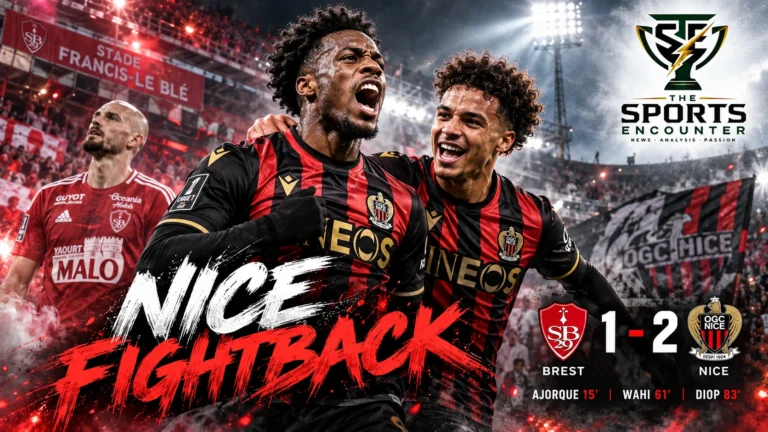 Ligue 1Wahi and Diop Rescue Nice With 2-1 Comeback at Brest as Ajorque’s Early Goal Goes to Waste
 Ligue 1Torino Beat Monza 3-2 as Fitz-Jim, Belghali and Vlašić Secure Third Straight Serie A Win Despite Late Scare
Frequently Asked Questions About Thierry Henry, Kate Scott, and the 2026 Ballon d’Or
Who is hosting the 2026 Ballon d’Or ceremony?
Thierry Henry and Kate Scott will co-host the 70th Ballon d’Or ceremony in London on October 26, 2026.
When were Thierry Henry and Kate Scott announced as hosts?
France Football and UEFA officially announced their appointment on Monday, October 19, 2026.
Where will the 2026 Ballon d’Or take place?
The ceremony will take place at the London Palladium in London, England.
What time does the Ballon d’Or ceremony begin?
The official ceremony begins at 8 p.m. British time, equivalent to 9 p.m. Central European Time.
Has Kate Scott hosted the Ballon d’Or before?
Yes. Scott previously presented the ceremony in 2014, 2015, and 2025. She co-hosted the 2025 ceremony with Ruud Gullit.
Has Thierry Henry ever won the Ballon d’Or?
No. Henry finished runner-up in the 2003 Ballon d’Or voting and received nine nominations during his playing career.
Is CBS Sports broadcasting the 2026 Ballon d’Or?
Henry and Scott are known for their CBS Sports Champions League partnership, but CBS does not control the ceremony’s production or global broadcasting rights. DAZN and designated regional broadcasters are distributing the event.
Why is the 2026 Ballon d’Or being held in London?
The ceremony marks the award’s 70th anniversary and honors the connection to its inaugural winner, English footballer Stanley Matthews.
Can viewers watch the Ballon d’Or on DAZN?
Yes. DAZN will stream the ceremony across eligible international markets, including the United Kingdom, while separate broadcasters hold rights in certain territories.
A New Chapter for Football’s Most Prestigious Awards Ceremony
When the lights come up at the London Palladium on October 26, the Ballon d’Or will be celebrating more than another season of outstanding football.
It will mark 70 years since Stanley Matthews received the inaugural award, while introducing a hosting partnership associated with a very different era of sports broadcasting.
Thierry Henry and Kate Scott have the experience, familiarity, and personalities to make that combination compelling.
Their challenge is to ensure that the ceremony feels both important and human.
The Ballon d’Or does not need to abandon its European heritage, its formal traditions, or the prestige surrounding its famous golden trophy.
But there is room for a presentation in which the hosts respond naturally to players, acknowledge unexpected emotions, and allow football’s personalities to emerge beyond carefully prepared speeches.
If Henry and Scott can achieve that balance, their partnership may provide a useful model for how major football ceremonies engage modern audiences.
The strongest legacy would not be a single viral joke or memorable exchange.
It would be an awards show in which the world’s best players remain the stars, while the people presenting their achievements make the occasion feel more personal.
On Monday night, London will discover whether two familiar broadcasting personalities can bring that possibility to life.
Editorial note: This feature examines the potential influence of Thierry Henry and Kate Scott’s established broadcasting chemistry on the 2026 Ballon d’Or. References to possible changes in ceremony style are editorial analysis, not confirmed production arrangements. Event details, hosting history, award categories, and broadcasting information were checked against official announcements available through October 24, 2026.