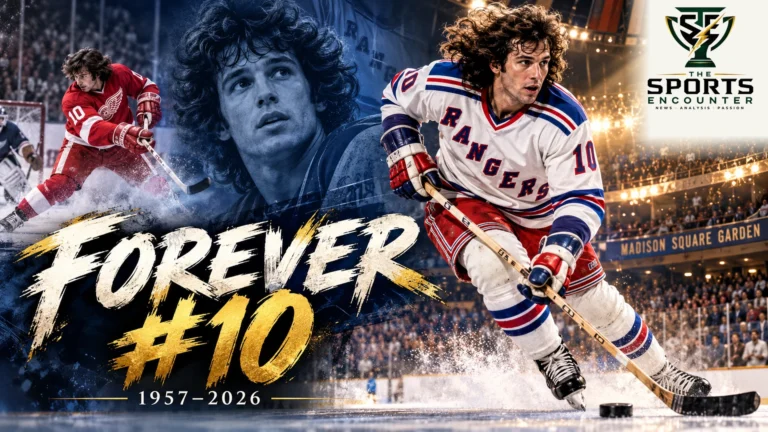
New York, United States, October 23, 2026: Ron Duguay was more than a flowing-haired New York Rangers star. He was a 40-goal scorer, a Stanley Cup finalist, an international player and an unlikely pop-culture phenomenon whose love of hockey survived the end of his NHL career. Following his death on October 22 at 69, these 100 moments trace his journey from Sudbury to Madison Square Garden, Detroit, broadcasting and one final night of recognition at home.
The kid from Val Caron who skated helmetless into Madison Square Garden, danced at Studio 54, scored 274 NHL goals and never quite stopped playing the game he loved.
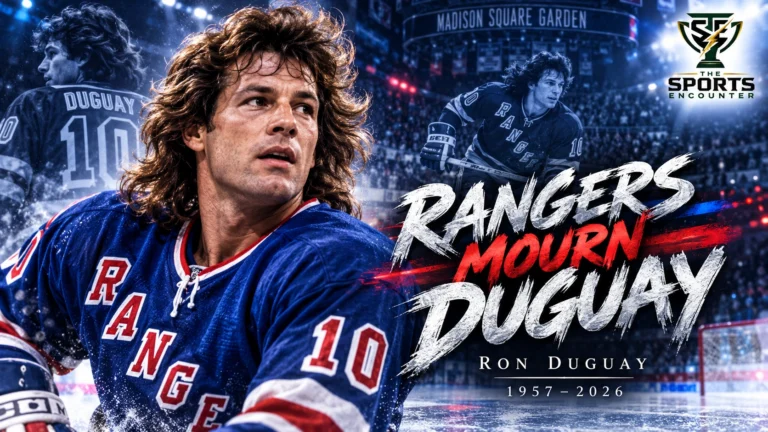
Ron Duguay died on October 22, 2026, at the age of 69, after a battle with Stage 4 colon cancer. For a generation of hockey fans, his name instantly summons a single image: a tall centre in a Rangers sweater, no helmet, dark curls streaming behind him as he swept through the neutral zone at Madison Square Garden. But the hair was only the most visible part of a remarkably full life.
Duguay was a junior superstar in his hometown of Sudbury, a first-round NHL pick, a Stanley Cup finalist, a 40-goal scorer, an NHL All-Star and a member of Team Canada. He was also a disco-era celebrity who sang on a novelty record, starred in a jeans commercial, appeared in the gossip pages beside some of the most famous women in the world, and later became a coach, a broadcaster and a charity fundraiser who simply refused to hang up his skates.
Story at a glance
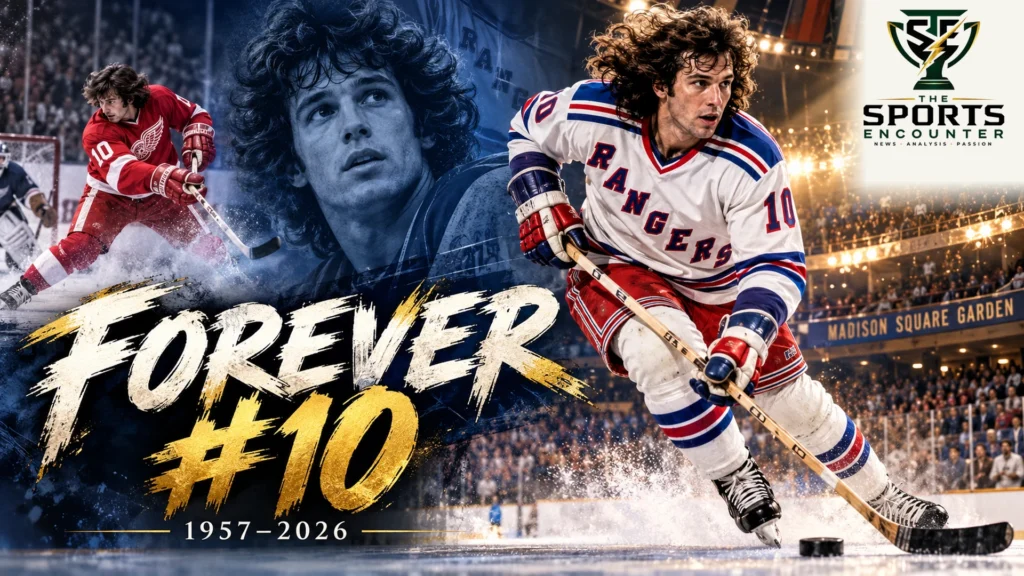
Ron Duguay: Quick Facts
Here are 100 things worth knowing about one of the most colourful personalities ever to play in the National Hockey League.
Roots in Northern Ontario
Things 1–15
Arriving on Broadway
Things 16–35
The Disco-Era Celebrity
Things 36–50
Detroit, Pittsburgh, a Return to New York and Los Angeles
Things 51–65
It is easy, looking back, to reduce Duguay to a caricature: the pretty boy of the Rangers, the man who spent more time on the dance floor than in the weight room. That picture does him a disservice. He went straight from junior hockey into the NHL at 20 and never looked out of place. He scored at least 17 goals in each of his first nine NHL seasons. He was trusted by coaches as different as Fred Shero, Herb Brooks and Phil Esposito, and he was chosen by Canada’s selectors to face the Soviet Union at the height of the Cold War rivalry. When New York grew tired of him, he went to Detroit and produced the two best seasons of his career.
It is just as easy to forget how unusual his celebrity was. In the late 1970s, hockey was still a regional sport in the United States, rarely seen on national television and often treated as an afterthought in the New York sports pages. Duguay, almost by accident, became one of the bridges between the game and mainstream American pop culture. Advertisers wanted him, magazine editors wanted him, and some of the most famous entertainers in the world wanted to be seen with him. Few hockey players before him had experienced anything like it, and few have since.
And then there is the third Ron Duguay, the one who never stopped playing. Long after his NHL days were over, he was still lacing up for minor-league teams in Germany, California and Florida, still coaching, still skating in charity games, still showing up at the Garden for alumni nights. His love for the game outlasted his fame, his marriages and his television career. Only illness could finally take him off the ice.
During his final year, The Sports Encounter followed the health crisis that led to Duguay’s July hospitalization and his determined rehabilitation in August. This tribute places those difficult final months within the larger story of his life.
Ron Duguay: Quick Facts
| Born | July 6, 1957, Sudbury, Ontario |
|---|---|
| Raised | Val Caron, Ontario |
| Died | October 22, 2026, aged 69 |
| Position | Centre / right wing; right-handed shot |
| Height and weight | 6 ft 2 in; approximately 200 lb |
| Junior team | Sudbury Wolves, 1973–1977 |
| NHL Draft | 13th overall, New York Rangers, 1977 |
| WHA Draft | 3rd overall, Winnipeg Jets, 1976 |
| NHL teams | New York Rangers, Detroit Red Wings, Pittsburgh Penguins, Los Angeles Kings |
| NHL regular-season career | 864 games, 274 goals, 346 assists, 620 points |
| Major highlights | 1979 Stanley Cup Final, 1982 NHL All-Star Game, 1981 Canada Cup, 1977 World Junior silver medal |
| Coaching | Jacksonville Barracudas, 2003–2006 |
| Broadcasting | MSG Network Rangers analyst, 2007–2018 |
| Nickname | Doogie |
Here are 100 things worth knowing about one of the most colourful personalities ever to play in the National Hockey League.
Roots in Northern Ontario
Things 1–15
- He was born in Sudbury in the summer of 1957
Ronald Duguay was born on July 6, 1957, in Sudbury, Ontario, a nickel-mining city in the heart of Northern Ontario. Hockey is close to a civic religion in the region, and Duguay would go on to become one of the most famous players the area ever produced, a point of pride for Sudbury for the rest of his life.
- He grew up in Val Caron
Although Sudbury is listed as his birthplace, Duguay spent his childhood in Val Caron, a community in the former township of Valley East, which has since been folded into the City of Greater Sudbury. He grew up in the Carol Richard Park neighbourhood, a short drive from the rinks where he first learned the game.
- His father was an electrician
Duguay came from a working-class family. His father worked as an electrician, a fitting background for a player whose game was built on energy and effort as much as on flash. Later in life, Duguay often credited his upbringing for keeping him grounded even as his celebrity reached heights few hockey players have ever experienced.
- He was on skates by age three
Like many Canadian kids of his era, Duguay started skating almost as soon as he could walk. He was reportedly on the ice by the age of three, and by the time he reached his teens it was clear that his skating ability was something special.
- His parents helped build a neighbourhood rink
To give their son and the neighbourhood children more ice time, Duguay’s parents helped build an outdoor rink near the family home. Countless hours on that backyard-style sheet helped shape the choppy, high-energy stride that later became his trademark in the NHL.
- He played his minor hockey at the Centennial Arena in Hanmer
Before he was a Wolf, Duguay was a local kid playing at the Centennial Arena in Hanmer, another community in Valley East. The arena remains a part of local hockey lore as the building where one of the area’s most famous sons first made his name.
- He played his entire junior career for his hometown team
Duguay joined the Sudbury Wolves in 1973 and stayed through 1977, never playing junior hockey anywhere else. For a local boy, starring for the hometown club was a dream come true, and the Wolves fan base adopted him as one of their own from the start.
- He scored 361 points as a Wolf
Over four seasons with Sudbury, Duguay piled up 361 points (131 goals and 230 assists) in 245 games. Those numbers placed him among the most productive players in franchise history and made him one of the top professional prospects in Canada by the time he turned 19.
- His 1975–76 season was spectacular
Duguay’s best junior season came in 1975–76, when he recorded 134 points, including 42 goals and 92 assists, in just 61 games. He was a playmaker first and a scorer second, a pattern that would carry over into his early professional years.
- He helped the Wolves win the Hamilton Spectator Trophy
That 1975–76 Sudbury team went 47-11-8 and won the Hamilton Spectator Trophy as the best team in the Ontario Major Junior Hockey League’s regular season. It was one of the finest seasons in the club’s history, with Duguay at the heart of it.
- He reached the league final
The Wolves went all the way to the OMJHL championship series in 1976, where they fell to the Hamilton Fincups in six games. Duguay was a force throughout the playoffs, putting up 20 points in 17 postseason games.
- He captained the Wolves
Duguay served as captain in Sudbury, a role that reflected both his talent and his popularity in the dressing room. The Wolves continued to refer to him as a former captain and franchise legend for the rest of his life.
- He was named to the league’s Third All-Star Team
Among his junior honours was a place on the OHL’s Third All-Star Team. In a league stacked with future NHL talent, being recognised among the elite forwards confirmed his status as a top professional prospect.
- He won a silver medal for Canada at the World Juniors
Duguay represented Canada at the 1977 World Junior Championship, registering two goals and four assists for six points in seven games as the Canadians claimed silver. It was one of the early occasions on which he wore the Maple Leaf in international competition. Source: Hockey Canada’s official 1977 player statistics.
- The Wolves retired his No. 10
Sudbury retired Duguay’s No. 10 sweater as part of the club’s 35th-anniversary celebrations in September 2006. The banner still hangs in the rafters of the Sudbury Community Arena, a permanent reminder of his place among the franchise’s all-time greats.
From Northern Ontario, his journey connected generations of players. For another TSE look at an earlier Canadian NHL champion, read our tribute to André Pronovost.
| Competition | Games | Goals | Assists | Points |
|---|---|---|---|---|
| NHL regular season | 864 | 274 | 346 | 620 |
| Stanley Cup playoffs | 89 | 31 | 22 | 53 |
| Season | Games | Goals | Assists | Points |
|---|---|---|---|---|
| 1973–74 | 59 | 20 | 20 | 40 |
| 1974–75 | 64 | 26 | 52 | 78 |
| 1975–76 | 61 | 42 | 92 | 134 |
| 1976–77 | 61 | 43 | 66 | 109 |
| Total | 245 | 131 | 230 | 361 |
Arriving on Broadway
Things 16–35
- The WHA wanted him first
Before the NHL came calling, the rival World Hockey Association made its move. The Winnipeg Jets selected Duguay third overall in the 1976 WHA Amateur Draft, at a time when the two leagues were fighting fiercely over young Canadian talent.
- The Rangers drafted him 13th overall in 1977
A year later, the New York Rangers took him in the first round, 13th overall, of the 1977 NHL Amateur Draft. Given the choice between Winnipeg and New York, Duguay chose the bright lights of Broadway, a decision that would shape the rest of his life.
- He jumped straight from junior to the NHL
In an era when many first-round picks spent time in the minors, Duguay went directly from the Wolves to the Rangers’ lineup. Remarkably, he would not play a single minor-league game until more than a decade into his professional career.
- His rookie initiation cost him his hair
The irony is delicious: the man famous for his hair had it shaved off in a rookie initiation ritual when he first joined the Rangers. He simply grew it back, longer than before, and it soon became the most recognisable feature in the sport.
- He scored 20 goals as a rookie
Duguay finished his first NHL season, 1977–78, with 20 goals and 40 points in 71 games. On a rebuilding Rangers team, he was one of the brightest signs of hope and quickly became a fan favourite at the Garden.
- He wore No. 10
Duguay wore No. 10 in New York, the same number he had worn as a junior in Sudbury. The jersey number became part of his brand, and he used it in his social media handle decades later.
- He reached 20 goals in each of his first three seasons
Duguay scored 20, 27 and 28 goals in his first three NHL campaigns, showing remarkable consistency for a young player. His 63-point season in 1978–79 was a major step forward and cemented his role as a core part of the Rangers’ attack.
- He arrived in the Sonny Werblin era
Duguay’s timing was perfect. The Rangers were run at the time by Sonny Werblin, the showman executive best known for signing Joe Namath to the New York Jets. Werblin believed athletes were entertainers, and he wanted his hockey team to be seen around town as much as it was seen on the ice.
- He was part of the 1979 Stanley Cup Final team
The 1978–79 Rangers, coached by Fred Shero and led by Phil Esposito and goalie John Davidson, swept the Los Angeles Kings, beat the Philadelphia Flyers and stunned the top-seeded New York Islanders in six games to reach the Stanley Cup Final. Duguay was a key young piece of that run, with nine points in 18 playoff games.
- The Rangers won Game 1 in Montreal, then lost four straight
Against the defending champion Montreal Canadiens, the Rangers shocked everyone by winning the opening game of the Final at the Forum. Montreal then won the next four games to claim the Cup. It was the closest Duguay ever came to lifting the trophy.
- He tied a Rangers record for the fastest goal
On April 6, 1980, Duguay scored just nine seconds into a game against the Flyers at the Spectrum in Philadelphia, an 8-3 Rangers win. The goal tied a franchise record for the fastest goal from the start of a game, shared with Fred Cook and Jean Ratelle.
- His 1981 playoff run was his best
Although injuries limited him to 50 games in 1980–81, Duguay was outstanding in the playoffs that spring, scoring eight goals and 17 points in 14 games. The Rangers beat the Kings and St. Louis Blues before being swept by the eventual champion Islanders in the semifinals.
- Herb Brooks became his coach
After the 1980 “Miracle on Ice,” the Rangers hired Craig Patrick as general manager and Herb Brooks as head coach. Many expected the disciplined, intense Brooks and the free-spirited Duguay to be an awkward fit, and the relationship would indeed become complicated.
- Brooks paired him with Mark Pavelich
Brooks put Duguay on a line with Mark Pavelich, the quiet American centre from the 1980 Olympic team. Off the ice, the pair could hardly have been more different; on it, they had immediate chemistry, combining speed and creativity in a way that suited Brooks’ flowing, European-influenced system.
- He scored 40 goals in 1981–82
Duguay’s best season in New York came in 1981–82, when he scored 40 goals and 76 points, leading the Rangers in goals. It was the only 40-goal season of his career and the peak of his first stint with the Blueshirts.
- He was an NHL All-Star
That same season, Duguay was selected to play in the 1982 NHL All-Star Game, representing the Rangers on the Wales Conference squad. For a player often dismissed as more style than substance, it was concrete proof of his standing in the league.
- He played for Canada in the 1981 Canada Cup
Before that breakout season, Duguay was chosen for Team Canada at the 1981 Canada Cup. He played in all seven of Canada’s games, including the final, which the Soviet Union won decisively. He later described representing his country in that tournament as perhaps the proudest achievement of his professional career.
- His play improved after the Canada Cup
Playing alongside the best players in Canada seemed to lift Duguay’s game. Observers noted that his production, which had been slowed by injuries, jumped noticeably after the tournament, setting the stage for his 40-goal season.
- 1982–83 brought a slump and friction with Brooks
The following year, Duguay’s goal total dropped to 19. Brooks openly questioned whether his star’s nightlife was affecting his play, and Duguay heard boos at home late in the season. To his credit, he largely avoided airing the dispute publicly.
- The Rangers traded him to Detroit in June 1983
On June 13, 1983, the Rangers sent Duguay, goalie Eddie Mio and forward Ed Johnstone to the Detroit Red Wings for Willie Huber, Mark Osborne and Mike Blaisdell. After six seasons, his first chapter on Broadway was over.
Duguay played at Madison Square Garden decades before today’s Rangers stars. TSE continues to cover that franchise, including New York’s early 2026–27 season.
The Disco-Era Celebrity
Things 36–50
- He skated without a helmet
Duguay played in the era before helmets were mandatory, and he chose to go without one. The decision was partly practical and partly personal style, and it produced the single most enduring image of his career: long curls flying behind him as he raced up the ice.
- The hair made him a sensation
Duguay’s flowing hair turned him into a pin-up figure, especially among female fans at the Garden. He became one of the few hockey players of his generation instantly recognisable to people who had never watched a game.
- The press gave him colourful nicknames
Teammates called him “Doogie,” but the press went further. He was dubbed things like the “Romeo of the Rink” and compared to Mick Jagger and to Joe Namath, the original New York sports celebrity, as writers struggled to describe a hockey player who behaved like a rock star.
- He was a regular at Studio 54
At the height of the disco era, Duguay was routinely waved past the velvet rope at Studio 54, Manhattan’s most exclusive nightclub. He was as closely associated with the club as he was with Madison Square Garden. He later joked to The New York Times that he was getting “extra cardio at Studio 54.”
- Liza Minnelli introduced him to Cher
Duguay recalled that Liza Minnelli introduced herself to him at Studio 54 and later connected him with Cher. He went on to date Cher for a time, a romance that kept the New York gossip columns busy.
- He told a famous story about that night
Decades later, on a New York Post podcast, Duguay shared the story of a night in January 1982. After a Rangers win over the Islanders, he said he ended up at Studio 54 dancing with Cher, who then whisked him off into the night. He admitted that as a Canadian kid who had grown up watching “Sonny & Cher,” he could hardly believe it was happening.
- He was linked with Cheryl Tiegs
Duguay also claimed to have dated supermodel Cheryl Tiegs, the era’s most famous cover girl, around the same time as his romance with Cher. Whatever the exact timeline, his social life was a constant source of material for the tabloids.
- He appeared in Andy Warhol’s Interview magazine
Duguay was featured in a cover story in Interview, the celebrity magazine founded by Andy Warhol. It was a rare honour for an athlete, let alone a hockey player, and a clear sign of how far his fame had spread beyond sports.
- He starred in the Sasson jeans commercial
In 1979, Duguay joined teammates Phil Esposito, Dave Maloney and Anders Hedberg in a television commercial for Sasson designer jeans. The players skated in tight denim to the catchy “Oo La La, Sasson” jingle, creating one of the most memorable sports advertisements of the decade.
- Fans never let the Rangers forget the ad
The jeans commercial was great publicity for the league, but opposing fans used it to taunt the Rangers. Crowds sang the jingle at them on the road, and Rangers lore holds that when the team was knocked out of the playoffs, fans twisted the words into “Oo La La, So Soon.”
- He sang on “Hockey Sock Rock”
Duguay was one of several Rangers who recorded “Hockey Sock Rock,” a 1979 novelty song written by Canadian actor and songwriter Alan Thicke. He shared vocal duties with Phil Esposito, Pat Hickey, Dave Maloney and John Davidson, and the track was released as a 45 rpm single.
- He was a fixture of the gossip columns
Duguay was scoring as often on Page Six as on the scoresheet. He turned up in commercials, on magazine covers and in society columns, becoming a genuine celebrity in a city that rarely gave hockey players that kind of attention.
- He stayed out of serious trouble
For all the late nights, Duguay generally avoided the kind of off-ice scandal that derailed some of his teammates in that era. Rangers historians often note that he managed to enjoy his fame without letting it turn into lasting trouble.
- His fame helped sell hockey in New York
At a time when the NHL badly needed exposure in the American market, Duguay brought the sport to audiences who would never have picked up a sports page. His celebrity was a gift to the Rangers’ marketing department and to the league itself.
- His image sometimes overshadowed his game
The flip side of fame was that critics, and at times his own coaches, assumed his nightlife mattered more to him than his hockey. That perception followed him throughout his career, even though his statistics show a productive, durable NHL forward.
The tension between fame and sporting achievement remains relevant today. Our ranking of hockey’s greatest players asks what makes a legacy endure after an athlete’s statistics stop changing.
Detroit, Pittsburgh, a Return to New York and Los Angeles
Things 51–65
- Detroit revitalised his career
The trade to Detroit gave Duguay a fresh start, and he made the most of it. Away from the glare of New York and the friction with Brooks, he produced the two finest statistical seasons of his career.
- He had 80 points in his first Red Wings season
In 1983–84, Duguay scored 33 goals and added 47 assists for 80 points in 80 games. He finished third on the team in goals and points and second in assists, helping the Red Wings return to the playoffs.
- He played alongside a rookie Steve Yzerman
That 1983–84 season was also Steve Yzerman’s rookie year in Detroit. Duguay was part of the veteran group around the future Hall of Fame captain at the very start of his legendary career with the Red Wings.
- His career-best season came in 1984–85
Duguay topped himself the following year with 38 goals, 51 assists and 89 points, all career highs. He finished second on the Red Wings in goals, assists and points, firmly answering anyone who had written him off after his last year in New York.
- He was traded to Pittsburgh at the 1986 deadline
With Detroit struggling in 1985–86, the Red Wings dealt Duguay to the Pittsburgh Penguins at the trade deadline in exchange for Doug Shedden. In 227 games as a Red Wing, he had scored 90 goals and 217 points.
- He played with a young Mario Lemieux
In Pittsburgh, Duguay joined a rebuilding team built around a young Mario Lemieux. He scored 13 points in 13 games after arriving, but his production slowed the following season, and he never became a long-term part of the Penguins’ plans.
- Phil Esposito brought him back to the Rangers
On January 21, 1987, the Rangers reacquired Duguay from Pittsburgh in exchange for Chris Kontos. The man who made the trade was general manager Phil Esposito, his old teammate from the 1979 Final run.
- His second Rangers role was different
Esposito did not bring Duguay back to be the flashy young scorer of the late 1970s. Instead, he was valued as a veteran presence and a reliable faceoff man, someone who could steady the lineup in key moments.
- He re-signed with New York in 1987
Duguay scored 21 points in 34 games after returning, then added two goals in six playoff games. He re-signed with the Rangers as a free agent in the summer of 1987, choosing to stay in the city where he had become a star.
- He played his first minor-league games in 1988
In January 1988, the Rangers sent Duguay to the Colorado Rangers of the International Hockey League for two games. It was the first time in more than a decade as a professional that he had played below the NHL level.
- The Rangers traded him to Los Angeles in February 1988
On February 23, 1988, New York sent Duguay to the Los Angeles Kings in exchange for defenceman Mark Hardy. Across his two stints in New York, he played 499 games for the Rangers, scoring 164 goals and 340 points.
- He became Wayne Gretzky’s teammate
Duguay’s final NHL season, 1988–89, was Wayne Gretzky’s first in Los Angeles after the blockbuster trade from Edmonton. Duguay had seven goals and 24 points in 70 games and finished with a plus-23 rating, one of the best of his career.
- His last NHL games came in the 1989 playoffs
Duguay played 11 playoff games for the Kings in the spring of 1989, as Los Angeles knocked out the Edmonton Oilers in seven games before being swept by the Calgary Flames. It was the final NHL action of his career.
- His career totals were impressive
Over 12 NHL seasons, Duguay played 864 regular-season games, scoring 274 goals and 346 assists for 620 points. He added 31 goals and 53 points in 89 playoff games, a body of work that compares favourably with many players who never achieved his fame.
- He attempted NHL comebacks in Toronto and Tampa Bay
Duguay tried to return to the NHL with the Toronto Maple Leafs in 1990 and again with the Tampa Bay Lightning in 1992, where his old friend Phil Esposito was general manager. Neither attempt led to a roster spot, and he abandoned the Tampa Bay comeback early in training camp.
Duguay’s four NHL clubs have each lived through major transitions since his playing days. TSE has examined Detroit’s modern rebuilding decisions, changes in Pittsburgh’s ownership, and how Los Angeles honored longtime captain Anže Kopitar.
Ron Duguay’s NHL Career Statistics by Team
| Team | Seasons | GP | G | A | Pts |
|---|---|---|---|---|---|
| New York Rangers | 1977–83, 1987–88 | 499 | 164 | 176 | 340 |
| Detroit Red Wings | 1983–86 | 227 | 90 | 127 | 217 |
| Pittsburgh Penguins | 1986–87 | 53 | 11 | 20 | 31 |
| Los Angeles Kings | 1988–89 | 85 | 9 | 23 | 32 |
| NHL Total | 12 seasons | 864 | 274 | 346 | 620 |
Ron Duguay’s Season-by-Season NHL Production
The table below shows how Duguay’s production rose and fell across his NHL career: a steady 20-goal beginning in New York, his 40-goal peak under Herb Brooks, two outstanding seasons in Detroit and the gradual transition to a supporting role in his final years.
| Season | Team | GP | G | A | Pts |
|---|---|---|---|---|---|
| 1977–78 | NY Rangers | 71 | 20 | 20 | 40 |
| 1978–79 | NY Rangers | 79 | 27 | 36 | 63 |
| 1979–80 | NY Rangers | 73 | 28 | 22 | 50 |
| 1980–81 | NY Rangers | 50 | 17 | 21 | 38 |
| 1981–82 | NY Rangers | 72 | 40 | 36 | 76 |
| 1982–83 | NY Rangers | 72 | 19 | 25 | 44 |
| 1983–84 | Detroit | 80 | 33 | 47 | 80 |
| 1984–85 | Detroit | 80 | 38 | 51 | 89 |
| 1985–86 | Detroit | 67 | 19 | 29 | 48 |
| 1985–86 | Pittsburgh | 13 | 6 | 7 | 13 |
| 1986–87 | Pittsburgh | 40 | 5 | 13 | 18 |
| 1986–87 | NY Rangers | 34 | 9 | 12 | 21 |
| 1987–88 | NY Rangers | 48 | 4 | 4 | 8 |
| 1987–88 | Los Angeles | 15 | 2 | 6 | 8 |
| 1988–89 | Los Angeles | 70 | 7 | 17 | 24 |
| Total | 864 | 274 | 346 | 620 |
Europe, the Minors and Behind the Bench
Things 66–80
- He played in Germany
After leaving the NHL, Duguay spent part of the 1989–90 season in Europe, playing 22 games for Mannheim ERC in the German Bundesliga. The club, now known as Adler Mannheim, is one of Germany’s most successful hockey franchises.
- He joined the San Diego Gulls
Returning to North America, Duguay signed with the San Diego Gulls of the International Hockey League, where he played two seasons beginning in 1990–91. Southern California suited his laid-back side, and he remained a popular draw wherever he played.
- One of his San Diego teammates now coaches the Rangers
Among Duguay’s teammates on the 1990–91 Gulls was a young Mike Sullivan, who would go on to win two Stanley Cups as coach of the Penguins and later become head coach of the Rangers. After Duguay’s death, Sullivan called it a big loss for everyone in the organisation.
- He retired in 1992
Following the 1991–92 IHL season, Duguay retired from professional hockey for the first time. He was 35, and for most players that would have been the end of the story. For Duguay, it turned out to be only an intermission.
- He came out of retirement in 1995
Three years later, Duguay returned to play for a new incarnation of the San Diego Gulls in the West Coast Hockey League. He said he wanted to help an injury-plagued team, and he also wanted his children, who had been too young to see him in the NHL, to watch him play.
- He was still productive at 38
In that 1995–96 comeback season, Duguay recorded eight goals and nine assists in just 12 games. Over the following two seasons he appeared in only five games for the Gulls, but he had made his point: he could still play.
- He played one game in the ECHL
In 1998–99, Duguay suited up for the Jacksonville Lizard Kings of the East Coast Hockey League, playing a single game before stepping away again. It marked his second retirement, at the age of 41.
- He moved to Florida
After his marriage to model Kim Alexis, Duguay settled in Ponte Vedra Beach, Florida, near Jacksonville. The move explains why so many of his later hockey adventures took place in North Florida rather than in New York or Ontario.
- He joined the Jacksonville Barracudas in 2003
In 2003, Duguay joined the Jacksonville Barracudas of the Atlantic Coast Hockey League. Even in his mid-40s, he played six games as a forward before moving behind the bench.
- He became the Barracudas’ head coach
After his brief stint on the ice, Duguay took over as Jacksonville’s head coach. It was his first real coaching job, and he brought his NHL experience and name recognition to a small-market minor league team.
- He coached a championship team
In 2003–04, with the Barracudas now playing in the World Hockey Association 2, Duguay guided the team to the league’s best regular-season record and the playoff championship. It was the only professional title of his hockey life.
- The team moved to the SPHL
In 2004, the Barracudas joined the newly formed Southern Professional Hockey League. Duguay remained behind the bench as the franchise navigated life in yet another league.
- His coaching record finished close to even
Over parts of three seasons with Jacksonville, Duguay compiled an overall coaching record reported as 92-92-0-3, plus a 6-3 playoff record. The near-even results reflected the demanding and unstable environment of lower-level professional hockey.
- His final coaching season was a struggle
The 2005–06 season was a difficult one. The Barracudas finished 15-39-0-2, and more than 50 different players passed through the roster. Duguay resigned in April 2006, telling the local newspaper simply that he was tired.
- He kept lacing up the skates for charity
In March 2009, nearly six years after his last professional game, Duguay played one game each for the Brooklyn Aces and the Jersey Rockhoppers of the Eastern Professional Hockey League to raise money for the Garden of Dreams Foundation. He signed a waiver to play the Brooklyn game without a helmet, and the hair still flowed.
His eventual move behind a bench and microphone gave him another way to stay involved. TSE also remembered former NHL player, coach and broadcaster Barry Melrose in its hockey tribute series.
Broadcaster, Family Man and Public Figure
Things 81–92
- He spent 12 years as a Rangers analyst
From 2007 to 2018, Duguay worked as an in-studio analyst for MSG Network’s coverage of the Rangers. A new generation of fans got to know him not as a helmetless winger but as a sharp-dressed, upbeat voice of the team’s television broadcasts.
- He was a regular on “Hockey Night Live!”
Alongside his game-night work, Duguay appeared regularly on MSG’s weekly “Hockey Night Live!” programme. The show gave him a platform to share stories from his playing days and opinions on the modern game.
- His MSG departure stung
Duguay’s contract with MSG expired in 2018 and was not renewed. He later told the New York Post that losing the job had been difficult, a candid admission from a man whose public persona was usually relentlessly positive.
- He competed on “Battle of the Blades”
In 2009, Duguay took part in the first season of CBC Television’s “Battle of the Blades,” a figure-skating competition that paired former hockey players with professional figure skaters. His partner was Olympic medallist Barbara Underhill, and he skated to raise money for World Vision Canada.
- He played in the 2012 Winter Classic alumni game
On December 31, 2011, Duguay joined other Rangers greats in the Winter Classic alumni game against Flyers legends in Philadelphia. Fans who had grown up watching him got one more chance to see him in a Rangers sweater.
- He was a fixture at Garden events
Duguay remained a familiar face at Rangers alumni events for decades, from jersey retirement ceremonies to charity skates such as Ronald McDonald House New York’s “Skate With the Greats.” He was on hand at the Garden when Jean Ratelle’s number was retired in 2018.
- He was deeply involved with the Garden of Dreams Foundation
Duguay was one of the most active alumni supporters of the Garden of Dreams Foundation, the Madison Square Garden-affiliated charity that works with children facing obstacles. His charity games in 2009 were only one part of a long commitment to the cause.
- He married model Robin Bobo in 1983
On December 1, 1983, Duguay married California model Robin Bobo. People magazine ran a feature the following spring suggesting that the famous bachelor had finally settled down. The couple had two daughters before they divorced.
- He later married supermodel Kim Alexis
In the 1990s, Duguay married Kim Alexis, one of the best-known fashion models of the late 1970s and 1980s. The couple made their home in Ponte Vedra Beach, Florida, and divorced in 2016.
- He dated Sarah Palin
In early 2022, Duguay was widely reported to be dating former Alaska governor and 2008 Republican vice-presidential nominee Sarah Palin. He confirmed the relationship in February 2022, and the two remained together through his illness.
- He drew controversy in 2026
In March 2026, Duguay attracted criticism for social media posts in which he blamed a Rangers loss on the team’s Pride Night event. The posts, which were widely reported, were later deleted. The episode showed that, even late in life, he was never far from the headlines.
- He leaves three children
Duguay is survived by his daughters, Shay Thomas and Amber Stavros, and his son, Noah Duguay. The NHL Alumni Association said that his family was his greatest pride and joy, and that his love for them came before everything else.
Final Chapter and Legacy
Things 93–100
- He was diagnosed with Stage 4 colon cancer
Duguay publicly disclosed a diagnosis of Stage 4 colon cancer in February 2026. Reports differ over the precise timing of his initial diagnosis. During treatment, he discussed the removal of his appendix and gallbladder. His illness and rehabilitation were publicly chronicled by his family and in interviews.
- Sudbury held “Ron Duguay Night” weeks before his death
On October 2, 2026, the Sudbury Wolves held Ron Duguay Night at the Sudbury Community Arena. He signed autographs with former Wolves teammates, took part in a pre-game ceremony featuring longtime Maple Leafs broadcaster Joe Bowen, and dropped the ceremonial puck before a game against the Niagara IceDogs. The Sudbury Wolves’ official event announcement details the tribute, puck drop and fundraising effort.
- The night raised money for cancer research
Proceeds from special Ron Duguay Night tickets and T-shirts went to colon cancer research. The Wolves also offered children 12 and under $10 walk-up tickets in honour of his No. 10. The club later said it was grateful he had the chance to reunite with friends, family and fans one last time.
- He died on October 22, 2026
Duguay died peacefully on October 22, 2026, at the age of 69, according to a statement shared by his daughter Shay Thomas and by Sarah Palin, who had asked the public to pray for him just days earlier. The family said a celebration of his life would be announced later. The October 22 Reuters obituary also documents the Rangers’ and NHL Alumni Association’s tributes.
- The Rangers called him one of their most popular players ever
In its statement, the Rangers described Duguay as “one of the most popular players in franchise history,” praising the skating style that captivated the Garden faithful and the skill, tenacity and charisma that won over New Yorkers. The NHL also paid tribute to him as a charismatic figure who left a lasting mark on the game.
- Hockey’s tributes poured in
The Sudbury Wolves, the Ontario Hockey League and the NHL Alumni Association all issued statements. The Alumni Association remembered him for his infectious smile, his compassion and his willingness to help others, while Sudbury’s club leadership called him one of the all-time greats.
- He ranks among the 100 Ranger Greats
In the 2009 book “100 Ranger Greats,” the authors ranked Duguay No. 49 among the more than 900 players who had worn the Rangers sweater in the franchise’s first 82 seasons. It is a fitting placement for a player whose influence went well beyond his statistics.
- He changed what a hockey star could be
Before Ron Duguay, hockey players were rarely treated as celebrities outside of Canada. He showed that a player could be a magazine cover star, a nightlife icon and a pitchman while still scoring 40 goals and representing his country. For better and occasionally for worse, he lived his life at full speed, with his hair flowing behind him, and the game was more colourful because of it.
Ron Duguay: Six Milestones Across Five Decades
| Year | Milestone | What It Signified |
|---|---|---|
| 1977 | Selected 13th overall by the New York Rangers | Move from Sudbury junior hockey directly to the NHL |
| 1979 | Rangers reach Stanley Cup Final | Closest he came to an NHL championship as a player |
| 1981–82 | 40 goals and NHL All-Star appearance | His Rangers scoring peak |
| 1984–85 | 89 points for Detroit | Best regular-season points total of his NHL career |
| 2003–04 | Jacksonville Barracudas win WHA2 title | Professional championship as head coach |
| October 2, 2026 | Sudbury Wolves honor Duguay | Final hometown celebration and cancer-research fundraiser |
For continuing coverage of the league, its history and the players who shaped it, visit The Sports Encounter’s NHL Hub.
Why Ron Duguay Mattered
Lists like this one can make a life look like a collection of trivia: a record here, a romance there, a trade, a comeback, a television job. But taken together, the 100 things above tell a more coherent story about who Ron Duguay was and why so many people felt a personal connection to him.
First, he was a genuinely good hockey player, and that should not be lost under the hair. A player does not jump straight from junior hockey into an NHL lineup at 20, score 20 goals as a rookie, reach a Stanley Cup Final, make an All-Star team and earn a place on Team Canada by accident. His 40-goal season in 1981–82 came under Herb Brooks, a coach who demanded discipline and conditioning above all else. His 89-point season in Detroit came on a team that was still finding its way, and he did it after New York had decided he was expendable. Across 864 regular-season games, he averaged better than 0.7 points per game, a strong rate for a forward of his era who was rarely the focal point of a power-play unit built around him.
Second, he arrived at exactly the right moment. The late 1970s were a period of excess and spectacle in New York, from Studio 54 to the Bronx Zoo Yankees. Sonny Werblin, who had turned Joe Namath into a national celebrity a decade earlier, saw in Duguay a chance to do something similar for hockey. Duguay was willing, charming and photogenic, and he understood that being seen was part of the job. The Sasson commercial, “Hockey Sock Rock,” the Interview magazine feature and the gossip-column appearances all flowed from that moment. They made the Rangers a talking point well beyond the traditional hockey audience.
Third, that celebrity came at a cost, and he handled it with more grace than he was sometimes given credit for. Coaches and critics questioned his commitment. Fans who had cheered him booed him when his goal totals fell. He was traded away from the city he loved, and decades later lost the broadcasting job that had brought him back into the Rangers family. Through most of it, he kept his complaints largely to himself, smiled for the cameras and kept showing up.
Fourth, he never stopped loving the game. The second retirement, the third comeback, the single ECHL appearance, the six games with the Barracudas before he took over as coach, the charity games in Brooklyn and New Jersey, the Winter Classic alumni game and the countless skates for good causes: none of these were about money or fame. They were about a man who simply wanted to be on the ice for as long as his body would let him. It is telling that one of his stated reasons for coming back in 1995 was so that his children could finally see him play.
Finally, he never forgot where he came from. Sudbury retired his number in 2006 and gave him one last night in the spotlight on October 2, 2026, just 20 days before he died. The fact that the evening was used to raise money for colon cancer research, and that he was there in person to drop the puck, says a great deal about both the man and the community that produced him.
Like anyone who lives a long time in public, Duguay was not without his controversies, and some of his late-life comments drew sharp criticism. But the outpouring of tributes from the Rangers, the NHL, the NHL Alumni Association, the OHL and the Sudbury Wolves after his death made clear how most of the hockey world will remember him: as a joyful, generous, unmistakable presence who made the game more fun to watch.
Continue the NFL Story

Frequently Asked Questions About Ron Duguay
How did Ron Duguay die?
Duguay died on October 22, 2026, at the age of 69, after a battle with Stage 4 colon cancer. He publicly disclosed his diagnosis in February 2026.
What teams did Ron Duguay play for?
In the NHL he played for the New York Rangers twice, the Detroit Red Wings, the Pittsburgh Penguins and the Los Angeles Kings. He also played junior hockey for the Sudbury Wolves, spent part of a season with Mannheim ERC in Germany, and played in the minor leagues for the Colorado Rangers, San Diego Gulls, Jacksonville Lizard Kings and Jacksonville Barracudas, plus two charity games in the EPHL.
Did Ron Duguay win the Stanley Cup?
No. The closest he came was in 1979, when the Rangers reached the Stanley Cup Final and won the opening game in Montreal before losing the series to the Canadiens in five games. His only championship as a professional came as a coach, with the Jacksonville Barracudas of the WHA2 in 2003–04.
Why didn’t Ron Duguay wear a helmet?
Helmets were not mandatory in the NHL for players who entered the league before 1979, so veterans of that era could choose to play without one. Duguay chose not to wear one, and his flowing hair became the defining image of his career.
Who was Ron Duguay married to?
Duguay married model Robin Bobo in December 1983; they had two daughters before divorcing. He later married supermodel Kim Alexis, and the couple divorced in 2016. From 2022 until his death, he was in a relationship with former Alaska governor Sarah Palin.
How many goals did Ron Duguay score in the NHL?
Duguay scored 274 goals and 346 assists for 620 points in 864 regular-season NHL games. He added 31 goals and 22 assists in 89 playoff games. His best goal-scoring season was 1981–82, with 40 goals for the Rangers, and his best overall season was 1984–85, with 89 points for Detroit.
What was Ron Duguay’s best NHL season?
His highest points total came with Detroit in 1984–85, when he produced 38 goals and 51 assists for 89 points. His best goal-scoring campaign was 1981–82, when he scored 40 for the Rangers.
Did Ron Duguay represent Canada internationally?
Yes. He won silver with Canada at the 1977 World Junior Championship, recording two goals and four assists in seven games, and appeared for Canada at the 1981 Canada Cup.
When did Sudbury honor Ron Duguay before his death?
The Sudbury Wolves hosted Ron Duguay Night on October 2, 2026. He met fans, joined former teammates and took part in the ceremonial puck drop as the event raised money for colon cancer research.
A Lasting Legacy Beyond the Numbers
Ron Duguay’s career statistics will always tell one part of his story: 864 NHL games, 274 goals, a Stanley Cup Final, an All-Star appearance and a Canada Cup. But the numbers cannot capture the image of the young man from Val Caron skating helmetless under the lights of Madison Square Garden, or the way he made an entire city, and an entire league, pay attention to hockey.
He gave the sport glamour when it needed it, kept playing long after most would have stopped, and returned home to Sudbury one last time to be celebrated by the fans who knew him first.
Rest in peace, Doogie.
Ron Duguay
- 100 Things to Know About Ron Duguay (1957–2026)
- Ron Duguay Dies at 69: The Rangers Icon Who Lit Up Madison Square Garden and Never Stopped Fighting
- Ron Duguay Walks Without a Walker as Stage 4 Cancer Fight Enters a New Treatment Phase
- Ron Duguay Hospitalized After Collapse as Cancer Battle Takes a Dangerous Turn