


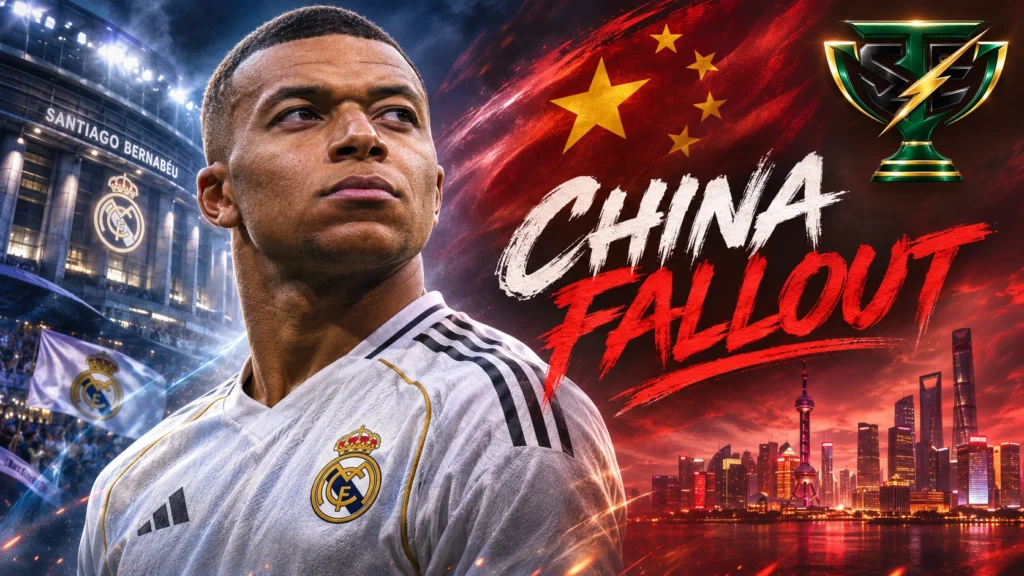
MADRID, Spain, November 6, 2026: China has confirmed it is communicating with Real Madrid and LaLiga over Kylian Mbappé’s controversial comments about a meme depicting him as Mao Zedong, offering Spanish football a possible route out of a dispute that has already cost the French superstar commercial partnerships and disrupted broadcasts in one of the world’s largest markets. Chinese Ambassador to Spain Yao Jing said Friday that communication was continuing but cautioned that no formal negotiations were underway. The intervention comes after Mbappé, Real Madrid and LaLiga apologized, while Chinese state broadcaster CCTV suspended Spanish league coverage and streaming service Migu omitted a Real Madrid match from its schedule.
The dispute presents a challenge extending far beyond Mbappé’s personal endorsements. LaLiga president Javier Tebas has been working to restore relations with Chinese partners whose broadcasting agreements are worth approximately €10 million annually and run through the 2029-30 season. Those rights previously generated substantially greater revenue. With the Real Madrid forward still delivering decisive performances in Spain and Europe, the controversy has created an uncomfortable contrast between his sporting importance and the commercial consequences of a viral video that Reuters initially said it could not independently authenticate. The immediate question is whether the apologies and ongoing communication will be enough to restore broadcasting arrangements and rebuild confidence.
China Confirms Contact With Real Madrid and LaLiga Over Mbappé’s Comments
Chinese Ambassador Yao Jing addressed the controversy on Friday before attending a forum at the University of Salamanca in Spain.
Speaking to Spanish news agency EFE, Yao confirmed that China was communicating with LaLiga, Real Madrid and other Spanish institutions about the fallout from the comments.
He distinguished those contacts from formal negotiations and indicated that people in China needed time to process the incident.
The distinction is important. Diplomatic communication establishes that both sides have channels through which to address the dispute. It does not mean an agreement has been reached or that television broadcasts will immediately resume.
Yao’s comments also indicate that the Chinese response involves questions of public sentiment as well as commercial relationships.
The ambassador said the incident had hurt feelings in China, a position consistent with the criticism expressed by Chinese officials, media outlets and companies after the video circulated in late October.
The full context of his November 6 remarks was reported by Spanish news agency EFE following its interview with Yao Jing.
What Is Confirmed, and What Remains Unresolved?
| Issue | Verified Position on November 6 | Outstanding Question |
|---|---|---|
| Communication with China | Ambassador confirms contact involving Real Madrid and LaLiga | Whether those discussions produce an agreed resolution |
| Formal negotiations | Ambassador says no formal negotiations are underway | Whether discussions develop into formal negotiations |
| Mbappé’s apology | Public apology issued October 27 | Whether Chinese authorities and commercial partners consider it sufficient |
| Real Madrid and LaLiga response | Both have apologized or expressed regret | Whether further action will be requested |
| CCTV coverage | LaLiga broadcasts suspended | When regular coverage might resume |
| Migu coverage | Real Madrid’s previous league fixture was omitted | Whether upcoming Madrid matches receive normal distribution |
| Chinese sponsorships | Several brands ended cooperation with Mbappé | Whether any relationships can be restored |
| Annual broadcasting contracts | Approximately €10 million, according to LaLiga president Javier Tebas | Actual financial consequences of the interruption |
The existence of a communication channel is encouraging for the league, but its value will ultimately be measured by specific outcomes.
For supporters, the most visible outcome would be the return of regular television and streaming coverage.
For LaLiga, the wider issue is whether relations with Chinese broadcasters and commercial partners can be repaired without creating further uncertainty.
What Did Kylian Mbappé Say About Mao Zedong?
The controversy began when a video circulated online on October 26 showing Mbappé discussing internet memes made using his image.
One meme reportedly placed his face on an image of Mao Zedong, the former Chinese leader who governed the People’s Republic of China from its founding in 1949 until his death in 1976.
In the circulated recording, Mbappé appeared to describe the person shown as a Chinese dictator. He did not specifically name Mao in the reported remark.
That distinction matters because the incident has sometimes been described in headlines as though Mbappé directly named Mao during the exchange.
Reuters reported on October 27 that it had not independently authenticated the video. The existence of that verification limitation should remain part of the reporting, even though Mbappé subsequently acknowledged making an ill-judged comment about an image of himself.
The broader meme trend predates the latest controversy.
Supporters have occasionally placed Mbappé’s face on images of historical political and military figures as a satirical commentary on his perceived influence over football decisions.
Those images are not evidence of his actual political views or the decisions made inside Real Madrid.
Why Was the Mao Image Particularly Sensitive?
Mao remains a central figure in the history and official political identity of the People’s Republic of China.
He is credited by supporters with founding the modern Chinese state, while his rule is also associated with historical policies and campaigns that caused extensive suffering and remain the subject of international historical debate.
Within China, public commentary and satire involving Mao can carry significant political and cultural sensitivity.
The backlash therefore developed from a combination of the imagery, the remark attributed to Mbappé and the wider significance attached to Mao’s historical role.
Not every Chinese supporter necessarily holds the same view. Public criticism, official statements and online reactions should not be treated as proof that every individual in China responded identically.
Mbappé Apologizes as Chinese Brands End Commercial Partnerships
Mbappé publicly apologized on October 27 after the controversy attracted widespread attention.
He acknowledged that his comment had been poorly judged and expressed regret over the offense caused to people in China and Chinese communities abroad.
His response was issued in multiple languages, including Mandarin, reflecting an effort to address the affected audience directly.
LaLiga president Javier Tebas also apologized and emphasized the importance of maintaining the league’s longstanding relationship with Chinese fans and commercial partners.
Real Madrid subsequently expressed regret over the incident.
However, the apologies did not immediately reverse the commercial consequences.
Several Chinese companies announced they were ending their relationships with Mbappé.
Among them were beverage company Dongpeng and dairy-related businesses Mengniu and Milkground.
The decisions demonstrated how quickly the commercial position of a prominent international athlete can change when a controversy develops in a major consumer market.
How the Mbappé-China Controversy Developed
| Date | Development | Immediate Consequence |
|---|---|---|
| October 26 | Video containing the reported Mao meme remark circulates online | Controversy develops across Chinese social platforms |
| October 27 | Chinese brands announce withdrawal from Mbappé partnerships | Direct endorsement relationships are affected |
| October 27 | Mbappé issues public apology | Player acknowledges offense caused by his remark |
| Late October | LaLiga and Real Madrid express regret | Institutional response expands beyond the individual player |
| Late October | CCTV suspends Spanish league broadcasting | Chinese television access to LaLiga is disrupted |
| Late October | Javier Tebas meets China’s ambassador to Spain | Direct diplomatic contact begins |
| November 1 | Migu omits Racing Santander vs. Real Madrid | Madrid’s 3-0 victory is not carried through that platform’s regular coverage |
| November 6 | Ambassador Yao Jing confirms continued communication | Possibility of resolving the dispute remains open |
The chronology is significant because the dispute has moved through several stages.
It began with a widely circulated video, developed into a commercial backlash and then became a matter involving the league’s international broadcasting relationships.
By November 6, the focus had shifted toward how those relationships might be restored.
The Sports Encounter’s November 5 column, Sorry Seems to Be the Smartest Word, previously examined Mbappé’s apology alongside other examples of prominent football personalities responding to public controversy.
The new development is China’s explicit acknowledgment that contact with the Spanish football institutions continues.
Why Did China Suspend LaLiga Broadcasts?
China’s state broadcaster CCTV suspended coverage of LaLiga following the controversy.
Streaming platform Migu also omitted Real Madrid’s November 1 match against Racing Santander while showing other Spanish league fixtures.
Those actions turned what began as a dispute involving an individual player’s remarks into a problem affecting the distribution of professional football.
The precise contractual mechanisms behind the interruptions have not been publicly established in the reviewed reporting.
Consequently, it would be premature to characterize the broadcaster decisions as a permanent cancellation of existing rights agreements.
A temporary suspension, the omission of a particular match and the termination of a commercial contract are different outcomes.
Each has potentially different consequences for broadcasters, leagues, clubs, advertisers and supporters.
Why Real Madrid’s Missing Match Matters
Migu’s omission of Real Madrid’s November 1 fixture provided a particularly visible example of the dispute’s impact.
The match itself was significant to the Spanish title race.
Real Madrid defeated Racing Santander 3-0, with Mbappé converting an early penalty before Jude Bellingham and Yan Diomande added further goals.
The victory extended Madrid’s strong run of results and reduced their deficit to LaLiga leaders Barcelona to three points.
Readers can revisit TSE’s detailed analysis of Real Madrid’s 36-minute scoring blitz against Racing Santander.
The contrast was striking.
Mbappé remained influential on the field, while a broadcasting partner in China excluded a match featuring his club.
That demonstrates why the consequences cannot be assessed solely through goals, assists or team results.
Football clubs and leagues operate simultaneously as sporting institutions, entertainment providers and commercial brands.
How Much Money Could LaLiga Lose in China?
LaLiga president Javier Tebas has placed an important figure on the league’s Chinese broadcasting relationships.
He said contracts involving CCTV and Migu currently generate approximately €10 million annually.
According to Tebas, those rights were once worth approximately €100 million a year at their peak.
The difference is substantial and demonstrates how the commercial value of international broadcasting agreements can change over time.
However, the entire €10 million cannot automatically be described as money already lost because of the present controversy.
The figure represents the approximate annual value of the contracts, not an independently established amount of suspended payments or compensation due.
LaLiga’s China Broadcasting Revenue: Current Value vs. Previous Peak
| Measure | Reported Value | Interpretation |
|---|---|---|
| Previous peak annual rights value | Approximately €100 million | Historical benchmark cited by Javier Tebas |
| Current annual rights value | Approximately €10 million | Combined reported value of CCTV and Migu contracts |
| Absolute difference | Approximately €90 million annually | Comparison between historical peak and current reported level |
| Current value as percentage of peak | 10% | Calculated using the two approximate figures |
| Decline from reported peak | Approximately 90% | Historical comparison, not a loss caused by Mbappé |
| Existing Migu agreement | Through 2029-30 season | Contractual relationship continues beyond the present season |
| Verified immediate revenue loss | Not publicly established | Cannot be calculated solely from the interruption in coverage |
TSE statistical finding: The current reported annual value of LaLiga’s major Chinese television agreements is only one-tenth of their previous peak, based on the approximate figures provided by Tebas.
That decline predates the present controversy and must not be attributed to Mbappé’s comments.
The comparison nevertheless explains why the league may be particularly sensitive to further commercial deterioration.
When a valuable international relationship has already contracted significantly from its historical peak, losing confidence among existing partners could make future negotiations more difficult.
Could a Broadcast Suspension Cost the Entire €10 Million?
Not necessarily.
There is insufficient public evidence to establish whether the agreements contain provisions for temporary interruptions, payment adjustments, refunds or termination under the circumstances involved.
The league might face limited immediate disruption if broadcasts resume quickly without contractual changes.
It could face a larger commercial challenge if the interruption continues or affects future negotiations.
Either outcome requires evidence before a monetary loss can be reported as fact.
What Could Happen to LaLiga’s Chinese Broadcasting Agreements?
The current information supports several possible scenarios, but no final outcome has been confirmed.
The most immediate possibility is a restoration of normal coverage following additional communication and acceptance of the apologies.
A more complicated outcome would involve a gradual return of selected matches while the parties continue discussions.
A prolonged interruption could create uncertainty for advertisers, distributors and future rights negotiations.
There is also the possibility that some commercial partners decide not to resume previous relationships with Mbappé even if broadcasts return.
| Scenario | What Would Need to Happen | Potential Consequence | Confirmed? |
|---|---|---|---|
| Full restoration | CCTV and Migu resume normal schedules | Major viewing disruption ends | No |
| Partial restoration | Some matches return while restrictions continue elsewhere | Coverage remains inconsistent | No |
| Extended suspension | Broadcasters maintain restrictions | Greater commercial and audience uncertainty | No |
| Revised commercial arrangements | Broadcasters and league agree to changes | Possible effect on contract terms | No |
| Personal sponsorship recovery | Individual brands reconsider their decisions | Potential restoration of endorsement opportunities | No |
| Continued brand withdrawal | Companies maintain terminated partnerships | Mbappé faces longer-term endorsement consequences | Some terminations confirmed; future outcome unknown |
The scenarios are analytical possibilities, not reports of agreements already reached.
For now, the most reliable evidence of progress would be a broadcaster announcement, confirmation that suspended fixtures have returned or an official statement from LaLiga identifying a completed agreement.
What Has Javier Tebas Done to Resolve the Dispute?
LaLiga president Javier Tebas has taken a direct role in addressing the commercial consequences.
He met Ambassador Yao Jing in late October and subsequently said that the league remained engaged with Chinese authorities and broadcasting partners.
Tebas described LaLiga’s relationships with CCTV and Migu as strong despite the dispute.
His public approach indicates that the league wants to prevent one player’s remarks from damaging a commercial presence built over many years.
The position is understandable from a business perspective.
LaLiga’s international distribution depends on broadcasters who can connect Spanish clubs with supporters outside Europe.
China provides a large potential audience for Real Madrid, Barcelona and other clubs, while commercial partners use football to reach consumers through broadcasts, sponsorship campaigns and digital platforms.
However, calling the relationship strong does not prove that the immediate restrictions have been lifted.
The current public evidence supports continued communication rather than a completed settlement.
Why the Dispute Matters to Real Madrid Beyond Mbappé
Real Madrid’s sporting position remains strong.
José Mourinho’s side have been competing closely with Barcelona in LaLiga and have maintained an excellent Champions League record.
Mbappé remains central to the team’s attacking output.
His performances have included decisive goals against Barcelona in El Clásico, an opening penalty against Racing Santander and another important Champions League goal against AEK Athens.
The Sports Encounter’s report on Mbappé’s two goals in Madrid’s 2-1 El Clásico victory examined his influence on the Spanish title race.
More recently, TSE’s November 5 Champions League report documented Madrid’s 3-2 comeback against AEK Athens, including Mbappé’s equalizer before Federico Valverde scored the winner in stoppage time.
Those performances underline why Mbappé is so important to Madrid on the field.
But a major football club’s commercial interests extend beyond the immediate result of a match.
Real Madrid’s global appeal depends partly on the accessibility of its matches, the popularity of its players and relationships with broadcasters and sponsors.
When distribution becomes uncertain in a major market, the effects can reach supporters who have no involvement in the original controversy.
Could the Controversy Affect Real Madrid’s Results?
There is no verified evidence that the diplomatic and commercial dispute has reduced Madrid’s on-field performance.
Indeed, the recent results point in the opposite direction.
Mbappé scored against Racing Santander on November 1 and AEK Athens on November 4 while the controversy was ongoing.
That does not establish that the dispute has had no psychological or personal impact. Such claims would require reliable evidence.
What can be established is that his recent scoring contributions have continued.
Madrid’s broader attacking progress has also involved other players.
Jude Bellingham, Yan Diomande, Arda Güler and Federico Valverde have supplied important contributions, reducing the burden on any one attacker.
The distinction between commercial reputation and sporting output should remain central to evaluating the story.
Mbappé’s Recent Performances: Why Madrid Cannot Treat This as a Routine Publicity Problem
Mbappé has contributed to several important Madrid victories during the opening months of the season.
His hat trick against Real Sociedad in August highlighted his ability to transform matches through finishing and attacking movement.
The Sports Encounter examined the performance in its report on Madrid’s 4-1 victory over Real Sociedad.
He also scored against Inter Milan in the Champions League, a match in which Madrid survived considerable pressure despite being outshot by their opponents.
That performance was analyzed in TSE’s report on Mbappé and Valverde’s contributions against Inter.
His recent successes explain why Madrid has a considerable interest in protecting both the player and the club’s international reputation.
A star athlete can simultaneously be central to sporting performance and involved in a controversy that places commercial relationships under pressure.
Those realities are not mutually exclusive.
What Does the Controversy Reveal About Football’s Dependence on International Markets?
European football clubs and leagues increasingly operate through international media and sponsorship agreements.
Broadcasting rights help distribute matches, generate revenue and build familiarity with clubs among audiences who may never visit their home stadiums.
Player endorsements strengthen that reach.
Major international athletes can become commercial ambassadors for products, competitions and clubs far beyond their domestic markets.
That creates substantial opportunities, but it also exposes those relationships to political and cultural disagreements.
When a controversy involving an individual athlete develops, commercial partners may make decisions based on local consumer expectations rather than on the player’s football performances.
The Chinese response to Mbappé is an example of that dynamic.
Several companies ended their endorsements, while broadcasters restricted coverage.
It is important to distinguish the commercial decisions of individual brands from actions involving state-controlled media or government representatives.
They may respond to related public concerns, but they are not necessarily governed by identical contractual responsibilities or decision-making processes.
Why the Comparison With Other Sports Requires Caution
International sporting organizations have experienced disputes involving China before.
One prominent example occurred in 2019 when comments by a Houston Rockets executive concerning Hong Kong led to a major backlash affecting the NBA’s relationship with Chinese broadcasters and commercial partners.
The broad comparison is relevant because it illustrates how a public controversy can influence sports distribution and sponsorship.
However, the circumstances, participants and underlying political issues differ.
It would be inappropriate to assume that LaLiga will experience the same duration of disruption or identical financial consequences.
Each contractual relationship needs to be examined on its own terms.
Why LaLiga Has More at Stake Than One Player’s Sponsorships
Mbappé’s personal commercial agreements and LaLiga’s broadcasting contracts are separate revenue streams.
A sponsor may choose to terminate its relationship with one athlete without ending a partnership with the league.
A broadcaster may suspend coverage of certain fixtures without automatically terminating its broader rights agreement.
That distinction is essential to avoid exaggerating the financial damage.
Nevertheless, both forms of disruption can undermine confidence.
Brands want predictable associations with public figures. Broadcasters want dependable access to desirable content. Leagues want consistent distribution and a stable commercial environment.
The present dispute threatens those objectives in different ways.
For LaLiga, the priority is therefore not simply protecting Mbappé’s image.
It is preserving the broader relationship through which Spanish football reaches Chinese supporters.
Can Real Madrid and LaLiga Respond Without Compromising Their Own Institutions?
There is no simple formula for resolving a dispute involving cultural sensitivities, political history, individual expression and commercial interests.
Chinese officials and companies have emphasized the offense they believe was caused by the remarks.
Mbappé has apologized and acknowledged that his comment was ill judged.
LaLiga and Real Madrid have also expressed regret and indicated that they want to restore relationships.
Those positions leave room for further communication.
However, football institutions also have to consider how they respond consistently to future controversies.
A policy developed solely around one player’s commercial importance may create uncertainty when other athletes face criticism.
A more dependable approach would distinguish personal expression, discriminatory behavior, contractual commitments and the responsibilities of clubs and leagues.
Those categories should not automatically be treated as equivalent.
Madrid have already experienced other controversies involving player behavior and institutional decisions this season.
The Sports Encounter’s report on Vinícius Júnior’s four-match suspension before El Clásico examined the sporting consequences of a separate disciplinary decision.
Those were different disputes governed by different rules. Their relevance here lies in the need to distinguish a player controversy from the specific actions and obligations of the institutions involved.
How Could the China Dispute Affect the LaLiga Title Race?
At present, there is no demonstrated direct effect on the title standings.
Madrid’s recent results remain strong, while Barcelona have continued producing substantial attacking performances.
The Sports Encounter’s analysis of Barcelona’s 6-1 victory over Deportivo Alavés highlighted the continuing competition between the two clubs after Madrid’s El Clásico win.
Madrid’s earlier victory over Sevilla also helped establish the momentum that carried into the late-October and early-November fixtures.
As reported in TSE’s coverage of Madrid’s 4-1 win over Sevilla and Barcelona’s nine-game winning start, Mbappé’s goals were already central to keeping Madrid close to their rivals.
The immediate sporting consequences of the China controversy should not be invented simply because the commercial consequences are significant.
What the dispute may affect is the ability of Chinese viewers to follow the ongoing championship race through their usual distribution services.
That becomes more consequential when Madrid and Barcelona are producing closely contested title developments.
Real Madrid’s Next Match: Why November 7 Is Worth Watching
Real Madrid are scheduled to visit Valencia on Saturday, November 7.
The fixture offers another opportunity to observe whether Mbappé’s sporting performances continue unaffected by the public controversy.
It also provides a practical checkpoint for monitoring the distribution dispute in China.
If Chinese platforms carry the fixture through their usual arrangements, that would provide new evidence about the broadcasting situation.
If the match remains absent, questions about the duration and scope of restrictions will persist.
Neither outcome should be assumed before the relevant broadcaster schedules are verified.
Fans can check the official LaLiga competition portal for fixtures, results and standings.
Five Developments That Will Determine Whether the Mbappé-China Dispute Is Ending
The next stage of the controversy can be measured through observable actions rather than speculation.
| Development to Monitor | Evidence Needed | Why It Matters |
|---|---|---|
| Restoration of CCTV coverage | Official programming or broadcaster confirmation | Shows whether suspended linear television distribution resumes |
| Restoration of Migu coverage | Real Madrid fixtures appearing on the service | Tests the impact on club-specific streaming distribution |
| Formal agreement | Joint or independently confirmed institutional statement | Distinguishes communication from a completed resolution |
| Commercial partnership changes | Statements from affected sponsors | Shows whether player endorsements recover or remain terminated |
| Financial consequences | Verified contract adjustments or league disclosures | Establishes measurable losses rather than hypothetical exposure |
A return to normal broadcasting would be an important step, but it would not necessarily restore terminated sponsorships.
Similarly, renewed commercial activity with Mbappé would not by itself establish that all broadcasting arrangements had been repaired.
Each development should be evaluated separately.
What Does China Want From Mbappé and Spanish Football?
Chinese authorities have acknowledged Mbappé’s apology while emphasizing the importance of his subsequent conduct.
China Media Group indicated that it would consider what the player had said in his apology and pay attention to what he did afterward.
The latest comments from Ambassador Yao suggest that the diplomatic response remains cautious.
He confirmed communication with Spanish football institutions but did not announce specific conditions for ending the dispute.
It would therefore be speculative to claim that China has demanded a particular new apology, financial settlement, formal sanction or other measure not established in the reporting.
The verified position is narrower: the remarks caused offense, apologies have been issued, and communication continues.
What Can Mbappé Do to Rebuild Commercial Confidence?
Mbappé has already taken the clearest publicly documented step by apologizing for the remark and acknowledging its impact.
Any further action would need to be evaluated against what he, his representatives and the relevant partners actually announce.
There is no confirmed requirement for him to travel to China, participate in a particular campaign or make another public statement.
Commercial relationships may recover through ordinary business decisions, or some companies may choose to maintain their withdrawal.
The outcome will depend on individual partners as well as the broader diplomatic environment.
In the meantime, his immediate professional responsibilities remain with Real Madrid, where the team is competing in LaLiga and the Champions League.
Frequently Asked Questions About Mbappé’s China Controversy
Why is Kylian Mbappé facing criticism in China?
A video circulated in late October in which Mbappé appeared to comment on a meme depicting him as Mao Zedong. The reported remark caused offense in China, prompting public criticism, lost sponsorships and broadcasting restrictions.
Did Mbappé specifically name Mao Zedong?
In the reported video, Mbappé did not specifically name Mao. The remark was understood as referring to a meme that placed his face on an image of the former Chinese leader.
Has the video been independently authenticated?
Reuters reported when the controversy emerged that it could not independently authenticate the circulating video. Mbappé later acknowledged making an ill-judged comment about an image of himself.
Has Mbappé apologized to China?
Yes. He issued an apology on October 27, acknowledging that his words had caused offense and expressing respect for Chinese people and their history.
Has Real Madrid apologized?
Real Madrid expressed regret over the controversy, while LaLiga president Javier Tebas also apologized and engaged with Chinese representatives.
Why did Chinese brands drop Mbappé?
Several companies ended endorsement relationships after the reported remark caused public criticism in China. Their decisions concerned commercial association with the player.
Has China banned Real Madrid matches?
Chinese broadcasting restrictions have affected Spanish league coverage. CCTV suspended LaLiga broadcasts, while Migu omitted Madrid’s November 1 match against Racing Santander. A permanent ban on every future Madrid fixture has not been established.
Are Real Madrid and China negotiating?
China’s ambassador confirmed communication with Real Madrid and LaLiga on November 6, but explicitly distinguished it from formal negotiations.
How much are LaLiga’s Chinese broadcasting rights worth?
Javier Tebas said agreements involving CCTV and Migu are worth approximately €10 million annually, compared with a previous peak of approximately €100 million.
Has LaLiga already lost €10 million?
No such loss has been independently established. The €10 million figure represents the approximate annual value of the broadcasting contracts, not a confirmed financial penalty resulting from the controversy.
When does Real Madrid play next?
Madrid are scheduled to visit Valencia on November 7, 2026, in LaLiga.
The Sports Encounter Verdict: A Football Dispute That Will Be Resolved Beyond the Pitch
Kylian Mbappé remains one of Real Madrid’s most influential players, and his recent goals show why the club continues to depend on him in the Spanish and European title races.
But the controversy involving China has created a problem that cannot be solved with another winning performance.
Several Chinese companies have withdrawn from commercial relationships with the French forward. Broadcasters have restricted LaLiga coverage, and the competition’s president has become directly involved in discussions with Chinese representatives.
Friday’s comments from Ambassador Yao Jing provide the clearest indication that communication remains possible.
They do not establish that a settlement is imminent.
For Real Madrid and LaLiga, the practical objectives are straightforward: rebuild confidence, protect established broadcasting relationships and restore access for supporters affected by the dispute.
For Mbappé, the challenge is different. He has apologized, but the decisions of sponsors and broadcasters are outside his direct control.
There is also an important lesson about distinguishing different forms of consequence.
A damaged endorsement relationship is not the same as a suspended television broadcast. A broadcaster’s temporary scheduling decision is not automatically a canceled contract. And the reported €10 million annual value of Chinese broadcasting agreements is not evidence that LaLiga has already lost that amount.
The real measure of progress will be observable: restored matches, confirmed commercial decisions and an agreement publicly acknowledged by the institutions involved.
Real Madrid’s next game against Valencia offers an immediate test of the broadcast situation, while the diplomatic and commercial discussions may require considerably more time.
Mbappé can continue influencing games with goals. Whether the controversy surrounding his remarks fades will be decided through actions and relationships far beyond the football field.