


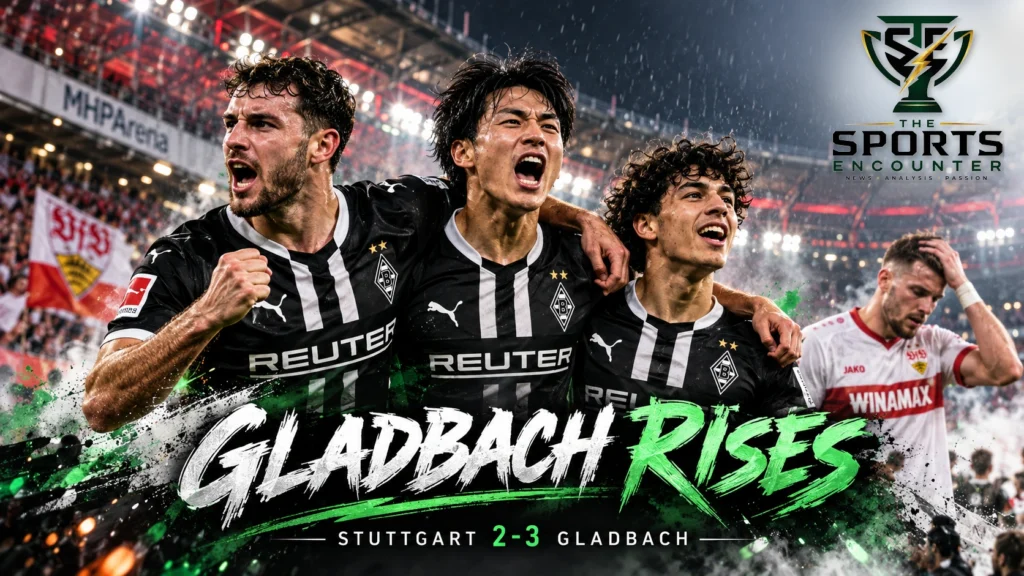
STUTTGART, Germany, October 23, 2026: Borussia Mönchengladbach finally ended their nightmare start to the Bundesliga season with a dramatic 3-2 victory over VfB Stuttgart at the MHPArena on Friday, recovering from an early Ermedin Demirović goal through strikes from Joe Scally, Shuto Machino and 17-year-old Wael Mohya. The result delivered Alexander Blessin’s first victory as Gladbach manager and prevented the club from becoming the first team in Bundesliga history to lose its opening seven matches.
Stuttgart dominated possession with 66%, completed 674 passes compared with Gladbach’s 204 and attempted more shots, but failed to convert that territorial advantage into points. Demirović scored after five minutes and again in the 83rd to threaten a remarkable late comeback, yet goalkeeper Moritz Nicolas produced a crucial stoppage-time save from Bilal El Khannouss to protect the visitors’ lead. Gladbach finished with only 34% possession and three goals from six shots on target, securing three precious points after six consecutive defeats.
Stuttgart vs Gladbach 3-2: Bundesliga Matchday 7 Result and Match Summary
Few Bundesliga matches this season have carried such sharply contrasting expectations.
Stuttgart entered the contest after showing encouraging form in the UEFA Champions League, remaining unbeaten through their first three European matches.
Gladbach arrived without a single league point.
Six defeats from six matches represented the worst opening to a Bundesliga season in the club’s history. Another loss would have created an unwanted league-wide record.
Yet the visitors responded to the pressure with their most effective attacking performance under Blessin, recovering from an early setback before scoring twice in the second half.
It was a significant change from the defensive uncertainty that had dominated The Sports Encounter’s analysis of Bundesliga Matchday 6, when Gladbach lost 2-1 to Hoffenheim and remained rooted to the bottom.
Friday brought another two goals conceded, but this time the team found enough answers at the other end.
Full-time result: VfB Stuttgart 2-3 Borussia Mönchengladbach.
Competition: Bundesliga 2026-27, Matchday 7.
Venue: MHPArena, Stuttgart, Germany.
Referee: Dr. Matthias Jöllenbeck.
Five Goals, Four Lead Changes or Equalizers: How the Match Unfolded
The game began in the worst possible fashion for Gladbach.
Demirović gave Stuttgart the lead in the fifth minute, placing immediate pressure on a visiting team that had struggled badly whenever opponents scored first.
Gladbach spent much of the opening half attempting to find a way back into the game.
Joe Scally eventually equalized in the 38th minute with a backheel finish, ensuring that the teams entered halftime level at 1-1.
The second half brought the decisive transformation.
Shuto Machino put Gladbach ahead in the 51st minute, giving the visitors their first lead of the night.
Wael Mohya extended the advantage in the 66th minute, moving Gladbach into a 3-1 position that few would have predicted after Stuttgart’s early breakthrough.
Demirović scored again in the 83rd minute to reduce the deficit to one goal.
Stuttgart continued attacking, but Gladbach survived the closing pressure to secure their first victory of the campaign.
| Minute | Goalscorer | Team | Score After Goal | Match Significance |
|---|---|---|---|---|
| 5′ | Ermedin Demirović | Stuttgart | 1-0 | Early home advantage |
| 38′ | Joe Scally | Gladbach | 1-1 | First-half equalizer |
| 51′ | Shuto Machino | Gladbach | 1-2 | Visitors take the lead |
| 66′ | Wael Mohya | Gladbach | 1-3 | Gladbach establish a two-goal cushion |
| 83′ | Ermedin Demirović | Stuttgart | 2-3 | Late comeback attempt |
Gladbach scored three unanswered goals between the 38th and 66th minutes, completely reversing the position created by Demirović’s opener.
That 28-minute scoring sequence proved decisive, even though Stuttgart recovered sufficiently to threaten another change in the result.
Joe Scally’s Equalizer Changed the Match and Reversed a Painful Stuttgart Memory
Scally’s 38th-minute goal had significance beyond bringing Gladbach level.
In January 2026, the American defender had endured a difficult encounter against Stuttgart when he inadvertently turned Chris Führich’s corner into his own net during a 3-0 defeat.
That own goal helped Stuttgart establish a two-goal advantage before Deniz Undav completed the victory.
Nine months later, Scally returned to the same rivalry and scored for Gladbach rather than against them.
His backheel equalizer gave the visitors the opportunity to approach the second half with a completely different outlook.
For a team that had begun the league campaign with six consecutive losses, recovering from an early deficit was especially important.
Gladbach had repeatedly struggled to sustain momentum after promising passages of play.
Against Hoffenheim on October 18, Mohya equalized early in the second half, only for Alexander Prass to restore Hoffenheim’s lead five minutes later.
Friday’s equalizer produced a different response.
Gladbach did not immediately surrender their improved position. Instead, they turned the level score into an advantage shortly after halftime.
Scally’s contribution also continued an encouraging individual scoring run.
He had already scored against Elversberg in September and headed home against Cologne during the Rhine derby earlier this month.
The sequence shows how increasingly important the American wing-back has become when Gladbach need attacking contributions from positions outside their traditional forward line.
Machino and Mohya Strike After Halftime as Blessin’s Changes Deliver
Gladbach manager Alexander Blessin made two changes to his starting lineup following the defeat against Hoffenheim.
Daiki Hashioka replaced Kevin Diks, while Shuto Machino came into the attack in place of Isac Lidberg.
The decision to start Machino proved important.
The Japanese attacker scored in the 51st minute, putting Gladbach ahead for the first time.
His goal arrived only six minutes into the second half, creating an immediate advantage after the teams had entered the interval level.
The visitors then extended their lead through Mohya in the 66th minute.
At 3-1, Gladbach had accomplished something their opening six matches had repeatedly failed to deliver: building a substantial advantage after recovering from a setback.
The three goals also showed how widely the decisive contributions were distributed.
Scally scored from a wing-back position, Machino contributed in attack, and Mohya provided another important finish from an advanced role.
That variety matters for a team attempting to rebuild its confidence.
Rather than depending on one experienced scorer to rescue the result, Gladbach found goals from three different players.
The club’s official pre-match assessment had documented the historic danger facing the team and the difficulties created by six consecutive defeats.
Friday’s response demonstrated that Gladbach still possessed enough attacking talent to challenge Bundesliga opponents, despite their dreadful start.
Wael Mohya: The 17-Year-Old Offering Gladbach a Reason for Optimism
Mohya’s goal deserves particular attention because of his age and the circumstances surrounding Gladbach’s season.
The 17-year-old had already become the youngest Bundesliga scorer of the 2026-27 campaign when he equalized against Hoffenheim five days earlier.
Stuttgart’s official pre-match research also identified him as the first Gladbach player to score three Bundesliga goals before his 18th birthday.
His goal at the MHPArena added another important moment to that early career record.
But Mohya’s development should not be judged only by his scoring numbers.
He has been trusted with important minutes during a period when more experienced players have struggled to find consistency.
That responsibility places considerable pressure on a young footballer, particularly at a club facing the possibility of relegation.
Against Stuttgart, Mohya helped turn a promising comeback into a two-goal advantage.
The performance suggests that Blessin can use him as an important attacking option, although protecting his development and managing expectations will remain essential.
Gladbach’s most immediate challenge is to ensure that the teenager’s contributions form part of a more stable collective performance rather than becoming another isolated highlight during a difficult season.
Stuttgart Had 66% Possession but Gladbach Won the Chances That Mattered
The match statistics reveal a striking difference between territorial control and scoring effectiveness.
Stuttgart enjoyed 66% possession, attempted 674 passes and completed 87% of them.
Gladbach had only 34% possession, attempted 204 passes and completed 64%.
Stuttgart therefore attempted approximately 3.3 passes for every one Gladbach attempted.
Yet their advantage was considerably smaller when measured through attempts on goal.
The hosts had 14 shots, compared with Gladbach’s 13.
Stuttgart placed seven attempts on target and Gladbach six.
The visitors therefore generated almost as many scoring attempts despite spending substantially less time with the ball.
| Statistic | VfB Stuttgart | Borussia Mönchengladbach |
|---|---|---|
| Goals | 2 | 3 |
| Total shots | 14 | 13 |
| Shots on target | 7 | 6 |
| Possession | 66% | 34% |
| Passes attempted | 674 | 204 |
| Pass accuracy | 87% | 64% |
| Fouls | 9 | 14 |
| Yellow cards | 2 | 4 |
| Red cards | 0 | 0 |
| Offsides | 2 | 2 |
| Corners | 6 | 5 |
TSE statistical insight: The difference in possession was 32 percentage points, but the difference in total shots was only one.
That contrast provides a more useful understanding of the match than possession alone.
Stuttgart controlled the ball for longer periods, but Gladbach found opportunities to attack often enough to keep the contest competitive.
Possession does not automatically measure the quality of chances created. Teams can maintain the ball in relatively safe areas without consistently threatening the goal.
Equally, a team with lower possession can produce dangerous opportunities by moving forward quickly after recovering the ball.
The statistics suggest that Gladbach made more effective use of limited possession, although they do not independently establish the quality of every chance or the exact tactical sequence behind each goal.
The Scoring Efficiency Numbers Explain Why Stuttgart’s Control Was Not Enough
The most important difference appeared in front of goal.
Gladbach converted three of their 13 shots into goals.
Stuttgart converted two of 14.
The visitors also scored from three of their six attempts on target, while Stuttgart converted two of seven.
| Measure | Stuttgart | Gladbach |
|---|---|---|
| Total shots | 14 | 13 |
| Shots on target | 7 | 6 |
| Goals | 2 | 3 |
| Shot accuracy | 50.0% | 46.2% |
| Goals per total shot | 14.3% | 23.1% |
| Goals per shot on target | 28.6% | 50.0% |
| Shots per goal | 7.0 | 4.3 |
Calculation: Gladbach scored from 23.1% of their attempts, compared with 14.3% for Stuttgart. The difference was approximately 8.8 percentage points.
The gap was even more noticeable when considering attempts on target.
Gladbach converted half of their shots on target, compared with 28.6% for Stuttgart.
These figures describe finishing outcomes, not expected goals or the difficulty of individual chances.
They nevertheless explain an important part of the result.
Stuttgart were not dramatically superior in the number of attempts generated despite their enormous passing advantage.
Gladbach, meanwhile, made enough of their fewer accurate efforts count.
A similar contrast emerged in TSE’s earlier examination of Schalke’s 3-1 victory over Union Berlin, where the winning team converted a relatively small share of possession into an effective scoring performance.
The comparison does not mean possession is unimportant. It demonstrates why judging a game requires examining what teams accomplish with the ball rather than how long they keep it.
Demirović Scores Twice, but Stuttgart’s Bundesliga Problems Continue
Ermedin Demirović provided Stuttgart with two goals and remained their most dangerous individual finisher.
His early breakthrough created a promising position for Sebastian Hoeneß’s side.
His 83rd-minute goal then revived Stuttgart’s hopes after the visitors had established a two-goal cushion.
The striker’s performance was another demonstration of his quality in front of goal.
Earlier in September, Demirović scored a remarkable 12-minute hat trick as Stuttgart recovered to defeat Viking FK 3-1 in the Champions League.
Our report on Demirović’s hat trick against Viking examined how he transformed an early European setback into a Stuttgart victory.
That game offers an important contrast with Friday’s defeat.
Against Viking, Demirović’s scoring burst changed the direction of the match and Stuttgart protected their advantage.
Against Gladbach, his two goals could not compensate for three conceded at the other end.
Why Stuttgart’s European Form Has Not Translated Into Bundesliga Consistency
Stuttgart entered Matchday 7 unbeaten in their first three Champions League matches.
They had beaten Viking FK 3-1 and Slovan Bratislava 3-0 before drawing 1-1 with Atlético Madrid.
The domestic campaign has produced a very different picture.
Stuttgart have lost five of their opening seven Bundesliga games, collecting only six points.
Their league victories came against Cologne and Paderborn.
They also suffered defeats against Bayern Munich, Hoffenheim, Borussia Dortmund, Hamburger SV and now Gladbach.
| Competition | Match or Record | Result | What It Shows |
|---|---|---|---|
| Bundesliga | Stuttgart vs Cologne | Won 4-1 | Convincing home attacking performance |
| Bundesliga | Stuttgart vs Dortmund | Lost 0-1 | Unable to score despite competing closely |
| Bundesliga | Hamburg vs Stuttgart | Lost 1-0 | Another defeat despite heavy shot production |
| Bundesliga | Stuttgart vs Gladbach | Lost 2-3 | Two goals insufficient to secure points |
| Champions League | Stuttgart vs Viking FK | Won 3-1 | Demirović hat trick drives comeback |
| Champions League | Slovan Bratislava vs Stuttgart | Won 0-3 | Convincing away victory |
| Champions League | Stuttgart vs Atlético Madrid | Drew 1-1 | European unbeaten start continues |
The contrast is significant, but it should not be reduced to a claim that Stuttgart perform better solely because of the competition.
Different opponents, lineup choices, match circumstances and finishing outcomes can all influence results.
What is clear is that Stuttgart have not translated their European competitiveness into consistent Bundesliga points.
Against Borussia Dortmund in September, Maximilian Beier scored the decisive goal in a 1-0 defeat for Hoeneß’s team.
TSE’s detailed Stuttgart-Dortmund report examined how an otherwise competitive performance ended without points.
Against Hamburg on October 17, Stuttgart took 23 shots without scoring, losing to Miro Muheim’s late winner.
Against Gladbach, Stuttgart finally scored twice, but defensive problems determined the outcome.
The nature of the difficulty changed. The disappointing result did not.
Hoeneß’s Selection Changes Offered Opportunities but No Winning Solution
Stuttgart entered the match after a demanding Champions League encounter against Atlético Madrid earlier in the week.
Hoeneß made significant alterations to his starting lineup, with Lorenz Assignon returning for his first Bundesliga start of the season following a shoulder injury.
Leo Sauer also received his first league start since joining the club.
Dženan Pejčinović joined Demirović in the starting attack, while Deniz Undav began the match on the bench.
The changes reflected Stuttgart’s need to manage a busy schedule while attempting to improve league results.
However, the reshaped lineup did not resolve the defensive shortcomings that Gladbach exploited.
Stuttgart’s attacking players created enough opportunities for Demirović to score twice, but the team failed to protect an early lead and then conceded two further goals after halftime.
The Bundesliga’s official match center provides the matchday lineup context and competition information.
Hoeneß faces an important decision about how to balance rotation, defensive stability and attacking efficiency during the next round of fixtures.
Gladbach’s Six Defeats Before Stuttgart: A Crisis Finally Interrupted
Gladbach’s victory cannot be understood without examining the severity of the team’s opening six games.
They lost their first match against RB Leipzig 3-0, then surrendered a 3-1 lead to lose 4-3 against newly promoted Elversberg.
Freiburg followed with a 5-0 victory.
Mainz then won 4-3 at Borussia-Park in another chaotic match that highlighted Gladbach’s defensive weaknesses.
October brought a 2-1 derby defeat against Cologne, followed by a 2-1 loss to Hoffenheim.
Those results left Gladbach with eight goals scored and 20 conceded after six rounds.
| Matchday | Opponent | Result | Gladbach Goals | Goals Conceded |
|---|---|---|---|---|
| 1 | RB Leipzig | Lost 0-3 | 0 | 3 |
| 2 | Elversberg | Lost 3-4 | 3 | 4 |
| 3 | Freiburg | Lost 0-5 | 0 | 5 |
| 4 | Mainz | Lost 3-4 | 3 | 4 |
| 5 | Cologne | Lost 1-2 | 1 | 2 |
| 6 | Hoffenheim | Lost 1-2 | 1 | 2 |
| 7 | Stuttgart | Won 3-2 | 3 | 2 |
| Total | 11 | 22 | ||
TSE statistical insight: Gladbach conceded 20 goals in their six consecutive defeats and scored only eight. Their win at Stuttgart raised their goals scored to 11 and their points total from zero to three, while their overall goal difference improved from minus-12 to minus-11.
The victory does not erase the defensive concerns, but it ends the damaging sequence of consecutive losses.
Two previous results are especially relevant.
Against Elversberg in September, Gladbach led 3-1 before conceding three unanswered goals and losing 4-3.
TSE’s Matchday 2 roundup examined how the promoted club turned an apparently lost match into a remarkable victory.
Against Mainz two weeks later, Gladbach again scored three goals but conceded four.
Our Matchday 4 analysis examined the defensive instability exposed during that seven-goal contest.
The Stuttgart match reversed the underlying pattern.
This time, Gladbach fell behind, fought back, established a lead and protected it.
What Has Changed Under Alexander Blessin?
Alexander Blessin inherited a team struggling with confidence, defensive positioning and a rapidly deteriorating league record.
His first league match ended in a 2-1 defeat against Cologne.
The second produced another 2-1 loss against Hoffenheim.
Yet the performance against Stuttgart offered the first tangible evidence that the team’s work during training could translate into a victory.
After the Hoffenheim defeat, Blessin had identified defensive positioning and insufficient aggression in challenges as problems his team needed to address.
Defender Kevin Diks also called for unity, saying, “We have to stick together.”
Those comments appeared in Gladbach’s official post-match reaction following the Hoffenheim loss.
Against Stuttgart, the team still conceded twice, but its attacking response was considerably stronger.
Blessin’s decision to start Machino also produced an immediate return through the Japanese forward’s second-half goal.
The coach must now determine whether the same level of attacking effectiveness can be sustained against opponents that use different tactical systems.
One victory is not sufficient evidence that Gladbach have solved their defensive difficulties.
It is, however, a measurable improvement from six consecutive matches without a point.
Gladbach Avoid a Record No Bundesliga Club Wanted
Before Friday, only three previous Bundesliga clubs had opened a season with six consecutive defeats.
Fortuna Düsseldorf suffered that fate in 1991-92, Mainz in 2020-21 and Bochum in 2022-23.
Gladbach became the fourth club to reach six straight opening defeats.
No team had begun a Bundesliga season by losing its first seven matches.
That made the Stuttgart fixture more significant than an ordinary early-season relegation contest.
Gladbach were playing to avoid a record that would have placed them alone at the bottom of a particularly unwanted historical list.
The three goals at Stuttgart prevented that outcome.
The comparison also emphasizes why Gladbach’s victory matters psychologically.
A team without points after six matches faces growing pressure with every defeat.
Players become more vulnerable to mistakes, opponents can approach fixtures with greater confidence, and every conceded goal threatens another collapse.
Friday did not eliminate those risks, but it gave Blessin’s squad a concrete result on which to build.
Can Gladbach Build on This Victory Before the Relegation Gap Grows?
The win gave Gladbach three points from seven matches.
They remain in a difficult position near the bottom of the standings, but the result prevents their immediate rivals from continuing to increase the gap without a response.
More importantly, it demonstrates that the team can recover after conceding first.
The challenge now is to convert that single victory into a more consistent run.
Gladbach must reduce defensive errors, continue developing the contributions of Scally, Machino and Mohya, and improve their performance when opponents create sustained pressure.
Stuttgart’s experience also provides a warning.
A team can enjoy extensive possession and still lose if it fails to convert opportunities while allowing opponents to score efficiently.
Gladbach cannot expect to win every match with 34% possession and three goals from six shots on target.
Those numbers represent an excellent finishing outcome on Friday, but repeated success requires a sustainable balance between chance creation and defending.
What Happens Next for Stuttgart and Gladbach?
Stuttgart’s next Bundesliga match is scheduled against Bayer Leverkusen on Saturday, October 31.
Hoeneß must address the defensive mistakes that undermined the team’s control against Gladbach while attempting to maintain the attacking threat Demirović has demonstrated across domestic and European matches.
Gladbach are scheduled to host SC Paderborn on the same date.
The match offers Blessin an opportunity to build on his first victory and assess whether the team’s improved resilience can continue against another opponent.
The psychological value of the Stuttgart win may prove important, but Gladbach will need more victories to climb away from the relegation positions.
For the hosts, the defeat creates additional questions about why a team competing successfully in Europe continues to struggle against domestic opponents.
For the visitors, the victory ends a losing streak that had threatened to define the entire season before November.
Stuttgart vs Gladbach 2026: Frequently Asked Questions
Who won Stuttgart vs Borussia Mönchengladbach on October 23, 2026?
Borussia Mönchengladbach defeated VfB Stuttgart 3-2 at the MHPArena during Bundesliga Matchday 7.
Who scored Gladbach’s goals against Stuttgart?
Joe Scally scored in the 38th minute, Shuto Machino in the 51st and Wael Mohya in the 66th.
Who scored Stuttgart’s two goals?
Ermedin Demirović scored twice, in the fifth and 83rd minutes.
How much possession did Stuttgart have?
Stuttgart had 66% possession and attempted 674 passes, compared with Gladbach’s 34% and 204 passes.
How many matches had Gladbach lost before beating Stuttgart?
Gladbach lost their opening six Bundesliga matches before recording their first victory of the 2026-27 season against Stuttgart.
Did Gladbach avoid a Bundesliga record?
Yes. No club had previously lost its opening seven Bundesliga games. Gladbach’s win prevented them from becoming the first to do so.
Who is Borussia Mönchengladbach’s manager?
Alexander Blessin is the manager. The 3-2 victory over Stuttgart was his first win in charge of Gladbach.
When do Stuttgart and Gladbach play next?
Stuttgart are scheduled to visit Bayer Leverkusen on October 31, while Gladbach host SC Paderborn on the same day.
Final Analysis: Gladbach Finally Find an Answer, Stuttgart Lose Control of the Result
The result represents a significant moment in Gladbach’s troubled season.
Six consecutive defeats had placed the club under enormous pressure and threatened an unprecedented Bundesliga record.
Against Stuttgart, the visitors finally delivered a different outcome.
Scally’s equalizer restored hope, Machino’s goal established the lead and Mohya gave Gladbach enough separation to survive Demirović’s second strike.
Stuttgart had more of the ball, passed more accurately and attempted more shots, but those advantages could not overcome Gladbach’s superior finishing.
The result gives Blessin his first victory and his team its first three points.
It also leaves Hoeneß confronting a difficult question: how can a side that remains competitive in the Champions League continue surrendering valuable Bundesliga results?
Gladbach have not escaped their wider problems. They have finally shown they can overcome them for 90 minutes.
Final result: VfB Stuttgart 2-3 Borussia Mönchengladbach. Scorers: Demirović 5′, 83′; Scally 38′, Machino 51′, Mohya 66′. Gladbach win their first Bundesliga match of 2026-27 after six consecutive defeats.