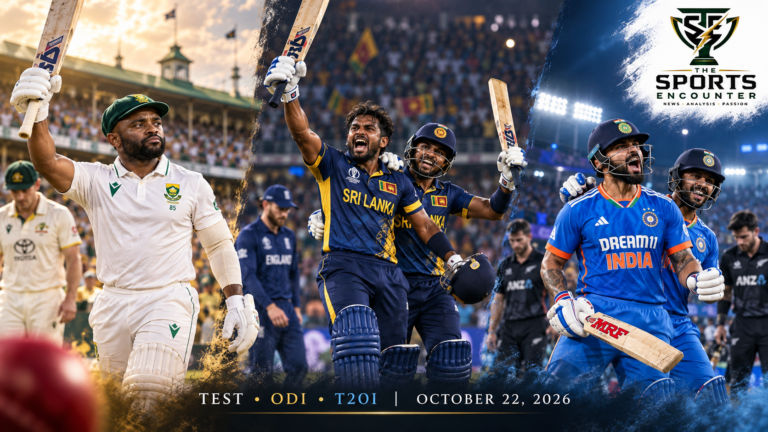
CHRISTCHURCH, New Zealand, October 22, 2026: On a remarkable day for international cricket, South Africa defeated Australia by an innings and 31 runs in a Test at Gqeberha, Sri Lanka chased 430 to beat England in an ODI at Rawalpindi, and India hunted down 226 against New Zealand in a T20I at Christchurch. Three formats, six countries and three very different victories converged on October 22, producing a rare showcase of the contrasting skills and pressures that make cricket such an unpredictable sport.
The results were extraordinary even when considered separately. Temba Bavuma’s career-best 179 transformed South Africa’s Test against Australia, Harry Brook’s record-breaking 202 could not prevent England from suffering an astonishing ODI defeat, and Sanju Samson and Naman Dhir helped India complete its highest successful T20I chase. Although cricket history offers earlier examples of all three formats producing results on the same date, the circumstances of these victories made October 22 especially memorable.
Reader poll for WordPress: Which October 22 performance was the most extraordinary?
- South Africa’s innings victory after recovering from 110/6
- Sri Lanka chasing 430 against England
- India’s record T20I chase of 226 against New Zealand
- All three deserve equal recognition
Editorial integration note: Insert TSE’s verified interactive poll immediately here. The poll’s voting system has not been verified, so this specification must not be mistaken for a functioning poll.
Story at a glance
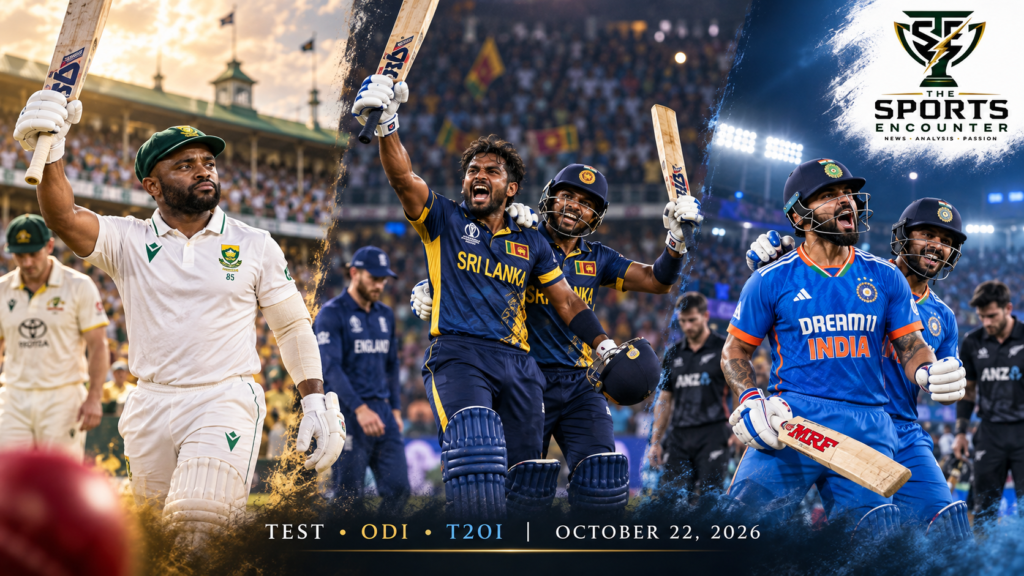
Three Formats, Three Results: What Happened on October 22, 2026?
The fourth result makes the date even more interesting. Ireland scored 229 for 9 before dismissing Namibia for 174, completing a 55-run victory at Windhoek.
South Africa Turn 110 for 6 Into an Innings Victory Against Australia
The Test result in Gqeberha was perhaps the most remarkable reversal of the day.
Sri Lanka Chase 430 as Harry Brook’s Historic 202 Ends in Defeat
While South Africa were attempting to complete their Test victory, another extraordinary contest unfolded at Rawalpindi Cricket Stadium.
India Chase 226 Against New Zealand in a T20I Thriller
The third major result came at Hagley Oval in Christchurch.
The Numbers That Made October 22 Extraordinary
The limited-overs matches alone produced 1,314 runs.
Three Formats, Three Results: What Happened on October 22, 2026?
| Format | Match | Venue | Result | Defining performer |
|---|---|---|---|---|
| Test | South Africa vs Australia | Gqeberha, South Africa | South Africa won by an innings and 31 runs | Temba Bavuma, 179 |
| ODI | England vs Sri Lanka | Rawalpindi, Pakistan | Sri Lanka won by 2 wickets | Pavan Rathnayake, 130 |
| T20I | New Zealand vs India | Christchurch, New Zealand | India won by 4 wickets | Sanju Samson, 67 |
| ODI | Namibia vs Ireland | Windhoek, Namibia | Ireland won by 55 runs | Additional international result |
The fourth result makes the date even more interesting. Ireland scored 229 for 9 before dismissing Namibia for 174, completing a 55-run victory at Windhoek.
However, the three headline matches provide the strongest editorial comparison because they represent different forms of international cricket and three distinct challenges.
South Africa needed to dismiss Australia twice before time ran out.
Sri Lanka needed to maintain a scoring rate above 8.6 runs per over for nearly 50 overs.
India needed to score at more than 11 runs per over in a T20 contest.
The victories demanded markedly different combinations of patience, aggression, tactical control and composure.
South Africa Turn 110 for 6 Into an Innings Victory Against Australia
The Test result in Gqeberha was perhaps the most remarkable reversal of the day.
South Africa had entered the second Test trailing Australia 1-0 in the three-match series.
Australia had won the opening Test at Durban by 214 runs and appeared capable of taking control of the series when South Africa collapsed to 110 for 6.
At that stage, the visitors had a realistic opportunity to dismiss the hosts cheaply and establish another significant advantage.
Bavuma prevented that outcome.
Temba Bavuma’s 179 Changes the Entire Test
The South African captain scored a career-best 179 from 334 deliveries, producing an innings built around concentration, judgment and the ability to absorb pressure.
He found invaluable support from Marco Jansen, who scored 85, and Simon Harmer, who contributed 82.
South Africa eventually declared at 425 for 9.
The recovery was extraordinary.
After losing six wickets for 110, the hosts added another 315 runs while losing only three further wickets.
Those runs became the foundation of the eventual victory.
Jansen subsequently took five wickets for 33 runs as Australia collapsed to 99 in its first innings.
South Africa enforced the follow-on.
Australia resisted through Travis Head’s 121 and Scott Boland’s determined 40 from 166 deliveries, but the visitors were eventually dismissed for 295.
South Africa won by an innings and 31 runs.
The Sports Encounter’s detailed report on Bavuma’s 179 and South Africa’s remarkable innings victory reconstructs the recovery, Jansen’s bowling and the final-day struggle.
Why the Test Result Was Particularly Significant
The victory was achieved despite considerable interruptions caused by rain.
South Africa also had to manage the absence of Anrich Nortje from its second-innings bowling attack after he left the field with a suspected groin injury.
Bavuma therefore needed to manage the remaining bowlers carefully.
Kagiso Rabada, Wiaan Mulder, Jansen and Harmer combined to complete the victory.
The result leveled the series 1-1, setting up a deciding Test at Cape Town beginning October 27.
It was a victory shaped by Test cricket’s most demanding qualities: sustained concentration, lower-order resilience, bowling depth and the ability to keep taking wickets against opponents determined to occupy the crease.
Sri Lanka Chase 430 as Harry Brook’s Historic 202 Ends in Defeat
While South Africa were attempting to complete their Test victory, another extraordinary contest unfolded at Rawalpindi Cricket Stadium.
England captain Harry Brook scored 202 from only 116 deliveries in the third match of the Pakistan ODI Tri-Nation Series.
He became the first England men’s batter to score an ODI double century and reached the milestone from 114 balls, a record for the fastest double century in men’s ODIs.
Brook struck 21 fours and ten sixes.
Will Jacks supported him with an unbeaten 66 as England reached 429 for 4.
An English victory appeared likely.
Sri Lanka, however, refused to accept that the target was beyond reach.
Rathnayake, Fernando and Shanaka Keep Sri Lanka in Contention
Sri Lanka lost two early wickets and slipped to 24 for 2.
Avishka Fernando and Pavan Rathnayake then added 166 runs for the third wicket.
Fernando scored 97 from 83 deliveries.
Rathnayake continued to dominate, producing 130 from 106 balls.
Dasun Shanaka then accelerated the chase with a remarkable 97 from 50 deliveries.
His partnership with Rathnayake added 133 runs, keeping Sri Lanka within reach of the target.
The visitors had transformed a seemingly impossible chase into a contest that could be decided in the final over.
Janith Liyanage Completes the Chase With a Six
Janith Liyanage produced the decisive finish.
He scored an unbeaten 61 from 27 deliveries.
Sri Lanka entered the final over needing eight runs.
Josh Tongue claimed two wickets from successive balls, briefly reviving England’s hopes.
But Liyanage remained unbeaten.
With six runs required from two balls, he launched Tongue for six.
Sri Lanka reached 430 for 8 in 49.5 overs, completing the second-highest successful chase in men’s ODI history at the time.
The Sports Encounter’s full analysis of Sri Lanka’s record chase and England’s bowling failure examines the partnerships, Brook’s record and England’s tactical problems.
The ICC’s official account of Sri Lanka’s extraordinary victory also confirms the historical significance of the successful pursuit.
Why the ODI Result Was Different From South Africa’s Test Victory
South Africa won by controlling the game through an enormous first-innings advantage and then dismissing Australia twice.
Sri Lanka won by chasing a target that required almost continuous aggression.
One victory depended primarily on constructing a total and taking wickets.
The other depended on maintaining scoring momentum even when wickets fell.
The contrast illustrates how cricket’s formats produce different tactical priorities.
Yet both results had something important in common.
Neither winning team surrendered after falling into a difficult position.
India Chase 226 Against New Zealand in a T20I Thriller
The third major result came at Hagley Oval in Christchurch.
New Zealand scored 225 for 4 from 20 overs in the opening T20I against India.
Glenn Phillips produced an outstanding unbeaten 82 from 40 deliveries, while Finn Allen contributed 45 from 24.
The hosts had established a formidable target.
India required 226 to win, demanding a scoring rate of 11.3 runs per over.
The visitors responded with an attacking opening partnership.
Sanju Samson’s 67 Gives India the Foundation
Sanju Samson scored 67 from 33 deliveries.
His aggressive innings allowed India to establish a strong scoring rate during the Powerplay.
Abhishek Sharma contributed 29 from 12 balls, helping India attack New Zealand’s opening bowlers.
New Zealand attempted to recover through wickets and tighter bowling.
India lost several batters during the chase, allowing the hosts to regain hope.
Captain Shreyas Iyer provided stability with 42 from 28 deliveries.
But the decisive performance came from the lower middle order.
Naman Dhir’s Unbeaten 42 Finishes India’s Record Chase
Naman Dhir scored an unbeaten 42 from just 15 deliveries.
His hitting ensured India maintained the momentum needed to complete the chase.
He struck the decisive six during the final over.
India reached 230 for 6 in 19.4 overs, winning by four wickets with two balls remaining.
It was India’s highest successful chase in T20 internationals at the time.
The Sports Encounter’s analysis of India’s 226-run chase and New Zealand’s costly mistakes examines the batting, dropped chances and bowling decisions.
The ICC’s official report on India’s record chase confirms the result and the decisive contributions of Samson and Dhir.
India’s victory gave the visitors a 1-0 lead in the five-match series.
The Numbers That Made October 22 Extraordinary
The limited-overs matches alone produced 1,314 runs.
Sri Lanka and England combined for 859 runs at Rawalpindi, while India and New Zealand scored another 455 at Christchurch.
Both games featured successful chases against totals that would ordinarily place the defending side in a favorable position.
The Two Record Chases Compared
| Metric | Sri Lanka vs England, ODI | India vs New Zealand, T20I |
|---|---|---|
| Target | 430 | 226 |
| Winning score | 430/8 | 230/6 |
| Legal balls used in chase | 299 | 118 |
| Chase scoring rate | 8.63 | 11.69 |
| Wickets remaining | 2 | 4 |
| Balls remaining | 1 | 2 |
| Historical significance | Second-highest men’s ODI chase | India’s highest successful T20I chase |
TSE calculation using final match totals and legal deliveries. Scoring rate equals winning runs divided by legal balls faced, multiplied by six.
The table reveals an important difference.
Sri Lanka sustained a demanding scoring rate over nearly 50 overs, requiring several substantial innings to keep the chase alive.
India operated at a much higher rate but had fewer deliveries to manage.
Both teams benefited from contributions beyond their leading batters.
Shanaka and Liyanage supplied Sri Lanka’s decisive acceleration.
Iyer and Dhir played similarly important roles for India.
The ability to maintain batting depth under pressure was central to both victories.
South Africa, Sri Lanka and India: Three Different Routes to Victory
| Tactical challenge | South Africa | Sri Lanka | India |
|---|---|---|---|
| Starting difficulty | 110/6 in first innings | Chasing 430 after early wickets | Chasing 226 |
| Principal recovery | Bavuma, Jansen and Harmer | Fernando and Rathnayake | Samson and top-order aggression |
| Decisive contribution | Jansen’s 5/33 and final-day bowling | Shanaka’s 97 and Liyanage’s 61* | Dhir’s 42* |
| Main resource under pressure | Time and wickets | Required run rate and wickets | Deliveries and scoring rate |
| Final outcome | Innings victory | Won with one ball remaining | Won with two balls remaining |
The three matches highlight a fascinating feature of modern international cricket.
The basic objective remains unchanged: score more runs than the opposition, within the rules of the format.
But the path to victory varies considerably.
In Test cricket, South Africa could convert a single commanding innings into victory by taking 20 Australian wickets.
In ODI cricket, Sri Lanka needed enough batting stability to chase a record target without losing all ten wickets.
In T20 cricket, India needed explosive hitting from multiple players because preserving wickets without scoring quickly would have been insufficient.
The three winning teams adapted to different match conditions, but all relied on performers who changed the contest after the initial advantage appeared to favor the opposition.
Was October 22, 2026, the First Time All Three Cricket Formats Produced Results on the Same Day?
No. Historical scorecards establish at least one earlier occasion when a Test, ODI and T20I were all decided on the same calendar date.
On December 17, 2024, three men’s international matches produced results across the three formats.
December 17, 2024: A Verified Historical Precedent
| Format | Match | Venue | Result |
|---|---|---|---|
| Test | New Zealand vs England | Hamilton, New Zealand | New Zealand won by 423 runs |
| ODI | South Africa vs Pakistan | Paarl, South Africa | Pakistan won by 3 wickets |
| T20I | West Indies vs Bangladesh | Kingstown, St. Vincent | Bangladesh won by 27 runs |
New Zealand’s victory over England completed the third Test in Hamilton, with the hosts winning by 423 runs.
In Paarl, Saim Ayub scored 109 and Salman Ali Agha contributed an unbeaten 82 as Pakistan successfully chased 240 against South Africa.
Bangladesh completed the third result by defending 129 for 7 and dismissing West Indies for 102, securing a 27-run T20I victory.
The international match archives confirm that all three contests were decided on December 17, 2024.

BBC Sport
+2
Why the Historical Distinction Matters
A claim that October 22, 2026, represented the first such occasion in cricket history would be incorrect.
The December 2024 precedent establishes that the combination had already occurred.
However, determining exactly how often it has happened would require a comprehensive comparison of international cricket results across different eras, national teams and calendars.
The number of fixtures has increased considerably since T20 internationals became part of the global schedule.
The growing involvement of associate nations also means that more international matches can take place simultaneously across different regions.
Consequently, the historical significance of October 22 should be based on the exceptional performances and consequences of the matches rather than an unsupported claim of a world-first occurrence.
The Overlooked Contribution: Supporting Players Made All Three Victories Possible
The most famous performances from October 22 were obvious.
Bavuma scored 179.
Brook hit 202.
Rathnayake made 130.
Samson struck 67.
But focusing exclusively on those performances misses something important.
Simon Harmer’s 82 Helped South Africa Transform the Test
Harmer’s eighth-wicket partnership with Bavuma added 183 runs.
His innings of 82 was particularly important because Australia had already reduced South Africa to 242 for 7 when the partnership began.
The stand transformed a recovery into a dominant first-innings total.
Harmer also bowled 39 overs in Australia’s second innings, claiming two wickets while helping the hosts manage Nortje’s absence.
His contribution was substantial in both disciplines.
Dasun Shanaka and Janith Liyanage Supplied Sri Lanka’s Finishing Power
Fernando and Rathnayake established Sri Lanka’s chance of winning.
Shanaka’s 97 from 50 balls accelerated the chase.
Liyanage’s unbeaten 61 from 27 finished it.
Without their aggression, Sri Lanka’s early partnerships would probably have produced an impressive effort that still ended in defeat.
The key was maintaining the required scoring rate throughout the innings.
Naman Dhir Prevented India’s Chase From Stalling
Samson had established India’s aggressive foundation.
But New Zealand’s wickets threatened to disrupt the chase.
Dhir’s unbeaten 42 from 15 balls completed the result.
His contribution demonstrates the increasing importance of lower-middle-order hitting in T20 cricket.
Teams pursuing targets above 200 cannot rely exclusively on their top three batters.
They need players capable of scoring quickly immediately after arriving at the crease.
What Changed in the Three International Series?
The victories had very different consequences.
| Competition | Position before October 22 | Position after October 22 | Next significant fixture |
|---|---|---|---|
| South Africa vs Australia Tests | Australia led 1-0 | Series level 1-1 | Third Test, Cape Town, October 27 |
| Pakistan ODI Tri-Series | Sri Lanka had lost to Pakistan | Sri Lanka gained 2 points; England remained winless | Pakistan vs England, Lahore, October 25 |
| India vs New Zealand T20Is | Series had not started | India led 1-0 | Second T20I in the five-match series |
South Africa’s victory forced a Test-series decider.
Sri Lanka’s win revived its hopes of reaching the Pakistan tri-series final while placing greater pressure on England.
India’s victory provided an early advantage in its five-match T20I series.
The same day therefore changed three international competitions in three different ways.
For South Africa, the immediate objective is completing a comeback from a series deficit.
For Sri Lanka, the task is to convert an extraordinary victory into qualification for the final.
For India, the challenge is to maintain its aggressive batting approach while improving its bowling and fielding consistency.
What October 22 Tells Us About Modern International Cricket
There is no single statistical record connecting the three main results.
They were played in different countries, under different rules and with different competitive stakes.
What makes the date worth remembering is the quality and variety of the performances.
South Africa won a Test after appearing vulnerable at 110 for 6.
Sri Lanka successfully chased 430 despite England producing a record-breaking individual innings.
India chased 226 in a T20I after New Zealand had seemingly established a formidable total.
Each contest required a different type of resilience.
Bavuma needed to bat for hours and rebuild with the lower order.
Sri Lanka needed to attack for almost 50 overs while protecting enough wickets to complete the chase.
India needed to maintain an extraordinary scoring rate and retain sufficient batting firepower for the closing overs.
Those differences reflect the continuing evolution of international cricket.
Test cricket still rewards the capacity to survive, adapt and sustain pressure across multiple sessions.
ODI cricket increasingly demands both traditional innings construction and the aggressive scoring associated with T20 cricket.
T20 internationals place even greater emphasis on immediate attacking intent, bowling flexibility and the capacity of lower-order batters to finish high-scoring matches.
October 22 offered compelling examples of all three.
Why This Day Deserves a Place in Cricket’s Historical Memory
December 17, 2024, demonstrates that international cricket had previously produced completed Test, ODI and T20I results on the same date.
October 22, 2026, therefore should not be treated as an unprecedented calendar achievement.
Its significance lies in what happened on the field.
South Africa overturned a six-wicket collapse to win by an innings.
Sri Lanka transformed England’s 429 into a losing total.
India chased 226 with two balls remaining.
Ireland also completed an international victory over Namibia, adding another result to an exceptionally busy day.
Most cricket followers experienced those contests separately, following the teams and formats that interested them most.
Viewed together, they offer a broader perspective.
A Test match demonstrated the enduring importance of batting patience and wicket-taking persistence.
An ODI produced one of the greatest successful run chases ever recorded.
A T20I showcased the explosive finishing power that increasingly defines the shortest international format.
On October 22, cricket did not produce a new format or an unprecedented calendar first. It produced an exceptional demonstration of what its three international formats can deliver on the same day.
That is a historical achievement worth remembering on its own merits.
Continue the Cricket Story
 CricketThe Vanishing Workhorse: How Pakistan’s Fast-Bowling Burden Really Changed Over the Years
 A Celebration of 5000 ODIsA Celebration of 5000 ODIs Match 61: Pakistan Need 10 With One Wicket Left, Afridi Smashes Ashwin for Two Sixes to Break India’s Heart
 Big Bash LeagueBig Bash 2026-27: Perth Sign Aneurin Donald, Renegades Lose Behrendorff as WBBL Injuries Force Changes
Frequently Asked Questions
What Was Special About International Cricket on October 22, 2026?
A Test, ODI and T20I all produced results on the same date. South Africa defeated Australia, Sri Lanka beat England and India defeated New Zealand. Ireland also beat Namibia in an ODI.
Was This the First Time All Three Formats Produced Results on the Same Day?
No. December 17, 2024, provides a verified earlier example involving New Zealand vs England in a Test, South Africa vs Pakistan in an ODI and West Indies vs Bangladesh in a T20I.
Which Team Completed the Biggest Run Chase on October 22?
Sri Lanka successfully chased 430 against England at Rawalpindi, reaching 430 for 8 with one ball remaining.
Who Scored the Fastest ODI Double Century That Day?
England captain Harry Brook reached 200 from 114 balls and finished with 202 from 116, although England lost to Sri Lanka.
How Did South Africa Defeat Australia?
South Africa scored 425 for 9 declared and dismissed Australia for 99 and 295, winning by an innings and 31 runs.
How Did India Defeat New Zealand?
India chased 226, reaching 230 for 6 in 19.4 overs to win the first T20I at Christchurch by four wickets.
Which Other International Match Finished on October 22?
Ireland defeated Namibia by 55 runs in an ODI at Windhoek, giving the date another completed men’s international result.
What Were the Main Series Consequences?
South Africa leveled its Test series with Australia 1-1, Sri Lanka strengthened its position in the Pakistan ODI tri-series, and India took a 1-0 lead over New Zealand in their T20I series.