


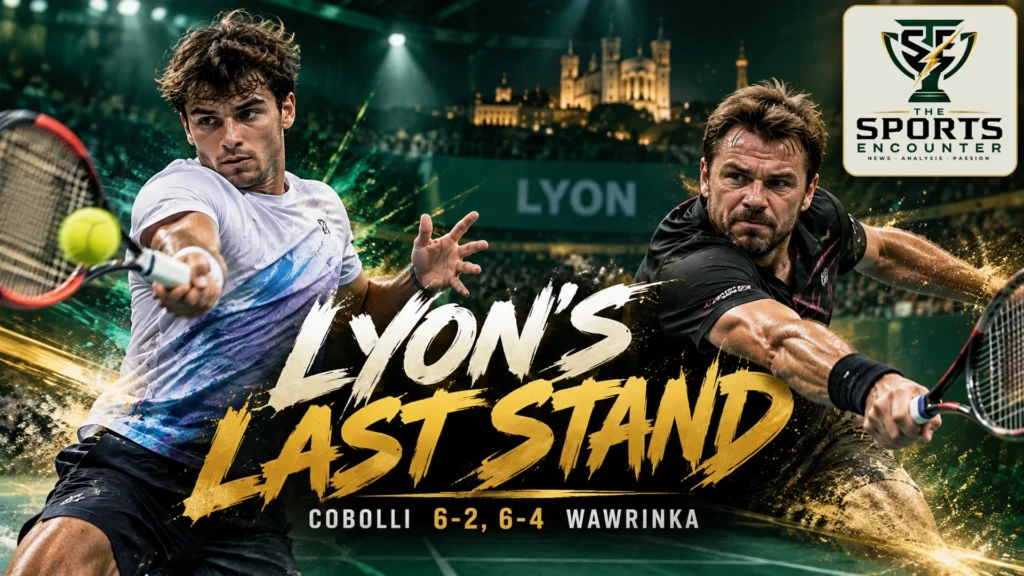
LYON, France, October 22, 2026: Stan Wawrinka had spent nearly three hours fighting to keep his Lyon campaign alive on Wednesday. Twenty-four hours later, Flavio Cobolli needed just two sets to end it. The 24-year-old Italian defeated the three-time Grand Slam champion 6-2, 6-4 on Thursday, turning what could have been another emotional farewell battle into an efficient display of serving and attacking tennis. For Wawrinka, the defeat carried significance beyond elimination: his penultimate scheduled tournament was over, and only a final appearance in his native Switzerland remained.
Cobolli, the tournament’s top seed and world No. 6, had arrived in Lyon needing a change of momentum after a difficult Asian swing. He found it against one of tennis’s most respected veterans, winning 87% of points behind his first serve and converting three of four break opportunities. The result sent the Italian into the Grand Prix Auvergne-Rhône-Alpes quarterfinals, while Wawrinka, now 41, turned his attention toward the Swiss Indoors Basel, scheduled to provide the closing chapter of an extraordinary professional career.
Cobolli vs Wawrinka: Lyon ATP 250 Result and Match Facts
The contrast between the players was considerable before the opening ball.
Cobolli was the No. 1 seed, ranked sixth in the world and attempting to restart his late-season campaign. Wawrinka entered as a wild card, ranked No. 140, and was competing in his final year on the ATP Tour.
Both had compelling reasons to win. Cobolli needed ranking points, momentum and another opportunity to strengthen his position ahead of the ATP Finals. Wawrinka wanted to extend his final appearance on French soil.
| Match Detail | Verified Information |
|---|---|
| Tournament | Grand Prix Auvergne-Rhône-Alpes |
| ATP Category | ATP 250 |
| Date | October 22, 2026 |
| Round | Round of 16 |
| Venue | Lyon, France |
| Surface | Indoor hard court |
| Winner | Flavio Cobolli, Italy |
| Final Score | 6-2, 6-4 |
| Cobolli’s Ranking | World No. 6 |
| Wawrinka’s Ranking | World No. 140 |
| Cobolli’s Seeding | No. 1 |
| Wawrinka’s Entry | Wild card |
| Next Round | Cobolli advances to the quarterfinals |
The ATP Tour’s official Lyon tournament page confirms that the competition runs from October 19 to 25, with a 28-player singles draw.
For Cobolli, this was his first singles match of the tournament after receiving a first-round bye. Wawrinka had taken a considerably more demanding route into the second round.
Why Cobolli’s First Serve Made Such a Difference
The defining statistic from Thursday’s contest was Cobolli’s performance behind his first serve.
The Italian won 87% of those points, making it extremely difficult for Wawrinka to establish sustained pressure in return games.
That service efficiency mattered because Cobolli also created and converted opportunities when receiving.
He broke Wawrinka’s serve three times from four opportunities, a 75% conversion rate.
| Statistic | Result | Significance |
|---|---|---|
| First-serve points won | 87% | Limited Wawrinka’s opportunities to attack Cobolli’s serve |
| Break points created | 4 | Four opportunities to take control of Wawrinka’s service games |
| Break points converted | 3 | Three successful breaks across two sets |
| Break-point conversion rate | 75% | Converted three of four chances |
| Games won | 12 of 18 | Two-thirds of the games played |
| Sets conceded | 0 | Advanced without a deciding set |
Match statistics reported by TennisTemple on October 22, 2026. Break-point percentages and total games are calculated from the confirmed figures.
The numbers explain how Cobolli avoided allowing the match to develop into a prolonged battle.
In tennis, returning well is only half the equation. A player must also convert the resulting pressure into breaks of serve.
Cobolli did both.
His three successful breaks allowed him to build advantages without becoming trapped in the extended, momentum-shifting exchanges that had characterized some of his recent matches.
Two Sets, Three Breaks: How the Lyon Match Unfolded
Cobolli established his superiority during the opening set.
The Italian’s strong serving performance made it difficult for Wawrinka to gain a foothold, while Cobolli’s pressure on return produced the breaks needed to take the set 6-2.
Wawrinka had demonstrated remarkable resilience just a day earlier, but Thursday presented a different problem.
Against Cobolli, he could not consistently neutralize the Italian’s first serve or reproduce the momentum needed to extend the contest.
The second set was more competitive, with Wawrinka winning four games rather than two.
However, Cobolli still found the decisive break and completed a 6-4 victory.
| Set | Cobolli | Wawrinka | Difference |
|---|---|---|---|
| First Set | 6 | 2 | 4 games |
| Second Set | 6 | 4 | 2 games |
| Total | 12 | 6 | 6 games |
One important question is how much Wawrinka’s exhausting first-round match influenced his ability to compete against Cobolli.
The short recovery period is relevant, but it should not be presented as the confirmed reason for his defeat. Cobolli’s superior first-serve performance and break-point conversion are established match facts. The precise contribution of fatigue cannot be determined from the available statistics alone.
Wawrinka’s Final French Victory Came After a Nearly Three-Hour Marathon
Wawrinka’s Lyon appearance had already produced one final reminder of his extraordinary competitive determination.
On Wednesday, October 21, the 41-year-old defeated Spain’s Martin Landaluce 6-3, 6-7(2), 7-6(5).
The match lasted almost three hours.
Wawrinka won the opening set, lost the second in a tiebreak and then survived another fiercely contested decider.
The victory was significant partly because he had struggled to secure tour-level wins during the latter stages of the season.
It was also a reminder that even in retirement year, Wawrinka was determined to compete rather than merely participate in farewell ceremonies.
The following day, however, he encountered a top-six opponent who was both well rested and highly effective behind his serve.
Wawrinka had to play a deciding-set tiebreak to reach the second round. Cobolli needed no such struggle to reach the quarterfinals.
Three Meetings, Three Cobolli Victories: A Rivalry Across Generations
The Lyon encounter was not the first time Cobolli and Wawrinka had met.
Their previous contests had been considerably closer.
At the 2024 Shanghai Masters, Cobolli recovered from losing the opening set to win 6-7(6), 7-6(4), 6-3.
The two met again at the United Cup in January 2026. Cobolli won another three-set encounter, this time 6-4, 6-7(2), 7-6(4).
Both victories required the Italian to survive difficult periods against the former world No. 3.
Lyon provided a very different conclusion.
| Date | Tournament | Winner | Score |
|---|---|---|---|
| October 7, 2024 | Shanghai Masters | Flavio Cobolli | 6-7(6), 7-6(4), 6-3 |
| January 4, 2026 | United Cup | Flavio Cobolli | 6-4, 6-7(2), 7-6(4) |
| October 22, 2026 | Lyon ATP 250 | Flavio Cobolli | 6-2, 6-4 |
| Head-to-Head After Lyon | Cobolli leads 3-0 | ||
The progression is noteworthy. Their first two matches each required three sets and multiple tiebreaks. Their third ended in straight sets with Cobolli conceding just six games.
That does not establish that Cobolli would necessarily dominate every future meeting. But it does show how effectively he handled this particular opportunity.
From French Open Finalist to Lyon’s Top Seed: Cobolli’s Remarkable 2026
For Cobolli, the victory matters because his season has included extraordinary achievements alongside difficult setbacks.
In June, he reached the French Open final, where Alexander Zverev defeated him in five sets.
That breakthrough was examined in The Sports Encounter’s detailed report on Zverev’s maiden Roland Garros championship.
Cobolli’s progress continued during the North American hard-court season.
In August, he reached his first ATP Masters 1000 semifinal at Cincinnati after recovering from a set down to defeat Tommy Paul.
Our Cincinnati quarterfinal analysis explored how Cobolli overcame physical fatigue and an early deficit to win 2-6, 6-3, 6-4.
Arthur Fils ended his run in the semifinals, but Cobolli left the tournament having demonstrated his ability to survive demanding matches against elite opponents.
As detailed in our report on Fils’ Cincinnati championship and Cobolli’s career-high ranking, the Italian had climbed to world No. 6.
Then came the US Open.
Cobolli began his campaign with a remarkable comeback from two sets down against Francisco Comesana.
TSE’s coverage of the rain-affected US Open opening rounds documented that five-set escape.
He subsequently produced one of the tournament’s memorable improvised shots against Tristan Schoolkate, striking a remarkable between-the-legs lob.
The shot and its competitive significance featured in our analysis of Cobolli’s spectacular US Open tweener.
But his late-season form became less convincing after the North American swing.
At the China Open, Roman Safiullin defeated him 6-3, 6-2 in a significant ranking upset.
Our Beijing report examined Safiullin’s ability to attack Cobolli’s second serve while saving every break point he faced.
Adrian Mannarino then defeated Cobolli at the Shanghai Masters, adding another early exit to the Italian’s Asian campaign.
That sequence explains why Thursday’s win in Lyon was more valuable than the ranking difference alone might suggest.
After three consecutive defeats, Cobolli needed both a result and an opportunity to rediscover his competitive rhythm.
Against Wawrinka, he achieved both.
Wawrinka’s Farewell Season: A Champion Who Refused to Stop Fighting
For Wawrinka, the outcome was more emotional.
Few players in modern tennis have built careers quite like the Swiss champion.
He won three Grand Slam singles titles, reached world No. 3 and established himself as one of the most formidable competitors of his generation.
His trademark one-handed backhand became one of the sport’s most recognizable shots, while his willingness to challenge the era’s dominant champions gave him a distinctive place in tennis history.
| Year | Tournament | Final Opponent | Result |
|---|---|---|---|
| 2014 | Australian Open | Rafael Nadal | Won 6-3, 6-2, 3-6, 6-3 |
| 2015 | French Open | Novak Djokovic | Won 4-6, 6-4, 6-3, 6-4 |
| 2016 | US Open | Novak Djokovic | Won 6-7(1), 6-4, 7-5, 6-3 |
Those achievements represent only part of his career.
Wawrinka won Olympic doubles gold with Roger Federer in Beijing in 2008 and helped Switzerland claim the Davis Cup in 2014.
His final season has included both victories and defeats, along with the emotions of saying goodbye to tournaments that shaped his life.
In August, his participation in Cincinnati was another opportunity for tennis fans to see an established champion on the court.
The Sports Encounter covered Wawrinka’s Cincinnati wildcard as part of a wider story about veteran players, injuries and late-career opportunities.
He also represented Switzerland in the Davis Cup during September, losing a close three-set encounter against Brazil’s Gustavo Heide.
That match was included in TSE’s coverage of the Davis Cup World Group I ties.
The common thread through these appearances is that Wawrinka has continued trying to win rather than simply collecting farewells.
His December 2025 retirement announcement confirmed that 2026 would be his final season, following a career spanning more than two decades.
The ATP Tour’s official report on his retirement decision also records his 16 tour-level singles titles and career-high No. 3 ranking.
Why Basel Could Be Wawrinka’s Most Emotional Goodbye
Wawrinka’s departure from Lyon brings the focus firmly to Basel.
The Swiss Indoors, scheduled for October 26 to November 1, is expected to provide his final professional tournament appearance.
There is an emotional symmetry to that possibility.
After winning major championships in Australia, France and the United States, Wawrinka is preparing to finish his career on home soil.
He will not arrive in Basel with the ranking or physical freshness of his peak years.
But he will arrive with something that cannot be measured by ranking points: more than two decades of memories, rivalries and achievements that helped define an era.
His Lyon defeat demonstrated the competitive gap he sometimes faces against players approaching the peak of their careers.
Yet Wednesday’s victory over Landaluce also demonstrated why his farewell season remains worth watching.
At 41, Wawrinka was still willing to endure an exhausting three-set contest for another chance to compete.
The challenge for Basel is not whether he can recreate the dominance of his Grand Slam-winning years. It is whether he can produce one final performance that reflects the determination for which he has become known.
Who Will Cobolli Face in the Lyon Quarterfinals?
Cobolli’s quarterfinal opponent will emerge from the match between France’s Kyrian Jacquet and American fifth seed Brandon Nakashima.
Jacquet entered the second round after upsetting Matteo Berrettini 7-6(4), 7-5.
Nakashima reached the same stage by defeating Serbia’s Hamad Medjedovic 7-6(4), 6-7(4), 6-2.
The prospective matchup gives Cobolli a different challenge from Wawrinka.
Against Nakashima, the Italian would face an established hard-court competitor capable of sustaining pressure through long baseline exchanges.
Against Jacquet, he would encounter a French player competing with home support and momentum from a victory over Berrettini.
Neither opponent would be straightforward.
The important question is whether Cobolli can reproduce the serving consistency that made Thursday’s victory so comfortable.
A single excellent match does not establish that his recent problems have disappeared. But it provides evidence that he can respond positively when the circumstances demand it.
What Cobolli and Wawrinka’s Lyon Match Tells Us
Thursday’s contest brought together two players whose careers are moving in opposite directions.
Cobolli is attempting to consolidate his place near the top of men’s tennis after a breakthrough year.
Wawrinka is approaching the end of one of the sport’s distinguished careers.
The match was decided by current performance, not historical reputation.
Cobolli won 87% of first-serve points, converted 75% of his break opportunities and conceded only six games.
Those were the measurable reasons for the result.
The wider significance lies in the contrast between the players.
One is building toward the future, trying to turn a rapid rise into sustained success. The other is preparing to say goodbye after collecting achievements that most professionals can only dream of.
For Cobolli, the Lyon victory represents a useful step toward restoring momentum.
For Wawrinka, it marks the end of another chapter in a farewell season that has repeatedly demonstrated his refusal to stop competing.
Frequently Asked Questions
Who won Flavio Cobolli vs Stan Wawrinka in Lyon?
Flavio Cobolli defeated Stan Wawrinka 6-2, 6-4 in the Round of 16 at the 2026 Grand Prix Auvergne-Rhône-Alpes on October 22.
What is the Cobolli vs Wawrinka head-to-head record?
Cobolli leads 3-0 following victories at the 2024 Shanghai Masters, January 2026 United Cup and October 2026 Lyon ATP 250.
How many break points did Cobolli convert against Wawrinka?
Cobolli converted three of four break-point opportunities, a 75% success rate.
How effective was Cobolli’s first serve?
He won 87% of points played behind his first serve, helping him maintain control throughout the match.
How did Wawrinka reach the second round in Lyon?
Wawrinka defeated Martin Landaluce 6-3, 6-7(2), 7-6(5) in a match lasting almost three hours.
Who will Cobolli play in the Lyon quarterfinals?
His opponent will be the winner of the match between Kyrian Jacquet and Brandon Nakashima.
Is Stan Wawrinka retiring in 2026?
Yes. Wawrinka announced in December 2025 that the 2026 season would be his final year on the ATP Tour.
When is Wawrinka’s final scheduled tournament?
His final scheduled appearance is at the Swiss Indoors Basel, running from October 26 to November 1, 2026.
How many Grand Slam titles has Wawrinka won?
He won three men’s singles majors: the 2014 Australian Open, 2015 French Open and 2016 US Open.
The Result Belongs to Cobolli, but the Farewell Belongs to Wawrinka
Flavio Cobolli arrived in Lyon searching for a way out of a difficult run of results.
He leaves his opening match with an emphatic victory and a place in the quarterfinals.
Stan Wawrinka arrived hoping to extend the final French tournament of his career.
He leaves with one last scheduled appearance ahead of him.
Both players have something important to pursue.
Cobolli needs to demonstrate that his impressive 2026 achievements can become the foundation for lasting success.
Wawrinka has one final opportunity to step onto the court in Switzerland and compete before bringing his extraordinary career to a close.
In Lyon, the younger man had the answers.
In Basel, the older champion will have his chance to write the ending.