
Contributed by Irfan Farooq | Edited by The Sports Encounter
DUBAI, United Arab Emirates, October 21, 2026: There was a time when Pakistan’s leading fast bowler was expected to take the new ball, return for another spell, and keep going until his captain had exhausted every option. Fazal Mahmood, Pakistan’s first great pace bowler, embodied that tradition. On the country’s 1957–58 tour of the West Indies, he bowled approximately 320 overs across five Tests, an extraordinary workload even by the standards of an era when fast bowlers were routinely asked to shoulder long spells. The demands placed on him reflected a team with limited bowling depth, as much as they did the expectations of the time.
Pakistan has since produced generations of fast bowlers, from Sarfraz Nawaz and Imran Khan to Wasim Akram, Waqar Younis, Shoaib Akhtar, Umar Gul and most recently Shaheen Afridi. Yet their career figures reveal a more complicated history than the familiar story of old-fashioned workhorses giving way to modern bowlers protected by sports science and workload management. Some of Pakistan’s greatest quicks carried immense workloads; others were repeatedly interrupted by injuries. And several modern bowlers have shouldered substantial burdens despite the greater attention now paid to their physical welfare.
Comparing the Test careers of nine Pakistani fast bowlers, from Fazal Mahmood to Shaheen Shah Afridi’s most recent Test appearances in 2026, offers a useful starting point. The figures show a clear difference between the earliest generation and some of its successors, but they also demonstrate why overs per Test cannot, by itself, explain how fast-bowling workloads have changed.
What the nine careers show
| Bowler | Test career | Tests | Balls bowled | Overs per Test |
|---|---|---|---|---|
| Fazal Mahmood | 1952–62 | 34 | 9,834 | 48.2 |
| Sarfraz Nawaz | 1969–84 | 55 | 13,951 | 42.3 |
| Imran Khan | 1971–92 | 88 | 19,458 | 36.9 |
| Wasim Akram | 1985–2002 | 104 | 22,627 | 36.3 |
| Waqar Younis | 1989–2003 | 87 | 16,224 | 31.1 |
| Shoaib Akhtar | 1997–2007 | 46 | 8,143 | 29.5 |
| Umar Gul | 2003–13 | 47 | 9,599 | 34.0 |
| Mohammad Abbas | 2017–26 | 33 | 6,915 | 34.9 |
| Shaheen Shah Afridi | 2018–26 | 34 | 6,684 | 32.8 |
Career figures supplied by the contributor and checked against available records, as of October 20, 2026. Overs per Test = balls bowled ÷ 6 ÷ Tests played. The measure includes only Tests played, not matches missed.
At first glance, the contrast is striking. Fazal averaged 48.2 overs per Test, compared with 32.8 for Shaheen. But the figures between those two extremes refuse to form a neat downward staircase. Imran and Wasim averaged almost identical workloads despite their different bowling styles and careers. Waqar and Shoaib recorded lower figures. Meanwhile, Umar Gul and Mohammad Abbas carried heavier Test workloads than either of them.
The figures measure how much each bowler bowled when represented in Test cricket. They do not measure total workload across formats, the number of rest days between matches, the intensity of individual spells, or the physical cost of bowling at different speeds. That distinction is central to understanding what the numbers can, and cannot, tell us.
The Workhorse Era: One Bowler, No Escape
Fazal Mahmood’s workload has to be understood in the context of Pakistan’s early years as a Test nation. The team did not possess the depth of specialist fast bowlers available to later generations, and Fazal often had to shoulder a disproportionate share of the responsibility. His 85.2-over effort in an innings at Sabina Park in Kingston, Jamaica, during the 1957–58 West Indies tour illustrates the demands placed on him. In that match, Garry Sobers made his record-breaking 365 not out. The original scorecard confirms Fazal’s 85.2 overs, 20 maidens, 247 runs conceded and two wickets in the innings.
| Pakistan bowler | Overs | Runs conceded | Wickets |
|---|---|---|---|
| Fazal Mahmood | 85.2 | 247 | 2 |
| Khan Mohammad | 54.0 | 259 | 0 |
| Abdul Hafeez Kardar | 37.0 | 141 | 0 |
| Nasim-ul-Ghani | 15.0 | 39 | 0 |
Source: Pakistan Cricket Board’s official scorecard. These figures concern one West Indies innings, not the five-Test tour.
Fazal’s career average of 48.2 overs per Test is the highest in this comparison. It reflects not simply an older attitude towards fast bowling, but the circumstances in which he operated. Captains needed him to bowl long spells, and the team had fewer frontline seamers with whom to share the work. His workload belonged to a cricketing environment in which endurance was an essential part of a fast bowler’s job.
Sarfraz Nawaz, who made his debut in 1969, averaged 42.3 overs per Test. That remains a substantial workload, but Pakistan’s attack was beginning to evolve. Sarfraz’s partnership with Imran Khan gave the team two major pace options, allowing responsibility to be distributed differently from the way it had been during Fazal’s era.
The contrast between the two early generations is therefore not merely a story of changing attitudes towards player welfare. It is also a story of bowling resources. A captain with two established fast bowlers has different options from a captain who has only one quality pacer.
The Imran–Wasim Plateau
Imran Khan averaged 36.9 overs per Test, while Wasim Akram averaged 36.3. Their figures are remarkably close for two bowlers separated by a different cricketing era and possessing different strengths. Imran combined pace, movement and stamina with the responsibilities of captaincy and all-round performance. Wasim, a left-armer capable of producing late swing and reverse swing, became one of the most dangerous fast bowlers in the world.
Their similar averages suggest that Pakistan’s leading fast bowlers could still be expected to carry substantial workloads well into the late 1980s and 1990s. But the figures do not prove that the same workload pattern persisted unchanged across those decades. Career averages conceal variations in conditions, bowling roles, injuries, match lengths and the support available from other members of the attack.
Imran’s six-Test home series against India in 1982–83 is an especially revealing example. He took 40 wickets at an average of 13.95, one of the most remarkable bowling performances in Pakistan’s history, while sending down 223.1 overs across the series. That amounts to approximately 37.2 overs per Test, almost exactly his career average. The series records reveal that Sarfraz Nawaz bowled more overs than Imran, even though Imran claimed more than twice as many wickets.
| Bowler | Team | Tests | Overs | Wickets |
|---|---|---|---|---|
| Imran Khan | Pakistan | 6 | 223.1 | 40 |
| Sarfraz Nawaz | Pakistan | 6 | 241.1 | 19 |
| Kapil Dev | India | 6 | 205.2 | 24 |
Source: series bowling records. Sarfraz bowled 18 more overs than Imran, yet Imran took 21 more wickets. In cricket notation, 223.1 means 223 overs and one ball, not 223.1 decimal overs.
That apparently ordinary rate is deceptive. Imran’s performance came at a considerable physical cost. The 40-wicket effort contributed to a stress fracture in his shin, which prevented him from bowling for a couple of years and cost him valuable playing time. His workload was not extraordinary relative to his career average, but its consequences were significant.
This is an important qualification to any romantic view of the old workhorse. A bowler could deliver an exceptional performance within his usual workload and still suffer a serious injury. Endurance was admired, but it did not make fast bowlers immune to the physical consequences of their profession.
Wasim Akram’s career figures reinforce the point that workload cannot be explained by era alone. He played 104 Tests and bowled 22,627 balls, yet his overs-per-Test average was almost identical to Imran’s. Longevity, skill and a bowler’s role all influenced the demands placed upon him. A career average cannot tell us whether a bowler was overworked in a particular series, nor whether a heavy spell was followed by adequate recovery.
The First Real Drop: Waqar and Shoaib
The clearest decline from the Imran–Wasim figures appears with Waqar Younis, who averaged 31.1 overs per Test, and Shoaib Akhtar, whose average was 29.5. It would be tempting to interpret this as evidence that Pakistan had begun managing its fast bowlers more carefully. Their careers, however, tell a different story.
Waqar’s devastating pace and ability to reverse-swing the ball made him one of the most destructive bowlers of his generation. His career was also affected by recurring back problems. The physical difficulties in his career are relevant context, although the average alone cannot tell us how injury affected his overs in the Tests he played.
Shoaib’s case is even more instructive. He appeared in only 46 Tests during his international career, often bowling in short, explosive spells rather than the long containing spells associated with earlier generations. His speed and physical volatility made him a different kind of fast bowler, while injuries and fitness problems repeatedly interrupted his career.
Shoaib’s lower overs-per-Test average does not prove that his workload was managed successfully. Crucially, a Test he missed because of injury does not enter either side of the calculation: the statistic divides balls bowled by Tests actually played. His pace, bowling role, short spells, and any physical limitations during matches he did play may have influenced the figure. Without match-level bowling and recovery data, it is impossible to attribute the lower rate to any single cause.
This is the point at which the “pre-1990 bowlers worked harder” narrative needs real qualification. Waqar and Shoaib’s low figures long predate the central-contract, sports-science, franchise-cricket era that’s usually credited with reducing modern workloads. Differences in bowling roles and fitness existed well before modern franchise schedules and sports-science programs. Test career averages alone cannot show whether those bowlers received better or worse workload management.
The Modern Era: Not as Light as Assumed
If modern fast bowlers were simply protected and rested more effectively, the most recent players in this comparison should have the lowest overs-per-Test averages. They do not.
Umar Gul averaged 34.0 overs per Test, while Mohammad Abbas averages 34.9. Both figures exceed Waqar’s and Shoaib’s. Abbas, a right-arm medium-fast seam bowler whose success has been built on accuracy, movement and relentless control, has often been used in long spells. His career workload illustrates how a bowler’s role can matter more than the decade in which he plays.
Shaheen Afridi averages 32.8 overs per Test, lower than Abbas and Gul but higher than Waqar and Shoaib. His figure needs to be read alongside his availability and the demands of cricket outside the longest format. A Test-only statistic cannot capture the cumulative workload of a player moving between international cricket, domestic competitions and franchise leagues.
Shaheen’s five most recent Test appearances through May 2026 provide a useful example. They were the Bangladesh Test in May 2026, two Tests against South Africa in October 2025, the England Test in October 2024 and the Bangladesh Test in August 2024. Across those matches, he bowled approximately 145 overs, or 29 overs per Test. That is well below his career average of 32.8.
| Test opponent | Match date | Wickets taken |
|---|---|---|
| Bangladesh | May 8, 2026 | 5 |
| South Africa | Oct. 20, 2025 | 1 |
| South Africa | Oct. 12, 2025 | 4 |
| England | Oct. 7, 2024 | 1 |
| Bangladesh | Aug. 21, 2024 | 2 |
Source: recent Test match returns. Five appearances, 13 wickets in total. This wicket summary does not measure recovery time or workload in other formats.
The sample does not prove that Shaheen’s overall workload was light. It shows only that his Test overs in those five appearances were lower than his career rate. His other professional commitments must be considered separately, and the physical demands of a short-format spell are not identical to those of a long Test innings.
In September 2024, Pakistan’s white-ball coach Gary Kirsten said that Shaheen had bowled three times as many overs as any other fast bowler in the world over an 18-month period. A subsequent independent Wisden fact-check found the claim inaccurate. Wisden calculated that Shaheen had bowled 646.1 overs across professional cricket from the beginning of 2023 to September 2024. Pat Cummins had bowled 592.4 overs in international cricket alone during that period.
The correction does not mean that Shaheen’s workload was unimportant. It means the case for managing him properly must be built on accurate comparisons, with equivalent periods and categories of cricket. A dramatic statistic can attract attention, but it cannot substitute for a careful assessment of the evidence.
There is also a more recent development that changes how Shaheen’s priorities should be described. In September 2026, Shaheen had reaffirmed his commitment to red-ball cricket, saying it remained his first priority. He was preparing to return to domestic first-class cricket after a lengthy absence from the format in Pakistan. It would therefore be inaccurate to suggest that he has openly prioritized T20 cricket over Tests. The more relevant question is how Pakistan can provide him with the opportunity, preparation and recovery needed to sustain a career across formats.
What the Comparison Actually Shows
The simple version of this story is that Pakistan’s fast bowlers used to bowl more overs and now bowl fewer because cricket has become more scientific about player welfare. The career figures support part of that argument, particularly at the extremes. Fazal Mahmood and Sarfraz Nawaz carried substantially heavier Test workloads than the modern bowlers in this sample.
| First Test debut range | Bowlers | Tests played | Total balls | Weighted overs/Test |
|---|---|---|---|---|
| 1952–1969 | 2 | 89 | 23,785 | 44.5 |
| 1971–1989 | 3 | 279 | 58,309 | 34.8 |
| 1997–2018 | 4 | 160 | 31,341 | 32.6 |
TSE calculation from the nine career totals above. Each rate = pooled career balls ÷ 6 ÷ pooled Tests. Groups reflect first-Test debut years, not distinct eras of equal duration, and are not independent evidence of improved medical management.
Continue the Cricket Story
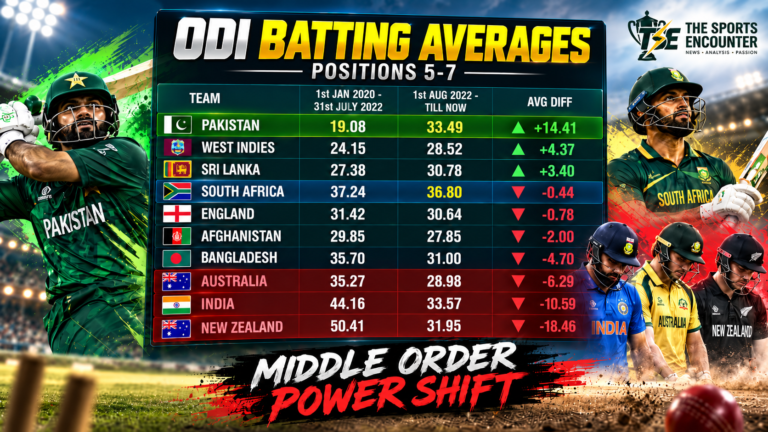 CricketODI Middle-Order Power Shift: Pakistan Surges, New Zealand Crashes as India’s and Australia’s Batting Depth Comes Under Scrutiny
 CricketSalman Agha’s Comeback Ton and Four-Pacer Attack Down Sri Lanka in Pakistan ODI Tri-Series Opener
 CricketPakistan U17 Turn 99-Run Defeat Into Series Triumph as Azan Ahmed and Ammar Khan Sink Sri Lanka
But the figures also show that the change was neither steady nor universal. Imran and Wasim averaged almost identical workloads. Waqar and Shoaib bowled fewer overs per Test in a comparison affected by bowling styles and, potentially, injuries during matches played. Umar Gul and Mohammad Abbas carried heavier Test workloads than either of them. Career averages alone cannot establish that one generation was better managed than another.
The modern game has, however, added a different layer of complexity. Earlier generations also faced demanding domestic first-class schedules and county commitments. Imran played county cricket, as did other Pakistan greats, and it would be wrong to imagine that the old workhorses spent their lives bowling only in Tests. What has changed is the addition of a crowded international calendar and a global franchise system that can require players to move repeatedly between formats, teams and conditions.
Test cricket remains physically demanding, but its workload is only one part of the picture. A complete assessment would need to track a bowler’s international Tests, ODIs and T20Is alongside domestic first-class cricket, List A matches, franchise competitions and the time available for recovery. It would also need to account for pace, spell length, travel, injuries and periods when a bowler was unavailable.
The figures in this article cannot establish that the modern fast bowler necessarily works harder than his predecessors. They show something more precise: Test workload per appearance has changed unevenly, and it is not a reliable stand-alone measure of a bowler’s total physical burden.
Fazal Mahmood’s generation was asked to endure long spells because Pakistan had few alternatives. Imran had a better support bowler in Sarfraz and later in a young Wasim Akram. Wasim carried substantial workloads while operating in better attacks. Waqar and Shoaib demonstrate how bowling style, in-match fitness and missed matches require separate measures when interpreting career averages. Abbas and Gul show that
modern bowlers can still be asked to bowl long spells in Test cricket, while Shaheen’s case illustrates the importance of examining a player’s entire schedule rather than a single format. The workhorse has not disappeared from Pakistan cricket. What has changed is the environment in which he works. The challenge for Pakistan is not to recreate the workloads of the 1950s or 1970s, nor to assume that every reduction in overs represents progress. It is to develop fast bowlers who can sustain their effectiveness over time, with workloads that are measured accurately and managed intelligently across the whole game.
Questions readers are asking
Why did Fazal Mahmood bowl so many overs?
Pakistan had fewer established frontline pace options, and the 1958 Kingston scorecard illustrates the burden: Fazal delivered 85.2 overs in a single West Indies innings.
Does overs per Test measure a bowler’s total workload?
No. It divides career balls delivered in Tests by Tests played. It excludes ODIs, T20s, first-class and franchise games, training loads, and recovery periods.
Do matches missed through injury lower overs per Test?
Not directly. Matches a player did not play are excluded from the denominator. Injuries affecting bowling in Tests actually played may influence the measured rate.
How do Imran Khan and Wasim Akram compare?
In the careers examined here, Imran averaged 36.9 overs per Test and Wasim 36.3. Their similarity does not mean their spells, injuries, or calendars were identical.
What happened to Imran Khan after the 1982–83 India series?
He took 40 wickets in six Tests. The PCB’s biographical account says the effort was followed by a stress fracture of the shin that interrupted his bowling for about two years.
Was Shaheen Afridi the world’s most heavily used fast bowler in 2024?
A widely repeated claim that he had bowled three times as many overs as any other fast bowler was refuted by a Wisden audit. Workload claims must compare the same formats and periods.
What should Pakistan track beyond Test overs?
A meaningful assessment requires deliveries across all formats, match spacing, spell intensity, travel, injury and training history, and actual recovery time.
Editorial methodology: Career workload data were supplied by contributor Irfan Farooq and checked for arithmetic consistency; official PCB scorecards and biographical records were used for the historical examples. Comparisons between formats or eras are expressly limited by their different conditions and incomplete information about recovery and training loads.