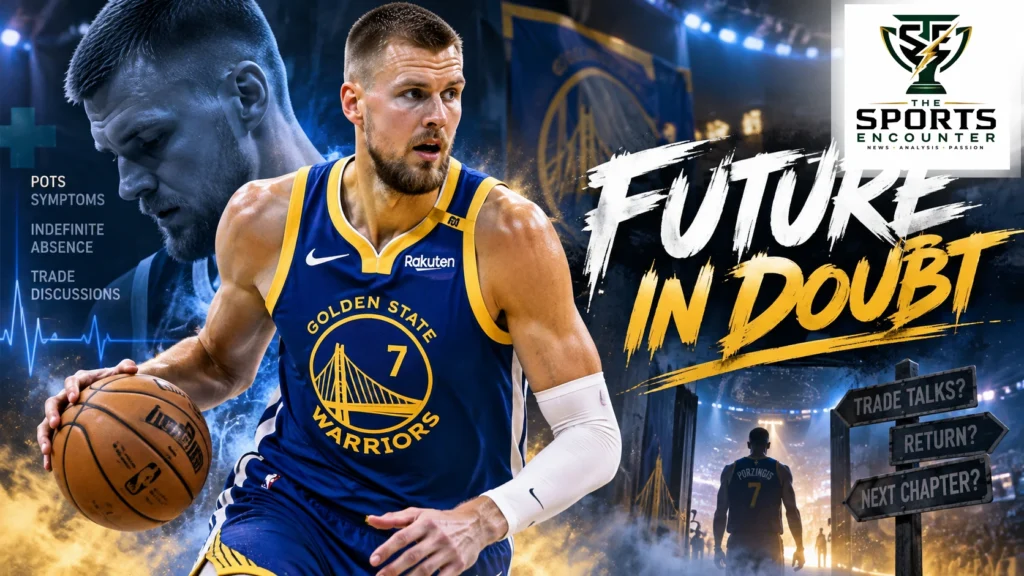
SAN FRANCISCO, United States, October 21, 2026: Kristaps Porziņģis’ future with the Golden State Warriors has become increasingly uncertain before he has played a game in the 2026-27 NBA season. The 31-year-old Latvian center is reportedly dealing with recurring symptoms of postural orthostatic tachycardia syndrome (POTS), while Golden State has begun exploring potential trades involving the former All-Star. ESPN’s Shams Charania reported Wednesday that Porziņģis is also seriously reconsidering his future in professional basketball, raising difficult questions about a player the Warriors re-signed to a two-year, $40 million contract less than four months ago.
The developments place Golden State in an uncomfortable position as Stephen Curry enters his 18th NBA season. Porziņģis was expected to provide size, perimeter shooting and interior defense, three attributes the Warriors have repeatedly sought in their frontcourt. Instead, he has missed training camp and the preseason, remains out indefinitely and has no announced return timetable. The immediate concern is his health, while the basketball implications extend to Steve Kerr’s rotations, Mike Dunleavy Jr.’s roster decisions and the franchise’s increasingly limited opportunity to compete for another championship around Curry.
Kristaps Porziņģis and the Warriors: What Has Actually Been Confirmed?
The latest reporting brings together two developments that must be understood separately.
The Warriors have officially confirmed that Porziņģis remains away from basketball activities because of a health-related matter. His absence has no publicly established end date.
Story at a glance
Kristaps Porziņģis and the Warriors: What Has Actually Been Confirmed?
The latest reporting brings together two developments that must be understood separately.
How Porziņģis’ Health Situation Developed From Boston to Golden State
The present uncertainty did not begin when the Warriors opened training camp.
What Is POTS, and Why Could It Affect an NBA Player?
Postural orthostatic tachycardia syndrome is a condition involving the autonomic nervous system, which helps regulate involuntary bodily functions, including heart rate and blood-pressure responses.
Porziņģis’ Own Words Reveal His Frustration and Determination
In a public statement on October 14, Porziņģis explained that he was consulting doctors and specialists while attempting to return to full health.
Why the Warriors Wanted Porziņģis Beside Stephen Curry
Porziņģis was acquired because his skill set addressed genuine tactical needs.
Separately, ESPN reported on October 21 that recurring POTS symptoms are affecting the player and that Golden State has begun investigating trade possibilities.
That does not establish that Porziņģis has requested a trade, agreed to retire or been medically ruled out for the entire season.
| Development | Current Status | Source or Qualification |
|---|---|---|
| Training camp participation | Did not participate | Confirmed in NBA reporting |
| Preseason availability | Did not play | Confirmed in NBA reporting |
| Regular-season status | Out indefinitely | Warriors’ announced position |
| Recurring POTS symptoms | Reported October 21 | ESPN, citing sources |
| Trade discussions | Exploratory stage | ESPN reporting; no completed trade |
| Possible retirement | Reportedly under consideration | No public retirement announcement |
| Return-to-play date | Unknown | No confirmed timetable |
| Contract | Two years, reported $40 million total | NBA contract announcement |
The distinction matters because a player’s medical situation and a franchise’s roster planning are not necessarily moving on the same timetable.
Golden State must prepare for games without a player whose return remains uncertain. Porziņģis, meanwhile, has described working with medical professionals to understand and address his condition.
The NBA’s official account of Porziņģis’ indefinite absence documents the Warriors’ initial announcement and the player’s public comments.
How Porziņģis’ Health Situation Developed From Boston to Golden State
The present uncertainty did not begin when the Warriors opened training camp.
Porziņģis experienced significant health difficulties while playing for the Boston Celtics during the 2024-25 season.
His symptoms affected his participation in Boston’s Eastern Conference semifinal series against the New York Knicks. After Game 5, Celtics coach Joe Mazzulla explained that Porziņģis had been unable to play the second half because of breathing difficulties.
The player was subsequently identified as having POTS, a condition that can affect heart-rate regulation, tolerance for standing upright and physical activity.
Boston’s attempt to defend its 2024 NBA championship ended against the Knicks.
Porziņģis later moved to the Atlanta Hawks before joining Golden State in a February 2026 trade involving Buddy Hield and Jonathan Kuminga.
The Warriors hoped a change of environment and another offseason would allow him to contribute more consistently.
By late September, however, he was unable to participate in the team’s training camp.
The Timeline Behind Golden State’s Current Uncertainty
| Period | Development | Significance |
|---|---|---|
| 2023-24 | Porziņģis wins NBA championship with Boston | Demonstrates his value to a title-winning roster |
| 2025 playoffs | Health symptoms significantly affect availability | Raises questions about sustained physical demands |
| 2025-26 | Plays for Atlanta and Golden State | Appears in 32 games across both clubs |
| February 2026 | Traded from Atlanta to Golden State | Warriors add a shooting and rim-protecting center |
| June 2026 | Agrees to a two-year, $40 million deal | Golden State commits to retaining him |
| September 2026 | Misses start of training camp | Expected frontcourt role remains unfilled |
| October 13-14 | Meets Warriors officials; remains out indefinitely | No return timetable established |
| October 21 | Recurring POTS symptoms and trade exploration reported | Health uncertainty becomes a roster-planning issue |
The chronology illustrates a problem that cannot be resolved through conventional basketball analysis alone.
Golden State committed to Porziņģis after a season already affected by limited availability. The latest symptoms introduce additional uncertainty about when, and whether, the center can resume a sustained NBA workload.
His previous championship experience and playing ability remain relevant, but neither establishes his present medical readiness.
What Is POTS, and Why Could It Affect an NBA Player?
Postural orthostatic tachycardia syndrome is a condition involving the autonomic nervous system, which helps regulate involuntary bodily functions, including heart rate and blood-pressure responses.
According to the Cleveland Clinic’s medical explanation of POTS, affected individuals may experience an unusually rapid heartbeat when moving from lying down or sitting to standing.
Symptoms can include dizziness, fatigue, palpitations, reduced exercise tolerance and difficulty performing ordinary activities.
The condition varies considerably between individuals. Some people experience intermittent symptoms, while others face more persistent limitations.
POTS can occur in association with other illnesses, including some autoimmune conditions. The precise cause is not always known, and describing every case as an autoimmune disease would be medically inaccurate.
For a professional basketball player, symptoms that interfere with physical exertion could potentially affect training consistency, stamina, recovery and game participation.
Those are general medical considerations, however. They do not establish the particular severity, triggers or prognosis of Porziņģis’ current symptoms.
Why His Return Cannot Be Predicted From the Diagnosis Alone
NBA basketball involves repeated high-intensity movements, frequent changes of direction, jumps, contact and physical recovery between games.
A center standing 7-foot-2 must repeatedly contest rebounds, defend the rim, sprint into offensive positions and sustain concentration during demanding sequences.
Whether Porziņģis can safely perform those activities, and when he might be cleared to resume them, are questions for his medical team.
No public evidence establishes a definite recovery schedule.
His decision to work with medical specialists should be treated separately from speculation about retirement or trade value.
Porziņģis’ Own Words Reveal His Frustration and Determination
In a public statement on October 14, Porziņģis explained that he was consulting doctors and specialists while attempting to return to full health.
He said he was improving but acknowledged the frustration associated with recurring health issues and injuries throughout his career.
His message also contained an important expression of perspective:
“Health is wealth.”
The statement deserves attention because Porziņģis described his recovery in personal terms rather than offering a definitive medical timetable.
He expressed appreciation for the support he had received and confidence in the professionals helping him.
At 31, he has already experienced the demands of playing in New York, Dallas, Washington, Boston, Atlanta and Golden State.
His career includes an All-Star selection and a championship with the Celtics.
The possibility of retirement is understandably significant, but no publicly confirmed decision has been announced.
For now, his health and any subsequent return-to-play determination remain the central issues.
Why the Warriors Wanted Porziņģis Beside Stephen Curry
Porziņģis was acquired because his skill set addressed genuine tactical needs.
Golden State has spent years building offense around Curry’s exceptional shooting range and ability to move without the ball.
That system becomes especially difficult to defend when other players can create space, handle the ball and threaten from outside the three-point line.
A healthy Porziņģis offers an unusually attractive combination.
At 7-foot-2, he can stretch opposing centers toward the perimeter, create shooting opportunities above smaller defenders and protect the basket at the other end.
His presence can also change defensive assignments. When a traditional center follows him beyond the arc, driving lanes can become more accessible to guards and wings.
Golden State hoped those qualities would strengthen its attack without sacrificing too much size around the rim.
The Warriors’ broader pursuit of veteran championship talent had already been examined in The Sports Encounter’s analysis of Golden State’s reported interest in LeBron James and Anthony Davis.
Porziņģis offered a different route toward addressing some of the same roster needs.
What the Warriors Actually Received After the February Trade
| Performance Measure | Verified Figure | What It Reveals |
|---|---|---|
| 2025-26 games, Atlanta and Golden State combined | 32 | Limited total availability |
| Games for Golden State | 15 | Small sample with the Warriors |
| Starts for Golden State | 11 | Substantial role when available |
| Golden State scoring average | 16.1 points | Meaningful offensive contribution |
| Golden State field-goal shooting | 43.3% | Offense retained efficiency concerns |
| Golden State three-point shooting | 31.1% | Below career shooting standard |
| Career three-point shooting | 36.4% | Historical evidence of perimeter ability |
| Share of combined 2025-26 appearances with Golden State | 46.9% | TSE calculation: 15 divided by 32 |
Sources: NBA.com reporting on Porziņģis’ 2025-26 season and July 2026 contract. The games-played percentage is calculated by The Sports Encounter and rounded to one decimal place.
The numbers provide an important distinction between talent and availability.
When he played, Porziņģis contributed more than 16 points per game for Golden State.
His shooting from three-point range fell below his established career standard, but a 15-game sample is too limited to conclude that his perimeter skill had permanently declined.
The more pressing issue is that Golden State entered another season without knowing when it could reliably use him.
The Warriors’ recent 128-118 preseason victory over Portland offered an early illustration of the alternatives available to Kerr, including Georges Niang’s timely scoring contribution. TSE examined those adjustments in its October 16 NBA preseason analysis.
Why Golden State’s Center Rotation Is Suddenly Under Pressure
Kerr’s immediate challenge involves balancing offensive spacing, rebounding and rim protection without the versatile center Golden State expected to use.
Smaller lineups can create advantages through speed, passing and three-point shooting.
However, they can also be vulnerable against opposing teams with dominant interior scorers or strong offensive rebounders.
Draymond Green remains an intelligent and versatile defensive organizer, but asking him to carry additional center responsibilities throughout a long season creates workload considerations.
Yaxel Lendeborg and the Warriors’ other available frontcourt players could receive greater responsibilities as the coaching staff experiments with combinations.
Charles Bassey’s reported knee tendinitis before the season opener adds another immediate availability concern.
Those developments create several tactical possibilities, although no single replacement can automatically duplicate Porziņģis’ height, shooting and shot-blocking ability.
Golden State’s history also provides useful perspective.
The franchise’s smaller, skill-heavy approach developed over decades, with former coach Don Nelson helping establish principles that later influenced Kerr’s championship teams.
The Sports Encounter explored that connection in its in-depth feature on Don Nelson’s influence on modern basketball and Stephen Curry’s early development.
That historical flexibility could help Golden State adjust. It cannot eliminate the physical demands of competing against larger opponents.
The $40 Million Question: How Trade Flexibility Changes the Warriors’ Options
Porziņģis agreed to a two-year contract reportedly worth $40 million during the offseason.
The agreement followed his February arrival from Atlanta and signaled that Golden State wanted to retain his combination of offensive size and defensive experience.
However, reports indicate that the second season carries contractual flexibility through a limited guarantee structure.
The exact operation of that provision matters because a player option, partial guarantee and fully guaranteed salary are different contractual mechanisms.
NBA.com’s July announcement described the second year as a player option, while subsequent reporting has characterized the 2027-28 financial commitment as partially guaranteed.
Those descriptions require reconciliation against authoritative contract records before the complete second-year obligations can be stated definitively.
What is clear is that Porziņģis is reported to earn approximately $20 million for the current season.
| Contract or Trade Factor | Reported Position | Practical Consequence |
|---|---|---|
| Contract signed | June 2026 | Offseason commitment to retain Porziņģis |
| Total reported value | $40 million | Two-season agreement |
| 2026-27 salary | Approximately $20 million | Relevant to trade salary matching |
| 2027-28 provisions | Reported contractual flexibility; exact terms require verification | Potential effect on future financial exposure |
| Current playing availability | Out indefinitely | Uncertain immediate roster contribution |
| Trade status | Options reportedly being explored | No deal or destination announced |
| Retirement status | Reportedly being considered | No confirmed retirement decision |
The NBA’s official July report on Porziņģis’ new Warriors agreement provides the initial contract announcement and relevant performance figures.
Would Another Team Trade for a Player Whose Return Is Uncertain?
That is one of the most difficult questions facing Golden State.
Porziņģis retains a valuable basketball profile when healthy. He can score from the perimeter, finish over defenders and protect the basket.
However, an acquiring team would have to assess medical information, contract obligations, roster requirements and its own appetite for uncertainty.
A potential transaction could involve another player, multiple contracts or other permitted assets, depending on the applicable NBA trade and salary-matching rules.
Those possibilities are hypothetical. No specific trade agreement has been announced, and no particular destination should be treated as confirmed.
His current salary could potentially contribute to a larger trade structure, but that does not automatically make him an attractive asset or guarantee that Golden State could receive a comparable center in return.
Can Stephen Curry’s Warriors Afford Another Season of Frontcourt Uncertainty?
Curry is 38, and Golden State’s championship window is increasingly shaped by the limited number of seasons remaining in his career.
The Warriors entered the new campaign seeking improvement after finishing 37-45 in 2025-26 and missing the playoffs.
The team has been adjusting its offensive approach while balancing the availability of veteran contributors.
Jimmy Butler’s injury history, Draymond Green’s workload and the development of younger players all influence how Kerr might manage the season.
Porziņģis’ absence adds a separate structural problem.
Golden State cannot simply rely on Curry’s shooting to resolve every defensive mismatch, particularly when the opposition controls rebounds or forces smaller lineups into difficult interior assignments.
That broader roster-building problem has appeared repeatedly in the franchise’s recent history.
Our earlier analysis of why Golden State appealed as a potential LeBron James destination also examined the relationship between star talent, veteran age, roster balance and championship expectations.
The Porziņģis situation adds urgency to those issues without establishing that a trade can resolve them immediately.
Why Trading Porziņģis Could Be More Complicated Than Keeping Him
Golden State faces several possible paths, each with material uncertainty.
Option One: Continue Supporting His Recovery
The Warriors could retain Porziņģis while their medical staff and the player assess his health and availability.
This would preserve access to his skills if he is eventually cleared to return, but the team would still require an immediate playing rotation capable of competing without him.
Option Two: Explore a Trade for Frontcourt Help
Golden State could investigate whether Porziņģis’ contract can facilitate the acquisition of another center or a different combination of roster pieces.
Any deal would depend on another team’s willingness to participate and the financial constraints applicable to both franchises.
Option Three: Develop Internal Alternatives
Kerr could distribute minutes among available big men and use Green in selected center combinations.
That approach would preserve trade flexibility, although it might leave the Warriors vulnerable against stronger interior opponents.
Option Four: Prepare for a Possible Retirement Decision
If Porziņģis eventually decides to retire, the Warriors would need to review the resulting contractual and roster consequences under NBA rules.
Retirement is only a reported possibility at present. It should not be treated as an established outcome.
These scenarios are planning considerations rather than predictions or recommendations concerning the player’s medical future.
What the Warriors Learned From Their Previous Veteran-Star Pursuits
Golden State’s repeated interest in experienced players reflects the unusual stage of its competitive cycle.
Curry remains capable of high-level scoring, but the team must surround him with enough defensive stability, size and dependable availability to compete across an 82-game season.
Past championship success does not remove the importance of those supporting pieces.
The departure of Klay Thompson from Golden State’s original championship core offered another example of how the franchise’s personnel needs have changed.
TSE’s examination of Thompson’s subsequent career and shooting legacy explored how elite perimeter skills remain valuable even as teams reconsider the composition of their veteran rosters.
Porziņģis was intended to supply a different kind of spacing threat through his unusual combination of height and shooting.
His absence means the Warriors must reconsider how to obtain that balance from the personnel currently available.
What Happens Next for Porziņģis and Golden State?
The next developments are likely to come from official medical-status updates, participation in team activities or a publicly confirmed roster transaction.
Three unresolved issues will shape the story.
The first is whether Porziņģis receives clearance to resume basketball activity and, eventually, game participation.
The second is whether Golden State identifies a trade structure attractive to another franchise.
The third is whether the Warriors’ existing rotation can remain competitive without the player they envisioned as an important frontcourt contributor.
Those questions operate on different timelines.
A player’s recovery cannot be reliably inferred from a trade rumor, and a team’s interest in exploring alternatives does not establish that the player will never return.
In the meantime, Golden State’s regular-season performances should provide useful evidence about its rim protection, rebounding, frontcourt scoring and lineup flexibility.
TSE’s analysis of NBA star power and national television expectations provides additional context on how heavily the league’s major franchises depend on the availability and appeal of established players.
Continue the NBA Story
 NBALuka Dončić Promises Lakers Fans ‘No Nights Off’ as LeBron’s Departure Puts an Entire NBA Era on His Shoulders
 NBABoston’s 77-Point Bench Stuns Philadelphia as Flagg Shines and Spurs Send Warning in NBA Preseason Finale
 NBALeBron James Tells Knicks Fan ‘I’m From Ohio’ as MSG Chants ‘We Don’t Want You’
Frequently Asked Questions About Kristaps Porziņģis and the Warriors
Is Kristaps Porziņģis Being Traded by the Warriors?
Golden State is reportedly exploring trade possibilities involving Porziņģis, according to ESPN’s October 21 reporting. No completed trade or destination has been announced.
What Is Wrong With Kristaps Porziņģis?
Reports indicate that he is experiencing recurring symptoms associated with POTS. The Warriors have publicly classified his current absence as a health-related matter without providing a detailed medical diagnosis for this episode.
What Is POTS?
Postural orthostatic tachycardia syndrome is a condition involving abnormal heart-rate responses when moving to an upright position. Symptoms may include fatigue, dizziness, palpitations and exercise intolerance.
Is Kristaps Porziņģis Retiring From the NBA?
Retirement is reportedly under consideration, but Porziņģis has not publicly announced a decision to retire.
When Will Porziņģis Return to the Warriors?
There is no confirmed return date. Golden State has listed him as out indefinitely and indicated that further updates will be provided when appropriate.
How Much Is Porziņģis’ Warriors Contract Worth?
He signed a reported two-year, $40 million agreement in June 2026. His current-season salary is approximately $20 million, while the precise future guarantee provisions require additional authoritative verification.
How Many Games Did Porziņģis Play for Golden State Last Season?
He appeared in 15 regular-season games for the Warriors after arriving from Atlanta in February 2026.
How Many Points Did He Average for the Warriors?
Porziņģis averaged 16.1 points per game across his 15 regular-season appearances for Golden State in 2025-26.
Why Did the Warriors Re-Sign Porziņģis?
His size, scoring, shooting range and defensive capabilities provided a potential solution to several roster needs. His current health-related absence has prevented Golden State from evaluating that planned role during the 2026-27 season.
A Basketball Decision With a Human Reality at Its Center
The Warriors’ uncertainty is significant because Porziņģis offered a specific set of skills that few NBA centers possess.
His height, perimeter shooting, scoring and shot-blocking made him an appealing addition to a roster attempting to compete while Curry remains an elite player.
The immediate outlook has changed dramatically since June.
Golden State has begun examining trade possibilities, while Porziņģis reportedly faces a far more consequential personal question about his future in professional basketball.
Only further medical information, a confirmed statement from the player or a completed transaction can establish how the situation will develop.
Until then, the Warriors must prepare for basketball without assuming a return date, while Porziņģis works through a health challenge whose implications extend well beyond wins, losses and contract negotiations.
The next meaningful update will come from confirmed changes to his health and playing status or an actual roster decision. Everything else remains provisional.