


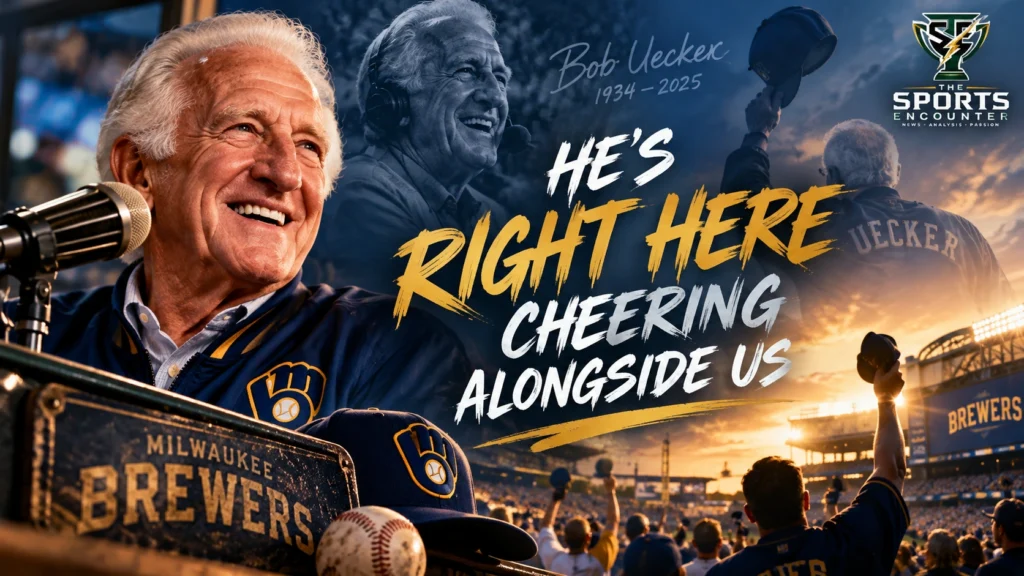
MILWAUKEE, United States, October 21, 2026: The Milwaukee Brewers are finally returning to the World Series after 44 years, but the voice that narrated generations of the city’s baseball hopes will not be there to call the first pitch. On Wednesday, the family of legendary broadcaster Bob Uecker shared an emotional message celebrating the Brewers’ historic achievement while acknowledging the absence of the man who spent 54 seasons telling Milwaukee’s baseball story.
Uecker died on January 16, 2025, at the age of 90, after battling cancer. Less than two years later, the Brewers have reached their first World Series since 1982 and will host the Tampa Bay Rays in Game 1 on Friday, October 23. For his family, the occasion carries a mixture of overwhelming pride and personal grief. For Milwaukee, it is a reminder that the person most closely associated with the franchise’s identity will remain part of its greatest moments, even without his familiar voice coming through the radio.
Bob Uecker’s Family Sends an Emotional Message to Milwaukee
For a city that has spent more than four decades waiting for another opportunity to win baseball’s ultimate prize, the family’s statement captured an extraordinary moment.
The message acknowledged the generations of supporters who had continued to believe that the Brewers would return to the World Series.
It also recognized that the celebration would feel incomplete without Uecker.
“He’s right here cheering alongside us.”
That sentiment, expressed by his family in a statement released by the Brewers on October 21, reflected the unique relationship Uecker maintained with Milwaukee throughout his life.
The family praised the players, manager Pat Murphy, the coaching staff, the club’s ownership and the supporters who had remained loyal through decades of disappointment.
The statement was more than an expression of gratitude. It acknowledged an emotional contradiction familiar to anyone who has lost a loved one before an important family milestone: the happiness of experiencing a long-awaited achievement alongside the sadness of knowing someone central to that dream cannot physically share it.
Uecker had lived through nearly every major chapter of Brewers history. He witnessed their emergence as an expansion-era franchise, the rise of the celebrated 1982 team, years of rebuilding, postseason disappointments and the development of a new generation of players.
Yet he never had the opportunity to broadcast a Brewers World Series championship.
That unfinished ambition is part of what makes the 2026 season so emotionally significant.
Milwaukee Brewers vs. Tampa Bay Rays: The World Series at a Glance
| Detail | Confirmed Position |
|---|---|
| Competition | 2026 Major League Baseball World Series |
| National League champion | Milwaukee Brewers |
| American League champion | Tampa Bay Rays |
| Game 1 | Friday, October 23, 2026 |
| Opening venue | American Family Field, Milwaukee |
| Brewers’ previous World Series | 1982 |
| Years between appearances | 44 |
| Brewers’ 2026 regular-season record | 103 wins |
| Brewers’ postseason milestone | Swept Los Angeles Dodgers in NLCS |
| Historical objective | Milwaukee’s first World Series championship as a franchise |
The Brewers secured their National League championship by sweeping the Los Angeles Dodgers in four games.
Tampa Bay reached the World Series after defeating Cleveland in the American League Championship Series, setting up a matchup between two franchises seeking a breakthrough championship.
The Sports Encounter’s report on the Rays’ American League pennant victory explained how Tampa Bay ended Cleveland’s hopes and advanced to face Milwaukee.
For both clubs, the stakes extend beyond winning the season’s final series. A championship would establish a new historical reference point for their franchises and supporters.
Why the Brewers’ World Series Return Means So Much to Bob Uecker’s Family
Uecker was not simply another former player who became a broadcaster.
He was a lifelong Milwaukee figure who helped define how the city experienced baseball.
For generations of listeners, the Brewers were not only the players taking the field. They were also the stories, observations and familiar humor that reached homes, cars, restaurants and workplaces through Uecker’s broadcasts.
Baseball’s long regular season gives broadcasters a special opportunity to become part of everyday life.
Unlike sports played once or twice a week, MLB teams compete across a 162-game regular-season schedule. Fans may spend hundreds of hours listening to the same announcers over the course of a year.
That repetition creates familiarity. The broadcaster becomes a companion through victories, disappointing losses and ordinary summer evenings when a team’s championship chances seem remote.
Uecker occupied that role for Milwaukee for more than half a century.
His family understands what the current achievement represents because he had witnessed the Brewers come close before.
The franchise’s previous World Series appearance came in 1982, when Milwaukee lost a seven-game championship series to the St. Louis Cardinals.
The current team has now given the city another opportunity to complete the journey that Uecker spent decades documenting.
It is particularly poignant because he remained involved with Brewers broadcasts into the final years of his life, even while managing serious illness.
Who Was Bob Uecker? From Milwaukee Catcher to Mr. Baseball
Robert George Uecker was born in Milwaukee, Wisconsin, on January 26, 1934.
His connection to baseball began long before he became a nationally recognizable broadcasting personality.
After serving in the United States Army, he signed with the Milwaukee Braves organization and worked his way through professional baseball as a catcher.
He reached the major leagues in 1962 and played six seasons for the Milwaukee Braves, St. Louis Cardinals, Philadelphia Phillies and Atlanta Braves.
His playing career was respectable without being statistically exceptional.
Across 297 MLB games, Uecker recorded a .200 batting average, 14 home runs and 74 runs batted in.
Those numbers later became an essential part of his comedy.
Rather than attempting to portray himself as a great former player, Uecker built an enduring public persona around humorous stories of his modest batting achievements and the challenges of being a major league catcher.
His willingness to laugh at his own career made him unusually relatable.
Fans recognized that his jokes came from someone who had actually lived inside professional baseball, understood its personalities and respected the people who played it.
Bob Uecker’s MLB Playing Career
| Career Measure | Record |
|---|---|
| Full name | Robert George Uecker |
| Born | January 26, 1934, Milwaukee, Wisconsin |
| Died | January 16, 2025, aged 90 |
| Primary playing position | Catcher |
| MLB seasons | 1962-1967 |
| Major league games | 297 |
| Batting average | .200 |
| Home runs | 14 |
| Runs batted in | 74 |
| World Series championship as a player | 1964 St. Louis Cardinals |
Uecker was a member of the Cardinals organization when St. Louis won the 1964 World Series.
That championship gave him a connection to baseball’s highest achievement as a player, even though his later identity became overwhelmingly associated with the Brewers.
The distinction matters in 2026. Uecker experienced a championship during his playing career, but Milwaukee’s continuing search for its first World Series title remained unfinished during his lifetime.
How Bob Uecker Became the Voice of the Milwaukee Brewers
Uecker began broadcasting Brewers baseball in 1971.
He joined an announcing team that included Merle Harmon and Tom Collins, initially bringing a former player’s experience and a natural sense of humor to the broadcasts.
His ability to describe the game while keeping listeners entertained quickly became one of his defining strengths.
Over time, his broadcasts developed into an important part of Wisconsin’s sporting culture.
He could explain complex baseball situations without making listeners feel excluded. He could acknowledge a team’s mistakes without sounding detached from its supporters. And he could transform otherwise unremarkable innings into entertaining radio.
That combination helped him connect with lifelong baseball followers and casual listeners alike.
He also brought an unmistakably local identity to the role.
Milwaukee was his hometown, and he had played professional baseball before the Brewers became the city’s major league representatives.
His relationship with the club therefore rested on personal history rather than a broadcasting assignment alone.
The Brewers’ official celebration of Bob Uecker’s life and career chronicles his playing years, broadcasting achievements and importance to the franchise.
The 1982 Brewers: The Championship That Escaped Milwaukee
To understand the emotion surrounding the 2026 World Series, it is necessary to revisit 1982.
That season, Milwaukee won the American League pennant and reached the World Series for the first time.
The team became widely known for its powerful offense and memorable personalities, including Robin Yount, Paul Molitor, Cecil Cooper and Rollie Fingers.
Milwaukee faced the St. Louis Cardinals in a seven-game championship series.
The Brewers came close to winning the title but ultimately lost the deciding game.
Uecker was already firmly established as the team’s broadcaster.
The defeat became part of a much longer franchise story: Milwaukee had reached baseball’s final stage but could not complete the last step.
In the decades that followed, the club experienced successful seasons, disappointing campaigns, organizational changes and renewed postseason ambitions.
Yet the gap between World Series appearances continued to grow.
For fans who remembered 1982, the 2026 appearance revives the hope they carried for 44 years.
For younger supporters, it represents the first chance to experience something their parents or grandparents remembered.
That intergenerational connection is central to the Uecker family’s message.
How the 2026 Brewers Finally Returned to the World Series
Milwaukee’s return has been built on a remarkable regular season and a postseason run defined by resilience.
The Brewers won 103 regular-season games, establishing themselves as one of baseball’s strongest teams entering October.
They then defeated the Dodgers in the National League Championship Series, completing a four-game sweep.
The final game illustrated the qualities that had carried Milwaukee through the season.
Los Angeles opened with a four-run advantage after Shohei Ohtani hit a three-run home run, placing Milwaukee under immediate pressure.
But the Brewers recovered through timely offense, including important contributions from Garrett Mitchell and David Hamilton, before the bullpen secured a 6-4 victory.
Jake Bauers was named National League Championship Series MVP.
It was an extraordinary reversal for a team that had been swept by the Dodgers in the previous year’s postseason.
The result secured Milwaukee’s return to the World Series for the first time since the season that had shaped much of the franchise’s modern mythology.
Milwaukee’s Road to the 2026 World Series
| Milestone | Achievement | Significance |
|---|---|---|
| 2026 regular season | 103 victories | Established Milwaukee as an elite contender |
| National League postseason | Advanced to NL Championship Series | Created opportunity to end long pennant drought |
| NLCS | Defeated Los Angeles Dodgers 4-0 | Secured first World Series berth since 1982 |
| NLCS Game 4 | Won 6-4 after trailing 4-0 | Completed dramatic comeback and sweep |
| NLCS MVP | Jake Bauers | Recognized for his championship-series contribution |
| World Series opponent | Tampa Bay Rays | Opportunity to win franchise’s first championship |
The decisive improvement was not built on one individual carrying the entire team.
Milwaukee combined timely hitting, aggressive baserunning, defensive contributions and late-inning pitching to win important games.
That balance is especially relevant against Tampa Bay, which reached the World Series through its own strong postseason performances.
Pat Murphy and the Brewers’ Emotional Championship Pursuit
Manager Pat Murphy has repeatedly emphasized the resilience and collective identity of his players.
The team’s postseason success reflects a roster that has demonstrated the ability to recover from difficult situations rather than depending exclusively on dominating every inning.
For Murphy and the players, Uecker’s legacy is more than a historical association.
The broadcaster was a familiar presence around the organization, someone whose influence crossed generations of managers, players and team employees.
That connection gives the 2026 postseason an emotional dimension that cannot be measured in batting averages or pitching statistics.
Milwaukee is attempting to win its first championship while carrying the memory of someone who helped connect the franchise to the city for more than five decades.
The challenge, however, remains a sporting one.
Sentiment cannot produce hits, turn double plays or protect late-inning leads.
What the memory of Uecker can provide is a shared sense of occasion, an understanding of what this World Series would mean to generations of supporters.
Why Bob Uecker Was More Than a Baseball Broadcaster
Uecker’s appeal extended far beyond Milwaukee.
He became one of America’s most recognizable sports personalities through television appearances, comedy, acting and national baseball broadcasting.
His appearances on Johnny Carson’s Tonight Show helped establish him as a popular entertainment figure.
He also became known for his work on the television sitcom Mr. Belvedere and his appearances in the baseball comedy films Major League and Major League II.
In the films, Uecker portrayed the fictional broadcaster Harry Doyle, delivering memorable commentary that drew on his real broadcasting experience.
His humor was rooted in baseball, but it remained accessible to people who did not follow the sport closely.
That ability to connect with different audiences was unusual.
A former professional athlete had become a respected broadcaster and a successful entertainer without abandoning his association with the game.
The result was a public identity that combined authenticity, humor and institutional knowledge.
Uecker’s career demonstrates why influential sports figures cannot always be evaluated through competitive statistics alone.
Some athletes leave their greatest mark through championships and records. Others shape how millions of people experience the sport.
Uecker accomplished the latter through his voice and personality.
The importance of influence beyond statistics is also explored in The Sports Encounter’s feature examining the qualities that make sporting figures respected across generations.
Bob Uecker’s Awards and Recognition
Uecker received numerous honors during his broadcasting career.
In 2001, he was inducted into the National Radio Hall of Fame.
Two years later, he received the Ford C. Frick Award, one of the most prestigious distinctions available to a baseball broadcaster.
The award recognizes significant contributions to baseball broadcasting and is presented by the National Baseball Hall of Fame and Museum.
Uecker’s 2003 recognition reflected a career that combined national prominence with decades of dedicated local broadcasting.
He was also honored through other broadcasting and entertainment institutions, including the National Association of Broadcasters Broadcasting Hall of Fame.
| Year | Honor | Why It Matters |
|---|---|---|
| 1964 | World Series champion with St. Louis Cardinals | Part of a championship-winning MLB organization as a player |
| 2001 | National Radio Hall of Fame | Recognition of his national broadcasting influence |
| 2003 | Ford C. Frick Award | Honored for major contributions to baseball broadcasting |
| 2010 | WWE Hall of Fame | Recognition of his entertainment appearances involving professional wrestling |
| 2012 | NAB Broadcasting Hall of Fame | Recognition of his broader broadcasting achievements |
The National Baseball Hall of Fame’s official biography of Uecker documents his 2003 Ford C. Frick Award and his influence on generations of baseball audiences.
Importantly, the Ford C. Frick Award is an honor for broadcasters rather than induction into the Hall of Fame as a player. Uecker is widely described as a Hall of Fame broadcaster because of that distinction.
How Radio Made Bob Uecker Part of Milwaukee’s Everyday Life
The lasting importance of Uecker’s work is best understood through the nature of radio broadcasting.
A television viewer can see a home run, a strikeout or an important defensive play.
A radio listener depends on the broadcaster to create that experience through language, pace and judgment.
The announcer must describe where the ball travels, how the fielders react, where runners are positioned and what the result means for the game.
At the same time, the broadcast must accommodate moments when very little happens.
Baseball contains long pauses, repeated pitching changes, strategic adjustments and quiet innings that can become difficult for a commentator to sustain.
Uecker excelled at making those periods enjoyable.
He blended accurate descriptions of the action with humor, memories and observations about the people involved.
His jokes rarely required viewers or listeners to possess advanced statistical knowledge.
Instead, they drew on universal subjects: embarrassment, disappointment, resilience, friendship and the absurdity of sport.
That helped create a broadcasting relationship that lasted for generations.
What Makes a Sports Broadcaster Truly Irreplaceable?
Replacing a broadcaster’s technical responsibilities is possible.
Another professional can describe a game, explain statistics and deliver interviews.
Replacing the emotional association built through half a century of shared experiences is far more difficult.
For Milwaukee supporters, Uecker’s voice was connected to the team’s identity.
A Brewers game on the radio could evoke a familiar sense of place regardless of where the listener happened to be.
That is one of the enduring strengths of local sports broadcasting.
It connects a team to its community in ways that extend beyond advertising, ticket sales or television ratings.
The changing economics of those relationships were examined in The Sports Encounter’s report on the rapid growth of global sports media rights.
Uecker’s story adds a human dimension to that commercial discussion.
The value of sports broadcasting cannot always be reduced to rights fees. A trusted voice can become part of the sporting institution itself.
The Brewers’ 2026 Success Shows How Quickly Baseball Fortunes Can Change
Major League Baseball regularly produces sudden changes in competitive fortunes.
Organizations invest in player development, coaching, scouting and roster construction without any guarantee that those decisions will produce immediate success.
Milwaukee’s rise stands in contrast to clubs still attempting to rebuild after disappointing seasons.
The Los Angeles Angels, for example, made another managerial change after a difficult 2026 campaign, as documented in TSE’s report on the franchise’s dismissal of Kurt Suzuki.
The difference is not simply one team’s willingness to spend and another’s refusal.
Successful baseball organizations must combine talent evaluation, roster balance, coaching development and the ability to respond to injuries and performance fluctuations.
Milwaukee’s championship run reflects the results of that long-term process.
It also illustrates why baseball supporters continue to believe in their teams through difficult periods.
A season that begins with familiar uncertainty can eventually produce the most significant result in decades.
Tampa Bay Rays Bring Their Own World Series Story to Milwaukee
The Brewers’ emotional circumstances do not mean the Rays are merely supporting characters in this championship.
Tampa Bay have their own franchise history, supporters and ambitions.
The Rays earned their place in the World Series after eliminating the Cleveland Guardians in the American League Championship Series.
That achievement brings together two organizations that have frequently operated under financial and market conditions different from those of baseball’s largest-revenue clubs.
The matchup offers an important reminder that championship contention is not reserved exclusively for the teams with the sport’s greatest commercial resources.
The organizational questions surrounding money, continuity and competitiveness also feature in TSE’s analysis of Brian Cashman’s long tenure with the New York Yankees.
For Milwaukee and Tampa Bay, the immediate objective is identical: win four World Series games.
Everything else, including the emotional weight of Uecker’s legacy, forms the larger human context in which those games will be played.
How Milwaukee Fans Are Remembering Bob Uecker
Uecker’s death created an absence that could not be filled by replacing his position in the broadcast booth.
His decades of work had helped define what Brewers baseball sounded like.
The family’s October 21 statement reflects the way many supporters continue to recognize him as part of the franchise.
That connection is particularly visible during a historic playoff run.
Supporters can celebrate the current players while remembering the broadcaster who narrated previous generations of hopes.
For older fans, this postseason may recall the team Uecker followed in 1982.
For younger followers, it offers an opportunity to understand why his reputation remains central to the club’s identity.
The relationship also demonstrates the enduring role of memory in sport.
Championships are measured in wins and losses, but their significance often depends on the people who experienced the journey.
When a community finally reaches a long-awaited milestone, the celebration naturally includes those who are no longer there.
Why the World Series Is an Especially Appropriate Moment to Honor Mr. Baseball
Uecker’s nickname, Mr. Baseball, was both affectionate and fitting.
He represented several sides of the sport: professional competition, broadcasting, entertainment and community identity.
His former playing career gave him credibility inside baseball.
His broadcasting work made him familiar to generations of fans.
His comedy introduced him to audiences who might never otherwise have listened to a Brewers game.
And his continued association with Milwaukee gave his public identity a consistency that few national entertainment figures maintain.
The nickname became part of his persona, but it also captured his ability to embody baseball’s wider cultural appeal.
The 2026 World Series brings those different dimensions together.
It is a competitive event, a major television spectacle, a commercial occasion and a deeply personal moment for Milwaukee supporters.
Uecker understood how those layers of meaning could coexist.
He could treat a baseball game with professional seriousness while remembering that sport is also supposed to bring people enjoyment.
What Happens Next for the Milwaukee Brewers?
The Brewers open the World Series against Tampa Bay at American Family Field on Friday, October 23.
Milwaukee will have home-field advantage for the opening two games of the best-of-seven championship.
Games 3 and 4 are scheduled to move to Tampa Bay, with additional games played if necessary.
Brewers supporters will also have opportunities to participate in club-organized gatherings, including watch parties at American Family Field for games played on the road.
The first challenge is to translate a historic National League championship into the franchise’s first World Series title.
The second, less measurable challenge, is to embrace the scale of the occasion without becoming overwhelmed by it.
Milwaukee have already demonstrated an ability to recover from difficult situations, including their comeback against Los Angeles in the deciding NLCS game.
That resilience will be important against a Tampa Bay team that has earned its own place in the championship.
Bob Uecker and the Brewers: Frequently Asked Questions
What Did Bob Uecker’s Family Say About the 2026 World Series?
His family released an emotional statement celebrating Milwaukee’s World Series appearance and expressing the belief that Uecker’s spirit remains alongside the players and supporters.
When Did Bob Uecker Die?
Bob Uecker died on January 16, 2025, at the age of 90.
How Long Did Bob Uecker Broadcast Milwaukee Brewers Games?
Uecker began broadcasting Brewers games in 1971 and remained associated with their broadcasts through the 2024 season, a span of 54 seasons.
Did Bob Uecker Ever Win a World Series?
Uecker was a member of the St. Louis Cardinals organization when the team won the 1964 World Series. However, he never witnessed a Brewers World Series championship during his lifetime.
When Did the Milwaukee Brewers Last Reach the World Series?
Before 2026, Milwaukee’s only World Series appearance came in 1982, when the Brewers lost to the St. Louis Cardinals in seven games.
Who Are the Milwaukee Brewers Playing in the 2026 World Series?
The Brewers are facing the Tampa Bay Rays, who won the American League pennant.
When Is Game 1 of the 2026 World Series?
Game 1 is scheduled for Friday, October 23, at American Family Field in Milwaukee.
Why Was Bob Uecker Called Mr. Baseball?
The nickname reflected Uecker’s recognizable personality and his wide-ranging career as a former MLB catcher, longtime Brewers broadcaster and nationally known entertainer.
Was Bob Uecker Inducted Into the Baseball Hall of Fame?
Uecker received the 2003 Ford C. Frick Award for his contributions to baseball broadcasting. The award recognizes broadcasters and is distinct from induction into the Hall of Fame as a player.
The Sports Encounter’s Perspective: The Voice Behind Milwaukee’s Longest Wait
Every championship belongs to the players who earn it, the coaches who prepare them and the organization that builds the team.
But championships also belong to the communities that spend years imagining them.
For Milwaukee, Bob Uecker helped give those dreams a voice.
His 54 seasons as a Brewers broadcaster stretched across generations of players, managers, owners and supporters.
He witnessed the 1982 World Series, remembered its disappointment and continued calling games through many years when another pennant seemed distant.
He remained connected to the sport despite illness and advancing age, preserving a relationship with the franchise that had become one of the enduring constants of Milwaukee life.
When the Brewers finally returned to the World Series in 2026, the achievement carried the weight of all those years.
That is why the family’s statement resonates.
It expresses the joy of a city seeing its team reach baseball’s biggest stage and the sadness of knowing that the person who accompanied so many earlier hopes will not be there to witness the occasion.
Milwaukee now has a chance to complete a journey that Uecker spent more than half a century narrating.
If the Brewers win, the title will belong to the 2026 team. It will also become part of the story of everyone who kept believing through the previous 44 years.
Bob Uecker’s contribution to that history is already secure, whatever happens against Tampa Bay.
His family has reminded Milwaukee that some voices remain part of a city long after the person behind the microphone has gone.
As the Brewers prepare for the World Series, the most enduring tribute to Mr. Baseball may be the sound of a city celebrating together.
More Coverage From The Sports Encounter
Follow the championship race through our coverage of Tampa Bay’s American League championship victory, examine how long-term leadership shapes MLB franchises, and explore the wider business of baseball through our sports broadcasting and media-rights analysis.
For a broader perspective on why sports history matters, revisit The Sports Encounter’s own publishing history and our account of building a publication across different sporting traditions.
Editorial methodology: The Uecker family’s October 21, 2026 statement was reported by Reuters and independently corroborated by Milwaukee-area reporting. His playing career, broadcasting history and honors were checked against Major League Baseball and the National Baseball Hall of Fame. The Brewers’ 2026 postseason achievements and World Series matchup reflect the confirmed position before Game 1 on October 23. Historical context and analysis are original to The Sports Encounter.