


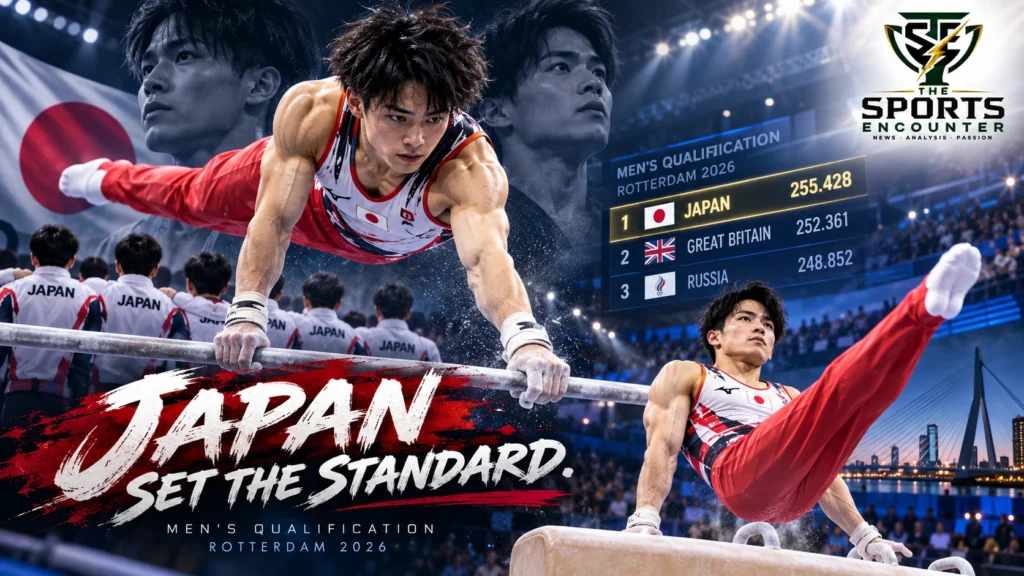
ROTTERDAM, Netherlands, October 20, 2026: Japan have established themselves as the leading contenders for the men’s team title at the World Artistic Gymnastics Championships, topping qualification with 254.529 points while Shinnosuke Oka and Daiki Hashimoto claimed the first two places in the individual all-around standings. The Japanese squad finished 3.069 points ahead of Great Britain and 5.367 ahead of Russia at Rotterdam Ahoy, with its strongest advantages coming on parallel bars and horizontal bar.
The final qualification rankings, completed after six subdivisions on October 18, also sent China, the United States, Switzerland, host nation Netherlands and Colombia into the eight-team final. Japan’s performance was particularly impressive because it combined two elite all-around gymnasts with apparatus specialists capable of contributing across the lineup. However, qualification scores do not carry forward, leaving Japan with another complete six-apparatus competition to negotiate before a world championship can be awarded.
World Artistic Gymnastics Championships 2026: Men’s Qualification Results
| Rank | Country | Points | Behind Japan |
|---|---|---|---|
| 1 | Japan | 254.529 | Leader |
| 2 | Great Britain | 251.460 | 3.069 |
| 3 | Russia | 249.162 | 5.367 |
| 4 | China | 247.493 | 7.036 |
| 5 | United States | 245.961 | 8.568 |
| 6 | Switzerland | 244.430 | 10.099 |
| 7 | Netherlands | 242.995 | 11.534 |
| 8 | Colombia | 242.727 | 11.802 |
Source: Official World Gymnastics men’s team qualification results. All eight countries qualified for the final. These are qualification standings, not final medal positions.
Japan’s Advantage Comes From Two Apparatus Where Rivals Could Not Match Them
Japan’s total of 254.529 was the highest across the completed qualification round, but the distribution of those points explains more than the overall ranking.
The team finished first on parallel bars with 44.466 and first on horizontal bar with 42.800.
Those two apparatus produced 87.266 points, accounting for approximately 34.3 percent of Japan’s total qualification score.
The Japanese also finished second on vault and third on floor exercise, pommel horse and still rings.
That consistency was crucial.
Gymnastics teams can gain valuable points through exceptional performances on one apparatus, but a major mistake elsewhere can quickly erase the advantage.
Japan avoided becoming dependent on a single discipline.
Japan’s Qualification Scores by Apparatus
| Apparatus | Japan’s Score | Apparatus Rank |
|---|---|---|
| Floor exercise | 41.433 | 3rd |
| Pommel horse | 41.966 | 3rd |
| Still rings | 41.265 | 3rd |
| Vault | 42.599 | 2nd |
| Parallel bars | 44.466 | 1st |
| Horizontal bar | 42.800 | 1st |
| Total | 254.529 | 1st overall |
Japan’s two strongest apparatus also offered a useful measure of its technical quality.
Shinnosuke Oka scored 14.866 on parallel bars, while Hashimoto and Shohei Kawakami each earned 14.800.
On horizontal bar, Kawakami delivered a 14.600 and Oka scored 14.500, both among the leading individual qualification performances.
Japan’s ability to produce multiple strong scores within the same apparatus suggests it possesses the depth required to withstand a difficult routine in the final.
Shinnosuke Oka Finishes First in Men’s All-Around Qualification
Oka produced the leading individual all-around score of 85.098, finishing 0.466 ahead of compatriot Hashimoto.
The result continues an important rivalry within Japanese gymnastics.
Oka entered the championships as an Olympic all-around champion, while Hashimoto brought extensive world championship experience and an established record of success across the six apparatus.
Their performances also gave Japan a rapid response to its setback at the September Asian Games.
At Nagoya, China’s Zhang Boheng defeated Oka and Hashimoto to win men’s all-around gold with 85.065 points.
Oka finished second with 84.698, while Hashimoto took bronze with 83.865.
The Sports Encounter’s Asian Games report examined how Zhang moved ahead of the Japanese pair and protected his advantage in the final rotation.
Rotterdam has produced a different qualifying order.
Oka and Hashimoto now occupy the leading positions, giving Japan both an advantage in team competition and two strong candidates for the individual all-around medals.
Oka vs Hashimoto: All-Around Qualification Comparison
| Apparatus | Shinnosuke Oka | Daiki Hashimoto |
|---|---|---|
| Floor exercise | 13.800 | 13.600 |
| Pommel horse | 13.900 | 14.533 |
| Still rings | 14.066 | 13.733 |
| Vault | 13.966 | 14.266 |
| Parallel bars | 14.866 | 14.800 |
| Horizontal bar | 14.500 | 13.700 |
| Total | 85.098 | 84.632 |
The numbers show how differently the two gymnasts accumulated their scores.
Hashimoto outscored Oka on pommel horse and vault, but Oka held advantages on floor exercise, still rings, parallel bars and horizontal bar.
Oka’s 0.800-point advantage on horizontal bar was particularly important because it exceeded the overall margin separating the two athletes.
The official men’s all-around qualification rankings confirm Oka first, Hashimoto second and Russia’s Arsenii Dukhno third.
Great Britain’s Strong Qualification Makes Japan’s Lead Vulnerable
Great Britain finished second with 251.460, only 3.069 points behind Japan.
The British team led qualification on pommel horse with 42.199 and vault with 42.799.
Jake Jarman provided one of its strongest individual performances, scoring 14.900 on vault.
Reuben Ward also made an important contribution on pommel horse with 14.466.
The British squad demonstrated enough technical quality to compete directly with Japan across several apparatus.
Its weakest team ranking came on horizontal bar, where it finished 11th with 40.132.
That creates a clear area of opportunity for the final.
Improvement on horizontal bar could help Britain close the qualification gap, provided it maintains its strength on vault and pommel horse.
The importance of converting qualifying potential into medals was evident at the Glasgow 2026 Commonwealth Games, where Canadian gymnast Felix Dolci produced a remarkable six-medal campaign.
TSE examined the repeated demands of apparatus competition in its Commonwealth Games Day 5 analysis.
Russia Return as a Major Team Medal Contender
Russia finished third in qualification with 249.162, placing itself among the leading medal contenders.
Arsenii Dukhno delivered the team’s strongest all-around result, ranking third overall on 83.866.
He also led men’s floor exercise qualification with 14.700.
Russia’s position carries particular significance because its return to international gymnastics has changed the competitive field.
The country is again able to compete under its national identity following changes to international participation restrictions.
That development was examined in TSE’s analysis of Russia’s return to the Rhythmic Gymnastics World Championships.
Artistic and rhythmic gymnastics are different disciplines, and success in one cannot predict results in the other.
Nevertheless, the restoration of international participation has placed Russian athletes back into direct competition with established world powers.
At Rotterdam, the qualification scoreboard shows that Russia has the team quality to challenge Japan and Britain.
China’s Fourth Place Reveals Strength and Weakness Across the Apparatus
China finished fourth with 247.493, more than seven points behind Japan.
Its strongest apparatus were still rings, where it ranked first with 41.932, and parallel bars, where it ranked second with 43.565.
Zou Jingyuan produced an outstanding 15.466 on parallel bars, one of the highest individual marks in the men’s qualification competition.
However, China ranked 11th on pommel horse and 13th on horizontal bar.
Those inconsistencies explain why the squad remained well behind Japan despite possessing athletes capable of outstanding apparatus performances.
The result also provides an interesting contrast with September’s Asian Games, where Zhang Boheng defeated Oka and Hashimoto in the men’s all-around.
China proved its individual strength in Nagoya, but the Rotterdam team result suggests the wider competition requires greater collective consistency.
United States, Switzerland, Netherlands and Colombia Complete the Eight-Team Final
The United States secured fifth place with 245.961.
The Americans led floor exercise team qualification on 41.766 and ranked third on horizontal bar with 41.433.
However, they finished 16th on parallel bars, giving the team a substantial weakness to address.
Switzerland placed sixth on 244.430, followed by the Netherlands with 242.995.
Colombia earned the final qualifying place with 242.727, only 0.268 behind the hosts.
The narrow difference between seventh and eighth illustrates how little separates some of the teams entering the final.
Colombia’s qualification also gives Angel Barajas another opportunity to compete at the highest level after establishing himself as one of the sport’s leading young talents.
Major championships repeatedly demonstrate that traditional gymnastics powers must now contend with athletes from a wider range of national programs.
The emergence of Carlos Yulo provides another example. He completed a major milestone by winning Asian Games floor gold in September, as reported in TSE’s September 24 Asian Games coverage.
Why Qualification Scores Cannot Determine the World Championship Medals
Japan’s 3.069-point advantage represents a strong qualification performance, but it is not a head start in the team final.
All eight finalists begin again from zero.
In the final, three gymnasts compete for each team on each apparatus, and all three scores count.
That format significantly increases the consequences of mistakes.
A fall, major landing deduction or incomplete routine can change the standings because teams cannot discard one of their three scores.
The qualification rankings therefore establish competitive expectations rather than guaranteed outcomes.
Japan demonstrated the strongest combined performance over six apparatus in qualification. Great Britain showed clear strength on pommel horse and vault. Russia possesses several high-scoring performers, while China has the ability to produce exceptional routines on rings and parallel bars.
That creates a final in which the quality of execution matters more than the order in which teams qualified.
Los Angeles 2028 Olympic Qualification Adds Another Layer of Pressure
The Rotterdam team final also carries consequences for the Los Angeles 2028 Olympic Games.
Under the published qualification framework, the three highest-ranked eligible National Olympic Committees in the men’s team final will earn Olympic team quota places.
Eligibility matters because a high placing does not automatically establish that every participating team can receive an Olympic quota.
Determinations concerning eligible national teams fall under the applicable World Gymnastics and International Olympic Committee rules.
The official World Gymnastics men’s team final results page provides the relevant championship standings and outlines the Olympic qualification mechanism.
For teams competing near the top of the rankings, Rotterdam therefore offers an opportunity to secure both a world championship medal and an important position in the next Olympic cycle.
Men’s Team Final: What Remains to Be Confirmed
| Item | Status |
|---|---|
| All men’s qualification subdivisions | Completed |
| Japan’s qualification score | 254.529, officially confirmed |
| Eight men’s team finalists | Confirmed |
| Men’s team final | Scheduled October 20, 19:30 CEST |
| Final gold, silver and bronze medalists | Awaiting complete official confirmation in this report |
| Olympic team quota recipients | Subject to final standings and eligibility |
Editorial status: This article reports the completed men’s qualification competition. The team final and medal positions must be updated from the completed official results before publishing any claim that Japan or another team has won the world championship.
World Artistic Gymnastics Championships 2026: Frequently Asked Questions
Which country topped men’s qualification in Rotterdam?
Japan finished first with 254.529 points.
Which countries qualified for the men’s team final?
Japan, Great Britain, Russia, China, the United States, Switzerland, Netherlands and Colombia.
Who led the men’s individual all-around qualification?
Shinnosuke Oka of Japan scored 85.098, ahead of teammate Daiki Hashimoto on 84.632.
How far ahead was Japan of Great Britain?
Japan finished 3.069 points ahead in qualification.
Which apparatus did Japan dominate?
Japan ranked first on parallel bars with 44.466 and horizontal bar with 42.800.
Who finished third in the men’s all-around qualification?
Russia’s Arsenii Dukhno finished third with 83.866.
How did China perform?
China finished fourth in team qualification with 247.493 points.
Do qualification scores carry into the men’s team final?
No. Every team starts the final from zero, with three scores counting on each apparatus.
When is the men’s team final?
The men’s team final is scheduled for October 20, 2026, at Rotterdam Ahoy.
Does the competition affect qualification for the 2028 Olympics?
Yes. The highest-ranked eligible national teams in the final can secure team quota places for Los Angeles 2028, subject to the official qualification rules.
Japan Have Set the Standard. The Final Will Test Whether They Can Repeat It.
Japan’s qualification campaign provided impressive evidence of its strength across men’s artistic gymnastics.
Oka led the all-around standings, Hashimoto finished second, and the team ranked among the top three on every apparatus.
Great Britain showed that it can challenge through pommel horse and vault, while Russia’s return introduced another serious contender. China has exceptional apparatus specialists but must produce greater consistency to close the gap.
The qualification scores leave Japan in the strongest position heading into the final, but the format ensures there is no guaranteed advantage.
The six apparatus must be negotiated again, every routine matters and the championship is decided by what happens in the final rather than what has already been achieved.
Rotterdam has established the contenders. The next competition will establish the champions.