


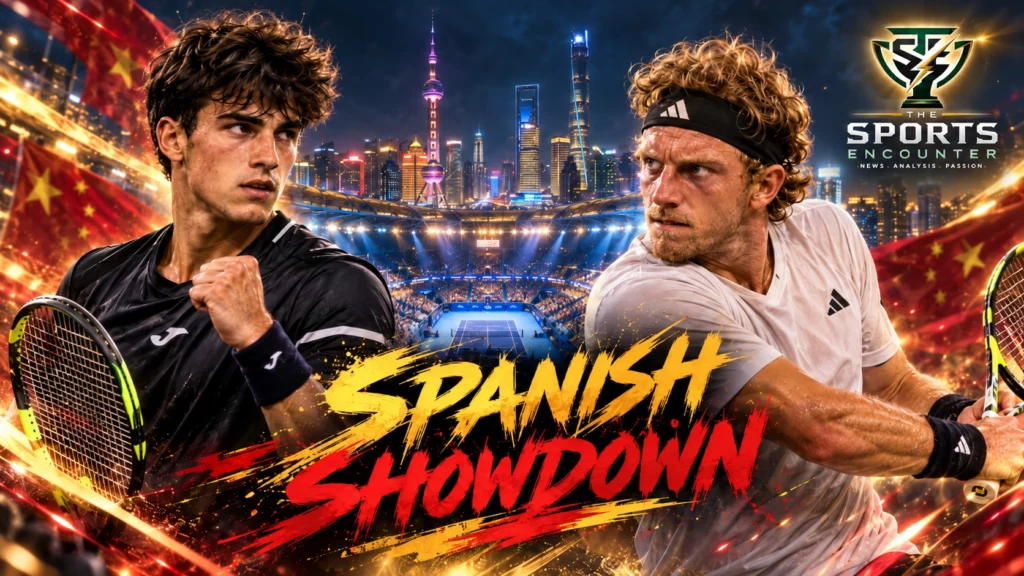
SHANGHAI, China, October 17, 2026: Spain will finally have a Shanghai Masters champion, and neither of the two men who made it possible is Carlos Alcaraz. Rafael Jodar defeated former champion Daniil Medvedev 6-3, 6-4 on Saturday after Alejandro Davidovich Fokina stunned top seed Alexander Zverev 5-7, 6-4, 6-3, setting up an all-Spanish final at the ATP Masters 1000 tournament on Sunday, October 18.
The results guarantee a Spanish men’s singles champion in Shanghai for the first time since the tournament began in 2009. Rafael Nadal reached the final twice without winning, while David Ferrer and Roberto Bautista Agut also finished runners-up. Now two players who entered the tournament with considerably different expectations will compete to end that history of near misses.
Jodar, 20, became the youngest finalist in Shanghai Masters history and reached his first Masters 1000 championship match. Davidovich Fokina, 27, advanced to his second final at this level, four years after losing the 2022 Monte-Carlo title match.
The most revealing detail is how differently they earned their places. Jodar had lost the opening set in each of his previous four Shanghai matches before finally winning one against Medvedev. Davidovich Fokina faced the opposite problem against Zverev: he lost a competitive opening set, then overturned the German’s advantage through more aggressive returning and better execution during the decisive stages.
Shanghai Masters 2026: October 17 Semifinal Results
| Semifinal | Result | Winner |
|---|---|---|
| Alejandro Davidovich Fokina vs Alexander Zverev | 5-7, 6-4, 6-3 | Alejandro Davidovich Fokina |
| Rafael Jodar vs Daniil Medvedev | 6-3, 6-4 | Rafael Jodar |
Both Spaniards will contest the championship match on Sunday, October 18, at Qizhong Forest Sports City Arena. Neither has previously won an ATP Masters 1000 singles title, guaranteeing another personal breakthrough alongside Spain’s historic first Shanghai championship.
Rafael Jodar Beats Medvedev Without Needing Another Shanghai Comeback
For four rounds, Rafael Jodar had made an uncomfortable habit of putting himself behind before finding a way to win.
Thiago Agustin Tirante, Jiri Lehecka, Botic van de Zandschulp and Casper Ruud all took the opening set against the Spaniard. None finished the match as the winner.
That extraordinary sequence made Jodar’s semifinal against Medvedev especially intriguing. Could the 20-year-old afford another slow start against a former world No. 1 and the 2019 Shanghai champion?
He never needed to answer that question.
Jodar won the opening set 6-3 and followed it with a 6-4 second set, ending Medvedev’s title challenge and reaching his first Masters 1000 final without surrendering a set.
As The Sports Encounter documented in its semifinal preview, Jodar’s earlier victories had depended on his ability to adjust his return positioning, sustain pressure and recover when opponents established control.
Saturday demonstrated a different aspect of his development: the capacity to establish an advantage rather than spend the afternoon attempting to recover one.
The result also removed a significant obstacle. Medvedev entered the semifinal following a 6-3, 1-6, 6-3 victory over Tommy Paul and had been enjoying a productive Asian hard-court swing.
The Russian had won the Hangzhou Open in September and reached the Beijing semifinals earlier in October. His Beijing defeat against Novak Djokovic, examined in TSE’s report on their China Open encounter, showed how difficult it could be to convert sustained pressure into victory against an opponent who executed better at critical moments.
In Shanghai, Jodar prevented Medvedev from extending his run to another Masters final.
Spanish news agency EFE confirmed Jodar’s 6-3, 6-4 semifinal victory and his status as the youngest finalist in the tournament’s history.
Why Jodar’s First Straight-Sets Victory Matters
Winning four successive three-set matches demonstrates resilience. It also creates considerable physical and psychological demands.
Jodar had repeatedly been forced to spend additional time on court after losing opening sets. Against Ruud, for example, he required two hours and 20 minutes to recover from a 4-6 deficit and win 6-4, 6-3.
Against Medvedev, he avoided that pattern entirely.
The distinction matters before Sunday’s championship match. Davidovich Fokina has already played several demanding contests in Shanghai, including successive deciding-set tiebreaks earlier in the tournament.
Jodar’s straight-sets semifinal does not guarantee fresher legs in the final, but it removes another extended deciding set from an already strenuous week.
More importantly, Saturday provides evidence that his success in Shanghai does not depend exclusively on recovering from poor starts. He has now won from behind and from in front against established opponents.
Davidovich Fokina Overcomes Zverev and Reaches His Second Masters 1000 Final
Alejandro Davidovich Fokina entered his semifinal facing one of the strongest statistical obstacles remaining in the Shanghai draw.
Alexander Zverev had won six of their previous seven meetings. The German was also the tournament’s top seed and had already secured the 2026 year-end world No. 1 ranking.
Two days earlier, Zverev produced an impressive 6-4, 6-4 victory against Alex de Minaur, saving five break points across two important service games.
That performance, examined in TSE’s Shanghai quarterfinal analysis, suggested that Zverev had found a more convincing balance between aggressive baseline play and reliable serving.
Davidovich Fokina nevertheless changed the direction of their semifinal.
After losing the first set 5-7, the Spaniard remained competitive in the extended exchanges and found his opportunity late in the second set.
A running backhand passing shot delivered a decisive breakthrough, allowing him to claim the set 6-4 and level the contest.
The third set brought another turning point.
According to the official Shanghai Masters semifinal report, Davidovich Fokina capitalized on a Zverev double fault early in the deciding set. He then protected his advantage with aggressive baseline tennis and effective serving.
The 27-year-old closed out a 5-7, 6-4, 6-3 victory, securing his sixth career win against a top-five opponent and his first such victory of 2026.
How Davidovich Fokina Turned Zverev’s Serving Advantage Against Him
Zverev’s serve had been a major weapon against De Minaur. When his first delivery landed effectively, he was able to control rallies and limit opportunities for his opponent to attack.
Davidovich Fokina needed to make the German work harder for those advantages.
Rather than depend solely on outright return winners, he extended exchanges, changed direction from defensive positions and created opportunities to attack after neutralizing Zverev’s initial serve.
The running backhand passing shot that helped decide the second set illustrated the quality of that approach. Davidovich Fokina stayed involved in a difficult point long enough to turn defense into an attacking opportunity.
His early advantage in the third set then changed Zverev’s problem.
The German could no longer rely on holding serve and waiting for a favorable return game. He needed to recover a break against an opponent whose confidence and serving effectiveness were improving.
Zverev was unable to make that recovery.
The victory was particularly significant because Davidovich Fokina had previously struggled to turn strong Masters 1000 performances into championships.
He reached the Monte-Carlo final in 2022 but lost to Stefanos Tsitsipas. Shanghai gives him another opportunity, this time against a younger compatriot contesting his first final at the same level.
Zverev Acknowledges the Physical Cost of His Demanding Schedule
Zverev’s defeat also came after an exceptionally busy stretch of tournaments.
The German progressed from the US Open to the Laver Cup, China Open and Shanghai with limited recovery time.
In his post-match comments published by the tournament, Zverev acknowledged carrying fatigue and a minor injury into Shanghai.
Those comments provide context for his performance, although they should not diminish Davidovich Fokina’s achievement or establish that physical discomfort alone determined the outcome.
Zverev still reached the semifinals and had produced an impressive quarterfinal. Davidovich Fokina had to defeat him on court, which required sustaining his own level after losing the first set.
The result does not affect Zverev’s confirmed year-end No. 1 ranking.
That milestone followed Carlos Alcaraz’s earlier defeat to Zizou Bergs, a development explained in TSE’s report on the Shanghai upset and its ranking consequences.
Spain Will Finally Win the Shanghai Masters After Four Previous Final Defeats
The historical importance of Sunday’s final extends beyond either player’s individual breakthrough.
Since the Shanghai Masters began in 2009, four Spanish finalists had attempted to claim the men’s singles title without success.
| Year | Spanish Finalist | Outcome |
|---|---|---|
| 2009 | Rafael Nadal | Runner-up |
| 2011 | David Ferrer | Runner-up |
| 2016 | Roberto Bautista Agut | Runner-up |
| 2017 | Rafael Nadal | Runner-up |
| 2026 | Rafael Jodar vs Alejandro Davidovich Fokina | Spanish champion guaranteed |
Shanghai had remained the only tournament among the current nine ATP Masters 1000 events without a Spanish men’s singles champion.
Sunday’s match removes that distinction regardless of who wins.
There is another significant historical detail. The Jodar-Davidovich Fokina contest will be the ninth all-Spanish final in Masters 1000 history, and the first played on a hard court. The previous eight took place on clay.
That record challenges the idea that Spain’s deepest strength is confined to clay-court tennis.
Neither finalist has built his Shanghai campaign through traditional clay-court patterns alone. Both have relied on hard-court movement, attacking returns and the ability to adapt quickly against opponents who can dominate with their serves.
The final also demonstrates that Spain can produce major results beyond its most prominent current star, Carlos Alcaraz.
Alcaraz’s elimination against Bergs appeared to remove Spain’s leading contender from the Shanghai title race. Instead, two other Spaniards survived the draw and eliminated the tournament’s top seed and a former champion on semifinal day.
Rafael Jodar’s 2026 Rise Has Been Building for Months
Shanghai represents the biggest final of Jodar’s career, but his progress has not come from one unexpectedly productive tournament.
His improvement has developed through a series of increasingly demanding events in 2026.
In August, he reached the Mubadala DC Open final before losing 7-6(2), 6-4 to Taylor Fritz.
That performance, detailed in TSE’s Washington championship report, demonstrated his ability to compete deep into an ATP 500 event despite having considerably less experience than the established contenders around him.
Jodar continued building momentum in Canada, where he recorded important results against higher-ranked opponents during the National Bank Open.
His development was examined in TSE’s review of the emerging contenders in Montreal.
September brought another major opportunity at the Laver Cup.
Representing Team Europe, Jodar defeated Alexander Bublik 6-2, 6-3, demonstrating that he could produce an assured straight-sets performance against an unpredictable opponent in a high-profile team competition.
As our analysis of Europe’s opening-day Laver Cup performance explained, Jodar controlled the important points and repeatedly prevented Bublik from establishing his preferred attacking rhythm.
Shanghai has demanded a different kind of consistency.
Four consecutive comeback victories tested his resilience, while Medvedev tested whether he could defeat a former Masters champion without surrendering the opening set.
Sunday now presents another challenge: competing for a championship against a compatriot whose recent hard-court form has also improved sharply.
Davidovich Fokina’s Nine-Match China Winning Streak Changes the Final
Jodar’s breakthrough provides the more unusual career story, but Davidovich Fokina brings considerable momentum into the final.
His victory over Zverev extended his winning streak in China to nine matches.
The run began with his title at the Chengdu Open in September, where he claimed his second ATP Tour singles championship.
In Shanghai, the Spaniard has repeatedly survived situations that could have ended his tournament.
He saved a match point against Frances Tiafoe before winning a deciding-set tiebreak. Another third-set tiebreak was required to defeat Hubert Hurkacz.
His quarterfinal against Arthur Gea ended early when the Frenchman retired because of injury, giving Davidovich Fokina additional recovery time before facing Zverev.
That combination of demanding victories and a shorter quarterfinal has brought him into Sunday’s final with confidence and experience in handling difficult matches.
Davidovich Fokina also climbed to No. 15 in the ATP Live Rankings following his semifinal victory, according to the tournament’s official report.
For the 27-year-old, winning Shanghai would mark his first Masters 1000 championship and further establish the strongest phase of his career.
How the All-Spanish Shanghai Final Affects the ATP Finals Race
Sunday’s result could carry important consequences for the season-ending ATP Finals in Turin, particularly for Jodar.
Before his semifinal, Jodar had moved into ninth place in the PIF ATP Live Race to Turin.
That position had become unusually valuable because Jannik Sinner ended his 2026 season due to a knee injury.
With Sinner unavailable, the ninth-ranked eligible player in the Race could benefit from the opening in the eight-player ATP Finals field, depending on the remaining results and final qualification standings.
The circumstances were explained in TSE’s report on Sinner’s season-ending injury and its ranking implications.
Jodar’s semifinal victory strengthens his position, while reaching the championship match creates another opportunity to collect valuable ranking points.
However, a place in the Shanghai final should not be confused with mathematically guaranteed qualification for Turin. Other contenders still have opportunities to gain points during the remaining tournaments.
Novak Djokovic is among the established players pursuing qualification.
His decision to return to the Swiss Indoors Basel gives him another chance to improve his position in the Race, a development examined in TSE’s analysis of Djokovic’s Basel return and ATP Finals ambitions.
For Jodar, the Shanghai final therefore offers two possible rewards: his first Masters 1000 title and a stronger position in the battle for Turin.
Jodar vs Davidovich Fokina: What Could Decide the Shanghai Masters Final?
The first ATP Tour meeting between the two Spaniards presents a matchup between contrasting forms of momentum.
Jodar has advanced through a series of comeback victories before finally winning comfortably against Medvedev. Davidovich Fokina has built a nine-match winning streak in China and overcome opponents with considerably different playing styles.
Three tactical questions deserve particular attention.
Can Jodar Sustain the Fast Start He Produced Against Medvedev?
Jodar’s ability to recover from losing positions has been essential throughout Shanghai.
Against Davidovich Fokina, however, beginning strongly could prove particularly valuable.
The older Spaniard has shown that he becomes dangerous when matches extend into physical rallies and when opponents offer opportunities during their service games.
A confident opening set would allow Jodar to dictate more of the contest rather than spend another match recovering.
Can Davidovich Fokina Disrupt Jodar’s Rhythm With Aggressive Returning?
The victory over Zverev demonstrated Davidovich Fokina’s ability to overcome an opponent with a powerful serve.
His challenge against Jodar will be different.
The younger Spaniard has shown enough variety and baseline strength to remain competitive through prolonged rallies. Davidovich Fokina must therefore find opportunities to attack without repeatedly giving Jodar the initiative.
His movement and ability to change direction during exchanges could become especially important.
Will Experience or Recent Form Matter More?
Davidovich Fokina has previously played a Masters 1000 final and has spent considerably longer competing against the ATP Tour’s established elite.
Jodar has never reached this stage before.
Yet his Shanghai performances suggest that unfamiliar situations do not necessarily prevent him from producing his best tennis.
The final will test whether Davidovich Fokina’s greater experience allows him to control the decisive stages, or whether Jodar’s confidence and improved consistency can carry him to another breakthrough.
Shanghai Masters 2026 Final: Key Facts
| Category | Details |
|---|---|
| Final | Rafael Jodar vs Alejandro Davidovich Fokina |
| Date | Sunday, October 18, 2026 |
| Venue | Qizhong Forest Sports City Arena, Shanghai |
| Surface | Outdoor hard court |
| Jodar’s age | 20 |
| Davidovich Fokina’s age | 27 |
| Previous ATP Tour meetings | None |
| Championship significance | First Spanish Shanghai Masters singles champion guaranteed |
| Career significance | First Masters 1000 singles title for the winner |
The final’s exact starting time should be confirmed against the latest official order of play before publication of any separate viewing guide.
Shanghai Masters 2026 Frequently Asked Questions
Who Won the Rafael Jodar vs Daniil Medvedev Semifinal?
Rafael Jodar defeated Daniil Medvedev 6-3, 6-4 on October 17, 2026, to reach his first ATP Masters 1000 final. At 20, he became the youngest finalist in Shanghai Masters history.
Who Won the Alexander Zverev vs Alejandro Davidovich Fokina Semifinal?
Alejandro Davidovich Fokina recovered from losing the first set to defeat Alexander Zverev 5-7, 6-4, 6-3 and reach his second career ATP Masters 1000 final.
Who Will Play in the 2026 Shanghai Masters Final?
Rafael Jodar and Alejandro Davidovich Fokina will contest the men’s singles final on Sunday, October 18, 2026.
Has a Spanish Player Ever Won the Shanghai Masters?
No Spanish player had won the Shanghai Masters men’s singles championship before 2026. With Jodar and Davidovich Fokina meeting in the final, Spain is guaranteed its first champion.
How Many Shanghai Masters Finals Did Rafael Nadal Reach?
Rafael Nadal reached the Shanghai Masters final twice, in 2009 and 2017, but lost both matches.
How Many Comeback Victories Has Jodar Recorded in Shanghai?
Jodar won four consecutive matches after losing the opening set before defeating Daniil Medvedev in straight sets in the semifinals.
Has Alejandro Davidovich Fokina Won an ATP Masters 1000 Title?
Davidovich Fokina has not yet won an ATP Masters 1000 singles championship. He previously reached the 2022 Monte-Carlo final, where he lost to Stefanos Tsitsipas.
How Does the Shanghai Masters Affect ATP Finals Qualification?
Jodar’s run strengthens his position in the Race to Turin. With Jannik Sinner unavailable for the remainder of 2026, the ninth-ranked eligible player could benefit from the opening in the eight-man field. Final qualification remains dependent on the remaining results and eligibility rules.
Shanghai Will Crown a Spanish Champion, but the Bigger Story Is Who Got There
Spain’s first Shanghai Masters title is now certain. The identity of the champion remains undecided.
For Jodar, victory would complete a remarkable tournament in which four consecutive recoveries from a set down led to a commanding semifinal win over a former world No. 1.
For Davidovich Fokina, it would reward a player whose persistence through difficult matches has brought him to another Masters final and whose victory over Zverev demonstrated his ability to beat one of the season’s strongest competitors.
The championship also carries a wider message about Spanish tennis.
Neither Nadal’s extraordinary career nor the efforts of Ferrer and Bautista Agut had delivered a Shanghai title. Alcaraz, Spain’s leading star of the present generation, was eliminated earlier in this year’s tournament.
Yet two other Spaniards found their way through the draw, each with a different combination of experience, resilience and improving hard-court tennis.
One of them will lift the trophy on Sunday.
What makes the final particularly compelling is that either outcome will establish a new achievement: a first Masters 1000 championship for the winner and a first Shanghai Masters singles title for Spain.