


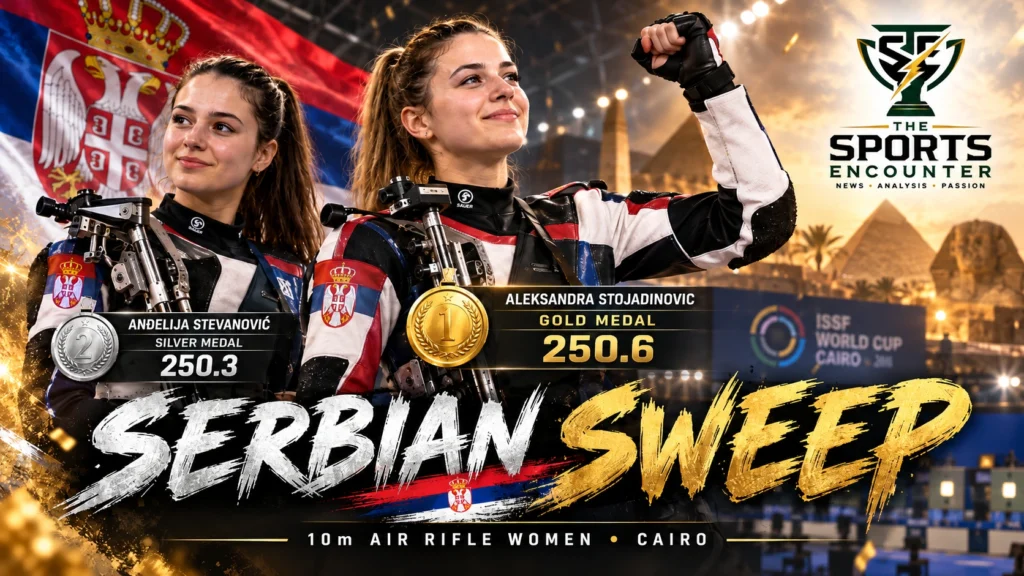
CAIRO, Egypt, October 15, 2026: Aleksandra Stojadinovic turned the last qualifying place in the women’s 10m air rifle final into her first senior ISSF World Cup gold medal on Thursday, defeating Serbian teammate Andelija Stevanovic by just 0.3 points at the Cairo World Cup. The two athletes were tied at 229.5 after 22 shots before Stojadinovic secured victory with a 10.7 on her final attempt, finishing with 250.6 against Stevanovic’s 250.3. Japan’s Misaki Nobata claimed bronze with 229.2, completing a final in which the three medalists were separated by only three-tenths at the point the bronze medal was decided.
The Serbian one-two carried several remarkable personal stories. Stojadinovic had qualified eighth with 631.1, more than four points behind Stevanovic, who finished second in qualification. Stevanovic entered the competition having won the Munich World Cup in May, while Nobata had already secured mixed-team gold in Cairo five days earlier. By the final shot, however, Stojadinovic had overturned the qualifying order and beaten two of the season’s most accomplished rifle shooters. Serbia collected both gold and silver in the event, a notable achievement at a World Cup featuring 385 athletes from 51 countries.
ISSF Cairo World Cup 2026: Women’s 10m Air Rifle Final Results
The final took place on October 15 at the Shooting Ranges of Egypt’s International Olympic City in the New Administrative Capital, with the event officially listed under Cairo.
| Rank | Athlete | Country | Final Score | Result |
|---|---|---|---|---|
| 1 | Aleksandra Stojadinovic | Serbia | 250.6 | Gold |
| 2 | Andelija Stevanovic | Serbia | 250.3 | Silver |
| 3 | Misaki Nobata | Japan | 229.2 | Bronze |
| 4 | Fan Xinyi | China | 208.6 | Fourth |
| 5 | Mariia Stashko | Ukraine | 187.4 | Fifth |
| 6 | Oceanne Muller | France | 166.7 | Sixth |
| 7 | Jeanette Hegg Duestad | Norway | 145.7 | Seventh |
| 8 | Emely Jaeggi | Switzerland | 123.4 | Eighth |
Source: International Shooting Sport Federation official results, October 15, 2026. Athletes eliminated earlier in the final completed fewer shots than those placed above them, so their cumulative scores should not be compared as if everyone fired the same number of shots.
The official ISSF women’s 10m air rifle final scorecard provides the cumulative scores, firing sequences and final rankings.
From Eighth Qualifier to Gold Medalist: How Stojadinovic Reversed the Odds
Stojadinovic’s victory began with a relatively modest qualifying position.
She scored 631.1 points across six series of 10 shots to secure the eighth and final qualifying place for the medal round.
Her teammate Stevanovic produced 635.4, taking second place behind Norway’s Jeanette Hegg Duestad, who led qualification with 635.6.
The difference between the two Serbian athletes was 4.3 points.
Qualification and final scores are not combined to determine the medals, but the difference helps explain why Stojadinovic’s eventual victory was so noteworthy.
She entered the final behind seven competitors in the qualifying order, including a teammate who had already won an ISSF World Cup title earlier in the season.
The standings changed almost immediately once the medal contest began.
Two Serbian athletes, two spots on the podium! 🇷🇸🥇🥈 A special moment for Serbia in the 10m Air Rifle Women final in Cairo! #ISSF #ShootingSport https://t.co/mur4sYSgog
— ISSF (@issf_official) October 15, 2026
The Serbian Pair Begin Level
Stojadinovic and Stevanovic both scored 52.5 across their opening five shots.
The identical scores placed them together in the early stages of the final.
After 10 shots, Stojadinovic had edged ahead with 105.4, while Stevanovic stood on 104.8.
The six-tenths advantage was useful but far from decisive.
Other finalists remained close enough to challenge, and the elimination phase had yet to settle the medal positions.
The two Serbians maintained their competitiveness as athletes began leaving the final.
Stevanovic Closes the Gap With Four Shots Remaining
After 18 shots, Stojadinovic had scored 188.3 and Stevanovic 188.2.
Only one-tenth separated them.
Following the 20th shot, the scores were 209.2 and 209.0.
Stojadinovic still led, but the advantage remained minimal.
Nobata was also in contention and continued pushing both Serbian athletes as the medal positions were decided.
Then came one of the final’s most extraordinary moments.
After 22 shots, Stojadinovic and Stevanovic were tied at exactly 229.5.
Nobata stood on 229.2.
Just 0.3 points separated all three medalists at that stage.
Nobata was eliminated in third place, leaving the two Serbian teammates to contest gold with two shots remaining.
Two Shots, One Serbian Champion: How the Final 0.3-Point Margin Was Created
With Nobata out of the contest, gold and silver were already guaranteed for Serbia.
What remained undecided was which athlete would stand on the highest step of the podium.
The first of the final two shots produced no separation.
Stojadinovic scored 10.4.
Stevanovic also scored 10.4.
Both moved to 239.9 with one shot remaining.
The championship therefore came down to the 24th and final attempt.
Stevanovic scored another 10.4.
Stojadinovic delivered a 10.7.
Those three-tenths decided the gold medal.
| Stage | Stojadinovic | Stevanovic | Margin |
|---|---|---|---|
| After 5 shots | 52.5 | 52.5 | Tied |
| After 10 shots | 105.4 | 104.8 | Stojadinovic +0.6 |
| After 18 shots | 188.3 | 188.2 | Stojadinovic +0.1 |
| After 20 shots | 209.2 | 209.0 | Stojadinovic +0.2 |
| After 22 shots | 229.5 | 229.5 | Tied |
| After 23 shots | 239.9 | 239.9 | Tied |
| Final, 24 shots | 250.6 | 250.3 | Stojadinovic +0.3 |
The last shot is the defining moment because the athletes were level before taking it.
Stojadinovic’s 10.7 provided the entire winning margin.
She did not need Stevanovic to make a major mistake. A 10.4 is still a high-value shot in decimal scoring.
She needed to be slightly more precise when no opportunity remained to recover.
The official final scoring sequence establishes that the penultimate shots were identical and the final attempts created the difference.
That makes the outcome particularly meaningful for Stojadinovic, whose first senior World Cup medal also became her first title.
Why Stojadinovic’s First Senior World Cup Gold Is a Major Personal Breakthrough
Stojadinovic arrived in Cairo having demonstrated that she could compete near the highest level, but she had yet to collect a senior ISSF World Cup medal.
Thursday changed that record in the most emphatic possible way.
She secured the last qualifying place, survived every elimination stage and ultimately defeated the athlete who had been Serbia’s leading World Cup performer earlier in the year.
The result rewards a different skill from producing the strongest qualification score.
Qualification requires consistent shooting across 60 shots.
The final is a separate competition in which standings change after short scoring series and the lowest-ranked athletes are progressively eliminated.
The two formats reward precision, but the pressure and consequences of individual shots differ.
Stojadinovic’s performance demonstrates the importance of remaining competitive after an unremarkable qualifying position.
She was eighth before the final.
She was first after the final shot.
Stevanovic’s Silver Adds to a Season That Already Includes Munich Gold
Andelija Stevanovic had a substantial international achievement behind her before entering Thursday’s final.
On May 28, she won the women’s 10m air rifle gold medal at the ISSF World Cup in Munich.
She scored 252.3 and defeated Japan’s Misaki Nobata, who finished with 252.0.
The winning margin was 0.3 points.
Four and a half months later, Stevanovic finished on the other side of an identical margin in Cairo.
Her teammate Stojadinovic took gold by 0.3.
Nobata, who had been Stevanovic’s closest challenger in Munich, completed the Cairo podium in third place.
The parallels between the two finals are striking.
| World Cup | Gold | Silver | Winning Margin |
|---|---|---|---|
| Munich, May 28, 2026 | Andelija Stevanovic, 252.3 | Misaki Nobata, 252.0 | 0.3 |
| Cairo, October 15, 2026 | Aleksandra Stojadinovic, 250.6 | Andelija Stevanovic, 250.3 | 0.3 |
The results also show why Stevanovic’s silver should not be viewed simply as a missed gold.
She qualified second in Cairo and finished second in the final.
That performance adds another senior World Cup medal to the gold she won in Munich.
The two results establish her consistency near the top of the women’s international air rifle field during 2026.
Serbia’s Medal Order Has Changed Since the Mediterranean Games
There is another revealing comparison from August.
At the Mediterranean Games in Taranto, Italy, Stevanovic took silver in the women’s 10m air rifle competition, while Stojadinovic secured bronze.
Less than two months later in Cairo, the same athletes took the top two positions.
This time, Stojadinovic finished ahead.
The result does not establish that one athlete has permanently overtaken the other.
It shows that Serbia has two women capable of competing at a very high international standard, with the order between them changing according to the demands of each competition.
Misaki Nobata Wins Another Cairo Medal After Mixed-Team Gold
Japan’s Misaki Nobata entered Thursday’s individual final having already enjoyed success at the same World Cup.
On October 10, she partnered Naoki Hanakawa to win the 10m air rifle mixed team title.
The Japanese pair scored 500.4, defeating Croatia’s Anamarija Turk and Miran Maricic by only 0.1 points.
The victory provided another reminder of how exceptionally narrow championship margins can become in elite rifle shooting.
Five days later, Nobata returned to the podium.
Her 229.2 in the individual final earned bronze.
The difference between her score and the Serbian pair’s totals at the same 22-shot stage was only 0.3.
One further high-quality shot could have changed the composition of the final two.
However, the official result remains unambiguous: Nobata was eliminated in third place, and the two Serbians contested the remaining medals.
Stevanovic and Nobata Have Now Shared Two World Cup Podiums in 2026
The Munich and Cairo results reveal an emerging competitive connection.
Stevanovic beat Nobata by 0.3 for gold in Munich.
Both returned to the podium in Cairo, with Stevanovic taking silver and Nobata bronze.
Stojadinovic’s victory added another Serbian contender to that rivalry.
Nobata’s earlier mixed-team success also reinforces the significance of her week in Egypt.
She leaves the women’s individual event with another medal after already winning mixed-team gold.
What Happened to Norway’s Qualification Leader Jeanette Hegg Duestad?
One of the most important distinctions in shooting is that the qualification leaderboard does not determine the final podium.
Norway’s Jeanette Hegg Duestad led qualification with 635.6, the strongest score of the morning.
She finished seventh in the final with 145.7.
France’s Oceanne Muller also entered with a strong qualifying record, placing third with 634.4.
She finished sixth in the final with 166.7.
China’s Fan Xinyi progressed further, eventually securing fourth place.
Switzerland’s Emely Jaeggi completed the eight-woman final in eighth position.
How the Qualifying Order Changed in the Medal Round
| Athlete | Qualification Rank | Qualification Score | Final Rank |
|---|---|---|---|
| Jeanette Hegg Duestad | 1 | 635.6 | 7 |
| Andelija Stevanovic | 2 | 635.4 | 2 |
| Oceanne Muller | 3 | 634.4 | 6 |
| Misaki Nobata | 4 | 633.4 | 3 |
| Mariia Stashko | 5 | 633.2 | 5 |
| Fan Xinyi | 6 | 632.4 | 4 |
| Emely Jaeggi | 7 | 631.3 | 8 |
| Aleksandra Stojadinovic | 8 | 631.1 | 1 |
Source: ISSF official women’s 10m air rifle qualification results.
Stojadinovic improved seven places between the two standings.
Duestad moved from first in qualification to seventh in the final.
This is not a direct comparison of identical contests. The qualification and final have different structures, and previous scores do not carry forward.
That is precisely why strong qualification results are valuable for reaching a final but provide no guarantee of a medal.
What Makes a 0.3-Point Victory So Difficult in 10m Air Rifle?
The women’s 10m air rifle event uses decimal scoring, with each shot receiving a value up to 10.9.
The target is only 10 meters away, but the precision required to separate leading international athletes is extraordinary.
In qualification, shooters complete 60 scored shots, with the leading eligible athletes advancing to the final.
In the final, competitors begin a new scoring contest. After the opening series, elimination proceeds in stages until the last two athletes remain.
The gold medal is decided after a maximum of 24 shots.
The significance of decimal scoring was visible in Cairo.
With the last shot remaining, both Serbians had 239.9.
Stojadinovic scored 10.7.
Stevanovic scored 10.4.
The difference between the two shots was the difference between gold and silver.
There was no separate tie-break required.
Stojadinovic won outright on the final cumulative score.
Asian Games Results Show How Often Rifle Medals Are Decided by Fractions
September’s Asian Games in Aichi-Nagoya produced several similarly close shooting finishes.
In the women’s 10m air rifle individual final, Japan’s Hinata Taichi won gold with 253.0, just 0.6 ahead of India’s Elavenil Valarivan.
TSE’s first Asian Games medal-day report examined how Valarivan secured silver after spending much of the final in contention for gold.
In the men’s 10m air rifle competition, China’s Sheng Lihao claimed individual gold with an Asian-record 254.2.
His achievement accompanied a Chinese team world record of 1,899.0 in qualification.
Our detailed analysis of China’s record-breaking air rifle performance explained how consistency across a much larger number of shots produced a world-record team total.
Those results illustrate two related but different qualities in international shooting.
A strong qualifying score rewards precision repeated over many shots.
A successful final requires that precision to survive increasingly consequential elimination stages.
Stojadinovic’s Cairo result is an especially strong example of the second quality.
Serbia’s One-Two Joins a Season of Exceptional International Shooting Performances
Serbia’s achievement follows a series of important international shooting results across different countries and disciplines.
At the Asian Games, China produced another individual one-two in the women’s 50m rifle 3 positions event.
Han Jiayu won gold with an Asian continental record of 359.0, just 0.2 points ahead of teammate Zhang Liyuan.
TSE’s September 26 Asian Games report examined how China converted its depth in rifle shooting into another narrow sweep of the top two places.
Although that competition uses a different shooting format, the national result provides useful context.
A country placing two athletes on the podium demonstrates depth in an individual sport where every competitor must still perform independently.
Serbia achieved that in Cairo through two shooters whose preparation, qualification results and final performances followed different paths.
Why the Result Matters for Serbia’s Shooting Program
Stevanovic had already established herself as a senior ISSF World Cup champion in Munich.
Stojadinovic has now joined her as a World Cup gold medalist.
The pair also demonstrated their ability to finish ahead of strong international opponents from Japan, China, France, Norway, Ukraine and Switzerland.
The result provides evidence of competitive depth in women’s air rifle rather than dependence on one exceptional athlete.
It also offers a foundation for future competitions.
However, one final does not establish that Serbia is now the dominant nation in women’s 10m air rifle globally.
Other countries, including China, India, Japan and South Korea, have produced important international shooting results during 2026.
The competition among these national programs remains strong.
How Does Cairo Compare With Recent Asian Shooting Breakthroughs?
The wider 2026 shooting season has repeatedly shown that athletes can produce major results after disappointment, selection changes or difficult qualification positions.
At the Asian Games, India’s Suruchi Singh and Kamaljeet were paired for the mixed 10m air pistol event after failing to reach their individual finals.
They responded by winning gold with an Asian-record score of 484.6.
Our reconstruction of India’s mixed-pistol gold explained how a late combination change produced an immediate championship performance.
South Korea’s Choo Ga-eun provided another example of exceptional precision under pressure.
She won the women’s 10m air pistol title with an Asian-record 246.3, finishing five points ahead of China’s Shen Yiyao.
TSE’s analysis of Choo’s record-breaking final examined how she approached a world-record opportunity before finishing with gold and a continental record.
The scoring systems and events should not be treated as interchangeable.
Air pistol and air rifle involve different technical demands.
Nevertheless, the competitive lesson is similar: qualification establishes the opportunity, while performance under final-round pressure determines the medals.
Medal Margins Are Only Part of the Bigger Shooting Story
At the Asian Games, India’s Neeru Dhanda and Kynan Chenai also secured mixed trap gold as shooting continued to contribute to the country’s medal campaign.
Our September 30 Asian Games report documented their title alongside other major international results.
Trap, rifle and pistol are distinct shooting disciplines.
Their athletes compete under different scoring procedures, but the results collectively show the range of international competition developing across shooting sport.
Serbia’s Cairo podium double deserves attention within that wider landscape because of the narrow gold-medal margin, the reversal of the qualifying order and the progress of both medalists during the season.
What Comes Next After Serbia’s Cairo Gold-and-Silver Finish?
The ISSF World Cup Rifle/Pistol in Cairo is scheduled from October 8 through October 16.
Thursday’s final added two medals to Serbia’s campaign before the scheduled end of the competition.
The immediate importance of Stojadinovic’s victory is that it establishes her as a senior World Cup champion for the first time.
Stevanovic adds silver to the gold she secured in Munich.
Both athletes have also demonstrated that they can compete in major international finals against established performers.
Stojadinovic’s gold gives her a place at the World Cup Final scheduled for Rome in December, while Stevanovic had already secured qualification through her Munich victory.
Final event participation and the complete competitive field remain subject to the organizer’s official arrangements.
For Serbia, the next significant objective will be to convert this depth into further results across different international tournaments.
For Stojadinovic, the challenge is to build on the performance that delivered her first World Cup medal.
For Stevanovic, the Cairo silver reinforces a season that has already included a major senior title.
Why This Serbian Podium Double Deserves More Than a Medal-Table Mention
The official results record Stojadinovic first, Stevanovic second and Nobata third.
The numbers behind that order tell a considerably more interesting story.
Stojadinovic qualified eighth.
Stevanovic qualified second.
The two began the final with identical scores.
After 18 shots, only one-tenth separated them.
After 22 shots, they were tied, with Nobata only three-tenths behind.
The 23rd shot changed nothing between the Serbians.
The 24th changed everything.
Stojadinovic delivered a 10.7, three-tenths better than her teammate’s 10.4, and turned her first senior World Cup podium into a championship victory.
Serbia leaves the final with both top medals, but Stojadinovic leaves with a personal breakthrough that the qualification standings could not have predicted.
Serbia’s ISSF Cairo World Cup Double: Frequently Asked Questions
Who Won the Women’s 10m Air Rifle Gold at the Cairo World Cup 2026?
Serbia’s Aleksandra Stojadinovic won gold on October 15, 2026, with a final score of 250.6 points.
Who Won Silver and Bronze?
Serbia’s Andelija Stevanovic took silver with 250.3, while Japan’s Misaki Nobata won bronze with 229.2.
How Close Was the Gold-Medal Contest?
Only 0.3 points separated Stojadinovic and Stevanovic. Both were tied at 239.9 before the final shot.
What Were the Final Two Shots?
Both athletes scored 10.4 on the 23rd shot. On the 24th, Stojadinovic scored 10.7 and Stevanovic scored 10.4, deciding the championship.
Where Did Stojadinovic Finish in Qualification?
She qualified eighth with 631.1 points, securing the last available place in the eight-athlete final.
Who Topped Qualification?
Norway’s Jeanette Hegg Duestad led the qualifying round with 635.6. She later finished seventh in the final.
Was This Stojadinovic’s First ISSF World Cup Medal?
Yes. The Cairo gold was her first senior ISSF World Cup medal.
Had Stevanovic Already Won a World Cup Gold Medal?
Yes. She won the women’s 10m air rifle title at the Munich World Cup on May 28, 2026, scoring 252.3.
Did Misaki Nobata Win Another Medal in Cairo?
Yes. She had already won the 10m air rifle mixed team gold with Naoki Hanakawa on October 10 before taking individual bronze on October 15.
Where Was the Cairo ISSF World Cup Held?
The competition was held at the Shooting Ranges of Egypt’s International Olympic City in the New Administrative Capital, under the official Cairo World Cup event designation.