


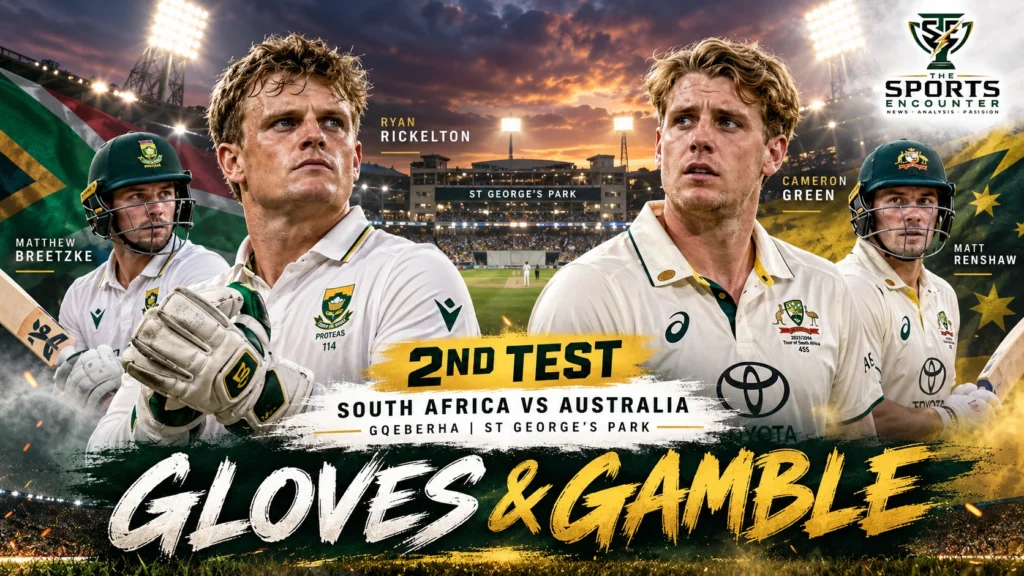
GQEBERHA, South Africa, October 15, 2026: South Africa have dropped Tristan Stubbs, recalled Matthew Breetzke and handed Ryan Rickelton the wicketkeeping gloves as they attempt to rebuild their batting after a 214-run defeat to Australia. The changes, announced Thursday, come before the second Test at St George’s Park on October 18, where the defending World Test Championship winners must avoid another defeat to keep their hopes of winning the three-match series alive. Australia lead 1-0 but have their own selection uncertainty, with Cameron Green’s abdominal injury and Josh Inglis’ fractured finger complicating decisions about a batting order that delivered victory in Durban.
The contrast is striking. South Africa’s selectors are trying to repair a lineup that managed 284 and 206 at Kingsmead, while Australia must decide whether to disturb a successful experiment that moved Matt Renshaw to No. 5, where he scored 190 and 82. Green’s possible return would create another middle-order option, although he will not bowl during the series. Rickelton’s new responsibility is equally consequential: his move behind the stumps could allow South Africa to select an additional specialist batter, with Kyle Verreynne’s place now under considerable pressure.
South Africa vs Australia Second Test: Match Details and Series Stakes
| Match Detail | Information |
|---|---|
| Match | South Africa vs Australia, Second Test |
| Series | Australia tour of South Africa, 2026 |
| Competition | ICC World Test Championship 2025-27 |
| Dates | October 18-22, 2026 |
| Venue | St George’s Park, Gqeberha |
| Scheduled start | 10:00 AM South Africa time, 08:00 UTC |
| Series standing | Australia lead 1-0 |
| South Africa captain | Temba Bavuma |
| Australia captain | Pat Cummins |
| First Test | Australia won by 214 runs in Durban |
| Third Test | October 27-31, Cape Town |
For South Africa, the stakes are immediate. Another defeat would give Australia an unassailable 2-0 lead. A draw would preserve the possibility of leveling the series in Cape Town, while victory would restore parity before the final Test.
Australia can secure the series with one match remaining. The visitors also have an opportunity to reinforce their position in the World Test Championship, having already beaten the reigning champions at Kingsmead.
The rivalry carries recent significance. South Africa defeated Australia in the 2025 World Test Championship final at Lord’s, while the current tour represents Australia’s first Test series in South Africa since the 2018 ball-tampering scandal.
That background featured prominently in The Sports Encounter’s original preview of Australia’s return to South Africa.
South Africa Drop Tristan Stubbs After Durban Batting Failures
Tristan Stubbs has become the most prominent casualty of South Africa’s defeat.
The 26-year-old scored 32 in the first innings and one in the second, contributing 33 runs across the match.
His dismissals added to concerns about his recent batting returns, with the South African management deciding that a change was necessary before the series moved to Gqeberha.
On October 15, the International Cricket Council confirmed South Africa’s revised 17-player squad, with Matthew Breetzke replacing Stubbs.
The decision is more significant than a straightforward exchange between two middle-order batters.
Stubbs had occupied the No. 5 position at Kingsmead, while Rickelton opened the innings and Verreynne kept wicket.
With Rickelton now set to take the gloves, South Africa can reconsider the entire arrangement.
Whether Breetzke opens or occupies another position will depend on the final batting combination. The selectors could also use Marques Ackerman or another available specialist batter to address a lineup that struggled against Australia’s sustained pressure.
Why Did Stubbs Lose His Place?
Stubbs’ Durban returns were disappointing, but two innings alone cannot explain every aspect of the selection decision.
South Africa were comprehensively outplayed after surrendering an early advantage, and several established batters failed to convert starts into substantial scores.
Stubbs’ second-innings dismissal was particularly damaging because South Africa were attempting to survive a demanding fourth-innings assignment.
He made one from 12 deliveries before edging Pat Cummins to wicketkeeper Alex Carey.
South Africa fell to 86 for four after 32.4 overs, having already lost David Bedingham and captain Temba Bavuma.
That sequence was documented in TSE’s fourth-day analysis of Australia’s control at Kingsmead.
The problem extended across the innings. South Africa lacked the sustained partnerships needed to resist Australia’s pace attack, particularly once the senior middle order was exposed.
Stubbs has paid the selection price for that collective failure.
For the coaching staff, the task is to determine whether a changed batting structure can produce greater stability without creating weaknesses elsewhere.
Ryan Rickelton Takes the Gloves, but Where Will He Bat?
Ryan Rickelton’s new role may have an even greater influence on South Africa’s XI than Stubbs’ omission.
Head coach Shukri Conrad has confirmed that Rickelton will be responsible for wicketkeeping in Gqeberha.
That means the selectors no longer need to reserve one position exclusively for Verreynne as the specialist wicketkeeper.
Verreynne remains in the 17-player squad, but his batting form has placed his selection under pressure.
Rickelton’s assignment therefore creates the possibility of adding another batter to the lineup.
The complication is that Rickelton was himself one of South Africa’s least productive batters in Durban.
He scored a duck in the first innings and two in the second, managing only two runs across the Test.
His elevation to wicketkeeper is consequently a calculated selection choice rather than a reward for recent batting success.
Can Rickelton Open the Batting and Keep Wicket?
Conrad has left open the possibility that Rickelton could continue opening while keeping wicket.
Rickelton has experience combining the two responsibilities, but Test cricket places considerable physical and mental demands on a wicketkeeper who must also face the new ball.
If Australia bat for an extended period, Rickelton could spend several sessions keeping before being required to open South Africa’s response.
That would leave relatively little recovery time between two demanding responsibilities.
Moving him down the order could provide an opportunity to introduce a different opening partner for Aiden Markram.
However, doing so would create another decision about the positions occupied by Bedingham, Bavuma, Wiaan Mulder and the additional specialist batter.
The available options demonstrate why the announcement of Rickelton as wicketkeeper does not establish the final batting order.
| Potential Arrangement | Possible Benefit | Selection Challenge |
|---|---|---|
| Rickelton continues opening and keeps wicket | Maintains an established opening option while creating room elsewhere | Combines wicketkeeping workload with new-ball batting |
| Rickelton moves into the middle order | Separates keeping duties from immediate new-ball responsibility | Requires a different opening partner for Markram |
| Breetzke receives a top-order opportunity | Introduces a batter in strong recent ODI form | His red-ball international record remains limited |
| Marques Ackerman enters the top order | Provides another specialist batting option | Would require further adjustments to the XI |
These are possible combinations, not confirmed selection decisions.
The central question is whether South Africa can improve their batting depth while preserving enough bowling resources to challenge Australia across five days.
Why Has Matthew Breetzke Been Recalled After Playing Only Two Tests?
Matthew Breetzke’s inclusion provides South Africa with a batter who has recently performed successfully against the same opposition.
The 27-year-old scored 171 runs across the three-match ODI series against Australia in September, including 112 from 106 deliveries in the opening match at Kingsmead.
That innings was particularly valuable because it came after South Africa had fallen to 29 for two.
Breetzke rebuilt the innings through difficult periods before combining with Marco Jansen, whose 75 helped South Africa reach 297 for eight.
The hosts eventually won by 67 runs.
Our detailed first ODI report examined Breetzke’s ability to survive the early pressure and build partnerships after repeated wickets.
That quality is relevant to South Africa’s immediate Test problem.
Their batting order struggled to remain together for extended periods in Durban, leaving individuals exposed to a demanding Australian attack.
Breetzke has demonstrated patience and adaptability in limited-overs cricket, but translating that success into Test runs will require a different level of application.
What Does Breetzke’s First-Class Record Tell Us?
Breetzke has played only two Tests, against Bangladesh in October 2024 and Zimbabwe in July 2025.
He has accumulated 14 Test runs, leaving relatively little international red-ball evidence on which to judge his suitability for the upcoming match.
His first-class batting average is approximately 37.
That record does not guarantee he will succeed against Cummins, Hazlewood, Mitchell Starc and Nathan Lyon.
However, the selectors have an additional reason to consider him: he arrives with confidence from his successful ODI performances against Australia.
Conrad has also emphasized Breetzke’s attitude and character as factors behind his recall.
The question now is how effectively those qualities translate into the longer format.
The Real Damage in Durban Began at 124 for Six
South Africa’s selection changes are understandable after a 214-run defeat, but the first Test’s most important passage occurred while Australia were batting.
On the opening day, South Africa reduced Australia to 124 for six.
Marco Jansen, Wiaan Mulder and Anrich Nortje took two wickets apiece, exposing the tourists’ top and middle order.
The situation appeared ideal for the hosts, who were playing at home and had already removed several established Australian batters.
Renshaw and Cummins then began a recovery that ultimately transformed the match.
The pair added 63 unbeaten runs before bad light ended the first day with Australia on 187 for six.
TSE’s opening-day reconstruction explained how the partnership prevented South Africa from completing the collapse they had created.
The recovery continued the following day.
Renshaw eventually made 190 from 397 deliveries, adding a crucial 134 runs for the ninth wicket with Nathan Lyon.
Australia reached 390.
From 124 for six, the visitors had added another 266 runs for their last four wickets.
That represents approximately 68.2 percent of their first-innings total.
The calculation illustrates the scale of South Africa’s missed opportunity.
They had dismissed six Australian batters for less than one-third of the eventual score, but could not finish the innings before Renshaw and the lower order changed the balance of the Test.
Renshaw’s 272 Runs Exposed the Difference Between the Teams
Renshaw followed his first-innings 190 with 82 in Australia’s second innings.
He scored 272 runs across the Test and also contributed two wickets.
For perspective, his individual aggregate exceeded South Africa’s entire second-innings total of 206 by 66 runs.
That comparison does not by itself explain every aspect of Australia’s victory, but it illustrates the unusually large contribution of one batter.
Australia declared their second innings at 314 for six, setting South Africa a target of 421.
Aiden Markram resisted with 75 from 237 balls, but Josh Hazlewood claimed six wickets for 49 runs as the hosts were dismissed for 206.
Australia won by 214 runs.
The official Cricket Australia match report confirms Hazlewood’s career-best figures and the final result.
The Sports Encounter’s complete Durban match report examines how Renshaw’s batting and Hazlewood’s bowling transformed the first Test.
What Must South Africa Fix Beyond Changing the Batting Order?
The immediate temptation after a heavy defeat is to focus on the players who failed with the bat.
South Africa’s difficulties at Kingsmead were broader.
They failed to dismiss Australia’s lower order quickly enough, allowed a major recovery and then struggled to build the partnerships required to challenge the visitors’ total.
The most important improvement would be to convert promising passages of play into sustained control.
Against Australia, creating an opportunity is only the first part of the task.
South Africa had Australia’s batting lineup in considerable trouble on the opening day. They needed to maintain that pressure against Renshaw and the remaining batters.
The inability to do so shaped the match more deeply than any isolated dismissal in South Africa’s own innings.
The issue also raises questions about the balance between attacking bowling, defensive fields and the way South Africa manage periods when a settled batter is controlling the game.
Those concerns featured in TSE’s broader examination of South Africa’s competitive intensity after Durban.
For Bavuma and Conrad, selecting a different batting combination will have limited value unless the team also improves its ability to finish strong positions.
Will Kagiso Rabada Return for the Gqeberha Test?
Kagiso Rabada’s possible return could be as consequential as the batting changes.
The fast bowler missed the opening Test after recovering from a right hamstring injury sustained in August.
He remains in South Africa’s squad for the second Test and is in contention to play, although his final selection had not been announced as of October 15.
Rabada would provide additional new-ball experience and another wicket-taking option during periods when Australia attempt to rebuild.
His importance was demonstrated during South Africa’s 2025 World Test Championship final victory over Australia, when he took nine wickets across the match.
His record against Australia also provides useful context: before this series, he had claimed 58 wickets in 11 Tests against them at an average of 21.39.
Those figures establish his history of success against the visitors, although they cannot guarantee a similar performance in Gqeberha.
The selection complication concerns balance.
South Africa used Keshav Maharaj and Simon Harmer as specialist spinners in Durban, alongside the pace options provided by Jansen, Nortje and Mulder.
If Rabada returns, the management must decide whether to retain both spinners or adjust the bowling attack for the conditions at St George’s Park.
Those decisions will influence the amount of pressure the hosts can apply through different stages of Australia’s innings.
Cameron Green’s Fitness Leaves Australia With an Unusual Selection Problem
Australia are dealing with a considerably more comfortable kind of uncertainty.
Their batting structure helped deliver victory in Durban, but Cameron Green’s recovery could create competition for the positions occupied by successful replacements.
Green missed the first Test because of an abdominal strain sustained during the preceding ODI series.
Coach Andrew McDonald confirmed on October 15 that Green was progressing with his rehabilitation but still needed to complete further fitness work before becoming available for selection.
The ICC’s official Australia fitness update also confirmed that Josh Inglis was recovering from a fractured finger and that both players remained subject to assessment.
The key distinction with Green concerns his role.
Even if cleared to play, he is not expected to bowl in South Africa because of a separate shoulder issue.
His possible inclusion would therefore primarily strengthen Australia’s batting options rather than add a conventional all-rounder’s bowling contribution.
Could Green’s Return Push Renshaw Back to Opening?
Australia entered the first Test with an unconventional arrangement.
Nic Maddinson, recalled after almost a decade outside Test cricket, opened alongside Travis Head.
Renshaw moved to No. 5, replacing the unavailable Green in the middle order.
The experiment ultimately delivered the match’s most important batting contribution.
Maddinson made a 33-ball duck in the first innings but recovered with 48 from 38 deliveries in the second.
Renshaw’s 190 and 82, meanwhile, established a strong case for keeping him at No. 5.
Green’s return would force selectors to reconsider how those roles fit together.
One possibility would be to move Renshaw back to opening and restore Green to the middle order.
Another would be to retain Renshaw at No. 5 and reconsider Maddinson’s position.
Alternatively, Australia could preserve the winning combination if Green is not yet fit enough to return.
McDonald has indicated that the batting order remains flexible and that conditions will influence the final decision.
However, flexibility creates its own challenge when an arrangement has just produced a major Test victory.
Changing roles could strengthen the team on paper while requiring a successful player to adapt again.
Josh Inglis and Cooper Connolly Add Further Selection Possibilities
Australia’s decisions extend beyond Green.
Josh Inglis is recovering from a fractured finger sustained during the ODI series against South Africa.
He has resumed limited batting activity, but the coaching staff must still establish whether he can bat comfortably at match intensity while managing the protective splint.
Inglis could provide an additional middle-order batting option.
His availability, however, does not automatically mean he will replace Alex Carey as wicketkeeper.
Carey played in Durban and remains Australia’s established wicketkeeper in the current Test side.
Cooper Connolly is another candidate for consideration after missing the first Test following illness.
His ability to provide left-arm spin could influence selection if the St George’s Park surface favors a greater variety of slow-bowling options.
The decisions involve several interconnected questions rather than a simple choice between two batters.
| Australian Player | Current Situation | Selection Implication |
|---|---|---|
| Matt Renshaw | 190 and 82 batting at No. 5 in Durban | Strong case to retain successful middle-order role |
| Cameron Green | Recovering from abdominal strain; not available to bowl | Possible specialist batting option if cleared |
| Josh Inglis | Recovering from fractured finger | Potential middle-order competition if fit |
| Nic Maddinson | 0 and 48 as an opener in Durban | Position could depend on Green and Inglis availability |
| Cooper Connolly | Recovering after illness before first Test | Potential batting and left-arm spin combination |
| Beau Webster | Played as an all-rounder in Durban | Provides another option for batting and supplementary bowling |
Australia’s selection flexibility was already a major discussion before the Test series began.
The earlier ODI series offered glimpses of that developing batting depth, including the contributions of Renshaw and Green.
Green’s abdominal injury subsequently complicated the transition between formats, a development covered in TSE’s report on Australia’s third ODI victory.
Why Renshaw’s Success Makes Australia’s Decision More Complicated
Renshaw’s performance in Durban offers an important reminder that batting positions are influenced by more than a player’s original specialist role.
He is an experienced opener, but his most successful Test innings came after being moved into the middle order.
That adjustment placed him against a different phase of the bowling attack and gave him a greater opportunity to work through the slower bowlers.
His 190 demonstrated patience, controlled scoring and the ability to build partnerships with lower-order batters.
The 134-run ninth-wicket stand with Nathan Lyon was particularly damaging to South Africa.
Australia’s decision-makers must now determine whether that success is sufficiently persuasive to retain the arrangement or whether the potential return of Green justifies another reshuffle.
There is no certainty that Renshaw would struggle if restored to opening.
However, the evidence from Durban makes it difficult to ignore the value of his recent contribution at No. 5.
The situation is almost the reverse of South Africa’s problem.
Conrad needs a new structure because the previous one failed. McDonald must decide whether improving Australia’s available personnel is worth modifying a structure that succeeded.
Gqeberha Conditions Could Decide Which Bowling Combination Both Teams Choose
St George’s Park will provide a new set of conditions after the Durban Test.
The pitch’s pace, bounce and potential assistance for spin will become important factors during the final selection process.
South Africa must decide how to distribute bowling responsibility between Rabada, Jansen, Nortje, Mulder, Maharaj and Harmer if all are available.
Australia must similarly consider whether their existing attack offers the best balance.
Pat Cummins, Mitchell Starc, Josh Hazlewood and Nathan Lyon provide established Test quality, but the workload of the fast bowlers is another consideration after the five-day contest in Durban.
The match also arrives only five days after the first Test concluded.
That turnaround makes physical recovery and player availability relevant selection factors, particularly for the fast bowlers.
Actual surface conditions must be evaluated before making confident claims about whether the Test will favor seam or spin.
A slower pitch could make changes to the batting and bowling combinations more attractive, while early movement might increase the value of specialist new-ball batting and seam-bowling depth.
Neither captain can make those judgments reliably from the venue’s reputation alone.
What Does South Africa’s ODI Success Against Australia Tell Us?
South Africa’s white-ball performances earlier in the tour offer a useful contrast to their Test struggles.
They won the first ODI through Breetzke’s century and Keshav Maharaj’s four-wicket performance.
They then secured the ODI series in Johannesburg, where David Miller made 142 and Bavuma scored 103 as South Africa posted 365 for nine.
Australia reached 333 in reply, falling 32 runs short.
That contest demonstrated South Africa’s ability to build substantial partnerships and maintain pressure against Australian batters who had started strongly.
TSE’s analysis of the Johannesburg ODI explained how South Africa’s batting and middle-over spin combinations delivered the series-clinching victory.
The longer format requires different skills and demands greater endurance.
Nevertheless, the ODI results are relevant to the selection debate because they show that several South African batters, including Breetzke, have recently succeeded against Australian opposition.
Rickelton also contributed an unbeaten 71 in the rain-affected third ODI.
South Africa’s challenge is to translate individual form and batting partnerships into sustained Test performances.
That is precisely what Australia managed through Renshaw in Durban.
Five Battles That Could Decide the Second Test
| Key Battle | Why It Matters |
|---|---|
| Markram and South Africa’s other opener vs Australia’s new ball | Early stability would reduce pressure on a reshuffled middle order |
| Rickelton’s keeping workload and batting position | The dual role influences batting depth, recovery and the final XI |
| Breetzke vs Australia’s seam attack | A recent ODI century offers encouragement, but Test conditions demand sustained discipline |
| Rabada and South Africa’s bowlers vs Renshaw | The hosts must prevent another major lower-order rescue |
| Australia’s batting flexibility vs St George’s Park conditions | Green and Inglis availability could reshape a winning combination |
South Africa vs Australia Second Test: What Should Readers Watch at the Toss?
The final team announcements will resolve several important questions.
For South Africa, the first concerns whether Breetzke immediately enters the XI and where he bats.
The second is whether Rickelton continues opening or moves into the middle order while taking responsibility behind the stumps.
The third concerns Rabada’s availability and the balance between specialist seamers and spinners.
For Australia, Green’s fitness remains the most prominent question.
If he returns, the batting order could change even though Renshaw has just produced the outstanding individual performance of the series.
Inglis and Connolly add further possibilities, while Maddinson and Webster are among those whose roles could be affected.
These questions explain why the second Test carries more than ordinary selection interest.
South Africa are trying to regain their competitive structure before the series escapes them.
Australia must decide how much to change while already holding the advantage.
The Durban result gives Cummins’ side stronger recent evidence that its existing combination can win.
Gqeberha will reveal whether Conrad’s changes produce the response South Africa need, and whether Australia’s willingness to adapt preserves the qualities that carried them to victory in the first Test.
South Africa vs Australia Second Test: Frequently Asked Questions
When Does the South Africa vs Australia Second Test Start?
The second Test begins on Sunday, October 18, 2026, at St George’s Park in Gqeberha. Play is scheduled to begin at 10:00 AM local time.
What Is the Current South Africa vs Australia Test Series Score?
Australia lead the three-match series 1-0 after winning the opening Test in Durban by 214 runs.
Why Has Tristan Stubbs Been Dropped?
South Africa omitted Stubbs after he scored 32 and one in the Durban Test, continuing a difficult period of batting form. Matthew Breetzke has replaced him in the 17-player squad.
Who Will Keep Wicket for South Africa in the Second Test?
Head coach Shukri Conrad has confirmed that Ryan Rickelton will take the wicketkeeping gloves. Kyle Verreynne remains in the squad, but his place in the playing XI is uncertain.
Will Ryan Rickelton Open the Batting in Gqeberha?
His batting position has not been finalized. South Africa are considering whether he should continue opening or move down the order to accommodate his wicketkeeping responsibilities.
Why Has Matthew Breetzke Been Recalled?
Breetzke scored 171 runs in three ODIs against Australia in September, including a century in Durban. South Africa hope his form and batting approach will help strengthen their Test lineup.
Is Cameron Green Fit for the Second Test?
Green’s availability remained uncertain as of October 15. He is recovering from an abdominal strain and must complete further fitness work. He is not expected to bowl during the South Africa series because of a separate shoulder concern.
Will Kagiso Rabada Play the Second Test?
Rabada is in contention after missing the first Test while recovering from a right hamstring injury. His selection had not been confirmed as of October 15.
Why Is Matt Renshaw’s Batting Position Under Discussion?
Renshaw scored 190 and 82 after moving to No. 5 in Durban. Cameron Green’s possible return creates a selection question over whether Renshaw remains in the middle order or returns to opening.
What Happens If Australia Win the Second Test?
Australia would take an unassailable 2-0 lead in the three-match series, securing the series before the third Test in Cape Town.