


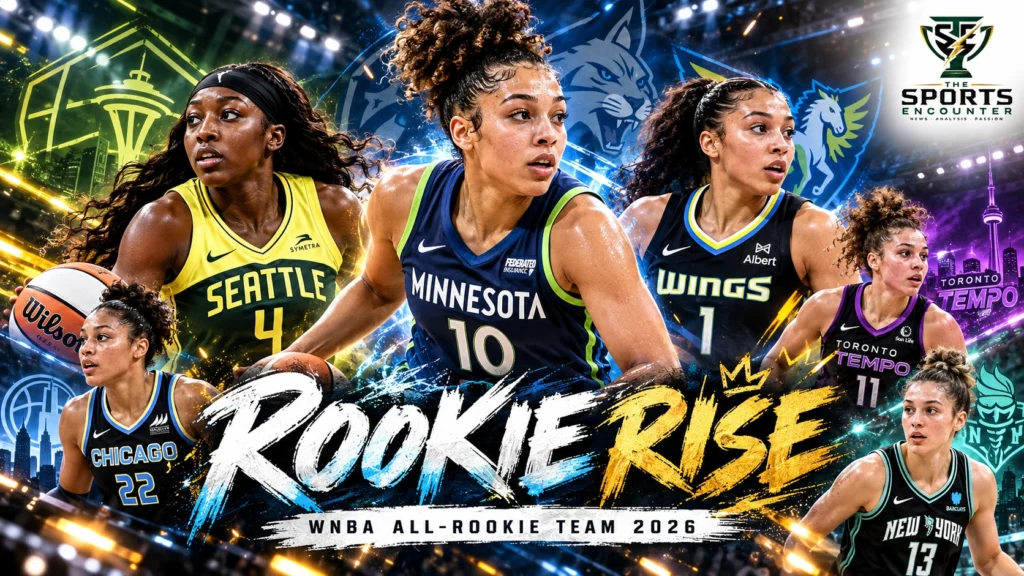
NEW YORK, United States, October 14, 2026: Olivia Miles has already broken the WNBA’s rookie scoring record and collected every Rookie of the Year vote. Now she leads an All-Rookie Team that has made history for a different reason. The league named six players instead of five after New York Liberty guard Pauline Astier and Toronto Tempo guard Kiki Rice finished tied in the voting, joining Miles, Azzi Fudd, Flau’jae Johnson and Sydney Taylor on an unusually revealing list of first-year standouts.
The announcement brings together the first two selections from the 2026 WNBA Draft, a pair of other first-rounders and two players who entered the league without being drafted. Between them, they have established scoring records, changed franchise expectations, overcome injuries and demonstrated that professional readiness cannot always be measured by draft position.
Miles, selected second overall by Minnesota, completed one of the most productive rookie seasons in WNBA history. She averaged 19.8 points, 6.0 assists and 4.7 rebounds, finishing with 790 points to surpass Caitlin Clark’s previous rookie record of 769. Her performances helped the Lynx secure the league’s best regular-season record at 33-11.
Fudd, the No. 1 overall pick by Dallas, earned recognition despite undergoing season-ending surgery on her right knee. Johnson delivered an unprecedented combination of scoring, rebounding, assists and defensive production for Seattle. Taylor became the highest-scoring undrafted rookie in league history. Rice established herself as an important player for Toronto’s expansion franchise, while Astier brought remarkable shooting efficiency to a New York team managing injuries and changing rotations.
The selections also reveal something important about the modern WNBA: every player on the 2026 All-Rookie Team is a guard or guard-oriented perimeter player. In a league increasingly influenced by ball-handling, spacing, creation and defensive versatility, the voting provides a striking snapshot of which skills translated most quickly into professional production.
The WNBA’s official October 14 All-Rookie announcement confirms all six selections.
2026 WNBA All-Rookie Team: All Six Players and Their Season Statistics
The following figures reflect completed regular-season performances. They should not be confused with statistical summaries published before the final games of the season.
| Player | Team | Games | Points Per Game | Rebounds Per Game | Assists Per Game | Distinguishing Achievement |
|---|---|---|---|---|---|---|
| Olivia Miles | Minnesota Lynx | 40 | 19.8 | 4.7 | 6.0 | Unanimous Rookie of the Year; 790 points |
| Azzi Fudd | Dallas Wings | 30 | 13.1 | 1.7 | 1.8 | No. 1 draft pick; 39.7% three-point shooting |
| Flau’jae Johnson | Seattle Storm | 42 | 14.9 | 4.8 | 2.9 | First rookie to reach five combined statistical milestones |
| Sydney Taylor | Chicago Sky | 37 | 13.6 | Not included in official award summary | 2.0 | 504 points, an undrafted rookie record |
| Kiki Rice | Toronto Tempo | 28 | 13.4 | 3.7 | 3.5 | First official end-of-season award recipient in Tempo history |
| Pauline Astier | New York Liberty | 44 | 9.3 | 2.7 | 3.3 | 54.6% field-goal shooting; undrafted |
The six selections collectively demonstrate several different definitions of a successful rookie season. Miles produced the strongest combination of scoring and primary playmaking. Johnson contributed across five major statistical categories. Fudd supplied perimeter shooting and defensive disruption. Taylor established a remarkable scoring record after entering the league without a draft selection. Rice produced efficiently despite a shortened season, while Astier combined dependable ball movement with elite shooting percentages.
The list is an official league honor, not a ranking of the six players from first through sixth. The voting tie explains the additional place, but it does not establish that every player’s long-term potential follows the order of the ballot.
Why Six Players Made a Team Normally Limited to Five
The WNBA’s All-Rookie Team traditionally recognizes five players.
In 2026, the voting produced a tie involving Kiki Rice and Pauline Astier for the final available position. Rather than separate them through an additional announced tiebreak, both players were included.
That resulted in six official selections.
The circumstance is important because the two tied players represent very different paths into the league.
Rice was the sixth overall pick and joined Toronto during the expansion franchise’s inaugural season.
Astier entered the WNBA undrafted after developing her professional game in France.
Both ultimately secured the same recognition.
The Tie Was About Recognition, Not an Extra Roster Position
The All-Rookie Team is a postseason award, not an actual squad that competes in games.
Including six players does not require the league to change an on-court roster limit, a competition rule or the number of players eligible to receive an individual award.
The additional selection simply recognizes that the voting did not separate the two candidates.
It is also important to distinguish the official WNBA All-Rookie selection from the Associated Press All-Rookie honor announced in September.
The AP awards are chosen through a separate media process and do not replace the league’s own postseason awards.
Why This Is More Interesting Than a Routine Award Announcement
The composition of the team challenges two assumptions about rookie recognition.
The first is that draft order reliably predicts immediate professional production.
Fudd and Miles justify the expectations attached to the first two selections, but Taylor and Astier demonstrate that a player can earn major recognition without hearing her name called in the WNBA Draft.
The second assumption is that raw scoring average always determines rookie value.
Miles was an exceptional scorer, but the other selections reflect shooting efficiency, creation, defensive production, consistency and the ability to occupy a useful role within a professional team.
That diversity of contributions is essential to understanding why these six players were recognized.
Olivia Miles: A Rookie Season That Went Far Beyond Expectations
Olivia Miles entered the WNBA as the second overall selection from TCU.
By the end of her first season, she had become the league’s unanimous Rookie of the Year, an All-Star starter and a first-team All-WNBA selection.
Those achievements place her debut season in an exceptional category.
Miles started all 40 of her regular-season appearances for Minnesota, averaging 19.8 points, 6.0 assists, 4.7 rebounds and 1.3 steals.
She shot 49.2 percent from the field, 38.8 percent from three-point range and 87 percent from the free-throw line.
The combination of high-volume scoring and efficient shooting is particularly noteworthy for a first-year guard responsible for making decisions with the ball.
Miles Breaks Caitlin Clark’s Rookie Scoring Record
Miles finished with 790 points, breaking the WNBA rookie record of 769 established by Caitlin Clark in 2024.
She also recorded 22 games with at least 20 points, surpassing the previous rookie record of 20 held by Seimone Augustus.
Miles added three games with at least 30 points and produced eight three-pointers in a single game against Golden State on June 4.
Her scoring record was not the result of a one-dimensional role.
Miles also finished with 239 assists, demonstrating that she could create scoring opportunities for teammates while remaining Minnesota’s leading offensive producer.
TSE documented her pursuit and eventual breaking of Clark’s landmark in its analysis of Miles overtaking the WNBA rookie scoring record.
The Distinction Between Scoring Volume and Complete Guard Play
Scoring 790 points is remarkable, but it is not the only reason Miles deserves her place.
A guard capable of averaging six assists must repeatedly identify defensive weaknesses, deliver accurate passes and create opportunities for teammates.
Miles combined those responsibilities with substantial individual scoring.
That combination places different demands on a player than operating primarily as a spot-up shooter or secondary attacker.
Her value to Minnesota extended across possessions in which she scored, assisted or initiated the movement that led to a teammate’s opportunity.
That is why her recognition extends beyond the rookie award category.
Unanimous Rookie of the Year After 74 Votes
Miles received all 74 votes from the national panel responsible for selecting Rookie of the Year.
That unanimity reflects the strength of her season relative to the other eligible players.
The WNBA’s official Rookie of the Year announcement confirms her statistical records, voting result and season achievements.
Her success had been anticipated to some extent. TSE’s WNBA midseason awards analysis examined the competition among emerging players and the wider award races.
What changed over the final months was the scale of Miles’ achievements.
She established records that put her debut alongside some of the strongest rookie seasons in league history.
Why Minnesota’s Playoff Exit Still Matters
There is one important qualification to the otherwise remarkable story.
Minnesota finished the regular season with the WNBA’s best record at 33-11 but lost to the New York Liberty in the first round of the playoffs.
That disappointing postseason finish does not invalidate Miles’ achievements.
It demonstrates the difference between extraordinary individual production over a regular season and collective success in a short playoff series.
Cheryl Reeve received major coaching and executive recognition for Minnesota’s regular-season performance, with TSE examining the contrast in its analysis of Reeve’s Executive of the Year award and the Lynx’s playoff collapse.
Miles will enter her second season with stronger expectations and the challenge of translating her individual impact into sustained postseason success.
Azzi Fudd: The No. 1 Pick Justified Her Talent Before Injury Interrupted Her Season
Dallas selected Azzi Fudd first overall after her successful college career at Connecticut.
Her rookie campaign demonstrated the shooting ability that made her such a highly regarded prospect.
But the season ended prematurely because of a right knee injury that required arthroscopic surgery.
Fudd appeared in 30 regular-season games, averaging 13.1 points, 1.7 rebounds, 1.8 assists and 1.7 steals.
She shot 45.6 percent from the field and 39.7 percent from three-point range.
Why Fudd’s Shooting Was Valuable to Dallas
Fudd averaged 2.1 made three-pointers per game, the highest rate among rookies.
That production demonstrates her ability to create value without dominating possession.
A capable perimeter shooter can force opponents to defend farther from the basket, opening space for driving guards and interior players.
Dallas benefits from that spacing because its offense also features Paige Bueckers, who can attack defenses through passing and shot creation.
Fudd’s shooting provides a complementary threat.
Her near-40 percent conversion rate from deep suggests the quality of the skill that made her the first overall pick.
Fudd Contributed Defensively, Too
Fudd’s offensive reputation can obscure her defensive production.
She averaged 1.7 steals and 0.8 blocks per game.
Those figures placed her among the more productive rookies in defensive counting statistics, despite her role as a perimeter player.
The combination of shooting and defensive activity is important for Dallas because it increases the number of lineup combinations in which she can contribute.
Her All-Rookie selection recognizes more than scoring.
How the Knee Injury Affects the Assessment
Fudd’s season-ending injury limited the amount of evidence available across the full regular season.
She could not accumulate totals over the same number of games as players who remained available throughout the year.
Her per-game production and efficiency therefore become especially important when evaluating her contribution.
The award recognizes what she demonstrated while healthy.
It does not establish a confirmed recovery timeline or guarantee how she will perform after returning.
Fudd’s next developmental challenge will be regaining full playing availability and integrating her shooting, movement and defense into Dallas’ long-term plans.
Flau’jae Johnson: Seattle’s Rookie Produced a Statistical Combination Never Seen Before
Seattle acquired Flau’jae Johnson in a draft-night trade after she was selected eighth overall.
The former LSU standout quickly became one of the Storm’s most important young contributors.
Johnson started all 42 games she played, averaging 14.9 points, 4.8 rebounds, 2.9 assists, 1.4 steals and 0.7 blocks.
Her production was significant because it reached across nearly every major statistical category.
A Five-Category Rookie First
Johnson became the first WNBA rookie to record at least 600 points, 200 rebounds, 100 assists, 50 steals and 28 blocks in one season.
That is a distinctive achievement.
It required scoring production, defensive activity, playmaking and consistent availability.
The combination also helps explain why she earned recognition despite playing in a draft class containing several outstanding guards.
Johnson was not simply competing for points per game.
She was contributing to Seattle’s offense and defense across multiple situations.
Johnson’s 626 Points Establish a Storm Rookie Record
Johnson scored 626 points, the eighth-highest total by a rookie in WNBA history.
She also set Seattle franchise rookie records for points, field goals made, three-pointers made, steals and minutes.
Her 60 made three-pointers added another dimension to her attacking value.
She recorded six games with at least 25 points, demonstrating that she could produce substantial individual scoring performances rather than contributing only through steady averages.
Those achievements are evidence of both versatility and the trust placed in her by Seattle’s coaching staff.
What Johnson Means for Seattle’s Future
The Storm are building around an increasingly interesting group of young players, including Dominique Malonga and Awa Fam.
Johnson’s immediate success gives the team another player capable of contributing on both ends of the court.
Her next step will involve improving efficiency and decision-making as opposing defenses become more familiar with her tendencies.
That is a normal challenge for a second-year player whose rookie campaign has already attracted substantial attention.
The selection also adds to a season in which the WNBA’s young talent has received significant attention through events such as the All-Star Game. TSE’s 2026 WNBA All-Star guide provides the wider context for the league’s established stars and emerging talent.
Sydney Taylor: The Undrafted Rookie Who Scored 504 Points
Sydney Taylor’s selection may be the most instructive example of why draft position cannot be treated as a complete measure of professional potential.
Taylor went undrafted in 2024.
She entered the Chicago Sky’s 2026 training camp on a contract that provided an opportunity to earn a regular-season roster place.
She made the team and eventually became one of its most productive scorers.
Taylor finished with 504 points in 37 games, averaging 13.6 points and 2.0 assists.
Her total established a WNBA record for an undrafted rookie.
From Training Camp Opportunity to Franchise Record
Taylor started 26 of her 37 appearances.
She made 71 three-pointers, the highest total among 2026 rookies and a Chicago Sky rookie franchise record.
Her 504 points made her the third-highest rookie scorer in the league.
The production is particularly notable because she did not begin her professional opportunity with the assurances attached to a high draft selection.
She had to establish her role through training camp and then retain it through regular-season performance.
Two Game-Winning Shots Demonstrate Her Composure
Taylor delivered decisive late three-pointers against Las Vegas on August 1 and Golden State on August 21.
She became the first WNBA rookie to make two go-ahead game-winning three-pointers with five seconds or fewer remaining.
Those shots provide an additional dimension to her scoring record.
A player can accumulate significant points across a season without regularly facing high-pressure late-game possessions.
Taylor demonstrated that she could contribute when the result depended on an individual shot.
The Chicago Sky’s official All-Rookie announcement confirms her scoring totals, three-point record and path from training camp to the honor.
Why Taylor and Fudd Can Both Lead Rookies in Three-Point Categories
There is a useful statistical distinction between the two players.
Taylor finished with the most made three-pointers among rookies across the season, with 71.
Fudd averaged the most made three-pointers per game, at 2.1.
Those statements are not contradictory.
Taylor played 37 games, while Fudd appeared in 30 before her injury.
Playing more games allowed Taylor to accumulate the higher season total even though Fudd produced slightly more three-pointers per appearance.
This distinction is important when assessing player performance. Per-game efficiency, total availability and overall production answer different questions.
Kiki Rice: Toronto’s First Official Award Winner
Kiki Rice arrived at the Toronto Tempo as the sixth overall selection from UCLA.
For a new franchise, her role extended beyond developing as an individual player.
She was also part of establishing the team’s first competitive identity.
Rice finished her rookie season averaging 13.4 points, 3.7 rebounds and 3.5 assists across 28 games.
She shot 47.2 percent from the field and 35.1 percent from three-point range.
Rice’s Season Was Interrupted by an Ankle Injury
Rice missed 16 games because of a severe ankle sprain.
She started 20 of the 28 games she played.
Her availability was therefore more limited than that of several other All-Rookie selections.
Despite the interruption, she ranked fourth among rookies in scoring average.
Her contribution was particularly encouraging because she combined efficient shooting with ball-handling and playmaking responsibilities.
Why the Honor Matters to the Toronto Tempo
Toronto completed its inaugural WNBA season with an 11-33 record.
The expansion club faced the considerable challenge of establishing a roster, team chemistry and a competitive system against opponents with greater continuity.
Rice’s selection became the first official end-of-season WNBA award recognition for a Tempo player.
That gives the club a tangible achievement from its first campaign.
It also identifies a young player around whom part of the team’s future development can be organized.
The significance goes beyond Rice’s individual scoring average.
A new franchise benefits from players who can establish expectations for consistency, professionalism and development during its opening years.
Rice and Astier: Two Different Paths to the Same Recognition
The voting tie provides a revealing comparison.
Rice entered as a first-round draft selection and became an important contributor for a new franchise.
Astier arrived without being drafted and established herself within a team already containing experienced championship-level players.
Both succeeded, but under very different organizational circumstances.
That helps explain why postseason honors should consider more than raw statistical rankings.
Pauline Astier: The Undrafted French Guard Who Turned Efficiency Into Recognition
Pauline Astier entered the WNBA after developing her professional game in France.
She joined a New York Liberty team containing established stars such as Breanna Stewart, Sabrina Ionescu and Jonquel Jones.
That environment required her to contribute without necessarily controlling the same number of possessions as rookies occupying primary scoring roles.
Astier appeared in all 44 regular-season games, starting 39.
She averaged 9.3 points, 3.3 assists and 2.7 rebounds.
Her most impressive statistical feature was efficiency.
Astier Shot 54.6 Percent From the Field
Astier converted 54.6 percent of her field-goal attempts.
Her true shooting percentage was approximately 63.5 percent.
True shooting percentage incorporates field goals, three-point attempts and free throws into a broader measure of scoring efficiency.
Astier’s figures were exceptional for a guard.
They demonstrate that she could generate valuable offensive production without needing a high volume of attempts.
That made her particularly useful within a roster containing established scoring options.
Why Astier’s Role Was Different From Miles’
Miles carried a large offensive workload for Minnesota and was responsible for substantial scoring and creation.
Astier’s contribution required a different balance.
She needed to move the ball effectively, recognize favorable opportunities and avoid wasting possessions.
Her scoring average was considerably lower, but her shooting percentages and assist production demonstrated that she could operate productively within New York’s system.
The two players should therefore not be evaluated through scoring average alone.
Their responsibilities differed.
The Liberty’s Season Gave Astier Valuable Experience
New York’s season included a series of injury-related adjustments and changing rotation demands.
Astier’s ability to appear in all 44 games provided continuity during those changes.
The Liberty also produced one of the postseason’s biggest surprises by eliminating top-seeded Minnesota in the first round before eventually falling to Atlanta.
TSE’s WNBA playoff semifinal coverage provides context for the teams and challenges shaping the closing stages of the season.
For Astier, the All-Rookie selection confirms that a player can make a meaningful immediate contribution through efficiency, consistency and intelligent decision-making.
What the Six Selections Reveal About the 2026 Rookie Class
The central analytical question is what these six players have in common beyond eligibility for a postseason award.
The answer is their ability to influence possessions from the perimeter.
Miles combines scoring and playmaking. Fudd stretches defenses through perimeter shooting. Johnson contributes as an attacker and defender. Taylor creates scoring through three-point shooting and decisive late-game attempts. Rice provides efficient offensive creation. Astier combines shooting accuracy with distribution.
All six are guards or guard-oriented perimeter players.
That does not establish that frontcourt rookies lacked talent.
It indicates that the players selected delivered the most persuasive combination of production and immediate impact under the voting process.
Draft Position Was Only Part of the Story
| Player | Draft Position or Entry Path | 2026 Team |
|---|---|---|
| Azzi Fudd | No. 1 overall, 2026 | Dallas Wings |
| Olivia Miles | No. 2 overall, 2026 | Minnesota Lynx |
| Kiki Rice | No. 6 overall, 2026 | Toronto Tempo |
| Flau’jae Johnson | No. 8 overall, 2026 | Seattle Storm |
| Sydney Taylor | Undrafted; entered WNBA roster in 2026 | Chicago Sky |
| Pauline Astier | Undrafted WNBA entrant | New York Liberty |
The presence of both the first and second overall selections indicates that the top of the draft produced immediate contributors.
But the inclusion of Taylor and Astier reinforces the importance of evaluation beyond the draft.
Teams can identify useful professional talent through overseas scouting, training camps and opportunities given to players who were not selected.
That does not mean draft status is irrelevant.
It means that a draft position is the beginning of a professional evaluation, not its final conclusion.
Availability Changed How Players Accumulated Statistics
There is also an important distinction between per-game production and total season contributions.
Miles scored 790 points in 40 games.
Johnson scored 626 in 42.
Taylor scored 504 in 37.
Fudd appeared in only 30 because of injury, and Rice played 28 following her ankle setback.
Astier completed all 44 games.
These differences affect cumulative totals and must be considered when comparing players.
A player with a slightly lower scoring average can finish with more total points because she appeared in more games.
Similarly, defensive and playmaking contributions should be considered alongside raw scoring.
Why Immediate Impact and Long-Term Potential Are Different Questions
The All-Rookie Team recognizes performances during the 2026 season.
It does not guarantee which player will have the most successful ten-year career.
Miles has already demonstrated star-level production.
Fudd’s shooting could become even more valuable if she maintains full availability.
Johnson’s versatility gives Seattle a range of ways to use her.
Taylor must prove that her scoring remains effective as opponents devote more attention to her.
Rice and Astier have opportunities to develop their roles further within very different team structures.
Those are genuine questions for future seasons, not conclusions established by Wednesday’s voting.
Which Notable Rookies Missed the Team?
The WNBA’s September awards discussion identified several additional rookies who deserved consideration.
They included Seattle’s Awa Fam, Toronto’s Laura Juskaite, Washington’s Lauren Betts and Connecticut’s Charlisse Leger-Walker.
All-Rookie selection inevitably involves difficult choices when a draft class produces numerous capable players.
The six-player result allowed one more candidate to receive recognition, but it did not remove the competition among other eligible rookies.
Why the Absence of a Traditional Post Player Stands Out
No traditional center or post-oriented forward made the final six.
That is unusual enough to deserve attention.
However, it would be premature to conclude that the league’s future belongs exclusively to guards.
Frontcourt players often have different developmental timelines and statistical responsibilities.
Some contribute through screening, rebounding, rim protection and defensive positioning, which may not attract the same immediate recognition as high-scoring perimeter performances.
The 2026 selections show which players were most successful within their rookie roles, not which positions are permanently more valuable.
How the Awards Fit Into a Record-Breaking WNBA Season
The All-Rookie announcement arrives during an important period for the WNBA.
The league has completed its 30th regular season, expanded its membership and continued attracting major attention to established stars and younger players.
Earlier in October, Las Vegas star A’ja Wilson won her fifth MVP award, establishing another individual record.
TSE examined that achievement in its analysis of Wilson’s historic fifth MVP award.
At the other end of the professional experience spectrum, Miles and her fellow rookies provide evidence of the talent entering the league.
Both developments matter.
Established stars raise the competitive standard, while successful newcomers create additional depth and new narratives for supporters to follow.
Expansion Has Created New Opportunities
Toronto’s inaugural season demonstrates how expansion can create immediate playing opportunities for rookies such as Rice.
Other franchises have also increased investment in player development, facilities and organizational infrastructure.
The broader significance of league expansion extends beyond the number of teams.
New organizations create additional roster places and opportunities for players whose paths into professional basketball may not have been straightforward.
That context makes the success of Rice, Taylor and Astier particularly interesting.
The Award Arrives as the WNBA Finals Approach
The Golden State Valkyries and Atlanta Dream are preparing for the 2026 WNBA Finals.
The championship series presents another opportunity to showcase the league’s depth and competitive development.
TSE recently examined the logistical challenge facing Atlanta and its decision to use State Farm Arena for part of the championship series in its report on the WNBA Finals venue arrangements.
The Finals and the rookie awards address different dimensions of the season.
One determines the champion.
The other recognizes players who have established themselves during their first year in the league.
Together, they help define both the immediate competitive landscape and the talent that could shape future seasons.
What the Next Generation Could Mean for WNBA Growth
The emergence of players across Minnesota, Dallas, Seattle, Chicago, Toronto and New York creates new opportunities for supporters to follow young talent throughout the league.
The WNBA has also announced that San Francisco will host the 2027 All-Star Game, a development TSE covered in its report on the 2027 All-Star host announcement.
A stronger pool of young contributors can enrich the competition and give more franchises recognizable players around whom to build their identities.
However, the commercial effects of an individual rookie class cannot be quantified solely from an awards announcement.
Future audience, attendance and engagement data will provide stronger evidence of how individual players influence league growth.
What to Watch in 2027: Six Different Developmental Challenges
The 2026 All-Rookie Team provides a natural starting point for evaluating the next stage of each player’s career.
- Olivia Miles: Can Minnesota maintain her offensive production while improving its postseason performance?
- Azzi Fudd: How effectively will she return from knee surgery, and can Dallas maximize her shooting alongside Paige Bueckers?
- Flau’jae Johnson: Can she improve scoring efficiency while preserving her unusually broad statistical contribution?
- Sydney Taylor: Can her three-point shooting and late-game execution remain effective as defenses prepare more specifically for her?
- Kiki Rice: Can she increase her availability and help Toronto build a more competitive second-season roster?
- Pauline Astier: Can she maintain elite shooting efficiency as her responsibilities develop within New York’s rotation?
Those questions will be answered by future performances rather than awards projections.
The 2026 selections provide evidence of each player’s early strengths, but they also establish a higher standard of expectation.
The Sports Encounter Verdict: The Rookie Vote Recognized More Than Draft Status
Olivia Miles is the clear individual headline.
She scored more points than any rookie in WNBA history, earned unanimous Rookie of the Year honors and helped Minnesota finish with the best regular-season record.
Her selection was expected because of the strength of that body of work.
But the deeper story of the 2026 All-Rookie Team lies in the five players alongside her.
Fudd demonstrated the value of elite shooting before injury interrupted her season. Johnson established a statistical combination never previously achieved by a WNBA rookie. Taylor became the league’s highest-scoring undrafted rookie. Rice gave Toronto its first official end-of-season award recipient. Astier proved that efficiency and intelligent play can earn major recognition even without high scoring volume or draft status.
The tie between Rice and Astier adds a memorable footnote, but it also reflects the different forms of contribution voters were asked to evaluate.
There is no single blueprint for an outstanding rookie season.
Some players arrive with enormous expectations and immediately justify them. Others need a training camp opportunity, a place within an established roster or the chance to prove that skills developed overseas can translate into the WNBA.
Six players earned places on a team usually limited to five. The more lasting story is that two of them entered the league without being drafted, while all six found different ways to make themselves impossible to overlook.
2026 WNBA All-Rookie Team: Frequently Asked Questions
Who Made the 2026 WNBA All-Rookie Team?
Olivia Miles, Azzi Fudd, Flau’jae Johnson, Sydney Taylor, Kiki Rice and Pauline Astier were selected.
Why Were Six Players Named Instead of Five?
Kiki Rice and Pauline Astier tied in the voting for the final All-Rookie position, resulting in six selections.
Who Won the 2026 WNBA Rookie of the Year Award?
Minnesota Lynx guard Olivia Miles won unanimously, receiving all 74 votes.
How Many Points Did Olivia Miles Score?
Miles scored 790 points in 40 regular-season games, breaking Caitlin Clark’s previous WNBA rookie record of 769.
Was Azzi Fudd the First Pick in the 2026 Draft?
Yes. The Dallas Wings selected Fudd first overall. She averaged 13.1 points across 30 games before undergoing season-ending right knee surgery.
What Record Did Flau’jae Johnson Set?
Johnson became the first WNBA rookie to record at least 600 points, 200 rebounds, 100 assists, 50 steals and 28 blocks in a season.
How Did Sydney Taylor Make the Team Without Being Drafted?
Taylor earned a Chicago Sky roster place after signing a training camp contract. She finished with 504 points, the highest total by an undrafted WNBA rookie.
What Was Kiki Rice’s Rookie Scoring Average?
Rice averaged 13.4 points, 3.7 rebounds and 3.5 assists in 28 games for the Toronto Tempo.
How Efficient Was Pauline Astier?
Astier averaged 9.3 points and shot 54.6 percent from the field, with a true shooting percentage of approximately 63.5 percent.
Did Any Undrafted Players Make the Team?
Yes. Sydney Taylor of the Chicago Sky and Pauline Astier of the New York Liberty both earned All-Rookie recognition without being WNBA draft selections.