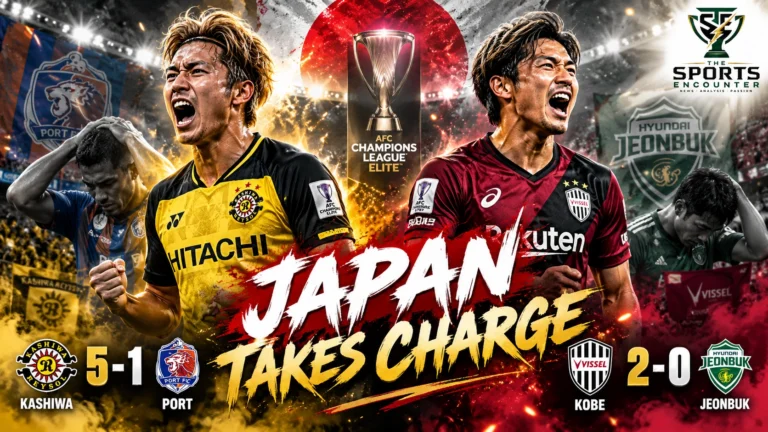
KASHIWA, Japan, October 14, 2026: Kashiwa Reysol needed just 28 minutes to turn a difficult AFC Champions League Elite start into one of the most devastating first-half performances of the season. Five different players scored before the half-hour mark as the Japanese club demolished Thailand’s Port FC 5-1. In Kobe, Yuya Osako and Yuya Kuwasaki delivered a different kind of victory, defeating South Korean champions Jeonbuk Hyundai Motors 2-0 to preserve Vissel Kobe’s perfect continental record.
Wednesday’s two East Region matches completed the second round of fixtures in the AFC Champions League Elite 2026/27 league stage. The results strengthened Japan’s position in the expanded competition, with Vissel Kobe joining Kashima Antlers, Gamba Osaka and Beijing FC on six points from two matches. Kashiwa, meanwhile, recovered from its opening defeat against Jeonbuk to move onto three points and repair its goal difference.
The contrasting performances were striking. Kashiwa scored five goals in the opening 28 minutes against a Port defense that struggled to contain the speed and variety of the home side’s attacks. Kobe needed greater patience against Jeonbuk, surviving an increasingly dangerous second-half response before Kuwasaki finished a counterattack in the 68th minute.
For Port, a second consecutive defeat leaves the Thai club without a point and with a significant defensive problem to address. For Jeonbuk, defeat in Japan erased the advantage gained from beating Kashiwa 2-1 in September and exposed the consequences of failing to convert chances during an encouraging second-half spell.
Story at a glance
AFC Champions League Elite October 14, 2026: Results and Goalscorers
Both matches began at approximately 7 p.m. local time in Japan. They followed Tuesday’s six East Region fixtures, which included victories for Kashima Antlers, Gamba Osaka, Kyoto Sanga and Beijing FC.
Kashiwa Reysol 5-1 Port FC: Five Goals in 28 Minutes Turn Defeat Into a Statement
For Kashiwa Reysol, Wednesday’s match began with urgency.
Why Kashiwa’s First 28 Minutes Were So Destructive
The headline statistic is obvious: five goals in 28 minutes.
Manuel Bihr Scores Port FC’s Only Goal, but the Damage Is Already Done
Port showed greater resistance after halftime.
From Jeonbuk Defeat to Five-Goal Victory: How Kashiwa Recovered
Kashiwa’s opening AFC Champions League Elite match had produced a very different outcome.
Both matches carried implications beyond their immediate results. The 2026/27 competition has expanded to 32 clubs, with 16 competing in each regional league. Only the top eight in the East and West progress to the round of 16, making early victories and goal difference particularly valuable.
The Sports Encounter examines the goals, turning points, leading performers and tactical lessons from both matches, along with their consequences for the increasingly competitive East Region standings.
AFC Champions League Elite October 14, 2026: Results and Goalscorers
| Match | Result | Goalscorers | Venue |
|---|---|---|---|
| Kashiwa Reysol vs. Port FC | 5-1 | Kubo 3′, Kakita 10′, Harakawa 15′ (pen.), Yuruki 26′, Yamauchi 28′; Bihr 64′ | Kashiwa Soccer Stadium, Japan |
| Vissel Kobe vs. Jeonbuk Hyundai Motors | 2-0 | Osako 11′, Kuwasaki 68′ | Misaki Park Stadium, Kobe, Japan |
Both matches began at approximately 7 p.m. local time in Japan. They followed Tuesday’s six East Region fixtures, which included victories for Kashima Antlers, Gamba Osaka, Kyoto Sanga and Beijing FC.
The official AFC report on Kashiwa’s victory over Port FC confirms that five different players scored inside the opening half-hour.
Kashiwa Reysol 5-1 Port FC: Five Goals in 28 Minutes Turn Defeat Into a Statement
For Kashiwa Reysol, Wednesday’s match began with urgency.
Ricardo Rodríguez’s side had lost its opening league-stage fixture 2-1 against Jeonbuk Hyundai Motors in September. Another defeat would have left the club without a point after two matches, creating immediate pressure before the remaining six fixtures.
Port FC arrived facing the same predicament. The Thai side had lost 2-1 at home to Vissel Kobe in its opening match and needed a result to avoid falling behind the East Region’s early leaders.
What followed was a first-half collapse of extraordinary speed.
Kashiwa took the lead in the third minute, doubled its advantage in the tenth, added a penalty five minutes later and scored twice more in the 26th and 28th minutes.
At halftime, the scoreboard read 5-0.
The home side had effectively settled the result before Port could establish a sustained attacking rhythm.
Tojiro Kubo Strikes in the Third Minute
Tojiro Kubo opened the scoring in the third minute following an attacking move involving Kenshin Yuba.
The early breakthrough immediately changed the tactical demands on both teams.
Kashiwa could continue attacking with confidence, knowing that its first sustained spell had already produced a reward.
Port, meanwhile, faced an uncomfortable choice: maintain a compact defensive structure while trailing or commit more players forward and risk creating spaces for the home side to exploit.
The speed of Kashiwa’s subsequent goals suggests that Port struggled to solve that problem.
An early concession does not automatically produce a heavy defeat. Teams regularly recover from falling behind in the first few minutes. Port’s difficulty was that it could not prevent the next wave of attacks from becoming equally dangerous.
Yuki Kakita Doubles the Lead After Ten Minutes
Yuki Kakita made it 2-0 in the tenth minute.
The goal reinforced Kashiwa’s control and placed Port under greater pressure to respond.
Kakita’s contribution mattered because it demonstrated that Kashiwa’s threat was not confined to one player.
The Japanese side could generate chances through different attacking positions, forcing Port’s defenders to make repeated decisions about marking, covering passing lanes and protecting the penalty area.
The second goal also increased the importance of avoiding another immediate mistake.
Instead, Port conceded again within five minutes.
Riki Harakawa Converts the Penalty as Kashiwa Race to 3-0
Riki Harakawa converted a penalty in the 15th minute to extend Kashiwa’s lead to three goals.
His successful spot kick was significant for two reasons.
First, it effectively removed Port’s opportunity to manage the opening half as a close contest.
Second, it demonstrated how pressure inside the penalty area can produce consequences beyond ordinary shots on goal.
When defenders are repeatedly forced to react to advancing attackers, the likelihood of a costly challenge or positional mistake can increase.
That does not establish the precise reason the penalty was awarded without examining the individual incident. It does help explain why a team dominating the attacking territory can generate scoring opportunities through several routes.
After 15 minutes, Kashiwa had scored three times and Port had a considerable deficit to overcome.
Koya Yuruki and Hinata Yamauchi Complete the Five-Goal Blitz
Koya Yuruki scored Kashiwa’s fourth goal in the 26th minute.
Hinata Yamauchi added the fifth just two minutes later, assisted by Nobuteru Nakagawa.
The two goals completed a devastating sequence in which five different Kashiwa players had scored before the match reached the half-hour mark.
That distribution of goals is one of the most important details in the result.
A five-goal first half built around one prolific striker would still be impressive. Kashiwa’s performance was different because the scoring was shared across the attacking unit.
Port had no single scorer whose influence it could isolate to restore control.
The visitors needed to address problems involving several combinations of movement, passing and finishing.
By the 28th minute, the tactical challenge had become enormous.
Why Kashiwa’s First 28 Minutes Were So Destructive
The headline statistic is obvious: five goals in 28 minutes.
But the deeper significance concerns efficiency and the speed with which the advantage became decisive.
The AFC reported that Kashiwa converted each of its first five shots on target during the opening half-hour.
That is an extraordinary finishing sequence.
It means that every accurate attempt in the early spell produced a goal, leaving Port’s defense and goalkeeper no opportunity to recover through successful saves.
Five Shots on Target, Five Goals: What the Numbers Reveal
Finishing efficiency can be influenced by the quality of chances, the positioning of defenders, goalkeeper performance and the execution of the attacking player.
A five-from-five return is a powerful indication that Kashiwa converted its opportunities exceptionally well.
It should not, however, be projected across the rest of the competition.
No club can reasonably expect every shot on target to become a goal throughout an eight-match league stage.
The more sustainable positive is that Kashiwa repeatedly created opportunities for different players in dangerous situations.
Its task now is to reproduce the quality of those attacking movements even when future opponents defend more effectively.
Port’s Defensive Organization Failed Under Pressure
Port’s 4-4-2 setup was unable to contain Kashiwa’s early attacking movement.
The Japanese club lined up in a 3-4-2-1 structure, providing different angles for attacks through the center and wider positions.
Those formations alone do not explain the result. A 4-4-2 can defend effectively against a 3-4-2-1 when its players coordinate their pressing and maintain appropriate distances.
The problem for Port was the combination of early concessions and its inability to slow the match.
Once Kashiwa took the lead, Port needed to regain possession, control the tempo and prevent another rapid breakthrough.
The next four goals showed that it did not achieve those objectives during the decisive opening period.
Why the Early Goals Changed Port’s Attacking Options
At 1-0, Port could still attempt to recover without taking excessive risks.
At 3-0 after 15 minutes, the situation became far more difficult.
The visitors needed goals but also needed to avoid leaving additional space behind their midfield.
That creates a tactical dilemma against opponents comfortable attacking through different channels.
Committing more players forward can increase the opportunities to score while also reducing defensive protection.
Remaining cautious may preserve the score but make a comeback increasingly unlikely.
Kashiwa exploited the period before Port could establish a sustainable response.
Manuel Bihr Scores Port FC’s Only Goal, but the Damage Is Already Done
Port showed greater resistance after halftime.
Defender Manuel Bihr reduced the deficit in the 64th minute, finishing an opportunity created by Chaiyaphon Otton.
The goal prevented Kashiwa from completing a clean sheet, but it did not materially change the outcome.
With the deficit reduced from five goals to four, Port still needed an extraordinary recovery during the remaining 26 minutes.
Kashiwa maintained its advantage and completed the 5-1 victory.
Port Must Separate the Second-Half Response From the First-Half Failure
Port can take some encouragement from finding a goal after a disastrous opening.
But a second-half improvement does not erase the structural problems exposed earlier.
Its most important task is identifying why Kashiwa generated so many decisive chances before the visitors established any control.
The team’s next opponents will examine that performance closely.
Port has conceded seven goals in two league-stage matches and remains without a point.
That places considerable importance on defensive improvement before Matchday 3.
From Jeonbuk Defeat to Five-Goal Victory: How Kashiwa Recovered
Kashiwa’s opening AFC Champions League Elite match had produced a very different outcome.
On September 16, the Japanese club took the lead against Jeonbuk through Kenshin Yuba.
Jeonbuk recovered after halftime, with Tiago Orobó equalizing before Italo scored the winner.
Kashiwa lost 2-1.
TSE’s Matchday 1 report on Jeonbuk, Kashiwa, Vissel Kobe and Port examined those opening fixtures and the contrasting starts made by the four clubs.
Wednesday’s result reverses much of Kashiwa’s early damage.
The club has now scored six goals and conceded three across its two matches.
That produces a positive goal difference of three, an important improvement from the minus-one position after Matchday 1.
Why the Goal Difference Could Be as Valuable as the Three Points
A victory awards three league-stage points, whether the margin is one goal or four.
But the AFC Champions League Elite ranking system also considers goal difference when teams are level on points.
Kashiwa’s 5-1 win improved its goal difference by four goals in a single match.
The club now has a stronger position than other three-point teams with inferior goal differences.
That does not guarantee a place in the round of 16.
It provides a useful advantage if the qualification battle becomes tight after eight matches.
Vissel Kobe 2-0 Jeonbuk: Osako Opens the Door, Kuwasaki Finishes the Job
Misaki Park Stadium, Kobe: While Kashiwa completed its victory through an extraordinary opening spell, Vissel Kobe had to demonstrate another kind of quality.
Michael Skibbe’s team defeated Jeonbuk Hyundai Motors 2-0, extending its perfect league-stage start to two wins.
Yuya Osako scored in the 11th minute, converting a chance created by Katsuya Nagato following a corner.
Kobe then faced sustained pressure as Jeonbuk attempted to equalize.
The second goal arrived in the 68th minute, when Yuya Kuwasaki completed a counterattack involving Yoshinori Muto.
The victory gave Kobe six points from its first two matches.
Jeonbuk remained on three.
Yuya Osako Converts Kobe’s Early Set-Piece Opportunity
Osako’s opening goal came from a move following a corner, with Nagato supplying the decisive ball.
The former Japan international finished from close range to give Kobe control of the scoreboard.
It was an important goal because both clubs had won their opening games and entered the match with an opportunity to move to six points.
An early lead allowed Kobe to approach the remainder of the contest with greater tactical flexibility.
The home side could defend more patiently, select moments to press and exploit opportunities when Jeonbuk committed players forward.
That strategy eventually became crucial.
Jeonbuk’s Second-Half Response Creates Real Danger
Jeonbuk improved after halftime.
Italo became increasingly influential as the South Korean side advanced into dangerous areas.
Bruno Mota and Lee Seung-woo were also involved in chances that threatened to restore parity.
Jeonbuk’s pressure was not merely cosmetic possession.
The visitors created shooting opportunities, forced defensive interventions and struck the woodwork.
That made the second half considerably more competitive than the final 2-0 score might suggest.
Choi Woo-jin Hits the Woodwork as Kobe Survive
Jeonbuk defender Choi Woo-jin struck the woodwork during the second half, coming close to an equalizer.
Bruno Mota also threatened, while Italo’s movement and distribution created additional opportunities.
Those moments explain why Kobe’s second goal was so decisive.
Had Jeonbuk equalized during its strongest period, the match could have developed into a very different contest.
Instead, the visitors failed to convert.
Kobe retained the lead and eventually punished the additional attacking risks.
Yuya Kuwasaki Scores Against the Run of Play
In the 68th minute, Yoshinori Muto helped launch a counterattack that created an opportunity for Kuwasaki.
The midfielder finished to make it 2-0.
The goal arrived during a period when Jeonbuk had been threatening more regularly.
That contrast made it the central turning point of the second half.
Jeonbuk’s attempts to equalize had forced the team to commit players forward.
Kobe identified the opportunity to attack the space that became available.
The result was a second goal that significantly reduced Jeonbuk’s chances of recovery.
Why Kobe Won Despite Jeonbuk Having More Possession and Shots
The statistical picture helps explain the difference between Kashiwa’s overwhelming victory and Kobe’s controlled success.
Against Jeonbuk, Kobe did not dominate every attacking category.
Match data recorded Jeonbuk with 53 percent possession to Kobe’s 47 percent.
The South Korean club also led the shot count 14-13 and produced four shots on target compared with Kobe’s three.
Jeonbuk won six corners to Kobe’s three.
Yet Kobe scored twice and kept a clean sheet.
| Statistic | Vissel Kobe | Jeonbuk |
|---|---|---|
| Goals | 2 | 0 |
| Possession | 47% | 53% |
| Total shots | 13 | 14 |
| Shots on target | 3 | 4 |
| Corners | 3 | 6 |
The figures demonstrate that the final score did not reflect uninterrupted domination.
Jeonbuk produced a competitive attacking performance and had opportunities to change the result.
Kobe was more effective at converting important chances.
Shuichi Gonda’s Clean Sheet Deserves Recognition
Goalkeeper Shuichi Gonda helped protect Kobe’s advantage.
Jeonbuk placed four attempts on target, and the home defense prevented any of them from becoming goals.
The clean sheet was particularly valuable because the visitors had an encouraging second-half spell.
Effective goalkeeping and defensive organization allowed Kobe to withstand that period without conceding.
That provided the foundation for the counterattacking second goal.
Kobe’s Counterattack Exposed Jeonbuk’s Risk
A team trailing 1-0 must eventually accept greater attacking responsibility.
Jeonbuk increased its pressure after halftime, but that approach also created opportunities for Kobe to attack rapidly after regaining possession.
Muto’s involvement in Kuwasaki’s goal illustrated how effectively Kobe could exploit those transitions.
The home side did not need to control possession throughout the match to remain dangerous.
It needed to defend the crucial spaces and make use of the opportunities produced when Jeonbuk advanced.
Why Jeonbuk’s Finishing Was the Decisive Weakness
Jeonbuk created enough opportunities to make the contest competitive.
Its inability to turn those chances into goals meant the pressure did not translate into an improved scoreline.
That is an important distinction.
A team can perform well during long passages and still lose because it fails to finish its best opportunities.
Jeonbuk must identify whether those missed chances reflected shot execution, decision-making or the quality of its final attacking actions.
The available evidence supports concern about finishing on the night. It does not justify declaring a permanent weakness after only two continental matches.
Kobe’s Two Wins Include Victories Over Both Thai and Korean Opposition
Kobe opened its AFC Champions League Elite campaign with a 2-1 victory over Port FC in Thailand.
Ren Komatsu and Yoshinori Muto scored for the Japanese side.
Wednesday’s victory over Jeonbuk has now given Kobe six points from two matches against opponents from different domestic leagues.
The results provide encouraging evidence of adaptability.
Against Port, Kobe had to secure a result away from home.
Against Jeonbuk, it defended its lead through a difficult second-half spell and scored on the counterattack.
The ability to win through different match patterns can become valuable in a continental competition involving varied opponents, travel demands and tactical systems.
What Michael Skibbe’s Team Has Established
Two victories demonstrate that Kobe has made an excellent start.
The team has scored four goals and conceded one, giving it a positive goal difference of three.
It has also beaten the defending K League 1 champions.
Those are meaningful accomplishments.
However, six league-stage fixtures remain.
Kobe must maintain its attacking efficiency and defensive consistency against opponents with different strengths.
An early six-point total improves its position. It does not guarantee qualification.
East Region Standings: Kobe Reach Six Points, Kashiwa Repair Their Position
Wednesday’s results changed the position of all four clubs involved.
Vissel Kobe joined the group of teams with six points.
Kashiwa moved onto three points and improved its goal difference from minus one to plus three.
Jeonbuk remained on three points, but its goal difference fell to minus one.
Port stayed on zero points and has now conceded seven goals in two matches.
| Club | Played | Won | Lost | Goals For | Goals Against | Goal Difference | Points |
|---|---|---|---|---|---|---|---|
| Vissel Kobe | 2 | 2 | 0 | 4 | 1 | +3 | 6 |
| Kashiwa Reysol | 2 | 1 | 1 | 6 | 3 | +3 | 3 |
| Jeonbuk Hyundai Motors | 2 | 1 | 1 | 2 | 3 | -1 | 3 |
| Port FC | 2 | 0 | 2 | 2 | 7 | -5 | 0 |
This is a comparison of the four clubs involved in Wednesday’s matches, not the complete 16-team East Region table.
Japan’s Clubs Continue to Impress
Kashima Antlers and Gamba Osaka also hold six points following victories on Tuesday.
Kashima defeated Cong An Ha Noi 1-0, while Gamba recovered from falling behind to beat Newcastle Jets 3-1.
Beijing FC also reached six points through its victory over Buriram United.
Vissel Kobe therefore joins three other clubs with perfect two-match records.
TSE’s October 13 East Region report details Gamba’s comeback and the other results that helped establish the early standings.
The broader pattern suggests that Japanese clubs have adapted effectively to the expanded league stage.
But the diversity of opponents and remaining fixtures means that early success must still be tested over a longer period.
Why Kashiwa’s Goal Difference Could Become Important
Kashiwa has the same three-point total as several other clubs, including Jeonbuk and Kyoto Sanga.
The difference lies in its goal record.
After scoring five against Port, Kashiwa has a plus-three goal difference.
Jeonbuk has minus one, while Kyoto’s is level.
The AFC’s ranking procedures use goal difference when clubs finish level on points.
That provides Kashiwa with an advantage over the other three-point teams on this criterion.
It remains an early snapshot, but the result demonstrates the importance of winning by a substantial margin rather than simply collecting three points.
How the Expanded AFC Champions League Elite Format Changes Qualification
The 2026/27 edition features 32 teams divided into two regional leagues of 16.
Each club plays eight matches against different opponents from its own region, with four home fixtures and four away fixtures.
The top eight teams in each regional league qualify for the round of 16.
That means only half of the East Region field will advance.
The remaining eight clubs will be eliminated at the conclusion of the league stage.
The J.League’s official explanation of the AFC Champions League Elite format confirms the league structure, points system, ranking procedures and knockout qualification rules.
Why Early Defeats Carry Greater Weight
With eight matches available, a team can recover from an opening defeat.
Kashiwa has demonstrated that possibility.
However, clubs cannot assume that six or seven remaining matches provide unlimited opportunities to correct poor results.
Port has lost both of its opening fixtures.
The Thai club must now collect enough points in its final six matches to challenge teams that have already established strong positions.
That is a difficult but not mathematically impossible task.
Why the East and West Standings Must Remain Separate
The competition has two regional league tables.
Kobe’s six points should therefore be compared with East Region opponents, not used to assign a position in a combined 32-team ranking.
West Region clubs such as Al Hilal, Al Ain and Shabab Al Ahli are involved in their own qualification race.
TSE’s West Region Matchday 2 roundup examines the different results and qualification pressures affecting those teams.
The regional distinction remains important until the competition reaches the later knockout stages.
What Japan’s Success Means for the Wider Asian Club Competition
Wednesday’s two results followed an encouraging Tuesday for Japanese clubs.
Kashima, Gamba and Kyoto Sanga all recorded victories.
Kashiwa and Kobe then added two more wins.
Continue the AFC Champions League Elite Story
 AFC Champions League EliteAzmoun’s Two Early Blows Sink Al-Ittihad Despite 21-Shot Siege in Jeddah
 AFC Champions League EliteWatkins Strikes, Neves Settles the Score: Al Hilal Turn the Tables on Al Sadd in Doha
 AFC Champions League EliteThe Bench Bites Back: Gamba’s Ex-Jet Haunts Newcastle as Japan Sweeps AFC Elite East
The pattern highlights the competitive depth represented by Japan’s participating clubs.
Yet it is important to distinguish the success of those clubs from a claim that Japanese football has already established permanent continental superiority.
The league stage remains young.
Several teams from South Korea, China, Thailand, Malaysia, Australia and Vietnam still have opportunities to change the balance.
The Different Routes to Victory Are Encouraging
Kashiwa’s success was built on attacking efficiency and an extraordinary opening spell.
Kobe relied on a combination of set-piece execution, defensive resilience and counterattacking precision.
Gamba recovered from a deficit against Newcastle.
Kashima secured a narrow victory against Cong An Ha Noi.
Those contrasting performances demonstrate that Japanese clubs are not relying on one identical method.
Adaptability may become particularly valuable when traveling across Asia and facing teams with different physical and tactical profiles.
Why the Opening Round Still Matters
The September results established the first competitive markers.
Kashima began its campaign with an emphatic victory over Newcastle, while Jeonbuk defeated Kashiwa.
TSE documented those outcomes in its opening Matchday 1 analysis.
What has changed since then is the relative position of the clubs.
Kashiwa has recovered, Jeonbuk has suffered its first defeat, and Kobe has maintained a perfect start.
The standings are beginning to reflect which teams can sustain their performances beyond the opening fixture.
How the East Region Story Compares With the West
The East Region’s Matchday 2 developments occurred alongside major results in the West.
Al Hilal defeated Al Sadd 2-0 through goals from Ollie Watkins and Rúben Neves.
Shabab Al Ahli defeated Al Ittihad 2-1, with Sardar Azmoun scoring twice.
Those matches highlighted the importance of defensive organization, attacking transitions and taking advantage of early scoring opportunities.
They also provided a useful contrast with Wednesday’s Japanese victories.
Al Hilal’s Controlled Victory
Al Hilal’s performance in Doha reflected a measured approach to a difficult opponent.
Watkins provided the breakthrough before Neves secured the result.
TSE’s report on Al Hilal’s victory over Al Sadd explains how the Saudi club executed its plan.
The connection with Kobe is tactical rather than statistical.
Both clubs demonstrated that a well-managed advantage can produce a valuable victory without overwhelming the opponent for every minute.
Shabab Al Ahli’s Early Goals Provide Another Parallel
Shabab Al Ahli’s victory against Al Ittihad offers a different comparison.
Azmoun’s two goals gave the Dubai club an advantage it was able to defend despite pressure from its opponent.
TSE’s analysis of Azmoun’s double details the attacking performance and the broader significance of the result.
The parallel with Kashiwa concerns the value of exploiting an opponent before it establishes defensive stability.
However, the matches differed substantially in final margin and how control developed afterward.
The comparison reinforces the broader lesson of Matchday 2: early goals can reshape tactical choices, but teams still need to manage what happens after taking the lead.
AFC Champions League Elite Matchday 3: Fixtures and Challenges Ahead
All four teams involved in Wednesday’s matches return to East Region action on October 27.
The next set of fixtures will help determine whether Kobe can maintain its perfect record and whether Kashiwa can build on its convincing recovery.
| Fixture | Key Question |
|---|---|
| Daejeon Hana Citizen vs. Vissel Kobe | Can Kobe preserve its perfect record in South Korea? |
| Ratchaburi FC vs. Kashiwa Reysol | Can Kashiwa reproduce its attacking efficiency away from home? |
| Beijing FC vs. Jeonbuk Hyundai Motors | Can Jeonbuk recover against another unbeaten opponent? |
| Johor Darul Ta’zim vs. Port FC | Can Port secure its first points against a difficult Malaysian opponent? |
The October 27 schedule is documented in the AFC Champions League Elite official competition hub, alongside match reports and tournament updates.
Vissel Kobe Face Another Korean Challenge
Kobe’s trip to Daejeon will test whether the team’s successful defensive and counterattacking approach remains effective away from home.
The early six-point total creates a strong foundation, but another victory would significantly strengthen its position among the regional leaders.
Kashiwa Must Prove the Port Result Was More Than a One-Off
Kashiwa’s five-goal burst was exceptional.
But the team cannot assume that Ratchaburi will concede at the same rate.
Winning away from home may require greater patience, more measured possession and the ability to create high-quality opportunities without immediately overwhelming the opponent.
The next match should therefore provide a more meaningful test of Kashiwa’s consistency.
Jeonbuk Need Greater Efficiency Against Beijing
Jeonbuk’s next opponent has already reached six points.
After failing to convert its second-half chances against Kobe, the South Korean club faces another match in which wasted opportunities could be costly.
It must retain the positive aspects of its attacking performance while improving its finishing and defensive response to turnovers.
Port Face an Increasingly Urgent Qualification Test
Port’s trip to Johor Darul Ta’zim presents a difficult challenge.
The Thai club has lost both of its opening matches and conceded seven goals.
Another defeat would leave it facing a substantial climb during the remaining league-stage fixtures.
Its immediate priority must be defensive stability, followed by creating enough attacking opportunities to compete for points.
The Sports Encounter Verdict: Kashiwa Won the Headlines, Kobe Strengthened Its Position
Wednesday’s two matches produced very different performances, but both carried substantial value for Japanese football.
Kashiwa delivered the most spectacular result.
Five different players scoring in 28 minutes is a remarkable attacking achievement. The victory transformed the club’s opening two-match record from a disappointing start into three points and a positive goal difference.
The performance was built on exceptional finishing and an opponent unable to withstand the opening pressure.
Kobe’s 2-0 victory was less dramatic but arguably more demanding tactically.
Jeonbuk created chances, applied pressure and came close to equalizing. The home side survived, then scored through Kuwasaki during a counterattack that effectively settled the contest.
The result gave Kobe six points and continued its perfect start.
For Jeonbuk and Port, the matches exposed different problems.
Jeonbuk must improve the conversion of promising attacking positions. Port must urgently address the defensive breakdowns that allowed Kashiwa to decide the game before the half-hour mark.
The expanded competition makes those details important. With eight league-stage matches and only eight qualifying places in each 16-club region, clubs must collect points while protecting their goal difference.
Kashiwa produced the night’s explosion. Kobe delivered the night’s controlled statement. Both results strengthened Japan’s early AFC Champions League Elite campaign, but the road to the knockout stage remains far from settled.
AFC Champions League Elite October 14, 2026: Frequently Asked Questions
Who Won Kashiwa Reysol vs. Port FC?
Kashiwa Reysol defeated Port FC 5-1 on October 14, 2026, in the AFC Champions League Elite East Region league stage.
Who Scored Kashiwa Reysol’s Five Goals?
Tojiro Kubo, Yuki Kakita, Riki Harakawa, Koya Yuruki and Hinata Yamauchi scored for Kashiwa.
How Quickly Did Kashiwa Score Five Goals?
All five goals came during the opening 28 minutes of the match.
Who Scored Port FC’s Goal?
Manuel Bihr scored Port’s goal in the 64th minute.
Who Won Vissel Kobe vs. Jeonbuk Hyundai Motors?
Vissel Kobe defeated Jeonbuk Hyundai Motors 2-0 at Misaki Park Stadium on October 14.
Who Scored for Vissel Kobe Against Jeonbuk?
Yuya Osako scored in the 11th minute, and Yuya Kuwasaki added the second goal in the 68th minute.
How Many Points Does Vissel Kobe Have?
Kobe has six points after winning its opening two East Region league-stage matches.
How Many Points Does Kashiwa Reysol Have?
Kashiwa has three points from two matches, with one win and one defeat.
How Many Teams Qualify for the AFC Champions League Elite Knockout Stage?
Eight clubs from the East Region and eight from the West Region qualify for the round of 16.
When Is Matchday 3 in the East Region?
The next East Region matches are scheduled for October 27, 2026, including Vissel Kobe at Daejeon, Kashiwa at Ratchaburi, Jeonbuk at Beijing and Port FC at Johor Darul Ta’zim.