


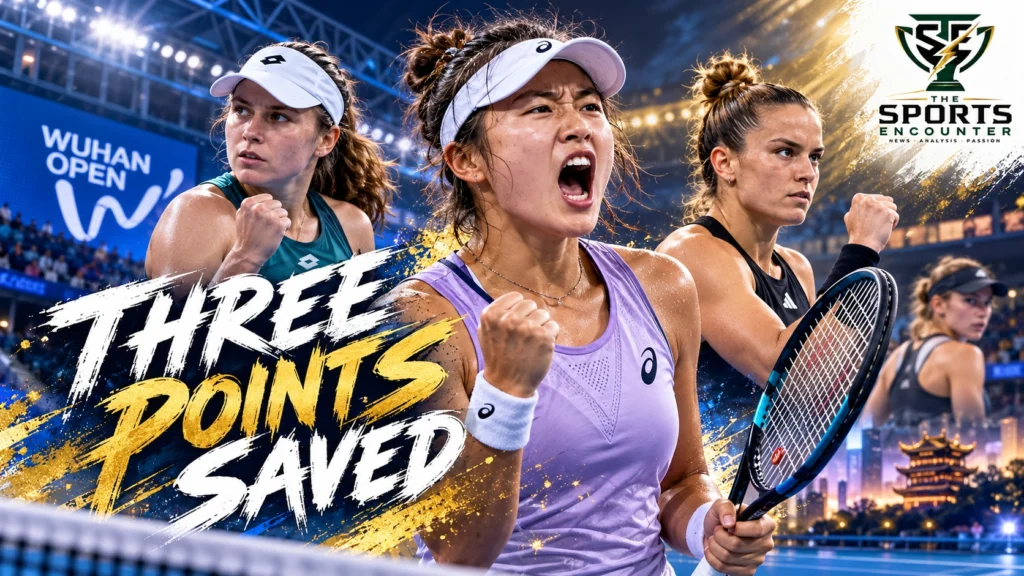
WUHAN, China, October 13, 2026: Guo Hanyu was a set and 0-4 down, faced three match points, and had every reason to believe her Wuhan Open was finished. Instead, the world No. 240 produced one of the most extraordinary escapes of the 2026 WTA season, defeating 12th seed Sorana Cirstea 1-6, 7-6(6), 7-5 on Tuesday. Her victory became the emotional centerpiece of a remarkable day at the final WTA 1000 tournament of the year, where Daria Snigur eliminated Elise Mertens, Maria Sakkari knocked out Marta Kostyuk, and 17-year-old Mia Pohankova reached the third round.
Guo’s achievement carried considerable personal meaning after a difficult period involving her father’s serious illness. Elsewhere, Snigur ended Mertens’ impressive Beijing momentum with a 6-4, 7-5 victory, Sakkari recovered from a set down to dismiss the eighth seed, and Pohankova defeated Wang Xiyu in three sets. Liudmila Samsonova, Yulia Putintseva and Katie Volynets also survived deciding-set battles. With major pre-tournament withdrawals already changing the draw, Tuesday’s results gave Wuhan an increasingly unpredictable identity before top seed Aryna Sabalenka and several other leading contenders begin their campaigns.
Wuhan Open October 13, 2026: Complete Women’s Singles Results
Tuesday’s schedule combined the remaining first-round singles matches with two second-round contests. The completed results included several upsets, multiple three-set matches and one retirement.
| Round | Winner | Defeated | Score |
|---|---|---|---|
| Second | Maria Sakkari | Marta Kostyuk (8) | 4-6, 6-2, 6-2 |
| Second | Mia Pohankova | Wang Xiyu | 7-6(2), 6-7(7), 6-1 |
| First | Guo Hanyu | Sorana Cirstea (12) | 1-6, 7-6(6), 7-5 |
| First | Daria Snigur | Elise Mertens (14) | 6-4, 7-5 |
| First | Liudmila Samsonova | Katerina Siniakova | 6-1, 5-7, 6-2 |
| First | Yulia Putintseva | Zeynep Sonmez | 6-7(1), 6-3, 7-5 |
| First | Katie Volynets | Kimberly Birrell | 6-7(1), 7-6(3), 6-3 |
| First | Nikola Bartunkova | Lilli Tagger | 7-6(4), 2-6, 6-1 |
| First | Dayana Yastremska | Cristina Bucsa | 6-4, 5-7, 6-3 |
| First | Diana Shnaider (11) | Katie Boulter | 6-3, 6-1 |
| First | Jelena Ostapenko | Daria Kasatkina | 6-1, 6-1 |
| First | Maja Chwalinska (16) | Mayar Sherif | 6-3, 6-2 |
| First | Ashlyn Krueger | Zhang Shuai | 6-3, 6-0 |
| First | Ann Li | Camila Osorio | 6-1, 3-0 (retired) |
Matches displayed as canceled in some score listings should not be interpreted as completed defeats. Several reflect draw changes following withdrawals, particularly those involving Zheng Qinwen, Mirra Andreeva and other originally scheduled participants.
The official WTA Wuhan Open draw provides the tournament’s evolving matchups and player progression.
Guo Hanyu Saves Three Match Points and Finds a Victory Bigger Than Her Ranking
Guo Hanyu defeats Sorana Cirstea 1-6, 7-6(6), 7-5
For much of Tuesday’s contest, Guo appeared to be heading toward a predictable first-round exit.
She entered ranked No. 240, facing world No. 16 Sorana Cirstea, an experienced Romanian with a substantial advantage in established tour-level singles results.
Cirstea won the opening set 6-1.
She then moved 4-0 ahead in the second.
At that point, Guo had won only one of the first 11 games.
The scoreboard offered little reason to expect the match to reach a deciding set. Yet Guo began recovering games, extended the contest and survived three match points before winning the second-set tiebreak 8-6.
She completed the comeback by taking the final set 7-5 after two hours and 41 minutes.
From the perspective of a lower-ranked wild card, the achievement was exceptional. Guo had overturned a substantial deficit against an opponent ranked more than 220 places above her.
Why Guo’s Upset Is Historically Significant
According to the WTA, Guo became the lowest-ranked player to defeat a Top 20 opponent at the Wuhan Open since the tournament began in 2014.
The victory also represented her biggest career singles win by opponent ranking.
It was only her second WTA 1000 main-draw singles victory and her first tour-level main-draw singles win since Jiujiang in 2025.
The numerical contrast makes the result striking. Her ability to reverse such a difficult match situation makes it more revealing.
Guo had to recover from the first-set defeat, rebuild her confidence after falling 0-4 behind, and remain composed after reaching the brink of elimination.
The deciding set then required her to turn a remarkable rescue into an actual victory.
That final requirement is often overlooked when discussing great comebacks. Saving match points extends a contest. Winning the subsequent games is what turns survival into a meaningful result.
The Personal Story Behind Guo’s Wuhan Triumph
Guo’s emotional response afterward revealed how much she had been carrying away from the court.
Earlier in 2026, she won the Wimbledon women’s doubles championship alongside Kristina Mladenovic, reaching one of the highest points of her professional career.
But her father subsequently became seriously ill and required intensive care.
Guo publicly discussed how difficult that situation had made her return to tennis. She described struggling to enjoy matches and training while worrying about her family.
Her statements help explain the emotional significance of Tuesday’s victory without implying that personal adversity was responsible for the result.
The match itself was won through a sustained competitive recovery against an established opponent.
The WTA’s official report on Guo’s victory documents the comeback, historical ranking milestone and her own account of the difficult circumstances surrounding her return.
Her next opponent will be American qualifier Katie Volynets, another player who survived an exhausting three-set match Tuesday.
That meeting will test how quickly Guo can recover emotionally and physically after the biggest singles victory of her career.
Snigur Ends Mertens’ Giant-Killing Run Just When Wuhan Seemed Ready for More
Daria Snigur defeats Elise Mertens 6-4, 7-5
Elise Mertens arrived in Wuhan carrying one of the most compelling stories from the China Open.
In Beijing, the Belgian had defeated three Grand Slam singles champions in consecutive rounds: Jelena Ostapenko, Coco Gauff and Iga Swiatek.
Those victories took her to the semifinals, where eventual champion Zheng Qinwen ended her run.
Mertens had developed a particularly effective pattern against elite opposition, using consistent baseline execution and return pressure to force opponents into uncomfortable service games.
Against Daria Snigur, however, the pattern stopped working.
The Ukrainian defeated the 14th seed 6-4, 7-5, ending Mertens’ Wuhan campaign in her opening match.
How Snigur Turned the Spotlight Away From Mertens
Snigur did not need a deciding set to produce the upset.
She claimed the first 6-4 and then protected enough of her advantage to close the second 7-5.
The victory was her fourth over a Top 20 opponent during the 2026 season.
That record is particularly important because it indicates that her success against Mertens belongs to a broader pattern of competitive performances against established players.
The defeat also creates a revealing contrast with Beijing.
Mertens had repeatedly turned the pressure against decorated champions, but she could not reproduce that control in Wuhan against an opponent whose ranking and reputation offered a very different challenge.
TSE documented the peak of Mertens’ Beijing run in our analysis of her victory over Iga Swiatek.
Her earlier elimination of Coco Gauff also featured in TSE’s report on the disappearance of Beijing’s leading seeds.
For Mertens, Wuhan illustrates how little a previous tournament’s momentum guarantees once a fresh draw begins.
For Snigur, it provides another result that strengthens her case as a dangerous opponent when established stars begin their campaigns.
Sakkari Recovers From a Set Down to Remove Eighth Seed Marta Kostyuk
Maria Sakkari defeats Marta Kostyuk 4-6, 6-2, 6-2
Tuesday’s highest-seeded singles casualty was Marta Kostyuk.
The Ukrainian eighth seed won the opening set against Maria Sakkari 6-4 and appeared positioned to build on that advantage.
Sakkari responded with two convincing sets, winning each 6-2 to secure her place in the Round of 16.
The Greek’s recovery was particularly notable because it followed her straight-sets victory over Donna Vekic in the opening round.
She has now defeated two experienced opponents in succession while conceding only four games across the final two sets against Kostyuk.
Why This Is an Important Late-Season Result for Sakkari
Sakkari entered Wuhan outside the group of players already qualified for the WTA Finals.
Her victory over Kostyuk was her third Top 10 win of the 2026 season, adding a useful result during the closing weeks of the tour calendar.
Against Kostyuk, Sakkari won 6-2 in both the second and third sets. That scoring pattern suggests she increasingly controlled the exchanges as the match developed.
The available match data also shows she converted more break opportunities as the contest progressed.
The result is meaningful because Sakkari has previously demonstrated that she can compete at the highest level but has also experienced periods when strong individual performances have not translated into sustained tournament success.
Wuhan gives her another opportunity to build a sequence of victories.
For Kostyuk, the defeat removes an important opportunity to add ranking and race points at the season’s final WTA 1000 event.
The loss does not, by itself, determine her final position in the year-end qualification race. That depends on results across the remaining events and the applicable ranking calculations.
Seventeen-Year-Old Mia Pohankova Refuses to Let Wuhan Become a One-Match Fairytale
Mia Pohankova defeats Wang Xiyu 7-6(2), 6-7(7), 6-1
Mia Pohankova arrived in Wuhan ranked No. 202 and competing on a wild card.
The 17-year-old Slovak had already made an impression Monday by defeating Anna Bondar 6-1, 6-3 for her first WTA 1000 main-draw victory.
On Tuesday, she added another result against China’s Wang Xiyu.
The contest could hardly have been tighter through the opening two sets.
Pohankova won the first-set tiebreak 7-2, but Wang responded by claiming the second in another tiebreak.
That left a deciding set to settle a match in which both players had demonstrated considerable resistance.
Pohankova then accelerated decisively, winning the third set 6-1.
Her victory took her into the third round.
What Makes Pohankova’s Two Wins Important?
Young players often produce a striking result against an established opponent before finding the next match considerably more difficult.
Pohankova has now avoided that immediate reversal.
She followed a comfortable opening victory with a more complicated three-set match, requiring a different response after losing a second-set tiebreak.
The scoreline alone cannot establish every tactical adjustment she made.
It does establish that she finished the third set with a substantial six-games-to-one advantage after two extremely close sets.
Her progress also reflects a wider development in women’s tennis during 2026.
Young competitors have repeatedly challenged highly ranked players rather than waiting several seasons to establish themselves.
One relevant example is Czech prospect Nikola Bartunkova, whose breakthrough at the China Open included a victory over Aryna Sabalenka and a deep tournament run.
That progression was examined in TSE’s report on Bartunkova’s rise through the Beijing draw.
Pohankova’s Shanghai-to-Wuhan-style Asian hard-court opportunity is different in scale and experience, but the underlying competitive question is similar: can a young player continue winning when opponents begin adjusting to her game?
Samsonova Survives Siniakova, Putintseva Edges Sonmez and Volynets Outlasts Birrell
While Guo, Snigur, Sakkari and Pohankova captured the main headlines, Tuesday also produced three demanding matches that revealed the physical and tactical challenges of the early rounds.
Samsonova Holds Off Siniakova’s Second-Set Response
Liudmila Samsonova began against Katerina Siniakova in commanding fashion, winning the opening set 6-1.
Siniakova recovered to take the second 7-5, forcing a decider after appearing likely to suffer a routine defeat.
Samsonova regained control and won the final set 6-2.
The victory gave Samsonova a 3-2 advantage in their career head-to-head series.
Her next challenge will be fifth seed Elina Svitolina, whose ability to absorb powerful baseline shots promises a different test from Siniakova’s variety.
Samsonova’s season provides useful context. Her results have improved during the later hard-court events, including a fourth-round appearance in Toronto and a semifinal in Guadalajara.
The WTA reported that Samsonova believes a relatively light earlier-season workload has left her with more energy for the closing tournaments.
Putintseva Beats Sonmez in Another Three-Set Examination
Yulia Putintseva recovered from a set down to defeat Turkish qualifier Zeynep Sonmez 6-7(1), 6-3, 7-5.
The match lasted two hours and 51 minutes, making it one of Tuesday’s longest contests.
Sonmez won the opening tiebreak comfortably, but Putintseva gradually changed the result by taking the second set and holding her nerve in the deciding set.
For the Kazakh player, the outcome adds another demanding win to a career defined partly by her ability to extend rallies and frustrate attacking opponents.
For Sonmez, the defeat ended her main-draw campaign after she had successfully negotiated qualifying.
Volynets Wins a Three-Hour Battle Against Birrell
Katie Volynets produced another comeback, beating Kimberly Birrell 6-7(1), 7-6(3), 6-3.
The American qualifier needed three hours and six minutes to overcome the Australian.
Both players won a tiebreak before Volynets established the decisive advantage in the third set.
The result sends her into a second-round meeting with Guo Hanyu.
That matchup brings together two players who spent more than two and a half hours competing on Tuesday and both had to recover from losing the opening set.
Their next contest will therefore examine recovery and execution under another short turnaround, although no specific physical impairment should be assumed without evidence.
Ostapenko, Shnaider and Chwalinska Produce the Cleanest Victories
Not every Tuesday match required a dramatic escape.
Jelena Ostapenko defeated Daria Kasatkina 6-1, 6-1 in one of the day’s most one-sided results.
Diana Shnaider dismissed Katie Boulter 6-3, 6-1, extending her perfect head-to-head record against the British player.
Sixteenth seed Maja Chwalinska also advanced comfortably, defeating Mayar Sherif 6-3, 6-2.
Ashlyn Krueger joined the straight-sets winners by beating China’s Zhang Shuai 6-3, 6-0.
All four performances limited their opponents to four games or fewer across two sets, apart from Chwalinska, who conceded five.
That matters during a compressed tournament schedule.
Players who can finish an opening match efficiently avoid the additional physical demands created by deciding sets and lengthy tiebreaks.
There is no guarantee that shorter matches produce better results in later rounds, but reduced time on court can offer a practical advantage when recovery periods are limited.
Bartunkova and Yastremska Survive, While Osorio Retires Against Ann Li
Nikola Bartunkova continued her strong Asian hard-court stretch by defeating Austrian teenager Lilli Tagger 7-6(4), 2-6, 6-1.
The result required the Czech player to recover after losing control of the second set.
Bartunkova had entered Wuhan following a memorable China Open campaign that included the elimination of Sabalenka and a place in the semifinals.
TSE examined that major upset in our report on Sabalenka’s Beijing defeat and Rybakina’s injury concerns.
Dayana Yastremska also needed three sets, beating Cristina Bucsa 6-4, 5-7, 6-3.
Ann Li advanced when Camila Osorio retired with the American leading 6-1, 3-0.
The recorded retirement is a confirmed match outcome. The score alone does not establish the reason Osorio stopped, and no diagnosis or recovery timetable should be inferred from it.
The different results illustrate the variety of challenges players face in a WTA 1000 opening round: some must solve three-set matches, some establish immediate control, and others advance through a retirement rather than completing two sets.
Why Are So Many Major Names Missing From the Wuhan Open?
The Wuhan Open was initially expected to feature a particularly deep field, including the world’s leading women and the defending champion.
But injuries, fatigue and scheduling decisions changed that expectation before the first round began.
World No. 1 Elena Rybakina withdrew while managing a foot-related physical concern.
Defending champion Coco Gauff withdrew following a demanding China Open campaign, explaining that her body needed recovery time.
Linda Noskova, the Wimbledon champion, withdrew with a left calf injury.
Amanda Anisimova, Naomi Osaka and several other established players also withdrew before their scheduled participation.
The most significant late changes involved Beijing finalists Zheng Qinwen and Mirra Andreeva.
Why Did Zheng Qinwen and Mirra Andreeva Withdraw?
Zheng became the first Chinese player to win the China Open women’s singles title on October 11, defeating Andreeva 7-5, 6-4.
She then withdrew from Wuhan, citing a right shoulder problem and the fatigue accumulated during her recent return to competition.
Andreeva withdrew because of a schedule change following her run to the Beijing final.
The decisions were announced before the affected Wuhan matches were played.
Accordingly, score services may display canceled fixtures involving those players. Such entries must not be mistaken for actual losses.
The WTA’s official explanation of the Zheng and Andreeva withdrawals confirms the different reasons for their absence and the changes to the draw.
How the Withdrawals Changed Wuhan’s Competitive Picture
The late withdrawals have given replacements and lower-ranked players opportunities they might not otherwise have received.
Camila Osorio entered as a lucky loser in Zheng’s original position.
Iva Jovic received a second-round bye following adjustments caused by Andreeva’s withdrawal.
Other places in the draw were also reshuffled as seeded and unseeded withdrawals were processed.
The context is particularly relevant for a tournament that TSE originally previewed as a gathering of the entire WTA Top 10.
Our September 18 Wuhan Open field analysis captured the original strength of the entries before the subsequent withdrawals changed the lineup.
The official updated field is now substantially different from those original expectations.
That distinction also explains why fans should rely on the latest tournament draw rather than older entry lists when checking upcoming matches.
Sabalenka and Swiatek Remain, but the Road to the Wuhan Title Has Changed
With Rybakina absent, Aryna Sabalenka enters the tournament as the top seed.
She has already won the Wuhan Open three times and remains the most accomplished active former champion in the 2026 field.
But her recent form has been uneven.
She suffered a third-round defeat against Nikola Bartunkova at the China Open, extending a title drought that has become an important part of her late-season story.
Iga Swiatek, seeded seventh, also has a reason to treat Wuhan seriously.
She was eliminated by Mertens in Beijing and remains involved in the contest for qualification to the season-ending WTA Finals.
Wuhan is the final WTA 1000 tournament of the year, which makes its available ranking points particularly valuable to players who have not yet secured their Finals places.
The tournament’s reduced field of high-ranked participants also changes the potential routes to the final.
Sabalenka and Swiatek occupy the same quarter of the draw and could meet in the quarterfinals if both advance.
That prospect is significant because they have not met in a completed tour match during the 2026 season.
Meanwhile, Jessica Pegula returns as last year’s Wuhan finalist, while Elina Svitolina, Karolina Muchova and other established contenders remain in the draw.
The absence of several leading rivals creates opportunity. It does not remove the challenge posed by players such as Guo, Snigur, Sakkari, Pohankova and Bartunkova, whose results have already disrupted expectations.
The changing relationship between Rybakina and Sabalenka was also explored in TSE’s analysis of Rybakina’s US Open victory and rise to world No. 1.
What Do Tuesday’s Results Tell Us About the Emerging WTA Generation?
One of Wuhan’s most useful lessons concerns the growing competitiveness of younger players and lower-ranked entrants.
Pohankova, 17, has won two matches and reached the third round.
Bartunkova, 20, has extended her impressive sequence from Beijing.
Snigur, 24, has registered another victory against Top 20 opposition.
Guo, while more experienced, entered ranked No. 240 and produced a comeback against a player ranked inside the world’s leading 20.
These achievements do not establish that a permanent generational shift has already occurred.
They do provide evidence that the gap between rankings and actual performance can narrow considerably in individual matches, especially when confidence, matchup characteristics and tournament circumstances change.
Wuhan’s young challengers are also arriving at a moment when several higher-ranked competitors are managing unusually demanding schedules or recent injuries.
That creates more opportunities, but each player still has to win the matches presented by the draw.
Alexandra Eala’s progress earlier in 2026 offers another useful example of a young player developing from breakthrough results into a wider international profile.
TSE traced that progression in our feature on Eala’s meeting with Maria Sharapova and her rise through the WTA Tour.
Eala’s own Wuhan campaign ended on October 12 when Chinese qualifier Shi Han defeated her in three sets.
That earlier result reinforces how unpredictable the opening rounds have become for players at very different stages of their careers.
Wuhan Open October 14: The Matches That Could Reshape the Third Round
The tournament continues Wednesday, October 14, with second-round matches involving leading seeds and Tuesday’s successful first-round players.
| Match | Why It Matters |
|---|---|
| Iga Swiatek vs. Magdalena Frech | Swiatek begins a crucial week in her WTA Finals qualification campaign. |
| Jessica Pegula vs. Jelena Ostapenko | The 2025 finalist faces an aggressive former Grand Slam champion. |
| Elina Svitolina vs. Liudmila Samsonova | Samsonova brings momentum from her three-set victory over Siniakova. |
| Jasmine Paolini vs. Nikola Bartunkova | Bartunkova seeks another notable win following her Beijing breakthrough. |
| Guo Hanyu vs. Katie Volynets | Both players must recover after lengthy Tuesday matches. |
| Diana Shnaider vs. Yulia Putintseva | Contrasting styles meet after very different first-round performances. |
| Karolina Muchova vs. Caty McNally | Muchova begins her campaign against an American qualifier. |
| Iva Jovic vs. Dayana Yastremska | Jovic returns with a revised draw position following Andreeva’s withdrawal. |
Scheduled matches remain subject to late withdrawals, revised orders of play and player availability.
The dates ahead are clear: the third round is scheduled for October 15, quarterfinals for October 16, semifinals for October 17 and the championship match for October 18.
Wuhan Open October 13, 2026: Frequently Asked Questions
Who produced the biggest upset at the Wuhan Open on October 13?
Guo Hanyu, ranked No. 240, defeated No. 12 seed Sorana Cirstea 1-6, 7-6(6), 7-5 after saving three match points.
How many match points did Guo Hanyu save?
Guo saved three match points before completing her three-set comeback against Cirstea.
Who defeated Elise Mertens in Wuhan?
Ukrainian player Daria Snigur defeated the 14th seed 6-4, 7-5 in the first round.
What happened between Maria Sakkari and Marta Kostyuk?
Sakkari recovered from losing the first set to defeat eighth seed Kostyuk 4-6, 6-2, 6-2, advancing to the Round of 16.
How old is Mia Pohankova?
Pohankova is 17 years old. The Slovak wild card reached the Wuhan Open third round after beating Anna Bondar and Wang Xiyu.
Did Zheng Qinwen lose at the Wuhan Open?
No. Zheng withdrew before competing, citing a right shoulder issue and fatigue following her China Open title victory.
Why did Mirra Andreeva withdraw from Wuhan?
Andreeva withdrew because of a scheduling change after reaching the China Open final in Beijing.
Who is the top seed at the 2026 Wuhan Open?
Aryna Sabalenka is the No. 1 seed following the withdrawal of world No. 1 Elena Rybakina.
Who does Guo Hanyu play next?
Guo is scheduled to face American qualifier Katie Volynets in the second round.
When is the Wuhan Open 2026 final?
The women’s singles final is scheduled for Sunday, October 18, 2026, at the Optics Valley International Tennis Centre in Wuhan.
The Sports Encounter Verdict: Three Match Points Could Not Stop Guo, and Wuhan’s Big Names Have Been Warned
Guo Hanyu entered Tuesday’s match with very little in the rankings to suggest she could beat Sorana Cirstea.
After losing the opening set and falling 0-4 behind in the second, the scoreboard was equally discouraging.
She still found a route back.
Three saved match points and a deciding-set victory later, Guo had produced the day’s defining performance.
Snigur then removed one of Beijing’s most successful competitors, Sakkari defeated a Top 10 opponent, and Pohankova carried her breakthrough into another round.
For the established stars, the message is increasingly clear.
Rankings, recent victories and previous tournament achievements provide context, but they cannot replace execution against the opponent standing across the net.
Sabalenka and Swiatek remain major contenders, and Pegula has a successful Wuhan history. Their experience will matter as the tournament progresses.
Yet Tuesday demonstrated that the path toward the October 18 final is already more complicated than the original draw suggested.
Guo may not win the tournament. Snigur, Sakkari and Pohankova may still encounter opponents they cannot overcome.
Their October 13 victories nevertheless deserve recognition on their own terms.
Wuhan has produced its first extraordinary comeback, several important upsets and a new generation of challengers demanding attention.
The trophy remains six days away. The tournament’s identity is already changing.