


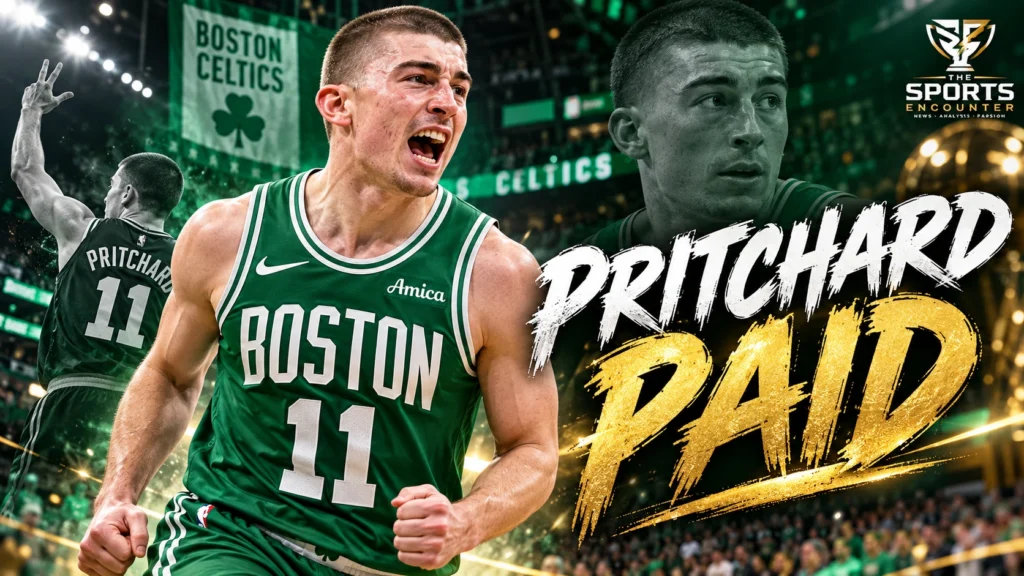
BOSTON, United States, October 14, 2026: Payton Pritchard entered the NBA as the 26th pick of the 2020 Draft, spent years proving he deserved a permanent place in Boston’s rotation, won a championship ring and eventually became the league’s best sixth man. Now the Celtics are reportedly rewarding that steady climb with a two-year, $44.2 million contract extension that could keep him in Boston through 2030. The agreement arrives at a decisive moment for a franchise attempting to remain a championship contender after trading Jaylen Brown and reshaping its supporting cast around Jayson Tatum, Derrick White and Paul George.
ESPN’s Shams Charania reported Tuesday, October 13, that Pritchard and the Celtics had agreed to the extension, with the details provided by his representatives, CAA Co-Head of Basketball Austin Brown and agent Max Saidman. The agreement includes a mutual option for the 2029-30 season and follows Pritchard’s career-best 2025-26 campaign, when he averaged 17.0 points, 5.2 assists and 3.9 rebounds while starting 50 of 79 regular-season games. However, the headline figure does not mean Boston will immediately pay him $22 million per season. Pritchard has two years remaining on his existing agreement, and the new extension is scheduled to begin in 2028-29.
The timing reveals something important about Boston’s approach to rebuilding its roster. The Celtics are not waiting for Pritchard to become an unrestricted free agent before deciding how much he matters. They have identified him as a player worth retaining through the next phase of the franchise’s championship ambitions. But the contract also raises a substantial basketball question: how much responsibility can Pritchard handle as Boston asks more from a guard whose career was initially defined by his contributions off the bench?
Payton Pritchard’s $44.2 Million Celtics Extension: Contract Details
Pritchard’s reported agreement adds two seasons beyond his existing contract, which runs through 2027-28.
The new extension is worth approximately $44.2 million in its reported headline value, including a mutual option for the 2029-30 season.
| Contract Detail | Reported Terms |
|---|---|
| Player | Payton Pritchard |
| Team | Boston Celtics |
| Current contract expires | After 2027-28 |
| New extension begins | 2028-29 |
| Extension length | Two seasons |
| Reported headline value | $44.2 million |
| Reported average annual value | Approximately $22.1 million |
| 2029-30 provision | Mutual option |
| Initial reporting | ESPN’s Shams Charania |
| Official contract registration | Final documentation not independently confirmed |
The agreement was first reported by ESPN and subsequently detailed by Yahoo Sports in its October 13 report on Pritchard’s extension.
How Much Will Pritchard Earn Each Season?
The most important financial detail is that the extension does not replace the two remaining seasons of Pritchard’s current contract.
He is scheduled to earn approximately $7.77 million in 2026-27 and $8.30 million in 2027-28.
The substantial raise begins with the 2028-29 season.
| Season | Salary | Contract Status |
|---|---|---|
| 2026-27 | $7,767,857 | Existing contract |
| 2027-28 | $8,303,571 | Existing contract |
| 2028-29 | Approximately $21.2 million | New extension |
| 2029-30 | Approximately $22.9 million | Reported mutual option |
The two extension-season salary figures have been reported in rounded form. The headline $44.2 million figure should therefore be treated as the reported agreement value, rather than a sum reconciled from the rounded annual numbers.
The NBC Sports Boston contract breakdown provides the existing salaries and the reported new-season figures, citing ESPN salary-cap analyst Bobby Marks.
This distinction is important for understanding Boston’s immediate financial position.
The Celtics do not suddenly add a $22 million Pritchard salary to their 2026-27 payroll.
Instead, they secure a future contractual commitment while continuing to benefit from his current, comparatively inexpensive agreement.
What Does the Mutual Option Mean?
The reported 2029-30 mutual option makes the final season different from a conventional fully guaranteed year without an option.
Public reports have not described the option’s exercise mechanism consistently.
Some accounts suggest either side can exercise the provision, while others describe it as requiring mutual agreement.
The exact contractual language has not been independently established in the public documents reviewed for this article.
Consequently, it would be premature to describe the entire $44.2 million as an unconditional two-year guarantee or to claim either side can terminate the agreement without restriction.
The verified central point is that the deal contains a reported mutual-option provision for 2029-30, giving that season a different contractual status from the first extension year.
Why Boston Extended Pritchard Before the October 19 Deadline
The Celtics faced an important decision heading into the final days before the 2026-27 regular season.
Pritchard became eligible for an extension on October 1, with the relevant negotiation window closing October 19.
Boston could have allowed him to enter the new season without another agreement.
That would not have made him an immediate free agent because his existing contract already covered the next two seasons.
But postponing negotiations would have created a different risk.
Another strong season could increase his leverage, particularly if his responsibilities expanded following the departure of Brown.
Pritchard’s value had already increased significantly over the previous two seasons.
By agreeing to terms before the deadline, Boston appears to have chosen greater long-term certainty over the possibility of waiting for another assessment of his market value.
Boston Had Room to Wait, but Waiting Carried a Cost
Reports before the agreement suggested Pritchard could have pursued a longer extension, potentially worth around $69 million over three seasons.
His reported two-year agreement provides a different structure, with a shorter commitment and an option in the second extension year.
The difference creates a useful way to understand the negotiation.
Boston secures a player it considers valuable without necessarily committing to the longest available extension term.
Pritchard receives substantial future compensation after years of outperforming his earlier contract.
Neither outcome guarantees the deal will eventually look inexpensive or expensive.
That will depend on his performance, health, role and the NBA salary environment when the extension begins.
From Sixth Man to 50 Starts: The Numbers Behind Pritchard’s Raise
Pritchard’s progression provides the strongest sporting explanation for Boston’s commitment.
In 2024-25, he averaged 14.3 points, 3.8 rebounds and 3.5 assists while playing 28.4 minutes per game.
He appeared in 80 regular-season games and started just three.
That performance earned him the 2025 Kia NBA Sixth Man of the Year Award.
One season later, the statistical profile looked substantially different.
| Statistic | 2024-25 | 2025-26 | Change |
|---|---|---|---|
| Games Played | 80 | 79 | -1 |
| Games Started | 3 | 50 | +47 |
| Minutes Per Game | 28.4 | 32.4 | +4.0 |
| Points Per Game | 14.3 | 17.0 | +2.7 |
| Rebounds Per Game | 3.8 | 3.9 | +0.1 |
| Assists Per Game | 3.5 | 5.2 | +1.7 |
| Three-Point Percentage | 40.7% | 37.7% | -3.0 percentage points |
Pritchard’s scoring average increased by approximately 18.9%.
His assists rose by approximately 48.6%, a much larger proportional improvement.
Those increases came with additional playing time and a substantially different role.
He started 50 games in 2025-26 compared with three the previous season, indicating that Boston had already begun trusting him with greater responsibility.
The change in assists is particularly revealing.
Pritchard was not merely scoring more because he played additional minutes.
He was also becoming more involved in creating opportunities for teammates.
His Three-Point Accuracy Fell, but His Offensive Responsibility Grew
Not every statistical change represents straightforward improvement.
Pritchard’s three-point percentage fell from 40.7% in his Sixth Man of the Year season to 37.7% in 2025-26.
He attempted approximately 7.1 three-pointers per game in the latter season.
That greater offensive workload provides context for the decline, although shot volume alone does not establish the reason his accuracy changed.
Defensive attention, shot difficulty, off-the-dribble attempts and lineup combinations can all affect shooting efficiency.
What matters is that Pritchard maintained a substantial scoring contribution while accepting a larger role.
His career three-point percentage of approximately 39.4% also provides evidence that outside shooting remains one of his established strengths.
Why Pritchard’s 2025 Sixth Man Award Still Matters
Pritchard’s 2024-25 award remains an important milestone in explaining his market value.
He became the fourth Celtics player to win the NBA Sixth Man of the Year Award, joining Kevin McHale, Bill Walton and Malcolm Brogdon.
He also made 246 three-pointers while coming off the bench, establishing an NBA single-season record for reserve players.
Including his appearances as a starter, he finished with 255 three-pointers that season.
Those were not simply numbers generated through occasional scoring bursts.
They reflected sustained production over an 80-game regular season.
The NBA’s official Sixth Man of the Year announcement documents his achievement and historic three-point production.
What Changed After Winning Sixth Man of the Year?
The award confirmed that Pritchard was among the league’s most productive reserve players.
His next season tested whether he could contribute in a different capacity.
Starting more often meant handling responsibilities that do not always fall on a conventional bench scorer.
He had to organize possessions with different lineup combinations, create opportunities alongside established stars and remain effective during longer stretches on the floor.
The increase from 3.5 to 5.2 assists per game suggests he adapted well to greater playmaking demands.
But becoming a dependable long-term starting guard requires more than one season of increased production.
Defensive reliability, postseason matchups and consistency against elite opponents remain important tests.
Jaylen Brown’s Exit Changes the Value of Every Celtics Guard
The Pritchard extension cannot be separated from Boston’s larger offseason restructuring.
Jaylen Brown left the Celtics for Philadelphia in a transaction that brought Paul George and draft compensation to Boston.
The trade changed the distribution of offensive responsibility around Jayson Tatum.
Brown had provided powerful wing scoring, athleticism, physical defense and the ability to attack difficult matchups.
George brings a different combination of shooting, size, defensive experience and playmaking.
But replacing Brown is not simply a matter of substituting one high-profile player for another.
Boston must redistribute touches, shot creation and closing-game responsibilities across its rotation.
That is where Pritchard becomes especially important.
More Creation Will Be Needed Around Tatum, White and George
Derrick White remains an established option at guard.
Tatum is central to the Celtics’ offensive structure.
George provides experienced scoring and wing play.
Pritchard gives coach Joe Mazzulla another ball-handler capable of initiating offense and attacking defensive weaknesses.
The question is how those players’ roles will fit together.
When Boston uses Pritchard alongside White, the team gains two guards who can shoot, pass and create opportunities without necessarily dominating every possession.
When Pritchard leads a second-unit combination, he can receive greater freedom to attack and organize the offense.
His ultimate playing time may depend less on whether he is announced as a starter and more on which combinations Mazzulla trusts when games become close.
Philadelphia’s New Roster Makes Boston’s Decision More Significant
Brown’s departure also strengthened a direct Eastern Conference rival.
Philadelphia now possesses a highly ambitious projected lineup featuring Tyrese Maxey, VJ Edgecombe, Brown, LeBron James and Joel Embiid.
The Sports Encounter explored its strengths and unresolved questions in our analysis of whether the 76ers have assembled the NBA’s best starting five.
Philadelphia’s greater concentration of star talent increases the pressure on Boston to maintain depth and tactical flexibility.
Pritchard’s agreement forms part of that response.
The Celtics are retaining a guard who already understands their system rather than allowing uncertainty over his future to become another problem during a major roster transition.
Boston Is Building Around More Than Superstar Contracts
Pritchard’s extension is part of a broader pattern in Boston’s team-building strategy.
The Celtics have also made smaller commitments designed to preserve useful contributors.
In July, Boston reportedly agreed to an extension with Jordan Walsh after his defensive development and improved shooting made him a more reliable rotation option.
That decision was examined in TSE’s detailed report on Walsh earning a new Celtics contract.
The Walsh agreement was substantially less expensive than Pritchard’s reported deal.
But both illustrate the importance of deciding which players deserve long-term commitments before they approach unrestricted free agency.
Ron Harper Jr. Represents Another Layer of Boston’s Strategy
Boston has also invested in lower-cost depth.
Its reported three-year agreement with Ron Harper Jr. reflected an effort to retain useful guard and wing options without committing major salary resources.
TSE examined that approach in our analysis of the Celtics’ Ron Harper Jr. contract and the wider NBA depth market.
The differences between those agreements are important.
Harper is being evaluated primarily as a relatively inexpensive supporting option.
Walsh is being retained for defensive development and rotation value.
Pritchard has progressed beyond that stage and is receiving compensation consistent with a much more prominent role.
Boston is attempting to build different layers of roster value around its established stars.
Why Pritchard’s Future Salary Matters Under the NBA Salary Cap
The NBA’s 2026-27 salary cap is $164.961 million.
Pritchard’s existing $7.77 million salary represents approximately 4.7% of that figure.
His new extension will begin in 2028-29, when the salary cap and luxury-tax thresholds will differ from their current levels.
It would therefore be misleading to use the 2026-27 cap to calculate his precise future percentage of team salary.
Boston’s actual financial position in 2028-29 will depend on the applicable cap, other player contracts, roster decisions and the league’s tax and apron rules.
The important near-term benefit is that the extension does not replace his existing 2026-27 and 2027-28 salaries.
The important longer-term risk is that Boston will be committing much more money to a player whose role and performance must justify the raise.
Is $44.2 Million Good Value for Payton Pritchard?
The answer depends on which version of Pritchard Boston expects to receive when the extension begins.
If he continues performing as a reliable scorer and secondary playmaker, an annual salary in the low-$20 million range could prove manageable relative to a future rising salary cap.
If his production declines or playoff opponents repeatedly exploit defensive matchups, the financial commitment becomes less attractive.
His profile makes that assessment particularly interesting.
At 6 feet 1 inch, Pritchard does not offer the size of many high-level two-way guards and wings.
However, his shooting range, ball-handling, pace and ability to create offense provide clear value.
The Celtics need to determine how much those strengths can contribute during high-pressure postseason possessions.
The Playoff Test Is More Important Than the Starting Label
Pritchard started 50 games last season, but that does not guarantee he will begin every contest in Boston’s starting five this season.
Different matchups may require additional size, perimeter defense or rebounding.
Mazzulla can use Pritchard alongside Tatum and White, or deploy him as an important offensive option when the first unit rests.
The ability to contribute in both arrangements strengthens his value.
But postseason basketball creates more demanding tests.
Opponents repeatedly target defensive weaknesses, and rotations shorten as teams prioritize their most trusted combinations.
Pritchard’s next challenge is to remain productive and defensively viable when an opposing coach builds a game plan specifically around limiting him.
Boston Is Betting on Development That Has Already Happened
The extension is more defensible because Pritchard’s improvement is not based exclusively on projected potential.
He has already contributed to an NBA championship.
He has already won a major individual award.
He has already completed a season with 50 starts and career highs in scoring and assists.
Those achievements do not guarantee further improvement.
They provide evidence that he has successfully adapted to expanding responsibilities.
That is different from paying a young player primarily for what management hopes he may eventually become.
From Oregon Star to Celtics Champion: Pritchard’s Unusual Development Path
Pritchard’s career began long before Boston selected him in 2020.
At the University of Oregon, he developed into one of the most accomplished guards in the school’s history.
He became Oregon’s first consensus first-team All-American in 80 years and won the Bob Cousy Award in 2020.
Those achievements reflected his combination of scoring, playmaking and competitive consistency.
His development took place under coach Dana Altman, whose long Oregon tenure helped prepare several players for NBA careers.
That record was examined in TSE’s report on Altman’s retirement and his lasting player-development legacy.
Pritchard’s NBA career has followed a similar pattern of gradual advancement.
He did not immediately become a star after arriving in Boston.
Instead, he accepted supporting responsibilities, improved his shooting and earned increasing trust.
His 43-Point Explosion Showed the Scoring Ceiling
One of Pritchard’s most memorable individual performances came on March 5, 2025.
He scored 43 points and made 10 three-pointers, demonstrating the explosive scoring ability that had become an increasingly important part of his role.
The performance provided evidence that he could do considerably more than maintain an offense while the starters rested.
His first NBA triple-double had come earlier, on April 9, 2023, against Atlanta, when he recorded 30 points, 14 rebounds and 11 assists.
Those performances helped establish his reputation as a guard capable of unusually productive nights when given sufficient opportunity.
The more significant achievement, however, has been converting that ability into consistent season-long production.
How Does the Pritchard Extension Affect Boston’s Championship Plans?
The Celtics remain part of a highly competitive Eastern Conference.
Philadelphia has assembled an ambitious roster around Embiid, Maxey, Brown and LeBron.
New York enters the season as the defending NBA champion.
Other contenders have also made significant changes.
The broader reshuffling was examined in TSE’s assessment of the major offseason moves influencing the 2027 championship race.
Boston’s answer has involved protecting continuity around Tatum while adding new personnel and keeping selected existing contributors.
Pritchard is now clearly among the players the organization considers important to that strategy.
Boston Remains a Contender Despite Its Roster Changes
The early championship market continued to respect the Celtics following the conclusion of the 2026 NBA Finals.
Boston opened at approximately +550 in the early 2026-27 title odds reported in June, behind San Antonio and Oklahoma City but ahead of defending champion New York.
Those historical opening odds were examined in TSE’s analysis of why the defending Knicks initially ranked fourth in championship betting.
Those prices are not current predictions and should not be treated as unchanged after subsequent roster decisions.
They do demonstrate that Boston remained part of the early championship discussion despite an unsettled offseason.
Pritchard’s extension does not determine whether the Celtics will win another title.
It does provide continuity at a position where the organization expects experienced decision-making and perimeter scoring.
Could Pritchard Eventually Replace Derrick White as Boston’s Starting Point Guard?
That possibility cannot be ruled out over the life of the new agreement, but it should not be treated as a confirmed organizational plan.
White remains an established two-way guard with substantial experience in Boston’s system.
Pritchard offers greater offensive flexibility than his original reserve role suggested, particularly through shooting and creation.
But the two players contribute different strengths.
Boston may prefer to use them together in some lineups and separately in others.
The decision will depend on performance, opponent matchups, health and the development of the Celtics’ other perimeter players.
For now, Pritchard’s extension should be understood as a commitment to his importance within the rotation, not evidence that Boston has promised him a particular starting position.
Why the 2026-27 Season Will Test Boston’s Investment Thesis
Pritchard’s new money does not begin until 2028-29, but the coming season will still provide valuable evidence about the decision.
With Brown gone, Boston needs to establish how its new offensive combinations function.
The coaching staff must determine where Pritchard contributes most effectively alongside Tatum, White and George.
His workload, playmaking responsibilities and defensive assignments will provide useful indicators.
Those observations can help establish whether he is developing into a more complete long-term contributor or remains most valuable as an offensive specialist.
Boston Opens the Regular Season Against Detroit on October 20
The Celtics are scheduled to begin their 2026-27 regular season on October 20 against the Detroit Pistons.
The league’s schedule has also positioned Brown’s return to Boston with Philadelphia for January 21, 2027, giving the season another major storyline.
Those fixtures were identified in TSE’s comprehensive analysis of the 2026-27 NBA schedule.
The Detroit opener will provide an early look at Boston’s rotation, but it will take a longer sample to judge the team’s new offensive identity.
For Pritchard, the priority will be adapting to whatever combination of starting and reserve responsibilities Mazzulla assigns.
The extension provides greater contractual certainty.
His role on the court must still be earned and maintained.
What Are the Risks in Boston’s $44.2 Million Commitment?
| Factor | Potential Benefit | Risk or Uncertainty |
|---|---|---|
| Proven Production | 17.0 points and 5.2 assists per game in 2025-26 | Whether output remains strong with changing lineups |
| Three-Point Shooting | 39.4% career three-point accuracy | Shot difficulty and defensive attention can affect efficiency |
| Contract Timing | Existing lower salaries remain through 2027-28 | Larger future payroll commitments |
| Role Flexibility | Experience as both reserve and starter | Closing-lineup fit against bigger opponents |
| Team Continuity | Established familiarity with Mazzulla’s system | New combinations following Brown’s departure |
| Mutual Option | Potential contractual flexibility | Exact exercise terms require confirmation |
The strongest argument for Boston is that Pritchard has repeatedly responded when his responsibilities increased.
The strongest argument for caution is that his new salary will begin two seasons from now, when the roster, salary cap and competitive environment may look different.
It is too early to label the extension either a bargain or an overpayment.
What can be established is that Boston is choosing to retain a proven contributor rather than allowing his future to remain unresolved.
Payton Pritchard Celtics Contract Extension: Frequently Asked Questions
How much is Payton Pritchard’s new Celtics contract worth?
Pritchard reportedly agreed to a two-year extension worth $44.2 million, including a mutual option for the 2029-30 season, according to ESPN’s Shams Charania.
When does Pritchard’s extension begin?
The new extension begins in 2028-29. His current contract covers the 2026-27 and 2027-28 seasons.
How much will Pritchard make in 2026-27?
He is scheduled to earn $7,767,857 under his existing contract.
How much will he earn in 2027-28?
His existing salary for 2027-28 is approximately $8.30 million.
Is the entire $44.2 million guaranteed?
Reports describe the agreement differently. The first extension season has been identified as guaranteed, while 2029-30 includes a mutual option. The final registered contract will provide the definitive guarantee and option terms.
What does a mutual option mean in Pritchard’s contract?
The reported provision applies to the 2029-30 season. Public accounts differ on the precise exercise mechanism, so the exact rights of the player and team should be confirmed from the final contract documentation.
What were Pritchard’s 2025-26 statistics?
He averaged 17.0 points, 5.2 assists and 3.9 rebounds in 79 games, including 50 starts, while playing approximately 32.4 minutes per game.
When did Pritchard win Sixth Man of the Year?
He won the NBA’s 2024-25 Sixth Man of the Year Award after averaging 14.3 points in 80 games and establishing a single-season record for three-pointers made off the bench.
Does the extension guarantee Pritchard a starting position?
No. The agreement concerns his contractual future. His playing role remains subject to the Celtics’ coaching decisions and lineup requirements.
When do the Celtics begin the 2026-27 NBA season?
Boston opens its regular season on October 20, 2026, against the Detroit Pistons.
The Sports Encounter Verdict: Boston Is Paying for Proof, With the Biggest Test Still Ahead
Payton Pritchard’s professional journey has rarely followed the fastest route.
He arrived as a late first-round selection, accepted a supporting role on a championship team and gradually earned greater responsibility.
The Sixth Man of the Year Award confirmed his value as a reserve.
His 50 starts and improved playmaking in 2025-26 demonstrated that he could contribute in a more demanding role.
Now Boston is reportedly committing another $44.2 million in potential future contract value to keep him through the end of the decade.
The deal reflects a decision about what the Celtics believe they already know.
Pritchard can shoot, handle the ball, create offense and function within a demanding team structure.
Those qualities have become more important after Brown’s departure and the broader changes to Boston’s roster.
The agreement also preserves his existing lower salaries for the next two seasons, giving Boston time before the substantial raise begins.
But the contract is not without risk.
Pritchard must continue demonstrating that he can produce against stronger defensive attention, remain effective in varied lineups and justify a larger financial role as the Celtics pursue another championship.
That evaluation will not be determined by his next 40-point game.
It will depend on how consistently he influences winning possessions, particularly when opponents are capable of exploiting every weakness.
Boston’s front office has made its choice before the season begins.
The Celtics believe Pritchard has earned the right to remain part of their future.
Now the guard who spent years proving he belonged must demonstrate how much further he can take them.