


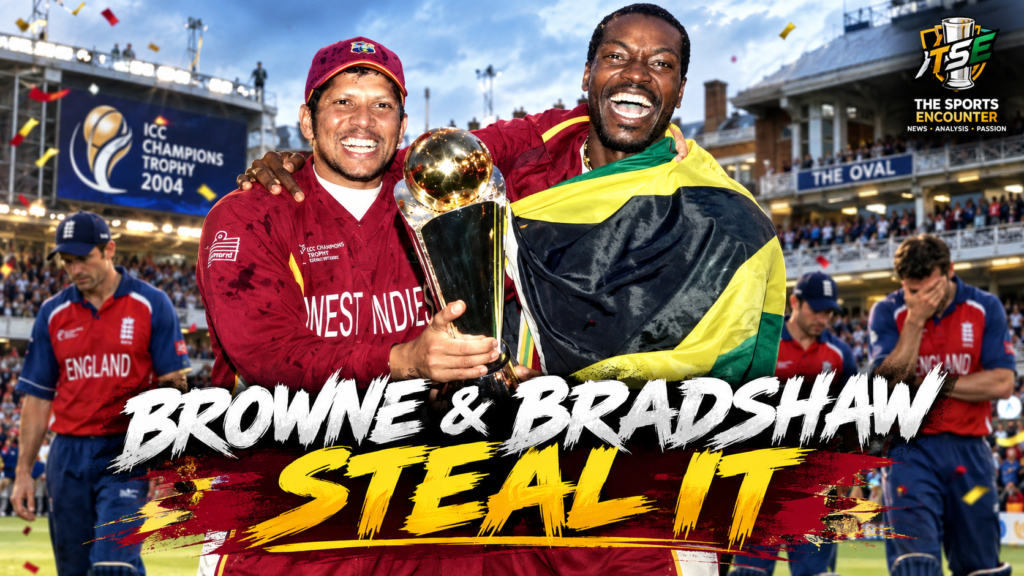
LONDON, England, September 25, 2004: England were two wickets away from winning their first major ICC men’s championship, and West Indies had seemingly run out of batters capable of stopping them. Chasing 218 in the ICC Champions Trophy final at The Oval, the Caribbean side had crumbled to 147 for 8, still requiring 71 runs. Courtney Browne and Ian Bradshaw then produced one of the most extraordinary lower-order recoveries in ODI history, adding an unbeaten 71 to carry West Indies to a two-wicket victory with seven deliveries remaining.
England had appeared to do enough through Marcus Trescothick’s determined 104 and a bowling attack led by Andrew Flintoff’s three wickets. But after Shivnarine Chanderpaul fell for 47, Browne and Bradshaw turned an unlikely partnership into a trophy-winning stand. Their remarkable composure denied Michael Vaughan’s England a historic home triumph and delivered West Indies their first major ICC title since the 1979 World Cup. Bradshaw, who also took two early wickets, was named Player of the Match.
The September afternoon became unforgettable because of the contrast between England’s apparent control and the remarkable ending.
West Indies had been struggling with the bat throughout the chase. Their top order failed, Brian Lara departed for just 14, and the recognized middle order disappeared under sustained pressure.
When Chanderpaul fell at 147 for 8, the outcome appeared inevitable.
England had dominated enough of the contest to believe the trophy was within reach. Yet Browne and Bradshaw found a way to overturn the result without losing another wicket.
That remarkable recovery earns the final its place as Match 52 in The Sports Encounter’s A Celebration of 5000 ODIs, a collection dedicated to the matches that demonstrate why one-day cricket can remain unpredictable until the final wicket or winning run.
England vs West Indies 2004 ICC Champions Trophy Final: Match Summary
| Match detail | Information |
|---|---|
| Tournament | ICC Champions Trophy 2004 |
| Match | Final |
| Date | September 25, 2004 |
| Venue | The Oval, London, England |
| Toss | West Indies won and elected to field |
| England | 217 all out in 49.4 overs |
| West Indies | 218/8 in 48.5 overs |
| Result | West Indies won by two wickets |
| Deliveries remaining | 7 |
| Player of the Match | Ian Bradshaw |
| Player of the Tournament | Ramnaresh Sarwan |
| England’s leading scorer | Marcus Trescothick, 104 |
| West Indies’ leading scorer | Shivnarine Chanderpaul, 47 |
| Best bowling figures | Wavell Hinds, 3/24 |
| Decisive partnership | Courtney Browne and Ian Bradshaw, 71* |
Marcus Trescothick’s 104 Keeps England Alive Through a Difficult Innings
Marcus Trescothick provided the backbone of England’s innings with a determined century that appeared capable of winning the final.
Opening the batting after West Indies elected to field, Trescothick watched his teammates struggle against disciplined bowling.
Vikram Solanki departed for four, and captain Michael Vaughan managed only seven.
England were 43 for 2 in the 11th over.
Andrew Strauss helped stabilize the innings with 18, but his run-out left England 84 for 3.
The position became increasingly uncomfortable when Andrew Flintoff departed for three, leaving the hosts 93 for 4.
Trescothick continued battling.
His 104 came from 124 deliveries and included 14 boundaries. It was an innings requiring patience, concentration and a willingness to remain at the crease while wickets fell around him.
He reached his century from 122 balls, having carried much of England’s batting responsibility.
His contribution was particularly valuable because the West Indies attack had consistently prevented England from establishing substantial partnerships.
Trescothick was eventually run out for 104 in the 48th over, with England at 211 for 7.
The dismissal meant England entered the final overs without their most established batter.
They were dismissed for 217 with two deliveries remaining.
Trescothick had scored almost 48% of England’s total himself, an indication of how heavily the innings depended on his presence.
His performance deserved a championship victory.
Instead, it became one of the outstanding centuries made in a losing ICC final.
Wavell Hinds’ 3 for 24 Gives West Indies the Bowling Advantage
Wavell Hinds produced the best bowling figures of the match, taking 3 for 24 from ten overs.
His spell was remarkably economical, including three maidens.
Hinds dismissed Flintoff for three, Paul Collingwood for 16 and wicketkeeper Geraint Jones for six.
The dismissals came during a period when England were attempting to recover from early setbacks.
At 93 for 4, England needed a meaningful partnership to establish a strong platform.
Hinds prevented that recovery from gathering momentum.
His dismissal of Flintoff was particularly valuable because the all-rounder possessed the attacking ability to change England’s scoring rate.
Collingwood and Jones also fell before they could provide substantial support to Trescothick.
The figures tell an important story.
Hinds conceded only 2.40 runs per over, creating sustained pressure in a format where even modest partnerships can shift the balance.
His contribution helped West Indies restrict England to 217, a target that initially appeared manageable.
Ironically, he would later make only three runs during the chase.
That contrasting contribution illustrated the difficulties West Indies experienced with the bat despite producing an effective collective bowling performance.
Ian Bradshaw Takes Two Early Wickets Before His Heroics With the Bat
Ian Bradshaw made his first significant contribution long before walking out to bat during the chase.
The left-arm medium-fast bowler dismissed both Vikram Solanki and Michael Vaughan.
Solanki was caught behind by Courtney Browne, while Vaughan was bowled for seven.
The dismissals left England 43 for 2 and prevented the hosts from establishing a comfortable opening platform.
Bradshaw finished with 2 for 54 from ten overs, including one maiden.
His economy rate was higher than those of Wavell Hinds and Corey Collymore, but his wickets came at an important stage.
England had hoped to take advantage of familiar conditions at The Oval.
Instead, Bradshaw’s early breakthroughs forced them to rebuild.
His bowling also established an interesting connection with what followed later.
Browne took the catch that dismissed Solanki off Bradshaw’s bowling.
Hours later, the same pair would combine in a very different role, completing one of the most remarkable partnerships in Champions Trophy history.
Their contributions across both innings explain why this final is remembered for something greater than a dramatic finish.
Dwayne Bravo, Collymore and Gayle Help Restrict England to 217
West Indies’ bowling success extended beyond the main wicket-takers.
Corey Collymore delivered ten overs for just 38 runs, including a maiden.
He did not take a wicket, but his control was important in keeping England’s scoring rate in check.
Dwayne Bravo finished with 1 for 41 from ten overs.
He dismissed Ashley Giles for 31, ending a valuable late contribution that had helped England recover from 148 for 6.
Chris Gayle also claimed a wicket, dismissing Darren Gough for a duck.
England were eventually bowled out for 217 in 49.4 overs.
The total represented a significant achievement for West Indies’ bowling attack.
Trescothick had made a century, but England’s remaining batters collectively failed to provide enough support.
The hosts had struggled to build partnerships and lost wickets at regular intervals.
West Indies therefore entered the chase requiring 218, a target considerably lower than many observers might have expected before the final.
The challenge, however, was about to become far more difficult.
Steve Harmison’s Early Wickets Leave West Indies Reeling at 49 for 3
England’s bowlers quickly demonstrated that 217 could be a challenging target.
Steve Harmison struck early, dismissing Wavell Hinds for three and Chris Gayle for 23.
Ramnaresh Sarwan, one of West Indies’ most important batters during the tournament, also departed cheaply.
Andrew Flintoff dismissed him for five.
West Indies were 49 for 3 in the tenth over.
The pressure was immediate.
The required run rate was relatively modest, but England’s ability to take wickets prevented West Indies from settling into a controlled chase.
Gayle had struck five boundaries during his 23, suggesting that he could provide a quick start.
However, his dismissal removed one of the visitors’ most dangerous attacking players.
Harmison completed his ten overs with figures of 2 for 34, including a maiden.
His pace and accuracy helped England establish control during the opening stages.
More importantly, his wickets forced West Indies’ middle order to rebuild under pressure.
Andrew Flintoff’s 3 for 38 Threatens to Win England Their First ICC Title
Andrew Flintoff played a major role in bringing England within touching distance of the trophy.
Having contributed only three runs with the bat, he responded with an outstanding bowling performance.
Flintoff dismissed Sarwan, Brian Lara and Dwayne Bravo.
His wicket of Lara was particularly important.
The West Indies captain represented one of the most dangerous batters remaining in the chase.
Lara scored 14 from 28 deliveries before Flintoff had him caught behind by Geraint Jones.
West Indies were 72 for 4.
Shortly afterward, Bravo fell without scoring, reducing the visitors to 80 for 5.
England were now firmly in command.
Flintoff eventually completed ten overs with figures of 3 for 38.
His wickets had dismantled the recognized West Indies batting order, leaving England increasingly confident of defending 217.
He also benefited from excellent support from England’s other bowlers.
Harmison had removed two early batters, while Paul Collingwood would later claim two more wickets.
The hosts appeared to have every component required for victory.
Their failure to finish the job would become one of the most painful chapters in England’s early Champions Trophy history.
Shivnarine Chanderpaul’s 47 Keeps West Indies Within Reach
Shivnarine Chanderpaul provided West Indies with the only substantial innings among their recognized batters.
He scored 47 from 66 deliveries, striking six boundaries.
His contribution came during a period of repeated setbacks.
After West Indies slipped to 80 for 5, Chanderpaul attempted to stabilize the chase.
He resisted England’s attack and gradually reduced the target.
However, his partners continued to disappear.
Ryan Hinds made eight before being dismissed by Marcus Trescothick.
Ricardo Powell contributed 14 before falling to Paul Collingwood.
West Indies were 135 for 7 in the 30th over.
Chanderpaul remained the visitors’ principal hope.
His innings demonstrated patience and control, but the situation became increasingly difficult as wickets disappeared.
The decisive setback arrived in the 34th over.
Collingwood dismissed Chanderpaul for 47, with Michael Vaughan taking the catch.
West Indies were 147 for 8.
They still required 71 runs.
Only Courtney Browne, Ian Bradshaw and Corey Collymore remained.
England were now just two wickets from victory.
Chanderpaul’s dismissal appeared to have settled the championship.
Instead, it established the stage for an extraordinary comeback.
Courtney Browne’s Unbeaten 35 Turns Desperation Into Belief
Courtney Browne was not expected to become West Indies’ principal batting hero in a Champions Trophy final.
The wicketkeeper had contributed effectively behind the stumps, including taking the catch that dismissed England’s Solanki.
However, his role became far more significant when West Indies were reduced to 147 for 8.
Browne now faced the responsibility of guiding an inexperienced lower-order partnership through a demanding chase.
He eventually scored an unbeaten 35 from 55 deliveries, striking two boundaries.
The innings required discipline and composure.
West Indies did not need to score at an extraordinary rate.
They needed 71 runs from 98 balls.
The difficulty lay in preserving the final two wickets.
Browne understood that attempting reckless shots would play directly into England’s hands.
Instead, he focused on building a partnership with Bradshaw.
Both batters rotated the strike when possible and avoided unnecessary risks.
Gradually, England’s advantage began to diminish.
The required runs dropped, the partnership grew and the pressure shifted toward the bowling side.
Browne’s composure was critical because he provided the stability Bradshaw needed to contribute meaningfully.
His unbeaten 35 may appear modest compared with Trescothick’s century, but its significance was enormous.
Without Browne’s patience, West Indies would almost certainly have failed to complete the chase.
Ian Bradshaw’s Unbeaten 34 Completes One of ODI Cricket’s Greatest Recoveries
Ian Bradshaw’s batting performance became the defining contribution of the final.
The left-arm bowler scored an unbeaten 34 from 51 deliveries, striking five boundaries.
He entered with West Indies still requiring 71 runs and only two wickets remaining.
England had every reason to expect a quick conclusion.
Bradshaw, however, demonstrated remarkable confidence for a player primarily selected for his bowling.
He supported Browne, defended carefully and punished scoring opportunities without allowing the required rate to become unmanageable.
The pair gradually reduced England’s advantage.
Their partnership reached 50, and the possibility of a West Indies victory became increasingly realistic.
As the chase entered its closing stages, England’s bowlers began to feel the pressure.
Darren Gough, Andrew Flintoff and Alex Wharf attempted to break the partnership, but Browne and Bradshaw refused to surrender their wickets.
Bradshaw’s boundaries proved particularly valuable.
His five fours accounted for 20 of his 34 runs, reducing the need for risky running between the wickets.
The pair completed an unbeaten 71-run partnership.
West Indies reached 218 for 8 in 48.5 overs, winning with seven balls remaining.
Bradshaw was named Player of the Match for his two early wickets and decisive contribution with the bat.
It was an exceptional all-round performance in a championship final.
The ICC later recognized the match among the greatest contests in Champions Trophy history, acknowledging how Browne and Bradshaw overturned a position that appeared hopeless.
ICC
Why the Browne-Bradshaw Partnership Was Such an Extraordinary Achievement
The unbeaten 71-run stand was exceptional for several reasons.
First, it came with only two wickets remaining.
West Indies had exhausted almost all their recognized batting resources.
Second, the partnership occurred in a major ICC final, with England pursuing a historic trophy on home soil.
Third, neither Browne nor Bradshaw was regarded as one of the leading batters in the team.
Fourth, the pair were required to survive more than 15 overs without losing another wicket.
The partnership lasted 91 deliveries, during which West Indies scored the remaining 71 runs.
That represents approximately 4.68 runs per over.
In isolation, the scoring rate was modest.
Under the circumstances, however, maintaining that rate without losing a wicket required extraordinary concentration.
The partnership also became West Indies’ highest ninth-wicket stand in ODI cricket at the time.
Its importance extended beyond the statistical record.
Browne and Bradshaw demonstrated that the ability to remain calm under pressure can be as decisive as spectacular boundary hitting.
Their approach was based on patience, communication and careful shot selection.
England repeatedly searched for the final breakthrough.
West Indies simply refused to provide it.
England’s 35 Extras Become an Important Part of the Final’s Story
One of the most revealing statistical details of the match concerns England’s bowling discipline.
West Indies received 35 extras during their chase.
Those included 19 wides, five no-balls and 11 leg-byes.
The figure represented approximately 16% of the winning total.
England had received 23 extras during their own innings.
The difference was 12 runs.
It would be simplistic to claim that extras alone caused England’s defeat.
West Indies’ lower-order partnership still required considerable skill and resilience.
However, England’s inability to maintain consistent bowling discipline contributed to the pressure facing their attack.
A side defending 217 has less room for errors than one defending 300.
Every wide and no-ball provides the batting team with additional scoring opportunities.
England’s 19 wides were particularly damaging because they increased the target’s accessibility without requiring the batters to play a scoring shot.
In a match decided by two wickets and seven deliveries, those contributions were significant.
The figures also reveal an interesting contrast.
West Indies’ bowlers conceded 23 extras while England’s attack gave away 35.
That difference reinforced the visitors’ advantage in a low-scoring final.
Four Turning Points That Decided the 2004 ICC Champions Trophy Final
1. Wavell Hinds Removes England’s Middle Order
England’s batting lineup had the opportunity to build around Trescothick’s century.
However, Hinds dismissed Flintoff, Collingwood and Jones, finishing with 3 for 24.
Those wickets prevented England from transforming Trescothick’s contribution into a substantially larger total.
The hosts finished on 217, leaving West Indies with a manageable target despite their batting difficulties.
2. Flintoff Removes Lara and Bravo to Put England in Command
England’s most productive bowling phase came when Flintoff dismissed West Indies captain Brian Lara and Dwayne Bravo.
The visitors fell to 80 for 5, and their remaining recognized batters were placed under severe pressure.
The dismissals established England’s control and created the conditions for an apparently comfortable finish.
3. Chanderpaul Falls at 147 for 8
When Collingwood dismissed Chanderpaul for 47, England appeared certain to win.
West Indies needed 71 runs, and the remaining batters were Browne, Bradshaw and Collymore.
The wicket represented England’s strongest position in the final.
It also marked the moment when the responsibility for winning the trophy passed almost entirely to West Indies’ lower order.
4. Browne and Bradshaw Add 71 Without Losing Another Wicket
The final partnership transformed the championship.
Browne’s unbeaten 35 and Bradshaw’s unbeaten 34 denied England the breakthrough they needed.
Their 71-run stand carried West Indies to victory with seven deliveries remaining.
The partnership was decisive because it combined survival with sufficient scoring momentum.
England were unable to force an error before the winning runs arrived.
Why England Lost Despite Dominating Most of the Final
England’s defeat was especially painful because they had controlled significant portions of the contest.
Trescothick’s century gave them a competitive total.
Harmison and Flintoff then dismantled West Indies’ top order.
Collingwood’s dismissal of Chanderpaul left the visitors 147 for 8.
England’s bowlers had therefore created a position from which victory appeared overwhelmingly likely.
However, the hosts could not dismiss either of the final recognized batters.
The bowling attack struggled to maintain sustained pressure during the ninth-wicket partnership.
England also conceded 35 extras, including 19 wides.
Those additional runs increased the difficulty of defending 217.
The hosts eventually faced a situation in which West Indies no longer needed to take significant risks.
Browne and Bradshaw could work the ball into gaps, take singles and wait for occasional boundaries.
England’s greatest failure was their inability to adjust quickly enough as the partnership developed.
Their bowlers had proved effective against the recognized West Indies batting lineup.
Yet the final two batters found a method of scoring that England could not disrupt.
Why West Indies Won After Losing Eight Wickets for 147
West Indies’ victory was built on three important contributions.
Their bowling attack established a manageable target.
Wavell Hinds’ 3 for 24, Bradshaw’s two wickets and Collymore’s economical spell prevented England from reaching a significantly larger total.
Chanderpaul then provided the main stabilizing contribution during the chase.
His 47 kept West Indies within reach despite the loss of several key players.
Finally, Browne and Bradshaw completed the recovery.
Their 71-run stand ensured the bowling team’s earlier success was not wasted.
The victory demonstrated the importance of batting depth in ODI cricket.
West Indies did not produce a century during the chase.
Their highest individual score was Chanderpaul’s 47.
Yet the contributions were distributed effectively enough for the lower order to complete the target.
England had relied heavily on Trescothick’s century.
West Indies succeeded through a combination of disciplined bowling, middle-order resistance and an exceptional final partnership.
How the 2004 Champions Trophy Ended West Indies’ 25-Year ICC Title Wait
West Indies’ victory carried enormous historical significance.
The Caribbean side had last won a major ICC men’s championship at the 1979 Cricket World Cup, when Clive Lloyd’s team defeated England at Lord’s.
Twenty-five years later, West Indies again defeated England in a major final in London.
The circumstances were dramatically different.
The 1979 team had been one of the dominant forces in world cricket.
By 2004, West Indies were no longer considered an overwhelming international powerhouse.
Their championship victory therefore represented a major achievement for a team attempting to restore its competitive reputation.
The final also provided a direct historical connection with the earlier era of West Indian excellence.
The Sports Encounter has already revisited Clive Lloyd’s century and Viv Richards’ fielding brilliance in the 1975 World Cup final, when West Indies became the inaugural men’s ODI world champions.
That triumph began an extraordinary period of Caribbean dominance.
The 2004 Champions Trophy represented a different kind of achievement.
West Indies were required to overcome serious adversity rather than impose their superiority throughout the match.
Their victory also ended England’s hopes of claiming its first ICC men’s championship on home soil.
England would eventually win a major ICC men’s title at the 2010 T20 World Cup.
The missed opportunity at The Oval remained particularly painful because the hosts had come so close.
Why Match 52 Belongs in A Celebration of 5000 ODIs
The 2004 Champions Trophy final meets almost every criterion for inclusion among ODI cricket’s most memorable matches.
It was a major tournament final.
It featured a century from Marcus Trescothick and an outstanding bowling performance from Wavell Hinds.
England appeared to have secured victory after reducing West Indies to 147 for 8.
The remaining batters then produced a remarkable unbeaten partnership to overturn the result.
The historical significance was substantial, ending a 25-year wait for another major West Indies ICC trophy.
The match also offers a compelling comparison with India’s remarkable chase against England in the 2002 NatWest Series final.
In 2002, England watched Yuvraj Singh and Mohammad Kaif rescue India from 146 for 5.
Two years later, England faced another extraordinary recovery, this time involving West Indies’ ninth-wicket pair.
The circumstances differed, but both matches demonstrated how an apparently commanding position can disappear when a partnership survives longer than the bowling side expects.
For West Indies, the 2004 final remains an enduring example of resilience.
For England, it is a reminder of how difficult finishing a match can become when victory appears certain.
For cricket supporters, the image of Courtney Browne and Ian Bradshaw celebrating an impossible escape captures everything that makes ODI cricket compelling.
Their partnership turned 147 for 8 into 218 for 8 and transformed an expected England triumph into one of the most extraordinary championship victories in the format’s history.
That is why the match deserves its place in The Sports Encounter’s celebration of 100 unforgettable ODIs.
4. Complete Match Scorecard
England Innings: 217 All Out in 49.4 Overs
| Batter | Dismissal | R | B | 4s | 6s | SR |
|---|---|---|---|---|---|---|
| Marcus Trescothick | Run out (Lara/Gayle) | 104 | 124 | 14 | 0 | 83.87 |
| Vikram Solanki | c Browne b Bradshaw | 4 | 13 | 0 | 0 | 30.77 |
| Michael Vaughan (c) | b Bradshaw | 7 | 18 | 1 | 0 | 38.89 |
| Andrew Strauss | Run out (Bravo) | 18 | 33 | 2 | 0 | 54.55 |
| Andrew Flintoff | c Lara b Wavell Hinds | 3 | 6 | 0 | 0 | 50.00 |
| Paul Collingwood | c Chanderpaul b Wavell Hinds | 16 | 40 | 1 | 0 | 40.00 |
| Geraint Jones (wk) | c Lara b Wavell Hinds | 6 | 18 | 0 | 0 | 33.33 |
| Ashley Giles | c Lara b Bravo | 31 | 37 | 3 | 0 | 83.78 |
| Alex Wharf | Not out | 3 | 6 | 0 | 0 | 50.00 |
| Darren Gough | st Browne b Gayle | 0 | 1 | 0 | 0 | 0.00 |
| Steve Harmison | Run out | 2 | 2 | 0 | 0 | 100.00 |
| Extras | 1 b, 7 lb, 15 w | 23 | ||||
| Total | All out, 49.4 overs | 217 |
Fall of wickets: 1-12 (Solanki, 4.2), 2-43 (Vaughan, 10.3), 3-84 (Strauss, 19.6), 4-93 (Flintoff, 22.1), 5-123 (Collingwood, 32.3), 6-148 (Jones, 38.2), 7-211 (Trescothick, 47.4), 8-212 (Giles, 48.3), 9-214 (Gough, 49.1), 10-217 (Harmison, 49.4).
West Indies Bowling
| Bowler | O | M | R | W | Econ |
|---|---|---|---|---|---|
| Ian Bradshaw | 10 | 1 | 54 | 2 | 5.40 |
| Corey Collymore | 10 | 1 | 38 | 0 | 3.80 |
| Chris Gayle | 9.4 | 0 | 52 | 1 | 5.38 |
| Dwayne Bravo | 10 | 0 | 41 | 1 | 4.10 |
| Wavell Hinds | 10 | 3 | 24 | 3 | 2.40 |
West Indies Innings: 218/8 in 48.5 Overs
| Batter | Dismissal | R | B | 4s | 6s | SR |
|---|---|---|---|---|---|---|
| Chris Gayle | c & b Harmison | 23 | 33 | 5 | 0 | 69.70 |
| Wavell Hinds | c Solanki b Harmison | 3 | 16 | 0 | 0 | 18.75 |
| Ramnaresh Sarwan | c Strauss b Flintoff | 5 | 7 | 1 | 0 | 71.43 |
| Brian Lara (c) | c Jones b Flintoff | 14 | 28 | 2 | 0 | 50.00 |
| Shivnarine Chanderpaul | c Vaughan b Collingwood | 47 | 66 | 6 | 0 | 71.21 |
| Dwayne Bravo | c Jones b Flintoff | 0 | 7 | 0 | 0 | 0.00 |
| Ryan Hinds | c Jones b Trescothick | 8 | 19 | 1 | 0 | 42.11 |
| Ricardo Powell | c Trescothick b Collingwood | 14 | 16 | 2 | 0 | 87.50 |
| Courtney Browne (wk) | Not out | 35 | 55 | 2 | 0 | 63.64 |
| Ian Bradshaw | Not out | 34 | 51 | 5 | 0 | 66.67 |
| Corey Collymore | Did not bat | |||||
| Extras | 11 lb, 19 w, 5 nb | 35 | ||||
| Total | 8 wickets, 48.5 overs | 218 |
Fall of wickets: 1-19 (Wavell Hinds, 3.5), 2-35 (Sarwan, 8.1), 3-49 (Gayle, 9.4), 4-72 (Lara, 16.3), 5-80 (Bravo, 18.3), 6-114 (Ryan Hinds, 24.5), 7-135 (Powell, 29.2), 8-147 (Chanderpaul, 33.4).
England Bowling
| Bowler | O | M | R | W | Econ |
|---|---|---|---|---|---|
| Darren Gough | 10 | 1 | 58 | 0 | 5.80 |
| Steve Harmison | 10 | 1 | 34 | 2 | 3.40 |
| Andrew Flintoff | 10 | 0 | 38 | 3 | 3.80 |
| Alex Wharf | 9.5 | 0 | 38 | 0 | 3.86 |
| Marcus Trescothick | 3 | 0 | 17 | 1 | 5.67 |
| Paul Collingwood | 6 | 0 | 22 | 2 | 3.67 |
Result: West Indies won by two wickets with seven balls remaining.
Player of the Match: Ian Bradshaw, 2 for 54 and 34 not out.
Player of the Tournament: Ramnaresh Sarwan.Historical scorecard checked against completed innings records and the ICC’s tournament documentation.
i.imgci.com
+1
5. Frequently Asked Questions
Who won the 2004 ICC Champions Trophy final?
West Indies defeated England by two wickets at The Oval, London, on September 25, 2004, successfully chasing 218 with seven deliveries remaining.
Who was the Player of the Match?
Ian Bradshaw received the award after taking two wickets and scoring an unbeaten 34 during the match-winning ninth-wicket partnership.
How many runs did Courtney Browne and Ian Bradshaw add?
Browne and Bradshaw shared an unbeaten 71-run partnership for the ninth wicket, rescuing West Indies from 147 for 8.
Who scored a century for England?
Marcus Trescothick scored 104 from 124 deliveries, including 14 boundaries.
Who took the most wickets for West Indies?
Wavell Hinds claimed 3 for 24 from ten overs, including three maidens.
What was West Indies’ score when Chanderpaul was dismissed?
West Indies were 147 for 8 after 33.4 overs, still requiring 71 runs to win.
Who was West Indies’ highest scorer?
Shivnarine Chanderpaul led the innings with 47 from 66 deliveries.
Why was the victory historically important?
It delivered West Indies’ first major ICC men’s championship since the 1979 Cricket World Cup, ending a 25-year title drought.
Who was the Player of the Tournament?
Ramnaresh Sarwan was named Player of the Tournament for the 2004 ICC Champions Trophy.