


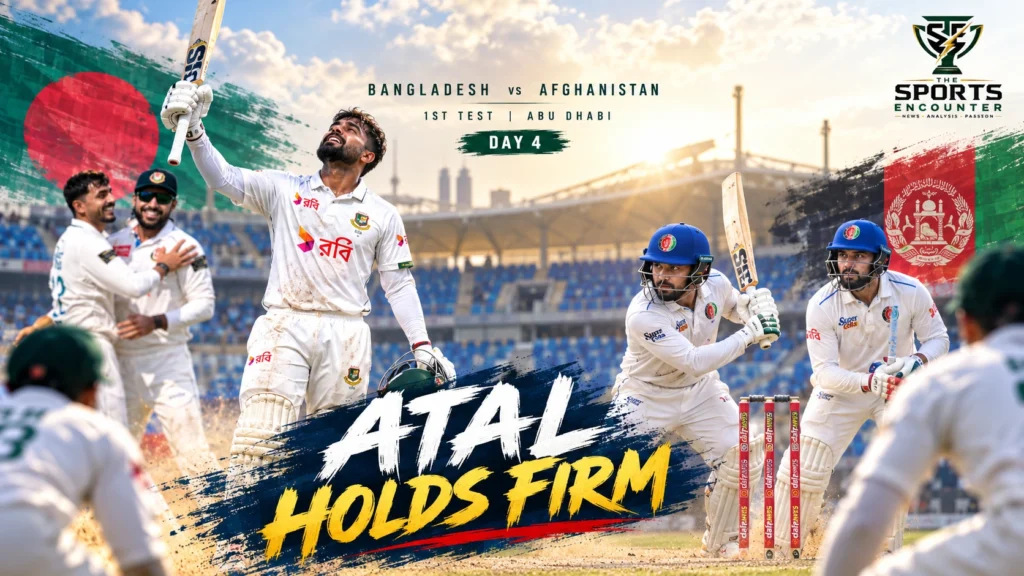
ABU DHABI, United Arab Emirates, October 12, 2026: Litton Das made 102, completed a Bangladesh-record eighth wicketkeeping dismissal and left Afghanistan staring at 479 for victory, yet Bangladesh still have seven wickets to take on the final day of their one-off Test at Zayed Cricket Stadium. The visitors declared at 372/7 on Monday before Afghanistan closed Day 4 at 132/3 from 50 overs, requiring another 347 runs in a chase beyond the highest successful target in Test history.
Litton and Mehidy Hasan Miraz built a 149-run seventh-wicket stand before Litton fell and Bangladesh declared, but Afghanistan’s resistance offered a different kind of contest. Captain Rahmat Shah followed his first-innings 105 not out with a determined 51, sharing an 82-run stand with Sediqullah Atal. Ebadot Hossain removed Rahmat late in the day, leaving Atal unbeaten on 35 from 126 balls alongside Hashmatullah Shahidi on 19. Bangladesh are firm favorites to win; Afghanistan’s best prospect is to bat out Tuesday.
Afghanistan vs Bangladesh Day 4: Match Situation at Stumps
| Match detail | Day 4 status |
|---|---|
| Fixture | Afghanistan vs Bangladesh, one-off Test; October 9-13, 2026 |
| Venue | Zayed Cricket Stadium, Abu Dhabi |
| Toss | Bangladesh won and chose to bat |
| Bangladesh, first innings | 346 all out, 92.3 overs |
| Afghanistan, first innings | 240 all out, 89.1 overs |
| Bangladesh, second innings | 372/7 declared, 105.2 overs |
| Afghanistan, second innings | 132/3, 50 overs at stumps |
| Target | 479 runs |
| Final-day equation | Afghanistan need 347 runs; Bangladesh need seven wickets |
| Not-out batters | Sediqullah Atal 35 (126); Hashmatullah Shahidi 19 (27) |
How Did Litton Das Turn 223/6 Into a 479-Run Target?
Bangladesh started Monday at 223/6, already 329 runs ahead but with their lower order exposed. Litton was five not out and Mehidy had yet to score. The seventh-wicket pair changed the match’s timetable: they advanced to 337/6 at lunch and stretched the innings to 372/7 before captain Najmul Hossain Shanto declared immediately after Litton’s dismissal.
Litton moved from five overnight to 102 from 117 deliveries, striking 14 fours. His final 97 runs came on Day 4 alone. Mehidy ended unbeaten on 52 from 97 balls with five boundaries, playing the steadier role while Litton repeatedly found the gaps. The 149-run partnership took Bangladesh’s advantage from 329 at the start of the day to a winning target of 479.
Afghanistan contributed to their predicament. Litton was reprieved on 14, 26 and 67, while Mehidy also benefited from missed fielding opportunities. These were consequential chances, particularly when Bangladesh had begun the day six wickets down. The three escapes let Litton keep scoring instead of exposing the remaining lower-order batters.
His century also carried a personal recovery story. Litton had struggled badly for runs during Bangladesh’s recent tour of Australia. TSE’s review of Bangladesh’s two-day defeat in Mackay records how the top order was dismantled, including another Litton duck, despite the team’s historic 1-1 series draw. His 53 in the first innings against Afghanistan and 102 in the second have now provided a compelling response.
Litton’s Eight Dismissals Give His Century a Rare Second Dimension
Litton has influenced this match from both sides of the stumps. He scored 53 in Bangladesh’s first innings and followed with his seventh Test century. Behind the wicket, he completed four catches and a stumping during Afghanistan’s first innings, then added three more catches during the second.
That gives him eight dismissals in the match, seven catches and one stumping, surpassing the previous Bangladesh Test record of seven held by Khaled Mashud, according to contemporary reporting. Ebadot’s late breakthrough against Rahmat supplied the record-breaking eighth dismissal.
The number also captures the partnership between Bangladesh’s pace attack and its keeper. Litton helped captain Shanto make the successful review that completed Hasan Mahmud’s hat-trick on Day 3, according to the ICC’s account of Hasan’s historic spell. The wicketkeeper’s reading of the game has therefore mattered beyond his batting runs and the catches that appear in the scorebook.
His return to form is particularly valuable given Bangladesh’s recent efforts to become a stronger touring Test side, an evolution explored in TSE’s Australia tour preview and our analysis of their landmark victory in Darwin.
Why Did Afghanistan’s 82-Run Stand Matter After 28/2?
Bangladesh appeared poised to make short work of Afghanistan’s chase when Ebadot had Abdul Malik caught behind for two with only three on the board. Hasan Mahmud then dismissed Shahidullah for 19, again caught by Litton, and Afghanistan slipped to 28/2 in the seventh over.
Rahmat Shah and Sediqullah Atal chose survival over chasing the required rate. Their third-wicket partnership added 82 runs from 214 deliveries, carrying Afghanistan to 110/2 in the 43rd over. Rahmat’s 51 took 124 balls and included five fours and a six. He had also remained unbeaten on 105 in Afghanistan’s first innings, making him the main reason the hosts resisted Bangladesh across both innings.
Atal played a markedly slower innings. By stumps he had faced 126 balls for 35, with one four and one six. The strike rate of 27.77 tells a more useful story than the run total: Afghanistan were using up time and deliveries, rather than pretending 479 was a conventional chase. Atal then watched Ebadot find Rahmat’s edge at 110/3, ending their partnership at 42.1 overs.
That dismissal was Bangladesh’s most important success in the final hour. Afghanistan would have reached stumps two wickets down if Rahmat had survived; instead, they lost the batter who had anchored their first innings and the longest stand of their second.
Which Missed Chances Kept Afghanistan in the Test?
Bangladesh had opportunities to shorten the task. Tanzid Hasan dropped Rahmat at slip when the Afghanistan captain was on 16, and a separate run-out chance went begging when Ebadot’s throw was off target and Tanzid could not complete the dismissal near the keeper’s end.
Rahmat added another 35 runs after his dropped catch. More important than the arithmetic, he helped absorb Bangladesh’s bowling through a prolonged third-wicket partnership. The same fielding pressure Bangladesh had failed to convert in the morning, when Afghanistan dropped Litton, became a problem for Bangladesh during the afternoon chase.
Missed opportunities have been a recurring feature of Bangladesh’s recent overseas Tests. TSE previously examined how a controversial Steve Smith review affected the Darwin Test’s opening day. The incidents in Abu Dhabi are different, but they underline how catches, reviews and run-outs can change the amount of time a batting side has to survive.
What Has Sediqullah Atal Changed to Bat Through the Pressure?
Atal offered a direct explanation after play. Afghanistan’s aim, he said, was to bat long enough to secure a draw, with shot selection and patience taking precedence over the attacking instincts he might use in white-ball cricket.
He also described discussions with batting coach Toby Radford about the preparation and methods of South African greats Graeme Smith, Jacques Kallis and AB de Villiers. Alastair Cook was another model for the kind of all-day resistance Atal hopes to produce on Tuesday.
Atal has played just three Tests including this match, according to his post-play comments. His admission that he is still learning to control his attacking impulses gives his 35 from 126 balls genuine significance. Those runs will only become valuable in the final result if he can extend his occupation of the crease.
Shahidi, unbeaten on 19 from 27 deliveries with two fours and a six, has offered a somewhat quicker scoring option. But Afghanistan cannot afford to pursue boundaries at the expense of their remaining seven wickets. The more important measure on Tuesday will be how many overs Atal and Shahidi can occupy together.
Hasan Mahmud and Ebadot Hossain: How Should Bangladesh Attack on Day 5?
Hasan’s first-innings 5/55 included a hat-trick against Ismat Alam, Qais Ahmad and Zia-ur-Rehman. It was Bangladesh’s first Test hat-trick by a fast bowler and was central to Afghanistan losing their final six wickets for just 21 runs. Ebadot supported him with 4/56, giving the seamers nine of the ten Afghan wickets.
On Monday, Ebadot finished with 2/32 from ten overs and Hasan with 1/31 from 12. Bangladesh’s spinners also offered control: Taijul Islam conceded 24 in 15 overs, including four maidens, while Nayeem Hasan allowed only ten from six overs.
The tactical decision for Shanto is how aggressively to pursue wickets on a surface where spin has not consistently produced sharp turn. Pace has created Bangladesh’s breakthroughs, while tight spin can deprive Atal and Shahidi of easy scoring without exhausting the quicks.
Hasan’s performances against Australia have already shown the value of Bangladesh’s developing pace attack, including the remarkable six-wicket first-innings effort in Darwin. His progress fits the wider discussion of decisive fast-bowling spells explored in TSE’s study of Test cricket’s fastest five-wicket bursts.
The team also has recent experience managing players’ competing international and franchise commitments. TSE’s Lanka Premier League squad analysis documented Hasan’s return from franchise cricket for Bangladesh duty, along with Mehidy’s scheduled departure. Their contributions in Abu Dhabi show the importance of those resources across formats.
Can Afghanistan Chase 347 on the Final Day, or Is a Draw the Realistic Goal?
Afghanistan have seven wickets standing and need 347 runs. Even if a full 90 overs were available on Tuesday, a successful chase would require roughly 3.86 runs per over, significantly above Monday’s 2.64. More decisively, the original target of 479 exceeds Test cricket’s record successful chase of 418/7 by the West Indies against Australia in Antigua in 2003, a benchmark documented in the ICC’s review of the biggest Test run chases.
Afghanistan have supplied no evidence that they intend to chase at that rate. Atal stated that they are trying to reach the final session and draw the match. Their survival plan will depend on reducing exposure to Ebadot and Hasan’s dangerous deliveries while resisting Shanto’s efforts to build sustained pressure through spin.
Bangladesh’s task is much clearer. Seven wickets will give them the match. With Rahmat already out, breaking the Atal-Shahidi stand early would expose Ikram Alikhil and the lower order, several of whom contributed little in the first innings.
There is no guarantee that wickets will come quickly. Afghanistan’s 82-run stand lasted 214 balls and proved that determined defense can frustrate Bangladesh on this surface. Conversely, their earlier collapse from 219/4 to 240 all out showed how swiftly the batting can unravel after one breakthrough.
What Happens After the Afghanistan-Bangladesh Test?
The final day’s play is scheduled for Tuesday, October 13. This is a standalone Test and is not part of the ongoing World Test Championship cycle. Both sides then switch to one-day cricket, with a tri-nation tournament involving Zimbabwe starting on October 17.
The Afghanistan Cricket Board has confirmed the series schedule: Bangladesh play Zimbabwe in Abu Dhabi on October 17, Afghanistan meet Zimbabwe on October 19, and Afghanistan face Bangladesh in Sharjah on October 21. The final is planned for October 23.
For Bangladesh, an Abu Dhabi Test win would extend a period of international improvement examined in TSE’s wider assessment of Bangladesh cricket’s changing fortunes. For Afghanistan, saving the Test would demonstrate a different, important kind of progress: discipline and endurance when an opponent has constructed an overwhelming lead.
Afghanistan vs Bangladesh: Complete Test Scorecard Through Day 4
All figures below reflect the close of play on October 12, 2026. Afghanistan’s second innings remains in progress.
Bangladesh First Innings: 346 All Out (92.3 Overs)
| Batter | Dismissal | R | B | 4s | 6s | SR |
|---|---|---|---|---|---|---|
| Shadman Islam | c Zia-ur-Rehman b Mohammad Saleem | 67 | 111 | 7 | 0 | 60.36 |
| Tanzid Hasan | c Ikram Alikhil b Ismat Alam | 83 | 71 | 8 | 4 | 116.90 |
| Mominul Haque | c Rahmat Shah b Yamin Ahmadzai | 39 | 70 | 4 | 0 | 55.71 |
| Najmul Hossain Shanto (c) | c sub (Rahmanullah) b Qais Ahmad | 29 | 42 | 1 | 2 | 69.04 |
| Mushfiqur Rahim | b Yamin Ahmadzai | 0 | 7 | 0 | 0 | 0.00 |
| Litton Das (wk) | c Yamin Ahmadzai b Mohammad Saleem | 53 | 89 | 4 | 0 | 59.55 |
| Mehidy Hasan Miraz | b Ismat Alam | 24 | 67 | 1 | 0 | 35.82 |
| Nayeem Hasan | not out | 35 | 67 | 4 | 0 | 52.23 |
| Hasan Mahmud | b Mohammad Saleem | 2 | 5 | 0 | 0 | 40.00 |
| Taijul Islam | c Ikram Alikhil b Mohammad Saleem | 9 | 20 | 0 | 0 | 45.00 |
| Ebadot Hossain | c Zia-ur-Rehman b Yamin Ahmadzai | 0 | 7 | 0 | 0 | 0.00 |
Extras: 5 (byes 4, no-ball 1). Fall of wickets: 124/1, 184/2, 221/3, 223/4, 225/5, 287/6, 303/7, 305/8, 335/9, 346 all out.
| Afghanistan bowler | O | M | R | W | Econ |
|---|---|---|---|---|---|
| Yamin Ahmadzai | 20.3 | 3 | 79 | 3 | 3.85 |
| Mohammad Saleem | 23 | 2 | 82 | 4 | 3.56 |
| Hashmatullah Shahidi | 3 | 0 | 24 | 0 | 8.00 |
| Ismat Alam | 12.4 | 5 | 20 | 2 | 1.57 |
| Zia-ur-Rehman | 19 | 1 | 77 | 0 | 4.05 |
| Qais Ahmad | 14.2 | 1 | 60 | 1 | 4.18 |
Afghanistan First Innings: 240 All Out (89.1 Overs)
| Batter | Dismissal | R | B | 4s | 6s | SR |
|---|---|---|---|---|---|---|
| Sediqullah Atal | c Tanzid Hasan b Hasan Mahmud | 17 | 31 | 3 | 0 | 54.83 |
| Abdul Malik | c Litton Das b Ebadot Hossain | 62 | 120 | 4 | 1 | 51.66 |
| Shahidullah | c Hasan Mahmud b Ebadot Hossain | 20 | 44 | 2 | 0 | 45.45 |
| Rahmat Shah (c) | not out | 105 | 216 | 10 | 2 | 48.61 |
| Hashmatullah Shahidi | st Litton Das b Mehidy Hasan Miraz | 0 | 2 | 0 | 0 | 0.00 |
| Ikram Alikhil (wk) | b Ebadot Hossain | 32 | 103 | 4 | 0 | 31.06 |
| Ismat Alam | b Hasan Mahmud | 1 | 4 | 0 | 0 | 25.00 |
| Qais Ahmad | c Litton Das b Hasan Mahmud | 0 | 1 | 0 | 0 | 0.00 |
| Zia-ur-Rehman | lbw b Hasan Mahmud | 0 | 1 | 0 | 0 | 0.00 |
| Yamin Ahmadzai | c Litton Das b Hasan Mahmud | 0 | 11 | 0 | 0 | 0.00 |
| Mohammad Saleem | c Litton Das b Ebadot Hossain | 0 | 3 | 0 | 0 | 0.00 |
Extras: 3 (leg bye 1, no-ball 1, wide 1). Fall of wickets: 30/1, 64/2, 134/3, 139/4, 219/5, 220/6, 220/7, 220/8, 223/9, 240 all out.
| Bangladesh bowler | O | M | R | W | Econ |
|---|---|---|---|---|---|
| Hasan Mahmud | 21 | 5 | 55 | 5 | 2.61 |
| Ebadot Hossain | 15.1 | 3 | 56 | 4 | 3.69 |
| Mehidy Hasan Miraz | 21 | 7 | 41 | 1 | 1.95 |
| Taijul Islam | 21 | 4 | 44 | 0 | 2.09 |
| Nayeem Hasan | 10 | 0 | 37 | 0 | 3.70 |
| Mominul Haque | 1 | 0 | 6 | 0 | 6.00 |
Bangladesh Second Innings: 372/7 Declared (105.2 Overs)
| Batter | Dismissal | R | B | 4s | 6s | SR |
|---|---|---|---|---|---|---|
| Shadman Islam | c Rahmat Shah b Mohammad Saleem | 13 | 22 | 2 | 0 | 59.09 |
| Tanzid Hasan | c Shahidullah b Yamin Ahmadzai | 31 | 38 | 6 | 0 | 81.57 |
| Mominul Haque | c Sediqullah Atal b Yamin Ahmadzai | 7 | 14 | 1 | 0 | 50.00 |
| Najmul Hossain Shanto (c) | b Qais Ahmad | 82 | 191 | 5 | 0 | 42.93 |
| Mushfiqur Rahim | c Shahidullah b Zia-ur-Rehman | 81 | 148 | 9 | 0 | 54.72 |
| Litton Das (wk) | c Ikram Alikhil b Mohammad Saleem | 102 | 117 | 14 | 0 | 87.17 |
| Hasan Mahmud | lbw b Zia-ur-Rehman | 1 | 6 | 0 | 0 | 16.66 |
| Mehidy Hasan Miraz | not out | 52 | 97 | 5 | 0 | 53.60 |
Did not bat: Nayeem Hasan, Taijul Islam, Ebadot Hossain. Extras: 3 (leg bye 1, no-ball 1, wide 1). Fall of wickets: 31/1, 44/2, 53/3, 212/4, 222/5, 223/6, 372/7 (declaration).
| Afghanistan bowler | O | M | R | W | Econ |
|---|---|---|---|---|---|
| Yamin Ahmadzai | 20 | 2 | 96 | 2 | 4.80 |
| Mohammad Saleem | 19.2 | 3 | 69 | 2 | 3.56 |
| Ismat Alam | 3 | 0 | 9 | 0 | 3.00 |
| Zia-ur-Rehman | 33 | 4 | 86 | 2 | 2.60 |
| Qais Ahmad | 15 | 0 | 70 | 1 | 4.66 |
| Abdul Malik | 3 | 1 | 9 | 0 | 3.00 |
| Hashmatullah Shahidi | 12 | 0 | 32 | 0 | 2.66 |
Afghanistan Second Innings: 132/3 (50 Overs, Stumps on Day 4)
| Batter | Dismissal | R | B | 4s | 6s | SR |
|---|---|---|---|---|---|---|
| Abdul Malik | c Litton Das b Ebadot Hossain | 2 | 5 | 0 | 0 | 40.00 |
| Sediqullah Atal | not out | 35 | 126 | 1 | 1 | 27.77 |
| Shahidullah | c Litton Das b Hasan Mahmud | 19 | 19 | 4 | 0 | 100.00 |
| Rahmat Shah (c) | c Litton Das b Ebadot Hossain | 51 | 124 | 5 | 1 | 41.12 |
| Hashmatullah Shahidi | not out | 19 | 27 | 2 | 1 | 70.37 |
Yet to bat: Ikram Alikhil, Zia-ur-Rehman, Yamin Ahmadzai, Qais Ahmad, Mohammad Saleem, Ismat Alam. Extras: 6 (byes 4, no-ball 1, wide 1). Fall of wickets: 3/1 (Abdul Malik, 1.1 overs), 28/2 (Shahidullah, 6.3 overs), 110/3 (Rahmat Shah, 42.1 overs).
| Bangladesh bowler | O | M | R | W | Econ |
|---|---|---|---|---|---|
| Hasan Mahmud | 12 | 0 | 31 | 1 | 2.58 |
| Ebadot Hossain | 10 | 2 | 32 | 2 | 3.20 |
| Mehidy Hasan Miraz | 7 | 0 | 31 | 0 | 4.42 |
| Taijul Islam | 15 | 4 | 24 | 0 | 1.60 |
| Nayeem Hasan | 6 | 1 | 10 | 0 | 1.66 |
Afghanistan vs Bangladesh Test Day 4: Frequently Asked Questions
What Was the Score at Stumps on Day 4?
Afghanistan were 132/3 after 50 overs, chasing 479. Sediqullah Atal was 35 not out and Hashmatullah Shahidi 19 not out.
How Many Runs Do Afghanistan Need on Day 5?
Afghanistan require another 347 runs, with seven wickets remaining. Their stated focus is to bat through the last day and secure a draw.
How Many Runs Did Litton Das Score?
Litton made 53 in the first innings and 102 from 117 balls, including 14 fours, in the second.
How Many Dismissals Did Litton Das Complete?
He had eight by the end of Day 4: seven catches and one stumping across Afghanistan’s two innings, a new Bangladesh Test record according to match reporting.
Who Was Bangladesh’s Best Bowler?
Hasan Mahmud claimed 5/55 with a hat-trick in Afghanistan’s first innings. Ebadot Hossain took 4/56 in that innings and 2/32 during the chase by Day 4 stumps.
What Did Rahmat Shah Score?
Afghanistan captain Rahmat Shah made 105 not out in the first innings and 51 from 124 balls in the second, before Ebadot dismissed him.
What Was the Litton Das-Mehidy Hasan Miraz Partnership?
They added 149 for Bangladesh’s seventh wicket, taking the second innings from 223/6 to 372/7 before the declaration.
When Does Day 5 Begin?
Play is scheduled to resume Tuesday, October 13, 2026, at 10 a.m. in Abu Dhabi, subject to match-day conditions and official playing arrangements.
Is This Test Part of the World Test Championship?
No. The ICC identifies the one-off Afghanistan-Bangladesh Test as outside the current World Test Championship cycle.
Bangladesh have the superior position and the wicket-taking resources. Afghanistan have a more modest but clearly articulated objective: take the game deep into the final day. The outcome now depends less on the enormous target than on whether Atal and Shahidi can deny Bangladesh the breakthroughs their bowlers have already produced repeatedly in this match.