


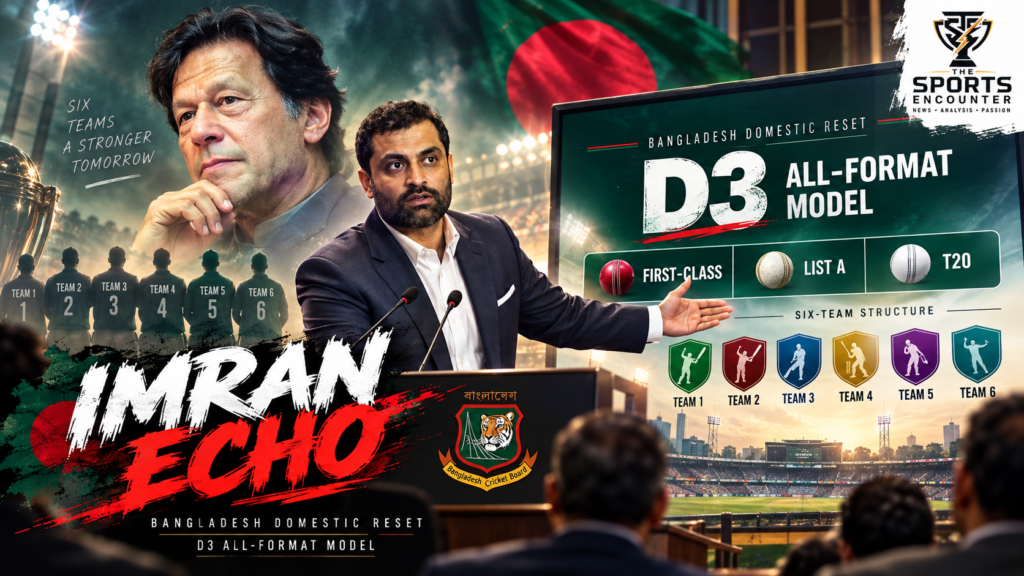
DHAKA, Bangladesh, September 27, 2026: More than seven years after Imran Khan pushed Pakistan toward a six-team elite domestic structure, Bangladesh is making a remarkably similar cricketing bet.
The Bangladesh Cricket Board under president Tamim Iqbal has launched D3, short for Domestic 3, a six-team structure covering first-class, List A and T20 cricket under the same franchise identities.
The philosophy is familiar.
Reduce the number of elite teams.
Concentrate the best players.
Make stronger cricketers compete against stronger opponents more often.
Build a clearer path between domestic cricket and the international game.
That was at the heart of Imran Khan’s domestic cricket argument in Pakistan.
Tamim is now applying a version of the same principle in Bangladesh, but with one major difference.
Imran’s model was built around regional teams.
Bangladesh’s D3 will be driven by corporate ownership.
That difference could determine whether D3 becomes a genuine domestic revolution or another expensive experiment in a cricket economy already bruised by the financial problems of the Bangladesh Premier League.
The Sports Encounter previously examined those problems when the BCB put the Bangladesh Premier League on hold for a full financial and governance reset.
D3 is therefore arriving at a fascinating moment.
Bangladesh is suspending one franchise model while building another.
What Is Bangladesh Cricket’s New D3 Structure?
D3 creates six elite teams operating across all three major domestic formats.
The same ownership groups will participate in:
- four-day first-class cricket;
- List A one-day cricket;
- T20 cricket.
The first season is scheduled to contain 42 matches across the three competitions.
The T20 segment begins first, followed by four-day cricket and then the List A competition.
The central idea is continuity.
Instead of creating separate teams for separate competitions, the BCB wants the same six identities to exist across the domestic calendar.
That could give players, coaches, owners and supporters a much clearer connection to the teams.
Who Owns the Six D3 Teams?
The six ownership groups announced for the first D3 cycle are:
| Ownership Group | Icon Player |
|---|---|
| Walton | Mehidy Hasan Miraz |
| Fortune | Towhid Hridoy |
| ACME | Mosaddek Hossain |
| Seven Rings Cement | Mushfiqur Rahim |
| ACE Blue Star | Nurul Hasan Sohan |
| Citizens Bank | Mohammad Naim |
Each ownership group has been given rights for three seasons.
The squads are expected to contain 23 players, with the BCB retaining significant control over salary structures, spending and competition regulations.
The board also intends to share part of sponsorship and ticket revenue with the teams.
That revenue-sharing mechanism could be crucial.
Corporate owners will be more likely to invest seriously if they see a route toward building a sustainable commercial property rather than simply funding a cricket team as a branding exercise.
Which Existing Competitions Will D3 Replace?
D3 does not replace Bangladesh’s entire domestic pyramid.
The National Cricket League four-day competition remains part of the structure.
The BCB has also moved toward a Second XI system designed to create additional playing opportunities.
D3 instead absorbs or replaces several elite competitions, including:
- the Bangladesh Cricket League four-day competition;
- the BCL one-day tournament;
- the NCL T20 competition.
That distinction may prove extremely important.
A six-team elite competition can raise standards.
It can also reduce opportunities.
Retaining broader domestic competitions underneath D3 gives Bangladesh a better chance of avoiding one of the biggest criticisms that followed Pakistan’s six-team experiment.
Why the Comparison With Imran Khan Is So Strong
Imran Khan spent years arguing that Pakistan had too many first-class teams.
His basic criticism was simple.
If elite players are spread too widely, the quality of domestic cricket falls.
Batters can build impressive statistics against ordinary attacks.
Bowlers can dominate weaker lineups.
The gap between domestic and international cricket becomes too large.
Imran wanted the best players facing one another as often as possible.
Pakistan eventually moved toward a six-team domestic structure in 2019, with the same regional associations competing across first-class, one-day and T20 cricket.
Bangladesh’s D3 follows much of the same competitive logic.
Six teams.
Elite concentration.
Cross-format continuity.
Higher standards.
A more selective pathway.
The difference is ownership.
Bangladesh is attempting to combine Imran’s sporting philosophy with a commercial franchise framework.
Tamim Iqbal Is Not Copying Imran Khan’s Model Exactly
Calling D3 a direct copy would be inaccurate.
Imran’s structure was based primarily around geographical regions and cricket associations.
D3 is based around companies.
That means the incentives are different.
A regional association exists fundamentally to develop cricket within its territory.
A corporate owner also needs commercial return.
That can be positive.
Companies may invest more aggressively in facilities, coaching, sports science, marketing and player development.
But commercial ownership can also create short-term thinking.
A company might value T20 success more than developing a technically sound first-class opener who needs three years before reaching international level.
That tension will define the project.
Why D3 Could Improve the Quality of Bangladesh Domestic Cricket
The strongest argument for D3 is competition quality.
If Bangladesh’s best domestic players are concentrated across six teams, the average level should rise.
Promising batters should face stronger bowling attacks more frequently.
Fast bowlers should bowl to better batters.
Spinners should have to work harder for wickets.
Players who dominate D3 should therefore offer selectors more meaningful evidence than players piling up numbers against weaker opposition.
Bangladesh already appears to have more international depth than it possessed several years ago.
The Sports Encounter explored that broader development in Bangladesh Cricket’s Sharp Rise Shows a Team No Longer Waiting for Permission.
D3 could provide the domestic system needed to sustain that progress.
Why One Identity Across Three Formats Could Matter
Bangladesh domestic cricket has often suffered from fragmented identity.
Teams change.
Competitions change.
Sponsors change.
Supporters struggle to build long-term attachment.
D3 attempts to solve that problem by giving teams continuity across formats.
A supporter could follow the same franchise through four-day cricket, one-day cricket and T20.
Players could remain within one organizational environment.
Coaches could work with the same group across multiple formats.
Owners could develop scouting and academy systems rather than assembling a squad for a short competition and disappearing afterward.
That could make domestic cricket feel more like a season and less like a collection of unrelated tournaments.
Why D3 Could Produce Better All-Format Cricketers
Modern cricket increasingly creates specialists.
That is not necessarily bad.
But Bangladesh still needs players capable of transferring skills between formats.
An all-format structure creates an interesting development opportunity.
A young batter may play T20 cricket in December, four-day cricket in January and List A cricket later in the season under the same coaching staff.
Coaches can see whether his defensive technique survives red-ball cricket.
They can assess whether he can rotate strike in 50-over cricket.
They can determine whether his power game works under T20 pressure.
That continuity gives selectors more complete information.
It could also make it harder for players to hide weaknesses behind one successful format.
The BPL Crisis Makes D3 Much More Than a Cricket Experiment
The new competition cannot be separated from the Bangladesh Premier League crisis.
The BCB has already postponed the next BPL season as part of a financial and structural reset.
Tamim has publicly argued that the competition had become financially unsustainable for the board.
The Sports Encounter’s analysis of the BPL suspension and governance reset examined why continuing the league without fixing the financial model could have created deeper problems.
That makes D3 unusually significant.
Bangladesh is not simply adding another domestic competition.
It is testing whether corporate cricket ownership can work under tighter controls than those that failed to protect the BPL.
The Biggest Question: Why Should Corporate Ownership Work in D3 if It Failed in the BPL?
This may be the most important question surrounding the entire project.
Franchise ownership itself is not automatically sustainable.
Companies can default.
Owners can withdraw.
Player payments can become delayed.
Commercial expectations can collapse.
The Sports Encounter has looked at similar risks elsewhere, including in our analysis of Mitchell Santner’s IPL payment dispute and the wider issue of franchise contract protection.
For D3 to avoid the BPL’s mistakes, the BCB needs strict financial safeguards.
Those should include:
- financial due diligence before ownership rights are awarded;
- bank guarantees;
- protected player-payment mechanisms;
- spending controls;
- regular audits;
- penalties for missed payments;
- ownership termination provisions;
- replacement mechanisms if a company withdraws.
If those safeguards are weak, D3 could spread franchise instability across three formats instead of fixing it.
The Three-Year Ownership Cycle May Be Too Short
Three years provides more stability than a one-season contract.
But cricket development often takes longer.
A franchise could identify a 19-year-old fast bowler in year one.
He may need two seasons of conditioning and first-class cricket before becoming a serious national prospect.
By the time he matures, the ownership contract may already be approaching renewal.
That could create pressure to prioritize immediate results.
The BCB should therefore consider franchise renewal criteria based partly on development.
Winning trophies should matter.
So should:
- academy investment;
- young-player progression;
- coaching development;
- injury management;
- player fitness;
- financial compliance;
- long-term squad planning.
Otherwise D3 risks becoming six short-term teams rather than six cricket institutions.
Higher Match Fees Could Make Domestic Cricket More Professional
One of the strongest supporting reforms is the increase in domestic player payments.
The announced match fees are:
| Format | Match Fee |
|---|---|
| Four-Day Cricket | Tk 1.5 lakh |
| List A | Tk 1 lakh |
| T20 | Tk 80,000 |
This is especially important because postponing the BPL removes one of the biggest annual earning opportunities available to Bangladeshi cricketers.
D3 therefore has to provide both cricket and financial stability.
A professional domestic system cannot demand international standards from players while leaving them financially insecure.
But Six Teams Also Mean Fewer Elite Places
The same concentration that raises standards can reduce opportunity.
Six teams create stronger squads because weaker players are excluded.
That is the point.
But selection pressure becomes damaging if players outside those six teams have nowhere meaningful to play.
Pakistan discovered this problem when its domestic restructuring dramatically reduced professional opportunities.
Bangladesh should therefore treat its NCL and Second XI competitions as essential infrastructure rather than secondary tournaments.
A strong elite league needs a strong feeder system.
Otherwise talent concentration turns into talent exclusion.
Bangladesh Must Protect Red-Ball Cricket From T20 Economics
D3 contains another structural challenge.
All three formats sit under the same corporate ownership.
But all three formats do not generate the same commercial value.
T20 cricket produces:
- bigger crowds;
- more highlights;
- easier sponsorship opportunities;
- stronger broadcast appeal;
- more social media engagement.
Four-day cricket rarely produces the same commercial return.
That means owners may naturally prioritize T20 performance.
Bangladesh cannot allow that.
A player capable of batting three sessions against quality pace may be more important to the national Test team than a domestic T20 finisher.
A bowler learning to maintain control across 20 overs may offer more long-term value than someone producing two spectacular overs in a short-format match.
The BCB must ensure D3 remains genuinely all-format rather than a T20 competition with first-class cricket attached to it.
Bangladesh’s Recent Results Show Why Different Skills Still Matter
Bangladesh’s recent T20 performances have demonstrated both their improving depth and their inconsistency.
Zimbabwe defeated Bangladesh in the opening match of their July series, a result The Sports Encounter covered in Zimbabwe Conquer Bangladesh Again in the 1st T20I.
Bangladesh responded strongly.
Saif Hassan and Tanzid Hasan built a 120-run opening partnership as Bangladesh punished Zimbabwe’s missed chances to level the series.
Tanzid then helped Bangladesh complete the series comeback in Bulawayo.
Against stronger opposition, however, Bangladesh were exposed again.
Australia broke Bangladesh’s T20 momentum in Chattogram before later completing a 3-0 series sweep.
Those results underline why domestic cricket needs to prepare players for different levels of pressure rather than simply produce successful domestic statistics.
Could D3 Eventually Replace the BPL?
That should not be the objective.
D3 and the BPL serve different purposes.
The BPL is supposed to be Bangladesh’s commercial T20 showcase.
D3 is designed as part of the domestic development structure.
Bangladesh should ultimately want both.
A financially stable BPL can bring:
- international players;
- broadcast revenue;
- sponsorship;
- entertainment;
- global visibility.
A strong D3 can provide:
- player development;
- elite domestic competition;
- format-specific preparation;
- scouting;
- coaching continuity;
- a pathway toward the national team.
Merging those two functions would risk damaging both.
What Pakistan’s Experience Should Teach Bangladesh
Imran Khan’s domestic philosophy contained a compelling cricket argument.
Elite players should face elite players.
The fewer-team structure was designed to make first-class cricket harder and therefore more meaningful.
But Pakistan also discovered the cost of removing too many existing opportunities too quickly.
Departmental cricket had provided employment to hundreds of players.
When that route disappeared, criticism grew around lost jobs, reduced opportunities and a weakened professional safety net.
Pakistan later restored departmental competition.
Bangladesh should study that experience closely.
D3 can become the top of the pyramid.
It should not become the entire pyramid.
D3’s Real Test Will Come When the Novelty Disappears
Launching D3 will generate attention.
There will be icon players.
Drafts.
New kits.
Sponsor announcements.
Opening ceremonies.
The real test will come later.
What happens when a team finishes last twice?
What happens when ticket revenue remains modest?
What happens when a company decides four-day cricket does not justify the expense?
What happens when a sponsor leaves?
What happens when an owner misses a payment deadline?
What happens when a talented player does not make one of the six squads?
Bangladesh’s answers to those questions will determine whether D3 survives beyond its initial three-year cycle.
Final Verdict: Imran Khan’s Philosophy Makes Cricket Sense, but Bangladesh Must Avoid Pakistan’s Mistakes
Tamim Iqbal’s D3 structure begins with a strong cricketing idea.
The best should play the best.
That principle drove Imran Khan’s domestic restructuring in Pakistan.
It now sits at the center of Bangladesh’s new model.
Six teams should concentrate talent.
Cross-format identities could create stronger team cultures.
Higher match fees can professionalize domestic careers.
Corporate investment can bring money, infrastructure and commercial discipline.
A continuing NCL and Second XI system can preserve pathways underneath the elite level.
The risks are equally clear.
Six teams mean fewer places.
Corporate owners may favor T20 cricket.
Three-year contracts may encourage short-term thinking.
The same ownership failures that damaged the BPL could reappear in another form.
Bangladesh therefore should not judge D3 by opening-night crowds or sponsor announcements.
It should judge the system by what happens to players three years from now.
Are better Test batters emerging?
Are fast bowlers stronger?
Are domestic matches genuinely harder?
Are players earning sustainable incomes?
Are franchises paying on time?
Are young cricketers outside the top six squads still progressing?
If those answers are positive, Tamim Iqbal may have taken one of Imran Khan’s most debated ideas and adapted it more successfully.
If not, Bangladesh will have discovered what Pakistan already learned.
Reducing the number of teams is easy.
Building a complete cricket ecosystem around them is much harder.
FAQs
What Is D3 in Bangladesh Cricket?
D3, meaning Domestic 3, is Bangladesh’s new six-team elite domestic structure covering first-class, List A and T20 cricket under common team ownership.
Why Is D3 Being Compared With Imran Khan’s Domestic Cricket Model?
Both systems are built around six elite teams and the principle of concentrating the best available players to improve the standard of domestic competition.
Is Bangladesh Copying Pakistan’s Six-Team System?
No. The philosophy is similar, but the ownership structure is different. Pakistan’s 2019 model centered on regional cricket associations, while Bangladesh’s D3 involves corporate ownership groups.
Who Are the Six D3 Icon Players?
The announced icon players are Mehidy Hasan Miraz, Towhid Hridoy, Mosaddek Hossain, Mushfiqur Rahim, Nurul Hasan Sohan and Mohammad Naim.
Will D3 Replace the National Cricket League?
No. The NCL four-day competition remains part of Bangladesh’s domestic system, while D3 replaces or absorbs several other elite competitions.
Why Is Bangladesh Launching D3 After Postponing the BPL?
The BCB is trying to rebuild domestic cricket under a different structure while addressing the financial and governance problems that damaged the BPL. TSE previously examined that reset in its analysis of the BPL suspension.
Could D3 Hurt Domestic Players?
Yes, if six elite teams reduce playing opportunities without a strong system underneath them. The NCL and Second XI competitions will therefore be critical.
Could D3 Replace the BPL Permanently?
That does not appear to be the intended role. D3 is a domestic development structure, while the BPL is designed as Bangladesh’s commercial franchise T20 competition.
What Is the Biggest Advantage of D3?
The biggest potential benefit is talent concentration. Bangladesh’s strongest players should face better opposition more frequently, making domestic performances more meaningful for national selection.
What Is the Biggest Risk With D3?
The biggest risk is that corporate ownership becomes financially unstable or overly focused on T20 commercial returns, weakening first-class development and recreating some of the problems that affected the BPL.