


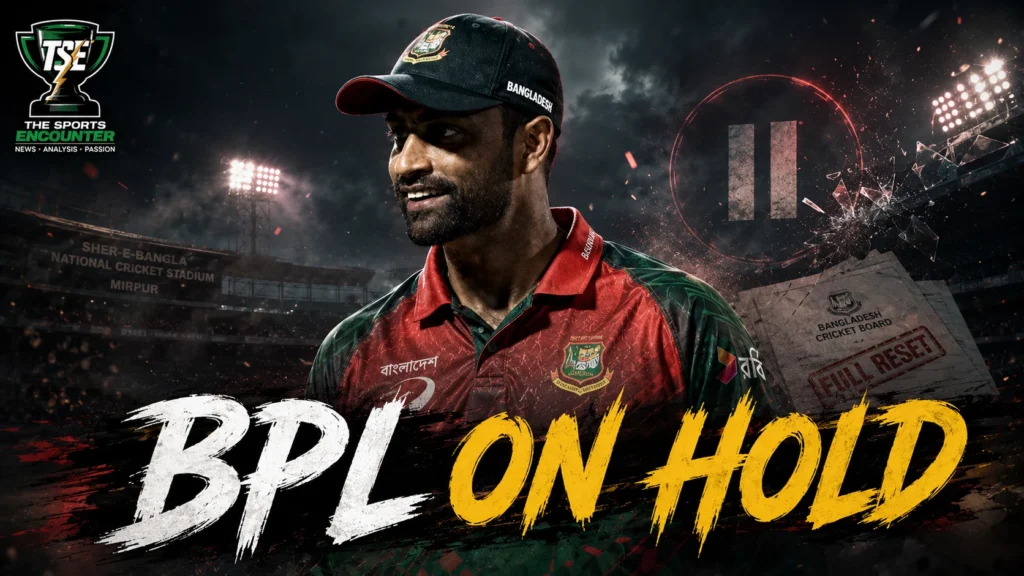
Bangladesh cricket has decided that one lost season is preferable to another Bangladesh Premier League that damages the competition a little more.
The BPL will not be held during the 2026-27 season after Bangladesh Cricket Board president Tamim Iqbal confirmed that the country’s flagship franchise tournament is being put on hold while the board attempts to repair its finances, franchise structure, governance and credibility.
The decision is extraordinary for a competition that has been part of the Bangladesh cricket calendar since 2012 and remains the country’s biggest domestic sporting property.
It is also difficult to describe as completely unexpected.
The BPL has spent years fighting recurring questions around player payments, franchise ownership, rule enforcement, financial sustainability and tournament administration. More recently, allegations involving betting and corrupt conduct added another layer of concern.
Tamim’s conclusion is unusually direct for a governing-body president: holding another BPL simply because Bangladesh has always held one is no longer enough.
“I don’t want to hurry. I want to do it right. If that takes six or 12 months, I’ll take that time,” he told reporters in Mirpur.
For a board that has often tried to repair the tournament while simultaneously staging it, the decision amounts to a change of philosophy.
The BCB is stopping the competition first.
Then it intends to rebuild it.
Bangladesh Premier League Shutdown at a Glance
| Detail | Current Position |
|---|---|
| Competition | Bangladesh Premier League |
| Launched | 2012 |
| 2026-27 season | Will not take place |
| BCB president | Tamim Iqbal |
| Reason for pause | Financial losses, franchise problems, governance concerns and integrity issues |
| Reported BCB losses | Approximately Tk 40 crore across the last two years |
| Possible rebuilding period | Six to 12 months |
| Target for franchise process | April-May 2027 |
| Long-term intention | Relaunch BPL under a stronger and more sustainable model |
Tamim Iqbal Has Chosen the Option BPL Administrators Avoided for Years
The easiest decision would have been to find five or six franchises, organize another player draft, announce a schedule and hope the familiar excitement around Bangladeshi T20 cricket covered the structural problems underneath.
Tamim says he could do exactly that.
He does not want to.
The BCB president has argued that the quality of the tournament and the reputation of the board matter more than maintaining an uninterrupted annual schedule.
That position has been developing for months.
In May, before he was formally elected BCB president, Tamim warned that Bangladesh would be better off without a BPL than with another hastily assembled edition compromised by weak franchises and broken rules.
By late July, he was again signaling that there might not be enough time to prepare the next tournament properly.
Now the uncertainty is over.
The 2026-27 edition is being sacrificed.
The decision fits a broader period of transition around Bangladesh cricket, which The Sports Encounter examined earlier this year in our analysis of Bangladesh’s changing cricket identity.
On the field, Bangladesh have shown signs of developing greater confidence and structure.
The BCB now believes its premier domestic league needs the same treatment off it.
Tk 40 Crore in Losses Makes the Existing Model Hard to Defend
Franchise cricket is supposed to generate money.
The BPL has been doing the opposite for the BCB.
Tamim said the board has lost approximately Tk 40 crore across the last two years while dealing with franchise-related problems and the costs of keeping the competition running.
That is roughly $3.27 million at current reported conversion levels.
For a national board, the problem extends beyond the absolute number.
The BPL is Bangladesh’s most commercially visible domestic competition. It has television value, sponsorship inventory, ticket revenue, player brands and one of the largest cricket audiences in the country available to it.
A tournament with those assets should be strengthening the board’s finances.
If the governing body is instead absorbing recurring losses, the business structure deserves examination.
Tamim has made that point explicitly.
According to United News of Bangladesh’s account of the decision, he argued that the BCB should make money from franchise cricket rather than lose it and that there was little justification for continuing until the underlying problems were fixed.
The BPL’s Franchise Problem Has Been Building for More Than a Decade
The tournament’s instability has rarely been about whether Bangladesh has enough cricket supporters.
It has been about who is allowed to own teams and whether those owners can meet their obligations.
Franchises have changed names.
Ownership groups have disappeared.
Payment disputes have returned repeatedly.
Some teams have failed to meet financial commitments.
The BCB has sometimes been forced to intervene directly to keep the tournament functioning.
That creates a vicious cycle.
A league wants prominent franchises, so it accepts ambitious ownership proposals.
If financial due diligence is weak, the problems emerge later.
Players then wait for money.
Vendors wait for money.
The board steps in.
The next season begins before the previous mess has been completely resolved.
The Sports Encounter recently examined the same structural issue in global franchise cricket after Mitchell Santner’s payment complaint raised wider questions about franchise contracts and player protection.
The lesson applies directly to Bangladesh.
A franchise should not receive access to players, broadcast exposure and league intellectual property unless its ability to meet financial obligations has been tested properly.
Tamim Wants the Next Franchise Process Finished Months Earlier
One of the clearest proposed changes concerns timing.
The BCB wants the next franchise selection process completed around April or May 2027.
That may sound administrative.
It could be one of the most important reforms.
Recent editions have suffered from decisions being made too close to the tournament.
A franchise pulls out.
A new owner has to be found quickly.
Contracts are rushed.
Financial safeguards become secondary to making sure enough teams exist.
Tamim wants that cycle broken.
If owners are selected months in advance, the BCB gains time to evaluate bank guarantees, contracts, funding, ownership structures and operational plans.
If one group withdraws, a replacement can be found without destabilizing the entire competition.
The Integrity Problem Made a Financial Reset Even More Urgent
The BPL’s problems have not been limited to money.
In May, the BCB suspended several individuals following an Integrity Unit investigation connected to the previous tournament.
The cases included allegations involving betting, failure to cooperate with anti-corruption inquiries and obstruction of investigations.
A domestic cricketer, team officials and individuals connected to franchise ownership were among those charged or suspended.
The BCB anti-corruption investigation reported by The Daily Star included alleged violations of the ICC Anti-Corruption Code and an exclusion order connected to earlier BPL editions.
Those remain allegations and disciplinary processes should not be confused with proven match fixing unless a competent process reaches that conclusion.
But the presence of serious integrity investigations creates reputational risk regardless.
A franchise league survives on trust.
Supporters have to believe the competition is genuine.
Players need confidence that contracts will be honored.
Sponsors need confidence that the product is stable.
Broadcasters need fixtures they can sell without wondering what crisis arrives next.
Player Boycotts Added Another Warning
The previous season also suffered disruption when domestic cricketers boycotted matches following controversial comments by a BCB official about players and their financial value.
Matches were rescheduled.
The tournament continued.
The reputational damage did not disappear when play resumed.
That episode matters because it illustrates how governance failures eventually reach the field.
A board can describe unpaid salaries, ownership disputes and administrative disagreements as off-field issues.
They stop being off-field issues when players refuse to play.
Bangladesh cricket has experienced separate salary disputes in domestic competition as well, reinforcing the need for stronger player-payment systems across the national structure.
Players Will Pay a Price for the Reset
The decision is easier to defend institutionally than it is financially for individual cricketers.
Local players will lose one of their most important annual earning opportunities.
That is especially significant for cricketers outside the highest BCB central-contract tiers.
One BPL contract can represent a substantial part of a domestic player’s yearly income.
Tamim has acknowledged that reality.
He said he would be disappointed if he were still a player and found out the tournament was disappearing from the calendar.
His argument is that players also understand how far the competition has fallen below the standard Bangladesh should expect.
That trade-off cannot be ignored.
A governance reset has a human cost.
The BCB should therefore consider whether alternative domestic competitions, expanded match fees or other mechanisms can soften the impact on players while the BPL is absent.
The BPL Still Matters to Bangladesh’s Player Pathway
Despite its administrative problems, the competition has produced genuine cricket value.
Young Bangladeshi players have shared dressing rooms with international professionals.
Domestic cricketers have performed under television pressure.
Fast bowlers have faced overseas power hitters.
Batters have learned to handle international-quality spin.
Players have experienced large crowds, tactical matchups and tournament pressure that ordinary domestic cricket cannot always reproduce.
That development pathway matters for a national team whose recent performances have suggested greater depth.
Bangladesh’s evolving T20 resources were visible during their Zimbabwe tour, even though the series began badly when Zimbabwe beat Bangladesh by 32 runs in the opening T20I.
The response showed why competitive domestic cricket remains valuable.
Bangladesh’s National Team Has Been Showing the Resilience the BPL Now Needs
After losing that first T20I in Bulawayo, Bangladesh recovered.
Saif Hassan and Tanzid Hasan built a 120-run opening partnership as Bangladesh won the second match by 34 runs to level the series.
They then completed the turnaround when Tanzid’s unbeaten 66 carried the visitors through a difficult chase in the decider.
That 2-1 comeback in Zimbabwe showed a side capable of absorbing a setback and correcting course.
The BCB is now attempting something similar institutionally.
The difference is that tournament governance cannot be repaired during a strategic timeout.
It requires contracts, due diligence, financial controls, independent integrity processes and enough lead time to make difficult decisions before the first ball is bowled.
Recent Results Show Why Bangladesh Cannot Afford a Weak Domestic T20 System
The national side’s T20 position remains uneven.
Earlier in the summer, Australia arrived in Bangladesh after losing the ODI series and immediately changed the momentum by winning the first T20I in Chattogram.
The series became increasingly one-sided.
Australia eventually completed a 3-0 sweep when Mitchell Marsh and Spencer Johnson overwhelmed Bangladesh in the third T20I.
Those results reinforced the competitive need for a strong domestic short-format structure.
Bangladesh cannot simply abandon franchise cricket.
It needs a version that actually helps produce better international cricketers while remaining commercially sustainable.
Tamim’s ICC Role Makes the Decision More Significant
There is an unusual international dimension to the BCB president’s position.
In July, the International Cricket Council appointed Tamim chairman of its newly created Franchise Leagues Committee.
The ICC confirmed the committee’s formation alongside representatives from Namibia, India, England and Australia.
The committee was established amid growing concern about the expansion of franchise cricket and its relationship with the international calendar.
Tamim has acknowledged the awkwardness himself.
He is helping oversee franchise-cricket questions internationally while the BPL remains unstable at home.
His response is essentially that Bangladesh should be willing to confront its own failures openly.
Stopping and rebuilding the country’s flagship league could therefore become a practical case study in the governance problems the ICC committee is supposed to examine.
The BPL Has Never Converted Popularity Into IPL-Level Stability
The comparison with the Indian Premier League is unavoidable but often unhelpful if taken too literally.
Bangladesh does not have India’s population, commercial market, broadcast economy or corporate depth.
The BPL was never going to become the IPL simply because both competitions use city-based franchises and Twenty20 cricket.
The better comparison is structural.
Successful leagues create predictable systems.
Franchises understand their rights.
Players understand their contracts.
Sponsors know the calendar.
Broadcasters know the product.
Owners have long enough terms to justify investment.
The BPL has repeatedly changed too many of those variables.
That instability makes long-term commercial planning difficult.
A Long-Term Franchise Model Could Be the Most Important Reform
Tamim has indicated that the BCB wants the tournament to return under a longer-term model.
That would be a significant departure from constant short-term uncertainty.
A credible franchise owner is more likely to invest in:
- coaching structures;
- scouting;
- analytics;
- academy programs;
- brand development;
- fan communities;
- sponsor relationships;
- and player retention
when the ownership horizon extends beyond one tournament.
Longer contracts also make accountability easier.
A franchise that breaches financial requirements risks losing something valuable.
If ownership rights are already temporary and unstable, that deterrent weakens.
Bank Guarantees Cannot Be a Paper Exercise
One of the issues Tamim has highlighted involves bank guarantees and outstanding financial commitments.
This is where the BCB’s reset can become measurable.
Before a franchise enters the next BPL, the board should know:
- who ultimately owns it;
- where its funding comes from;
- whether guaranteed player payments are protected;
- whether previous dues have been settled;
- what happens if the owner withdraws;
- and how quickly the league can access financial security if obligations are missed.
Those should be entry requirements, not crisis-management tools.
The BCB Also Needs to Protect the BPL From Last-Minute Decision-Making
Some of the tournament’s recurring chaos has come from compressed planning windows.
That creates pressure throughout the ecosystem.
Overseas player recruitment becomes harder.
Venues have less time to prepare.
Broadcast planning becomes rushed.
Sponsors receive less activation time.
Ticketing starts late.
Franchise rosters are assembled without long-term sporting logic.
The proposed April-May franchise deadline is therefore more important than it sounds.
A tournament held in the following season should already know its owners months beforehand.
This Is Also a Branding Crisis
The letters BPL still carry enormous recognition in Bangladesh.
Recognition alone does not guarantee trust.
Every payment dispute, ownership failure, boycott and corruption allegation attaches another negative association to the tournament.
Eventually the league stops being discussed primarily for cricket.
Tamim captured that problem when he asked whether Bangladesh could genuinely be proud of what had happened around the BPL in recent years.
That is a branding question as much as a governance question.
The next edition must make supporters talk about batting, bowling, rivalries and standings again.
If administrative controversy dominates another season, the reset will have failed.
The Pause Gives Bangladesh a Rare Opportunity
Cancelling a season creates breathing room that franchise competitions almost never receive.
The BCB can use it badly.
Or it can use it to redesign the competition properly.
The priority list should include:
- independent financial due diligence for all potential franchise owners;
- protected player-payment mechanisms;
- clear minimum capitalization requirements;
- multi-year ownership agreements;
- transparent franchise selection;
- stronger anti-corruption education and enforcement;
- independent integrity oversight;
- a fixed annual tournament window;
- commercial revenue-sharing rules;
- and a long-term player-development strategy.
None of those reforms will guarantee success.
Failing to address them would make the season-long pause difficult to justify.
What Happens to Bangladesh’s Franchise Cricket Reputation Now?
Initially, the cancellation is embarrassing.
There is no useful reason to pretend otherwise.
A major cricket nation has decided it cannot stage its premier domestic T20 competition to an acceptable standard this season.
That will be noticed by overseas players, agents, broadcasters and sponsors.
The longer-term reputational impact depends entirely on what happens next.
If BPL returns with strong franchises, guaranteed payments, reliable scheduling and fewer governance controversies, the pause may eventually look like the moment Bangladesh finally stopped improvising.
If the same problems return in 2027, the lost season will have achieved little.
The BPL Must Still Serve Bangladesh Cricket
The commercial reset should not lose sight of the competition’s sporting purpose.
Bangladesh needs meaningful opportunities for domestic players to compete alongside and against high-level overseas talent.
The recent rise of players such as Tanzid Hasan, Rishad Hossain and others shows that the country’s talent base remains productive.
Our Bangladesh cricket coverage has documented a national side capable of beating major opponents while still suffering sharp fluctuations across formats.
A healthy BPL should help narrow those fluctuations.
It should not create another set of problems for players to manage.
TSE Analysis: Tamim Is Taking a Political Risk
The easy path for a new BCB president would have been to deliver a tournament.
When the opening ceremony begins and six teams run onto the field, administrators can point to continuity.
Stopping the BPL produces no such immediate reward.
Players will be unhappy about lost income.
Fans will lose a major part of the domestic calendar.
Commercial partners lose an annual property.
Critics can accuse the board of failing to organize its biggest competition.
Tamim has decided to absorb those consequences.
That does not automatically make the decision correct.
It makes the standard for what comes next much higher.
The Reset Will Be Judged on Evidence, Not Promises
By the time the next BPL launches, supporters should be able to see what changed.
Who owns each franchise?
How long do they own it?
What financial guarantees have they provided?
Are outstanding player payments cleared?
What integrity structures exist?
How are franchises selected?
What happens when an owner breaks the rules?
How does the BCB prevent another multimillion-dollar loss?
Those answers should be available before the player draft, not after a controversy.
Final Verdict: Missing One BPL Season Is Painful. Repeating the Same BPL Would Be Worse
The Bangladesh Premier League has enough problems to make cancellation understandable and enough value to make permanent abandonment unthinkable.
That is the tension Tamim Iqbal is trying to resolve.
Bangladesh loves franchise cricket.
Players need the opportunities and income.
Broadcasters want the product.
Sponsors want access to its audience.
The national team benefits from players experiencing high-pressure T20 cricket.
But none of those strengths can excuse a tournament that repeatedly creates financial, contractual and governance crises.
Tamim has effectively decided that the BPL’s biggest opponent this year is the BPL itself.
There will be no trophy.
No final.
No franchise rivalry.
The work happens in boardrooms, contracts, financial checks and integrity systems instead.
That will frustrate supporters who want cricket and players who depend on the competition.
If Bangladesh uses the time properly, the reward could be a league strong enough to stop explaining its problems every season.
Tamim says he is willing to wait six months.
He is willing to wait 12.
The important question is what the BPL looks like when that waiting ends.
FAQs
Will the Bangladesh Premier League take place in the 2026-27 season?
No. BCB president Tamim Iqbal confirmed on August 20, 2026 that the BPL will not be staged this season while the board restructures the competition.
Why has the BPL been put on hold?
The BCB has cited financial losses, problems involving franchises, outstanding commitments, governance concerns and integrity issues surrounding recent editions.
How much money has the BCB reportedly lost on the BPL?
Tamim said the board has lost approximately Tk 40 crore across the last two years.
Has the BPL been permanently cancelled?
No. The BCB says it remains committed to the Bangladesh Premier League and intends to relaunch it after restructuring the competition.
When could the BPL return?
No final restart date has been announced. Tamim said he is willing to spend six to 12 months rebuilding the tournament if necessary.
When will new BPL franchises be selected?
The BCB wants to complete the next franchise selection process around April-May 2027, significantly earlier than in previous editions.
Were there corruption investigations involving the BPL?
Yes. The BCB Integrity Unit investigated alleged betting and corrupt conduct connected to previous BPL editions. Several individuals were provisionally suspended or charged under anti-corruption provisions. Allegations should not be treated as proven match fixing unless the relevant disciplinary process establishes that conclusion.
Why is Tamim Iqbal’s ICC role relevant?
The ICC appointed Tamim chairman of its Franchise Leagues Committee in July 2026. He has argued that Bangladesh must address the weaknesses in its own franchise competition while contributing to international discussions about franchise cricket governance.
Will Bangladeshi players lose income because of the cancellation?
Yes. The BPL is an important earning opportunity for domestic cricketers, and Tamim has acknowledged that players will understandably be disappointed by the lost season.
What does the BCB need to fix before bringing the BPL back?
The major priorities include stronger franchise due diligence, financial guarantees, reliable player payments, transparent ownership selection, anti-corruption safeguards, longer-term franchise agreements and more professional tournament planning.