


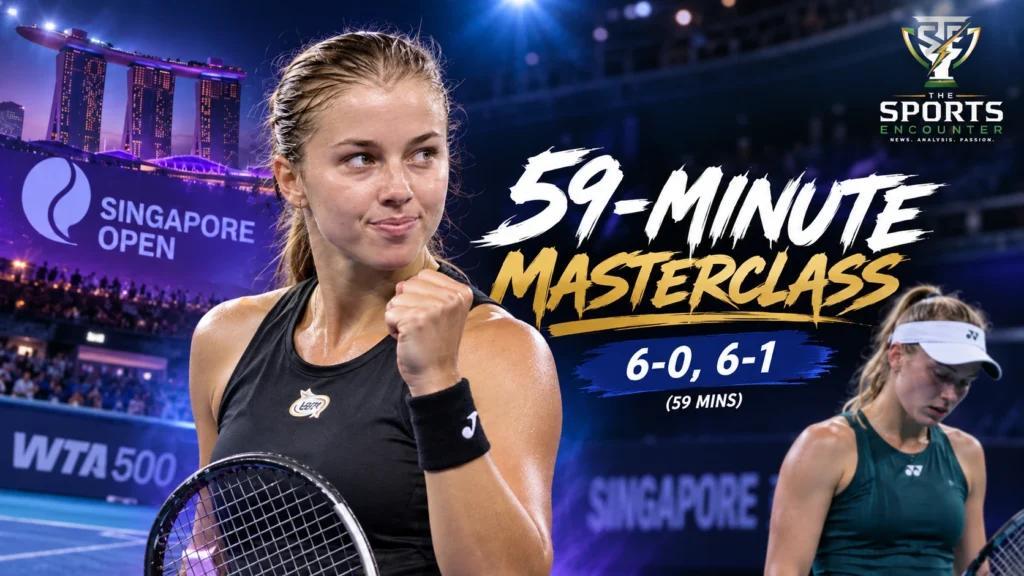
SINGAPORE, September 23, 2026: Maja Chwalinska did not give Oleksandra Oliynykova enough time to turn their Singapore Open second-round match into a contest.
The No. 5 seed needed only 59 minutes to win 6-0, 6-1 at the OCBC Arena, dropping just 20 points across the entire match and advancing to the quarterfinals without losing a set in Singapore.
The score is emphatic enough on its own. The underlying numbers make the performance even harder to dismiss. Chwalinska committed only seven unforced errors, struck 10 winners, converted six of eight break points and allowed Oliynykova just one break opportunity.
That efficiency matters because Singapore is no longer simply another good week following Chwalinska’s remarkable Roland Garros breakthrough. After reaching the French Open final as a qualifier earlier this season, she is now beginning to show that the variety, patience and court awareness that carried her through Paris can travel across surfaces and continents.
Her opening 6-4, 6-2 victory over Rebecca Sramkova required 79 minutes and a different kind of control. Against Oliynykova, there was almost no extended problem to solve. Chwalinska took command immediately and never allowed the Ukrainian enough sustained momentum to change the match.
Maja Chwalinska vs Oleksandra Oliynykova: Score and Key Numbers
| Category | Maja Chwalinska | Oleksandra Oliynykova |
|---|---|---|
| Final score | 6-0, 6-1 | 0-6, 1-6 |
| Match time | 59 minutes | |
| Winners | 10 | 7 |
| Unforced errors | 7 | 33 |
| Break points converted | 6/8 | 1/1 |
| Points lost in first set | 8 | Not applicable |
| Total points lost | 20 | Not applicable |
The figures come from the WTA’s official match analysis, and the largest gap is not the winner count.
It is the error count.
Oliynykova finished with 33 unforced errors, nearly five times Chwalinska’s seven. Against a player whose game is built around changing height, pace and direction, that imbalance becomes especially damaging because Chwalinska rarely needs to force low-percentage attacks when an opponent is already giving away points.
Chwalinska Lost Only Eight Points in the Opening Set
The first set lasted only six games, and Oliynykova won just eight points across all of them.
That level of control is difficult to produce even in a one-sided professional match because one loose service game, a short sequence of return errors or a few aggressive points from the opponent can quickly disrupt a 6-0 set.
Chwalinska never gave Oliynykova that opening.
Her return pressure made service games uncomfortable almost immediately, while her own error management prevented the Ukrainian from building free momentum. Oliynykova frequently had to play an additional ball and then another, often from positions that did not allow her to dictate.
The result was not spectacular tennis in the conventional sense of endless winners and highlight-reel aggression. It was suffocating efficiency.
That is also what separates Wednesday’s performance from some of the more dramatic matches already produced in Singapore. Tatiana Prozorova needed nearly three hours and a major comeback to survive Sofia Costoulas. Chwalinska required less than an hour because she prevented danger from developing in the first place.
Oliynykova’s 33 Errors Tell Only Part of the Story
A scoreline this lopsided can tempt analysis toward a simple explanation: one player played well and the other played badly.
That would miss what Chwalinska did to create the conditions for those errors.
Oliynykova had started her tournament by defeating Vivian Wolff 6-1, 7-6(1), a result included in TSE’s complete Singapore Open Day 2 report. She had already shown she could control stretches of play on these courts.
Chwalinska took that comfort away.
The Pole’s ability to vary spin and trajectory means opponents do not always receive the same ball twice. A rally can begin with a relatively neutral exchange and suddenly change when Chwalinska alters the height or pace enough to move the contact point.
That does not appear in the box score as a winner.
It frequently appears one or two shots later as an opponent’s mistake.
Against Oliynykova, those mistakes accumulated far faster than the Ukrainian could reset.
Six Breaks From Eight Chances Made Recovery Almost Impossible
Chwalinska also converted six of eight break points.
That is important because dominance on return does not always translate into dominance on the scoreboard. A player can create repeated opportunities, fail to finish them and allow an opponent to remain emotionally connected to a match.
Chwalinska gave Oliynykova almost no such escape.
Once a return game moved into break-point territory, she usually finished the job. That prevented Oliynykova from using difficult holds to regain confidence and ensured scoreboard pressure continued building.
The only significant interruption came when Oliynykova converted her lone break opportunity in the second set.
By then, the problem was much larger than one service break. Chwalinska already controlled the rhythm, the error differential and the return games.
Singapore Has Been Even Cleaner Than Chwalinska’s Opening Match
Chwalinska has now won four consecutive sets at the tournament.
She beat Sramkova 6-4, 6-2 in the first round and followed with 6-0, 6-1 against Oliynykova. Across those two matches, she has won 24 games and lost only seven.
Her first-round performance already stood out in TSE’s Singapore Open Day 1 analysis, which examined how Chwalinska, Leylah Fernandez, Aliaksandra Sasnovich and the qualifiers shaped the tournament’s opening day.
Wednesday raised the level of the argument.
Sramkova forced Chwalinska to solve a competitive opening set before the match separated. Oliynykova never reached that stage.
Two matches do not establish what the rest of the tournament will look like, especially with Elise Mertens waiting in the quarterfinals. They do establish that Chwalinska has reached the last eight without spending unnecessary physical or emotional energy.
At this stage of the season, that can matter.
Why This Quarterfinal Means More After Roland Garros
Chwalinska’s 2026 season changed in Paris.
She entered Roland Garros ranked outside the world’s Top 100, came through qualifying and reached the final before Mirra Andreeva stopped her 6-3, 6-2.
TSE documented that conclusion in our French Open final analysis, while the wider French Open 2026 archive shows how quickly the women’s draw changed around her breakthrough.
The challenge after a surprise Grand Slam run is always different from the challenge during it.
In Paris, Chwalinska entered matches with very little expectation attached to her. Opponents had limited recent tour-level evidence to study, and every victory expanded the story.
Now she is seeded fifth at a WTA 500 tournament.
Opponents know what she does well. Coaches can study the patterns that troubled higher-ranked players in Paris. Her variety is no longer a surprise.
That makes sustained results more revealing than the original breakthrough.
Singapore is beginning to provide them.
Chwalinska Has Now Reached Three WTA-Level Quarterfinals in 2026
The Singapore last-eight appearance is the third WTA-level quarterfinal of Chwalinska’s career, all of them coming during this season.
She previously reached the quarterfinals in Cluj-Napoca and then went considerably further at Roland Garros, where she finished runner-up.
The sequence matters because it shows the season is no longer defined solely by Paris.
Chwalinska’s results have not been perfectly linear since the French Open. Few breakout seasons are. She has experienced early exits and opponents adjusting more effectively to her game.
The relevant question is whether she can continue producing deep runs often enough for the Roland Garros result to become part of a larger progression.
Reaching the Singapore quarterfinals without losing a set moves that question in the right direction.
Chwalinska Is Now 2-0 Against Oliynykova
Wednesday was also Chwalinska’s second victory in two career meetings with Oliynykova.
The first came earlier this year at the WTA 125 event in Florianopolis.
Head-to-head records based on only two matches should not be overstated, particularly when the meetings come under different conditions. Still, the Singapore result was considerably more decisive than a routine second victory.
It suggests that Chwalinska’s variation creates a particularly uncomfortable problem for Oliynykova when the Pole controls the opening exchanges.
The next opponent will present a very different test.
Elise Mertens Awaits in a French Open Rematch
Chwalinska will face defending Singapore champion Elise Mertens in the quarterfinals.
Mertens advanced when Barbora Krejcikova withdrew from their scheduled second-round match because of a lower-back injury. The official WTA tournament page lists Mertens as the No. 4 seed and defending champion.
The matchup carries immediate history.
Chwalinska defeated Mertens 6-4, 6-0 in the second round of Roland Garros earlier this year, one of the victories that transformed her run from an interesting qualifier story into something much more serious. The official WTA match record shows how decisively that Paris meeting turned after the opening set.
Singapore changes the conditions.
Paris was played on clay. Singapore is an indoor hard-court event. Mertens also enters the quarterfinal without having to complete a second-round match, while Chwalinska arrives with two convincing wins and greater competitive rhythm on the surface.
That creates a useful tactical contrast.
Mertens will have freshness and extensive experience in these conditions. Chwalinska has momentum and recent evidence that this matchup can work in her favor.
Singapore’s Draw Keeps Changing Around the Contenders
The tournament has already lost several significant names.
No. 2 seed Amanda Anisimova withdrew before playing because of a left wrist injury, a development TSE covered in our report on Singapore’s changing draw.
Donna Vekic was then removed in emphatic fashion when Wang Xinyu beat the No. 8 seed 6-1, 6-2.
Krejcikova’s latest withdrawal removes another Grand Slam champion from active competition.
Those changes create opportunity, but Chwalinska’s route should not be reduced to a weakened draw.
She has played twice and dominated both matches. The quarterfinal against Mertens now gives her a direct test against the defending champion and a player she has already beaten during the defining tournament of her season.
What Chwalinska’s 59-Minute Win Actually Tells Us
The most important number is not 59.
It is seven.
Seven unforced errors across a complete match tells us how little Chwalinska gave away while forcing Oliynykova to take greater risks. The contrast with the Ukrainian’s 33 errors explains why the match accelerated away so quickly.
Chwalinska did not need to chase lines or turn every rally into an attacking exhibition. She controlled enough of the court, varied the ball effectively and waited for the balance of the rally to move in her favor.
That style can frustrate opponents who need rhythm.
It can also become vulnerable when a stronger player takes time away from her before she can establish those changes of pace.
Mertens should provide a much better test of that second possibility.
For now, though, Chwalinska has done exactly what a seeded contender should do against an opponent who begins making errors.
She did not let her back into the match.
Frequently Asked Questions
What was the Maja Chwalinska vs Oleksandra Oliynykova score?
Maja Chwalinska defeated Oleksandra Oliynykova 6-0, 6-1 in the second round of the 2026 Singapore Tennis Open.
How long did Chwalinska vs Oliynykova last?
The match lasted only 59 minutes.
How many unforced errors did Maja Chwalinska make?
Chwalinska committed only seven unforced errors while hitting 10 winners. Oliynykova finished with seven winners and 33 unforced errors.
How many break points did Chwalinska convert?
Chwalinska converted six of eight break-point opportunities. Oliynykova had one break point and converted it.
Has Maja Chwalinska dropped a set at the Singapore Open?
No. She defeated Rebecca Sramkova 6-4, 6-2 in the opening round and Oliynykova 6-0, 6-1 in the second round.
Who does Maja Chwalinska play next?
Chwalinska will face defending champion and No. 4 seed Elise Mertens in the quarterfinals.
Has Chwalinska beaten Elise Mertens before?
Yes. Chwalinska defeated Mertens 6-4, 6-0 in the second round of the 2026 French Open during her run to the Roland Garros final.
How many WTA-level quarterfinals has Chwalinska reached?
Singapore is the third WTA-level quarterfinal of her career, following Cluj-Napoca and Roland Garros earlier in 2026.
What seed is Maja Chwalinska in Singapore?
Chwalinska is the No. 5 seed at the 2026 Singapore Tennis Open.
Is the Singapore Tennis Open a WTA 500 tournament?
Yes. The tournament was upgraded to WTA 500 status for 2026 and is being played on indoor hard courts at the OCBC Arena.
Follow The Sports Encounter’s Tennis coverage for continuing Singapore Open results, player analysis, rankings context and coverage of the wider WTA Asian Swing.