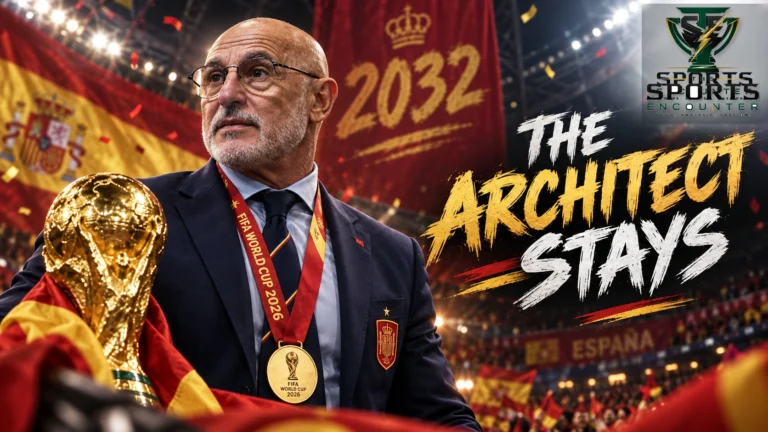
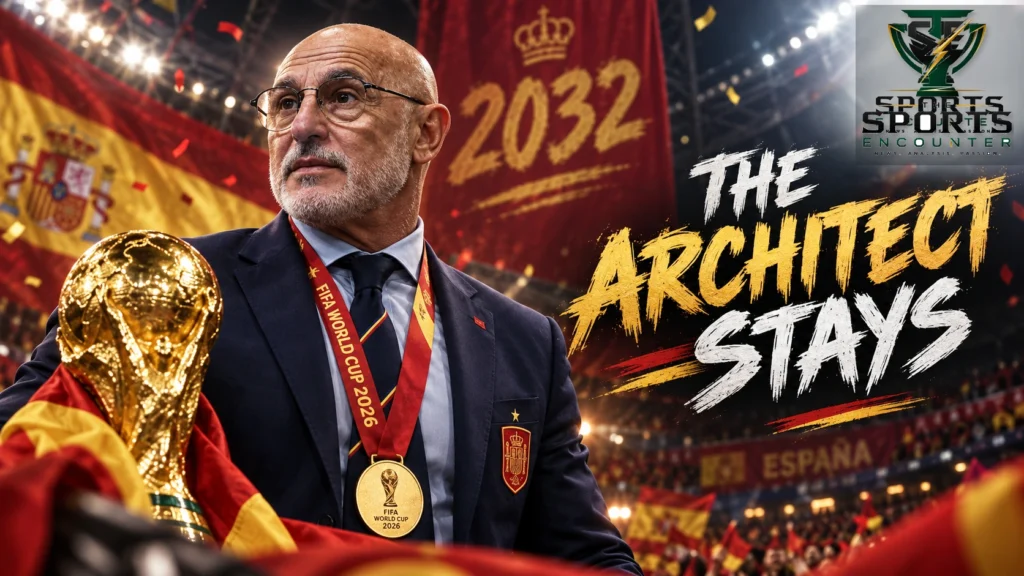
MADRID, Spain, September 21, 2026: Spain have moved quickly to secure the coach behind their return to the top of world football, extending Luis de la Fuente’s contract through 2032 and effectively placing the next six years of the national team under the same sporting leadership.
The Royal Spanish Football Federation approved the extension unanimously on Monday, two months after De la Fuente guided Spain to their second FIFA World Cup title with a 1-0 extra-time victory over Argentina in New Jersey.
The new agreement covers Euro 2028, the 2030 World Cup and Euro 2032. That timeline is important because the 2030 World Cup will be partly staged in Spain, giving De la Fuente responsibility for taking the reigning champions into a tournament carrying enormous domestic expectations.
The RFEF described the decision as one built around stability and confidence. Its president Rafael Louzán presented De la Fuente as the central figure in a long-term sporting project rather than a coach simply being rewarded for one successful tournament.
Story at a glance
What Does Luis de la Fuente’s New Spain Contract Cover?
The RFEF confirmed the six-year extension after a board meeting at the Ciudad del Fútbol in Las Rozas.
Why Spain Went Beyond the Expected 2030 Extension
The timing makes the additional two years revealing.
From Nations League Pressure to World Cup Champion in Three Years
De la Fuente’s senior-team tenure began in December 2022 after Spain’s Round of 16 exit at the Qatar World Cup.
Spain’s 2026 World Cup Run Strengthened De la Fuente’s Position
Spain did not cruise through every stage of the World Cup.
France Showed Why Spain Had Become More Than a Possession Team
The semifinal produced perhaps the clearest tactical argument for keeping De la Fuente.
Only six days earlier, The Sports Encounter reported that Spain were preparing to retain De la Fuente through the 2030 World Cup. The official agreement now goes further, carrying his tenure through the following European Championship in 2032.
What Does Luis de la Fuente’s New Spain Contract Cover?
| Competition Cycle | De la Fuente Status | Why It Matters |
|---|---|---|
| UEFA Nations League 2026-27 | Under contract | Immediate post-World Cup test |
| Euro 2028 | Under contract | Spain will defend the European title won in 2024 |
| FIFA World Cup 2030 | Under contract | Spain will be co-hosts and defending world champions |
| Euro 2032 | Under contract | Extension carries through another full continental cycle |
The RFEF confirmed the six-year extension after a board meeting at the Ciudad del Fútbol in Las Rozas.
The federation specifically identified Euro 2028, the 2030 World Cup and Euro 2032 as the competitions around which the new agreement is built.
This gives Spain unusual managerial certainty for an international team. National-team coaching cycles often change after a World Cup or European Championship, especially when a generation begins to evolve. Spain have chosen the opposite direction by tying the next phase directly to the coach who created the current one.
Why Spain Went Beyond the Expected 2030 Extension
The timing makes the additional two years revealing.
Reports earlier in September had pointed toward a deal carrying De la Fuente through the 2030 World Cup. That would already have represented a significant commitment because Spain will host part of that tournament alongside Portugal and Morocco, with opening centenary matches also scheduled in South America.
The RFEF instead extended the agreement through 2032.
That removes the 2030 World Cup from becoming an automatic contractual endpoint.
Spain are effectively saying that the coach responsible for their current system should also have the opportunity to manage whatever transition follows that tournament.
For a squad containing players at very different career stages, that could become important. Lamine Yamal and several members of the younger core may still be approaching their peak in 2030 and 2032, while established leaders such as Rodri will be much deeper into their careers.
De la Fuente has already shown that he is comfortable reshaping roles without tearing apart the wider structure.
From Nations League Pressure to World Cup Champion in Three Years
De la Fuente’s senior-team tenure began in December 2022 after Spain’s Round of 16 exit at the Qatar World Cup.
His first months were not universally convincing. Spain lost 2-0 to Scotland in only his second competitive match, and questions quickly emerged over whether a coach promoted from the federation’s youth structure could handle the senior job.
Seven months after his appointment, Spain won the 2023 UEFA Nations League.
One year later, they won Euro 2024.
In July 2026, they completed the sequence by lifting the World Cup.
The RFEF’s official review of De la Fuente’s tenure notes that Spain have reached the final of every tournament they have entered since he took charge.
| Major Competition | Spain’s Outcome Under De la Fuente |
|---|---|
| UEFA Nations League 2023 | Champions |
| Euro 2024 | Champions |
| FIFA World Cup 2026 | Champions |
The progression explains why Monday’s extension feels less like a conventional post-tournament reward and more like the continuation of an established national-team model.
Spain’s 2026 World Cup Run Strengthened De la Fuente’s Position
Spain did not cruise through every stage of the World Cup.
They opened with a frustrating draw against Cape Verde before finding their attacking rhythm and entering the knockout rounds with a clearer identity.
The real shift came once elimination football began.
Spain defeated Austria 3-0 in the Round of 32, a performance TSE examined in our report on Spain finally rediscovering their World Cup knockout authority.
Portugal followed in the Round of 16, where Mikel Merino’s late goal ended Cristiano Ronaldo’s final World Cup run. That decisive night is detailed in TSE’s Spain-Portugal analysis.
The quarterfinal against Belgium became a different test. Spain had to respond to resistance, goalkeeper changes and a match where rebounds rather than flowing combinations produced the decisive goals. Spain’s 2-1 quarterfinal victory over Belgium showed the team could win without controlling every decisive moment in the way it preferred.
France Showed Why Spain Had Become More Than a Possession Team
The semifinal produced perhaps the clearest tactical argument for keeping De la Fuente.
France entered with Kylian Mbappé, Ousmane Dembélé and one of the tournament’s most dangerous attacks.
Spain won 2-0.
They controlled territory, protected central areas and prevented France from turning transition opportunities into the type of open game that suited their forwards.
TSE described that shift in our semifinal report after Spain eliminated France.
The performance mattered because Spain’s old stereotype had become incomplete.
Possession remained central to the team’s identity, but De la Fuente had added direct running, stronger defensive spacing, greater wide threat and a willingness to let matches become more physical when necessary.
Those qualities carried directly into the final.
How the Argentina Final Completed De la Fuente’s Transformation
Argentina survived 105 minutes of Spanish pressure in New Jersey largely because Emiliano Martínez kept producing saves.
Spain eventually found the breakthrough in extra time.
Nico Williams helped create the decisive sequence before Ferran Torres scored in the 106th minute, giving Spain a 1-0 victory and their second men’s World Cup title.
The match is reconstructed in detail in TSE’s World Cup final report.
FIFA confirmed that Spain controlled long stretches of the final before Torres finally broke Argentina’s resistance. The official FIFA match report records the 106th-minute winner and Spain’s second global title.
The victory also gave Spain a rare historical position. The country became the reigning holder of both FIFA’s men’s and women’s world titles, following the women’s 2023 triumph.
De la Fuente’s 50-Game Record Explains the Federation’s Confidence
| De la Fuente With Spain | Record Through World Cup Final |
|---|---|
| Matches | 50 |
| Wins | 38 |
| Draws | 10 |
| Losses | 2 |
| Win Rate | 76% |
| Major Titles | 3 |
The World Cup final was De la Fuente’s 50th match in charge of Spain.
He reached that milestone with 38 victories, 10 draws and only two defeats.
The 76 percent win rate equals the best percentage recorded by a Spain coach over that opening 50-game span, according to the federation.
Those numbers become more significant when combined with tournament conversion.
Spain have not simply accumulated wins in qualifying matches and friendlies. The same period has delivered three major trophies.
The 38-Match Unbeaten Run Shows How Difficult Spain Have Become to Remove
Spain ended the World Cup on a 38-match unbeaten run.
FIFA lists that as the longest unbeaten streak in the history of men’s international football, moving Spain beyond Italy’s 37-game sequence from 2018 to 2021.
The run began against Brazil in March 2024 and carried through Euro 2024 and the entire 2026 World Cup.
What stands out is the variety of matches Spain survived during that sequence.
They won tournament finals, knockout matches, qualifiers and games requiring very different tactical solutions.
The World Cup route alone moved from Austria’s structure to Portugal’s emotional intensity, Belgium’s physical resistance, France’s transition threat and Argentina’s deep defense.
De la Fuente’s Spain found a different route through each one.
His RFEF Story Started Long Before the Senior Team
The six-year extension also reflects institutional familiarity.
De la Fuente joined the Spanish federation system in 2013 and spent years working through the youth structure before taking the senior job.
He won the European Under-19 Championship in 2015 and the European Under-21 Championship in 2019, while also coaching Spain’s Olympic team.
That history means many of the senior players passed through systems De la Fuente already understood before he became national coach.
Rodri, Mikel Merino and several other members of the present generation developed within the same federation pathway.
The RFEF has now chosen to maintain that continuity at the top rather than separate the senior team from the developmental structure beneath it.
Why the 2030 World Cup Will Create a Different Kind of Pressure
Winning the 2026 World Cup gives De la Fuente security.
The 2030 tournament will create expectations unlike anything he has experienced so far.
Spain will help host the World Cup alongside Portugal and Morocco, with centenary matches also planned in Uruguay, Argentina and Paraguay.
By then, Spain will be defending the trophy while playing a significant portion of the tournament in front of home supporters.
The combination of hosting responsibility and defending-champion status will change the emotional environment around every selection decision and tactical choice.
This is where the 2032 contract becomes relevant.
The coach enters 2030 without the immediate uncertainty of an expiring deal. The federation has already told the squad that one tournament result is not intended to determine the entire future of the project.
What Happens Next for Spain?
Spain’s attention now turns away from the World Cup celebration and toward the UEFA Nations League.
England, Croatia and the Czech Republic are among their upcoming opponents during the September and October international windows.
The challenge changes immediately.
Every opponent now meets Spain as the world champion.
De la Fuente must also begin managing the transition from a tournament-winning squad into a group capable of remaining fresh through Euro 2028 and beyond.
The World Cup final preview in TSE’s complete Argentina-Spain build-up showed how many of Spain’s current strengths depend on players who may still be central four years from now.
The federation has decided that the coach responsible for developing that group should remain with it as the next cycle begins.
Spain’s Bigger Bet Is Continuity
The 2032 extension says more about Spain’s direction than the contract length alone.
International football often rewards short cycles because one tournament can quickly change perceptions around a coach.
Spain have chosen to protect the system that produced the Nations League, Euro 2024 and the World Cup.
That does not guarantee the same results will continue.
It does give De la Fuente something national-team managers rarely receive after success: time to shape what comes after the winning generation as well as what remains of it.
TSE explored the historical bridge between Spain’s two World Cup victories in our feature connecting Andrés Iniesta’s 2010 winner with Ferran Torres’ 2026 goal.
The next phase will determine whether 2026 becomes the high point of De la Fuente’s Spain or one chapter inside something even longer.
Continue the Soccer Story

Frequently Asked Questions
How long is Luis de la Fuente’s new Spain contract?
Luis de la Fuente has agreed a six-year extension that keeps him in charge of Spain through 2032.
Which tournaments will De la Fuente manage under the new deal?
The agreement covers Euro 2028, the 2030 FIFA World Cup and Euro 2032, assuming he remains in the position throughout the full contract.
Why did Spain extend De la Fuente’s contract?
The RFEF cited stability, confidence and continuity after De la Fuente led Spain to the Nations League, Euro 2024 and the 2026 World Cup.
When did Luis de la Fuente become Spain coach?
He was appointed Spain’s senior national-team coach in December 2022 after the World Cup in Qatar.
How many trophies has De la Fuente won with Spain?
He has won three major senior titles: the 2023 UEFA Nations League, Euro 2024 and the 2026 FIFA World Cup.
What is Luis de la Fuente’s record with Spain?
Through his first 50 matches, De la Fuente recorded 38 wins, 10 draws and two defeats, a 76 percent win rate.
Who did Spain beat in the 2026 World Cup final?
Spain defeated Argentina 1-0 after extra time in New Jersey, with Ferran Torres scoring in the 106th minute.
How many World Cups have Spain won?
Spain have won two men’s World Cups, in 2010 and 2026.
What is Spain’s unbeaten record under De la Fuente?
Spain finished the 2026 World Cup on a 38-match unbeaten run, the longest recorded sequence in men’s international football.
Will Spain host the 2030 World Cup?
Yes. Spain will co-host the 2030 FIFA World Cup with Portugal and Morocco, while centenary matches will also be staged in Uruguay, Argentina and Paraguay.
Spain
- Spain Hand De la Fuente a 2032 Deal as World Champions Lock In Their Long-Term Architect
- Davis Cup 2026: Spain, Germany and Great Britain Complete Final 8 as Bologna Field Is Set
- Spain Trust the Architect: De la Fuente Set to Lead World Champions Into 2030
- Spain Crush Australia 89-66 to Join the Best Four in the FIBA World Cup 2026
- FIFA Hits Argentina with Heavy World Cup Sanctions as Paredes Gets 10-Game Ban