


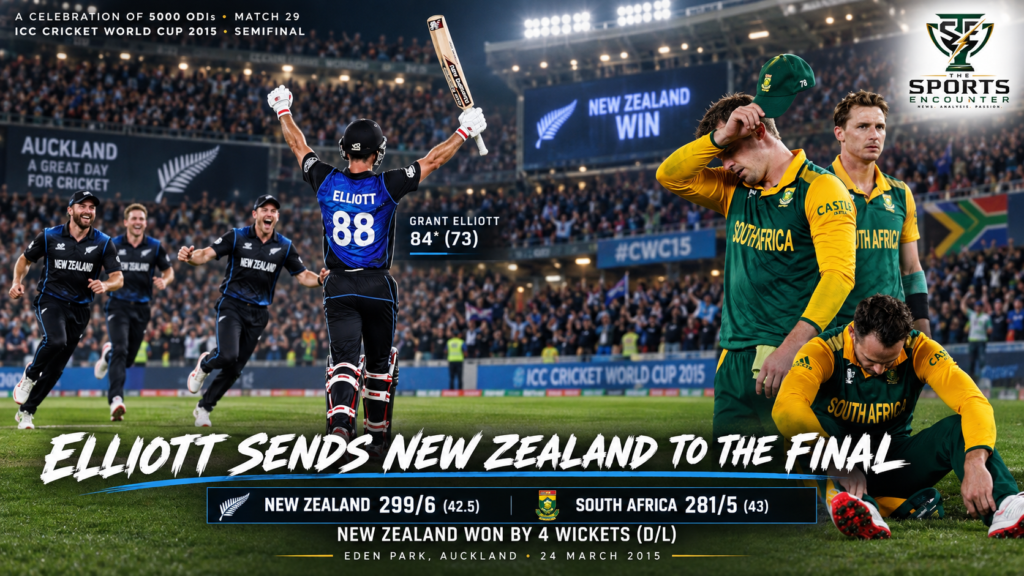
AUCKLAND, New Zealand, September 20, 2026: South Africa had five runs to defend from two deliveries, Dale Steyn with the ball, and a first men’s Cricket World Cup final within reach. Grant Elliott had spent much of the evening keeping New Zealand’s chase alive. Now he had to finish it.
His six off the penultimate delivery settled a semifinal that neither side could control for long. New Zealand reached 299/6 to beat South Africa by four wickets under the Duckworth-Lewis method at Eden Park on March 24, 2015.
After six previous semifinal defeats, New Zealand finally advanced. This entry in A Celebration of 5000 ODIs examines the work behind Elliott’s finish: an explosive opening, a demanding middle-order recovery, and opportunities South Africa could not convert.
Match at a Glance
| Detail | Information |
|---|---|
| Match | New Zealand vs South Africa |
| Competition | ICC Cricket World Cup 2015 |
| Stage | First semifinal |
| Date | March 24, 2015 |
| Venue | Eden Park, Auckland |
| Toss | South Africa elected to bat |
| South Africa | 281/5 in 43 overs |
| Revised target | New Zealand needed 298 from 43 overs |
| New Zealand | 299/6 in 42.5 overs |
| Result | New Zealand won by four wickets, D/L method, with one ball remaining |
| Player of the Match | Grant Elliott, 84* from 73 balls |
| Leading bowlers | Corey Anderson 3/72; Morne Morkel 3/59 |
| Decisive partnership | Elliott and Anderson added 103 for the fifth wicket |
| Consequence | New Zealand reached their first men’s World Cup final |
How Did Rain Change South Africa’s Innings?
South Africa recovered from 31/2 through partnerships that gave their strongest hitters a platform. Faf du Plessis and Rilee Rossouw added 83 before AB de Villiers helped lift the score to 216/3 after 38 overs.
Rain then reduced the match to 43 overs per side. South Africa returned with five overs available and added 65 runs, finishing at 281/5.
New Zealand’s target became 298. The adjustment recognized that South Africa had planned most of their innings around 50 overs before losing seven at short notice. The ICC’s explanation of rain-adjusted targets outlines the resources principle behind such calculations.
Rain interrupted South Africa’s acceleration, but their response still produced a formidable chase. It cannot explain the result on its own.
Faf du Plessis and AB de Villiers Built the Platform
Du Plessis scored 82 from 107 balls, absorbing the consequences of Trent Boult’s two early wickets. De Villiers supplied 65 unbeaten from 45, increasing the scoring rate without sacrificing his wicket.
Their contrasting roles mattered. South Africa could attack late because those two had preserved the innings.
David Miller Turned Five Overs Into a Major Threat
Miller’s 49 from 18 balls included six fours and three sixes. Forty-two of his runs came in boundaries.
His hitting exposed New Zealand’s expensive supporting overs. Anderson took three wickets but conceded 72 in six; Daniel Vettori’s 0/46 from nine offered valuable restraint elsewhere.
Brendon McCullum Made the Target Feel Reachable
McCullum scored 59 from 26 balls, with eight fours and four sixes. New Zealand reached 71 without loss after five overs.
That start gave the middle order room to survive later setbacks. Attacking Steyn also forced South Africa to confront a chase moving much faster than their target required.
The approach echoed New Zealand’s earlier Eden Park escape against Australia, although this time the challenge demanded sustained scoring rather than survival against a small total.
Morkel restored the contest by dismissing McCullum and Kane Williamson. Martin Guptill’s run-out and Ross Taylor’s departure eventually left New Zealand 149/4.
Corey Anderson Supplied the Partnership the Chase Needed
With 149 still required, Elliott and Anderson had to protect wickets while maintaining momentum.
Their 103-run partnership carried New Zealand to 252 before Anderson fell for 58. It prevented South Africa from attacking the lower order early enough to dictate the finish.
Anderson’s contribution deserves particular weight because his bowling had been expensive. He responded by helping repair the chase, giving New Zealand substantial value across both innings despite an uneven individual match.
Morne Morkel Kept South Africa in the Contest
Morkel’s 3/59 included McCullum, Williamson, and Anderson. Each dismissal interrupted an important phase of New Zealand’s innings.
Imran Tahir also applied pressure, conceding only 40 from nine overs. Together, they kept the target difficult despite Steyn’s eventual 1/76.
South Africa’s fielding undermined that work. De Villiers missed a run-out opportunity against Anderson, while Elliott survived a late catching chance when Farhaan Behardien and JP Duminy converged.
Those errors were costly, but describing the entire performance as another collapse would obscure its competitiveness. South Africa repeatedly recovered against a strong batting side.
Grant Elliott Finished What New Zealand Had Built
Elliott’s unbeaten 84 from 73 balls earned the Player of the Match award. His innings combined seven fours, three sixes, and enough controlled scoring to keep the final assault possible.
New Zealand needed 12 from the last over. Vettori’s boundary from the third delivery was crucial, followed by a bye that returned Elliott to strike.
Five were needed from two balls. Elliott cleared the boundary off Steyn, completing a chase that had required contributions at every stage.
The final over unfolded as follows:
| Delivery | Outcome | Runs still needed |
|---|---|---|
| 42.1 | Vettori, one bye | 11 |
| 42.2 | Elliott, single | 10 |
| 42.3 | Vettori, four | 6 |
| 42.4 | Vettori, one bye | 5 |
| 42.5 | Elliott, six | Target passed |
Why Does This Match Belong in the Collection?
New Zealand had experienced semifinal pain at this ground in their 1992 defeat against Pakistan. South Africa carried memories of the 1992 rain-rule controversy, the tied 1999 semifinal, and their 2011 elimination by New Zealand.
Here, history added pressure without determining the outcome. New Zealand won through the combination of early aggression, middle-order resilience, and late execution.
The match demonstrated how the ODI format’s longer innings can accommodate several competing stories before a single delivery resolves them.
Australia subsequently beat New Zealand in the final. That defeat left the title beyond reach, but it did not diminish what Elliott and his teammates achieved in Auckland.
Explore more matches in the 5000 ODIs collection and follow TSE’s wider cricket coverage.
Complete Match Scorecard
South Africa Batting
| Batter | Dismissal | R | B | 4s | 6s | SR |
|---|---|---|---|---|---|---|
| Hashim Amla | b Boult | 10 | 14 | 2 | 0 | 71.43 |
| Quinton de Kock | c Southee b Boult | 14 | 17 | 2 | 0 | 82.35 |
| Faf du Plessis | c Ronchi b Anderson | 82 | 107 | 7 | 1 | 76.64 |
| Rilee Rossouw | c Guptill b Anderson | 39 | 53 | 2 | 1 | 73.58 |
| AB de Villiers | Not out | 65 | 45 | 8 | 1 | 144.44 |
| David Miller | c Ronchi b Anderson | 49 | 18 | 6 | 3 | 272.22 |
| JP Duminy | Not out | 8 | 4 | 1 | 0 | 200.00 |
| Vernon Philander | Did not bat | — | — | — | — | — |
| Dale Steyn | Did not bat | — | — | — | — | — |
| Morne Morkel | Did not bat | — | — | — | — | — |
| Imran Tahir | Did not bat | — | — | — | — | — |
Extras: 14, including 1 bye and 13 wides
Total: 281/5 in 43 overs
Fall of wickets: 21/1, Amla (3.4); 31/2, de Kock (7.5); 114/3, Rossouw (26.1); 217/4, du Plessis (38.2); 272/5, Miller (42.2).
New Zealand Bowling
| Bowler | Overs | Runs | Wickets | Economy |
|---|---|---|---|---|
| Tim Southee | 9 | 55 | 0 | 6.11 |
| Trent Boult | 9 | 53 | 2 | 5.89 |
| Matt Henry | 8 | 40 | 0 | 5.00 |
| Daniel Vettori | 9 | 46 | 0 | 5.11 |
| Kane Williamson | 1 | 5 | 0 | 5.00 |
| Grant Elliott | 1 | 9 | 0 | 9.00 |
| Corey Anderson | 6 | 72 | 3 | 12.00 |
New Zealand Batting
Revised target: 298 from 43 overs
| Batter | Dismissal | R | B | 4s | 6s | SR |
|---|---|---|---|---|---|---|
| Martin Guptill | run out (Amla/de Kock) | 34 | 38 | 3 | 1 | 89.47 |
| Brendon McCullum | c Steyn b Morkel | 59 | 26 | 8 | 4 | 226.92 |
| Kane Williamson | b Morkel | 6 | 11 | 1 | 0 | 54.55 |
| Ross Taylor | c de Kock b Duminy | 30 | 39 | 4 | 0 | 76.92 |
| Grant Elliott | Not out | 84 | 73 | 7 | 3 | 115.07 |
| Corey Anderson | c du Plessis b Morkel | 58 | 57 | 6 | 2 | 101.75 |
| Luke Ronchi | c Rossouw b Steyn | 8 | 7 | 1 | 0 | 114.29 |
| Daniel Vettori | Not out | 7 | 6 | 1 | 0 | 116.67 |
| Matt Henry | Did not bat | — | — | — | — | — |
| Tim Southee | Did not bat | — | — | — | — | — |
| Trent Boult | Did not bat | — | — | — | — | — |
Extras: 13, including 6 byes, 2 leg byes, and 5 wides
Total: 299/6 in 42.5 overs
Fall of wickets: 71/1, McCullum (6.1); 81/2, Williamson (8.5); 128/3, Guptill (17.1); 149/4, Taylor (21.4); 252/5, Anderson (37.6); 269/6, Ronchi (40.1).
South Africa Bowling
| Bowler | Overs | Runs | Wickets | Economy |
|---|---|---|---|---|
| Dale Steyn | 8.5 | 76 | 1 | 8.60 |
| Vernon Philander | 8 | 52 | 0 | 6.50 |
| Morne Morkel | 9 | 59 | 3 | 6.56 |
| Imran Tahir | 9 | 40 | 0 | 4.44 |
| JP Duminy | 5 | 43 | 1 | 8.60 |
| AB de Villiers | 3 | 21 | 0 | 7.00 |
Scorecard and delivery sequence checked against the match’s ball-by-ball record in Cricsheet’s ODI dataset. Strike rates and economy rates are rounded to two decimal places.
Frequently Asked Questions
Who won the 2015 World Cup semifinal between New Zealand and South Africa?
New Zealand won by four wickets under the Duckworth-Lewis method, with one ball remaining.
Who was Player of the Match?
Grant Elliott received the award for his unbeaten 84 from 73 balls.
Why did New Zealand chase 298 when South Africa scored 281?
Rain reduced the match after South Africa had completed 38 overs. The Duckworth-Lewis calculation adjusted the target to account for the interruption and resources available.
Who hit the winning six?
Elliott hit Dale Steyn for six from the fifth ball of the final over.
How important was Brendon McCullum’s innings?
His 59 from 26 balls helped New Zealand reach 71 without loss after five overs, reducing pressure on the later stages of the chase.
Who took the most wickets?
Corey Anderson and Morne Morkel each took three wickets. Morkel conceded 59 runs and Anderson 72.
Did New Zealand win the 2015 World Cup?
No. They reached their first men’s World Cup final but lost to Australia by seven wickets in Melbourne on March 29.