


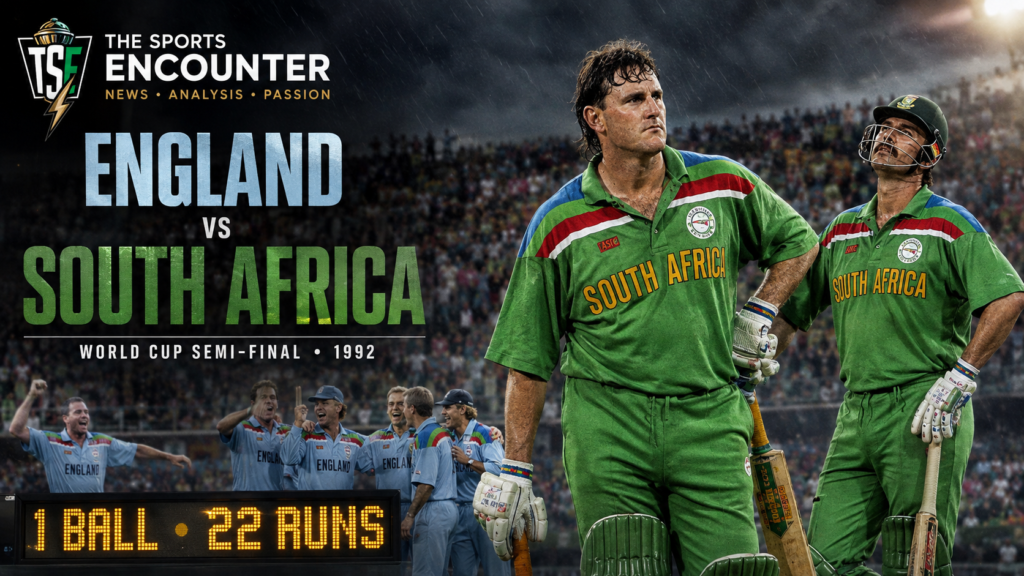
South Africa needed 22 runs from 13 balls. Brian McMillan and Dave Richardson were still there. A place in the World Cup final remained difficult, but entirely possible.
Then Sydney’s rain arrived.
Twelve minutes later, the equation that had taken almost seven hours of cricket to create had become impossible. The giant SCG scoreboard flashed the numbers that would follow South African cricket for decades: 22 runs required from one ball.
There is an important detail behind that famous image. Archived match records show the scoreboard was actually wrong. Under the calculation eventually applied, South Africa’s true requirement was 21 from the final delivery. It hardly mattered. No legal delivery could produce either number. The semifinal had effectively ended in a calculation rather than a cricketing contest.
That extraordinary finish is why England’s 19-run victory on March 22, 1992, is Match 11 in The Sports Encounter’s A Celebration of 5000 ODIs series. The match gave us Graeme Hick’s finest World Cup innings, Jonty Rhodes attacking under knockout pressure, a genuinely competitive chase and, finally, a rain rule so inadequate that cricket was forced to rethink how interrupted matches should be decided.
TL;DR
- England scored 252/6 from 45 overs, led by Graeme Hick’s 83 from 90 balls.
- South Africa reached 231/6 after 42.5 overs and required 22 from the final 13 balls when rain interrupted play.
- The Most Productive Overs method reduced the chase to an impossible final-ball equation.
- Jonty Rhodes made an attacking 43 from 38 balls, while Andrew Hudson top-scored with 46.
- Richard Illingworth and Gladstone Small took two wickets each for England.
- Graeme Hick was Player of the Match as England advanced to the final against Pakistan.
England vs South Africa 1992 World Cup Semifinal: Match Information
| Detail | Information |
|---|---|
| Match | England vs South Africa, 2nd Semifinal |
| Tournament | 1992 Cricket World Cup |
| Date | March 22, 1992 |
| Venue | Sydney Cricket Ground, Sydney |
| Toss | South Africa won the toss and fielded |
| England | 252/6 in 45 overs |
| South Africa | 232/6 in 43 overs |
| Result | England won by 19 runs under the revised target |
| Player of the Match | Graeme Hick, 83 from 90 balls |
| Top South Africa Batter | Andrew Hudson, 46 from 52 balls |
| Turning Point | Rain with South Africa needing 22 from 13 balls |
| Tournament Impact | England reached the World Cup final |
| Historical Impact | The finish exposed serious flaws in cricket’s rain-adjustment system |
Why Match 11 Belongs in A Celebration of 5000 ODIs
A famous controversy alone would not be enough.
This semifinal deserves its place because a very good cricket match was unfolding before the mathematics swallowed it.
South Africa were playing their first World Cup after returning to international cricket following more than two decades of isolation. They had already reached the semifinals at their first attempt. England, meanwhile, were trying to reach their third World Cup final.
The chase remained alive almost to its natural conclusion.
That combination of historical context, individual performance, knockout pressure and an unprecedented finish satisfies exactly what our 100-match ODI collection was built to preserve. The series has already revisited extraordinary World Cup moments such as Kapil Dev rescuing India from 17 for five against Zimbabwe and India defending 183 against West Indies in the 1983 final.
This one belongs for another reason: cricket eventually learned from it.
Graeme Hick Builds England’s Innings Under Pressure
England lost Graham Gooch for two and Ian Botham for 21, leaving the innings at 39 for two.
Graeme Hick supplied the stability they needed.
His 83 from 90 balls contained nine fours and came at a strike rate above 92, excellent tempo for an ODI semifinal in 1992. He added 71 with Alec Stewart, then helped push England toward a total capable of surviving South Africa’s deep batting order.
Hick’s dismissal at 187 for five could have stalled the innings.
Instead, England found another gear.
Dermot Reeve Turns 220 Into 252
Dermot Reeve’s contribution lasted only 14 balls.
It changed the value of England’s total.
Reeve struck an unbeaten 25 with four boundaries, while Chris Lewis added 18 not out from 16 deliveries. Their late acceleration carried England to 252 for six after the innings had been restricted to 45 overs because South Africa failed to complete their scheduled overs within the allotted time.
Those final runs became even more significant once the chase tightened.
Andrew Hudson Keeps South Africa Moving
South Africa lost captain Kepler Wessels for 17, but Andrew Hudson refused to allow England complete control.
Hudson made 46 from 52 deliveries with six fours and kept the required rate manageable despite regular wickets around him. Peter Kirsten fell for 11 before Hudson departed at 90 for three.
Adrian Kuiper then made 36, but England kept removing batters before partnerships could become decisive.
Richard Illingworth was particularly important, dismissing Hudson and Kuiper while conceding 46 from his 10 overs.
Jonty Rhodes Attacks the Semifinal
Jonty Rhodes produced South Africa’s most aggressive innings.
His 43 from 38 balls pushed the chase forward when the required rate was becoming uncomfortable. England knew one substantial partnership could take the match away from them, and Rhodes was beginning to build exactly that threat.
Gladstone Small eventually removed him with the score on 206.
Yet South Africa were not finished.
McMillan and Richardson took the total to 231 for six. Thirteen legitimate deliveries remained.
They needed 22.
Then the weather intervened.
The 12 Minutes That Changed Cricket’s Rain Rules
The 1992 World Cup used the Most Productive Overs method for rain-affected matches. When overs disappeared from the chasing team’s innings, the target was adjusted by removing the least productive overs from the first innings.
That logic became absurd when rain arrived near the end of this chase.
South Africa had only 13 balls left. Losing two overs therefore removed almost all their remaining opportunities, while England’s target reduction amounted to only one run.
The television and SCG scoreboard famously changed from 22 required from 13 balls, to 22 from seven, and finally 22 from one. Archived ESPN records note that the mathematically correct requirement was actually 21 from one.
McMillan pushed Chris Lewis’ final delivery for a single.
Nobody celebrated the cricket.
England had earned their position and had arguably been the better side over the match, but even they had reached the final through an ending nobody could reasonably defend as a competitive solution. The incident became one of the strongest arguments for developing a more sophisticated method for rain-adjusted targets, eventually leading ODI cricket toward the Duckworth-Lewis system.
Man of the Match: Graeme Hick
Hick’s 83 remains the central performance of the semifinal.
England’s innings repeatedly threatened to lose momentum, and none of their other top-six batters reached 35. Without Hick, there would probably have been no 252 to defend and perhaps no controversy for history to remember.
He therefore deserved the Player of the Match award.
His innings tends to disappear behind the famous scoreboard image, which is unfortunate. The rain rule explains why the match became infamous. Hick explains why England had something worth defending in the first place.
Complete Match Scorecard
England Innings: 252/6 in 45 Overs
| Batter | Dismissal | Runs | Balls | 4s | 6s |
|---|---|---|---|---|---|
| Graham Gooch | c Richardson b Donald | 2 | 8 | 0 | 0 |
| Ian Botham | b Pringle | 21 | 23 | 3 | 0 |
| Alec Stewart | c Richardson b McMillan | 33 | 54 | 4 | 0 |
| Graeme Hick | c Rhodes b Snell | 83 | 90 | 9 | 0 |
| Neil Fairbrother | b Pringle | 28 | 50 | 1 | 0 |
| Allan Lamb | c Richardson b Donald | 19 | 22 | 1 | 0 |
| Chris Lewis | not out | 18 | 16 | 2 | 0 |
| Dermot Reeve | not out | 25 | 14 | 4 | 0 |
| Extras | b 1, lb 7, w 9, nb 6 | 23 | |||
| Total | 6 wickets, 45 overs | 252 |
Did not bat: Phil DeFreitas, Gladstone Small, Richard Illingworth.
Fall of wickets: 20-1, 39-2, 110-3, 183-4, 187-5, 221-6.
South Africa Bowling
| Bowler | Overs | Maidens | Runs | Wickets |
|---|---|---|---|---|
| Allan Donald | 10 | 0 | 69 | 2 |
| Meyrick Pringle | 9 | 2 | 36 | 2 |
| Richard Snell | 8 | 0 | 52 | 1 |
| Brian McMillan | 9 | 0 | 47 | 1 |
| Adrian Kuiper | 5 | 0 | 26 | 0 |
| Hansie Cronje | 4 | 0 | 14 | 0 |
South Africa Innings: 232/6 in 43 Overs
| Batter | Dismissal | Runs | Balls | 4s | 6s |
|---|---|---|---|---|---|
| Kepler Wessels | c Lewis b Botham | 17 | 21 | 1 | 0 |
| Andrew Hudson | lbw b Illingworth | 46 | 52 | 6 | 0 |
| Peter Kirsten | b DeFreitas | 11 | 26 | 0 | 0 |
| Adrian Kuiper | b Illingworth | 36 | 44 | 5 | 0 |
| Hansie Cronje | c Hick b Small | 24 | 46 | 1 | 0 |
| Jonty Rhodes | c Lewis b Small | 43 | 38 | 3 | 0 |
| Brian McMillan | not out | 21 | 21 | 0 | 0 |
| Dave Richardson | not out | 13 | 10 | 1 | 0 |
| Extras | lb 17, w 4 | 21 | |||
| Total | 6 wickets, 43 overs | 232 |
Did not bat: Richard Snell, Meyrick Pringle, Allan Donald.
Fall of wickets: 26-1, 61-2, 90-3, 131-4, 176-5, 206-6.
England Bowling
| Bowler | Overs | Maidens | Runs | Wickets |
|---|---|---|---|---|
| Ian Botham | 10 | 0 | 52 | 1 |
| Chris Lewis | 5 | 0 | 38 | 0 |
| Phil DeFreitas | 8 | 1 | 28 | 1 |
| Richard Illingworth | 10 | 1 | 46 | 2 |
| Gladstone Small | 10 | 1 | 51 | 2 |
England Were Better, but South Africa Deserved a Cricketing Finish
It is tempting to retell this semifinal entirely as an injustice.
That loses some of its complexity.
England had made 252 despite being limited to 45 overs. Hick had played the game’s strongest innings. Their bowlers had taken six wickets and repeatedly prevented South Africa from putting together the partnership that could have settled the chase earlier.
South Africa also contributed to their own difficulty by taking too long to bowl England’s innings, which led to the reduction from 50 overs to 45.
Yet none of that makes the final equation sensible.
A World Cup semifinal with 22 required from 13 balls deserved to be decided by players attempting those 13 balls.
That is ultimately why Match 11 survives.
Readers can revisit other matches where a single moment changed a World Cup through our reports on Australia’s seven-run 1987 final victory over England and Gary Gilmour’s extraordinary 1975 semifinal against England, while ongoing match reports and analysis are available through The Sports Encounter Cricket Hub.
Final Takeaway: The Match Cricket Had to Learn From
England advanced to face Pakistan and South Africa went home from their first World Cup carrying an image that would become part of cricket folklore.
The semifinal’s real legacy, however, reaches further than heartbreak.
Hick played a superb innings. Rhodes attacked the chase. England’s bowlers kept the game under pressure. South Africa remained alive with 13 balls remaining.
Then the rules failed the match.
Thirty-four years later, people still remember 22 from one without needing the teams, venue or date explained to them. Few scoreboards in ODI history have said so little while revealing so much about why cricket sometimes has to change.https://chatgpt.com/backend-api/sentinel/frame.html?sv=20260810913b